ISSN: 1311-1728 (printed version); ISSN: 1314-8060 (on-line version) doi:http://dx.doi.org/10.12732/ijam.v31i4.8
ITERATIVE METHOD FOR CONSTRUCTING ANALYTICAL SOLUTIONS TO THE HARRY-DYM INITIAL
VALUE PROBLEM
O. Gonz´alez-Gaxiola1§, J. Ruiz de Ch´avez2, S.O. Edeki3 1Department of Applied Mathematics and Systems
UAM-Cuajimalpa, Vasco de Quiroga 4871 05348, MEXICO
2 Department of Mathematics UAM-Iztapalapa, Sn Rafael Atlixco 186
09340, MEXICO 3 Department of Mathematics Covenant University, Canaanland
Ota, NIGERIA
Abstract: In this paper, an analytical technique, namely the new iterative method (NIM), is applied to obtain an approximate analytical solution of the nonlinear Harry-Dym equation which is often used in the theory of solitons. The rapid convergence of the method results in qualitatively accurate solutions in relatively few iterations; this is obvious upon comparing the obtained analytical solutions with the exact solutions. Our results indicate that NIM is highly accurate and efficient, therefore can be considered a very useful and valuable method.
AMS Subject Classification: 35Q51, 37K40, 65D15
Key Words: nonlinear PDE, Harry-Dym equation, new iterative method, Adomian polynomials, approximate solution
1. Introduction
Nonlinear differential equations play an important role in modelling numerous
Received: April 23, 2018 c 2018 Academic Publications
628 O. Gonz´alez-Gaxiola, J. Ruiz de Ch´avez, S.O. Edeki
problems in physics, chemistry, biology, economy and engineering science. Many problems can be modelled as systems of differential equations, integral equa-tions, integro-differential equaequa-tions, partial differential equaequa-tions, fractional or-der differential equations. Many of these equations are nonlinear. Recently, Daftardar-Gejji and Jafari [1] proposed a new technique for solving nonlinear functional equations namely: New Iterative Method (NIM). The NIM has been extensively used by many researchers for the treatment of linear and nonlin-ear ordinary, and partial differential equations of integer and fractional orders, see [2, 3, 4]. The method converges to the exact solution, if it exists through successive approximations. However, for concrete problems, a few number of approximations can be used for numerical purposes with high degree of accu-racy. The NIM possesses a great potential in solving different kinds of functional equations. Both linear and nonlinear equations, and systems of such types are all amenable to the method. In the nonlinear case for differential equations and partial differential equations, the method has the advantage of dealing directly with the problem. These equations are solved without transforming them to more simple ones. The method avoids linearization, perturbation, discretiza-tion, or any unrealistic assumptions.
Considering the Harry-Dym equation being it nonlinear, most of the semi-analytical methods such as Adomian Decomposition Method (ADM), Differen-tial Transform Method (DTM), Homotopy Perturbation Method (HPM), etc., and their modified versions will require the involvement of Adomian polynomi-als but this is completely avoided via the NIM, yet high rate of accuracy and convergence is not neglected [5, 6].
In the present work, we will utilize the NIM to solve the Harry-Dym equa-tion [15]. This equaequa-tion is a nonlinear partial differential equaequa-tion which is of great importance in terms of applications; for example, in the analysis of the Saffman-Taylor problem with surface tension [16, 17]. We will design an algorithm to solve the Harry-Dym equation subject to some initial conditions. Finally, our proposed solution method is illustrated for effectiveness and relia-bility by considering the Harry-Dym equation for two different initial conditions based on their usual nature in the existing literature.
solve this equation as a problem of initial value. After, in “Numerical examples” section, we show by means of two examples, the quality and precision of our method, comparing the obtained results with the only exact solutions available in the literature [19]. Finally, in the “Conclusions” section, we summarize our findings and present our final conclusions.
2. Basic idea of new iterative method
To describe the idea of the NIM, consider the following general functional equa-tion [1, 14]:
u=N(u) +f, (1)
whereN is a nonlinear mapping between Banach spaces such thatN :B →B and f is a known function. We are looking for a solution u of Eq. (1) having the series form
u=
∞ X
i=0
ui. (2)
The nonlinear operator N can be decomposed as
N
∞ X
i=0 ui
=N(u0) +
∞ X i=1 h N i X j=0 uj −N i−1
X
j=0 uji
. (3)
From (2) and (3), (1) is equivalent to
∞ X
i=0
ui =f+N(u0) +
∞ X i=1 h N i X j=0 uj −N i−1
X
j=0 uj
i
. (4)
We define the recurrence relation as
u0=f, u1=N(u0),
um+1 =N Pmi=0ui
−N Pm−1
i=0 ui
, m= 1,2, . . . .
(5)
Then
m+1
X
i=0
ui =N m
X
i=0
ui (6)
and
u=f+
∞ X
i=0
630 O. Gonz´alez-Gaxiola, J. Ruiz de Ch´avez, S.O. Edeki
The m−term approximate solution of (2) is given byu=Pm−1
i=0 ui.
It may be observed here that in this decomposition method, computation of complicated quantities is not required and therefore the computing time is minimal.
If the operator N is a contraction, i.e.,
kN(x)−N(y)k ≤kkx−yk, 0< k <1,
then:
kum+1k=kN(u0+· · ·+um)−N(u0+· · ·+um−1)k ≤kkumk ≤ · · · ≤kmku0k, m= 0,1,2, . . . ,
and the series P∞
i=0ui absolutely and uniformly converges to a solution of (1), which is unique, in view of the Banach fixed point theorem [13].
This method decreases considerably the volume of calculations. The de-composition procedure given by NIM will be easily set, without linearising the problem. In this approach, the solution is found in the form of a convergent series with easily computed components; in many cases, the convergence of this series is very fast and only a few terms are needed in order to have an idea of how the solutions behave. For more details about convergence, we refer the reader to [14].
3. The Harry-Dym equation
In physics-mathematics, and in particular in the theory of solitons, the Harry-Dym equation is the third-order nonlinear partial differential equation given as:
∂u ∂t =u
3∂3u
∂x3. (8)
The Harry-Dym (HD) equation has nonlinearity and dispersion coupled to-gether. It was discovered by H. Dym in 1973-1974 while its first appearance in the literature occurred in a 1975 paper of Kruskal [15], where it was named after its discoverer. The Harry-Dym equation has strong links to the Korteweg-de Vries equation and the solitons theory, [18].
To make the description of the problem complete, we will consider some initial conditions for (8):
In the next section, we will develop an algorithm using the method described in Section 2 in order to solve the nonlinear Harry-Dym equation (8) without resort to any truncation or linearization.
4. General solution of the Harry-Dym equation through NIM Integrating (8) and considering the initial condition (9), we obtain
u(x, t) =
Z t
0
u3(x, s)uxxx(x, s)ds+f(x). (10)
Comparing (10) with (1), we have that the nonlinear term is given by
N(u) =
Z t
0
u3(x, s)uxxx(x, s)ds. (11)
By using (5) through the NIM, we obtain the following, recursively:
u0(x, t) =f(x), u1(x, t) =Rt
0u30(x, s)u0,xxx(x, s)ds, um+1(x, t) =Pmi=0
Rt
0u3i(x, s)ui,xxx(x, s)ds
−Pm−1
i=0
Rt
0 u3i(x, s)ui,xxx(x, s)ds, m= 1,2, . . . .
(12)
Finally, the exact solution of the Harry-Dym equation (8) is given by
u(x, t) =f(x) +
∞ X
i=0
ui(x, t). (13)
The m−term approximate solution of (8) is given byu=Pm−1
i=0 ui.
Using the expressions obtained above for (8), we will illustrate, with two examples, the effectiveness of NIM to solve the nonlinear Harry-Dym equation.
5. Numerical examples
To validate the present iterative approach, results are compared with the exact solution of the Harry-Dym equation provided by Mokhtari in [19] which can be expressed as
u(x, t) =a−3 √
b
2 (x+ct)
2/3
, (14)
wherea,band c are constants.
In all examples the package of Mathematica Version 11.0has been used to
632 O. Gonz´alez-Gaxiola, J. Ruiz de Ch´avez, S.O. Edeki
Example 1
Using the NIM, we solve the Harry-Dym equation subject to the initial condition f(x) = (1−3x)23.
Following the recurrent formula (12) we have: u0(x, t) = (1−3x)23,
u1(x, t) =
Rt
0 u30(x, s)u0,xxx(x, s)ds=−√3 8t 1−3x, u2(x, t) = 16t
2 (7168t3
+3040t2
(3x−1)+400t(1−3x)2
+5(3x−1)3 ) 5(1−3x)13/3 ,and
u3(x, t) =K
123363717358719057912659968t18 +193719587414863520628473856t17(3x−1) +136875836595891063698227200t16(1−3x)2 +56790926743757769911828480t15(3x−1)3 +15013293579608519564328960t14(1−3x)4 +2491321806795244547604480t13(3x−1)5
+203312399629040505323520t12(1−3x)6 −12290244149344783564800t11(3x−1)7
−5943603552977053286400t10(1−3x)8 −771521951049526476800t9(3x−1)9 −34544909525635891200t8(1−3x)10 +3980557304743219200t7(3x−1)11
+792770448614144000t6(1−3x)12 +53551228034304000t5(3x−1)13
−26729020032000t4(1−3x)14 −292556876612000t3(3x−1)15
−23265676434000t2(1−3x)16 −737782670625t(3x−1)17
−3233230000(1−3x)18
whereK= 606230625(1256t−33x)61/3. Then, the approximate solution for this example is given by uN IM =u0+u1+u2+u3.
63
4
O
.
G
on
z´a
le
z-G
ax
io
la
,
J
.
R
u
iz
d
e
C
h
´av
ez
,
S
.O
.
E
d
ek
i
t= 0.01 t= 0.02
x uN IM uex [19] Error uN IM uex [19] Error
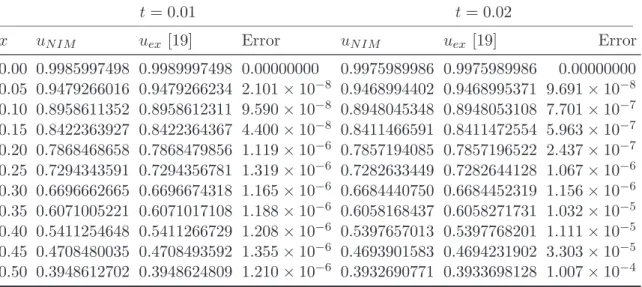
0.00 0.9985997498 0.9989997498 0.00000000 0.9975989986 0.9975989986 0.00000000 0.05 0.9479266016 0.9479266234 2.101×10⁻⁸ 0.9468994402 0.9468995371 9.691×10⁻⁸
0.10 0.8958611352 0.8958612311 9.590×10⁻⁸ 0.8948045348 0.8948053108 7.701×10⁻⁷
0.15 0.8422363927 0.8422364367 4.400×10⁻⁸ 0.8411466591 0.8411472554 5.963×10⁻⁷
0.20 0.7868468658 0.7868479856 1.119×10⁻⁶ 0.7857194085 0.7857196522 2.437×10⁻⁷
0.25 0.7294343591 0.7294356781 1.319×10⁻⁶ 0.7282633449 0.7282644128 1.067×10⁻⁶
0.30 0.6696662665 0.6696674318 1.165×10⁻⁶ 0.6684440750 0.6684452319 1.156×10⁻⁶
0.35 0.6071005221 0.6071017108 1.188×10⁻⁶ 0.6058168437 0.6058271731 1.032×10⁻⁵
0.40 0.5411254648 0.5411266729 1.208×10⁻⁶ 0.5397657013 0.5397768201 1.111×10⁻⁵
0.45 0.4708480035 0.4708493592 1.355×10⁻⁶ 0.4693901583 0.4694231902 3.303×10⁻⁵
0.50 0.3948612702 0.3948624809 1.210×10⁻⁶ 0.3932690771 0.3933698128 1.007×10⁻⁴
Example 2
Using the NIM, we solve this Harry-Dym equation subject to the initial condi-tion f(x) = (2− 92x)23.
Again, using the recursive formula (12) we have
u0(x, t) =
2−9x 2
2/3
,
u1(x, t) =
Z t
0
u30(x, s)u0,xxx(x, s)ds=− 27t
3
q
2−9x2 ,
u2(x, t) =
803538792√3 2t5 5(4−9x)13/3 −
40389516√3 2t4 (4−9x)13/3 +
90876411√3 2t4x (4−9x)13/3
+15943230 3 √
2t3x2 (4−9x)13/3 +
3149280√3 2t3 (4−9x)13/3 −
14171760√3 2t3x (4−9x)13/3
+ 531441t 2x3 22/3(4−9x)13/3 −
354294√3 2t2x2 (4−9x)13/3 −
23328√3 2t2 (4−9x)13/3
+157464 3 √
2t2x (4−9x)13/3 −
177147√3 2tx4 (4−9x)13/3 +
314928√3 2tx3 (4−9x)13/3
−209952 3 √
2tx2 (4−9x)13/3 +
27t
3
q
2−9x2 −
6912√3 2t (4−9x)13/3 +
636 O. Gonz´alez-Gaxiola, J. Ruiz de Ch´avez, S.O. Edeki
u3(x, t) =H
417556597392940948420895373324258437234688t18
+ 97139902865718901195138854210851789217792
×t17(9x−4)
+ 10168271724530912624176064009104155340800 ×t16(4−9x)2
+ 625022338687930785359319801888125917440
×t15(9x−4)3
+ 24478724703422023127484982150229429760
×t14(4−9x)4
+ 601781548616684359018704784199659635t13(9x−4)5 + 7275605314654963976138841502590480t12(4−9x)6 −65157138446771921494923637272900t11(9x−4)7 −4668179566361326613796010289400t10(4−9x)8 −89772275536125677895558883725t9(9x−4)9 −595489671942347798974203300t8(4−9x)10 + 10165535974706000989074975t7(9x−4)11 + 299937026237149453902750t6(4−9x)12 + 3001568714062581663000t5(9x−4)13 −221951517731658000t4(4−9x)14 −359899812647124750t3(9x−4)15 −4240169530096500t2(4−9x)16 −19920132106875t(9x−4)17
−12932920000(4−9x)18
,
where H = 6561t3 202076875 22/3
(4−9x)61/3. Then, the approximate solution for this example it is given byuN IM =u0+u1+u2+u3.
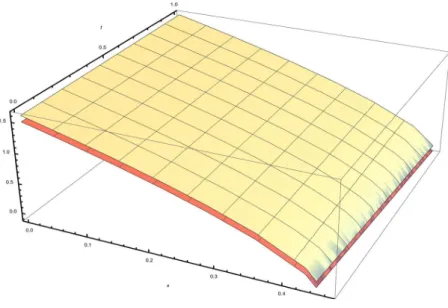
Figure 2: Plot ofuN IM(x, t) (below) anduex(x, t) (above) for nonlin-ear Harry-Dym equation with the initial conditionf(x) = (2−92x)23 corresponding to Example 2.
63
8
O
.
G
on
z´a
le
z-G
ax
io
la
,
J
.
R
u
iz
d
e
C
h
´av
ez
,
S
.O
.
E
d
ek
i
t= 0.01 t= 0.03
x uN IM uex [19] Error uN IM uex [19] Error
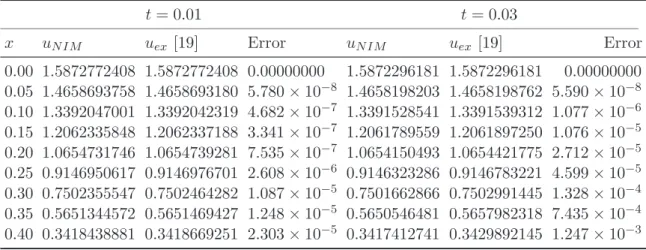
0.00 1.5872772408 1.5872772408 0.00000000 1.5872296181 1.5872296181 0.00000000 0.05 1.4658693758 1.4658693180 5.780×10⁻⁸ 1.4658198203 1.4658198762 5.590×10⁻⁸
0.10 1.3392047001 1.3392042319 4.682×10⁻⁷ 1.3391528541 1.3391539312 1.077×10⁻⁶
0.15 1.2062335848 1.2062337188 3.341×10⁻⁷ 1.2061789559 1.2061897250 1.076×10⁻⁵
0.20 1.0654731746 1.0654739281 7.535×10⁻⁷ 1.0654150493 1.0654421775 2.712×10⁻⁵
0.25 0.9146950617 0.9146976701 2.608×10⁻⁶ 0.9146323286 0.9146783221 4.599×10⁻⁵
0.30 0.7502355547 0.7502464282 1.087×10⁻⁵ 0.7501662866 0.7502991445 1.328×10⁻⁴
0.35 0.5651344572 0.5651469427 1.248×10⁻⁵ 0.5650546481 0.5657982318 7.435×10⁻⁴
0.40 0.3418438881 0.3418669251 2.303×10⁻⁵ 0.3417412741 0.3429892145 1.247×10⁻³
6. Conclusions
Very few exact solutions of the nonlinear Harry-Dym equation were known in the literature. In this work, we have obtained accurate approximate solutions for the Harry-Dym nonlinear partial differential equation using the new iterative method (NIM); thereby illustrating in this way, the use of NIM in the solution of nonlinear partial differential equations. We have chosen the Harry-Dym equation due to its importance in the theory of solitons. In order to show the accuracy and efficiency of our method, we have solved two examples, comparing our results with the exact solution of the equation that was obtained in [19]. The obtained results demonstrate the reliability of the algorithm and its wider applicability to nonlinear partial differential equations.
We therefore, conclude that the NIM is a notable non-sophisticated power-ful tool that produces high quality approximate solutions for nonlinear partial differential equations using simple calculations and that attains converge with only few terms.
References
[1] V. Daftardar-Gejji, H. Jafari, An iterative method for solving nonlinear functional equations,J. Math. Anal. Appl.,316 (2006), 753-763.
[2] S. Bhalekar, V. Daftardar-Gejji, Solving a system of nonlinear functional equations using revised new iterative method,World Acad. Sci. Eng. Tech., 6(2012), 968-972.
[3] S. Bhalekar, V. Daftardar-Gejji, New iterative method: application to par-tial differenpar-tial equations, Applied Math. and Comput., 203 (2008), 778-783.
[4] V. Daftardar-Gejji, S. Bhalekar, Solving fractional boundary value prob-lems with Dirichlet boundary conditions using a new iterative method,
Comput. &Math. with Applications,59 (2010), 1801-1809.
[5] O. Gonz´alez-Gaxiola, J. Ruiz de Ch´avez, J.A. Santiago, A nonlinear option pricing model through the Adomian decomposition method,Int. J. Appl. Comput. Math.,2 (2016), 453-467.
640 O. Gonz´alez-Gaxiola, J. Ruiz de Ch´avez, S.O. Edeki
[7] S. Abbasbandy, Improving Newton-Raphson method for nonlinear equa-tions by modified Adomian decomposition method, Applied Math. and Comput.,145 (2003), 887-893.
[8] C. Chun, Iterative methods improving Newton’s method by the decompo-sition method,Comput.& Math. with Applications,50(2005), 1559-1568. [9] J.H. He, A new iteration method for solving algebraic equations, Applied
Math. and Comput.,135 (2003), 81-84.
[10] J.H. He, Newton-like iteration method for solving algebraic equations,
Commun. Nonlinear Sci. Numer. Simul.,3 (1998), 106-109.
[11] E. Babolian, J. Biazar, Solution of nonlinear equations by modified ado-mian decomposition method, Applied Math. and Comput., 132 (2002), 167-172.
[12] R. Luck, J.W. Stevens, Explicit solutions for transcendental equations,
SIAM Review,44 (2002), 227-233.
[13] E. Kreyszig,Introductory Fuctional Analysis with Applications, John Wiley & Sons, New York (1978).
[14] S. Bhalekar, V. Daftardar-Gejji, Convergence of the new iterative method,
Int. J. of Differential Equations,2011 (2011), Article ID 989065.
[15] M.D. Kruskal, Nonlinear wave equations, In: Dynamical Systems, Theory and Applications, Springer, Heidelberg (1975), 310-354.
[16] L.P. Kadanoff, Exact solutions for the Saffman-Taylor problem with surface tension, Phys. Rev. Lett.,65 (1990), 2986-2988.
[17] G.L. Vasconcelos, L.P. Kadanoff, Stationary solutions for the Saffman-Taylor problem with surface tension,Phys. Rev. A,44(1991), 6490-6495. [18] W. Hereman, P.P. Banerjee, M.R. Chatterjee, Derivation and implicit solu-tion of the Harry-Dym equasolu-tion and its connecsolu-tions with the Korteweg-de Vries equation,J. Phys. A: Math. Gen.,22(1989), 241-255.