• No results found

Vol 48, No 2 (2018)

N/A
N/A
Protected

Academic year: 2020

Share "Vol 48, No 2 (2018)"

Copied!
6
0
0

Loading.... (view fulltext now)

Full text

(1)

387

THE INFLUENCE OF HAMMERS’ PERIPHERAL SPEED ON THE

PERFORMANCE OF THE HAMMER MILLS

PĂUN A.1), STROESCU GH.1), MOŞOIU C.2, BELC N.2), POPESCU C.3), PARASCHIV G.4)

1)

INMA / Bucharest / Romania; 3)SC HOFIGAL SA Bucharest / Romania;

4)University “POLITEHNICA” Bucharest

Tel: 021/269.32.50; Fax: 021/269.32.73; E-mail: [email protected]

Keywords: cereal milling, peripheral speed, hammer rotor, maize.

ABSTRACT

Cereal milling is a complex process resulting in a wide variety of particles that differ in size, surface or composition. Ensuring a rational regime regarding the technological process of hammer mills operation, actually refers to the correlation of the indices to ensure the functioning of the mills at optimal values. The peripheral speed of hammers is one

of the decisive factors in the milling process. Speed limitation is determined by fodder resistance, the construction of working parts and their durability. In the paper we study the influence of hammers’ peripheral speed on the product subjected to milling, through a series of experiments under exploitation conditions.

INTRODUCTION

Fodder milling, as a component of

technological processes for feed

preparation, is one of the basic

operations. The milling operation

produces physical (form, structure,

granulation) and chemical changes that increase the nutritional value of the fodder, increase digestibility, improve

taste, allow obtaining varied and

complete assortments of fodder receipts. In a given process, the grinding is usually accomplished by the interaction of several grinding principles, in which one of the following principles has the decisive weight (Păun, 2004, 2008, 2009):

- compression with flat roller type active part;

- splitting with corrugated roller type active part;

- bending with active part of stellar breaker type, with fingers and discs; - friction with stone type active part;

- hitting with hammer rotor type active part.

The grinding of concentrated fodder according to the grinding principles

mentioned above may be carried out by means of stone mills, in the case of dry seeds, of corrugated roller mills in the case of dry or wet cereal seeds (when we want to obtain cereal flakes), stellar and disc breakers for oilseeds and briquettes, finger breakers for corn cobs processing and hammer mills for all cases.

Being known the fact that fodder made of cereal seeds represent elastic, plastic and viscous bodies, but in the

same time complicated colloidal,

capillary-porous bodies where each part

of the seed behaves differently,

determining the resistance to grinding under different working regimes, allows establishing properly the constructive and functional parameters of the hammer mills.

Fodder (cereal seeds) as plant

material consists of two structural

elements; skeleton (coat) characterized by elastic and plastic properties and filling (endosperm) characterized by viscosity properties.

(2)

388 filling and the support action of the skeleton are high.

When the active parts of the machine hit the material, its resistance to

destruction is determined by the

resistance of the whole complex, the

skeleton-filling. This process (the

appearance of plastic deformations in the seed structure during the action of the external forces) takes place over time with an increasing speed which leads to the conclusion that the destruction is practically momentary.

In the process of milling machines, cereal seeds are subjected to various actions of the active parts but also to the influence of the environment (humidity, temperature, air pressure, etc.).

These actions result in a change in

the mechanical structure and

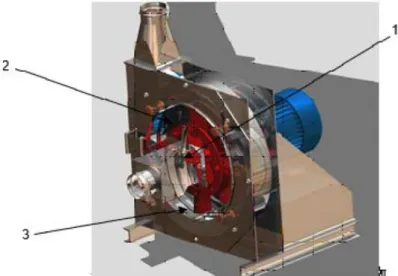
physicochemical properties of the seeds. The dynamic system of the hammer mill, Figure 1, can be imagined as a

physical model composed of three elements (Păun A., Gângu V., Cojocaru I., Schilacci G., 2007):

- 1-the rotor as a hitting impulse

generator which results in a multitude of ground particles;

- 2-a product-air layer as a volume

(or mass) that supports the equality between two simultaneous processes of "multiplication" (hammer rotor capacity) and "evacuation" (hole sieve capacity);

- 3-the useful surface (perforated) of

the grinding chamber (sieve with holes as a screen) that can limit the flow of material passing through the hammer mill.

The working process of the mill must be regarded as a stochastic process described by pseudo-static methods. In this case, the established working regime of the mill is a

continuous, incidental, stationary

process.

Figure 1. Hammer mill construction

MATERIAL AND METHOD

Material and method. The milling process is particularly complex due to the large number of factors that occur during its deployment and is a large energy consumer that can be characterized by three indices:

- grinding degree;

- grinding modulus, M;

- specific energy consumption, L;

The process of grinding, in the case of hammer mills, is influenced by the

following factors: technological,

mechanical, constructive, functional.

The main mechanical factors

influencing the grinding process in hammer mills are: percussions applied by hammers to the fodder particles, loss of

deformation energy during shock,

(3)

389 layer speed in the grinding chamber, the fan effect produced by the hammer rotor, the moment of inertia of the hammer rotor (Paun A., 2004) and (Voicu Gh., David L., Safta V., 1998).

The constructive factors that

influence the grinding process are: the size of the grinding chamber, the constructive shape of the hammers, the size of the distance between the hammers and the sieve, the constructive shape of the corrugations, the feed method of the machine, the discharge way of the grinding.

Seeds grinding in hammer mills can be considered as having three phases:

- Phase 1: fodder particles grinding

due to collision with the rotating rotor hammers when entering the grinding chamber;

- Phase 2: grinding the particles in

uneven motion resulting from the first collision and projected by hammers on the corrugated counterweight plates and the edges of the sieve holes, which surround the grinding chamber;

- Phase 3: fodder particles grinding

as a result of collisions in the milling chamber. Ensuring a rational regime

regarding the technological working

process of hammer mills actually refers to the correlation of the indices to ensure the functioning of the mills at optimal values.

The parameters that influence the performance of hammer mills it is inflenced by the pharameters from

equation (1), (Păun A., Ivancu B., Ioniță

Gh., Zaica A., 2014).

P= f (Q, q, D, v, z, b, e, d, l, A, M,

(1)

G, F, E, ρ, g)

Where: Q – the feed flow of the mill,

[kg/h]; vc – peripheral speed of the

hammers, [m/s]; D – diameter of the rotor

with hammers, [m]; vds – the movement

speed of the seed layer in grinding

chamber, [m/s]; z - number of hammers;

b – hammer width, [mm]; e - distance

between the top of the hammers and the

sieve, [mm]; d - diameter of the sieve

holes in the grinding chamber, [mm]; β -

the coverage angle of the grinding

chamber, [0]; l – hammer length, [mm]; qa

- air quantity required to evacuate the material from the grinding chamber,

[m3/min]; A - total area of sieve holes,

[mm2]; M - fineness modulus of the

grinding, [mm]; G - grinding granulation,

mm; F - crushing resistance of the seeds,

[kgf/cm2]; E - elastic modulus of the

seeds, [kgf/cm2]; ρ - the density of the

material that is being ground, [kg/m3]; g -

rotor - hammers dynamic system.

The peripheral speed of the

hammers is the most important factor because it influences the hitting speed and the flow of the material layer in the grinding chamber. Grinding of the fodder particles takes place at a peripheral speed of hammers higher than the rate of

material destruction. The rate of

destruction when seeds are ground by hitting is given by the relation (2), where:

Ρ is density, [kg/m3

]; and E c0

 is

propagation velocity of the elastic waves, [m/s] (Melnicov S.V. s.a., 1979).

E E vdsl ds

(2) Analyzing relation (2) we find that the limit rate of destruction depends on the physical-mechanical properties of the material undergoing hammer hitting.

Therefore, a correlation between the

hammer speed and the

physical-mechanical properties of the milled product must be made.

To determine the optimum value of hammer speed, must be used the equations (3) and (4), (Revenko V., 1971): d p c v k 1 1 v

v 

 

(3)

E

v

v

d

p

(4)

Where: - destruction rate by

(4)

390

material deformation, [m/s]; - effort to

destroy the material, [N/cm2]; - material

elastic modulus, [N/cm2]; - peripheral

speed of the hammer, [m/s]; -

coefficient that takes into account the influence of the speed of layer in the

grinding chamber; - speed of the layer on the working surface of the grinding

chamber, [m/s]; - proportionality

coefficient determined in practice as having a value between 4÷ 5.

RESULTS AND DISCUSSIONS

In order to determine the influence of the hammer peripheral speed on the grinding flow Q, the specific energy consumption q and the grinding modulus

M, determinations were made according to Tables 1. Based on the results obtained in the experiments, a series of diagrams was made, figure 1, 2, 3.

Table 1 Table with experimetnal data

No. Crt.

Processed product

mill’s sieve holes diameter

[mm]

Peripheral hammers

speed vc, [m/s]

Grinding flow Q, [kg/ h]

Power absorbed

P, [kW]

Specific energy consumption

q, [kWh/t]

Grinding modulus M, [mm]

0 1 2 3 4 5 6 7

1

Maize

3

65 250 3.25 13.00 0.64

2 65 380 4.04 10.60 0.63

3 65 500 4.94 9.88 0.62

6 77 250 3.55 14.2 0.62

7 77 380 4.75 12.5 0.61

8 77 500 5.35 10.24 0.60

11 85 250 3.95 15.8 0.60

12 85 380 4.99 13.1 0.59

13 85 500 5.85 11.7 0.58

16

5

65 375 3.28 8.75 0.96

17 65 585 4.25 7.26 0.97

18 65 778 5.05 6.49 0.98

21 77 375 3.65 9.73 0.81

24 77 910 6.25 6.87 0.85

25 77 1028 7.22 7.02 0.87

26 85 375 3.85 10.27 0.76

27 85 585 4.95 8.46 0.77

28 85 778 5.75 6.32 0.77

31

Barley

3

65 250 3.95 15.8 0.51

32 65 300 4.71 15.70 0.52

33 65 405 6.01 14.83 0.53

35 77 250 4.25 17.00 0.59

36 77 300 5.00 16.66 0.60

37 77 405 6.28 15.50 0.61

39 85 250 4.45 17.8 0.55

40 85 300 5.25 17.5 0.56

41 85 405 6.55 16.17 0.57

43

5

65 500 4.01 8.02 0.63

44 65 610 5.05 8.28 0.64

45 65 700 6.10 8.71 0.65

47 77 500 4.20 8.4 0.65

48 77 610 5.25 8.61 0.66

49 77 700 6.45 9.21 0.68

51 85 500 4.50 9.00 0.67

52 85 610 5.65 9.26 0.68

(5)

391

sieve holes diameter of ø= 3 [mm] sieve holes diameter of ø= 5 [mm]

sieve holes diameter of ø= 3 [mm] sieve holes diameter of ø= 5 [mm]

Figure 1. Influence of hammer speed on mill’s performance in maize seed milling,

sieve holes diameter of ø= 3 [mm] sieve holes diameter of ø= 5 [mm]

(6)

392

CONCLUSIONS

Research has shown that for each product undergoing the milling process, an optimal peripheral speed of the hammers is required to obtain the necessary grinding degree. Analyzing the graphs in Fig. 1 and 2, made for the maize and barley seed milling with sieves having hole size of ø = 3mm and ø = 5mm, it is found that in both products the

increase of the peripheral speed of the hammers, to a power required to operate within very close limits, the capacity the milling decreases, and the grinding

modulus decreases. The most

advantageous indices are obtained with the peripheral speed of the hammers of 65 m/s.

BIBLIOGRAPHY

1. Melnicov S.V. s.a., 1979 - Mehanizatia jivotnovodceskih ferm., Kolos Publishing House, Moscow.

2. Păun A., 2004 - Study on the grinding process of concentrate fodder in hammer mills, PhD thesis.

3. Păun A., 2008 - Hammer mills. Study on the grinding process of concentrated fodder, "Terra Nostra" Publishing, ISBN 978-973-1888-04-7, Iasi.

4. Păun A., 2009 - Technologies and equipment for obtaining concentrated fodder from the seeds grain, "Terra Nostra" Publishing, ISBN 978-973-1888-34-7, Iasi.

5. Păun A., Gângu V., Cojocaru I.,

Schilacci G., 2007 - The influence of quality parameters of working, constructive and functional on grinding cereal seeds technology for obtaining concentrated fodder, Scientific papers, SCIENTIFIC PAPERS -INMATEH - V; vol. 23, pp.11-18; ISSN 1583-1019; Bucharest; November 2007.

6. Păun A., Ivancu B., Ioniță Gh., Zaica

A., 2014 - Optimization of constructive

and functional parameters of hammer mills in order to increase productivity and reduce specific energy consumption,

International Symposium Agricultural And

Mechanical Engineering, 30 – 31

October, ISSN 2344-4118, INMA

Bucharest / Romania, pp. 445-451.

7. Revenko V., 1971 -O vilcanii skorosti molotkov na efectivnost proţessa izmelcenia kormovîh materialov, Tractorî i selhozmaşinî 3/1971.

8. Vasile C., Bădescu M., 2010 - Studies on fodder grinding machines and on the necessity of dust filtering for grinding machines, INMATEH - Agricultural

Engineering, Vol. 30, No.1. (ISSN 2068 –

2239).

9. Voicu Gh., David L., Safta V., 1998

Aspects regarding the determination of main parameters of hammer mills,

Machine Building Journal, 4-5, pp.23-25, (ISSN 0573-7419).

Figure

Figure 1. Hammer mill construction

References

Related documents

4.1 The Select Committee is asked to consider the proposed development of the Customer Service Function, the recommended service delivery option and the investment required8. It

Kho du lieu duqc xay dung de tien loi cho viec truy cap theo nhieu nguon, nhieu kieu du lieu khac nhau sao cho co the ket hop duqc ca nhung ung dung cua cac cong nghe hien dai va

National Conference on Technical Vocational Education, Training and Skills Development: A Roadmap for Empowerment (Dec. 2008): Ministry of Human Resource Development, Department

more than four additional runs were required, they were needed for the 2 7-3 design, which is intuitive as this design has one more factor than the 2 6-2 design

Using text mining of first-opinion electronic medical records from seven veterinary practices around the UK, Kaplan-Meier and Cox proportional hazard modelling, we were able to

• Follow up with your employer each reporting period to ensure your hours are reported on a regular basis?. • Discuss your progress with

In the simplest scheme based on the boolean model for retrieval, we retrieve the documents that have occurrences of both good and teacher.. Such

The corona radiata consists of one or more layers of follicular cells that surround the zona pellucida, the polar body, and the secondary oocyte.. The corona radiata is dispersed