128
THE RESEARCHS ON THE BIOCHEMICAL COMPOSITION OF
POTATO TUBERS DEPENDING ON THE VARIETY AND THE WATER
SUPPLY IN CONDITIONS OF SANDY SOILS IN SOUTHERN OLTENIA
MIHAELA CROITORU, AURELIA DIACONU, MILICA DIMA, I. DRAGHICI
Key words: potato, sandy soils, irrigation, quality, production
ABSTRACT
Water is one of the most important factors for potato vegetation. From this point of view, potatoes has been classified among the plants sensible to water shortages, falling under our country from this point of view immediately after rice (Zanfirescu, 1977, quoted by Chichea, 2000). At CCDCPN Dăbuleni was studied an assortment of 14 potato varieties depending on the level water supply. The results show differences between the varieties studied and between levels of water supply within the same variety. They highlighted varieties: Astral, Magic, Tresor, Artemis, Robusta by a dry matter content of over 20%. The vitamin C content was more influenced by the variety in the study and less than the water supply. Best yields were obtained for varieties: Carrera (43.6 t / ha), Tresor (40.8 t / ha), Riviera (39.3 t / ha) on the ceiling irrigated at 80% of the interval active moisture.
INTRODUCTION
Water is one of the most important factors for potato growing. From this point of view, the potato is classified among the most sensitive plants to water scarcity, falling under our country from this point of view immediately after rice (Zanfirescu 1977, cited by Chichea, 2000).
The lack of water in the period, May to September at the time of tuber formation and accumulation of intensive influences the quantity of water and dry matter content of potato tubers, the content of carbohydrates, vitamins, the accumulation of minerals, etc.
Research conducted abroad by: Anastazia Ginterova, 1960, W. Leszczyński and G. Lisińska W., 1988, Cieslike,1994, Tony Kelloch, Toolangi, 1995, Dinesh Kumar, R. Ezekiel, 2006, E. B. Geremew, J. M. Steyn, J. G. Annandale, 2007, etc., have highlighted the role of the chemical composition of tubers of potato cultivars differentiation, influence the conditions and climate of the area culture of the sugar content and dry matter in potato tubers (climate chart, variety, the culture conditions determines the increase of dry matter content in the production of potatoes).
An important role belongs, taking the variety in culture, combined with other technological measures.
In our country have been carried out research about nutritional quality of potato tubers depending on variety studied, irrigation system, planting density, climatic conditions in the area of culture (Mureşan S., Olteanu Gh., Tănăsescu Eugenia, 1980, Crăciun Ana, 1994, Lorinczi Adina, 1997, Chichea I., 2000, Aurelia Diaconu, 2007). On sandy soils in southern Oltenia were promoted in a culture series of potato varieties with different vegetation periods, that responded also different to the climatic conditions of the area as well as at the culture. Has been studied behavior of 14 varieties depending on the system supply water, on the elements of production and determination of nutritional quality.
MATERIAL AND METHOD
129
• the factor A -the variety of potato: Tresor, Riviera, Carrera, Magic, Astral, Tentant, Artemis, Sante, Robusta, Redsec, Gared, Coval, Nemere, Evolution.
• the factor B –
-P1 – irrigated at 50% of active moinsture interval; -P2 – irrigated at 80% of active moinsture interval.
From tubers of potato at maturity for consumption were performed the following determinations
* total dry matter and water (%) - gravimetric method; * soluble dry matter (%) - refractometry method; * carbohydrate (%) - Fehling Soxhlet method; * C vitamin (mg/100 g f.s.)- iodometric method; * production of tubers (t/ha).
RESULTS AND DISCUSSION
The experiment was placed on a low stocked soil total nitrogen, extractable phosphorus normally stocked and stocked in small to medium exchangeable potassium. The results obtained highlight the unevenness of the soil, sandy soil specific. The supply status, soil in organic matter was reduced and soil pH that was placed experiences, values ranged between 6.69 and 6.74 that show a moderately acidic to neutral reaction.
Ensuring a humidity limits the optimum, in period from May to September, in the moment of forming and accumulation of tubers intense influences the quantity of water and dry matter content of potato tubers, the content of carbohydrates, of vitamins, of minerals accumulation etc.
Total dry matter accumulation is influenced by variety, the irrigation system as well as the climatic conditions of the culture. The high temperature of due to atmospheric drought characteristic in the summer months for sandy soils leading to increasing the quantity of total dry matter and decreasing the amount of water.
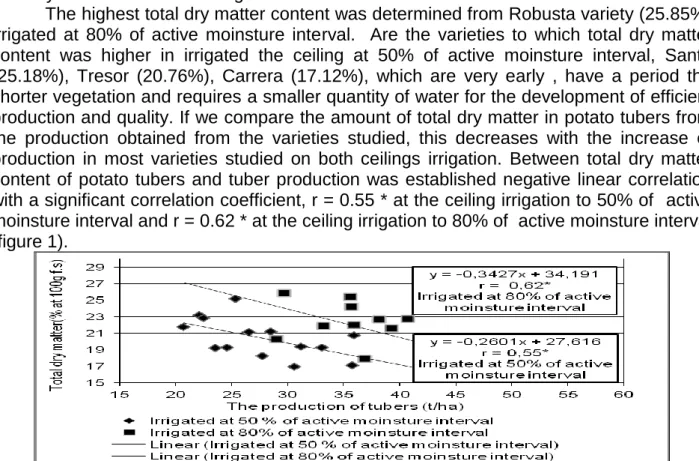
The highest total dry matter content was determined from Robusta variety (25.85%) irrigated at 80% of active moinsture interval. Are the varieties to which total dry matter content was higher in irrigated the ceiling at 50% of active moinsture interval, Sante (25.18%), Tresor (20.76%), Carrera (17.12%), which are very early , have a period the shorter vegetation and requires a smaller quantity of water for the development of efficient production and quality. If we compare the amount of total dry matter in potato tubers from the production obtained from the varieties studied, this decreases with the increase of production in most varieties studied on both ceilings irrigation. Between total dry matter content of potato tubers and tuber production was established negative linear correlation with a significant correlation coefficient, r = 0.55 * at the ceiling irrigation to 50% of active moinsture interval and r = 0.62 * at the ceiling irrigation to 80% of active moinsture interval (figure 1).
130
By converting the quantity of total dry matter from grams per 100g fresh substance in tonnes / hectare at the ceiling irrigated at 50% of the interval active moisture this increases with increased production of tubers after a positive regression with a correlation coefficient distinctly significant (r = 0.77 **), and at the ceiling irrigation to 80% of active moinsture interval total dry matter expressed in in tons / ha is accumulated in tubers after a polynomial regression, with a significant correlation coefficient (r = 0.58 *) (figure 2). Are a number of varieties (Magic, Astral, Tresor, Coval, Redsec) which by irrigating the ceiling of 80% of the IUA, the highest yields of tubers, with a quantity of total dry matter expressed in t / ha also very high. For industrialized, it is preferred that the tubers have a high and uniform level of dry matter, the ideal value is between 22 and 24%. The increase in the amount of total dry matter from tubers decreased amount of water.
a = Irrigated at 50% of active moinsture interval b = Irrigated at 80% of activemoinsture interval
Figure 2. The correlation between the amount of total dry matter(t/ha) and theproduction of tubers on the the ceiling of irrigation.
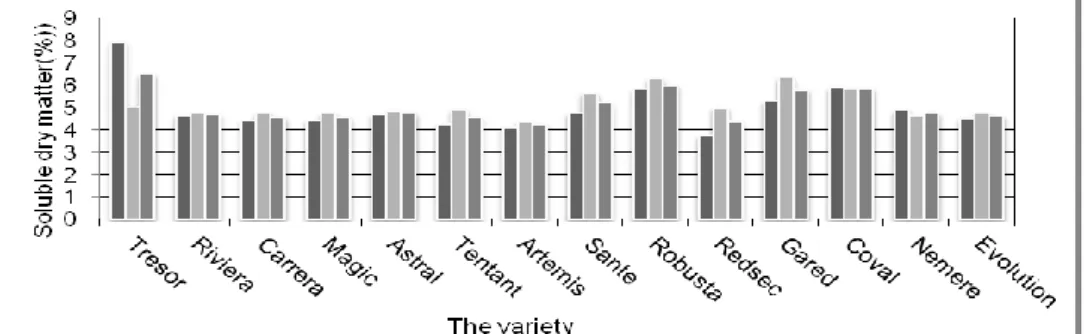
Also, it can be seen an increase in the content of soluble dry substance, with, increasing the amount of water of from 50% to 80% of active moisture interval in most varieties (Figure 3).
The content of C vitamin of the vegetables and fruits varies in very large limits, depending on species, variety, and conditions agropedoclimatic. The specialty literature highlights the at potato tubers, a C vitamin content of between 15mg and 22 mg/100g sp with an average of 17 mg/100g s.p. Cieślike (1994) determined in potatoes an average content of 16.4 mg/100g.
At varieties the studied, C vitamin content was comprised between 7.92 mg / 100g fresh substance in variety Evolution on the ceiling irrigated at 50% of the interval active moisture and 19.30 mg/100g fresh substance at the variety Artemis, on the ceiling irrigated at 80% of the interval active moisture (figure 4). All varieties the studied have the presented a higher content of C vitamin , on the ceiling irrigated at 80% of the interval active moisture.
131
Figure 4 - The influence of variety and irrigationceiling on the content of C vitamin in potato tubers
The content of reducing carbohydrate in potatoes is an average of of 1.2% with limits between 0.4 to 3.4%. (Gherghi A. et al., 1983).In this case, the content of carbohydrates was comprised between 1.20% to Nemere variety on the ceiling irrigated at 80% of the interval active moisture and 1.92% to Magic variety, in the same variant. From figure 5, it can be observed that the irrigation influence very little reducing of carbohydrates accumulation in potato tubers. Although reducing carbohydrates (glucose, fructose) represent a small proportion of the total dry matter, they are of particular importance, because they even at these concentrations determines the browning products potato toasted. From this point of view it is preferred that potato tubers have a content as low as possible in the components (Crăciun Ana, 1994).
Production of tubers was greatly influenced by the ceiling irrigation that which highlights the the role of water in the success of the potato culture on sandy soils.The highest yields were obtained at varieties: Tresor (42.2 t / ha), Riviera (42t/ha) Carrera (47.7 t / ha), Redsec (40.7 t / ha), Evolution (44.2 t / ha) on the ceiling irrigated at 80% of the interval active moisture, yields statistically assured, that very significant (figure 6).
Figure 5 - The influence of variety and irrigation
ceiling on the content of reducing carbohydrates in potato tubers
132
CONCLUSIONS
1. The results obtained on the influence of the amount of water applied through irrigation on, the nutritional quality of potato tubers, highlights the differences between the varieties studied and between ceilings, irrigation within the same variety. 2. Groups were revealed through statistically assured productions and the quality, tuber the varieties: Tresor, Riviera, Magic, Astral, Sante. The very high yields stood out varieties:Carrera, Redsec, Gared, Coval, and Evolution, and, through enhanced quality traits and lower production varieties: Robusta and Artemis 3. From the analysis of the influence of the quantity of water on, tuber qualityis observed that in potato tubers was determined a higher content of total and soluble dry matter and vitamin C on the ceiling irrigated at 80% of the interval active moisture. Also tuber production was higher on the ceiling irrigated at 80% of the interval active moisture.
BIBLIOGRAPHY
1. Cieslike,1994. The effect of naturally occurring vitamin C in potato tubers on the levels of nitrates and nitrites, Food chemistry ISSN 0308-8146, Coden Fochidj, vol. 49, nr.3, pag..233-235
2. Chichea I., 2000, Cartoful timpuriu şi de vară, Ed. ALMA, Craiova
3. Crăciun Ana, 1994, Densitatea optimă de plantare în funcţie de soi şi unele
măsuri fitotehnice la cartof, Lucrări ştiinţifice - Anale ale Institutului de cercetare şi producţie a cartofului, vol. XXI, Braşov.
4.Aurelia Diaconu, 2007, Rezultate privind ficziologia tuberculilor de cartof în
funcție de soi, nivelul de aprovizionare cu apă și sol în ondiții de stress termohidric din Dolj, Lucrări Științifice , CCDCPN Dăbuleni. Vol. XVI, Editura Sitech, Craiova, 2007
5. Dinesh Kumar, R. Ezekiel, 2006, Developmental changes in sugars and dry matter content of potapo tuber under sub tropical climates, Scientia Horticulturae, vol.110, ISSUE 2, p.129-134.
6.Geremew E. B., Steyn J.M., Annandale J.G., 2007, Evaluation of growth performance and dry matter partitioning of four processing potato (Solanum tuberosum)
cultivars, New Zealand Journal of Crop and Horticultual Science, vol. 35, 385-393. 7.Anastazia Ginterova, 1960, Content of different forms of vitamina C in potatoes,
Treated with ethylene chlorhidrin, Biologia Plantarum, Praha, 2(1), 19-26.
8. Gherghi A. et al, 1983, Biochimia şi fiziologia legumelor şi fructelor, Ed. Academiei RSR, Bucureşti
9. Kellock Tony, Toolangi,1995, Potatoes: factors affecting dry matter, Agriculture Notes, ISSN 1329-8062.
10.Lorinczi Adina, 1997, Calitatea cartofului, concepte şi cerinţe, Lucrări ştiinţifice( Anale ale Institutului de cercetare şi producţie a cartofului, vol. XXIV , Braşov.
11.W. Leszczyński, G. Lisińska W., 1988, Influence of nitrogen fertilization on chemical composition of potato tubers, Food Chemistry, vol.28, ISSUE, pag. 45-52, available online 1 october 2003.
12. Mureşan S., Olteanu Gh., Tănăsescu Eugenia, 1980, Controlul calităţii