7
EVALUATING OF WILD HELIANTUS SPECIES OF SUNFLOWER
AND INTERSPECIFIC HYBRIDIZATION FOR RESISTANCE TO
BROOMRAPE (
OROBANCHE CUMANA
WALLR.)
Anton F.G. (1,2), Pacureanu Joita M. (1), Sauca F. (1) and Risnoveanu L. (3,4) (1) National Agricultural Research and Development Institute, Fundulea,1 Nicolae Titulescu, Fundulea, Calarasi County, 915200, +4-0242-642080, Romania. e-mail: [email protected], [email protected], [email protected] (2)University of Agronomic Sciences and Veterinary Medicine of Bucharest, 59 Marasti Blvd, District 1, 011464, Bucharest, Romania, Phone: +4021.318.25.64, Fax: + 4021.318.25.67 (3) Agricultural Research Development Station Braila, Viziru km. 9 street, Braila, Braila
County, 818008, +4-0239-684744, Romania, email: [email protected] (4) „Dunarea de Jos” University of Galati, Engineering and Agronomy Faculty of Braila-Agronomy Center for Research and Consultancy and Environment „Lunca”, 29 Calarasi, Braila,
Braila County, 810017, +4-0239-612572, Romania, email: [email protected]
Key words: sunflower, broomrape, wild species, resistance, testing
ABSTRACT
Broomrape become in the last years very dangerous for sunflower crop in Romania and new races apears in evry year. Orobanche cumana Wallr (broomrape) is present in more than half of areas cultivated with sunflower in our country.Broomrape causes important louses to sunflower seed yield. The better method to control this parasite is genetic resistance. Breeding for resistance of broomrape can be done by transfering genes from wild species of Helianthus. By testing different sunflower genotypes, resistant to the most virulent races of the parasite, in artificial condition from different infested areas, year by year is study of the relationship between the parasite and the host plant. Resistant genotypes at broomrape in one year lose resistance next year and become tolerant.
INTRODUCTION
For broomrape parasite (Orobanche cumana Wallr), resistance genes have been
identified in wild sunflower species. Thus, the first sources of resistance were created by
crossing the species of Helianthustuberosus with the cultivated sunflower (Pustovoit,
1976). Ruso et al. (1996) tested 26 perennial wild species and 12 annual wild spesies and
Terzić et al. (2016) tested 7 annual wild species and 182 accesion, most of which showed
good resistance to the attack of the respective broomrape population.
Annual wild species Helianthus debilis subsp. tardiflorus poses resistance to race G
(Velasco et al. 2012) Perennial wild species have more resistance than annual species to
Race F (Seiler and Marek, 2011).
Wild Helianthus species represent a valuable genetic resource for new broomrape
races who are more virulence in evrey year (Pacureanu-Joita M. et al, 2015; Anton F.G. et
al., 2016; Risnoveanu L. et al, 2016 a.; Risnoveanu L. et al, 2016 b).
MATERIALS AND METHODS
8
The population of broomrape was collected from, Braila 2015, and was testet to
identify the genotype of sunflower resistant to this races of Orobanche cumna Wallr in year
2016, in greenhouse. In 2017 tested in greenhouse the same genotype for resistance with population of broomrape from Braila 2016 where is present very virluent races. Check resistant is hybrid PR64LE20 and check sensitive is hybrid Performer.
13 accessions of five annual Helianthus species and was tested for resistance to
bromrape in 2016 and 2017 in greenhouse.
RESEARCH RESULTS
Sunflower differential line for race Fof broomrape, LC 1093B controlled by a single
dominant gene Or6, was sensible in both years of testing at race G of broomrape (table
1).
Table 1.
Results from the sunflower differentials set for resistance to broomrape population (Orobanche cumana Wallr.) from Braila 2015 and 2016
Differentials lines
Races of broomrape
Race C Race D Race E Race F Race G
173B
-Record
R S S S S
LC1002 B R R S S S
LC1003 B R R R S S
LC1093 B R R R R S
All accesions of Helianthus praecox and Helianthus petiolaris and two accesions of
Analele Universităţii din Craiova, seria Agricultură – Montanologie – Cadastru (Annals of the University of Craiova - Agriculture, Montanology, Cadastre Series)Vol. XLVII 2017
9 Table 2
Resistance of annual Helianthus species in year 2016, in greenhouse
Annual Helianthus wilde species
Intensity of broomrape atack(%)
(population of broomrape from Braila 2015 area)
A1Ne Helianthus neglectus 1
A2De Helianthus debilis 1
A3De Helianthus debilis 0
A4De Helianthus debilis 0
A5Pe Helianthus petiolaris 0
A6Pe Helianthus petiolaris 0
A7Pe Helianthus petiolaris 0
A8Pe Helianthus petiolaris 0
A9Pr Helianthus praecox 0
A10Pr Helianthus praecox 0
A11Pr Helianthus praecox 0
A12Pr Helianthus praecox 0
A13Arg Helianthus argophyllus 8
Two accesions of Helianthus debilis, Helianthus petiolaris and Helianthus
praecoxis resistant topopulation of broomrape from Braila 2016 area (table 3).
Table 3
Resistance of annual Healianthus species in year 2017, in greenhouse
Annual Helianthus wilde species
Intensity of broomrape atack(%)
(population of broomrape from Braila 2016 area)
A1Ne Helianthus neglectus 5
A2De Helianthus debilis 6
A3De Helianthus debilis 0
A4De Helianthus debilis 0
A5Pe Helianthus petiolaris 0
A6Pe Helianthus petiolaris 1
A7Pe Helianthus petiolaris 0
A8Pe Helianthus petiolaris 2
A9Pr Helianthus praecox 1
A10Pr Helianthus praecox 2
A11Pr Helianthus praecox 0
A12Pr Helianthus praecox 0
A13Arg Helianthus argophyllus 20
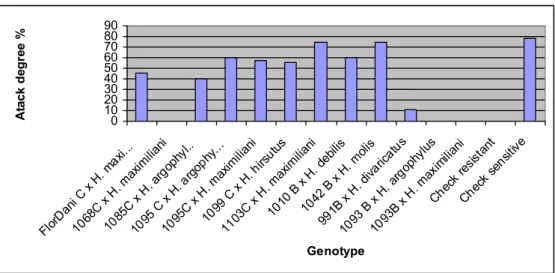
Three interspecific hybrids LC 1068Cx Helianthus maximiliani, LC1093B x
10
resistant to these population of broomrape and check sensitive (hybrid Performer) was susceptible.
Figure 2. Atack degree of broomrape in greenhouse, in 2016
Only one interspecific hybrids, LC1093B x Helianthus argophyllus, present
tolerance to population of broomrape from Braila 2016 area (figure 3).
Figure 3. Atack degree of broomrape in greenhouse, in 2017
The check resistant (hybrid PR64LE20) was tolerant to this population of broomrape from Braila 2016 and check sensitive (hybrid Performer) was susceptible (figure 4).
Figure 4.Screening for resistance to broomrape after 40 days after sowing 0 10 20 30 40 50 60 70 80 90 Flor Dan
i C x H. m
axi.. .
1068 C x
H. m axim
ilian i
1085 C x
H. a rgop
hyl..
1095 C x
H. a rgop
hy...
1095 C x
H. m axim
ilian i
1099 C x
H. h irsut
us
1103 C x
H. m axim
ilian i
1010 B x
H. d ebili
s
1042 B x
H. m olis
991B x H
. div aric
atus
1093 B x
H. a rgop
hylu s
1093 B x
H. m axim
ilian i
Che ck re
sist ant
Che ck s
ensi tive Genotype A ta c k de gre e % 0 20 40 60 80 100 120 Flor Dan
i C x H. m
axi.. .
1068 C x
H. m axim
ilian i
1085 C x
H. a rgop
hyl..
1095 C x
H. a rgop
hy...
1095 C x
H. m axim
ilian i
1099 C x
H. h irsut
us
1103 C x
H. m axim
ilian i
1010 B x
H. d ebili
s
1042 B x
H. m olis
991B x H
. div aric
atus
1093 B x
H. a rgop
hylu s
1093 B x
H. m axim
ilian i
Che ck re
sist ant
Che ck s
Analele Universităţii din Craiova, seria Agricultură – Montanologie – Cadastru (Annals of the University of Craiova - Agriculture, Montanology, Cadastre Series)Vol. XLVII 2017
11 CONCLUSION
Anual wilde species can be used in breeding program for resistance to broomrape.
Some accesions of Helianthus praecox, Helianthus debilis,Helianthus petiolaris is full
resistance to races of broomrape present in Romania. There is difference in the parasite attack degree, depending on year and location of broomrape population.
In area Braila 2015 whas present more then race F of broomrape and interspecific
hybrids LC 1093 B x Helianthus argophyllus, LC 1093B x Helianthus maximiliani and LC
1068C x Helianthus maximiliani have 0% infestation with Orobanche cummna Wallr.
Interspecific hybrids LC 1093 B x Helianthus argophyllus, LC 1093B x Helianthus
maximiliani and LC 1068C x Helianthus maximiliani have a good tolerance to more of race F of broomrape who whas present in Braila 2016.
BIBLIOGRAPHY
Anton F.G., Joita- Păcureanu M., Cornea C. P. 2016 - The parasite broomrape (Orobanche cumana) in sunflower –identifying sources for genetic resistance.Scientific Bulletin. Series F. Biotechnologies, Vol. XX, p. 11-17.
Joita Păcureanu M., Risnoveanu L., Anton F.G. 2015- Broomrape (orobanche cumana wallr.) control by breeding in sunflower. Abstract book II. International Plant Breeding Congress and Eucarpia – Oil and protein crops section conference, 1-5 november 2015 Antalya, Turkey, p. 151.
Panchenko A.Y. 1975. -Early diagnosis of broomrape resistance in breeding and improving seed production. Vestnik-S.H.N. No.2:107-115. (In Russian).
Pustovoit, G.V., Ilatovsky, V.P., Slyusar, E.L. 1976-. Results and prospects of sunflower breeding for group immunity by interspecific hybridization.In: Proc. 7th Intl. Sunfl. Conf.,Krasnodar, Russia. Intl. Sunfl. Assoc., Paris, France, 27 June–3 July, pp. 193–204.
Risnoveanu L., Joita-Păcureanu M., Anton F.G. 2016 a - The Virulence of Broomrape (OrobanchecumanaWallr.) in Sunflower Crop in Braila Area, in Romania.Helia, Volume 39, Issue 65 (Dec 2016), p. 189-196.
Risnoveanu L., Joita-Pacureanu M., Anton F.G. 2016 b– Broomrape (Orobanche cumana Wallr.), the most important parasite in sunflower crop in Romania. LucrăriŞtiinţifice – vol. 59(2)/2016, seriaAgronomie, p. 209-212.
Ruso J., Sukno S., Dominguez-Gimenez J., Melero-Vara J.M. and Fernandez-Martínez J.M. 1996 - Screening of wild Helianthus species and derived lines for resistance to several populations of Orobanche cernua.Plant Disease 80: 1165-1169.
Seiler G., Marek L.2011 - Germplasm resources for increasing the genetic diversity of global cultivated sunflower.Helia 34(55): p. 1–20.
Terzic S., Dedic B, Atlagic J., Jocic S., Miladinovic D., Jockovic M. 2016 -Testing annual wild sunflower species for resistance to OrobanchecumanaWallr- Abstract book of International Sunflower Conference , Edirne, Turkey, 2016. p- 294-295.
Velasco, L., PrrezVich, B., Yassein, A.M., Jan, C.C., FernandezMartinez, J.M. 2012 -Inheritance of resistance to broomrape (Orobanche cumana Wallr.) in an interspecific cross between Helianthus annuus and Helianthus debilis ssp. tardiflorus.Plant Breeding