An Analysis of Communicative Language Functions in the
Speech Patterns of Bilingual Korean and Mexican Immigrant
Children
Jin Sook Lee
1* , Jane Y. Choi
2, Laura Marqués-Pascual
31
Department of Education, University of California, Santa Barbara, USA {[email protected]}
2
Mathematica Policy Research, Chicago, USA {[email protected]}
3
Department of Spanish and Portuguese, University of California, Santa Barbara, USA
{[email protected]}
Received on 17 April 2016; revised on 30 April 2016; accepted on 24 June 2016; published on 15 July 2016 DOI: 10.7821/naer.2016.7.193
ABSTRACT
For children from immigrant families, opportunities to develop additive bilingualism exist, yet bilingual attainment has varied widely. Given the significance of language development opportu-nities in home settings, this study examines the home language use of 20 second-generation children (ages 6-8) of Mexican and Korean descent in the United States. Using a language function framework, we provide a descriptive analysis of the communica-tive functions performed by these children and how their profi-ciency level, the interlocutors, and their home settings may influ-ence their language use. Data include English and heritage lan-guage proficiency assessments, interviews with children and their mothers, and multiple video recordings of home interactions. Findings show little variation in the kinds of language functions performed by these children who mainly used language to convey or seek factual information, unless they were involved in imagi-nary play. Moreover, children found creative ways to communi-cate different linguistic functions as needed, even among those with limited proficiency. Interestingly, the Mexican American children had a greater tendency to use more heritage language in the home than the Korean American children, who used more English. The children rarely engaged in intersentential code-switching. Implications for educators, parents, and researchers are discussed.
KEYWORDS: COMMUNICATIVE SKILLS, LANGUAGE
DEVELOPMENT, BILINGUALISM, CHILDREN, ASSESSMENT, KOREAN, SPANISH
1
INTRODUCTION
Research continually demonstrates the cognitive, social and academic benefits of bilingualism (Bialystok, 2011; Lauchlan, Parisi, & Fadda, 2013; Lee & Suarez 2009; Mehisto & Marsh, 2011). Yet in contexts like the U.S. where the ideological force of English monolingualism is strong, what remains largely
unknown are the processes by which young children develop bilingual competence. Furthermore, we have little understanding of the kinds of communicative and linguistic demands bilingual children face on a daily basis. While research on bilingual children’s interactions has focused attention on school and playground settings (see Creese & Blackledge, 2010; Cromdal, 2001; Kyratzis, Tang & Koymen, 2009; Martin-Jones, 2000), there remains limited research on how bilingual children use one or more languages in the home setting, a setting widely acknowledged as crucial in supporting bilingualism among children of immigrants.
In order to address the need for this research, we investigated the kinds of communicative functions performed by 20 young Mexican and Korean children (ages 6–8) in their home settings. We explored the language use of both Mexican and Korean bilingual children, rather than one ethnic group in isolation, because the potential uniqueness of their community, cultural, and language characteristics (Lee & Suarez, 2009) may lend fuller insights into immigrant children’s language use at home, where two languages and cultures intersect. For this study, we asked the following research questions:
1. What are the patterns of language use in their home set-tings?
1a. What kinds of language categories and functions do bilingual Mexican and Korean children perform in their home settings?
2. Which language(s) do they use to perform these language function categories?
2a. Does the choice of language vary with the child’s level of language proficiency, the type of language func-tion category, and/or the addressee?
2
THEORETICAL FRAMEWORK
To understand the range of language functions that bilingual children perform in home settings, we drew from two different frameworks that account for the development of pragmatic competence among speakers. First, we understand interactional settings that provide for or restrict the opportunity to use certain linguistic codes, such as English, heritage language (HL) or both as shaping language competence (Blommaert, Collins, &
ORIGINAL
*To whom correspondence should be addressed:
Slembrouck, 2005; Gumperz & Hernandez-Chavez, 1972). That is, social interactions take place in geographical and interpersonal spaces that are characterized by a set of norms and expectations about communicative behavior, and therefore, the development of language competence is shaped by the types of exposure to language input, opportunities to practice the language, and the norms and expectations that are related to language use (Blommaert et al., 2005). Thus, differences in home and school settings as well as other relevant settings (like peer groups and neighborhoods) provide different kinds of spaces for language use and opportunities for language development among children (Haworth, 2006).
Second, since language is embedded in the cultural context, one must examine the pragmatics of language use to understand how language is used and interpreted in a given context. The core of pragmatic language use is based on the use of speech acts (e.g., to request, to apologize, to greet), the minimal units of linguistic action. Speech Act (SA) Theory accounts for what people do with language, which is akin to communicative intentions (Searle, 1969). Pragmatic competence is concerned with how message units relate to the acts or functions that speakers intend to perform through these message units (illocutionary force); it is also concerned with the relationship between message units, acts or functions, and the characteristics of the context of language use that determine the appropriateness of message units (Bachman 1990: 89-90). Furthermore, Bialystok (1993) defines pragmatic competence as encompassing several abilities: the ability to make use of a variety of language functions; the ability to understand the speaker’s real intention; and the modification of speech according to the context. Thus, pragmatic competence entails using language for different purposes to request, to instruct, and to effect change as well as the listener’s ability to understand the speaker’s communicative intentions, especially when these intentions are not directly conveyed (e.g., indirect requests, irony, sarcasm). We adapt this foundational framework to investigate the English and heritage language use of young bilingual children.
3
METHODS
3.1
Participants
Children (ages 6–8) were recruited from four schools in southern California based on two criteria: (1) They had some proficiency in English and their HL, and (2) Their parents were first-generation immigrants from Mexico or Korea who came to the U.S. after the age of twenty-one. School administrators and teachers assisted with the identification of families who met our criteria. From the list of potential participants, we contacted each family to reconfirm their eligibility and to request their voluntary participation. Our sample included 20 children and their families: 11 Mexican families and 9 Korean families (see Appendix A for participant demographic information). In the majority of the families, mothers were the primary caregivers and our point of contact.
The Mexican sample included 11 children (ages 7–8) who lived in households with two parent figures. The parents’ education level ranged from third grade to three years in a vocational college, and the majority of the parents graduated from junior high. The families lived in the U.S. for an average of 10 years (range: 3 to 16 years). They lived in a community with a large, visible presence of Spanish speakers. Their reported
average annual income was approximately $30,000 (range: $17,000 to $76,000). All of the parents reported speaking primarily in Spanish to their children, and the children reported speaking mostly Spanish to their parents with some English. The parents self-assessed their English oral proficiency on a 25-item “can-do” proficiency questionnaire (Clark, 1981). The mothers’ average rating was 68 points, which indicated fairly low proficiency in English (a score of 25 indicates no proficiency, 125 indicates native-like proficiency).
In the Korean group, there were 9 children (ages 6–8) from two-parent households. All of the children’s parents were college graduates. The families lived in the U.S. for an average of 9 years (range: 2 to 14 years). The Korean children were from two different communities: one with a moderate presence of Korean speakers and another with a limited presence of Korean speakers. Their reported average annual income was approximately $50,000 and (range: $20,000 to $80,000). All of the parents reported speaking mainly in Korean to their children, and the children reported speaking both English and Korean to their parents. Like the Mexican parents, the Korean mothers also completed the 25-item “can-do” English self-assessment and their average rating was 80 points, which indicated an intermediate-range proficiency in English.
3.2
Data Sources and Analysis
Speech samples
We lent each family a digital video camera for three weeks and asked parents to record home interactions to capture their children’s naturalistic language interactions. In all but three of the videos, the families recorded interactions when the researcher was not present. We asked that parents record their child in three types of activities: mealtime, homework time, and playtime. The length of time of these interactional events varied with each family, but the recordings for most of the families were within the 60- to 90-minute range.
Since we did not have the same length of recordings for each child, we selected the lowest common denominator in minutes of recordings, prioritizing the recordings where children spoke the most. For each of the participants’ recordings, two Korean-English bilingual speakers and two Spanish-Korean-English bilingual speakers rated the speech samples independently using the Foreign Language Oral Skills Evaluation Matrix (FLOSEM) (Padilla & Sung, 1997). The FLOSEM rubric has five discrete language skills: comprehension, fluency, vocabulary, grammar, and pronunciation scored on a 1 (no proficiency) to 6 (native-like proficiency).If there was a discrepancy between the two raters’ scores of more than one point, a third rater assessed the speech sample. The two scores were averaged for the language proficiency score (in the case of three raters, the two most similar scores were used). The reliability of the ratings, based on an intraclass correlation, were high: .90 for Korean and .86 for English (See Appendix B for the focal children’s FLOSEM scores).
word count. When a child started to say a word but stopped before completing it, it was only included in the word count if identifiable.
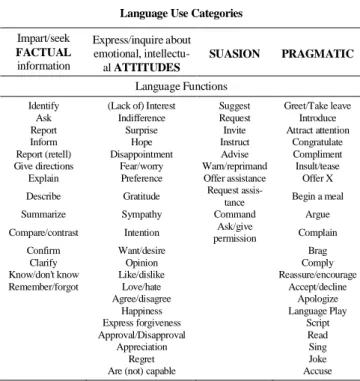
We also analyzed the children’s speech by the communicative language functions they used. We adapted the Notional Functional Syllabus framework (van Ek, 1975), based on Searle’s (1969) Speech Act Theory. We chose van Ek’s Notional Functional Syllabus framework instead of Searle’s five speech act categories because van Ek’s categories were more specific, and thus more useful in capturing the nuances in the focal children’s language functions. The final categories we used are reported in Table 1.
Table 1. Language Categories and Language Functions
Language Use Categories
Impart/seek
FACTUAL
information
Express/inquire about emotional,
intellectu-al ATTITUDES
SUASION PRAGMATIC
Language Functions
Identify (Lack of) Interest Suggest Greet/Take leave Ask Indifference Request Introduce Report Surprise Invite Attract attention Inform Hope Instruct Congratulate Report (retell) Disappointment Advise Compliment Give directions Fear/worry Warn/reprimand Insult/tease
Explain Preference Offer assistance Offer X Describe Gratitude Request
assis-tance Begin a meal Summarize Sympathy Command Argue Compare/contrast Intention Ask/give
permission Complain
Confirm Want/desire Brag
Clarify Opinion Comply
Know/don't know Like/dislike Reassure/encourage Remember/forgot Love/hate Accept/decline
Agree/disagree Apologize Happiness Language Play Express forgiveness Script Approval/Disapproval Read
Appreciation Sing
Regret Joke
Are (not) capable Accuse Note. Bold indicates language function category label.
The recordings had over 4000 message units. The second and third authors coded the message units for language functions and continually crosschecked the coding throughout the analytic process. The coders also noted the language(s) the focal child used and to whom the message was directed (i.e., the addressee) for each message unit.
Interviews
Bilingual researchers conducted three to four semi-structured interviews with the children and their parents in the participants’ language(s) of choice. Each interview was approximately one hour. The same bilingual researchers also transcribed and coded the interviews inductively and deductively for themes (Strauss & Corbin, 1990). In these interviews, the participants provided contextual information on children’s language use patterns, on children’s instructional activities, and on their motivations and attitudes related to language learning and bilingualism. The interview data also provided explanations for the patterns of language use we found.
4
RESULTS
4.1
Language functions
Our first research question was aimed at finding out the kinds of language functions that these bilingual children perform in order to better gauge what their language communications are in their home setting. Table 2 summarizes the quantity and most frequently used language functions (classified in common categories) performed by the Mexican and Korean focal children in the sample of home interaction recordings. We found that our focal children did not use all of the categories of language functions equally. The majority of the language functions focal children used were in the Factual category; 69% of the message units from the Mexican children’s speech and 62% of the Korean children’s were coded as Factual. The remaining categories we coded for —Attitudes, Suasion, and Pragmatic— made up 8–17% of the children’s speech in the sample recordings.
Table 2. Quantity of Language Functions Performed by the Mexican and Korean Focal Children
Mexican Children Korean Children
Category Factual 1108 (69%) Factual 1843 (62%) Functions Inform Ask 252 (23%) 174 (26%) Ask Describe 578 (30%) 327 (18%)
Category Suasion 224 (14%) Attitudes 497 (17%) Functions Command 126 (56%) (Dis)Agree 115 (23%) Suggest 32 (14%) Preference 57 (11%)
Category Attitudes 147 (9%) Suasion 345 (12%) Functions Intention 43 (29%) Command 159 (46%) Preference 39 (27%) Suggest 53 (15%)
Category Pragmatic 134 (8%) Pragmatic 296 (10%) Functions Complain 36 (27%)
Compliment,
49 (17%) Insult
Brag 37 (13%)
Note. Percentages of language function category use was out of a total coded message units of 1613 and 2981 for the Mexican and Korean children, respectively. We included only the language functions that were close to or exceeded ten percent.
Below, we discuss each language function category and highlight examples of common language functions the focal children used. The most common language function category was Factual (to seek and impart factual information). The top
Factual language functions for the Mexican focal children were
Inform (23%) (e.g. “No hay jugo,” There’s no [more] juice) and
Ask (16%) (e.g. “¿Cuál es tu primer nombre?” What’s your first name?). The top Factual language functions for the Korean focal children were Ask (30%) (e.g. “What are you doing here?”)
and Describe (18%) (e.g. “이거다아빠친구에요대학교때”
This is all of my dad’s friends from college).
The Attitudes category was the third most frequently used among the Mexican focal children (9%) and the second most frequently used among the Korean focal children (17%). The top Attitudes language functions for the Mexican focal children were Intention (29%) (e.g. “Voy a hacer la tarea” I’m going to do my homework) and Preference (27%) (e.g. “I don’t like it”). The top Attitude language functions for the Korean focal children were Agree/Disagree (23%) (e.g. “yeah I guess so”) and Preference (18%) (e.g. “ 나반찬만먹을래” I just want to eat the side dishes).
top Suasion language functions for the Mexican and Korean focal children were the same: Command at 56% and 46% respectively, and Suggest at 14% and 15%, respectively. Examples of Command include “Siéntate en el medio, siéntate aquí.” (Sit in the middle, sit here) or “No don’t stand.” Examples of Suggest include “Mejor lo vamos a poner aquí.” ([It’s] best if we put it here) or “You play piano and I sing a song.”
Lastly, for the Pragmatic category, both the Mexican and Korean focal children performed them the least frequently at 8% and 10%, respectively. The most common language function the Mexican focal children used in this category was Complain at 27% (e.g. “Por qué la pusiste allí?” Why did you put it there?)
and the most common language functions for the Korean children were Compliment/Insult at 17% (e.g. “good job!”, “너
뚱뚱하지” You are fat) and Brag at 13% (e.g. “난 예쁘게
그렸어” I drew this really well.)
From our analyses, we found that the children did not use all of the language functions; there were some that were much more frequently performed than others. The limited types of language function use suggest that our participants engaged in a similar range of daily routines at home in addition to the fact that at this developmental stage, children mostly engage in seeking or conveying information.
Furthermore, we found that certain activities seemed to promote the focal children’s use of different language function more than others. For example, during mealtimes, the children mostly sought or expressed factual information. However, we observed more instances of complaining, bragging, and complimenting during playtime. There were a few focal children who role-played with imaginary characters, puppets and dolls. In such interactions, the children imagined various contexts, scenarios, characters, and time frames; in these imagined scenarios, the children used varied language functions like commanding, reprimanding, identifying, greetings, and expressing emotions. The children’s imagination was a great source of language practice in both English and their heritage language and should be encouraged much more as a form of play in homes and at schools. Given that our 20 focal children seemed to have overwhelming opportunities to use language for factual purposes, we must consider the potential benefit of purposefully creating opportunities for home language use that may not be routinely available in order for them to practice using a wider range of language function categories and functions at home; imaginative scenarios may be a rich, engaging way to provide children with more opportunities to use a variety of different language functions categories.
4.2
Governing factors for language function
performance
Regarding our second research question and the different factors governing language choice and performance, we found that the Mexican children used the heritage language more than the Korean children, and that code-switching was not common within one utterance. The average number of words per message unit varied per child and per speech sample: the Korean focal children used an average of 6.66 words per message unit (2981 total message units) and the Mexican focal children used an average of 4.85 per message unit (1684 total message units). Moreover, we found that the Mexican focal children used more Spanish (62%) compared to English (34%) and the Korean focal children used more English (60%) compared to Korean (34%).
For both the Mexican and Korean focal children, there was limited code-switching (using both languages) in one message unit (4-12% of message units). The low frequency of code-switching in each message unit may be due to the relatively short length of the average message units (4.5–7 words). In addition, the children’s limited frequency of code-switching may have also been influenced by the parents’ negative attitudes toward code-switching, as shown in the following quotes:
Edward’s Mother:
Para mí sería, que si está hablando en español, en español y si está hablando en inglés, en inglés.
For me it would be, if he is speaking Spanish, it's just Spanish and if he is speaking English, it's just English.
Daisy’s Mother:
그니까니가만약에표현하고싶다면영어로할래 그럼 영어로 하든지 아니면 한국말로 하려면 한국말로다하던지그렇게해요.
So if you want to express something in English then do it in English or if you want to say something in Korean do it all in Korean.
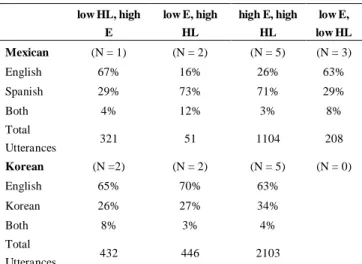
In addition to exploring the general patterns of focal children’ language choice, we also examined whether the focal children’s language choice was influenced by their own proficiency levels in the heritage language and English. As we can see in Table 3, the Mexican children who had high proficiency in a language tended to use that language more frequently than the other language. For example, Edward, who had higher English proficiency than Spanish, used more English (67% of message units), and Ana and Eugene, who had higher Spanish proficiency than English, used more Spanish (73% of their combined message units). The Mexican focal children who had low proficiency in both languages (Matthew, Briana and Alberto) used more English than Spanish (63% of message units), perhaps because, as the dominant social language, they used English for the majority of the day while at school.
Table 3. Language Used by Focal children as Categorized by their General Language Proficiency
low HL, high
E
low E, high HL
high E, high HL
low E, low HL
Mexican (N = 1) (N = 2) (N = 5) (N = 3) English 67% 16% 26% 63% Spanish 29% 73% 71% 29% Both 4% 12% 3% 8% Total
Utterances 321 51 1104 208
Korean (N =2) (N = 2) (N = 5) (N = 0) English 65% 70% 63%
Korean 26% 27% 34% Both 8% 3% 4% Total
Utterances 432 446 2103
Note. E refers to English. Focal children’ FLOSEM scores were categorized as low or high, using the median as the cut-off.
in Korean and English, used more English than Korean in the speech samples (63–70% of the message units). Although the majority of our sample of Korean parents reported that they spoke predominantly Korean at home, based on our analyses of the sample of home recordings, the Korean focal children used more English. This included interactions with their parents: we observed that the children typically used English to their parents and the parents responded in Korean using English words as needed, a pattern of language use that is well-documented among Korean American immigrant families (Au & Oh, 2009; Shin, 2005; Wong Fillmore, 1991). This is exemplified in an interaction between Sunny and her mother while they cooked together for Sunny’s birthday celebration:
Sunny: 엄마 can I just do it in the big huge bun?
Mom can I do it in the big, huge bun?
Sunny’s Mother: 그럴라고 그래 big huge
bun할라고그래
That’s what I’m going to do, I’ll do a big, huge bun
In the above interaction, when Sunny asked her mother in English if she could make the dough into a “big, huge bun,” Sunny’s mother accommodated to Sunny’s English use both by responding to her request (rather than asking her to speak to her in Korean) and by repeating the phrase, “big, huge bun.”
The Korean parents’ accommodation of their children’s English use may, in part, be motivated by the greater importance they placed on English compared with Korean (Choi, Lee & Oh, forthcoming). Many of the parents expressed that English is more important in the U.S. since it is the language used in schools and that learning Korean can wait because it does not have the same societal value as English.
Unlike the Korean parents’ accommodation of their children’s English use at home, our sample of Mexican mothers encouraged their children to use Spanish at home.
Gabriela’s Mother:
A veces me pregunta cosas en inglés y le digo que “en español porque si no, no te voy a entender y no te voy a dar lo que quieres.” Cositas si le entiendo y me hago que no la entiendo para que me hable en español.
Sometimes she asks me things in English and I tell her “in Spanish, otherwise I am not going to understand you and I am not going to give you what you want.” Little things [in English] I do understand, but I pretend that I don’t understand her so that she’ll speak in Spanish.
Furthermore, the communities in which the Korean and Mexican participants resided differed in the presence of HL speakers, which may have impacted the focal children’s perceptions of the social utility of the HL. There was a large number of Latinos in their community and Spanish was used more overtly in the community, for example in the many Mexican- or other Latino-owned businesses and in the abundance of Spanish street and city names. Thus, the children perceived Spanish as an important language to know in the U.S. because it had societal utility as evidenced below in some of the children’s and mother’s comments.
Sofia:
[I like knowing English and Spanish] cuz mostly people en Los Estados Unidos speak Eng—both languages
Ariel’s Mother:
Lo que sí es muy importante... y lo que yo inculco en ella es que tiene que aprender los dos idiomas. Es una mejor oportunidad para ella en el futuro. Además cuando ella llegue a ir a México, se va a poder desenvolver en el idioma [español] y eso es otra ventaja. El inglés es su idioma, porque ella nació aquí pero el español va a ser su segundo idioma, y si ella lo sabe, va a tener muchas más oportunidades para un futuro.
What is very important… and what I instill in her is that she needs to learn both languages. It is a better opportunity for her in the future. Besides, when she goes to Mexico, she will be able to manage in the language [Spanish], and that is another advantage. English is her language because she was born here, but Spanish is going to be her second language, and if she knows them both then she will have more opportunities in the future.
On the other hand, while the Korean focal children may have had access to the Korean language in Korean businesses or at their Korean churches, Korean was not societally embedded in their communities the way that Spanish was in the Mexican participants’ community. Many of the focal children expressed discomfort with speaking Korean and mothers also mentioned how their children reacted to using Korean.
Sunny’s Mother:
자기가한국말을하면이상하지않을까 …
It seemed as if she was worried that] if she spoke Korean, would it be strange…
We thus observed a difference in the Korean and Mexican participants’ attitudes toward the social acceptability of their HL, which may have also contributed to the differing degrees of English and the HL language use between the two groups.
Lastly, we analyzed the data for whether there were patterns in the focal children’s language choice based on the addressee and the focal children’s language proficiency. We found that the Korean focal children mostly spoke English with all of the addressees in their speech samples, apart from a Korean researcher who had immigrated to the U.S. two years prior, and their monolingual grandmothers, to whom they spoke mostly in Korean. The Mexican focal children mostly spoke Spanish with their family members (e.g., mother, father, siblings) and spoke mostly English with a Spanish-English bilingual researcher and a balanced amount of both Spanish and English when playing with toys or by themselves.
We also found that the focal children did not use the two languages equally to each addressee in the speech samples, indicating that the focal children accommodated to the language use of the person they were addressing. As can be seen in Table 5, the Mexican focal children who had high proficiency in the HL and low proficiency in English used mostly Spanish with their parents but used both languages with their sibling(s). Similarly, the Korean focal children also did not use the two languages equally to each addressee. As can be seen in Table 6,
the Korean focal children with high Korean and English proficiency used mostly English when they spoke to their parents, siblings and friends, but used mostly Korean with their grandmother. Additionally, the Korean focal children who had high Korean proficiency and low English proficiency spoke mostly Korean with their mothers, likely because their mothers were recent arrivals to the U.S. and reported limited English proficiency (see Appendix A); however, these same children spoke mostly English with all other addressees in the speech samples.
5
CONCLUSION
This study examined the patterns of language use among young bilingual children in their home settings and found that, the children in our sample from both Korean and Mexican homes predominantly performed language functions associated with the factual language function category (i.e., to seek and impart factual information). We found the most varied use of language functions was in situations where the child engaged in imaginary role-play with puppets or dolls, or their imaginary friends. Therefore, to provide children with opportunities to practice Table 4. Language Used to Perform Language Function Categories based on Proficiency
Factual Attitudes Suasion Pragmatic
English HL English HL English HL English HL
Korean
Low HL, High E 63% 25% 69% 20% 83% 11% 95% 3% Low E, High HL 66% 28% 71% 26% 73% 25% 66% 30% High E, High HL 53% 41% 56% 39% 50% 44% 58% 37%
Mexican
Low HL, High E 67% 29% 81% 19% 61% 26% 80% 20% Low E, High HL 3% 84% 1% 99% 25% 75% 67% 22% High E, High HL 29% 68% 46% 49% 19% 80% 33% 66% Low E, Low HL 63% 31% 54% 43% 55% 20% 52% 39%
Note. The percentages of message units where children used both English and the HL are not displayed.
Table 5. Language choice of Mexican American children by addressee
high E, low HL high HL, low E high HL, high E low E, low E
En
g
HL B
o
th
To
ta
l
En
g
HL B
o
th
To
ta
l
En
g
HL B
o
th
To
ta
l
En
g
HL B
o
th
To
ta
l*
Mother 5% 82% 14% 22 15% 73% 13% 48 12% 85% 3% 410 50% 39% 11% 88 Father 0% 100% 0% 5 0% 100% 0% 1 9% 87% 4% 170 59% 25% 15% 59 Sibling 80% 17% 3% 60 50% 50% 0% 2 3% 97% 1% 230 97% 0% 3% 39 Researcher 100% 0% 0% 21 78% 15% 7% 248 85% 6% 9% 33 Toys, self 100% 0% 0% 7 55% 45% 0% 101 46% 49% 6% 35
Note. *Total message units by addressee
Table 6. Language choice of Korean American children by addressee
high E, low HL high HL, low E high HL, high E
Eng HL Both Total* Eng HL Both Total* Eng HL Both Total* Mother 59% 30% 11% 261 44% 55% 1% 103 55% 38% 7% 564 Father 73% 17% 10% 30 76% 22% 2% 50 59% 37% 4% 143 Sibling 93% 4% 2% 92 69% 21% 10% 182 60% 36% 5% 84 Friend 85% 9% 5% 182 99% 0% 1% 192
Researcher 22% 73% 5% 389
Grandmother 0% 88% 13% 8
Toys, self 80% 0% 20% 10 100% 0% 0% 2 93% 6% 1% 138
using a variety of language functions, we recommend purposefully creating opportunities for language use that may not be routinely available at home. Imaginative scenarios may be a rich, engaging way to provide children with more opportunities to use a variety of different language function categories and language functions and should be encouraged much more as a form of play in homes and at schools.
Second, we found that all the children performed the necessary language functions for their communicative needs— regardless of their English and HL language proficiency—by using various communicative devices, such as intonation, stress, and body language. However, we also discovered that the children did not use both languages equally: the Korean children used more English regardless of their English or HL proficiency and regardless of the language function they performed. The Mexican children had a greater tendency to use their stronger language to perform the different language functions. Furthermore, there was a stronger presence of HL use in Mexican homes than in Korean homes.
An aspect of being a competent speaker is to be able to accommodate one’s language use to be comprehensible to the interlocutor. We found that even at this young age, our focal children accommodated the language they used based on the perceived language abilities of their interlocutors, regardless of their own proficiency in the language of interaction. For example, if the child perceived the interlocutor to be a dominant speaker of the HL and have limited to no English abilities, the child used the HL to accommodate to the speaker. In cases where the interlocutors had high levels of proficiency in both languages, the children had a tendency to perform the language function in English.
Although the findings are based on a small sample size, this study offers insights into the language demands and language development opportunities that are available to children in the home setting. It brings to light the critical need for bilingual children to be placed in a wider range of situations and spaces where they will be able to develop a fuller range of communicative functions. The findings call for future studies to examine what conditions optimize opportunities for children to be exposed to different kinds of language use and to practice language.
ACKNOWLEDGEMENTS
Funded by: Foundation of Child Development Young Scholars Program, USA.
Funder Identifier:http://dx.doi.org/10.13039/100001624 Award: UCSB-1-08
This study was funded by the Foundation for Child Development. We thank the participants who shared their interactional spaces with us; our research team who assisted with data collection, Eunsook Jeong, Piljoo Kim, Graciela Fernandez, and Veronica Lopez; and Meghan Morales Corella for her feedback on an earlier version of the manuscript.
REFERENCES
Au, T. K., & Oh, J. S. (2009). Korean as a heritage language. In C. Lee, G. B. Simpson, & Y. Kim (Eds.), Handbook of East Asian psycholinguistics (Part III: Korean psycholinguistics, pp. 268–275). London: Cambridge University Press. Bachman, L. F. (1990). Fundamental considerations in language testing. Oxford,
UK: Oxford University Press.
Bialystok, E. (1993). Symbolic representation and attentional control in pragmatic competence. In G. Kasper & S. Blum-Kulka (Eds.), Interlanguage Pragmatics (pp. 43-58). Oxford, UK: Oxford University Press.
Bialystok, E. (2011). Reshaping the mind: the benefits of bilingualism. Canadian Journal of Experimental Psychology/Revue canadienne de psychologie expé-rimentale, 65(4), 229. doi:10.1037/a0025406
Blommaert, J., Collins, J., & Slembrouck, S. (2005). Spaces of multilingualism. Language and Communication, 25(3), 197-216.
doi:10.1016/j.langcom.2005.05.002
Choi, J., Lee, J. S., & Oh, J. (forthcoming). Examining the oral language compe-tency of children from Korean immigrant families in English-only and dual language immersion schools. Journal of Early Childhood Research.
Creese, A., & Blackledge, A. (2010). Translanguaging in the bilingual classroom: A pedagogy for learning and teaching?. The Modern Language Journal, 94(1), 103-115. doi:10.1111/j.1540-4781.2009.00986.x
Clark, J. (1981). Language. In T. S. Barrows (Ed.), A Survey of Global Under-standing: Final Report (pp. 87-100). New Rochelle, NY: Change Magazine Press.
Cromdal, J. (2001). Can I be with?: Negotiating play entry in a bilingual school. Journal of Pragmatics, 33(4), 515-543. doi:10.1016/S0378-2166(99)00131-9 Gumperz, J., & Hernández-Chávez, J. (1972). Bilingualism, bidialectalism and
classroom interaction. In J. Gumperz (Ed.), Language in Social Groups (pp. 311-339). Stanford, CA: Stanford University Press.
Gumperz, J. J. (1982). Discourse strategies (Vol. 1). Cambridge: University Press. doi:10.1017/CBO9780511611834
Halliday, M. A. K. (1975). Learning How to Mean. London, UK: Edward Arnold. doi:10.1016/b978-0-12-443701-2.50025-1
Haworth P., Cullen, J., Simmons, H., Schimanski, L., McGarva, P., & Woodhead, E. (2006). The role of acquisition and learning in young children's bilingual development: A sociocultural interpretation. International Journal of Bilingual Education & Bilingualism,9(3), 295-309. doi:10.1080/13670050608668651 Kyratzis, A., Tang, Y. T., & Koymen, S. B. (2009). Codes, code-switching, and
context: Style and footing in peer group bilingual play. Multilingua, 28(2-3), 265–290. doi:10.1515/mult.2009.012
Lauchlan, F., Parisi, M., & Fadda, R. (2013). Bilingualism in Sardinia and Scot-land: Exploring the cognitive benefits of speaking a ‘minority’language. Inter-national Journal of Bilingualism, 17(1), 43-56. doi:10.1177/1367006911429622
Lee, J. S., & Suarez D. (2009) A synthesis of the roles of heritage languages in the lives of immigrant children. The education of language minority immigrant students in the United States. Clevedon, UK: Multilingual Matters.
Lindholm-Leary, K. J. (2001). Dual language education. Clevedon, United King-dom: Multilingual Matters.
Martin-Jones, M. (2000). Bilingual classroom interaction: A review of recent research. Language teaching, 33(01), 1-9. doi:10.1017/S0261444800015123 Mehisto, P., & Marsh, D. (2011). Approaching the economic, cognitive and health
benefits of bilingualism: Fuel for CLIL. Linguistics Insights. Content and For-eign Language Integrated Learning, 108, 21-48.
Padilla, A., & Sung, H. (1999). The Stanford foreign language oral skills evalua-tion matrix (FLOSEM): A rating scale for assessing communicative proficien-cy. Stanford University.
Searle, J. R. (1969). Speech acts: An essay in the philosophy of language. Cam-bridge, U.K.: Cambridge University Press. doi:10.1017/CBO9781139173438 Shin, S. J. (2005). Developing in two languages: Korean children in America (Vol.
5). Multilingual Matters Ltd.
Strauss, A., & Corbin, J. (1998). Basics of qualitative research: Procedures and techniques for developing grounded theory. Thousand Oaks, CA: Sage. van Ek, J. A. (1975). The threshold level. Strasbourg, France: Council of Europe. Wong Fillmore, L. (1991). When learning a second language means losing the first.
Early childhood research quarterly, 6(3), 323-346. doi:10.1016/S0885-2006(05)80059-6
How to cite this article:
APPENDIX B. FOCAL CHILDREN’ LANGUAGE
PROFICIENCY (FLOSEM SCORES)
Total
HL E
Mexican
All 20,6 20,3
low HL, high E 19 26 low E, high HL 23,5 15,6 high E, high HL 26,3 24,4 low E, low HL 9,7 14,9
Korean
All 21,5 21,4
low HL, high E 17,7 25 low E, high HL 26,8 14,3 high E, high HL 21,1 23,2
Note. The total FLOSEM scores refer to the sum of the categories (i.e., comprehension, fluency, grammar, vocabulary, pronunciation), range of 0 to 30. Score breakdown: 0/1 – 5 Pre-production stage; 6-10 Early Production; 11-15 Speech Emergence; 16 – 20 Low Intermediate; 21-25 High Intermediate; and 26 – 30 Native-like speaker (Padilla & Sung, 1999). Mexican: low HL, High E includes Edward; Low E, High HL includes Anna, Eugene, Katie, and Alicia; High, High includes Ariel, Gabriela, Flor; and Low, Low includes Mathew, Briana, Alberto. Kore-an: Low HL, High E includes Mina and Davy; Low E, High HL includes Hyunsuk and Yonghoon; High, High includes Eunhae, Sunny, Daisy and Charlene.
APPENDIX A. PARTICIPANT DEMOGRAPHIC INFORMATION
Pseudonym Sex Place of Birth Grade Mother's Highest Education Father's Highest
Educa-tion Income
Mother's English Proficiency*
Mexican
Sofía F U.S. 3 Junior high school 3rd grade 61,000-66,000 51 Ana F Mexico 3 9th grade 3rd grade 40,000 and
below 49 Alicia F U.S. 3 Business Administration
school
Business Administration
school 41,000-40,000 64 Ariel F U.S. 3 High school 8th grade 41,000-60,000 93 Matthew M U.S. 2 High school 4th grade 21,000-40,000 106 Eugene M U.S. 2 Junior high school High school 28.000 71 Briana F U.S. 3 Elementary school Not reported 20,000 and
below 57 Gabriela F Mexico 3 High school High school Room and
board, stipend 50 Alberto M Not reported 3 3rd grade No formal education Not reported 31 Edward M U.S. 3 High school Junior high school 12,000-17,000 88 Flor F Mexico 3 6 months vocational college 3.5 year vocational college 76.800 87
Korean
Mina F U.S. 1 Masters Masters 81,000+ 80 Rebecca F U.S. 1 College College 61,000-80,000 65 Eunhae F U.S. 4 College College 81.000 93 Davy M U.S. 4 College College 81,000+ 113 Sunny F U.S. 1 College College 61,000-80,000 80 Hyunsuk M Korea 1 College College 20,000 and
below 68 Yonghoon M Korea 1 College College 21,000-40,000 67 Daisy F U.S. 1 College College 21,000-40,000 93 Charlene F U.S. 1 College College 42,000-80,000
and above 62