Jamie Blake
A thesis submitted to the faculty at the University of North Carolina at Chapel Hill in partial fulfillment of the degree of Master of Arts in the Department of Music.
Chapel Hill 2016
© 2016 Jamie Blake
Under the direction of Cora S. Palfy
The music of Keith Jarrett reveals an artist deeply invested in the experience of each moment, a pursuit guiding his perception, improvisational decisions, and the construction of his performance environment. Jarrett has discussed how he conceives his improvisational practices, breaking down complex simultaneous processes into personae with distinct, but interrelated, functions. Jarrett’s descriptions of these personae and their individual and cooperative responsibilities suggest a clear link between his creative process and the autotelic experience described by Mihály Csíkszentmihályi’s flow theory. In examining Jarrett’s work through this lens, it is possible to observe the synthesis of his improvisational methodologies and
this work. It is through Dr. Palfy’s tireless patience, her generous dedication of time and resources, her meticulous eye for detail, and her kind, genuine support that this project grew from a pile of ideas into a thesis. I also wish to thank Dr. David Garcia and Dr. Stephen
INTRODUCTION ... 1
CHAPTER 1: EXPANDING FLOW THROEY ... 6
Mihály Csíkszentmihályi’s Flow Theory ... 6
Gradations of Flow ... 13
Collective Flow ... 18
CHAPTER 2: DECONSTRUCTING THE IMPROVISATIONAL PROCESS ... 22
Personae and Processes ... 22
Analysis: Considerations of Context ... 26
Flow and Decision-Making: The Creative Process ... 31
Realization: From Ideas to Sounds ... 36
Performance as a Flow Activity ... 43
CHAPTER 3: FLOW POTENTIAL, DISRUPTION, AND COMMODIFICATION ... 51
Flow Conditions and Flow Potential ... 51
Orchestrating Flow Potential ... 53
When Flow Breaks Down: Failure, Rupture, and Intermittence ... 62
Flow as Goal; Flow as Commodity ... 65
CONCLUSIONS ... 68
Figure 1 - Visual representation of the balance between challenge
and ability necessary to facilitate flow in a given activity ... 10 Figure 2 - Challenge/ability graph visually representing a graduated
INTRODUCTION
Tonight, the concert feels as if it exists in a different world. Gary Peacock plucks away at his bass, his hands moving in tandem with the chattering groove set up by Jack DeJohnette. They both begin to lean slightly forward as pianist Keith Jarrett reaches the climax of a solo. There is nothing subtle about Jarrett’s movements. He twists his whole body, contorting his knees in one direction and his shoulders in the other. His face is scrunched and he is inadvertently humming along with his own solo. Despite his seemingly uncomfortable position, he moves both up and down with the pulse and back and forth to emphasize the landing point of his gestures. Peacock and DeJohnette are not the only people locked in to Jarrett; the whole audience seems to contorting and swaying back and forth with him. It is Tokyo, 1986, the Keith Jarrett trio is, or at least appears to be, fully immersed in their performance.
and fulfillment”1 Csíkszentmihályi called state of complete engagement flow and experiences within that state optimal experiences.
I argue that flow is a critical aspect of the creative process for Keith Jarrett, a vantage point from which to view the intersection of motivation, engagement, and satisfaction within the scope of the performance experience. Although flow is not necessarily linked to the quality of a musician’s output, it does help us to understand a performer’s perception of the performance experience. Moreover, flow offers an avenue towards better understanding the improvisation experience, which is often mystified (sometimes even by performers
themselves). Over the course of Jarrett’s career, he has frequently discussed the nature of his improvisational experiences, and his theorizations of the improvisational process provide insight into the success, failure, and function of flow in his music.
Csíkszentmihályi wrote of flow that, “It is the opposite of psychic entropy.”2 He argues that in contrast to the mind in a condition of disuse and disarray, the mind engaging in flow is utilizing its resources to their fullest capacity. One’s mental and physical resources are expended as one engages with an appropriate challenge, and the ensuing sense of success provides a feeling of intense satisfaction. While engaged in an activity that facilitates flow, one experiences the consistent positive feedback loop of their ongoing success. This subject is neither self-conscious nor self-critical, and will typically be unaware of aspects of their present reality that are not pertinent to the activity. A subject may lose track of time or their surroundings and is likely unaware of others unless interaction is a critical part of the
1 Abraham Maslow, Religions, Values, and Peak Experiences (Columbus, OH: Ohio State University Press,
1964). See also Abraham Maslow, The Psychology of Being (Princeton: Van Nostrand, 1962).
2 Mihály Csíkszentmihályi, Flow: The Psychology of Optimal Experience (New York: Harper Collins, 1990),
40.
3 Audience members might be so captivated listening that they feel as if they, too, are part of the performance, 2 Mihály Csíkszentmihályi, Flow: The Psychology of Optimal Experience (New York: Harper Collins, 1990),
activity. In this state, a complicated, largely improvisational nine-minute song passes by as if it was a three-minute pop tune. Performers describe moments like this as transcendent, so engrossed are they in playing that they could think of nothing else.3
The intersections between flow and musical performance have interested music scholars with varied applications. Ethnomusicologists such as Thomas Turino and Bruno Nettl for example, have treated flow as a characteristic of participatory music.4 Jazz scholars such as Ingrid Monson (1996), Paul Berliner (1994), and Robert Fink (2011) have explored the closely-related concept of groove, which utilizes analytical tools and genre conventions as well social cultural theories to develop a nuanced understanding of group dynamics and performance preferences in jazz performance.5 More recently, the collection The
Improvisation Studies Reader includes an entire section centering on flow and its
applications across artistic media, from jazz and classical music to dance and theater arts.6
3 Audience members might be so captivated listening that they feel as if they, too, are part of the performance,
expressing the music alongside Jarrett and his band. Although this thesis primarily follows the flow experiences of performer(s), some pertinent extensions into audience experience have been footnoted throughout.
4 Turino makes the distinction between music for performance and music for participation, which I discuss
more thoroughly in chapter 2 (2008). Nettl approaches the educational process necessary to produce optimal experience in complex improvisational traditions in his essay “On Learning the Radif and Improvisation in Iran” (2009).
5Groove has a somewhat debated definition, though the term is most commonly used in jazz to describe the
systematic rhythmic foundation of a work typically performed by piano, bass, drums, guitar, and percussion or some combination thereof. Groove reflects the genre and style performed as well as the abilities, personal preferences, and group dynamic of the performers involved. Ingrid Monson, Saying Something: Jazz
Improvisation and Interaction (Chicago: University of Chicago Press, 1996); Paul Berliner, Thinking in Jazz: The Infinite Art of Improvisation, Chicago Studies in Ethnomusicology, ed. Philip Bohlman and Bruno Nettl (Chicago and London: University of Chicago Press, 1994); Robert Fink, “Goal Directed Soul? Analyzing Rhythmic Teleology in African American Popular Music,” Journal of the American Musicological Society, Vol. 64 No. 1 (Spring 2011), 179-238.
6 Rebecca Caines and Ajay Heble, ed, The Improvisation Studies Reader: Spontaneous Acts (London and New
York: Routledge, 2015).
A number of challenges face a scholarly examination of flow. Owing to the highly personal nature of flow engagement, no one analysis can definitively systematize
engagement in a flow state in a way that is universally applicable. Furthermore, the discursive nature of an individual performer’s experiences with flow allow for constant development and redefinition of how and under what circumstances that individual can engage in a flow state. However, a deeper understanding of flow is necessary to better theorize how and why musicians perform and, more specifically, how and why they improvise. With this in mind, I approach flow from several vantage points. I will explore flow as a process in the continual forward motion of real-time performance in the first two chapters, deconstructing the mechanisms at work in musical performance as a flow activity. In chapter one, I map flow theory onto improvisation, drawing on the testimony of
performers (Jarrett in particular) as well as previous scholarship in this area. Next, I deconstruct the flow process in the specific context of jazz combo improvisation utilizing Jarrett’s work as well as his verbal explanations in interviews and writings. In chapter three, I will approach flow as a performance goal, drawing parallels to Csíkszentmihályi’s ideas about flow as optimal experience (and, to a lesser extent, parallels in Maslow’s theory of peak experience). Finally, I examine flow as a cultural product which can be consumed by an audience wishing to witness the flow state as a spectacle, taking as a starting point the
intersections between cultural capital and cultural industry as theorized by Pierre Bourdieu and Theodor Adorno, respectively.
style makes plain many of the distinct characteristics Csíkszentmihályi theorizes as markers of flow, and, when considered in conjunction with his verbal explanations regarding his improvisational process, Jarrett’s performance serves to clarify the unique flow environment produced in improvisational music. Flow theory, in turn, helps to theorize context to shed light on many of Jarrett’s ideas, performances, and professional choices.
In terms of broader applications, it is my hope that the exploration of flow theory begun here will also demonstrate its utility as a tool for better understanding improvisation. As Nettl noted in the preface to his edited volume Musical Improvisation: Art, Education, and Society, “I maintain that we haven’t found ways to study improvised music as efficiently as we do music composed and recorded in writing or memory.”7 Despite the recently
growing interest in improvisation as well as expanding tools for modern analysis, Nettl’s arrival still holds true. Flow theory can serve as a tool sharpened specifically for its effectiveness in analyzing improvisation.
7 Bruno Nettle, “Preface,” to Improvised Music: Art Education and Society, ed. Nettle and Gabriel Solis
CHAPTER 1: EXPANDING FLOW THEORY Mihály Csíkszentmihályi’s Flow Theory
The concept of flow describes a set of conditions that allow a person to engage in optimal experience in the course of an activity.8 These conditions require that the activity be goal-oriented and rule-bound, that the challenge presented by the activity is balanced with the participant’s ability and, I will argue, the presence of intentionality on the part of the person performing the activity. In this section, I will discuss flow theory as explained by
Csíkszentmihályi, in preparation for the use of flow theory as an analytic tool. Furthermore, this grounding will serve to illuminate specific areas of expansion necessary for a thorough application of the theory.
According to Csíkszentmihályi, a flow activity must take place within an established framework of rules and goals. This framework can be strict (as in a sport with precise rules, penalties, and rewards) or more fluid (as in reading a book). Within the activity’s framework, the structure is essentially a set of limitations guiding the process of the activity. These limitations are necessary in order to make the activity challenging, to prevent it from
becoming overwhelming, and to make the achievement of a goal rewarding. A soccer player, for example, would feel little reward if kicking the ball anywhere would result in a goal. Goal nets, like many other broad and fine rules in soccer play, provide structure. Musicians
encounter structure in many ways: the process of producing a sound through playing an
8 The varied examples in Csíkszentmihályi’s work demonstrate that almost any activity can allow a participant
instrument or singing, the stylistic expectations of the genre(s) performed, compositional, improvisational, and/or interpretive processes, expectations of embodiment on a live stage, and the process of recording sound are all examples of ways in which limits can be placed to bind an activity to its structure.
There are also intersecting structural elements in the music itself, such as form, time, texture, melody, harmony, and timbre. In improvised music, many of these elements are malleable. For example, Jarrett frequently improvises long, fantasia-like introductions to his pieces, even when performing standards. These fantasia-like introductions often take on their own formal structures apart from the form of the tune, and harmonic and melodic content vary from recognizable bits of the standard to novel ideas drawing inspiration from diverse musical sources.9 In addition to bending or discarding typical structural elements in a rule-bound activity, one might also add additional rules to raise challenge. Jarrett’s extreme sensitivity to the instrument on which he is playing creates and additional consideration and by extension, greater challenge.10 While many pianists note differences from instrument to instrument, a given piano has a particularly meaningful impact on Jarrett’s performance on any given night. While he could still generate thoughtful improvisation without necessarily catering so closely to the quirks of a particular instrument, Jarrett’s sensitivity to such minute idiosyncrasies provide him another layer of challenge.11 Challenge may be added by applying additional structure or limitations, such as playing blindfolded or with only one hand, by reducing structure and forcing the performer to make more simultaneous decisions, and by
9 See Dariusz Terefenko, Keith Jarrett’s Transformation of Standard Tunes: Theory, Analysis and Pedagogy
(Saarbrücken: Verlag, 2009).
approaching physical limitations by increasing speed and/or technical demand. Rules can be manipulated to raise or lower challenge, a tactic that can be utilized to increase the likelihood of a flow experience. It should be noted that the manipulation of rules in a rule-bound
environment is not unique to musical performance. For example, in soccer the field size is often reduced to lower challenge for younger players, whereas more experienced players might add or alter rules (such as limiting the number of times an individual can touch the ball before passing it) to raise the challenge in practice.
Within the framework of an activity, structure is necessary in order to provide goals and the subsequent satisfaction felt when achieving them. While structure implies that a goal be somehow understood, it is not necessary that goals be objectively measurable. Moreover, it is not necessary that all people participating in an activity have the same goals. In
describing the variety of activities that can offer a flow experience, Csíkszentmihályi explains that goals can be as concrete as winning a game or as elusive as religious
transcendence. He reported that respondents surveyed in his research described similar flow experiences almost regardless of the activity, provided that it had structure and the
respondents expected a result—a goal—from their participation in the activity:
The pursuits we studied—climbing, chess, basketball—are flow activities that seem to provide the corresponding (flow) experience. Games are obvious flow experiences, and play is the flow experience par excellence . . . Flow experiences can be found in activities other than games. One such activity is creativity in general, including art and science. The composers and chess players in our sample described their feelings in ways that did not differ substantially from the descriptions of climbers or chess players. Surgeons involved in medical research and mathematicians working on the frontiers of their field answered the interviews in terms that were almost
interchangeable with those used by players.12
As a creative activity, playing music offers ample opportunities to engage in flow. While the motivations for playing music can vary widely, playing music provides the necessary goal-directed, rule-bound environment to foster flow experiences. It is this
environment in which Csíkszentmihályi’s second condition can be met: the level of difficulty of the activity (hereafter referred to as challenge) should be matched to the skill of the person performing the activity.13 If the activity is too challenging, a person can become anxious and frustrated and, as a result, disengaged. If the activity is not challenging enough, the person may initially engage, but will likely become disinterested as the activity will not require enough effort to remain fully engaged.
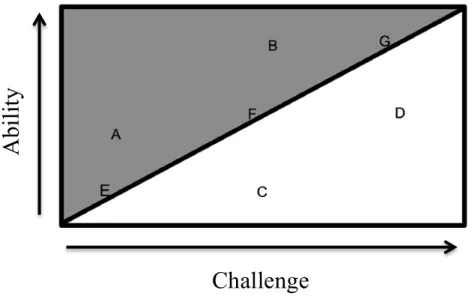
Figure 1 represents a basic representation of the intersection of challenge and ability, similar to those used by Csíkszentmihályi; positions A-G have been placed to represent situations in which a person is participating in an activity that has the potential to induce flow. In positions A and B, ability overbalances challenge, and both positions are likely to result in loss of interest. In positions C and D, challenge overbalances ability, and both positions are likely to experience frustration and/or anxiety. Positions E, F, and G represent positions in which challenge and ability are relatively well balanced. Although position E’s ability is far less developed than position G, the challenge facing E is also less difficult, allowing for the potential of flow in both positions.
13 The concept of challenge/skill balance has been suggested in other areas of study as well, notably in video
Fig. 1. Visual representation of the balance between challenge and ability necessary to facilitate flow in a given activity.
The balance between challenge and ability requires that as person performing the activity becomes more skilled, the challenge must be raised accordingly in order to allow them to continue to feel the same sense of optimal experience. Csíkszentmihályi offers that the challenge may be raised by external force, such as playing a game against a more skilled opponent, but a person engaging in a flow activity may also raise the challenge internally. A runner, for example, might try to improve a finishing time, or a golfer might try to attain a lower score. Or, as Csíkszentmihályi suggests, a worker tasked with a relatively simple and repetitive job on a factory line might raise the challenge by trying to complete more items in less time or trying to complete each item more perfectly.14
Musicians who hope to engage in a flow state must also balance challenge with skill. Musically speaking, this condition requires that the performer play in a context suitable to achieving this balance. Performance context can include a number of factors, such as
14 Mihály Csíkszentmihályi, Flow: The Psychology of Optimal Experience (New York: Harper Collins, 1990).
A
bi
li
ty
repertoire, venue, audience, and the abilities of fellow performers. For example, as far as repertoire is concerned, a musician hoping to engage in flow should select works that are reasonably suited to their skill set, both in technical demand and stylistic experience.
Contextual factors such as the pressures of public performance, venue, time of day, length of performance, and the health and well-being of the performer also have the potential to
encourage or disrupt the engagement in flow.15 In improvised music, for example, familiarity improvising over a given set of changes can drastically alter the potential for a musician to engage in flow. As I will discuss later in this chapter, familiarity and trust amongst ensemble performers also affects the flow potential of a given performance.
As a final condition implicit in Csíkszentmihályi’s theory, though not explicitly argued in his work, I suggest that intentionality is necessary to experience a flow state while participating in an activity. That is, within the scope of a rule-bound, goal-oriented activity, a person must intentionally work towards a goal in order to engage in flow. While it is not necessary that all those participating work towards the same goal, it is the process of having a goal and progressing towards it that creates the experience of success and thus satisfaction that Csíkszentmihályi equates with flow. Intentionality must be personal; in order to engage in flow an individual must choose to work towards a goal. Intentionality may be driven by any number of internal or external motivations, including such motivators as anger, fear, or stress. However, Csíkszentmihályi suggests that when achieved regularly, the pleasure of engaging in flow can itself act as a motivational force. He suggests that the positive feelings associated with optimal experience are the central force motivating individuals to participate
15 Disruption and disengagement will be discussed in greater detail with regards to Jarrett’s music in chapter
in flow activities not necessarily because they provide pleasure alone, but because they provide pleasure linked to success and self-growth, a combination that is uniquely satisfying.
This leg of flow theory can be particularly useful for the analysis of music and musical performance. Indeed, participation in music can be seen as a practice motivated by the desire to achieve optimal experience. This desire drives musicians to find ways to increase their challenge: playing harder repertoire, tackling high-pressure situations, playing more/different instrument(s) or playing their own instrument differently. Musicians might dabble in writing their own compositions, arranging, or participating in a form of musical performance in which they are decidedly less skilled.16 Creativity itself can present a challenge for musicians, when they challenge themselves to generate musical output that feels new and fresh, such as inventive, curious improvised solos or new stylistic approaches. If musicians are motivated to play in hopes of finding optimal experience, it is possible to extrapolate that many of their musical decisions center on the need to find the appropriate level of challenge for their (often considerable) skill.
It can be assumed that other motivations may also play a role in musical decision-making (such as career, monetary, and interpersonal factors), but these should not be seen as eclipsing the drive towards flow. One might consider, for example, that there are many ways to balance challenge—including, for many performers, the motivation to continue their current level of performance success. Csíkszentmihályi’s findings, however, held that people
16 Roger Blackburn, for example, played third trumpet in the Philadelphia Orchestra for nearly three decades. A
excelling in fields as far apart as chess and rugby, dance and neural surgery have credited flow as the most significant factor motivating them to continue to practice their activity.
Csíkszentmihályi is careful to point out that while his respondents point to optimal experience as the dominant motivation for participating in a flow activity, there is no sure way to guarantee that one will experience flow. Instead, he characterizes flow as a favorable outcome of a particular set of circumstances. In his words, one cannot create flow; it is a condition that can (but will not necessarily) happen to a person when the conditions are correct. Nevertheless, while it is possible that a flow experience might take a person by surprise, continued optimal experiences in the same flow activity require that the challenge of the activity shift with the rising skill of the person participating. Thus, flow could be seen as a moving target—one that, if Csíkszentmihályi is correct, hits the shooter rather than vice versa. Despite the “elusive” nature flow seems to present, Csíkszentmihályi’s conditions provide the necessary landscape in which flow can take place. In the coming sections, I hope to expand this theory beyond Csíkszentmihályi’s discussion in two important ways: the concept of flow as a continuum and the notion of collective (or multi-person) flow
experiences. These expansions will provide flow theory a more complete perspective from which to view combo jazz.
Gradations of Flow
Csíkszentmihályi’s flow theory is built firmly on the notion of flow as an exceptional state of being. Even his alternate verbal description, optimal experience, suggests an
built for the purpose of reaching the top.17 As in Csíkszentmihályi’s flow concept, a person attaining peak experience is standing at the top; proximity to the top is irrelevant. Like figure 1, above, Csíkszentmihályi’s diagrams display a clear distinction between a position in the “flow channel” (in figure 1, the diagonal black line representing balance) and those outside of it.
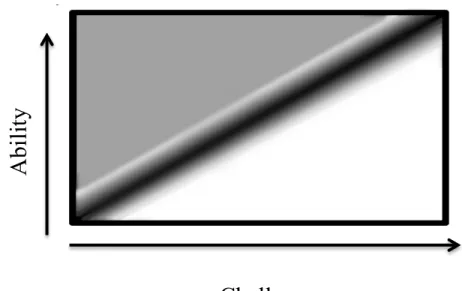
With respect to the analysis of a flow activity, however, I posit that it is necessary to expand this black-and-white assessment to include grey areas (see figure 2).
Fig. 2. Challenge/ability graph visually representing a graduated channel of flow, in which some flow experiences might categorized as peak (positioned at the center of the flow channel) while others are more peripheral (positioned with relative proximity to the center of the channel).
This shading would account for deeper and lighter flow experiences. The possibility that one might experience flow to differing degrees challenges the notion that flow is an on/off state and accounts for episodes in which a person experiences some of the markers of the flow state (but not all or not completely). For example, a person engaging in a flow activity may
17 Abraham Maslow, Religions, Values, and Peak Experiences (Columbus, OH: Ohio State University Press,
1964).
A
bi
li
ty
feel some of the signs Csíkszentmihályi identified as markers of optimal experience, such as time slippage and obliviousness to physical discomforts. These distinctions are not drawn along crisp lines, however, and one may be partially aware of time, even if its motion feels faster or slower than they would normally perceive. Similarly, one may be aware of some physical issues while others go unnoticed during the flow experience. For example, a soccer player might feel thirsty or notice that they are slowing down from exhaustion in the second half of the game but be unconcerned about a bruised muscle or unaware that they have become hot or hungry. One might be able to engage in some level of flow on a fairly regular basis while performing a flow activity, but on some occasions may note that their flow is deeper or more prolonged and perhaps more memorable as an experience.
For a musician, some gigs might provide a stronger, more palpable, more memorable flow experiences than others. In his interview with Elina Hytönen-Ng, jazz musician Gunter Kürmayr explained, “I found [it] was an unbelievable gig for us, yesterday, because we were . . . we didn’t have a gig, I think, for a week or so. And it’s always when you haven’t played for a while, and the first gig that you get everyone is on fire right away.”18 Here, Kürmayr describes the effect of distance and perhaps rest between gigs on his (and presumably his fellow musicians’) ability to engage in flow. For Kürmayr, distance increases the flow potential of a particular gig. Many other factors involving a musician’s audience, venue, gig circumstances, and fellow musicians might also affect the degree to which flow might be achieved. While flow can be achieved almost regardless of circumstances, artists themselves describe their fondest flow experience as a convergence of many factors. It is perhaps for this reason that musicians with lengthy careers will recall a few memorable performances
decades later, often (though not always) because they were deeply engaged in flow during those performances.
Hytönen-Ng’s study further confirms that while most musicians seemed to agree that they experienced flow, their opinions on the frequency of engagement varied. Some
musicians felt that they achieved flow nearly every performance, with the possible exception of when something catastrophic interrupted the possibility of engagement. Others reserved the term for their most prized experiences, describing flow as an elusive force that seized upon them only when all conditions were ideal. When Hytönen-Ng interviewed Elliot Henshaw, he explained:
I think those of us who have to work hard to get to a certain level, [flow] makes it all worthwhile when you experience it. It gives you a kind of a benchmark. It’s like, on that gig, I achieved that level of emotion, and maybe, on this gig, I didn’t get up to that, but you still . . . I think . . . You know it’s possible, and also it gives you another focus . . . 19
Meanwhile, interviewee Michael Janisch told her:
And [flow] always happens to some degree. If you love music, it will always happen . . . Every gig, with me anyway, it always happens. Erm . . . I noticed some gigs a lot of people don’t . . . If you’re working with musicians that don’t actually like what
they’re doing, I think a lot of musicians can actually play music without caring what they’re doing.”20
This second quote sheds light on two major points. First, that flow clearly means something different to Janisch than it does to Henshaw. For Henshaw, flow is a goal, a rare achievement to be savored when accomplished. For Janisch, it is nearly always the state of the activity. This brings us back to some of Csíkszentmihályi’s examples: the chess player and the factory worker. While the chess player requires increasingly more difficult matches (as their skill increases) to experience flow, the factory worker can continue to self-challenge, day in and
day out, and experience flow for longer stretches and more regularly than the chess player. Rather than simply assessing that the factory worker is better at achieving flow, or that the factory line is a better flow activity, it might be said that the factory worker is able to experience flow at one level, while for the chess player the degree of flow required to observe optimal experience might be much higher. Likewise, for Janisch, the activity of performing music draws him in to a certain degree of flow. Whereas some performances might be particularly spectacular for him, he considers nearly all performances flow
experiences. On the other hand, Henshaw reserves the term flow for particularly exceptional experiences, which he believes occur infrequently and only when all conditions are
favorable.
The second point that Janisch’s quote exemplifies is that flow need not be related, necessarily, to the quality of activity participant’s output. This too, is a point of contention among musicians, but Hytönen-Ng’s study does a thorough job of uncoupling the concept of flow to the quality of performance. Optimal experience does not necessarily mean optimal output. An eight-year-old, for example, giving a first piano recital, will likely play fairly simple music clumsily and perhaps with mistakes. Nevertheless, the child can still feel the rush of flow during the performance, even if the parents and friends in the audience do not. Similarly, a musician may feel uncomfortable throughout a performance, never achieving optimal experience, and play exceptionally high-quality music. Hytönen-Ng explained her findings:
a recording afterwards, he found nothing special. Such comments underline how flow cannot necessarily be heard on a recording, even by musicians themselves.21
Meanwhile, some of Hytönen’s respondents disagree, as in this exchange:
Respondent 1: But certain guys are in flow, and they sound like crap . . . I mean I’ve heard it, you know.
Respondent 2: But I don’t know what you’re talking about . . . I wouldn’t think of them as in flow if they sound like crap.
Respondent 1: But they think they are. I’d think, so am I. So who’s gonna say? It’s art. There’s no right, no wrong.22
The power in this discussion helps to locate flow as a highly individualized, subjective experience. While flow experiences share certain traits and are often described in similar terms, they cannot be presumed standardized from person to person. Moreover, a single person may experience differing degrees of flow at different times. While one musician might consider only the highest, most fully engaging experiences as “optimal,” another might consider any experience that allows a complete investment into the activity as flow
engagement. Because output is not a strong indicator of an individual’s engagement in flow and flow experiences are highly subjective, claiming that a performer is or is not
experiencing a flow state is dangerous—it forces questions of whose definition of flow we are to use and by what measure. It is more effective and reliable to allow for a range of flow experiences that peak at the ideal, fully-focused optimal experience.
Collective Flow
Hytönen-Ng identifies another key limitation of Csikzentmihalyi’s flow theory: it solely addresses flow as it relates to the individual. She wrote,
Collectivity is of special importance in jazz and improvisation. While playing, musicians need to be open to the other musicians as flow is not just an
individual’s experiences. For musicians, flow is pre-eminently a communal phenomenon that cannot really be achieved alone. Making music means interacting and sharing with others. Even when playing solos, musicians are reacting to all of the influences they have had. They always create flow in a context that involves other musicians and other people.23
Perhaps Hytönen-Ng overstates in suggesting that flow must occur in an environment of collectivity, stretching collectivity to include not only fellow musicians in a performance but also the entirety of a musician’s personal experience. By this definition, collectivity is atemporal and uncontained, a definition that defies its own usefulness by embracing all things as potentially part of a performance’s collective. To avoid this confusion, I will utilize
collectivity literally, to refer to the collective of musicians participating in a given
performance. In contrast, I discuss Hytönen-Ng’s broader approach to the network of music and musicians that might influence (and be influenced by) a given artist at any given time as
discourse, referencing the work of Michel Foucault and Reiner Keller.24
While Hytönen-Ng is perhaps too broad in her definition of collectivity, she is correct in assessing that it has largely been left out of literature dealing directly with flow theory and peak experience in jazz improvisation. However, the importance of collectivity has been approached through ideas such as groove in Berliner’s work, which locates the jazz soloist in the context of ensemble, and the work of Ingrid Monson, who explores the interaction
between rhythm section players as a fundamental network in combo improvisation.25 Groove
23 Ibid., 64.
24 See Michel Foucault, L'archéologie du savoir (Paris: Gallimard, 1969), Trans A. M. Sheridan Smith (New
York: Routledge, 2002); Berger, P. L. and T. Luckmann, The Social Construction of Reality: A Treatise in the Sociology of Knowledge (Garden City, NY: Anchor Books, 1966); Reiner Keller, “The Sociology of
Knowledge Approach to Discourse,” Human Studies 34 (1), 2011c, 43–65.
25 See Paul Berliner, Thinking in Jazz: The Infinite Art of Improvisation (Chicago: University of Chicago Press,
provides the musical context within which a given soloist works and, like flow, has been explored in related but discrete ways in global traditions by scholars such as Thomas Turino (2008) and Stephen Feld (1988).26 In this sense, collectivity has been and continues to be an important consideration for the study of many musical traditions, including jazz, popular music, and many global music traditions.
It is significant, then, that collectivity is not adequately addressed in
Csíkszentmihályi’s theoretical framework. To this end, I suggest that flow be considered a function of a given performer within a given musical context, drawing on fellow musicians as moving parts in the performance that may or may not create feelings of optimal
experience. Hytönen-Ng’s interviews feature many comments from her respondents regarding the importance of musical interactions during a performance. Her respondents discussed communication and trust as essential to creating an atmosphere in which flow can take place, though they characterized communication and trust in different, sometimes contradicting ways. Nevertheless, musicians unanimously concluded that their ability to achieve flow in performance is tethered to their onstage peers. Thus, it is necessary to appreciate collectivity as an important facet in the development of flow theory.
Discourse, though not a facet of collectivity in the way that I have defined it, also plays an important role in improvisation. Discourse between contemporaneous musicians and
26Groove has, as discussed widely by Barry Kernfeld, many alternative interpretations. It is commonly used by
across time (through recordings, recollections, etc.) can have a profound effect on the improvising musician in informing the musician’s creative decisions. Moreover, many musicians, Jarrett included, can attest to an awareness of their role in the evolving discourse of the genre.27 Discourse as an influence on improvisational decision-making will be
discussed more thoroughly in chapter two.
In expanding Csíkszentmihályi’s flow theory to include considerations of gradation and the effects of collective cooperation, it is possible to approach a more complete
perspective regarding jazz improvisation as a flow activity. Moreover, these factors interact in significant ways. For example, musicians in a given performance may not all experience the same degree of flow. Still, assuming none of them effectively disrupt the flow of their fellow performers, it is possible to collectively work towards flow experiences that are still highly individual. In the next chapter, I discuss Keith Jarrett’s characterizations of flow in performance, paying particular attention to the satisfying collaborations Jarrett found in his trio work.
27 Jarrett references an awareness that his prominence as an artist places him in an influential position on several
occasions, most notable in his short essay on working with Miles Davis, “On Playing Free Jazz,” found in
CHAPTER 2: DECONSTRUCTING THE IMPROVISATIONAL PROCESS
Personae and Processes
Flow-inducing activities require that a person analyze the current moment, make decisions regarding what should happen next, and then realize those decisions through embodiment. In the course of an activity, this process is a continuous cycle; as each decision is realized, the embodied reality becomes part of the past. This past, in turn, is reflected upon so that new decisions can be made. Keith Jarrett discusses this process in terms of “being” three people at once while improvising: the Improviser, the Spontaneous Composer, and the Keyboardist (the man at the keyboard).
The improviser is the easiest to explain (though no one in their right mind would try to). He sits there, confident in his ability to find some musical way from A to B (although he has no idea what B is). The spontaneous composer is harder to explain, though his position is slightly above the improviser. He “sends down” material (sorry, it’s the only way I know how to say it) at the spur of the moment whenever the
improviser calls for it. He might have to create B out of thin air. His job is harder because he has to supply substantial “content” on the spur of the moment, in case the improviser gets stuck or lost or just plain loses his connection to “the zone.” The composer eggs on the improviser (and vice versa), while the man at the keyboard— monitoring the proceedings and trying not to judge too quickly or intervene, even when he disapproves—attempts to pay attention to it all, simultaneously (all of this is simultaneous).”28
Jarrett’s acute articulation of the way in which he perceives of the improvisational process helps to clarify the depth and complexity of the rule-bound system in which he operates as a performer. Jarrett himself is performing all of the tasks he describes simultaneously, but in an attempt to explain improvisation as an activity, he breaks down the task of performing into
separate but interdependent “jobs” completed by his personae. I suggest that this insight offers a view of flow in improvisation as a balance and harmony between these tasks. Jarrett describes the perfect work of his personae as the height of improvisational experience; when each of his personae are able to work freely and in harmony with the others, Jarrett is able to engage in flow. Conversely, all three of Jarrett’s personae must be working effectively and together in order for him to engage fully. In the following chapter, I discuss each of Jarrett’s personae as well as their roles in the improvisational process, supported by Jarrett’s own descriptions as recorded in his writings and interviews.
For Jarrett, the Improviser analyzes each given moment and generates a feeling, a direction, a notion. The Improviser does not deal in notes and rhythms but in sentiments. Jarrett goes so far as to say that when he tries to use the Improviser to forward particular musical ideas, his flow crumbles under the pressure to put a particular idea to work. Instead, the Improviser must be completely free to respond to the impulses felt in any given moment in the improvisation. This response is not formulated; it is merely a sentiment, like an utterance, waiting to be interpreted into notes, rhythms, and gestures.
It is at this point that Jarrett introduces the Spontaneous Composer. He calls this part of his persona “difficult to describe,” and indeed, scholars of improvisation studies have at times used spontaneous composition interchangeably with improvisation.29 For Jarrett,
29 See Laudan Nooshin’s argument that the term improvisation is itself inappropriate, advocating for the use of
the designations performed and notated to differentiate compositions that are written spontaneously in performance versus those that are notated in advance of a performance and then learned (and noting the existence of a grey area in between). Laudan Nooshin, “Beyond the Radif: New Forms of Improvisational Practice in Iranian Music,” Music Theory Online, Vol. 19 no. 2 (June 2013,
http://www.mtosmt.org/issues/mto.13.19.2/mto.13.19.2.nooshin.html, accessed 3 July 2016). See also Merce Cunningham’s description of dance as spontaneous choreography in “The impermanent Art,” and Michael Chekhov’s characterization of improvisational composition in the stage ensemble in “Improvisation and Ensemble,” both in The Improvisation Studies Reader (New York: Routledge, 2015). See also Robert Levin’s discussion regarding composition and improvised composition in “Improvising Mozart,” in Musical
however, the Spontaneous Composer translates the artistic impulses of the Improviser into playable ideas. It is important to Jarrett that the ideas not originate with the Spontaneous Composer, but that they emerge out of the notions supplied by the Improviser. While this might seem like splitting hairs, Jarrett insists that without this process, his Improviser is unable to operate freely, and as a consequence, his ability to function as a creative artist is stifled. In an interview with Ted Rosenthal, Jarrett again referred to the process by which musical utterances are translated via composition to playable musical ideas and then performed in concert. Jarrett was asked why he hummed while playing jazz, but not while playing Mozart. Jarrett answered,
Well I think the singing comes from the fact that the subject matter is being dictated to me and I have to quickly transcribe it and then decide how to play it and in what dynamic and which finger and all that, so it's an explosive process. Whereas playing Mozart is not, in that sense, explosive.30
The third of Jarrett’s improvisational personae is the Keyboardist. Unlike the Improviser and the Spontaneous Composer, whose jobs are more internal, Jarrett’s Keyboardist physically realizes the ideas provided by the Spontaneous Composer. The Keyboardist is the most embodied of the three personae, reaching out to touch the piano and creating audible sound. The Keyboardist interacts physically with the instrument, feeling the weight of the keys, the heft of a pedal, or the spring of a plucked string. If the Spontaneous Composer is a translator for the Improviser, the Keyboardist is a translator for the
Spontaneous Composer. The Keyboardist also seems to supply the Improviser with analysis (“monitoring the proceedings”), completing the cycle in each interval.31
30 Keith Jarrett, interview with Ted Rosenthal, “Keith Jarrett: Focus and Finesse,” Piano & Keyboard (Jan/Feb
1997, 29-34).
31 “Interval” is used here in the context of performance criticism, as defined by Dylan Bolles and Peter
In interviews, Jarrett frequently discusses his relationship to a particular piano on a particular night. Characteristics such as tuning, weight, and timbre of areas on the keyboards (and sometimes individual keys) are important to him. As he plays, his process takes into account the unique characteristics of the instrument he is playing as well as the quirks of the venue in which the performance takes place. When asked about a particular recording session or live performance, Jarrett frequently turns to the physical and sonic qualities of the
instrument and space. Moreover, his lifelong distain for electronic instruments, a bias he cites as an important factor in his decision to leave the Miles Davis band, is a testament to the importance of the physicality of the acoustic instrument for him. The imperfections of an acoustic instrument are part of his process; they inspire him. Thirty years after his famed “Köln Concert” (January 24, 1975), Mike Dibbs’ documentary describes the circumstances of the concert (which was recorded live and sold a record number of albums). The piano Jarrett had ordered had not arrived and according to the documentary,
The one in the hall was substandard, sounding tinny and thin in the outer registers. Mr. Jarrett nearly refused to play, changing his mind at the last minute. Almost as an afterthought, the sound technicians decided to place the mikes and record the concert, even if only for the house archive. Later, longtime friend and record producer
Manfred Eicher said: “Probably he played it the way he did because it was not a good piano. Because he could not fall in love with it he found another way to get the most out of it.”32
The need to feel and hear the acoustic instrument and all its imperfections can be linked to the personae in Jarrett’s process. Jarrett’s Improviser takes in the entire context of the
moment for analysis, including the sonic qualities of the space and the way his fingers feel on the instrument. The Improviser utters the next idea to the Spontaneous Composer, who
coordinates. An interval is ‘between the ramparts’, an opening like a set of doorposts to let in light, or a place you can walk through, It creates space without coordinates, fissures, energy.” Dylan Bolles and Peter Lichtenfels, “Interval,” in Performance Studies: Key Words, Concepts, and Theories, ed. Bryan Reynolds (London: Palgrave, 2014), 57-64.
translates it into playable musical ideas. Whereas the Improviser must consider the musical context as it exists at a given moment, the Spontaneous Composer’s job is predictive,
requiring this persona to take into consideration what a given musical idea will sound like on this particular instrument and in this particular space. The Keyboardist, too, must be attentive to the instrument and space and adjust the realization accordingly. For example, whereas one piano’s high range might sound cool and clear, another’s might sound brassy with abundant overtones. Jarrett’s Improviser responds to these tendencies in the instrument, high
Spontaneous Composer considers them when articulating his improvisation, and his Keyboardist accounts for them in the process of realization.
All three personae must be working in tandem in order for Jarrett to reach flow, as Jarrett’s personae are yet a deconstruction of the improvisational process he himself
completes. This deconstruction is highly useful, as it provides an illustration of improvisation as a flow activity. Nevertheless, interruptions or failures at any point in the process (and by any of Jarrett’s personae) result in a loss of flow potential. In this chapter, I will discuss the processes of analysis, creativity and embodiment through the work of Jarrett’s personae. I will then turn to the act of performance as a flow activity, considering the ways in which Jarrett’s personae work together to allow him to engage in flow.
Analysis: Considerations of Context
possibility and becomes reality, a reality to be analyzed in order to create the next sound. Max Roach described this motion in an interview with Paul Berliner:
After you initiate the solo, one phrase determines what the next is going to be. From the first note that you hear, you are responding to what you’ve just played: you just said this on your instrument, and now that’s a constant. What follows from that? And then the next phrase is a constant. What follows from that? And so on and so forth.33 Here, Roach discusses the linear, moment-to-moment analysis a soloist engages in to produce each new sound against the backdrop of what came before. For Hytönen-Ng’s interviewees, however, the analysis that takes place during an improvisation is not limited to the soloist’s output.34 She argues that soloists also respond to other factors in a given performance, including other musicians, venue, and audience. Jarrett’s intimate consideration of the piano adds the physicality and response of the instrument itself to this list. In the course of an improvised solo, the soloist may consider the entire environment and every sound produced in it as context worthy of analysis to inform their improvisation. Moreover, they shape their improvisations both with respect to the analysis of the immediate musical moment and considerations for the large-scale structures of the piece and performance.
Findings published by both Hytönen-Ng and Sven Bjerstedt suggest that jazz improvisers are actively aware of the historical context of their work as well.35 Musicians consider their improvisations to be influenced by the past, and in particular by a lineage of jazz greats and personal influences. Hytönen-Ng argues that this influence is neither a
33 Paul Berliner, Thinking in Jazz: The Infinite Art of Improvisation (Chicago: University of Chicago Press,
1994), 192.
34 Elina Hytönen-Ng, Experiencing ‘Flow’ in Jazz Improvisation (Surrey, England, Burlington, VT: Ashgate,
2013).
35 Ibid. Also, Sven Bjerstedt, “The Jazz Storyteller: Improvisers’ Perspectives on Musical Narrative,” Jazz
hypothetical in which a musician cites players/performances which may have influenced their playing, nor an indirect influence related only to the development of a musician’s personal style. Instead, she finds that her musicians regularly and intentionally invoke historical influences in their playing through means as direct as quotation and motivic use or as vague as timbre and stylistic interpretation. Jazz musicians are keenly aware of the history of their genre, and they treat this history as an immediate and important part of
improvisational context. During an improvised solo, a jazz musician analyzes personal output, everything happening in the immediate performance context, as well as the history and context of the piece, style, and instrument they are playing (as far as they know it).
For Jarrett, each of these levels of analysis plays a role in his improvisational process, and each of his personae engages, to some extent, in analysis. Jarrett’s Improviser considers both the immediate past (that which has been played in the preceding moment, in the current song, and in the current performance) and the distant past (that which Jarrett has played in other performances and historical influences). This is not to say that Jarrett consciously utilizes preconceived musical notions. According to Jarrett each “nanosecond” is analyzed such that his Improviser can decide from a place of complete freedom, what to utter next.36 I will liken Jarrett’s nanosecond to the theoretical concept of the interval, as presented by Bolles and Lichtenfels.37 An interval is an undefined measure of space in which processes may occur, between the physical, real-world happenings that are the result of such processes.
36 Jarrett refers to the process of improvising by “nanosecond” in several interviews, including: Keith Jarrett,
interview with National Public Radio staff, All Things Considered, NPR, 14 November 2011; Keith Jarrett, appearance with Dr. Charles Limb, TED Radio Hour, NPR, 6 May 2015; Dan Ouellette, “Out of Thin Air,”
Downbeat (August 2005).
37 Dylan Bolles and Peter Lichtenfels, “Interval,” in Performance Studies: Key Words, Concepts, and Theories,
Jarrett’s Spontaneous Composer utilizes analysis. While the free utterance of the Improviser might be interpreted in a number of ways, the Spontaneous Composer determines the ways in which that utterance will sound when interpreted on the instrument.
Considerations such as the range, timbre, and tuning of the instrument as well as the performance space and the potential reactions of other musicians are all part of the Spontaneous Composer’s analysis. According to Jarrett, his Keyboardist utilizes analysis similarly, considering the movement involved in playing, but also observes the broader performance and the interactions between the first two personae in order to supply the Improviser with analysis.
Jarrett often describes intervals of analysis which have taken him in an unexpected direction, reacting to the immediate in ways he could not have planned. In a 2012 interview, Jon Regan prompts Jarrett to talk about surprising moments and his onstage inspiration:
Regan: . . . Rio sounds like you’re as surprised by the music as the listener is—like we’re finding the notes together. Was that intentional?
zingy sound was part of my language, and it adds to your experience of phrasing when you’re listening.38
Even sounds that have proven distracting (and potentially flow-inhibiting) to Jarrett are factored into his analysis and, ultimately, his performance. Interviewer Dan Ouellette discussed the matter of coughing sounds heard on another studio-mastered live recording,
Radiance, released in 200639:
Initially ECM chief Manfred Eicher requested the coughs be excised; upon hearing the mix, Jarrett disagreed. “I’m the one who demanded the coughs back, he says with a laugh, as if to say, can you believe it? “To get his mix Manfred had to close down some of the mikes in the house. I listened to what he did and it didn’t sound right. During those shows the coughs had been cues to what I did next. For example, there’s one cough that determined where the end of a piece should be. I was playing very softly and I could have gone on, but that cough told me it’s about ready to resolve. So, it was like getting messages from the audience.40
The coughs might be considered disruptive, and indeed Jarrett has been known to pause mid-concert to quell distractions. Nevertheless, they become part of Jarrett’s analysis and vitally informative to his improvisation—so crucial, in fact, that he cannot fathom releasing the album featuring these live recordings without the necessary coughs.
Analysis plays an important role in any flow activity. It is analysis that provides the mental organization needed for a person to participate in a rule-bound, goal-oriented activity. Csíkszentmihályi argues that the natural state of the human mind is chaotic and that it seeks organization through structured thought. Without analysis, the mind would be unable to contextualize and process participation in an activity as progressive and, in turn, to sense
38 Jon Regen, “Keith Jarrett: The Power of Being in the Moment” Keyboard, 38 (2012), 13-16, 18. The
recording referred to is Rio, Jarrett’s two-disc release of his live show performed at Teatro Municipal, Rio de Janeiro on April 9, 2011, mastered under Jarrett’s direction and released by ECM later that year.
39Radiance is a combination of two live performances, recorded in Osaka, Japan on October 27, 2002 and
Tokyo, Japan on October 30, 2002, and released in 2006 by ECM records.
accomplishment.41 Jarrett is emphatic about the need for complete freedom in order to experience flow, but this freedom does not preclude organization. Even if he keeps his mind open to an infinite world of possibilities, Jarrett does not play anything at any time. Rather, according to his own description of his process, he analyzes everything around him including extremely subtle influences, such as the feel of a given key on the keyboard or the ring of the bass in the performance space. He then uses this information to choose what to play next. Chaotic freedom would mean selecting things to play at random; through analysis, Jarrett’s ideas are all connected to each other and to the rest of the performance. The following section explores the process of choice and the role of flow within it.
Flow and Decision-Making: The Creative Process
Csíkszentmihályi argues that a person is at their most creative when engaged in optimal experience. This notion is supported by Jarrett’s description of the process of improvisation, in which he uses analysis to help him choose what to play next from an infinite number of possible gestures in any given moment. I suggest that creativity is the process by which he makes this choice; in other words, creativity is the bridge connecting input to output through decision-making. A deeper explanation, however, regarding the process of creativity requires nuance depending on the persona/job being discussed.
While creativity can be difficult to quantify or evaluate, relative creativity can be observed. As a seasoned musician, for example, Jarrett can imagine many more possibilities at any given moment than an average amateur player who, in turn, can call on more
possibilities than a beginner. Furthermore, Jarrett’s creativity is celebrated precisely because of the choices he makes, many of which are pleasing, surprising, or deliberately agitating. His creativity allows him to play a given tune in radically different ways from one
performance to the next, as his live recordings attest. He contends that the freedom to improvise without even traditional restrictions is so important to him that he often surprises himself in the process of playing:
I often think I’m literally asking myself, “Okay, what comes next?” The audience quiets down, and then I throw them an arpeggiated A minor. And right away, the room’s different. Everything’s different around me, and I’m the one in charge, so I have to know, “Okay why did I play that?” And then, “How far away from that chord do I want to go?” And those are things I’m certainly not thinking in words. It’s way, way faster than that.42
Although Jarrett’s process of analysis and decision-making happens too fast to verbalize even in his own head, it is nevertheless a process he recognizes taking place in every
“nanosecond” of his improvisation.
Each of Jarrett’s three improvisational personae could be said to utilize creativity. Jarrett’s Improviser chooses, from a seemingly endless well of possibilities, what to utter in any given musical moment. Jarrett consistently describes the process driving these utterances in intangible ways, using words like feeling, sense, and instinct. It is clear that at least to Jarrett, the process of analysis and subsequent decision-making is not scientific; he does not evaluate each musical situation and then select the best option, regardless of what criteria might be included in the definition of best. If this were the case, his improvisations on performances of the same song would bear more resemblance to each other (even taking into account differences of audience, venue, and instrument which Jarrett consider critical), and he would likely describe his process with more emphasis on intelligent musicianship than sentiment. Instead, Jarrett plays what he feels belongs next, and both feeling and belonging
are ambiguous and subjective enough to warrant different choices in every performance. The
Improviser’s creativity lies in the ability to reinterpret feeling and belonging to reach new outcomes in every performance.
Jarrett’s Spontaneous Composer also bears creative burdens. In interpreting the Improviser’s utterances, the Spontaneous Composer must make countless decisions that shape the improvisation, such as pitch, rhythm, range, volume, articulation, texture, and direction. Whereas an utterance is inherently a limit, narrowing down limitless possibilities to a family of similar possibilities, the utterance still necessitates that the Spontaneous
Composer make many concrete decisions. These decisions, though often technical, take Jarrett’s free utterances and translate them into ideas that can be played on the piano. The Keyboardist, in turn, realizes these ideas. Jarrett’s Keyboardist is left with the creative decisions revolving around the embodiment of the performance. Whereas the Spontaneous Composer’s ideas are more concrete than the utterances of the improviser, they are still just hypothetical ideas until realized. Furthermore, as will be discussed in the next chapter, embodiment itself is a cycle of choices and executions that may or may not always succeed as planned.
Before Jarrett’s improvisational personae are put to work, however, a rather conscious creative choice must be made: repertoire. Throughout his career, Jarrett has insisted that repertoire is not selected prior to a performance; rather he allows himself to choose the next piece after each piece concludes, depending on factors such as venue,