AUTHORING AMERICAN: AN EXPLORATION AND INTERPRETATION OF IDENTITY PRACTICES IN AN ELEMENTARY CLASSROOM
Matthew M. Green
A dissertation submitted to the faculty of the University of North Carolina at Chapel Hill in partial fulfillment of the requirements for the degree of Doctor of Philosophy in the School of
Education (Culture, Curriculum and Change).
Chapel Hill 2015
Approved by: Lynda Stone George Noblit Xue Rong
iii ABSTRACT
Matthew M. Green: Authoring American: An Exploration and Interpretation of Identity Practices in an Elementary Classroom
(Under the direction of Lynda Stone)
iv
v
ACKNOWLEDGMENTS
It’s not very often that you get a chance to sit down and actually write out your
appreciation for others. I feel like I never really say thank you enough, or tell people how much I appreciate them, or tell them how much my life is better because they are a part of it. For me at least, it always seem that the words, feeling, thoughts and sentiments are there, but not always said.
Thank you to my committee of five intelligent, wise and caring individuals. Lynda Stone, George Noblit, Xue Rong, Sherick Hughes and Karla Martin. Lynda, you have been with me for 7 years through my Masters and PhD. Thank you for you continuous support and efforts to push me to be a more thoughtful scholar and academic. George, I will honestly and truly miss our office next-door conversations. They were always thought provoking, insightful and most of all enjoyable. Xue, thank you for pushing me academically and providing me opportunities to expand my research horizons. Sherick, I am so glad that I met you oh so many years ago and you could share this dissertation process with me. You are both a colleague and a friend. Karla, thank you for all of your support, willful listening to me complain and spew ideas about my data in the early stages.
vi
Thank you ‘Ms. Washington’, while anonymous in this dissertation, you are a friend and welcomed me into your classroom and the lives of your students this year. I loved every second of it.
Jodi, Laurie, Caroline, Kara, Mike – Thank you for making Student Affairs a warm and welcoming place, for allowing me to use the fridge, the coffee maker, the cakes and candies, thank you for the conversations and the smiles. It always felt good knowing where my first stop was every time I walked into Peabody. Thank you Martinette, I always looked forward to greasy lunches and the conversations that accompanied them. I don’t know if I will ever be able to replace the greasy lunch crew and I will always remember the hypotenuse. Thank you to Deb Eaker-Rich for tirelessly supporting students and working with me anytime a problem was in need of a solution.
Thank you to the Bryan family. Jamie, Catherine, Carolyn, Alison, Jackie, Bucket and Jim. You welcomed me into your home figuratively and literally. I have enjoyed getting to know all of you, especially Tuesday dinners with Momo and singing the 12 Day of Christmas. Through tragedy and triumph your support has been steadfast and instrumental in my success and how much I have love Chapel Hill.
vii
Alison, Summer and Tim, thank you for the conversations and comradery in the C.R.E.D. this year. You all have made sure I wasn’t sighing before sighing time, didn’t drink too much coffee, interacted with other human and promoted positivity. Thank you Dani for all the laughs, hugs and being in this struggle with me, thank you Esme never ceasing to push me to be better and for your humor, thank you to my cohort for making this journey more enjoyable, thank you to all the teachers, former students and colleagues for being an integral part of my Chapel Hill and School of Ed. experience.
Thank you to Matt Miller. I‘ve enjoyed the ride no matter how tough. Sitting at the desk next to you this year helped me laugh and stay sane. And above all else thank you for always reminding me that in all of this madness – “Hegel is arguing that the reality is merely an a priori adjunct of non-naturalistic ethics, Kant via the categorical imperative is holding that
ontologically it exists only in the imagination, and Marx claims it was offside.”
Thank you Mandy Bean. I honestly would not have made it through this year without you. You got to see it all and thank you for always being a friend when I needed it most. Thank you for the Saturday coffee and work sessions, for being the other half of the GreenBean, for your sense of humor, for happy hours and especially for all the hugs. Thanks for not being a sparrow.
viii
encouragement, for pushing me, for inspiring me with your passion and for your support. Thank you for allowing me to be part of your journey. Thank you for all shared laughs and smiles and memories. Most of all, thank you for always allowing me to be me. Thank you for everything. As much as I could try and want to express my appreciation and gratitude here - words are never enough.
Anne Bryan - Sometimes thank you isn’t enough. It isn’t enough to capture the
appreciation. It isn’t enough to convey thoughts and feelings. It isn’t enough to tell someone how much they have truly made a difference. That is certainly the case here. I have leaned on your more than anybody else through everything. Thank you for the lunches, for the daily calendars, for convincing me to go to the gym and listening to me grumble about it the whole way. Thank you for the open door to your office, for the trips to YoPo, picking me up when I was down, for being my cheerleader, and continuously giving. Thank you seems insignificant when I look at the ways in which you have impacted my life. You are truly a trusted confidant and friend. You cannot be replaced and I hope that I never have to try. I will always be there to eat sandwiches if you need me to.
ix
the bad and the ugly in all of this. You will never be able to read this, but I hope that I can be as good to you as you have been to me.
x
Table of Contents
List of Tables ... xiv
List of Figures ... xv
I: Introduction and Rationale ... 1
Context of Schooling ... 5
Children's Views on Identity, Race and Ethnicity ... 7
Boundaries of Identity ... 9
II: Theoretical Considerations ... 15
Identity-in-Practice Framework ... 16
Figured World... 17
Positionality ... 19
Self-Authoring ... 21
Making Worlds ... 23
Identity-in-Practice Research ... 25
III: Research Methods and Design ... 31
The Plan ... 31
xi
The Collection ... 35
The Participants, The Classroom, The School ... 37
Paralleling Grounded Theory ... 41
The Man, The Reflection, The Positionality ... 53
IV: ‘American’ Identity-In-Practice ... 63
Figured Worlds ... 63
Defining Cultural Symbols ... 64
Defining Cultural Artifacts ... 76
Defining Cultural Tools ... 79
Subject Position ... 81
Authoring Identity ... 87
Use of Cultural Tools ... 88
Enacting Cultural Symbols ... 92
Cultural Legacies ... 95
Barriers to Authoring ... 98
Making-Worlds ... 101
Limitations of Identity in Practice ... 102
V: Redes, Space and Identity ... 105
Physical Space, Similarity and Difference ... 106
xii
Groupings ... 108
Outside of School. ... 111
Physical Space and American Identity ... 112
National Identity and Country ... 113
National Identity as School and Home ... 116
Social Space, Similarity and Difference ... 118
Friends ... 119
Familiarity ... 120
Social Space and American Identity ... 122
Family ... 122
Peers... 125
Symbolic Space, Similarity and Difference ... 127
Interests/Personalities ... 127
Curriculum ... 129
Symbolic Space and American Identity ... 131
Cultural Traditions ... 132
Language and Skin Color ... 134
Curriculum. ... 141
Changes in Space/Identity. ... 147
xiii
Summary of Results ... 155
Implications for Practice ... 159
Implications for Research... 161
Conclusion ... 162
Appendix A ... 166
Appendix B ... 169
Appendix C ... 170
Appendix D ... 171
Appendix E ... 172
Appendix F ... 174
xiv List of Tables
xv List of Figures
1
I: Introduction and Rationale
This dissertation is a study of how 5th grade students come to experience, construct, and understand ‘American’ identity, sameness and difference, both related to and separate from ‘American’ in the context of one rural North Carolina school. As North Carolina experiences new and changing diversities, so to do North Carolina schools. The ways in which students across this spectrum of diversity experience, construct and understand ‘American’ identity, their sameness and difference in school significantly influences how students orient their identities in relation to others and institutions. The ways in which students experience peers, classrooms and schools in North Carolina greatly affects the formation of identities for all students.
For immigrant children – or children of immigrants – or students who are merely seen as immigrants – understanding of ‘American’ identity and the reification of ‘American’ identity may be especially salient (Baptista, 1983; Graham, 2005; Olsen, 1996; Orozco & Suárez-Orozco, 1995; Suárez-Suárez-Orozco, 2000; Valenzuela, 1999). Identity significantly influences how people come to understand themselves and others and their places in the world. Much research has identified the role of schools in identity formations, in students’ worldviews, outlooks on life and education, peer and teacher relationships, and academic orientations (Green, 2010; Montes, 2007; Perreira, Fuligni & Potochnick, 2010; Rubin, 2007; Urrieta, 2007; Wortham, 2006).
This dissertation seeks to answer three questions:
2
(2) In what ways do 5th grade students identify sameness and difference with regard to who they and others are?
(3) Overall, what is ‘American’ identity and their relationship to it?
To answer these questions I build on literature by using two interpretive frames for analysis. This dissertation is an exercise in both inductive and deductive analysis. Firstly, by using identity-in-practice (Holland, Lachicotte, Skinner & Cain, 1998) as an analytic framework, this study explains how students construct identity in relation to ‘American’ identity, how this identity is authored and how the navigation of identity affects their experiences with peers and in classrooms. Secondly, through a grounded theory approach, this study also examines the themes that emerged through observation and interviews with students, both in describing similarity and difference in peers and their multiple relationships that student have to ‘American’ identity.
3
It is also important to note that much of the research on immigrant identity focuses on adolescent immigrant student experiences, not elementary age students. Much of the existing literature identifies race and ethnicity as key factors in the schooling experiences of immigrant students. Thus, I provide a brief background on research into children’s views about race and ethnicity, differentiating them from older students. Lastly, I problematize the literature to place this study within the context of previous, emerging and future research on the intersection of identity in general, national identity and student experiences in schools.
In the second chapter, I examine the theoretical considerations of an identity-in-practice framework and how this identity framework has been used in education literature. I provide some of the theoretical background on how Holland et al. (1998) bridge and ‘suture’ culturalist and constructivist theory to create the identity-in-practice framework. This chapter also works to explain it four categorizations – figured worlds, positionality, self-authoring and making worlds. After explicating the theoretical underpinnings of identity-in-practice theory I examine how researchers have approached identity through this framework and discuss how the framework has been used and applied in education research.
4
to construct my framework. Lastly, I present the ways in which my own subject position, action and interaction in the classroom and with students intersected with the research.
In the fourth chapter I present findings utilizing the identity-in-practice theoretical framework. Within this chapter I first set out the four components of identity-in-practice - figured worlds, positionality, self-authoring and making worlds. Within construction of the
figured world(s) of ‘American’ identity I offer data on how students construct and define cultural symbols, artifacts and tools. These elements were used specifically because they were what emerged from the observational, interview, focus group and artifact data. Secondly I examine how students experience and construct subject positions in relation to peers and the socio-historic context. In the shift to thinking about subject position and authoring, student change their
thinking about ‘American’ identity and the elements presented here are from the ways in which students described cultural tools, symbols and legacies. I further describe the barriers students experience in authoring identity. Lastly I discuss the student’s ability, or lack of ability, in constructing new figured worlds of identity.
5
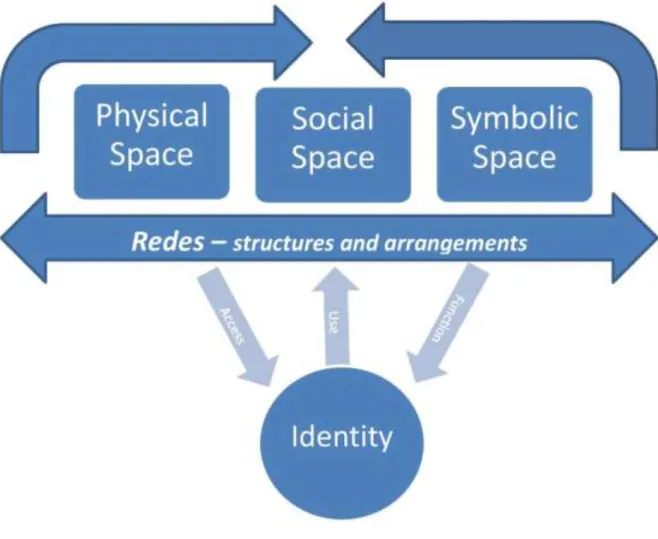
which students’ identities of similarity, difference and ‘American’ identity change when the arrangement and structure of space changes.
In the final chapter, I present a summary of the data from chapters Four and Five as they relate to the research questions. I then provide a discussion of the data in relation to the
theoretical frameworks presented and prior research. I conclude with the limitations of this study and the ways in which this study relates to other and future research.
Context of Schooling
North Carolina’s population has significantly changed over the past twenty years, leading the state to be labeled an “Emerging Gateway State” for immigrant populations (Singer, 2004; Anrig & Wang, 2006). The term “Emerging Gateway State” stems from the identification of previous immigrant hot spots, including Florida, Texas, California and New York, as doorways into the United States where immigrant populations eventually settled. The foreign-born population in North Carolina grew 67%, from 2000 to 2010, with the foreign-born population representing 7.5% of the North Carolina population with Asian and Hispanic people representing the largest foreign-born groups (Migration Policy Institute, 2012). This influx of new residents to the state is also reflected in the student population in North Carolina schools. In North Carolina children residing with at least one immigrant parent at home accounted for 16.9% of children under the age of 18 in 2010 (Migration Policy Institute, 2012).
6
North Carolina schools is an essential element to how they come to form identities in relation to each other. Understanding the new diversities of populations, communities and students that have been established in North Carolina schools is significant for researchers and educators.
The positive and negative ways in which identity interacts with the schooling process has been studied. In general, schools are sites that allow for interaction between private and public social spaces. Positively, students bring their personal contexts, including life histories and experiences, to school. The negative impact of schooling exponentially affects the identities of native-born minorities as well as immigrants and children of immigrants. For some, students’ lives fit school and for others they do not. Here research has shown that America’s schools historically have been designed to strip immigrant students of their heritage identity in favor of an ‘American’ identity (Baptista, 1983; Graham, 2005; Olsen, 1996; Tyack, 2003). One result of this process has been differential allocation of educational resources among students (El Haj, 2007). How immigrant students experience schooling affects how they come to position
themselves in American society, as well as the ways in which they are able to access educational, cultural, and life resources.
7
The coupling of American citizenship and American identity does not necessarily exist as it once did. Focusing on the historical and still contemporary push to ‘Americanize’ the young, one body of literature makes the case that what has come to be known as ‘subtractive schooling,’ that is, the ‘white-washing’ of heritage identity (Olsen, 1996; Orozco, C. & Suárez-Orozco, M.M., 1995; Suárez-Suárez-Orozco, 2000; Valenzuela, 1999). This results is a divestment of social, cultural, and academic capital for these students and in turn marginalizes them at school (Valenzuela, 1999). As indicated above, within issues of national identity, race and ethnicity continue to be key factors (Devos, Gavin & Quintana, 2010; El Haj, 2007; Green, 2010; Rong & Brown, 2002; Urrieta, 2009; Valenzuela, 1999; Waters, 1994).
Children's Views on Identity, Race and Ethnicity
The perspectives of young children are an aspect of immigrant identity literature that has not received much attention in previous research. In particular, what is lacking is how
elementary students experience, construct and understand identity in relation to their peers and in relation to categorical labels and classifications such as “American.” Some prior literature does describes the beginning formation of children's political attitudes in their elementary years, with schools playing the largest role in developing attitudes, beliefs and conceptions of national allegiances (Hess & Turney-Purta, 1967).
In the late eighties, Aboud (1988) explained how children see peers: “the child's awareness of ethnic groupings also takes the form of perceiving certain similarities between members of the same group and perceiving certain differences between members of different groups” (p. 47). For young children, similarities and differences are used to organize and categorize themselves and peers into groups based mostly on perceptual and physical
8
understanding of ethnic and racial differences in appearance, specifically between Whites and Blacks. By the age of nine or ten, children are aware of myriad ethnic groups and are able to identify differences beyond a Black/White dichotomy (Aboud, 1988). Further, young children use different metrics when categorizing peers as similar or different. Specifically, skin color is often used as a measure of dissimilarity more than a measure of similarity, whereas culture and common history is seen as important when classifying peers as similar (Aboud, 1988; Lambert & Klineberg, 1967). In young children, beliefs about race develop into a body of knowledge from which inferences are made about category members, far beyond the range of interpersonal experiences (Hirschfeld, 1996). Interestingly, these beliefs often lead children to build stereotypes based on their limited understanding of category groups, and these stereotyped understandings of peers and groups are more rigidly believed by children than adults (Ambady, Shih, Kim & Pittinsky, 2001). The rigidity of stereotypes which students construct on limited understanding of peers, difference and self can lead them to implicitly activate sociocultural stereotypes in their own behaviors, which then can have an impact on students’ social and academic experiences in school (Ambady et al., 2001).
This study focuses on how students, especially elementary students, experience, construct and understand these categorizations and labels for each other. Children's views of their own identity constancy (the maintenance of identity over time despite change in outward appearance) is not as fixed as in adults; moreover children believe that they can be different people when they grow up, as opposed to always being who they presently are (Hirschfeld, 1996). Identity
9 Boundaries of Identity
As introduced above, research on the identity formations and schooling experiences of students has often been approached through the ‘immigrant’/’American’ dialogism and by examining how groups and individuals with assumed collective identities assimilate or acculturate into American society. Assimilation has been defined as the process in which
individuals give up multiple social, political, ethnic and racial characteristics or beliefs and come to adopt those of a new group or society (Gordon, 1964; Phinney, 1989, 1990; Quintana, Herrera & Nelson, 2010). Critiques of the assimilation model point out that immigrant adaptation is non-linear and much more of a complex process than perhaps initially conceived in the literature (Rumbaut, 1997).
Another iteration of the assimilation model is the “additive” model of acculturation in which individuals acquire new cultural capital while maintaining some degree of heritage capital (Gibson, 1995). Acculturation in this sense has been defined as the process of cultural exchange between different groups as they come into contact with one another over a period of time and how cultural characteristics of individuals change as a part of this process (Banks, 1999, Fuligni, 1998). Acculturation approaches identity as fluid because change and adaptation occur through cultural exchange between people as opposed to unidirectional flow of culture and identity. In sum, problems for understanding identity exist when it is understood that the notion of an
‘American’ national identity has evolved over time in relation to the concept of the United States being a culturally pluralistic society.
10
predominately been examined through the lens of the theories just identified. The examination of identity, in this respect, has always centered on the individual, group and collective identities, and on social inclusion/exclusion rather than how boundaries are created and group memberships are maintained.
The examination of identity in regards to immigrant students has recently moved away from static models of cultural characteristics to the examination of how the dynamic role social (re)production and (re)creation of imagined communities (Anderson, 2006; El Haj, 2007) plays into how national identity is defined and distinguished. Imagined communities are collectively held communities of social membership that exist despite the presence or lack thereof of social interaction among its members. The nation-state is an example of a modern imagined
community, in that not all of its members interact socially with every other member. Within their
imagination, they do believe that the community, nation-state, exists outside of themselves as a collective. Anderson (2006) argues that imagined communities represent the idea that national identity is held within socially imposed and reified constructs and only changes as needed for political advantages by the dominant group.
The privileging and positioning of certain imagined identities exemplify power that exist within identity by providing access to the valued cultural resources to members and not ‘others’. Cultural resources here are the habitually used cultural tools, artifacts and cultural means by which people enact particular identities of a world (Holland et al., 1998). The creation of
subjectivities and assigning of collective identities to these subjects, along with the use of subject position for accessing or limiting cultural resources, creates the boundaries of an imagined community. Wortham (2006) puts forth the argument that social identification depends on
11
indexed in actual events of identification. Holland et al. (1998) explain that this positioning of figured and positional identities is dependent on the mass circulation of cultural resources of the imagined community. The imagined community of ‘American’ national identity provides access
through activities, performances, discourses and artifacts. To this end, the construction of national identity is very important to the understanding of the construction of boundaries of inclusion, exclusion, the construction of the ‘other’, or non-member, and how students experience these boundaries in and through schools.
Alba (2005) observed that the schooling environment of immigrant students often has a distinct effect by sometimes creating “blurred” or “bright” boundaries. Blurred boundaries create fewer distinctions between immigrants and native students, whereas “bright” boundaries make cultural traits and identity differences explicit, thereby elevating the possibility for social segregation between immigrants and native students. The creation of these boundaries is directly related to how students view and construct their own identities and those of their peers. The construction of these boundaries, bright or blurred, the ways in which students experience these boundaries, and how they affects their schooling experiences are the subjects of this study.
12
The concept of identity, especially with immigrants, is often seen as a single “ethnic identity,” when it is actually a multitude of “selves” being acted on by competing outside forces (Quintana et al., 2010). Current literature on immigrant identity in education suggests that identity be understood as produced much more actively and dynamically, situating it as a cultural product that is created by people through interactions. What is significant in an
identity-in-practice framework (Holland et al, 1998) is that the creation of a world that has become ‘figured’ through cultural production, as well as how individuals enact identity within this ‘figured world’. This means that people are able to enact identity and possibly enact classifications, rather than simply being a classification. However, the reified notion of ‘American’ as an imagined community allows an identity-in-practice framework to elucidate some of the complexities that
students experience with identity, peers and school. This isn’t to deny that classifications exist; rather the goal is to provide context for this study within the literature.
Immigrant students do experience the subject position of their identity different from those native born. Some are positioned and positively labeled “model minority” or “smart” (Lee, 1996; Urrieta, 2009), while others are racialized into lower status groups (El Haj, 2007; Rong & Brown, 2002; Urrieta, 2009; Valenzuela, 1999; Waters, 1994). Latin@s living in the United States are consistently seen as less American than their Caucasian American counterparts because of perceived differences, thereby highlighting the boundaries and dissociations between ethnic and national identities (Devos et al., 2010; Green, 2010).
13
is a political phenomenon. Schools often become sites for the political classification and identification of ‘American’ and ‘non-American’ to play out. Further problematizing the entrenchment of this categorization is the critiques of the label “immigrant” as many diaspora populations reject the notion of “not belonging,” which is often forced upon them in the “host” versus “newcomer” relationship (Villenas, 2007).
The shift away from examining identity as a study of individuals or collectively held identities, towards understanding how identity is created and defined, plays an important role in understanding the boundaries that create difference. The complexity and intersection of
experience, identity, movements of people and movements of borders/boundaries is a common phenomenon historically and currently within schools. Abu El-Haj (2007) has explained the significance that schools play in this intersection:
Schools play important roles in the construction of the symbolic boundaries of the nation – in constructing who is and is not a member of the nation – and in the provision of resources with which immigrant youth learn to belong to and navigate their new society. (p. 288)
The creation of boundaries is the first step in the production of barriers for immigrant youth in schools. Ong (1996) described this phenomenon of national identity membership as cultural citizenship, “a dual process of self-making and being-made within webs of power linked
to the nation-state and civil society” (p. 738). The navigation of boundaries and resulting
14
15
II: Theoretical Considerations
To frame this study and my approach to identity research, I rely heavily on the ‘identity-in-practice’ framework. Holland, Lachicotte, Skinner and Cain (1998) constructed this
framework through a combination of the fields of cultural anthropology and psychology creating a sociohistorical, “cultural studies of the person” (p.6) lens for examining identity. The frame utilized by them builds upon, and moves beyond, the culturalist approach of Bakhtin and the constructivist approach of Vygotsky. Combining the culturalist and constructivists approaches provides a framework that moves away from cultural determinism and allows for agency. Holland et al. write of this shift,
Our plan is to follow a different possibility for understanding the “suturing” of persons to position. From Bakhtinian-sociohistoric perspective, persons develop through and around the cultural forms by which they are identified, and identify themselves, in the context of their affiliation or disaffiliation with those associated with those forms and practices. A better metaphor for us is...codevelopment – the linked development of people, cultural forms, and the social positions in particular historical worlds. (p.33)
Holland et al. (1998) explain that the purpose for bridging and ‘suturing’ these two traditions together is an effort to move identity theory forward toward a more nuanced hybrid
understanding that involves both structure and agency. They continue,
16
Bridging Bahktin and Vygotsky allows for a new framework for understanding identity in that a person is not entirely driven either by internal logic or by social situations.
Holland et al. also borrow from the activity theory of Leontiev in which individuals are always in a state of active engagement with the environment in a historical, collectively defined, and socially constructed way. Activity theory views the individual’s interaction with a culturally constructed environment as a fluid interaction that could change daily, rather than a constant encounter/reactive dichotomy. Activity theory shares the understanding of how individuals are constantly engaged with their environment according to Bourdieu's (1977) practice theory and through the action of improvisations. Holland et al. make a clear distinction between their theory and that of Bourdieu in that Bourdieu's view of improvisation made an impact on the next
generation, whereas they see improvisation of action as making a difference in the next interaction or moment of cultural production.
Holland et al. explain the suturing of these theories as a process of heuristic development, where a behavior is described as a person-in-practice, with activity/practice/behavior becoming symbols and icons which can be used in mediation of future behavior (p.40). The concept of heuristic development with regard to identity is beneficial because it moves away from extremes
of cultural determinism and situational totalitarianism and focuses on a dual process of the creation of products that meet persons in practice, and appropriation of these products for use in the next moment of activity (Holland et al., 1998, p.40).
Identity-in-Practice Framework
17
identifies the theoretical foundations of the identity-in-practice framework, as well as explores the ways in which this framework has been used in past education research. Holland et al. (1998) define identity as “a concept that figuratively combines the intimate or personal world with the collective space of cultural forms and social relations” (p. 5). This understanding of identity relies on the premise that identity is lived in and through activity and social practices. Identities in this sense “trace our participation, especially agency, in socially produced, culturally
constructed activities” (p. 41).
Figured World
The figured world plays a particularly central role in identity construction and practice for Holland et al. (1998). They define a figured world as “a socially and culturally constructed realm of interpretation in which particular characters and actors are recognized, significance is assigned to certain acts, and particular outcomes are valued over others” (p. 52). Holland et al. (1998) also note that “a figured world is formed and re-formed in relation to everyday activities and the events that ordain happenings within it” (p. 53). Using a figured world’s framework to understand identity allows for examination of the dual cultural process of both making and being made. In his research Urrieta (2007) further elaborates on the meaning of figured worlds:
Figured worlds are thus formed through social interaction, and in them people “figure” out who they are in relation to those around them. Through participation in figured worlds people can re-conceptualize who they are, or shift who they understand themselves to be, as individuals or members of collectives. Through this figuring, individuals also come to understand their ability to craft their future participation, agency, in and across figured worlds. (p. 120)
18
First, they are historical phenomena to which people either choose to enter or are recruited to, and they develop through the work of participants. Second, figured worlds are social encounters in which participants' subject positions matter. Third, figured worlds are socially organized and reproduced through participant interaction. Fourth, figured worlds distribute people through landscapes of action.
Furthermore the figured world rests upon people’s ability to form and reform in “as-if” communities. People's identity and agency are tied to the dialectical and dialogical nature of figured worlds as imaginative “as-if” realms. The (re)production of figured worlds through people works to carry out the co-production of activities, discourses, performances and artifacts. A dialogism is an open-ended coproduction of the social and cultural world in which cultural products are placed in socio-historic dialogue, both constructing meaning and being constructed. Holland et al. (1998) explain that objects are made into cultural tools collectively through the attribution of meaning and through constant use and interaction between people; these tools become resources for people to use through enaction. Figured worlds do not only exist in the imaginative “as-if” realm but as happenings in historical time. Embedded are issues of power and privilege associated within figured worlds.
19
In constructing and deploying signs and symbols into the world, individuals collectively act to create meaning and shape a figured world. This figured world is populated not only by signs, symbols and artifacts, but also by people who practice and embody them. Within this figured world which acts to provide meaning and construction to identity, individuals are both positioned and position themselves. This process is the second element of the
identity-in-practice framework; positionality, which specifically examines the role of the subject position in identity construction and practice.
Positionality
Positionality is where persons are positioned socially, within the figured world, and within the power and privilege associated with the positions within it. These positional identities are important for the identity-in-practice framework because, they place people relationally within a dialogism of self and other; and this relational positioning becomes internalized and embodied over time. The dialogism of self and other in this sense, is an intersection with many borderlands of meaning which come to conceptualize the subject. Holland et al. (1998) make the distinction theoretically between relational, positional and figurative identities, for them,
relational identities have to do with behavior as indexical of claims to social relationship with others. They have to do with how one identifies one’s position relative to others, mediated through the ways one feels comfortable or
constrained. (p.127)
20
Positional identities have to do with the day-to-day and on-the-ground relations of power….with the social-interactional, social-relational structures of the lived world. Narrativized or figured identities, in contrast have to do with stories, acts, and characters that make the world a cultural world. (p. 127)
Perhaps put too simply, figurative identities are about signs that evoke storylines or plots among generic characters; positional identities are about acts that
constitute relations of hierarchy, distance or perhaps affiliation. (p. 128)
The distinction that Holland et al. draw is that nuance between immediate interaction among two individuals characterized by difference and how this characterized meaning is created through assigning of meaning to the signs, symbols and characteristics of individuals within socio-historical context. This dichotomy for Holland et al. is again a distinction between the culturalist and constructivist positions and why there is a need to adopt ideas and theories from both fields.
For Holland et al., social positions develop heuristically over time and become
dispositions through participation in and identification with positional identities which inhabit Bourdieu’s habitus. Social positions also work to become “fossilized,” internalized and
embodied aspects of identity through “mundane activities” which become habit. Holland et al. explain for an individual,
21
a form of self-management, becomes what Vygotsky and Bakhtin called inner speech. (p. 142)
Along with the theoretical distinctions made in understanding and positioning of subjects as populated in figured worlds, Holland et al. also recognize controversy with regards to subject position and issues of enduring social categories that cut across many figured worlds and position individuals in concrete ways – most specifically the issue of race. While they do not reconcile the issue and impact of major socio-historic categorizations with their identity-in-practice framework, they accept and recognize the impact that these enduring identities have on construction of figured worlds and the practice of identity. Further, these enduring identities are so intertwined in social, physical and symbolic worlds that they are not cleanly separated from each other.
Positional identities, however, are not without disruption. Individuals have agency through the use of symbols, artifacts and tools. They continue,
The same semiotic mediators, adopted by people to guide their behavior…may serve to reproduce structures of privilege and identities, dominant and
subordinate, defined within them, may also work as potential for liberation from social environment. (Holland et al, 1998, p. 143)
The third element of the identity-in-practice framework is space of authoring. Authoring provides actors within the figured world agency and capacity to put identities into practice.
Self-Authoring
22
Holland et al. (1998) point out the substantive reasoning behind it. In constructing the identity-in-practice framework it was necessary to articulate valuable aspects of inner and social speech. Bahktin emphasizes the inner speech, dialogic view, power, status, stratification and ownership that is missed in Vygotsky. As Holland et al. (1998) describe, Vygotsky provided a
semantic, representational potential of mature linguistic practice and its potential for semiotic mediation, and thus gave less attention to what Bakhtin continued to emphasize, the pragmatic aspects of language – how it was used, how it
communicated power and authority, how it was inscribed in status and influence. (p.178)
To construct the theoretical space for self-authoring, Holland et al. again marry Bakhtin, Vygotsky and dialogism. Bridging Bakhtin’s notion of ‘self-fashioning’ and Vygotsky’s ‘semiotic mediation’ provides a framework for self-authoring. Dialogism is important to the framework because it involves a self that always exists in a state of being “addressed” and in the process of “answering”. As Holland et al. explain, the self is positioned from which meaning is made, and through addressing and answering the world, the self “authors” the world (p. 173). The combination of Bakhtin and Vygotsky allows inner speech to move to social speech and into the practice and activity of identity.
23
others (Holland et al, 1998, p.36). When one begins directing speech inward toward oneself, the process of semiotic mediation and control of symbols to modify one’s mental environment and direct symbols towards behavior begins.
Semiotic mediation not only provides a reference for meaning making among individuals and collective systems, it also provides for agency. Semiotic mediation allows for one to gain control over one's behavior. Agency, through semiotic mediation, remains a social process in which symbols that are being mediated are collectively produced, learned through
practice/action, but remain distributed among others over time, space and place (Holland et al, 1998, p.38). Agency is both individual and social through semiotic mediation. Holland et al. explain further that “semiotic mediation as a means to agency gives us a good vantage on the social and historical creation of identities as means to self-activity” (p.40).
This use of semiotic mediation provides a framework that moves away from cultural determinism and allows for agency. Holland et al. (1998) use Vygotsky’s concept of semiotic mediation when conceptualizing “voluntary control of activity...through the mediation by cultural devices” (p. 35). This move from ‘inner speech’ to ‘social speech’ directs one’s own behavior, action and practice, and organizes both expression and experience through this process of semiotic mediation. The last element of identity-in-practice is the ability to make, construct and re-construct ‘worlds’.
Making Worlds
24
them. In authoring one’s self the interpersonal becomes the intrapersonal, and identity becomes inhabited. Holland et al. explain this process:
If inhabitation is the one moment of social reproduction when one figured world, one set of active identities, comes to dominate us as an author, then dishabituation is its complement. We unlearn bodily in the remove from dominant to emerging world, so that we return to the everyday, perhaps, with an altered subjectivity. (p.238)
The creation of new figured worlds (or re-figuring of worlds) begins in the imagination with activity which ignores the immediate setting, constitutive condition and cultural
conventions. Holland et al. explain this phenomenon through the concept of ‘play’, in that through ‘play’ the imagination becomes the embodied, and the possibility of other social and cultural productions become material. Drawing off of Vygotsky again, the capacity for
individuals to engage in symbolic and semiotic mediation is central to understanding the role of ‘play’ in construction of new figured worlds and identity. Holland et al. describe this succinctly in that, “The social practice of ‘acting otherwise’ becomes the grounds for our ‘thinking
otherwise’” (p.236).
25
positionality, self-authoring and making worlds. The elements identity-in-practice are
concurrent in nature, with all components inherently tied to, and dependent upon, the others. In constructing this framework Holland et al. have sutured the interaction between inner speech and social speech, between constructivism and cultural determinism, examining how identity
becomes activity.
Identity-in-Practice Research
Research using the identity-in-practice framework is still emerging in many fields. In the field of education, research has focused mostly on the concept of figured worlds itself and has already been used to better understand a multitude of phenomena. For example, figured worlds theory has been used to explain how students, teachers, and educators in general construct certain identities in and around school and how these identities influence students' experience of
schooling, teacher training, teacher perceptions and other related experiences. In this vein, Fedecho, Graham, Hudson-Ross (2005), Hatt (2007), Luttrel and Parker (2001), Urrieta (2007, 2009), Rainio (2008), Rubin (2007) and Rush and Fedcho (2008) have all highlighted the ways in which individuals come to “figure” themselves and others in socially constructed “worlds” within schools, classrooms and institutions of higher education.
Such studies work to operationalize the ways in which identity is not intrinsically held, but is manifested in the real world through an identity-in-practice framework. How students come to “figure” who they are in relation to others across multiple socially constructed “worlds” form student identities as a cultural product and determine how they come to understand
26
These studies emphasize figured worlds and make concrete some of the components of identity-in-practice. In what follows, Urrieta’s (2007) study specifically focused on groups of college and adult aged self-identified Chicana\o Activist Educators between 2001 and 2003. Hatt (2007) began collecting data in 2005 with a group of eighteen 18-24 year olds who withdrew or were expelled from high school. Rubin (2007) studied high school students in a single 9th grade social studies classroom. Fedcho, Graham, and Hudson-Ross (2005) described how teacher researchers and teacher educators co-constructed figured worlds and the ways that unsettling states between figured worlds creates opportunities for examining practice, research and collaboration. Rainio (2008) utilized figured worlds theory to explain how elementary age students and a teacher in a Finnish classroom take up roles of characters in “play worlds”. Rush and Fedcho (2008) examined how a single undergraduate middle school education student and a single speech pathology student experienced a collision of figured worlds and utilized
improvisation to navigate through an inquiry based course. Luttrell and Parker (2001) examined the lack of fit between teenagers’ home experiences and their choices with reading and writing and school based reading and writing assignments.
Urrieta (2007) examined way in which Chicna/o educator activists “remade” themselves as activist educators in an act of “self-authoring” within a figured world of Chicana/o educator activists. His study showed that for these activists, identity production occurred conceptually as well as procedurally. Conceptually, their figured world of educator activist involved a new figuration of the world that changed how people viewed and acted in the world, both through reinterpreting their pasts and developing new understandings of themselves. Procedurally, these educator activists (re)produced and enacted cultural forms by embracing cultural artifacts
27
Hatt (2007) examined how the figured world of “smartness” is constructed in schools. She found that smartness as a figured world is comprised of three key components: artifacts, discourse and identity. She further examined the artifacts that students used to represent being “smart” and what students associated with “smartness.” The students’ smartness artifacts included grades, books, diplomas, gifted classification, honors classes, scoring well on tests, participation in college prep courses and having a large vocabulary (Hatt, 2007). These artifacts that represented students’ understandings of smartness as a cultural product were “tangible”, concrete products within the environment.
Hatt (2007) also explored students’ self-identities in relation to how school legitimated the identity of being smart or not smart. The legitimate identities found in schools were those of students who embodied the artifacts of smartness and performed the expected behaviors. At the same time, marginalized identities were created in contrast. Hatt (2007) showed that students figure identities as responses to what is seen as legitimate. For her, “students are figuring academic identities in different ways in direct responses to what schools frame as a “legitimate” identity” (p. 157).
Rubin (2007) investigated the figured world of learning in an urban high school. She identified the discursive practices, categories and interactions which constituted the figured world of learning, as well as the ways in which students' identities took shape. Students’
understandings of good students were represented by “compliance with rote, repetitive tasks that were distanced from meaning, amid humiliating interactions and unflattering categorizations” (p. 240). Rubin found that, from a student’s perspective, the figured world of learning was
28
Hatt’s (2007) study of smartness, students’ identities as learners were being constrained by the rigid definition of a figured world, and their ability to enact this identity affected their ability to become “smart.”
Fedcho, Graham and Hudson-Ross (2005) situated their research on figured worlds around the praxis of teacher educators, teacher candidates and mentor teachers. The researchers also viewed figured worlds as physically located, meaning that teachers’ figured worlds were based on teaching context and research community. The researchers described this as ‘the wobble’ which is “that authored space of uncertainty that lies between and among figured worlds” (p. 175). This research focuses primarily on agency and participants’ use and ability to use ‘improvisation’ as a tool for authoring within their own contexts. Further, the researchers focused on the way context of teaching worked to stabilize and destabilize participants’ concepts of school, teaching, and learning. Year-long engagement across classrooms allowed teachers to re-author their understanding of figured world through dialogue with students, teachers and researchers. The ‘wobble’ described by the authors represents the destabilizing nature of challenges to teachers’ understanding of their context and position in figured worlds.
29
that the teacher holds power in the figured world by controlling meaning making and the cultural artifacts and resources that are allowed to be used in the figured world. In this context, Rainio noted that the use of tools and symbols always subordinates the user to the power of tools and symbols.
As Rush and Fedcho (2008) put it, their research “focused on how students in the [middle grades education] course were making sense of the concepts being introduced and were using this process of meaning making to alter their perceptions of themselves as educators and as speech-language pathologists” (pg. 124). The focus of their article is the interaction between individuals with socially ascribed identities and how they come to interact and improvise identities in the college setting. The authors utilize figured worlds to examine how social institutions influence individual identities and how individuals improvise to create agency. Specifically, improvisation as a primary focus and factor in the identity-in-practice framework. Through improvisation actors ‘refigure’ the cultural worlds they inhabit.
Luttrell and Parker (2001) focused on construction of a figured world of literacy at school, and they explored how students utilize improvisation to navigate and enact writing and literacy within the social institution of a single high school, this is despite teachers labeling students as lazy or unmotivated. The authors explored how figured world creation and
improvisation empowered actors to adapt and achieve agency in spite of teachers preconceptions. Overall this body of education research illustrates how school can play a vitally important role in the construction of students' identities. The ways in which students “figure” themselves within various socially constructed “worlds” affects their experiences in school. The
30
constructed through the assigning of meaning to artifacts within discourse. Urrieta (2007) also pointed out that these boundaries played out conceptually through participants’ reinterpretation of their figured world and procedurally through their enacting of artifacts. Finally, Rubin (2007) provided a lens for understanding how practices and interactions of schools worked to shape both conceptual and procedural identities through the use of artifacts and discourse.
The commonality of among all studies is that they employed figured worlds and parts of identity-in-practice as an interpretive framework to analyze and categorize data. These studies
also utilize a variety of research methodologies and represent a range of contexts that provide a lens into how identity-in-practice can be used in education research to examine the role of identity and the construction of figured worlds in schools. While, this study is however not a direct replication of any of these previous studies, it does follow in their approach by using identity-in-practice as a framework with which to interpret data and identity construction and it
shares some methodological similarities. Further, none of these studies are focused on
elementary age students’ constructions and experiences of sameness, difference and ‘American’ identity. Further, these studies only draw upon certain aspects of the identity-in-practice
framework, mainly focusing on self-authoring and what tools, symbols and artifacts constitute various figured worlds. In extending this body of literature, this dissertation aims to address all four elements of the identity-in-practice framework – figured worlds, positionality,
31
III: Research Methods and Design
Throughout the research process the research methods and design intersected with multiple contextual and methodological factors. This chapter outline the factors, elements and context relevant to the data collection, analysis and interpretation of this study. It begins with a description of the dissertation, including the planned design and how it fits together
methodologically. A description of the data collection process is provided, along with a
contextual description of the students, school and school district to situate the study. The study and development of an emergent interpretation of data prompted the construction of a grounded theory approach. The final section describes the ways in which the researcher influenced data and possibly study participants, the limitations to this form of data collection, and the possible impact of the researcher’s position on the research.
The Plan
At the outset of this dissertation the goal was to mirror prior research that utilized
identity-in-practice as a theoretical framework to conduct an ethnographic case study examining
32
The shared patterns of culture within this classroom in this case are the way in which identities are formed. According to Holland and Lave (2001), identity formation and all
identities are grounded in culture; identity formation is, at its core, a study of culture and creation of cultural products between people. An exploratory case study approach seemed best suited for this study because it is context dependent, and context dependent knowledge is at the heart of activity and the phenomenon (Flyvberg, 2006). This study examines how students construct identity through difference in the socio-historical time and place of their classroom. Context is paramount.
The use of an anthropological identity framework at the outset of the study was also very important as it represents the basis of the initiating literature, methodology and research design. However, the research design was amended to make the investigation, phenomenon and topic more easily translated for 5th grade students. This study aimed to bridge the utilization of academic language with the voices of participants. Students’ knowledge and understandings of each other, and the element of figured worlds in which their identities operate, and provided the context for which actions and application of cultural tools and artifacts create agency.
33
of identity and how the construction of identity differs in students based on their socio-historic subject positions.
Fifth grade students in North Carolina were identified for this study for two reasons. First, it is the grade in which North Carolina students learn about United States history, as well as the history of other regions of North America, Canada and Mexico. As a result, the curriculum attempts to make clear distinctions regarding who and what constitutes American history and establishes American artifacts. Second, Fifth grade is also the age in which children's political attitudes develop rapidly with icons and symbols that become crucial focal points for their attachment to national identity (Hess & Turney-Purta, 1967). The intersection of the curriculum with the schooling experiences of students in the fifth grade is powerful in reinforcing notions of difference.
Fifth grade was also selected because it embodies the oldest students by age and grade level in elementary schools in North Carolina. Referring back to previous literature, much of the research on how students construct notions of national identity has focused on immigrant identity and has taken place in high school settings. There is very little understanding of how elementary aged students come to understand their own identity, the identity of others, and the construction of national identity in schools and how those understandings shape their experiences. One reason for selecting a fifth grade cohort to research is the expectation that fifth graders will be better able to articulate their understanding of their experiences and differences of identity better than younger children. Moreover, there is a greater likelihood that fifth grade students will have spent multiple years in the American public school system than students in lower elementary grade levels.
34
to having multiple and varied interactions with students. Data collection can occur across multiple settings while students engage in activities throughout the day. The age-graded, single classroom nature of elementary school classrooms allows for the same students to remain together across school activities. This is not the case in most public middle and high schools.
The Recruitment
Recruitment for this study occurred in two phases. The first phase began in May 2014 and encompassed finding a classroom which would provide a rich context. The second phase began in mid-September 2014, after a classroom had been identified, with recruitment of participants within the classroom.
The goal of the first phase was to locate a classroom and school which would provide similar demographic characteristics of prior research that examined how students constructed and saw national identity in schools. Being located in an ‘Emerging Gateway State’ for Hispanic immigrants, the search and recruitment for this study was focused on public schools with a large but not predominant Hispanic population in central North Carolina counties. The goal being to find a school and classroom that had equal representations of racial diversity. The search began by identifying schools that both matched initial criteria and were also schools with which I had professional contacts. As a former classroom teacher who attended college in central North Carolina and through my work with the elementary education program at a major university in central North Carolina, I have colleagues and former students across the target region. I reached out via email to a specific colleague I knew personally, as we student-taught in the same
35
The second phase of recruitment began September of 2014 after approval from the university IRB and the local education agency. I recruited students in Ms. Washington’s classroom through an in-person presentation, consent letters and recruitment letters to
parents/legal guardians. During this recruitment phase I went to Ms. Washington’s class to talk to students about the project and its scope, along with what my role and their role would be. I also attended a curriculum night for parents to directly answer any of their questions.
The Collection
Data in this study was collected from five data sources: interviews, observations,
including informal conversations, focus groups, surveys and classroom artifacts. Data collection occurred over the course of four months from mid-September 2014 to mid-December 2014. Collection began with observations and an initial survey, which allowed me to gather data and frame questions going into initial interviews with the participants. Initial observations and survey data also helped to provide context, develop questions further and gather some
information regarding how students shaped and constructed categorizations of themselves and peers. After the initial survey, and while observations were still ongoing, individual interviews were conducted. At the end of the data collection process after all interviews were completed, two focus group sessions were held with eight students.
36
designed to provide data on how students saw themselves and what characteristics, traits or labels they felt were important and accurately described themselves. The third section of the survey, asked students to categorize themselves by race. This section was designed to collect data on how students identified in relation to institutional frameworks and socio-historical categorizations of race. This is not to assume students have a singular racial identity, or a binary racial identity, but to examine the impact of socio-historic construction of race and how students locate themselves within that construct. The categories were borrowed from the Grove County school district reporting data on race. These three survey methods provided data on how students identify in relation to peers, identify personally and identify in relation to institutional categorization. Surveys were used to both create interview protocols and to create a social map of the class that rendered a visual representation of how students categorized peers as similar and different.
37
Forty-three interviews were conducted face-to-face with participants across the length of data collection and were semi-structured in nature. The original goal was to conduct two
interviews with each student, but because of student attendance, classroom schedules, school schedules and necessity, very few students were only interviewed once. These students were asked about the same topics as students who were interviewed twice. Interviews varied in length from 10-30 minutes and were conducted in the school library at a table away from other students in the class in order to maintain confidentiality. Each interview was adapted from a common interview protocol to ensure common themes were addressed and to ensure that questions that arose from observations were incorporated. This method also provided flexibility in the interview protocols that honored each student’s voice rather than presupposing what factors shaped identity.
Eight students were selected to participate in the focus group sessions. These two sessions happened on back-to-back days, both with all eight students present. Students represented a cross section of gender and race and also represented key informants from throughout the data collection process. Focus groups were conducted in the classroom while other students were in the cafeteria. The focus group sessions were semi-structured, like the interviews, and themes were taken from observations, student interviews and prior literature. The use of interviews, observations, focus groups and artifact collection provided multiple data sources that enabled triangulation. Overall, the research design focused on collecting data in multiple ways across a common case, the classroom. All data collection protocols and templates can be found in the Appendixes.
38
Southern Elementary School is located in Grove County, a rural county in the central North Carolina and is located near three major universities. The Grove County School District is 62.5% White, 16.6% Hispanic and 15.5% Black. In 2013 Southern Elementary enrolled 625 students (42.5% White, 42% Hispanic and 11% Black). Both Grove County School District and Southern Elementary are approximately 48.7% Female and 51.3% Male. Southern Elementary has a larger Hispanic population than other Grove County schools and the average for other elementary schools in the state. Significantly, Southern Elementary has an equal population of White and Hispanic students.
39
Table 1. Brief Description of Study Participants
Pseudonym Race Gender Pseudonym Race Gender
Anna Hispanic Female Jerry White Male
Billy White Male Joey White Male
Bobby White Male Kelsey White Female
Brittany White Female Luke White Male
Carolina Hispanic Female Michael White Male
David White Male Randy Hispanic Male
Emilly White Female Rowan Hispanic Female
Emma Hispanic Female Star White Female
Eric White Male Taylor White Female
Erika Black Female Tom Hispanic Male
Gabriel Hispanic Male Zoey Hispanic Female
Jenny White Female
Note: Students created their own pseudonyms. Race was self-identified as part of the initial survey. Race categories of survey used school district classifications to maintain consistency in reporting of contextual demographic data.
Fifty-five percent of Southern Elementary teachers have 10+ years of experience, but the teacher turnover rate is 17%, which is higher than the district and statewide average of 13%. Ms. Washington was in her ninth year of teaching in North Carolina and sixth year of teaching at Southern Elementary. She is also National Board Certified in Literacy: Reading Language Arts for Early and Middle Childhood and previously won Grove County Teacher of the Year award. She is White and identifies as a heterosexual female. She was raised in the Grove County area and has always resided in the area where her immediate family and grandparents remain. She was trained as a teacher at a small private university approximately 30 minutes west of Grove County and Southern Elementary School.
40
‘looped’ with the students in the class, meaning that almost all the students were together for both fourth and fifth grade. Only Eric and Jenny were additions to the class for fifth grade. Students and Ms. Washington also indicated that three students had left the class to join other classes or go to different schools. Another pedagogical aspect of Ms. Washington’s class that was unique is that no students leave the room for remedial services.
Further, Ms. Washington maintains a strong relationship with students’ families. She regularly organizes curriculum nights for parents, student presentations to showcase learning for parents, as well as weekend excursions for students and students families based around
community service, local landmarks and physical fitness activities. Additionally, Ms.
Washington loves US History and her unit on the American Revolution is her favorite subject to teach. This is partially a reason that I chose Ms. Washington’s classroom, because of the
prevalence of social studies curriculum. While the curriculum for American colonization and the American Revolution was part of the 5th grade curriculum, Ms. Washington’s class covered topic involving American Indians and Native Americans in 4th grade.
Literacy specialists came into the room and worked with the students who need services provided. The only time students left the classroom for academic services was for the
41 Figure 1. Classroom Diagram
Closet Sink
Counter
Space Closet
Door Bookshelf Computer
Bookshelf Cart
Teacher Smart Board White
Board Computer
Paralleling Grounded Theory
I never meant to end up where I did, nor did I know where I had been until long after I arrived. Four months of data collection, 23 participants, 43 interviews totaling 20 hours, two focus groups, countless hours of observations and interactions, 135 pages of field notes, 111 specific analytic codes, three qualitative analysis software packages and multiple analysis attempts later, I have come to realize that I have committed multiple reckless acts of grounded theory along the way. As a result this study has been framed not only by my initial expectations, initial research design and theoretical framework, but also by the disequilibrium I experienced as