CONFORMATIONAL AND PHASE TRANSITIONS OF BRUSH-LIKE MACROMOLECULES AT INTERFACES
Jamie Boyce Arnold
A dissertation submitted to the faculty of the University of North Carolina at Chapel Hill in partial fulfillment of the requirements for the degree of Doctor of Philosophy in the
Department of Chemistry
Chapel Hill 2008
Approved by
Advisor: Sergei Sheiko
Michael Rubinstein
ABSTRACT
JAMIE B. ARNOLD: Conformational and Phase Transitions of Brush-like Macromolecules at Interfaces
(Under the direction of Sergei S. Sheiko)
Flexible molecular brushes have exhibited extraordinary conformational and phase behavior that is largely a result of their brush-like architecture. The interaction between the densely grafted side chains controls both the conformation of the flexible backbone (hence molecular shape) and the intramolecular interactions (hence ordering and mixing). The unusual behavior of molecular brushes was especially evident when studying either single adsorbed molecules or dense monolayers on substrates. Molecular imaging by atomic force microscopy in combination with Langmuir-Blodgett monolayer characterization and
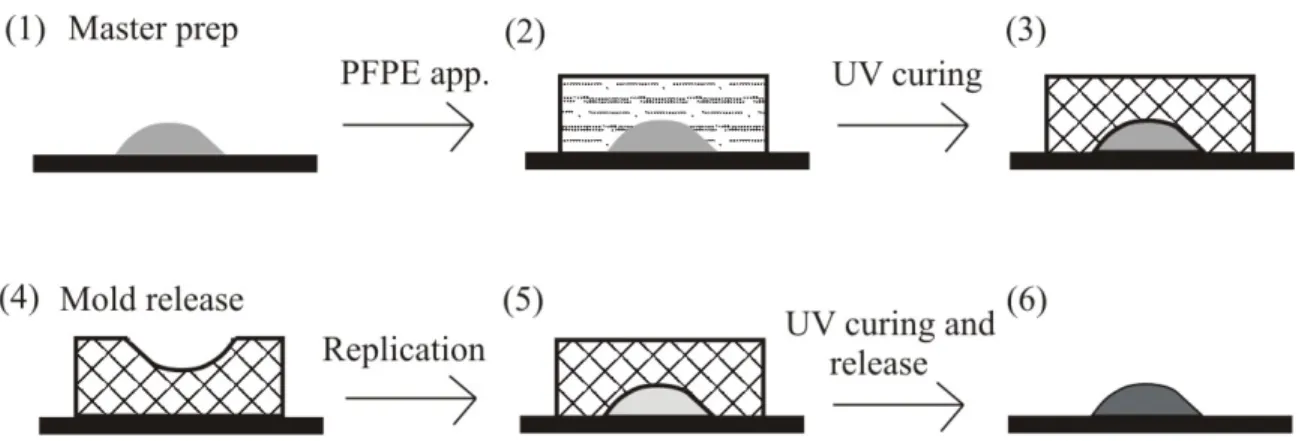
replication via a PFPE-based soft-lithography technique proved to be an invaluable tool to characterize molecular weight distributions, individual branch size distributions, and conformational transitions of individual brush-like macromolecules. These molecules were observed to undergo discrete conformational transitions in response to changes of substrate area and substrate chemical composition. The transitions depended on the details of the molecular branching architecture as well as the molecular chemical composition. In addition to the molecular properties, the brush architecture stabilized the ordering of disk-like
iv
ACKNOWLEDGEMENTS
I want to thank my mom and dad, Toby and Julie Boyce, for always encouraging me no matter what decisions I made, even when I decided to go to graduate school and you weren’t even sure what that meant! Laurie, thanks for being proud of me and encouraging me—it meant more than you know.
Mr. Burner, thank you for encouraging me to take AP chemistry, for seeing something in me that I didn’t yet see in myself.
Dr. Seidman, thank you for showing me the excitement of physical chemistry and for teaching me classes when I was the only student taking them.
Dr. Mattson, thank you for helping me to think outside the box and for showing me that I usually am not. Thank you for teaching me how to make a solution and properly clean glassware, among many other invaluable, while seemingly ordinary skills a chemist should have.
Stephanie Canyon—without your encouragement I may never have attended graduate school at all. Thank you for helping me to see things in myself that I could not yet see.
Laurie and Greg McCauley—what an amazing friendship that developed from me tutoring Scott and Lauren! Thank you for your overflowing encouragement and your prayers for “finishing well.” My life has been forever changed by our vivid friendship.
To Isaac LaRue—your surprising combination of patience and candor helped me immensely to persevere in the early years of research. Thank you for your help.
Sam Lord, your genuine love for science was inspiring and encouraging. Thank you for inadvertently spawning the lab cake-cooking contest.
Frank Sun, you often made coming to lab much more fun than it otherwise would have been. Thank you also for your candor and for your help in giving me fresh perspective on my projects.
Sherryl Yu, Mike Barrett, and Hui Xu, thank you for all your help in just learning instrumental techniques, discussing research problems, and then just having fun. I couldn’t have asked for a better lab group.
Dr. Rubinstein, thank you for asking the hard questions. The fear of them made me be better prepared for seminars and conferences and made me think more thoroughly about my research.
vi
Charles, what a life we have begun together. Thank you for bearing with me in these final hours of graduate work and being proud of me. Your constant presence and support is a new luxury I pray I will never take for granted.
And, of course, I must thank my God and Savior, Jesus Christ, who led me here and gave me this task. I thank him for sustaining me and giving me everything that I have needed to complete the work I had to complete. I am thankful for the many experiences I have had during this time, though many of them painful. I have been changed by the
TABLE OF CONTENTS
LIST OF TABLES………...xi
LIST OF FIGURES………...xii
Chapters 1 INTRODUCTION……….…1
1.1 Introduction of the Problem………..….1
1.2 Biological Brushes………...4
1.3 Synthetic Molecular Brushes………...………..…7
1.4 Synthesis of Molecular Brushes………....9
1.5 Conformation of Brush-like Macromolecules……….…12
1.5.1 Brush Conformation in Solution………...….12
1.5.2 Brush Conformation on Surfaces………...…..….15
1.6 Fundamental Issues……….……... .21
1.7 Experimental Challenges……….21
2 SINGLE MOLECULE CHARACTERIZATION OF COMPLEX MACROMOLECULES: THE DIMENSIONS, CONFORMATION, AND ORDERING OF MULTI-ARM BRUSHES………...24
2.1 Addressing the Challenges of Complicated Molecules…………...………24
viii
2.3 The Characterization of Single-molecule Dimensions.………...……28
2.3.1 Confirming the Synthesis of Star-like Molecular Brushes………...……28
2.3.2 Molecular Weight Characterization………...……30
2.3.3 Molecular Weight Distribution………...….32
2.3.4 Arm-length Distribution………...…33
2.3.5 Conclusions for Single-molecule Characterization…………...….36
2.4 Conformational Transition and Surface Ordering of the Four-arm Brush………...….37
2.4.1 Conformational Transitions………...……37
2.4.2 Ordering of Four-arm Macromolecules………...……40
2.5 Conclusions………....……46
3 THE EVALUATION OF THE ACCURACY OF AFM USING MOLECULAR REPLICATION………...….48
3.1 A Shortcoming of Tapping Mode AFM………...…….48
3.2 Curable PFPE-Based Molecule Replication………...…….50
3.3 Replicating Single Molecules Using the Soft Lithography Technique………...…..53
3.4 Analysis and Discussion………..……56
3.4.1 Masters and Replicates………...….56
3.4.2 Considering the Surface Properties of PFPE………...……61
3.5 Conclusions………....………..63
4 COMPARING THE CONFORMATIONAL BEHAVIOR OF HYDROPHILIC AND HYDROPHOBIC MACROMOLECULAR BRUSHES………...65
4.1 The Conformational Transitions of Brush Polymers………...……65
4.3 Synthesis and Characterization………...…..69
4.4 Results and Discussion………..….….71
4.4.1 The Stability of PDMA Monolayers at the Air-Water Interface: Linear and Brush-like Macromolecules……….….…71
4.4.2 Conformational Transitions………....….78
4.4.3 Discussion………..….84
4.5 Copolymer Brushes………....….87
4.5.1 Characterization………....…..87
4.5.2 Results and Discussion………....…87
4.6 Conclusions………....….91
5 THE MIXING OF CHEMICALLY DIFFERENT MACROMOLECULAR BRUSHES………...…93
5.1 Polymer Mixing………...…….93
5.2 Polymers Studied………...….96
5.3 The Phenomenon………....…98
5.3.1 Linear Polymer Mixing………..…98
5.3.2 Brush Polymer Mixing………...…101
5.4 Effects on Mixing………...103
5.4.1 Brush Mixtures with Varying Side Chain Lengths…………...….103
5.4.2 Linear and Brush Mixtures………...…..107
5.5 Mixing Kinetics and Analysis of Ordering………....……109
5.6 Discussion………...….114
5.7 Conclusion………....….116
x
LIST OF TABLES
2.1 Molecular Weight Data for Backbones and Brushes………...33 2.2 Length Characterization from AFM Measurements………....34 3.1 Areas and Heights for Single Collapsed Molecules and Drops
Determined from AFM Height Images………59 3.2 Heights for Extended Linear Brush and Collapsed Four-arm Brush Determined from
xii
LIST OF FIGURES Figure
1.1 Examples of Trichomes………...4
1.2 Structure of a Proteoglycan Aggregate………...7
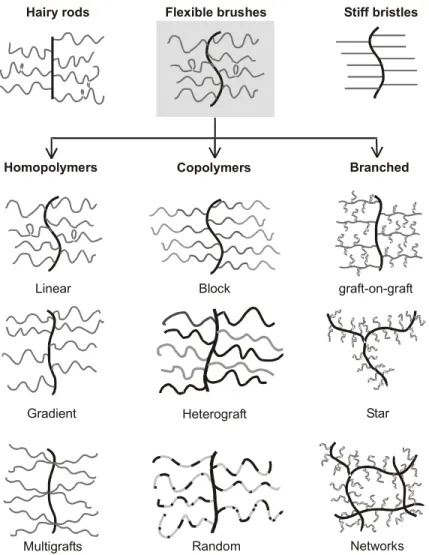
1.3 The Variety of Brush Structure………...….8
1.4 Three Synthetic Strategies for Brushes………....10
1.5 Surface Conformations of Brushes………..………16
1.6 Equilibrium Spreading……….17
1.7 AFM Images of Brush Surface Conformations….……….….19
2.1 Multi-arm Brush Synthetic Scheme………...29
2.2 AFM Height Images of Multi-arm Brushes………...30
2.3 Schematic of the Langmuir-Blodgett (LB) Trough………....….31
2.4 LB Monolayer Transfer onto a Solid Substrate………..….32
2.5 Schematic for the Conformational Transition of a Multi-arm Brush Molecule Caused by Two-dimensional Compression………...…38
2.6 LB Isotherm for the Four-arm Brush………...…39
2.7 AFM Height Images of the Four-arm Brush Conformational Transition……….…40
2.8 2D Power Spectral Density of Monolayers of Globular Molecules………42
2.9 Angular Dependence of the 2D Power Spectral Density Function………..…42
2.10 Radial Correlation Function and Amplitude Decay……….…43
2.11 Orientational Order Function………...….45
2.12 Exponential and Power Law Fits for G6...46
3.2 Perfluoropolyether………...……51
3.3 Soft Lithography Process……….52
3.4 AFM of the Replication of Single Collapsed Molecules……….…53
3.5 AFM of the Replication of Droplets………54
3.6 AFM of the Replication of Extended Molecules……….…55
3.7 AFM of the Replication of Collapsed Star Molecules……….…56
3.8 The Contact Angle of the Cap……….…62
4.1 Conformational Diagram for Cylindrical Brushes………..66
4.2 Compressed Brush Conformations………..67
4.3 Linear PDMA Consecutive Isotherms……….72
4.4 Pressure Limited Consecutive Isotherms of Linear PDMA………72
4.5 Consecutive PDMA Brush Isotherms………..75
4.6 Monitoring of the a/w Interface for Adsorbing Molecules………..76
4.7 PBA Brush Isotherm and Corresponding AFM Height Images ……….79
4.8 PDMA Brush Isotherm and Corresponding AFM Height Images………...81
4.9 Dependence of Intermolecular Distance with Compression………....82
4.10 Molecular Parking………...84
4.11 Conformational Changes of PBA-PDMA Copolymer Brushes………...88
4.12 Dependence of Intermolecular Distance on MMA………...89
4.13 Copolymer and Homopolymer Isotherms………....90
5.1 Possible States of Two-Component Mixing………....92
5.2 Chemical Structures of the Monomers Used………...98
xiv
5.4 PDMA Domain Size in Linear Mixture with Time………...100 5.5 AFM Height Images of Mixed Monolayers at Different Lateral
Pressures………....102 5.6 Phase Contrast Between PBA and PDMA………...102 5.7 AFM Height Images of Mixed Monolayers with Different Side
Chain Length PBA Brushes………...104 5.8 Intermolecular Distances of All Species in Monolayers with Different
Side Chain Length PBA Brushes………...105 5.9 AFM Images for Mixed Monolayers with Different Side Chain Length
PDMA Brushes………..106 5.10 Intermolecular Distances Between All Species with Different Side
Chain Length PDMA Brushes………...106 5.11 AFM Height and Phase Image of Linear PDMA with PBA Brushes………....107 5.12 Monolayers of Various Linear Polymers Mixed with PDMA Brush...108 5.13 The Dependence of PDMA Brush Intermolecular Distance on the Molecular
Weight of the Linear Polymer………....109 5.14 AFM Height Images of Brush Monolayers Mixed with Time………..110 5.15 Fractions of Like and Unlike Polymer Pairs in Monolayers at Different
Pressures and Times………...112 5.16 Intermolecular Distances Between All Species in the Premixed
CHAPTER 1 INTRODUCTION
1.1 Introduction of the Problem
From cleaning teeth to painting walls, brushes are used in nearly all aspects of life. The brush form is ubiquitous because of its functionality, which is imparted by the flexible bristles that are densely tethered to a substrate. This dense grafting gives the brush shape persistence even in the case of flexible substrates. The brush morphology also provides a large surface-to-volume ratio, increasing the mass-loading of a fluid such as for a paint brush.
Similar principles are relevant for molecular brushes. If there was a molecule with a flexible backbone decorated with densely grafted long side chains, this brush-like
macromolecule would adopt the shape of a semi-flexible cylinder possessing a high density of functional groups. However, in contrast to colloidal brushes on a rigid substrate,
2
macromolecules, which could also switch its shape and maintain shape persistence in
multiple conformations, inspired polymer chemists. Synthetic molecules have been designed that change shape with changes in their environment (temperature, pH, ionic strength) as well as respond to an external field. Such stimuli responsive molecules can be used as small containers for drug delivery, fragrance in health and beauty products, or other similar applications. One of the many examples is a 32-arm star core-shell molecule having a
hydrophobic poly(n-butyl acrylate) core and a hydrophilic poly(ethylene glycol) methyl ether methacrylate shell.1 These molecules were able to carry a hydrophobic load as unimolecular containers (i.e. without aggregating) in an aqueous solution. Cylindrical polymer brushes have been used to make water-soluble nanowires of a similar core-shell structure, by crosslinking the inner block of diblock side chains.2 While these nanowires were rigid and did not have a variable conformation, their unique chemical structure allowed them to exhibit lyotropic liquid crystalline-like behavior. In a sense, this gives the system as a whole a conformational variability. Demonstrating further utility, shape persistent molecules can self-organize on surfaces, resulting in bottom-up lithography, the feature size of which is only limited by the size of the molecules. Brush-like macromolecules with the switchable and persistent shapes can be viewed as peculiar mesoscopic building blocks for the
construction of larger structures and functional systems. These applications depend on being able to control the molecule’s shape or conformation.
The conformation of brush-like macromolecules depends on their architecture and chemical composition. The architecture comprises branching topology, grafting density, and
1 Kreutzer, G. et al. Macromolecules 2006, 39, 4506.
2 Yuan, J.; Xu, Y.; Walther, A.; Schumacher, M.; Schmalz, H.; Müller, A.H.E. Polym. Prepr.
length of the side chains. The chemical composition determines molecular interactions and chain flexibility. The side chains can be hydrophilic or hydrophobic, stiff or flexible. Because of these variables it is necessary to thoroughly study and understand their conformational behavior both as single molecules and in assemblies. In an effort to reach this goal, four main studies are reported here:
• Development of molecular imaging and image analysis techniques for characterization of individual branched macromolecules
• The conformation and ordering of star-like brush molecules at interfaces.
• The control of conformation: a comparative study of hydrophilic and hydrophobic brushes
• The architecture-induced mixing in a monolayer of hydrophilic and hydrophobic brushes
An important aspect of this research is the characterization of brush-like macromolecules that includes the molecular weight distribution of the backbones and side chains, and the
4
characterization techniques. In addition, characterization was done with some of the
traditional techniques, including gel permeation chromatography and laser light scattering.
1.2 Biological Brushes
Brush structures are one of the most typical morphologies found in nature.
Macroscopic brushes such as trees and hair allow for dense packing of functional species within shape-persistent, though flexible, objects. More biological brushes can be found on a microscopic scale. Plants have microscopic brush-like structures known as trichomes on their leaves. These trichomes help the plant by reducing water loss,
Figure 1.13,4 Examples of Trichomes Trichomes on the leaves of plants can be a macro- or microscopic brush structure designed for the protection and viability of the leaf (left and middle). Microscopic roughness combined with even smaller hairy structure makes lotus leaves superhydrophobic and, therefore, self-cleaning (right).
regulating temperature and protecting it from insects and disease. Covering a surface in bristles also alters its wettability and can result in a surface that is self-cleaning. This effect
has been studied with lotus leaves and has been termed the “lotus effect.”4 Surface roughness combined with a hairy structure on a smaller scale makes lotus leaves
superhydrophobic and allows water droplets to pick up debris as they roll off the leaves. Tethered hair-like microscopic structures are also found in the human body. Known as cilia these structures are found in and on a variety of organs and pathways including the sinuses, airways, kidney tubules, fallopian tubes, ears, and eyes. Sometimes their purpose is simply to protect cell surfaces, but other times they serve some more complicated function such as detecting sound in the ears or moving mucous through the lungs. Cilia in the lungs beat between 1000-3000 times per minute, moving mucous with trapped contaminants and bacteria out of the lungs. This process is regulated not only by the movement of the tethered brush-like cilia, but also by the viscoelastic properties of mucous, one of the components of which is a molecular brush called mucin.5,6 Mucous that is too viscous or not viscous enough can not be propelled by cilia causing serious health problems, such as cystic fibrosis.
Progress in microscopic techniques led to the discovery of molecular brushes such as proteoglycans that represent another major class of biomolecules in addition to DNA and proteins.7,8 Proteoglycans consist of a protein backbone with polyelectrolyte carbohydrate side chains. These brush-like molecules are found in many places in the body performing
4 Barthlott, W.; Neinhuis, C. Planta 1997, 202, 1.
5 Bansil, R.; Stanley, E.; LaMont, J.T. Annu. Rev. Physiol. 1995, 57, 635. 6 Bromberg, L.E.; Barr, D.P. Biomacromol. 2000, 1, 325.
7 Seog, J.; Dean, D.; Plaas, A.H.K.; Weng-Palms, S.; Grodzinsky, A.J.; Ortiz, C.
Macromolecules 2002, 35, 5601.
6
various functions, such as cell to cell signaling, joint lubrication and cell surface protection. 9-11 In one of the most well-studied examples, proteoglycans, as one of the main components of cartilage, act as a water sponge and result in the shock absorbing and lubricating functions of cartilage.12-14 This is possible because of the high charge density per unit length the dense brush structure affords which results in a high osmotic pressure upon compression.15 It is believed that the functional properties of proteoglycans are a direct result of their brush-like structure, which insures a high density of charged groups per unit length.
9 Kaneider, N.C.; Dunzendorfer, S.; Wiedermann, C.J. Biochemistry 2004, 43, 237. 10 Scott, J.E. Biochemistry 1996, 35, 8795.
11 Jay, G.D.; Haberstroh, K.; Cha, C.-J. Connet. Tissue. Res. 1992, 28, 71.
12 Chen, L.; Yang, B.L.; Wu, Y.; Yee, A.; Yang, B.B. Biochemistry 2003, 42, 8332. 13 Li, Z.; Hou, W.-S.; Bromme, D. Biochemistry 2000, 39, 529.
14 Simon, W.H. J. Biomech 1971, 7, 379.
Figure 1.27 Structure of a Proteoglycan Aggregate AFM height image of a proteoglycan aggregate reveals its brush-like structure. Its many carbohydrate side chains are grafted to a protein backbone.
1.3 Synthetic Molecular Brushes
8
These variables affect their properties, but it is the relatively dense grafting that has the greatest effect on the structure and properties of brush polymers.
Homopolymers Branched
Linear
Star Gradient
Multigrafts
Hairy rods Flexible brushes Stiff bristles
Copolymers
Block graft-on-graft
Heterograft
Networks Random
1.4 Synthesis of Molecular Brushes16-18
Polymer brushes have been synthesized by a variety of techniques in an effort to gain greater control over composition and architecture in order to obtain well-defined macromolecules. For useful brush synthesis it is important to control the grafting density, the ratio of side chain and backbone degrees of polymerization, and the polydispersities of the backbone and side chains. However, controlling these parameters has proven a challenge because of steric hindrance during synthesis.
There are three methods used to synthesize cylindrical brush polymers: “grafting through” (the polymerization of macromonomers), “grafting to” (the addition of already polymerized side chains to a backbone), and “grafting from” (the polymerization of side chains from a macroinitiator backbone). Each of these methods controls different molecular parameters well, but each also has significant disadvantages. Often multiple synthetic approaches are combined in order to synthesize more challenging architectures that cannot be achieved with only one technique. Each technique has been tested using multiple polymerization routes including anionic polymerization, ring-opening matathesis polymerization, conventional and controlled radical polymerization, different coupling reactions (“click chemistry”), and miniemulsion polymerization. Not all of these techniques
16 Sheiko, S.S.; Sumerlin, B.S.; Matyjaszewski, K. Prog. Poly. Sci. 2008, (submitted) (and references therein)
17 Boyce, J.R.; Sun, F.C.; Sergei, S.S. in “Responsive Polymer Materials: Design and Applications” by Sergei Minko (Ed.), 1-26 (2006). (and references therein)
10
have been successful in creating well-defined brush molecules with backbones much longer than the side chains.
Figure 1.417 Three Synthetic Strategies for Brushes Schematics of grafting through (A), grafting to (B), and grafting from (C)
polymerization has had more success due to the larger spacing between side chains because of the ring opening, and ring strain adds the thermodynamic driving force for polymerization. Controlled/living methods have also been used for “grafting through,” but with limited control of parameters, with some exceptions using atom transfer radical polymerization (ATRP). The ATRP method resulted in a brush with a molecular weight that increased linearly with conversion up to high degrees of polymerization with a narrow molecular weight distribution (MWD).
“Grafting to” employs end functionalized side chains that react with corresponding functional groups on a backbone. One of the benefits of this approach is that the side chains and backbone are synthesized separately before brush synthesis, and can be well-characterized. Often this type of brush synthesis utilizes supramolecular assembly via secondary interactions such as hydrogen bonding, coordination, and ionic interactions to assemble molecules. The weakness of the “grafting to” method is that as side chains are attached, they sterically hinder the attachment of more chains resulting in a lower grafting density. The most efficient methods that have been used to prepare brushes using this method are nucleophilic substitution and click chemistry (copper(I)-catalyzed azide-alkyne coupling). Nucleophilic substitution is hampered by side reactions, while the success of the click chemistry route depends heavily on the size of the side chain monomers. A modular approach with chlorosilane chemistry has been used to make multifunctional branch points resulting in brushes with multiple side chains from the same grafting site, increasing the complexity of the architecture.
12
is less of a problem and higher grafting densities can be achieved, although compared to “grafting through,” it provides less control over side chain length and grafting density. How well these parameters are controlled is a function of the initiation efficiency. This is why “grafting from” with ATRP has been used the most successfully to synthesize brushes with as high as 100% grafting density. “Grafting from” results in well-defined molecules with long backbones, high grafting densities and narrow MWD without fractionation. It also lends itself to even more complicated architectures such as stars and brushes with gradient grafting density, as well as copolymers, such as core-shell type molecules and heterograft molecules (molecules with more than one type of side chain).
1.5 Conformation of Brush-like Macromolecules
The conformation of a brush-like molecule is determined by the competition between the entropic elasticity of the flexible backbone and the steric repulsion of the densely grafted side chains. As a result of the chemical connectivity, molecules adopt a cylindrical conformation. However, this conformation may change in response to the surrounding environment, which effectively changes the interaction between the densely grafted side chains. The possible environments include solvents and substrates. As such, one should separately consider brushes in solution and brushes on surfaces.
1.5.1 Brush Conformation in Solution
Because of their unique architecture, cylindrical brush polymers behave differently in solution than their linear counterparts.19 In solution, brush molecules can contract from a rod
to a globule with changes in temperature, solvent quality, or pH depending on their chemical composition. Their dense grafting causes them to have a worm-like shape, rather than the coil of a linear polymer. One of the most unique properties of brush polymers is their ability to change length and stiffness with changes in solvent quality, characterized by length per monomer (lm) and persistence length (lp), respectively. These parameters are affected by the degree of polymerization of the side chains and the grafting density of the backbone.
Currently, the effect of the molecular composition on these parameters is not completely understood and recent literature on the subject is sometimes contradictory. Several theories have been proposed relating lp to side-chain length. If lp increases more quickly than the brush diameter D, lyotropic ordering of cylindrical brush polymers in solution is
expected.20,21 One theory suggests that the ratio of lp to D is approximately constant, meaning that lp increases proportionally to the dimensions of the side chains.22 This is in agreement with some computer simulations, although they also predict that lp/D levels off with side chain length.23,24 Lyotropic ordering would not be possible in such a system, though it is expected for brushes with stiff25,26 and bulky27,28 side chains. It has also been theoretically
20 Onsagar, L. Ann. N.Y. Acad. Sci. 1949, 51, 627.
21 Khokhlov, A.R.; Semenov, A.N. Physica A 1981, 108, 546.
22 Birshtein, T.M.; Borisov, O.V.; Zhulina, E.B.; Khokhlov, A.R.; Yurasova, T.A. Polym.
Sci. U.S.S.R. 1987, 29, 1293.
23 Saariaho, M.; Ikkala, O.; Szleifer, I.; Erukhimovich, I.; ten Brinke, G. J. Chem. Phys. 1997, 107, 3267.
24 Rouault, Y.; Borisov, O.V. Macromolecules 1996, 29, 2605.
25 Saariaho, M.; Subbotin, A.; Szleifer, I.; Ikkala, O.; ten Brinke, G. Macromolecules 1999,
14
predicted that the lp/D ratio increases with the length of the side chains as lp/D ∼ N9/8, where N is the degree of polymerization of the side chains.29 If this relation is physically true, lyotropic ordering is asymptotically expected because the persistence length increases with the side-chain length faster than the brush diameter.
Experimental results have also proven inconclusive, although they have led to new insights into brush conformation. Several light and neutron scattering measurements showed that both lm and lp increased with increasing side chain length and increasing side chain solvent quality.30-34 Other scattering experiments showed that neither lp nor lm depend on the side chain length.35 Recent experiments have confirmed that lm is not dependent upon side
26 Subbotin, A.; Saariaho, M.; Stepanyan, R.; Ikkala, O.; ten Brinke, G. Macromolecules 1999, 32, 4439.
27 Elli, S.; Ganazzoli, F.; Timoshenko, E.G.; Kuznetzov, Y.A.; Connolly, R. J. Chem. Phys. 2004, 120, 6257.
28 Percec, V.; Ahn, C.-H.; Ungar, G.; Yeardley, D.J.P.; Möller, M.; Sheiko, S.S. Nature 1998,
391, 161.
29 Fredrickson, G.H. Macromolecules 1993, 26, 2825.
30 Fischer, K.; Schmidt, M. Macromol. Rapid Commun. 2001, 22, 787.
31 Gerle, M.; Fischer, K.; Roos, S.; Müller, A.H.E.; Schmidt, M.; Sheiko, S.S.; Prokhorova, S.; Möller, M. Macromolecules 1999, 32, 2629.
32 Fischer, K.; Schmidt, M. Macromol. Rapid Commun. 2001, 22, 787.
33 Gerle, M.; Fischer, K.; Roos, S.; Müller, A.H.E.; Schmidt, M.; Sheiko, S.S.; Prokhorova, S.; Möller, M. Macromolecules 1999, 32, 2629.
34 Lecommandoux, S.; Chécot, F.; Borali, R.; Schappacher, M.; Deffieux, A.
Macromolecules 2002, 35, 8878.
35 Rathgeber, S.; Pakula, T.; Wilk, A.; Matyjaszewski, K.; Beers, K.L. J. Chem. Phys. 2005,
chain length, but that lp increases with increasing side chain length in theta and good solvents.36,37 These discrepant results illustrate the need for continued study to rightly understand the connection between architecture and functionality or behavior for molecular brushes. Beyond changes in contour length, macromolecular brush polymers also undergo a conformational transition from a rod-like to a globular shape in solution, similar to that of linear polymers, with changes in solvent quality.38,39 Cylindrical brush molecules, stabilized by their many side chains, remain in solution as single molecules longer than linear chains even when collapsed. Similar stability during conformational changes has also been observed on surfaces.40
1.5.2 Brush Conformation on Surfaces
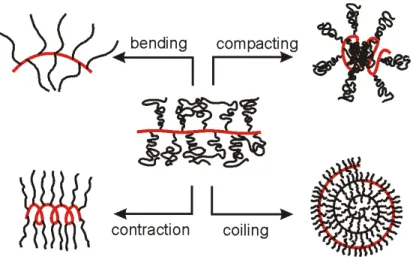
On surfaces, the conformation of brush molecules depends on the interaction of the side chains with the surface. Interfacial interactions along with the substrate confinement results in a larger variety of conformations compared to those in solution. Depending on the fraction and distribution of adsorbed side chains, the molecules can have extended, curved, or collapsed conformations (see Fig. 1.5). Imaging by atomic force microscopy (AFM) is a simple route for determining conformation, measuring contour length, radius of gyration,
36 Terao, K.; Nakamura, Y.; Norisuye, T. Macromolecules 1999, 32, 711.
37 Nakamur, Y.; Wan, Y.; Mays, J.W.; Iatrou, H.; Hadjichristidis, N. Macromolecules 2000,
33, 8323.
38 Li, C.; Gunar, N.; Fischer, K.; Janshoff, A.; Schmidt, M. Angew. Chem. Int. Ed. 2004, 43, 1101.
39 Tsubaki, K.; Kobayashi, H.; Sato, J.; Ishizu, K. J. Colloid Interface Sci. 2001, 241, 275. 40 Neugebauer, D. ; Carson, B.E. ; Sheiko, S.S. ; Matyjaszewski, K. Polym. Prep. (Am.
16
persistence length, as well as getting more complicated information about rheological properties, ordering and patterning of polymer brush molecules.
Figure 1.5 Surface Conformations of Brushes The brushes with their responsive conformations make ideal molecular actuators. The following conformational changes lead to the following mechanical actions within an individual brush molecule: bending, contraction, compacting, and coiling.
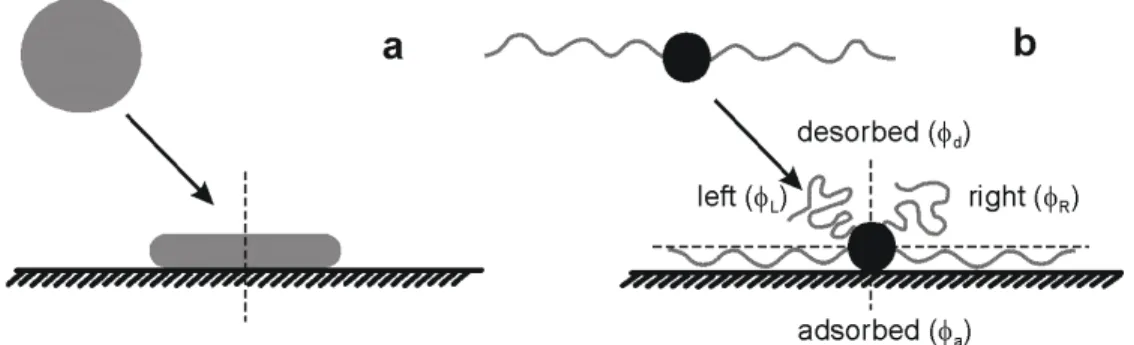
Unlike simple fluids that rapidly reach one of two simple equilibrium conformations (i.e. drops or disks (Fig. 6a)) when adsorbed on a surface, polymer brushes have a covalently bound architecture that restricts their conformation leading to more complex morphologies formed on longer time scales (Fig. 6b). A brush adsorbed to a surface adopts a conformation in response to the interplay between the intramolecular and surface forces.41-44 The conformational transformation of large polymer molecules can be a slow process potentially leading to non-equlibrium and metastable structures. Moving a brush molecule from solution
41 Saariaho, M.; Ikkala, O.; ten Brinke, G. J. Chem. Phys. 1999, 110, 1180.
42 Khalatur, P.; Khokhlov, A. R.; Prokhorova, S. A.; Sheiko, S. S.; Moller, M.; Reineker, P.; Shrirvanynts, D.; Starovoitova, N. Eur. Phys. J. E 2000, 1, 99.
43 Prokhorova, S. A.; Sheiko, S. S.; Mourran, A.; Moller, M.; Beginn, U.; Zipp, G.; Ahn, C.-H.; Percec, V. Langmuir 2000, 16, 6862.
to a surface breaks its cylindrical symmetry resulting in a partitioning of the side chains. One partition corresponds to adsorbed and desorbed side chains. The other partition results from the adsorption of the side chains on different sides of the backbone. Because the side chains can distribute differently with respect to the surface plane and the backbone, a variety of conformations is possible. The ratio of the fraction of side chains adsorbed to the surface (φa) to the fraction of side chains desorbed from the surface (φd) is the largest factor determining the surface conformation, as well as the fraction of side chains to the right (φR) and left (φL) of the backbone. The four experimentally observed surface macromolecular brush conformations correspond to four different ratios of φa to φd and φR to φL.
Figure 1.610 Equilibrium Spreading Cross-section of the adsorption of simple liquids and molecular brushes. (a) A drop of simple fluid can easily adopt a variety of equilibrium shapes (shown here is the pancake). (b) The conformation of adsorbed molecular bottlebrush is confined by its interconnectivity and determined by the ratio of φa to φd.
18
forms by a process known as spontaneous curvature.45 In order to gain entropy, some side chains flip from one side to the other causing an uneven distribution along the backbone and curvature toward the side with fewer side chains.
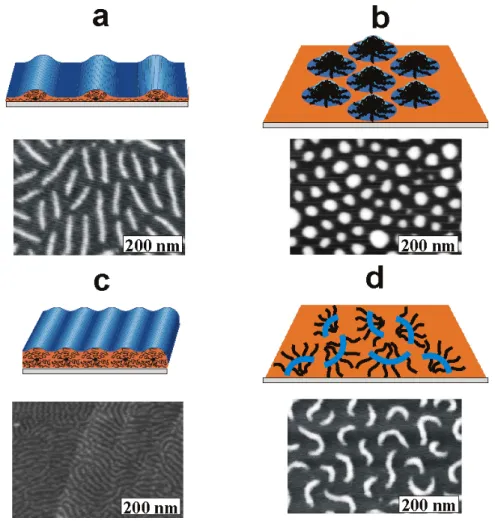
On low energy surfaces side chains no longer adsorb strongly resulting in φa < φd, with two conformations observed in this regime. The side chains gain entropy by desorbing from the surface at the expense of surface contacts. Because there are so few side chains adsorbed to the surface, in the first conformation the backbone is able to collapse forming a globular conformation. This conformation is very well documented and understood.46,47 The second conformation seen on low energy surfaces is a cylindrical one.48 While the mechanism of this conformation is much less understood, the desorbed side chains behave in such a way as to keep the backbone extended.
45 Potemkin, I.I.; Khokhlov, A.R.; Sheiko, S.S Macromolecules 2004, 37, 3918.
46 Gallyamov, M.O.; Tartsch, B.; Khoklov, A.R.; Sheiko, S.S.; Börner, H.G.; Matyjaszewski, K.; Möller, M.; Macromol. Rapid Comm. 2004, 25, 1703.
47 Sun, F.; Sheiko, S.S.; Moller, M.; Beers, K.; Matyjasqewski, K. J. Phys. Chem. A 2004,
108, 9682.
Figure 1.717 AFM Images of Brush Surface Conformations The four distinct
conformations have been observed on surfaces. The conformations occur due to variations in the number of adsorbed and desorbed side chains: (A) rod-like (φa ≌ 1), (B) globular (φa < 1), and (C) cylindrical (φa << 1). The conformation in (D) is when spontaneous curvature occurs due to an uneven distribution of the side chains (φR ≠φL). The micrographs corresponding to the schematics show the monolayer structure of the same brush molecules (Nbackbone = 567, N = 51) measured by AFM under different surface conditions.
The conformations described above apply to brushes that have relatively long side chains and are densely grafted. Changing the grafting density, side chain length, or side chain chemical composition changes the interaction of the brush with the substrate, and therefore the conformation.49 This effect can be compared to the conformations described above which are dependent upon the fraction of adsorbed and desorbed side chains.
20
However in the case of grafting density the number of side chains adsorbed to the surface is restricted by architecture. For example, on a high energy surface a brush with a higher grafting density will adopt a plate-like conformation, whereas a brush with a relatively low grafting density will have a globular conformation simply due to the fact that it has fewer side chains.
1.6 Fundamental Issues
The physical understanding of the conformational behavior of molecular brushes is one of the biggest remaining challenges. There continues to be ambiguity regarding the conformation of brushes in solution as well as on surfaces, particularly with respect to the backbone and side chains as separate components. How each of these parts responds to the environment and how they then interact with each other, results in the final conformation of the brush. It is known that certain stimuli, such as changes in the surrounding environment, can switch the conformation of a molecule. However, the way molecular brushes respond to stimuli remains largely unknown. Indeed, the cylindrically-shaped macromolecules can undergo multiple changes in different dimensions, such as longitudinal contraction, diameter increase, collapse into a globule, and sheet-like arrangements. The conformational transition might be continuous or discrete. Furthermore, which stimuli and the extent of the stimuli’s effect on the switching are also not all known. Apart from the conformation as a single molecule, there is a great set of problems on the arrangement of the molecules in dense materials such as melts, films, and monolayers. How the molecules are affected by stimuli while they are in dense forms, and how intermolecular interactions change their conformational behavior has hardly been broached. Most studies of brushes up to this point have been single molecule or dilute systems.
1.7 Experimental Challenges
22
unusual phase (ordering and mixing) behaviors. The conformational and phase behavior depend not only on architecture, but also on the chemical structure of the branches and the underlying substrate. New experimental approaches are required to visualize and understand the molecular picture of these complex systems. Because of these special circumstances, experimental studies of macromolecular brushes require approaches that resolve the behavior of single molecules in varying environments. This work evolved through the following experimental steps:
• The development of molecular imaging and image analysis techniques for characterization
• The molecular-scale study of conformational and ordering behavior in direct space
• The molecular-scale study of their mixing behavior in the presence of other molecules, both of similar composition and architecture and different.
These issues will be addressed here via several means. The use of molecular imaging has been broadened for the analysis of molecular brushes by employing AFM in combination with quantitative Langmuir-Blodgett sample preparation technique. In addition, molecular replication using newly developed perfluoropolyether-based soft lithography has allowed the more accurate characterization of molecular dimensions for soft liquid-like molecules and droplets. 50,51 The tethering of many side chains to one backbone results in a molecule that responds very differently than linear molecules to environmental changes. The molecular
50 Rolland, J.P.; Van Dam, R.M.; Schorzman, D.A.; Quake, S.R.; DeSimone, J.M.; J. Am.
Chem. Soc. 2004, 126, 2322.
51 Rolland, J.P.; Hagberg, E.C.; Denison, G.M.; Carter, K.R.; DeSimone, J.M.; Angew.
CHAPTER 2
SINGLE MOLECULE CHARACTERIZATION OF COMPLEX
MACROMOLECULES: THE DIMENSIONS, CONFORMATION, AND ORDERING OF MULTIARM BRUSHES
2.1 Addressing the Challenges of Complicated Molecules52
One of the goals in modern synthetic polymer chemistry is to prepare polymers with controlled molecular weight and well-defined architecture. Controlled/living radical polymerization (CRP) provides a route to polymers with well-defined molecular weight and narrow molecular weight distributions, as well as with various architectures. Atom transfer radical polymerization (ATRP) is among the most efficient CRP methods and has been successfully applied to the synthesis of linear, hyperbranched, comb-like, and star-like structures. Densely grafted brush polymers are among the most intriguing macromolecular structures and ATRP lends itself to their synthesis. ATRP has been successfully used to synthesize linear brushes with various chemical compositions.53-57 To attempt even greater
52 Matyjaszewski, K.; Qi, S.; Boyce, J.R.; Shirvanyants, D.; Sheiko, S.S. Macromolecules 2003, 36, 1843.
53 Beers, K.L.; Gaynor, S.G.; Matyjaszewski, K.; Sheiko, S.S.; Möller, M. Macromolecules 1998, 31, 9413.
54 Matyjaszewski, Krzysztof; Qin, Shuhui; Boyce, Jamie R.; Shirvanyants, David ; Sheiko, Sergei S. Macromolecules 2003, 36, 1843.
molecular complexity, a series of brushes were synthesized with a star-like backbone having two, three, and four arms. The synthesis of such a complicated molecule begs confirmation on a variety of levels: the number of arms of the backbone, the grafting efficiency of side chains from these unusual backbones, and the molecular weight distribution of the individual arms along with entire molecules. In order to determine if the synthesis was “successful,” all variables of the molecules need to be determined including total backbone length, individual arm length, side chain length, and total molecular weight. Traditional polymer characterization techniques such as gel permeation chromatography (GPC) or viscometry do not provide this level of discrimination. GPC is an excellent example to demonstrate the weaknesses of these types of solution studies. Calibration of GPC is based on linear standards of some particular polymer, such as polystyrene or poly(methyl methacrylate). Molecular weights are determined by how quickly these linear polymers elute through columns packed with a porous material. Branched molecules are more compact than linear polymers of corresponding mass, i.e. have a smaller hydrodynamic volume, and therefore elute more slowly returning underestimated molecular weights. Using GPC with a light scattering detector, one can obtain relatively accurate information about the molecular weight distribution and the molecular dimensions in solution. However, the method becomes less accurate when analyzing large molecules (qRg > 1) and molecules with complex architecture. It also gives no information about the number and length of branches or comparison of backbone to side chain lengths. This inability to distinguish the backbone from the branches (side chains and arms) is why solution studies of branched
56 Qin, S.; Matyjaszewski, K.; Xu, H.; Sheiko, S.S. Macromolecules 2003, 36, 605.
26
macromolecules have serious limitations. Scattering techniques can be helpful for determining an average molecular weight, however, they fail to characterize both intramolecular dimensions (branches and side chains) and overall conformation., Even well-planned out scattering experiments cannot fully separate the backbone from the many massive side chains.
AFM imaging overcomes all the limitations of other characterization techniques because the molecules become visible. The backbone, individual arms, and side chains can be seen and measured separately in direct space. Imaging reveals both the size and the overall conformation of the molecule. When combined with an appropriate substrate and sample preparation technique, one can even retrieve information about the solution conformation of brush molecules by AFM. The high resolution that AFM imaging provides makes possible the detailed characterization and analysis necessary for confirming the synthesis of and understanding the behavior of macromolecular brush polymers.
2.2 The Necessity of Molecular Imaging
the molecule facilitates accurate analysis, which is important in order to understand behavior and confirm the synthesis. Confirming the synthesis allows a definite connection to be made between the functional properties of the molecules and their chemical and structural composition, furthering the base of knowledge from which to design functional molecules for specific applications. In addition to verifying synthetic strategies, molecular visualization enables accurate and quantitative measurements of molecular weight, size, and conformation. The unique advantage of molecular imaging is that one obtains molecular dimensions in direct space affording more opportunities for statistical analysis. The pictorial resolution also allows fractionation of the visualized molecules by size, branching topology, and chemical composition as well as sorting out irrelevant species.
There are few imaging techniques, such as fluorescence and electron microscopy, that were developed to explore single molecules. However, optical techniques fail to achieve nanometer resolution of flexible polymer chains with a persistence length below 100 nm. Electron microscopy needs special imaging conditions that may perturb or even damage the native molecular structure. Due to the nanometer lateral and vertical resolution, AFM demonstrates its unique advantage as it allows the imaging of molecules in great detail, including the contour length and the local curvature. The technique does not require any sample modifications and allows imaging under ambient conditions.
28
Specific molecular conformations can be quantified in part because of the 3D information, and thus conformational and/or phase changes can be observed with the appropriate sample preparation. Furthermore, higher multimolecular structures and self-assembly can be analyzed for intermolecular distance and patterning. This is possible not only because individual molecules are resolved, but also because polymers of different chemical compositions can often be distinguished through phase imaging because of differences in physical properties.
AFM provides the most direct and facile route to the observation, characterization and behavior analysis of cylindrical macromolecular brushes.
2.3 The Characterization of Single-molecule Dimensions 2.3.1 Confirming the Synthesis of Star-like Molecular Brushes
Figure 2.1Multi-arm BrushSynthetic Scheme The cartoon illustrates the synthetic scheme and molecular structure of multi-arm molecular brushes (3). This particular scheme corresponds to four-arm brushes (f = 4). A branching core of functionality f = 4 (1) was used to prepare a 4-arm BPEM macroinitiator (2) followed by the grafting from of nBA side chains.
30
100 nm 250 nm
100 nm 250 nm
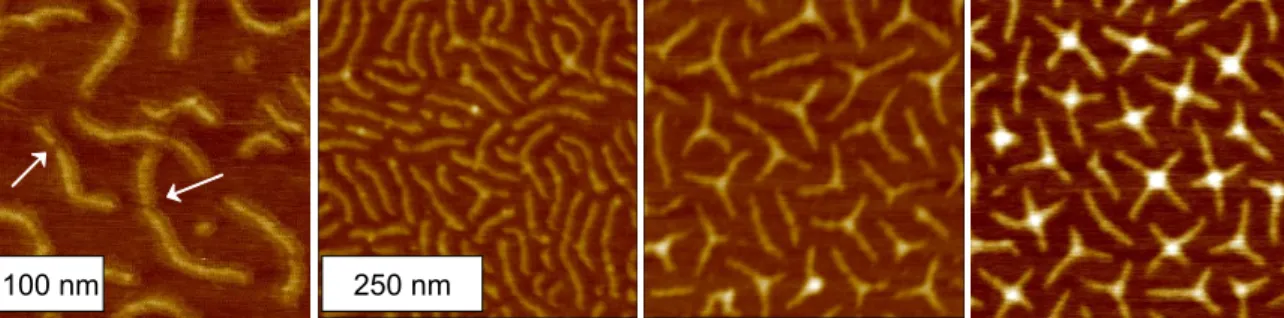
Figure 2.2 AFM Height Images of Multi-arm Brushes AFM height images reveal the structure of multiarmed brush polymers. The branching center of spin cast two arm molecules (far left) are visible as a notch in the molecule. This notch is not as easily visible in the monolayer (second from left). AFM images of LB monolayers of two arm, three arm and four arm molecules (left to right) show discrepancies in the number of arms per molecule and polydispersity in the arm length.
2.3.2 Molecular Weight Characterization
Combining AFM with Langmuir-Blodgett monolayer preparation adds another powerful dimension to brush analysis by providing a route for molecular weight analysis. LB monolayers are prepared by spreading polymer from a solution onto the surface of a shallow trough of water. This surface is bound by two barriers that can move together, decreasing the surface area available to the polymer. In this way monolayers can be formed and compressed to induce phase or conformational transitions. Monolayers are transferred by pulling a hydrophilic substrate vertically up through the layer (the “Z” method) and can then be imaged. The molecular weight determination is based on molecular imaging, which allows counting of individual molecules and accurate measurement of the number of molecules per unit area of an LB monolayer. From the mass per unit area, where M is the total mass of polymer applied to the trough, S is the surface area of the trough, and T is the transfer ratio
ST M
and the number of molecules per unit area, where N is the number of molecules per image area, A,
A N
=
! (2) the number-average molecular weight can be readily calculated:
!
m N M
Mn " = (3)
Although the AFM measurements are done on a solid substrate, the number density is close to that on the water surface since the transfer ratio is always almost one. The transfer ratio is separately measured. Typically it varies from 0.9 to 1. The transfer ratio is the ratio of the actual mass transferred to a solid substrate to the mass of the water-supported monolayer.
32
Figure 2.4 LB Monolayer Transfer onto a Solid Substrate Z type deposition of hydrophilic portion of molecules onto a hydrophilic substrate from the water surface.
2.3.3 Molecular Weight Distribution
The macroinitiator molecular weights were determined by GPC with a multiangle laser light scattering detector (MALLS) and the degrees of polymerization of the backbones were calculated. The final brush molecular weights were determined by both the AFM-LB method and GPC-MALLS. Assuming 100% grafting density (a side chain on every
Table 2.1 Molecular Weight Data for Backbones and Brushes
Sample Mn x 105 PDI Mnb x 106 Mnc x 106 PDIb nnd mne
1-arm (linear) 1.5 1.4 2.7 2.5 1.3 567 35
2-arm 1.9 1.3 1.1 1.8 1.3 720 17
3-arm 2.1 1.1 2.7 2.8 1.3 790 26
4-arm 2.8 1.1 5.5 6.0 1.3 1100 41
degrees of polymerization
macroinitiatora brushes
a
Determined from MALLS-GPC in THF, dn/dc=0.084
bDetermined from MALLS-GPC in THF, dn/dc=0.068
c
The number average molecular weight was determined by AFM-LB from the mass per unit
area (
ST M
m= ) and the number of molecules per unit area ( S N
=
! ) as
!
m N M
Mn " = .
d
Number average degree of polymerization of the macroinitiators:
0
M M
n n
n = , where M0 = 265
g/mol is the molar mass of BPEM.
e
Number average degree of polymerization of the side chains:
0 m n M M m n ator macroiniti n brush n n ! "
= , where m0 = 128 g/mol is the molar mass of BA
2.3.4 Arm-length Distribution
Along with being convenient and reliable for molecular weight determination, AFM
enables accurate measurements of the molecular length. For the star-like brushes, one can
measure the length of the arms separately from the length of the entire molecule. This
demonstrates the strong advantage of AFM compared to other techniques such as light
scattering and viscosity measurements that give average molecular dimensions. The
information about the arm-length distribution is important for gaining insight into the
synthetic process by which the arms grow.Table 2.2 summarizes the obtained results. The
34
every sample. The same PDIL was measured for the linear molecules. This was expected
because the macroinitiator, i.e. backbone, for each sample was synthesized in the same
manner. Looking one step further at the whole molecule, the total length polydispersities
determined by AFM decreased with increasing functionality from 1.15 to 1.04. The lowest
polydispersity was found for the four-arm brushes. This had direct effects on the
multimolecular structuring of the molecules, which will be discussed later.
Table 2.2 Length Characterization from AFM Measurements
Sample Ln (nm)a PDILb Ln (nm)a PDILb Theoretical
PDILc
lm (nm)d
1-arm 130 ± 5 1.15 ± 0.08 130 ± 5 1.15 ± 0.08 1.15 0.23 ± 0.03
2-arm 69 ± 2 1.2 ± 0.2 137 ± 3 1.1 ± 0.2 1.075 0.19 ± 0.03
3-arm 55 ± 2 1.15 ± 0.08 165 ± 4 1.05 ± 0.08 1.050 0.21 ± 0.03
4-arm 64 ± 2 1.15 ± 0.08 256 ± 4 1.04 ± 0.08 1.038 0.23 ± 0.03
Individual Arm Entire Brush Molecule
a) L
n - number average molecular length
b)
n w
l L
L
PDI = - length polydispersity index
c)
Determined from eq. 4
d) n n m N L
l = - length per monomeric unit, where Nn is the number average degree of
polymerization of the backbone.
One should note that the PDIL values determined from the length distribution are
lower than PDI values from the mass distribution measured by GPC (Table 2.1). The
disagreement may be caused by fundamental differences in the size analysis by the
GPC-MALLS and the AFM-LB techniques. GPC blindly measures all species that are injected into
small fractions of unreacted macroinitiators, individual side chains, and crosslinked
molecules. In contrast, AFM is based on real space analysis, which enables selecting only the
“right” species, i.e. multiarm brush molecules that possess a characteristic shape.
Table 2.2 also shows theoretical values of PDI that were calculated assuming random
growth of the arms. Based on this assumption, one can readily calculate the polydispersity
index of a star molecule, PDI = PDIstar. Indeed, if one assumes that the molecular weight
distribution of arms is given by a normalized function, ρ(M) (i.e.,
!
"=
0
1 )
(M dM
# ), such that
ρ(M) = 0 for all M<0, the corresponding distribution of a star-shaped molecule containing f
arms (!(M)star) of arbitrary chosen lengths reads as a series of f auto-convolutions
) ( )... ( ) ( )
(M star ! M ! M ! M
! = " , where $(M)*$(M)#
!
$(µ)$(M "µ)dµ. From thedefinition of PDI ( (1) 2
) 2 ( )) ( ( ) ( M M PDI ! !
= , where ρ(i)(M) denotes the ith moment of the
corresponding distribution), the PDIstar can be calculated as
f 1 f f PDI PDI arm star ! +
= (4)
For example, it is easy to show that for f = 2
2 ) 1 ( ) 2 ( 2 2 ) 2
( (M) { (M)* (M)}M dM ( ) (M )M d dM 2 (M) 2( (M))
star ! ! ! µ ! µ µ ! !
! =
#
=##
" = +For any arbitrary integer value of f one obtains,
2 ) 1 ( ) 2 ( ) 2
( (M) f (M) f (f 1) ( (M))
star ! !
! = " + " # " , from which eq (4) follows directly.
The equation is also consistent with the Flory-Schulz theory for condensation
polymerizations, which proceed in a random fashion.58,59
36
Also noted in Table 2.2 is the length per monomeric unit (lm), which is a measure of
the extension of the arms. Values of lm cannot exceed 0.25 nm, which corresponds to the
monomer length of a fully extended carbon chain in the all-trans conformation. All the
samples have similar lm, meaning that the backbones are equally extended on the substrate,
which further substantiates our analysis by AFM.
2.3.5 Conclusions for Single-molecule Characterization
Visualization by AFM of this series of star brush polymers provided important information about their synthesis and enabled accurate characterization of their
size/dimensions:
1. The syntheses resulted in brush molecules with multiple arms. The majority of molecules in all cases had the anticipated number of arms, with side chains grown from them (as
evidenced by the molecular weights). Thus, the syntheses were successful. 2. Not all molecules had the correct number of arms. This points to some type of
termination occurring during the synthesis of the macroinitiator. Without visualization there would be no way to know about these missing arms.
3. The PDI of the individual arms for every star brush and the linear brush was
approximately 1.15. This confirms that the polymerization proceeded in a similar fashion for every sample despite the increase in functionality.
4. The total PDI of each sample decreased with increasing functionality, being consistent with random growth, which is expected for radical polymerization.
molecules. GPC measures everything including side products from the synthesis. The flexibility of the AFM-LB technique could allow it to be used with even larger or more complicated molecules that GPC would not be able to measure.
2.4 Conformational Transition and Surface Ordering of the Four-arm Brush60 2.4.1 Conformational Transitions
As shown previously for linear brush molecules61
, 2D compression causes partial
desorption of side chains, which is followed by the coiling of the otherwise extended
backbone (Fig. 2.5). In the case of linear brush molecules, one observes a transition from a
ribbon-like to a globular conformation characterized by a semi-spherical shape. Unlike
linear brushes the star-like brushes form a disk-like shape with a height much smaller than its
diameter, because the backbone is somewhat constricted by the branching (Fig. 2.5b,c). Note
that the side chains undergo only partial desorption. Those side chains which remain
adsorbed on the substrate form a dense corona around the coiled part, and thus control the
surface arrangement of the adsorbed molecules. Here, only the results for the four-armed
brush will be reported, since the behavior of the two-arm brushes is identical to that of linear
molecules reported earlier61
, and the three-arm molecules behave similarly to the four-arm
ones.
38
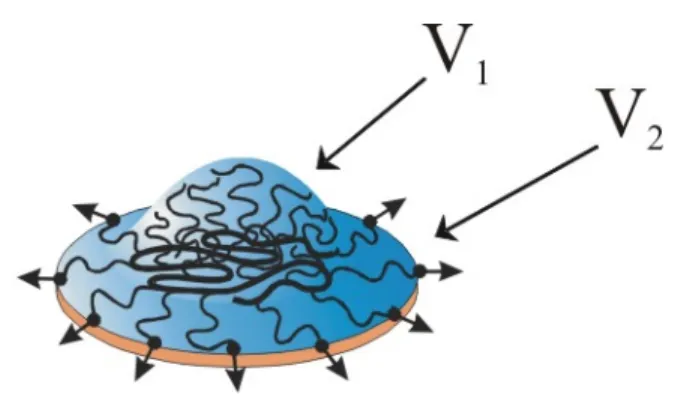
Figure 2.5Schematic for the Conformational Transition of a Multi-arm Brush Molecule Caused by Two-dimensional Compression As opposed to the hemispherical (globular) conformation of compressed linear brush molecule61, multi-arm brushes undergo a transition
from an extended conformation (a) to a disk-like conformation (b,c). The (b) and (c) show overhead and side views of the disk-like conformation, where the backbone remains adsorbed to the substrate.
A monolayer of the four-arm brush was imaged by AFM at three different degrees of
compression. Figure 2.6 shows the surface pressure-molecular area isotherm for the
four-arm brush. Similar to other fluids, compression of the multifour-arm brushes was reversible, as
expected for equilibrium spreading. However, the isotherm has characteristics that
distinguish it from conventional liquids. The pressure onset occurred at a mean molecular
area of approximately 14,000 nm2
and rose until an area of 8000 nm2
where the pressure
reached a plateau of 22.5 mN/m. This plateau continues to about 5600 nm2
where a second
plateau at 23.5 mN/m is observed. Similar behavior was observed for linear brushes (f = 1).61
In order to study the conformational changes occurring upon compression, four samples were
transferred onto mica at different degrees of compression. Letters on the isotherm indicate
molecular areas where the samples were taken.
Figure 2.6 LB Isotherm for the Four-arm Brush The surface pressure-molecular area isotherm for the four-armed brush was measured at T=23ºC. The mean molecular area was determined for the number average molecular weight Mn= 6.0 x 10
6
g/mol obtained by AFM-LB. The mean molecular area is the average area of a single brush molecule on the water surface. The points on the compression isotherm indicate compressions at which a monolayer was transferred onto mica for AFM studies. Each point corresponds to an AFM image in Figure 2.7.
Figure 2.7 shows molecular conformations depicted by AFM during the transition for
the four-arm brush. At a molecular area of 12,000 nm2
(Fig. 2.7a) all of the arms are fully
extended. As the molecules were compressed to a molecular area of 7200 nm2
(Fig. 2.7b),
the arms began to shorten and the middle of the molecules slightly increased in height. At
this area, there is a coexistence of extended molecules and disk-like molecules, as well as
some that appear to be in a transient state. At a molecular area of 6200 nm2
(Fig. 2.7c), all
40
Figure 2.7 AFM Height Images of the Four-arm Brush Conformational Transition
AFM records the transition of the four-arm brush from a star-like to a disk-like conformation. The transition was caused by lateral compression of monolayer films on the surface of water. The height images correspond to the different degrees of compression depicted in Figure 2.6. The cartoon in (d) shows hexagonal ordering of disk-like molecules stabilized by the steric repulsion of adsorbed side chains. The cross-sectional profile in (e) was measured along the dashed line in (c).
2.4.2 Ordering of Four-arm Macromolecules
At low pressures, star-like molecules are disordered because of the flexible nature of
the arms, which results in the irregular shape of adsorbed molecules. Once the molecules
transform from an extended to a disk-like conformation, they also gain local hexagonal order,
which is stabilized by the steric repulsion of adsorbed side chains. Regions of short-range
hexagonal order are clearly seen in the AFM images (see Figure 2.7c). The observed order is
consistent with the lower polydispersity of the four-arm brushes.
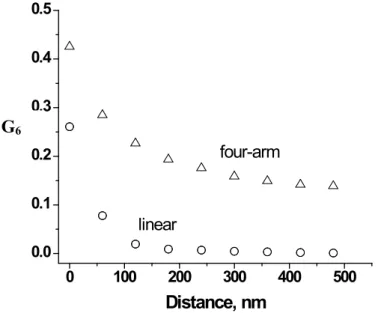
One can compare the ordering behavior of the four-arm brushes (PDIL = 1.04) and
of linear brushes in globular conformation (Fig. 2.8a) and four-arm brushes in the disk-like
conformation (Fig. 2.8b). Visual comparison of the images of the linear and four-arm
compressed brushes reveals that the monolayer of the four-arm molecules is more ordered.
In the insets in Figure 2.8, there are small domains with nearly perfect hexagonal order that
are also evidenced by the 2D power spectral density, P2(s), where s is the 2D reciprocal space
vector. The P2(s) of the four-arm brush demonstrates a well defined six-fold symmetry,
whereas the linear brush has a less defined pattern indicating less order. The observed
modulation in the scattering intensity vanishes in large samples. Figure 2.9 shows the angular
dependence of the radial-averaged intensity I(φ) for 1x1 µm2
and 5x5 µm2
AFM images. This
function was calculated as
!
= P s ds
I(") 2( ,") (5)
where the integration is performed in the range of s corresponding to the first-order
diffraction peak (see insets in Fig. 2.8). The smaller areas clearly show distinct peaks
separated by 60 degrees (Fig. 2.9a). However, even for the larger area, one can distinguish
42
Figure 2.8 2D Power Spectral Density of Monolayers of Globular Molecules Height images of the compressed linear brush (a) and four-arm brush (b). The highlighted area in (b) shows a domain with nearly perfect hexagonal order. The insets show the 2D power spectral density measured for 1x1 µm2
areas of the monolayers. Six peaks are clearly visible in the four-arm PSD indicating the presence of orientational and translational order in the system.
Figure 2.9 Angular Dependence of the 2D Power Spectral Density Function P2(s)
calculated according to eq. (5). A-B correspond to AFM images of the four-arm brushes with sizes of 1x1 and 5x5 µm2