
Continuum-atomistic algorithms for dendritic formation
Gregory Herschlag
A dissertation submitted to the faculty of the University of North Carolina at Chapel Hill in partial fulfillment of the requirements for the degree of Doctor of Philosophy in the Department of Mathematics.
Chapel Hill 2013
Approved by
Sorin Mitran
M. Gregory Forest
Laura Miller
Rene Lopez
ABSTRACT
GREGORY HERSCHLAG: Continuum-atomistic algorithms for dendritic formation (Under the direction of Sorin Mitran)
Nanoscale patterning of materials at scales of less than 20nm remains a challenging
problem. Standard techniques, such as lithography, rely on electron and photon beams
to shape materials, yet these methods are difficult to employ at the sub 50nm scale. We
consider the possibility of employing natural interface instabilities during solidification
in order to reliably produce desirable structures. Existing continuum methods for
com-plicated materials may break down at these scales, while direct atomistic simulation is
computationally infeasible. The primary objective of the thesis is to develop methods
ca-pable of efficiently resolving the atomistic computations which may eventually be solved
concurrently with continuum scale approaches. In the present work we develop atomistic
algorithms to furnish closures for continuum methods. We develop novel molecular
tech-niques capable of resolving detail only about an interface with non-periodic boundaries
and accelerated by GPUs. The new algorithms provide a method to determine interfacial
dynamics based on local curvature, employing wedge shaped domains. These dynamics
lead to continuum closures which are used to determine necessary physical parameters
ACKNOWLEDGEMENTS
I would like to thank my advisor, Sorin Mitran, for his patience in teaching me
structure and planning, Greg Forest for his guidance, Laura Miller for giving me my
first taste of research, and my parents for their constant support. I am grateful to UNC
through which I have developed many friends and colleagues who have helped me grow
TABLE OF CONTENTS
LIST OF TABLES . . . vii
LIST OF FIGURES . . . viii
Chapter 1. Material design for interfacial growth phenomenon . . . 1
1.1. A brief survey of material design . . . 1
1.2. An outline for dendrite formation upon solidification . . . 6
2. Existing continuum solidification models . . . 9
2.1. Sharp interface models . . . 9
2.1.1. The Gibbs-Thomson relationship . . . 11
2.1.2. Algorithms for sharp interface methods . . . 21
2.1.3. Assumptions and limitations . . . 27
2.2. Phase field models . . . 28
2.2.1. Algorithms for phase field methods . . . 30
2.2.2. Assumptions and limitations . . . 31
3. Molecular dynamics and applications to solidification . . . 34
3.1. Statistical mechanics . . . 37
3.1.1. Common ensembles . . . 37
3.2. Hamiltonian dynamics . . . 41
3.2.1. Hamiltonian molecular dynamic algorithms . . . 42
3.2.2. Hamiltonian conservation of phase space . . . 44
3.3.1. The virial theorems to derive molecular temperature and pressure 46
3.3.2. NVT equations . . . 49
3.3.3. NPT equations . . . 50
3.3.4. Numerical integration of the NVT and NPT equations . . . 52
3.4. Closing the Gibbs-Thomson equation . . . 53
3.4.1. Determining density and latent heat . . . 53
3.4.2. Determining the curvature closure coefficient . . . 53
3.4.3. Determining the velocity closure coefficient . . . 60
3.5. Discussion . . . 62
4. Finite domain molecular dynamics with non-periodic boundaries . . . 63
4.1. The Langevin equation . . . 64
4.1.1. The classical Langevin equation . . . 64
4.1.2. The generalized Langevin equation . . . 66
4.2. Other existing non-periodic boundary methods . . . 71
4.3. A novel method for non-periodic boundaries . . . 74
4.3.1. Transition equations . . . 74
4.3.2. Closing the equations . . . 77
4.3.3. The numerical implementation . . . 81
4.3.4. Results . . . 84
4.3.5. Discussion . . . 90
4.4. A novel barostat without altered particle dynamcis . . . 92
5. Interface dynamics . . . 97
5.1. Details of previous methods . . . 98
5.2.2. Curved domains . . . 104
5.3. Effects on solidifying structures . . . 107
5.3.1. Solidifying argon . . . 114
6. Discussion and Future directions . . . 120
6.1. Summary . . . 120
6.2. Future directions . . . 121
LIST OF TABLES
Table 4.1. Solid and liquid dilatation rates along with phase change temperature for all algorithms . . . 89
Table 5.1. Velocity closure coefficient of argon . . . 103
Table 5.2. Velocity of the front vs temperature in two wedge shaped domains . . 107
LIST OF FIGURES
1.1. Figure of nano-patterns on butterfly wings . . . 3
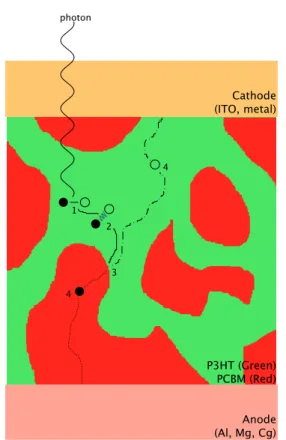
1.2. Physical outline of the mechanism behind solar cells . . . 4
1.3. Organization of the bulk-heterojunction . . . 5
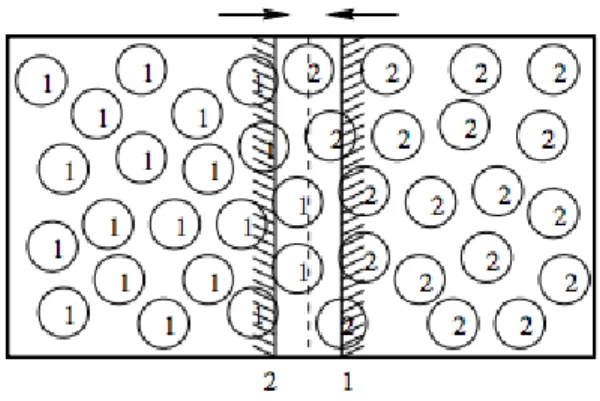
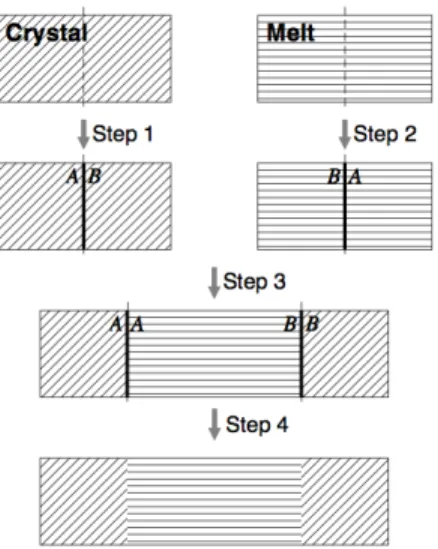
3.1. Cleaving method to determine interfacial surface energy . . . 54
3.2. Work on the system during the cleaving method . . . 56
4.1. Chi-squared test for the distribution on a crystalline solid . . . 86
4.2. Correlations between velocity and mean position . . . 86
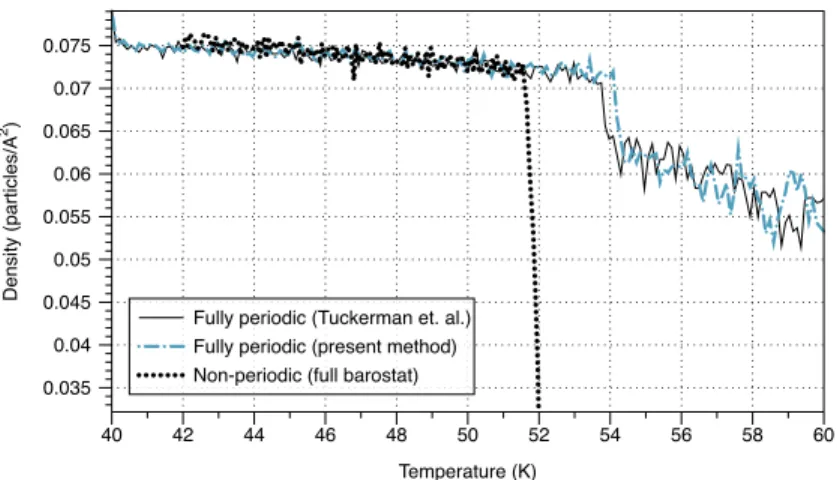
4.3. The mean virial gives incorrect NPT dynamics . . . 87
4.4. Statistical comparison of the new method with the periodic method . . . 88
4.5. Comparison of equilibrated and non-equilibriated wedge shaped domains . . 95
4.6. Large barostat frequencies may lead to accurate dynamics when compared to periodic simulations . . . 96
5.1. Solidification with imposed rate . . . 98
5.2. Solidification of argon for different thermo and barostat weights . . . 102
5.3. Solidification of argon for for the non-periodic, rectangular geometry . . . 103
5.4. Solidification of argon for for the non-periodic, wedge shaped geometry . . . . 106
5.5. Parameter sweep; increasing velocity closure coefficient with zero curvature closure coefficient. . . 109
5.6. Parameter sweep; increasing velocity closure coefficient with non-zero curvature closure coefficient. . . 110
5.7. Parameter sweep; increasing velocity closure coefficient with decreased latent heat and zero curvature closure coefficient. . . 110
5.8. Initial conditions in the planar solidification problem . . . 111
5.9. Demonstration of planar fingering . . . 112
5.11. Demonstration of no planar fingering . . . 113
5.12. Second demonstration of planar fingering . . . 113
5.13. Large undercooling of 10K in the liquid region of argon is unable to form dendrites at the 20nm scale. . . 117
5.14. Dendritic structure formation of argon. . . 117
5.15. A parameter sweep over the velocity and curvature closure coefficients for solidifying argon . . . 118
CHAPTER 1
MATERIAL DESIGN FOR INTERFACIAL GROWTH PHENOMENON
1.1. A brief survey of material design
The long-standing recognition that molecular arrangements and mesoscale structures
determine bulk material properties has led to the goal of gaining control over these
small scales to enable the design and fabrication of new materials. Conventionally, this
has been a process of trial and error: invent or select a material, allow it to undergo
a particular process and inquire into resulting macroscopic properties. Endeavors in
metallurgy have led to historically significant advances as well as recent insights and novel
material designs. For example, metals were strengthened by the addition or reduction
of impurities during fabrication; in one such instance of this process, ancient Damascus
sabers underwent a manufacturing process which embedded carbon nanotubes in the
weapons, leading to sharper and stronger blades [116]. Strong alloys also resulted from
this process; steel, for example, is produced by removing carbon impurities from melted
iron ore, and then alloying the metal with elements such as nickel or magnesium [82].
The processing of a material may also significantly change its properties, and Japanese
sword makers have long known that folding steel leads to more robust katanas [142]. The
metallurgical revolution continues to this day with advances in biologically unobtrusive
alloys used for surgical and dental implants [97], advances in annealing treatments for
heat resistant castings [11], and much more [105].
This approach of trial and error has also led to the polymer revolution in which
newly invented polymers have lead to a plethora of invention. Lead primarily by
Wal-lace Carothers of E. I. du Pont de Nemours and Company (DuPont), chemists began
proved remarkably useful, and have since become household names including neoprene,
mylar, nylon, teflon and vinyl. The processes to manufacture these polymers into
de-sirable bulk materials nearly always involve some combination of annealing (heating) a
polymer blend, pressing or stretching the material, or allowing the polymer to form a
thin film. For example, Arnold Miller Collins and Wallace Carothers discovered the
syn-thetic rubber neoprene by the purfication of divinyl acetylene in the presence of cuprous
chloride via a careful process of heating [48]. Mylar, which is stretched polyethylene
terephthalate (PET), is formed via a process that requires heating and stretching a thin
film [114]. Kevlar, invented by Stephanie Kwolek, is formed by extracting a mixture
of poly-p-Phenylene-terephthalate and polybenzamide from a spinneret, forming a fiber
with extremely high tensile strength [30]. In summary, the field of material fabrication
has been an enormously successful endeavor.
This success has lead to ever widening methodologies and approaches to design and
understand new materials. In addition to the chemical and manufacturing approaches
described above, computational simulations seek to provide insights toward gaining
con-trol over the microscopic scale in order to produce desirable properties at meso or macro
scales. Instead of starting with a microscopic material and then testing its macroscopic
properties, the framework is shifted: given desirable macroscopic properties, we search
for microscopic configurations that are able to produce these desirable properties. This
is a challenging problem and requires detailed mathematical models that span multiple
scales, along with numerical tools that are able to accurately capture desired
observ-ables, kinetics, and bulk properties. Perhaps the most prevalent method in material
design is density functional theory (DFT) [53]. In terms of bulk properties, DFT has
lead to improvements in alloy designs in titanium [68] and steel [54]. In [68], the Young’s
modulus was estimated by slight deformations in a body centered periodic cube (bcc)
composed of titanium and a variable second element; the authors were able to classify
and quantify structures which had greater tensile strength than pure bcc titanium which
new materials Gum Metals TM. DFT is also commonly used to determine jump rates for
surface catalysis [117]; these reaction rates are then employed in kinetic Monte Carlo
simulations to determine the utility of different types of material for surface catalysis,
enabling for the optimization of surface type based on rates of catalysis. As a third, but
by no means exhaustive, example, DFT calculations were used to propose tetragonal iron
cobalt alloys which have highly desired uniaxial magnetic anisotropy along with a high
saturation magnetization; the new material may prove useful in improving the recording
density of hard drives [22].
In addition to DFT, an array of continuum models, stochastic, and molecular models
have enabled advancements in material design. For example, continuum models are
used to test and and simulate discovered materials and models have been used to stress
test airplanes, bridges and buildings given strength estimates of component parts (for
example [47], [94], and [158] respectively). Stochastic methods have been used effectively
Figure 1.1. Figure take from [148] (a)
shows the unaltered blue color of theMorpho rhetenor wing (bar is 1cm) while (b) shows the micro-scale that leads to such coloring (bar is 1.8µm). (c) shows the wing structure ofMorpho didius (bar is 1.8µm
to model mesoscale behaviors in which it
is necessary to reduce large degrees of
free-dom to ranfree-dom variables; as an example,
these methods have been used to
simu-late polymer dynamics and aid in modeling
protein folding [119]. Molecular dynamics
is used when all degrees of freedom in a
problem are important and has been used,
for example, to predict crack formation in
materials under manufacturing conditions
[33].
While the above examples primarily
focused on control of volume structures,
there is also a great deal of interest in determining the evolution and growth of interfaces.
crystals, die patterns on butterfly wings [148] (see figure 1.1), crystal formation upon
an evaporating solvent [121], geological structures [46, 27], interpenetrating fluids [87],
and more.
In addition to understanding the physical processes that enable the formation of these
complex geometries, the structures themselves have many potential applications. The
butterfly wings of Morpho rhetenor and Morpho didius contain tree-like structures with features on the order of the wavelength of light. These structures act
P3HT (Green) PCBM (Red) Cathode (ITO, metal)
Anode (Al, Mg, Cg)
photon
3 4
2
4
1
Figure 1.2. A photon creates a bound
ex-citon in an electron donning material. Dif-fusion causes the exciton to collide with an interface where separation is energetically fa-vorable. The split charge carries are trans-ported to the anode and cathode via an in-ternal potential field. The island to the right will not allow for charge collection. The physics are further explained in [141]. as a photonic crystal that perfectly reflects
part of the visible spectrum leading to
bril-liantly metallic blue wings as is shown in
figure 1.1[148, 113]. Surface structures
can also lead to desirable dewetting
prop-erties, such as that which occurs on the
lotus leaf, insect eyes, peacock wings, and
many other types of living organisms found
in nature [151]. There are also proposed
techniques for using complex interfacial
structures to trap medicinal particles and
create a slow release for the delivery of
medicine [106].
The practical application that
moti-vates this thesis is that there are a
num-ber of processes that benefit from a high
ratio of surface area to volume, yet also
require the interfaces to be well ordered.
For example, organic solar cells generate
charge carriers when excited electron-hole
material [39]. The lifetime of an exciton, however, is short, so typically the electron
accepting and donating materials are well mixed to create a high surface area to volume
ratio (see figure 1.2). The mixing generates isolated islands of material which trap charge
carriers, as well as complex pathways for charge extraction, which lead to losses by
re-combination. Theoretical modeling [154] has revealed that ordered structures with high
surface area to volume ratios would allow a 50% efficiency gain in energy production (see
figure 1.3).
The importance of complex interfacial structures has been established, but the
chal-lenge of how to control formation of these interfaces remains. For small scale
struc-tures (structure on the order of 30-100nm) the field that has arisen to tackle these
construction problems is called nanolithography. The most heavily employed methods
in these fields involve fabrication via the careful application of an energy beam
com-prised of electrons, photons, or ions. This practice has lead to a number of advances
including electron beam production of graphene [159], and photolithography techniques
for semiconductors leading to smaller and faster and transistors (for example [65]).
Figure 1.3. Ordered phase separation of
the bulk heterojunction leads to enhanced efficiency in organic solar cells [154].
Nanoimprint lithography is also used for
cheap and reproducible production of
diffraction grating patterns; these patterns
can be used to generate photonic
crys-tals with enhanced adsorption properties
at targeted areas of the spectrum [85].
Fi-nally, in Aryal et al [6] the authors
success-fully produced two dimensional patterns
mimicking the butterfly wings.
An alternative approach toward
inter-face generation is to ask how we can use
naturally occurring interface instabilities to grow and pronounce emerging structures,
either use the old methods of trail and error, or develop new mathematical and numerical
techniques which allow us both to understand and simulate these emerging structures
in a faster and less expensive environment. In the present work, we focus on the
de-velopment of atomistic to continuum linkage algorithms which model the phenomenon
of crystallization of a solid leading to dendritic pattern formation. We present a brief
history and outline of this problem below, as well as outline the following chapters and
structure of this work.
1.2. An outline for dendrite formation upon solidification
Nanoscale patterning of materials at scales of less than 20nm remains a challenging
problem. Standard techniques, such as lithography, rely on electron and photon beams
to shape materials, yet these methods are difficult to employ at the sub 50nm scale. We
consider the possibility of employing natural interface instabilities during solidification
in order to reliably produce desirable structures. Existing continuum methods for
com-plicated materials may break down at these scales, while direct atomistic simulation is
computationally infeasible. The primary objective of the thesis is to develop methods
ca-pable of efficiently resolving the atomistic computations which may eventually be solved
concurrently with continuum scale approaches. In the present work we develop atomistic
algorithms to furnish closures for continuum methods. We develop novel molecular
tech-niques capable of resolving detail only about an interface with non-periodic boundaries
and accelerated by GPUs. The new algorithms provide a method to determine interfacial
dynamics based on local curvature, employing wedge shaped domains. These dynamics
lead to continuum closures which are used to determine necessary physical parameters
that allow for dendritic patterning at the sub 20nm scale.
This work begins with the question as to how a material will solidify upon the
ex-istence of a crystal seed, which has been of interest since the 1800’s, drawing interest
differential equations to describe this process around 1890 [147], given as
∂T ∂t =Dl
∂2T
∂x2 for x∈Ωl
(1.1)
T =TM for x∈∂Ωl
(1.2)
HereDl is the thermal diffusivity coefficient in the liquid, Ωl is the liquid domain, TM is
the melting temperature of the material, and ∂Ωl is the boundary of the liquid domain
surrounded by a solid phase of the same material. The equations can be generalized to
allow for the diffusion of heat in the solid, as well as for spatially varying heat capacities
and specific heats. Consideration of multiple dimensions leads to effects of curvature on
the interface, and the question of how heat transfer should be treated at the boundary. A
relationship relating the temperature to the curvature of a sharp interface was proposed in
1932 by Paul Kubelka [89]. However the relationship became known as Gibbs-Thomson
relationship, despite the fact that neither Josiah Willard Gibbs nor William Thomson
(Lord Kelvin) derived it [52]. William Thomson did however derive relationships between
curvature and the surface pressure between droplets separating liquid-vapor phases [133],
and the Gibbs-Thomson relationship has been extended to describe the relationship
be-tween melting temperature and curvature, and then again to encompass relationships
between surface solute concentration and curvature (for example [96, 107]).
Chapter 2 will develop the Stefan equations along with methods to solve the resulting
equations, as well as present continuum and thermodynamic arguments for the
Gibbs-Thomson closure. We will focus on the Gibbs-Gibbs-Thomson relationship as a correction to
equation 1.2 which we will reveal as a linear expansion about curvature and the velocity
of the front. We also briefly review phase-field theory. Where the Stefan problem may
be thought of as a sharp interface model, phase field theory is a diffuse interface model
requiring mesoscale approximations. The two methods are required to be equivalent
in the sharp interface asymptotic limit, and we include discussion of both for the sake
the linear terms in Gibbs-Thompson relationship will be shown to have physical
sig-nificance under certain quasi-equilibrium, thermodynamic assumptions and we will also
revisit improvements made by Herring [58] for the physical descriptions of the curvature
coefficients.
The main difficulty in computational modeling of solidification is the necessity to close
the continuum models. Molecular techniques require far to much detail to be feasible for
direct computation, but the closure laws must reflect the molecular detail. In chapter 3,
we review current methods used to fit Gibbs-Thomson coefficients. The existing methods
all measure the Gibbs-Thomson relationship indirectly and there is evidence that the
relationship will break down for complicated molecular materials. We thus begin to
build a new approach to find this relationship in chapter 4 where we present non-periodic
strategies for molecular dynamics. Such non-periodic strategies may be used in arbitrary
domain shapes, allowing us to directly capture curvature effects on the molecular level
without resolving the entire bulk. Chapter 5 uses these new molecular techniques to
estimate Gibbs-Thomson coefficients for different materials and compares this with the
existing methods presented in chapter 3. The results are used in the continuum theory to
predict the variety in structure from solidifying seeds given the Stefan continuum model
along with the algorithms used to solve these equations from chapter 2. Finally we discuss
the implications and contributions of the work in chapter 6, along with promising future
CHAPTER 2
EXISTING CONTINUUM SOLIDIFICATION MODELS
Interface formation during solidification occurs at scales which render molecular
de-scriptions computationally intractable. At the continuum level, there are two physical
descriptions for solidification processes, and numerical algorithms have been developed
for each. The first method supposes that the phase change may be modeled as a sharp
interface in which the boundary width separating the phases is of infinitesimal width.
The second is classified under phase field models in which the interface is modeled as a
diffuse region of small, but finite thickness. This chapter is dedicated to reviewing these
continuum methods. We start with a discussion on the sharp interface methods, and
next describe the phase field models. We then discuss the underlying assumptions and
limitations of these models. In the discussion on the sharp interface methods, we expose
and derivate the Gibbs-Thomson closure; this closure is used to set the temperature at
sharp interfaces, and is as a constraining equation for asymptotic limits of thin interfaces
in phase field models.
2.1. Sharp interface models
The hypothesis behind sharp interface models is that an interface between liquid
and solid regions may be assumed to have negligible thickness. The interface separates
physical domains, each with prescribed bulk dynamics, and the bulk phases communicate
through closure laws on the interface. The bulk properties determine the dynamics of
the interface, and the properties of the interface determine boundary conditions on the
bulk dynamics. In the present work, we consider solidification of a solid seed in a liquid.
The classical Stefan equations are derived when we assume that temperature is the only
important field variable and that in each region temperature will evolve according to
the heat equation. Allowing the liquid and solid regions to be denoted by Dl and Ds
respectively, temperature evolves within each domain according to
(2.1) ci
∂T
∂t =∇ ·(ki∇T),
fori∈ {l, s}, and whereciis the volumetric heat capacity andkiis the thermal diffusivity.
The jump condition at the interface, called the Stefan condition, is given as
(2.2) LV =−
kl
∂Tl
∂n −ks ∂Ts
∂n
,
whereLis the latent heat of solidification, the subscripts s, l refer to the liquid and solid
regions respectively, and n refers to the normal vector at the interface that points into the liquid region. Finally, V is the velocity of the interface in the direction of n. The Stefan condition equates the energy flux released by the phase transition of the moving
front, with the energy flux due to the transfer of heat, giving local conservation of energy.
Temperature boundary conditions are, as of yet, unprescribed at the interface of
the phase transition. Initially [147], Dirichlet boundary condition were used to set the
melting temperature at the interface to be the melting temperature of the bulk solid,
given as TM. There is, however, a change in free energy due to the presence of an
interface which causes a shift in the melting temperature. This may be closed by the
Gibbs-Thomson relationship, which may be written as
(2.3) T(x, t) =−Cκ−VV +TM,
where κ is the curvature of the solid-liquid interface and is positive when the center of
curvature lies in the direction of the solid, andV is the velocity of the front as described
above. The’s are considered to be constant material properties of the system in question.
Throughout this thesis, we will refer to C as the curvature closure coefficient and V as
positive curvature due to the fact the interface lattice sites have a higher probability
of interacting with liquid particles on the boundary while at the same time having less
average solid particles setting up the lattice potential wells to keep them in the solid
phase. The velocity of the front may also be expressed as a function of under cooling,
where higher undercooling lead to faster rates of solidification; thus, the correction due
to the velocity term arises. In general, each correction term may be anisotrpic and
depending on the orientation of the underlying solid structure. The derivation of this
closure arises from a linearized expansion after solving for the free energy change due to
the presence of a surface and will be explained in detail in the proceeding subsection.
The classical Stefan problem may be compared to the more modern formulation of the
Stefan problem which considers advection in the liquid due to changes in density between
the phases, and may also include advective transport of a solvent which forms the solid
seed in a solute (see, for example, [130]).
2.1.1. The Gibbs-Thomson relationship. Before we begin the derivation of the Thomson equation from equation 2.3, we note that generally speaking a
Gibbs-Thomson equation refers to any equation which relates thermodynamic, geometric, and
system dynamics to the properties of an interface. In addition to the temperature
correc-tion above, other Gibbs-Thomson relacorrec-tionships derive equacorrec-tions for pressure or densities
across an interface [12], the chemical potential across an interface [71], or surface
con-centrations [107]. In all of these relationships derivations are nearly always based upon
an assumption of quasi-equilibrium states that depend on interfacial size, shape,
tem-perature, surface tension, temperature and pressure. A few results are derived from
statistical physics [12], however no such derivation exists for the relationship on melting
temperature. In addition to the quasi-equilibrium theory, non-equilibrium theories have
been developed to account for corrections due to advancing interfaces. This correction,
corresponding to V, is often referred to as a kinetic correction, however we will call this
used to derive the Gibbs-Thomson relationship due to curvature corrections, and next
review the theory for the kinetic correction.
2.1.1.1. Curvature based correction on the melting temperature. A simple derivation of the curvature based correction on Gibbs-Thomson relationship (following [36]) may be
derived starting from the spherical Young-Laplace relationship
(2.4) Ps−Pl =
2γ r ,
where Pi is the pressure in the solid region (s) and liquid region (l), γ is the surface
tension (more accurately, the surface free energy), and r is the radius of curvature of a
spherical seed.
Next we consider the Gibbs-Duhem equation [26] arising from the basic
thermody-namic postulates that (i) we can express the energy U of a system as a function of the
extensive system properties entropy, volume, and particles (S, V, N, respectively), and
that (ii) the relationship is given as U(S, V, N) = T S−P V +µN. Here T is
tempera-ture, P is pressure and µ is the chemical potential. Linearizing the energy about small
perturbations then impliesdU =T dS−P dV +µdN which, in turn, implies that
(2.5) 0 =SdT −V dP +N dµ.
The Gibbs-Duhem relationship can be used to write
ssdT −ρ−s1dPs+dµs = 0,
(2.6)
sldT −ρ−l 1dPl+dµl = 0,
(2.7)
for the solid and liquid phases, where si is the entropy per particle given as Si/Ni, and
ρi = Ni/Vi is the density. We next assume that the external pressure of the liquid is
constant throughout the liquid phase so that dPl = 0. The differentials of the chemical
potentials in the bulk materials are assumed to be equal so thatdµs =dµl [71, 66]. This
may be seen by noting that the Gibbs free energy must be equivalent for each phase at
to be equal in each phase so that µsN = µlN. Subtracting the first equation from the
second gives
(sl−ss)dT +ρ−s1dPs = 0,
(2.8)
L Tm
dT +ρ−s1dPs = 0,
(2.9)
where the latent heat of the phase transformation is given as L = (sl−ss)T, since this
is the free energy change due to the change in entropy between phases. Taking the
differential of the Young-Laplace relationship in equation 2.4 yields
(2.10) dPs−dPl=d
2γ r
,
Again using the assumption that dPl= 0, we can substitute to obtain
L
TdT +ρ
−1
s dPs = 0,
L
TdT +ρ
−1 s (d
2γ
r ) = 0,
Z
L
TdT = −
Z
ρ−s1(d2γ r ), Llog T Tm
= −ρ−s12γ r . (2.11)
Assuming that the corrected temperature is close to the melting temperature, we can
linearize the above equation to find
(2.12) T =Tm
1− 2γ
ρsL
1 r
,
which provides us with the curvature based correction of the Gibbs-Thomson relationship
For general surfaces, the Young-Laplace equation is
(2.13) Ps−Pl=γ
where κ1 and κ2 are the two principal curvatures. This formulation leads to a more
general Gibbs-Thomson closure [5]
(2.14) L T Tm −1 +∆cP T log T Tm
+Tm−T
+vsγ(κ1+κ2)+γa+k1(κ1−κ2) = ∆v(Pl−Patm),
where ∆cP is the jump in specific heat with constant pressure across the phase transition,
Patm is the pressure at infinity and Pl is now the pressure of the liquid at the surface;
vs = ρ−s1 is , a = A/ms is the ratio of the surface area of the phase transition to the
mass of the solid,k1 is called the coefficient of curvature (a correction term to the energy
based on curvature) and ∆v = ρ−1
s −ρ
−1
l is the jump in inverse density related to the
phase transition.
The corrected Young-Laplace condition causes additional terms to rise in deriving the
Gibbs-Thomson relationship, and a corrected scaling law arises. Assuming ∆cP = 0, we
get
(2.15) Ti =Tm−
Tm
L (vsγ(κ1 +κ2) +γa+k1(κ1+κ2)−∆v[Pl−Patm]),
and then assumingκ1 =κ2 and Pl=Patm
Ti = Tm−
2Tmγ
ρsLr
− Tmγa
L
= Tm−
2Tmγ
ρsLr
− Tmγ4πr
2
Lms
= Tm−
2Tmγ
ρsLr
− Tmγ4πr
2
L(4πr3/3)ρ s
= Tm−
5Tmγ
ρsLr
.
The form of the equation is the same as the simplified relationship, however there is a
corrected scaling factor on the interfacial temperature.
In [58], Herring determined that for droplets surrounded by vapor, the difference in
expressed as
(2.16) µsi −µv =
1 ρs
γ+ ∂
2γ ∂θ2 1 1 R1 +
γ+∂
2γ ∂θ2 2 1 R2 ,
whereR1andR2 are the principal radii of curvature in the principal planesP1andP2 (i.e.
orthogonal planes each containing the normal vector at the interface). The θ variables
follow the path of the interface, and thus the double derivatives represent the concavity
of the surface tension γ as the position on the interface is perturbed. The chemical
potential of the solid at the interface is denoted byµsi, and the chemical potential of the
bulk vapor is µv.
The primary mechanism behind Herring’s correction, is to notice that when the
sur-face tension depends on orientation and is twice differentiable, the free energy variation
inherits a second derivative in the leading order term. We compute the change in free
energy caused by a variation in the surface via a functional derivative on the interface.
We begin by rederiving the right-hand side of the Young-Laplace equation for a single
dimension, and first assume a constant γ with respect to orientation. The interfacial
energy may be given as Fsr = R
γds, where we integrate over the surface. Letting θ
be the tangent angle to the surface, assume it is small so that θ ≈ dy/da, where y
is the height of the surface and a parametrizes the arc length A. We then have that
ds = sec(θ)dφ ≈ (1 + (dy/da)2/2)da. Taking a small variation over the interface
de-scribed byy(a) gives
δFsr ≈ Z A
0
1 + 1 2
d(y+δy) da
2!
γ− 1 + 1 2 dy da 2! γda = γ Z A 0 dδy da dy
dada+O(δy
2)
= −γ
Z A
0
δyd
2y
da2da
= −γ
R
Z A
0
δyda
= −γ
where the third line comes from integration by parts, the fourth comes using the
relation-ship that curvature is the inverse of the radius is the second derivative ofywith respect to
a, and the fifth line equates the change in volume due to the change in surface. Assuming
we are at equilibrium and that the variation maintains the energy, the Young-Laplace
equation arises when we assume that the pressure redistributes to balance this change,
giving
(2.17) (Ps−Pl)δv+δFsr= 0.
The additional factor of two arises from the transition from two to three dimensions. We
can next ask how the free energy differential changes when we allow γ to depend on θ.
Carrying out similar analysis to the above and Taylor expanding about θ = 0 (without
loss of generality) gives
δFsr ≈ Z A
0
1 + 1 2
d(y+δy) da
2!
γ(d(y+δy)
da )− 1 + 1 2 dy da 2! γ(d(y da )da
δFsr ≈ Z A
0
1 + 1 2
d(y+δy) da
2!
γ(0) +γ0(0)d(y+δy) da +γ
00
(0)
d(y+δy) da
2!
...
...− 1 + 1 2
dy da
2!
γ(0) +γ0(0)dy da +γ
00 (0) dy da 2! da = Z A 0 dδy da dy
daγ(0) + dδy
da dy daγ
00
(0) +O(δy2)da
= −γ(0) +γ 00(0)
R δv,
which gives the Herring correction to the surface tension. In three dimensions, the Herring
correction yields a new Gibbs-Thomson equation for temperature given as
(2.18) Ti =Tm 1−
1 ρL
X
i=1,2
(γ+∂
2γ ∂θ2 i ) 1 Ri ! ,
The Gibbs-Thomson closure has been corrected over the past century and a half,
however there is still controversy as to what correction terms are necessary for an
by positing functions for the surface tension as a function of orientation. The idea
be-hind this assumption is that the interfaces of interest in solidification are typically 1000
times larger than the interface width (roughly O(µm) : O(nm)) and thus the surface
is considered locally flat. It is interesting to note that the curvature effects the
Gibbs-Thomson relationship attempts to capture, assumes that the surface tension will not
depend on curvature. In fact, there are known surface tension corrections for curvature
(see for example [66]), yet there is no existing solidification study that takes this effect
into account.
The temperature correction methods rely on linear expansion methods to solve for
temperature corrections. For multicomponent systems such as metal alloys, however,
there has been a great deal of work that has demonstrated the importance of adding
non-linear effects and corrected models for Gibbs-Thomson relationships between interfacial
concentrations and curvatures [107, 120]. In these works, the authors show that the
classical assumptions fail and develop novel equations that seek to correct the earlier
models, however they do not attempt to determine corrected melting temperatures.
In addition to the equilibrium closure, a kinetic coefficient has also been added to the
Gibbs-Thomson relationship to adjust for non-equilibrium effects. We shall review this
correction presently.
2.1.1.2. Velocity corrections to the Gibbs-Thomson relationship. We next address the velocity term of equation 2.3. In addition to the curvature based corrections of the
inter-facial temperature, non-equilibrium effects also play an important roll for solidification.
The idea behind the corrected temperature-velocity relationship comes form studies on
interface dynamics [69] which relate the temperature of a front with the speed at which
it solidifies.
Current theory behind evolving interfaces describes the rate of the advancing front
as a balance between particles from the liquid becoming a part of the solid phase with
simple relationship
(2.19) V =V+−V−,
where V is the velocity of the interface, V+ is the rate of advancement and V− is the
rate of retreat. The velocity terms are refined by setting
(2.20) Vi =af νi,
where a is the change in the local length of the front due to an attachment or
detach-ment event, f is the fraction of the surface area with sites available for attachment or
detachment, and nui is the rate of attachment/detachment. The first two factors are
chosen based on the orientation of the solid, where the third is unknown and based on
out-of-equilibrium dynamics. The constant of proportionality between νs and νl is
as-sumed to be given by a Poisson process which is governed by the underlying particle
energy difference in the liquid and solid states. This leads to rate constants which are
proportionally closed via a Boltzmann distribution based on the jump in potential energy
for each particle. In a bulk thermodynamic point of view, νi can also be thought of as
jump in the energy associated with being in each phase.
We must then determine the change in the Gibbs-free energy across the phases. For
each phase, the Gibbs free energy and its variation is given as
Gi = µiNi,
∆Gi = µidNi,
for i ∈ {l, s} for liquid and solid. At the equilibrium point the two energies must be
equival in order for both phases to exist stably. Due to the motion of the interface, we
expand about the differential of each phase to get
∆Gi = µinterfacei dNi
≈ dNi(µbulki +
∂µbulki ∂T
P
∆T +
∂µbulki ∂P
T
∆P)
= dNi(µbulki +
∂2H i
∂T ∂Ni
P
∆T +
∂2H i
∂P ∂Ni
T
∆P)
= dNi(µbulki − ∂Si ∂Ni P ∆T + ∂Vi ∂Ni T ∆P),
whereH is the enthalpy. To find the change in the Gibbs free energy associated with the
interface, we then integrate
Z
d(Gl−Gs) = − Z
∂Sl
∂Nl
P
∆T dNl+
Z
∂Ss
∂Ns
P
∆T dNs,
(2.21) + Z ∂Vl ∂Nl T
∆P dNl−
Z
∂Vs
∂Ns
T
∆P dNs,
∆G=Gl−Gs = −(Sl−Ss)∆T + (Vl−Vs)∆P,
(2.22)
= −L∆T /Tm+ (Vl−Vs)∆P
(2.23)
where we have again used the fact that µbulks = µbulkl . Since we presently assume a flat
interface, the pressure correction is absent so that the energy difference in moving across
the interface is given as−L∆T /Tm, with ∆T =Ti−Tm. Thus for an undercooled surface,
it is energetically favorable for particles to attach to the solid phase.
With the above arguments, we may determine the constant of proportionality between
attachment and detachment events to write
(2.24) ν−=ν+exp
−∆G
kT
=ν+exp
−L∆T
kTmT
.
We can then write the velocity of the front as
(2.25) V =af ν+
1−exp
−L∆T
kTmT
and linearize about small interfacial temperature fluctuations to get
(2.26) V ≈af ν+ L∆T
kTmT
.
Given the temperature correction, we can find the velocity, and subsequently
(2.27) Ti ≈Tm(1−
kTm
af Lν+V).
There are other closures for this correction as well. In [157], Wilson proposes that an
activation energy associated with atom mobility to account for the probability of leaving
or entering the solid interface. The activation energy was fit based on the model, and
the model was shown to fit well for the crystallization of silicon [69].
Molecules with pair interactions prescribed by the Lennard-Jones potential, fail for
the model proposed in [157]. These ensembles may, however, be accurately modeled by
allowing the the velocity V to scale with √T in [20, 21] the new model given as
(2.28) V = a
λ
r
3kT m f
1−exp
−∆G
kT
,
where λ is a constitutive correction term and physically interpreted as the distance an
atom must move to join the crystal. In this case we have a nonlinear correction to the
temperature. Setting T =Ti, linearizing the above exponential function, and solving the
resulting equation for the interfacial temperature gives
(2.29) Ti =Tm
1 + kTmλ
2
6a2f2L2V
2−p
kmT3 mV λ
p
12a2f2L2+kmT mV2λ2
1 6a2f2L2
.
We can linearize about the square root term and discard the terms of O(V2) and above
to get
(2.30) Ti =Tm 1−
r
kT3
mm
3 λ af LV
!
which leads to a different physical interpretation of the velocity closure coefficient in the
In addition to the difficulty associated with choosing the proper model based on
molecular potentials, there have been no molecular or kinetic Monte Carlo verifications
to account for the effect of curvature on the velocity closure coefficient. To our knowledge,
there is no theory tying the curvature of an interface with the speed of the advancing
front. Such a proposal however is easy to posit. In equation 2.22 the interior pressure
differential may be replaced with the Young-Laplace equation. Futhermore, we can admit
the possibility that ν+ depends on the interfacial temperature as is predicted in the
Lennard-Jones fit from [20] and equation 2.28 which gives
(2.31) V = a
λ
r
3kT m f
1−exp
−L(Ti−Tm)
kTmT
− 2γ
krρsT
,
Similar analysis leads to a corrected equation
(2.32) Ti =Tm 1−
2γ Lρs 1 r − s 3kmT3
m(rρs−2γ/L)
rρs
λ 3af LV
!
,
providing a relationship on how the velocity closure coefficient will depend on curvature.
Note that the classical Gibbs-Thomson correction arises naturally in the second term of
the right hand side. Furthermore, this equation reduces to the flat interface result of
equation 2.30 in the limit r → ∞. A similar correction may be made with the Herring
contribution. Note however that the assumptions from the linearization require that the
perturbed interfacial temperature are small, and thus Lρ2γ
s
1
r 1, thus we can approximate
this equation as
(2.33) Ti =Tm
1− 2γ
Lρs 1 r − p 3kmT3 m λ 3af LV
,
to recover the full Gibbs-Thomson equation, corrected both for the curvature and velocity
closure effects.
2.1.2. Algorithms for sharp interface methods. With the physics of the sharp interface problem having been reviewed, we now review algorithms that are used to
tracking methods, and we review these below. Other methods exist such as boundary
integral methods, finite element adapting meshes for enthalpy formulations, and others,
but we omit discussing them in the present work.
2.1.2.1. Level set methods. Utilizing the assumption that there is a sharp interface be-tween the liquid and solid regions, level set methods embed this interface via a discretized
field variable which is tracked on a cartesian mesh. The interface is embedded by having
the field variable hold values based on how far the surface is away from the interface.
The zero level set of this field represents the desired interface, and hence the description
‘level set methods.’ The apparent disadvantage of this method is that we are increasing
the dimensionality of the surface and requiring an additional amount of memory
stor-age. The advantage is that by advancing the field, as opposed to the surface, we avoid
difficulties in tracking the surface directly; because of this, moving from two to three
dimensions results in no additional algorithmic complexities
For solidification, both finite difference and finite volume level set methods have been
employed. In the present section we will focus on the conceptually simpler finite difference
schemes. We will outline ideas from [31] and [50].
The basic idea of the algorithm is to use operator splitting by first solving the heat
equation for a fixed interface and then evolving the interface with a fixed temperature
field. This is accomplished by discretizing the domain on the standard regular cartesian
grid, in which we embed the interface on a field described at these points. The field takes
on values by having the regular grid points hold the minimum distance from the interface.
To extract the interface, we can interpolate nodes of the interface that lie between grid
points where there is a change in sign. More sophisticated interpolation schemes will
lead to higher accuracy in recapturing the interface, however linear schemes are often
sufficient and also widely employed in practice.
With the phase of the material assigned by the sign of the embedded field, we can now
expose the techniques used to solve the heat equation. In considering grid points which
scheme for the heat equations (equation 5.11). For example, taking a backward Euler
approach and assuming that the thermal diffusivity is constant throughout the region
will yield
(2.34) T
n+1
i −Tin
∆t =
k c
Ti+1n+1−2Tin+1+Tin+1−1
∆x2 ,
where Tin is the temperature at node point i at time step n, ∆t is the size of a time
step, ∆x is the length of the spatial discretization, and c and k are the volumetric heat
capacity and thermal diffusivity as given above in equation 5.11.
This is not valid when the interface cuts between two finite difference node points.
To circumvent this issue, suppose that the interface cuts between xi and xi+1. The
Gibbs-Thomson relationship specifies the temperature at the interface and thus we have
Dirichlet boundary conditions. Before we can solve the heat equation about grid point
i, we first need to find the interfacial temperature at the interfacial position between xi
and xi+1. This temperature will be a function of the interfacial velocity VI according
to the Gibbs-Thomson relationship; the Stefan condition may be used to determine the
interfacial velocity, however it requires knowledge of the interfacial temperature. We thus
have a two dimensional system with two unknowns
VI =
1 L
−kj
∂T ∂~n
, (2.35)
TI =Tm−CκI −VVI,
(2.36)
whereTI is now defined as the interfacial temperature, andκIis the interfacial curvature.
We then discretize these equations to get
VI =
1 L
−ks
TI−Tis √
2dx
−kl
TI −Til √
2dx
,
TI =Tm−CκI−VVI,
whereTis andTil are the temperatures a distance of √
2dx away from the interface in the
values are found by interpolating from the known mesh via the equation
Tik =(1−fx)(1−fy)T(i+1)j+ (1−fx)fyT(i+1)(j+1)+fx(1−fy)T(i+2)j+fxfyT(i+2)(j+1).
(2.37)
Here we have assumed the four points surrounding the location a distance √2dx in the
normal direction are of a single phase. We next find the curvature at points xi and xi+1
by using the fact that the curvatureκl can be related to the gradient of the normal vector
(2.38) κ=∇ ·n=∇ · ∇φ
|∇φ| =
φ2
yφxx−2φxφyφxy +φ2xφyy
(φ2
x+φ2y)3/2
,
where φ is the field that embeds the level set. Taking typical finite difference schemes,
we can determine the curvature each point on the mesh and then interpolate it to the
interface, similarly to equation 2.37.
We can then write a stencil for the heat equation depending on the interpolation
schemes that we choose. Taking a linear interpolation to the interface yields
(2.39) T
n+1
i −Tin
∆t =
k c∆x
TI−Tin+1
xI−xi
− T
n+1
i −T
n+1 i−1
∆x
.
This closes the description of the heat equation. After this step is complete we next
evolve the interface. To evolve the interface, we first determine the different energies
entering and leaving the system via equation 2.2. This is done in the standard way,
interpolating to the boundary as was done above. Knowing the velocity at the front we
then extend the velocity to the entire fieldφ, denoting this velocity field asF. To extend
the velocity field there are several proposed methods. The original method used in [31]
relies on continuously extending the jump of the derivatives away from the front. To
accomplish this, we may set
u1t + sgn(φφx)u1x = 0,
with u1 = [∂T /∂x] and u2 = [∂T /∂y], sgn is the sign function, and τ is a fictitious
time parameter that will be used to determine the extended velocity field. The idea is
to advect the contributions of the velocity at the interface throughout the domain from
each point of the interface. The velocity, which will be normal to the level set at any
value of φ, is then taken to be the norm of these advected velocities. The issue with this
method is that the field φ does not maintain itself as a distance function away from the
level set which can lead to errors in the interface and present problems with numerical
stability. The solution is then to reset the field as the signed distance function. In [31]
an iterative process is used to relax the field back toward the signed distance function.
Instead of advecting the field via the above method, we can use the Fast Marching
Method [1] which extends the front velocity to the field in a way that preserves the
distance function. The idea is similar to the one above, in that it also advects the field
away from the known values on the mesh, however instead of summing over a variety of
solutions, it advects a unified wave front from the surface and checks the validity of each
point as it marches along.
With the velocity field now extended, we can advect the level set points numerically
using a simple upwind scheme
(2.40) φn+1i =φni −dt max(0, Fi)∇++ min(0, Fi)∇−
,
where
(2.41)
∇+/− = max(0, D−x/+x) + min(0, D+x/−x) + max(0, D−y/+y) + min(0, D+y/+y),
and D+/−x/y is the first order one sided finite difference derivative. From here we can
apply the diffusive and advective schemes as a split operator.
In summary, the algorithm will work as follows:
(1) InitializeT(~x, t) and the interface Γ. Initialize φ.
(2) Find the temperature at each point of Γ that intersects a line of the mesh.
(4) Find the velocity at each point on Γ.
(5) Extend the velocity on the path to φ, denoting this field F
(6) Advect F
(7) Determine Γ by interpolating the new values ofφ.
(8) Repeat.
Higher order corrections have been constructed and implemented [49, 104], as
com-pared to the low order method described above. Many of the level set methods are also
also unable to globally conserve energy about the boundary, however due to continually
improved methods, current methods are able to conserve energy energy upon numerical
discretization [130].
As mentioned above, a minor downside to implementing level set solidification
al-gorithms is that they require extra memory to store φ. There also is the requirement
of constantly moving back and forth between the interfacial and field descriptions to
track where the phase transition occurs. These produce minor algorithmic complexities
however, and the solutions found by these methods are qualitatively accurate and agree
well with solvability theory, an analytic theory that predicts ranges for the tip velocity
[83]. Furthermore, they allow for low resolution about the interface, compared to the
phase field methods that have a sharply changing phase field about the interface, and
thus require high resolution. As a final advantage, level set methods have proven to be
relatively easy to implement in both two and three dimensional settings.
2.1.2.2. Interface tracking methods. Interface tracking methods for solidification are sim-ilar to the level set methods, as both assume a sharp interface between the solid and
liquid phases. Algorithmically however, the interface is directly tracked and advected
throughout the simulation, rather than being embedded in an extended field. Interface
tracking methods applied to solidification appeared before similar application of level
set methods, a notable one appearing in 1996 by Juric and Tryaggvason [72] (3 years
before the first level set methods were used). These methods have since been
has waned, most likely due to algorithmic complexities in generating and updating the
moving Lagrangian interface.
These methods suffer from the same problem of non-globally conserved energy,
how-ever no such method has come along to fix this problem as has been accomplished in level
sets [130]. While the algorithms are diverse in nature, they can be thought of precisely
as the above level set description, in which the interface is advanced directly instead
of being embedded within the level set. While there are algorithmic variations among
both level set and interface tracking methods, the above pseudo code for the level sets
demonstrates a potential interface tracking methods algorithm: operator splitting may
again used and the heat equation is solved identically as in the level set method. The
exception is that the interfacial discretization is redefined at each time step instead of
being embedded in the field variable φ.
The method may be seen as having an advantage over the level set methods in that it
no longer requires interpolating the path at the grid line intersections and it avoids moving
between embedded and explicit representations of the interface. Difficulty is preserved
however, when we acknowledge that the discretization of the path must adapt with the
changing front. Growing fronts will require insertion of node points and methods are
developed to determine how to place them. Additionally, node points may cross, leading
to loops in the path and the necessity to remove points no longer on the interface. Case
based algorithms are fully capable of handling these nuances at the interface, but care
must be taken in accounting for all possibilities.
2.1.3. Assumptions and limitations. The main limitation of the continuum sharp interface model is that we do not know, a priori, the interfacial dynamics employed in the Gibbs-Thomson closure. As discussed above, there has been a great deal of effort to
properly close this equation and relate it to the microscopic properties of the materials.
At the molecular scale, methods have been developed to determine the resulting physical
constants necessary to close the Gibbs-Thomson relationship, and these will be discussed
field models have lead to several distinct possibilities for a Gibbs-Thomson closure,
how-ever there are minor inconsistencies in the results. We will continue this section by review
phase field models.
2.2. Phase field models
Phase field models treat the interface as diffuse across some width w. If taking on a
physically meaningful model, this width should be proportional to the capillary length
between the changing phases, however in many physical scenarios, dendritic fingering
structures occur at length scales on the order of microns, while molecular dynamics
suggest that the capillary length scale is roughly three orders of magnitude smaller.
This length scale disparity makes phase field computation difficult, and in many cases
intractable. Never-the-less supposing larger values for the interface widthwhas provided
a useful tool in modeling problems involving solidification as will be discussed below.
The main advantage of phase field models for computation is that they mitigate
nu-merical noise, grid anisotropies, and other issues that occur in sharp interface modeling
by replacing the challenge of reconstructing advancing fronts with the challenge of
cre-ating grids capable of resolving the diffuse interface. Similar to level set methods, a new
field variableφ is added to the equations which is set to be 1 in the solid phase, 0 in the
liquid phase, and smoothly varies between phases across the front. The evolution ofφ is
found by proposing an evolution equation to minimize a proposed free energy functional,
given in the form of
(2.42) F =
Z
V
dV
w2
2 |∇φ|
2
+f(φ, T, ...)
,
wheref is the free-energy density that depends on the phase field variableφ, temperature,
and possibly other important field variables such as the concentration of a solute. In this
equationf is typically taken to be a low order polynomial inφwith coefficients depending
on physical constraints, with the gradient of φ included as a truncated expansion of the
surface effects on the free energy [91]. Linear effects from the polynomial are omitted
due to the observation that the free energy should be rotationally symmetric.
Phase field models begin as phenomenological expansions of the local free energy.
From the phenomenological descriptions, polynomial coefficients are fit from
thermody-namic arguments to make the free energy descriptions consistent with known theory.
Indeed, the development of phase field models are looked and constructed at in one of
two ways: the first is a construction based on thermodynamic arguments; the second is
purely as a mathematical descriptor which is used to represent a diffuse interface [13].
Once a free energy description is chosen, we must propose an evolution equation
that tracks the systems heat exchange, we may take a similar equation as the diffusion
equations above, however we must include the latent heat exchange as a source term,
as there is no definitive boundary condition any more. Such an equation tracking heat
exchange is now written as
(2.43) cp
∂T ∂t +L
∂φ
∂t =∇ ·(k∇T),
wherecp is the heat capacity,kis the specific heat,Lis the latent heat, andT is again the
temperature. In the sharp interface model the latent heat production was accounted for
directly by equating the energy production of the propagating front with the energy flux
from the boundary, however here latent heat is introduced to the system at the interface
as φ changes from one phase to another (represented in the second term). The heat
capacities and specific heats are known in the bulk phases, however simple constitutive
relationships can be used to link the domains. The simplest and most often used closure
is to let cp = φcs + (1− φ)cl where the subscripts {l, s} refer to the liquid and solid
regions respectively; a similar equation may be used to find the specific heat across the
phase transition.
In addition to resolving the heat exchange, we must also minimize the free energy.
To do this we want to find the interfacial energy found by the changingφ and allow φto
functional derivative must then be zero at equilibrium
(2.44) δF
δφ = ∂f ∂φ −w
2∇2
φ= 0.
In order to relax the system to the equilibrium state, constitutive models can be used to
describe the relaxation process. In solidification, the most commonly used is called the
model A equation, which accounts for simple exponential relaxation. It is written as
(2.45) τ∂φ
∂t =−
∂f ∂φ −w
2∇2φ
,
whereτ is a characteristic time scale of relaxation. More complicated models exist which
seek to conserve various physical quantities (see [59]).
In minimizingF, there is a competition between the gradient ofφand the polynomial
f (see equation 2.42). We note that the free energy of a pure phase (given by the
polynomial f in equation 2.42) must be at a local minimum when φ is either 0 or 1 (in
the liquid or solid phase) since we would otherwise not have a separation of phase, and
thus this term will be minimal when the interface is infinitely thin. The integral of the
squared gradient term, however, is minimized as the interface becomes infinitely large.
This competition between free energy contributions sets the width of the interface.
2.2.1. Algorithms for phase field methods. As we noted before, there is a roughly three order of magnitude difference between the interface width and the radius of
curva-ture associated with dendritic tips. This leads to a large discrepancy of scales which cause
the resulting physical equations in the previous section to be quite stiff. To overcome this
issue, there have been a series of adaptive meshing algorithms that have sought to sharply
resolve the interface while zooming out to account for heat transport in the surrounding
pure phases [103, 111, 112, 109]. In [112], for example, Provatas, Goldenfeld, and
Dantzig close the phase field model with a free energy described by [78]. The authors
then develop an adaptive finite element quad tree structure that is able to efficiently
cap-ture the evolving interface. Without such a method the authors demonstrate that grid
at low undercooling (leading to slower fronts and sharper interfaces) which is unfeasible
computationally. Their results agree well with known theory for high undercooling, but
do not for low undercooling.
For pure melts, Karma and Rappel [79] reformulated the sharp-interface analysis via
a phase field model to recover the sharp interface model. The artificially thick interface
analysis demonstrates that the Gibbs-Thomson relationship at the solid-liquid interface
can be recovered with w much larger than the microscopic surface tension length. This
analysis also allows for asymptotic limits in which the interface can be assumed to be in
local thermodynamic equilibrium, and thus the velocity closure constant (i.e.
tempera-ture correction via the velocity of the front) can be discarded. This artificially diffuse
interface method has lead to a hybrid sharp interface-diffuse phase-field method which
is able to conserve energy and achieves the theoretical predictions at low undercooling
[130].
2.2.2. Assumptions and limitations. While the phase-field methods have proved remarkably useful, they rely on referencing the macroscopic sharp-interface equations
for proper closures able to capture experimental predictions. Care must be taken in
construction of the phase field closures to ensure that the continuum limits are achieved,
and phase-field models are verified based on their ability to asymptotically achieve the
continuum limit rather than taken as a more fundamental physical closure. Assuming a
Ginzburg-Landau theory, Caginalp was the first to show the possibility for recovering the
Gibbs-Thompson closure from a phase field assumption [23, 24], however the interfacial
width needed to be smaller than the capillary length for the sharp interface limit to
be achieved. Karma and Rappel relaxed this restriction allowing the sharp interface
limit to be achieved with a method that allows for a phase-field interface width which is
larger than the capillary length [78, 79]. Despite these advancements the closures and
parameter estimates of phase-field theory are still dependent on the assumptions of the
A second non-physical consequence of phase-field modeling is that numerics performed
using coarse, finite-difference meshes exhibit side branching typical of real dendrites
be-cause discretization errors introduce noise into the calculation. However, a coarse square
mesh can also induce grid anisotropy. As the computational mesh is refined, side branches
disappear in phase-field models, which is an unphysical consequence of the model. To
avoid this problem noise may be introduced to induce side branching. This is typically
implemented by adding stochastic forcing to the phase-field equations [42, 92]. More
recently, noise has been introduced by Monte Carlo techniques which solve the heat
equation away form the interface, essentially constructing a mesh free method away from
the interface; this method provides the noise necessary for side branching and
addition-ally circumvents the necessity of adaptive meshing [109]. To contrast this feature with
sharp interface models, the continuum model contains no inherent length scale in the
dimensional analysis, and thus the fingering process occurs at all length scales and
in-dependently of the mesh structure. Care must be taken in all methods to avoid grid
anisotropy.
Up to this point, we have reviewed phase-field models that are parametrized by a
single phase-field scalar variable. The assumption is that we can take the solid lattice
and liquid density probability density distributions and reduce this function to a single
order parameter [56, 81]. Multiple-order phase field methods exist as well, which are
able to capture richer dynamics across phases (see for example [13]). Anisotropy is
typically taken into account in an ad hoc manner, as is done in the sharp interface
method. Alternatively, one can keep the multiple-order parameter picture and naturally
derive anisotropic effects [16].
The diffuse, but small interface also requires proper grid resolution in order to
ac-curately compute the free energy. This requires adaptive meshing techniques to resolve
interfaces which provide more thoughtful algorithms for three dimensional structures.
Three dimensional solidification via phase field models has been achieved in a number of
Sharp interface and Phase-field modeling provide tools for analyzing solidification
of many types of materials. The remaining task is how to close parameters for given
materials either through the Gibbs-Thomson relationship or for the parameters for the
free energy formulation of the phase-field equations. Having reviewed the descriptions
of continuum laws at both macroscopic and mesoscopic scales given the Gibbs-Thomson
closure, we turn now to how molecular simulations allow us to obtain coefficients for the
![Figure 1.1. Figure take from [148] (a) shows the unaltered blue color of the Morpho rhetenor wing (bar is 1cm) while (b) shows the micro-scale that leads to such coloring (bar is 1.8µm)](https://thumb-us.123doks.com/thumbv2/123dok_us/8315971.2203271/12.918.482.805.562.799/figure-figure-shows-unaltered-color-morpho-rhetenor-coloring.webp)
![Figure 1.3. Ordered phase separation of the bulk heterojunction leads to enhanced efficiency in organic solar cells [154].](https://thumb-us.123doks.com/thumbv2/123dok_us/8315971.2203271/14.918.485.804.656.871/figure-ordered-phase-separation-heterojunction-enhanced-efficiency-organic.webp)

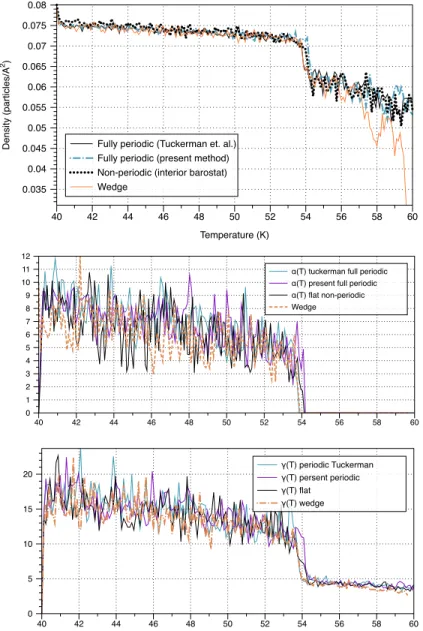
![Table 4.1. The solid and liquid dilatation rates, and phase transition temperatures are presented for the algorithm presented in [136] for pe-riodic boundary conditions, and for the present algorithm for pepe-riodic, rectangular and wedge shaped domains.](https://thumb-us.123doks.com/thumbv2/123dok_us/8315971.2203271/98.918.219.725.85.196/dilatation-transition-temperatures-presented-algorithm-presented-conditions-rectangular.webp)

