For Peer Review
Trust Maintenance as a Function of Construal Level and Attributions: the Case of Apologies
Journal: European Journal of Social Psychology
For Peer Review
ApologiesGijs van Houwelingen
Rotterdam School of Management, Erasmus University Marius van Dijke
Rotterdam School of Management, Erasmus University David De Cremer
Judge Business School, Cambridge University
Authors’ note
Correspondence should be addressed to Gijs van Houwelingen, Rotterdam School of Management, Erasmus University Rotterdam, Burgemeester Oudlaan 50, 3062PA,
Rotterdam, the Netherlands.
E-mail: [email protected]
For Peer Review
ABSTRACTWhen do recipients of an apology (‘trustors’) base their decision to trust a perpetrator (a
‘trustee’) on the attributional information embedded in an apology? Attributions provide a
detailed account of the trustee’s causal involvement in committing a transgression. We therefore
argue that trustors in a low construal level mindset use this information in their trusting decision.
However, trustors in a high construal level mindset likely consider all apologies as simple
statements of regret, regardless of the attributional information they contain. We find support for
this argument in four laboratory experiments. This research nuances the idea that to restore trust
by means of an apology, the trustee must only use an effective attribution for a negative
outcome. We also present a more realistic understanding of the process leading from apologies to
trust than has been offered in previous work by simultaneously considering the role of the trustor
and that of the trustee in the trust restoration process.
Keywords: trust, apologies, social accounts, construal level theory, conflict management 6
For Peer Review
Trust Maintenance as a Function of Construal Level and Attributions: the Case of
Apologies
Apologies restore trust because they convey regret (Davis & Gold, 2011): the trustee
satisfies the needs of the victim (or ‘trustor’) for acknowledgement of the wrongdoing and for
reconciliation (Schnabel & Nadler, 2010). However, apologies do more than just conveying
regret. They also communicate information about the trustee’s causal involvement in the
transgression (i.e., attributional information; Van Dijke & De Cremer, 2011). Research indicates
that attributions affect perceptions of responsibility and blame, and—as a result—they affect
trust (Kim, Dirks, Cooper, & Ferrin, 2006).
Nonetheless, it remains unclear when just conveying regret is insufficient to restore trust
(Tomlinson & Mayer, 2009)? The answer to this question is important, as it might yield insight
into the conditions under which apologies can restore trust in a trustee (Kim, Dirks, & Cooper,
2009). We suggest that much depends on how trustors understand or ‘construe’ the apology. The
information that attributions provide tends to be relatively detailed in nature: attributions provide
information regarding whether the cause of the transgression is internal or external to the trustee,
the extent to which these causes were under the trustee’s control, and/or their temporal stability
(Weiner, 1986). Construal level theory (Trope & Liberman, 2010) suggests that people are
sensitive to such relatively detailed information when they construe matters at a relatively low—
that is, concrete—level (Berson, Halevy, Shamir, & Erez, 2015). Combining these two
arguments, we argue that attributions restore trust mainly when trustors construe apologies at a
relatively low (concrete) level, as opposed to a high (abstract) level.
With this we present a realistic understanding of the trust restoration process by looking 6
For Peer Review
simultaneously at how a trustee phrases the apology and the way the trustor construes that
information. The apology literature has focused excessively on trustee-side antecedents of the
trust restoration effect of apologies (such as the type of attributions used). As a result, the
literature tends to present trustors as overly passive accepters of apologies (Kim et al., 2009).
Theoretical Background
Attributions in apologies
Apologies are commonly conceptualized as explicit verbal or written statements that
contain an expression of remorse or regret and at least some attributional information (Bashford,
Offerman, & Behrend, 2014). Communicating regret helps promote trust after a transgression, as
it conveys that the trustee feels bad about the transgression and is willing to make up for it
(Desmet, De Cremer, & Van Dijk, 2011). As a result, the trustor is more likely to regard the
transgression as aberrant behavior and may give the trustee a second chance (Tomlinson &
Mayer, 2009). Despite the importance of regret, other research has indicated that providing
causal information after a transgression (i.e. an attribution) also helps to restore trust (Kim et al.,
2009). In the event of volitional moral transgressions, attributions that serve to minimize the
trustee’s perceived causal involvement in a transgression have been shown to be most effective
at inspiring a trustor to reconsider and restore trust as a result (Struthers, Eaton, Santelli, &
Uchiyama, 2008). Trustees can do this by giving trustors a relatively detailed understanding of
the set of causes that brought about the transgression: who and what were involved, the extent to
which he or she was in control, and/or how temporally persistent the causes were (Weiner,
1986).
A critical assumption underlying the arguments for the role of attributions in restoring 6
For Peer Review
trust is that trustors are generally likely to pick up on and use to the information that attributions
provide. In this respect, it is notable that people are more likely to be sensitive to information
that ‘fits’ their mindset. For instance, people are more likely to used detailed information in
making decisions when they are in a mindset that involves a relatively concrete versus an
abstract focus (e.g., Berson et al., 2014). Such a mindset is called a low construal level mindset
(Trope, & Liberman, 2010).
Construal level fit and apologies
Construal level is a processing mindset related to the abstractness or concreteness of our
mental representations of stimuli or events (Burgoon, Henderson & Markman, 2013). A high
construal level implies that an object is represented relatively abstractly. This means that
relatively little schematic information is retained and that the representation is ‘gist-like’. A low
construal level implies that representations are relatively concrete; in this case, a relatively large
amount of information is retained, and much of that information is relatively peripheral and
detailed (Trope & Liberman, 2010). Construal level is a quite fundamental psychological
phenomenon, in the sense that it has been shown to be involved in one way or another in a host
of downstream consequences, such as categorization (Ledgerwood, Trope, & Liberman, 2010),
self-regulation (Freitas, Gollwitzer, & Trope, 2004), value-congruent behavior (Torelli &
Kaikati, 2010), and many more.
Construal level fit occurs when the level of abstraction at which information is presented
matches a receiver’s construal level mindset. Relatively concrete information has a greater effect
on judgment and decision making when people are in low construal level mindsets, whereas
(relatively) abstract information has greater influence when people are in high construal level 6
For Peer Review
mindsets (Lee, Keller, & Sternthal, 2010). As an example of this phenomenon, for instance,
Berson et al. (2014) showed that people are more likely to be motivated by visionary, abstract
messages when they are in high construal level mindsets but are more likely to be motivated by
concrete, detailed messages when they are in low construal level mindsets.
We extend this thinking to attributional information embedded in apologies. Attributions
provide relatively concrete information that allows a trustor to build a detailed understanding of
the involvement of the trustee in bringing about a negative outcome with a transgression. This
type of information fits a low—but not high—construal level mindset (Ledgerwood, Trope, &
Liberman, 2010). We thus expect that attributions communicated via apologies influence trust if
trustors are in low construal level mindsets. By contrast, we expect that the effect of attributions
communicated via apologies is attenuated (or even blocked) when trustors are in high construal
level mindsets. Therefore, we set out to test the following hypothesis in this paper:
Variations in attributional information embedded in an apology following a
transgression will have a stronger influence on trust when the trustor is in a low, rather than a
high, construal level mindset.
Overview of studies
We tested our prediction in four laboratory experiments. In Studies 1 to 3, participants
interacted with a transgressing subordinate in a hierarchical setting. We measured their trusting
intentions after this subordinate apologized for the transgression. Studies 1, 2 and 3 are based on
Weiner’s (1986) influential three-dimensional framework of attribution. This framework posits
that attributions may vary along the locus of causality (i.e. internal vs. external attributions), the
controllability (controllable vs. uncontrollable) and stability (stable vs. unstable) dimensions. In 6
For Peer Review
each of our first three studies we investigate the effect of attributions varying along one of these
dimensions on intentions to trust.
In Study 4, we focused again on the locus of causality dimension of attributions, but this
time, we tested the effect of attributions included in the apology (as moderated by trustor
construal level) on the trusting behavior of participants who interacted with an equal status other
in a trust game (Berg, Dickhaut, & McCabe, 1995). Additionally, we included a control
condition in this study in which trustors received a statement of regret (“I am sorry”) but no
attributional information. As our theoretical argument for all four studies is essentially the same,
we meta-analyzed the results of our four studies to arrive at an overall conclusion and to check
for inconsistencies within the results (Goh, Hall, & Rosenthal, 2016).
STUDY 1
In Study 1, we used internal vs. external attributions as a way to manipulate the
attributional information in an apology: external attributions are generally thought to be more
effective at restoring trust after a transgression since they diminish perceptions of causal
involvement of the trustee (Kim et al., 2006; Struthers et al., 2008). Based on our construal level
analysis, we expect that the effectiveness of external (relative to internal) attributions in
promoting trusting intentions is found particularly among trustors in a low, rather than high,
construal level mindset.
Method
Participants and design. One hundred and thirteen undergraduate business students
from a medium-sized European university, Mage = 20.68, SD = 2.67, 61 women (54%),
participated in this study, either for partial course credit or for a monetary reward of €5.00 6
For Peer Review
(approx. $6.37 at the time of the study). The participants were randomly assigned to one of four
conditions in a 2 (construal level: high vs. low) × 2 (attribution locus: internal vs. external)
between-subjects factorial design.
Procedure. Participants were informed that over the course of the study they would be
working for a small simulated company consisting of one CEO, several middle managers, and a
number of low-level subordinates (adapted from Van Houwelingen, Van Dijke, & De Cremer,
2015). Each middle manager was responsible for two subordinates and reported to the CEO.
Subsequently, participants were informed that they had been selected to fulfill the role of middle
manager. They were also informed that all other roles would be fulfilled by other participants. In
reality, however, all interactions were preprogrammed.
We modeled our procedures on other studies addressing the effects of apologies on trust
(see, e.g., Kim et al., 2004; Struthers et al., 2008). As a first assignment, participants were asked
to allocate different tasks to their subordinates. They were told that they would receive some
additional information on each subordinate as well as texts written by the subordinates to
introduce themselves. For one of the two subordinates, the additional information included the
fact that the subordinate had been caught cheating during a study similar to the one they were
currently involved in. As a result of this, the team had lost all the money they had earned up to
that moment. We also informed participants that their subordinates were preparing a message to
inform them about their preferences with regard to the available tasks to fulfill.
While participants were waiting for the subordinates’ messages, we asked them to
participate in another short study. This study was presented as a “short thought exercise [to help
you get] into the right mindset to be an effective manager.” In reality, we introduced our 6
For Peer Review
construal level prime at this point. We told them this that exercise had been developed to “help
you focus your mind.” We used the procedure developed and validated by Freitas, et al.(2004).
Participants were asked to generate either superordinate (high-level condition) or subordinate
(low-level condition) means for achieving a particular goal. This priming procedure is used
widely in the construal-level literature (e.g., Fujita & Roberts, 2010; Torelli & Kaikati, 2009)
and consistently induces high- versus low-level construal mindsets (Freitas et al., 2004; McCrea,
et al., 2012).
After participants had gone through this priming procedure, they received a message
from the transgressing subordinate apologizing for her behavior. The content and phrasing of the
message was based on Kim et al. (2006). In the internal attribution condition, the transgressing
subordinate admitted guilt, and explained that she “just could not resist the temptation.” In the
external attribution condition, the trustee also apologized but claimed she was only “partly
guilty” as she had been pressured by her team leader to cheat. Both attributions are controllable
(the subordinate could still have resisted the team leader’s pressure or the temptation) and
unstable. We pre-tested this manipulation in a separate sample (results of these tests are available
in the online supplementary material to this paper). After this, assessed our dependent variable
and performed a comprehension check.
Comprehension check. To check whether participants understood the contents of the
apology correctly, we asked them to indicate on a forced-choice response scale how the trustee
had responded to the accusations. The response options were: 1) by admitting to cheating and
admitting to being personally responsible, 2) by admitting to cheating but stating that another
person had helped create the problem, 3) by denying the accusations, and 4) by neither admitting 6
For Peer Review
nor denying the accusations (see Kim et al., 2006, for a similar procedure).
Dependent variable. To measure trust, we asked participants to indicate whether they
would allocate a task “they considered to be critical for their own success” to this subordinate (1
= definitely not; 7 = definitely).
Results
Comprehension check. In the condition in which the transgressor communicated an
internal attribution with her apology, 86.5% of participants indicated that this person admitted to
being personally responsible; 13.5% of participants indicated that the transgressor admitted to
cheating but stated that another person had helped create the problem. In the condition in which
the transgressor communicated an external attribution with her apology, these percentages were
27.9% and 70.1%, respectively. None of the participants chose another response option. We used
binary logistic regression to test whether the differences between the conditions in these two
alternative answers were significant. This analysis—with construal level and attribution locus, as
well as the interaction between them, as independent variables—revealed a significant main
effect for attribution locus (B = 2.55, SE = .67, Wald(1) = 14.28, p < 0.001, Odds ratio = 12.78,
95% CI [3.41, 47.90]) but no significant main effect for construal level (p = .77) or a significant
interaction effect (p = .59). Participants in the internal-attribution condition were thus
significantly more likely to indicate that the trustee admitted to cheating and took personal
responsibility than participants in the external-attribution condition. This confirms that our
manipulation was successful.
Hypothesis test. ANOVA with construal level and attribution locus as independent
variables and trust as a dependent variable revealed no significant main effect for construal level, 6
For Peer Review
F(1, 109) = .78, p = .38, η2 = .01, or for attribution locus, F(1, 109) = 1.03, p = .31, η2 = .01.
However, the analysis revealed a significant construal-level by attribution-locus interaction
effect, F(1, 109) = 4.35, p = .04, η2 = .04 (see Figure 2). Simple-effects analyses revealed that for
low-level construal trustors, external attributions were significantly more effective at restoring
trust, M = 3.30, SD = 1.55, than internal attributions, M = 2.22, SD = 1.08, F(1, 109) = 4.79, p =
.03, η2 = .04. For high-level construal trustors, there was no significant difference between
internal, M = 3.00, SD = 1.50, and external attributions, M = 2.72, SD = 1.37, F(1, 109) = .57, p
= .45, η2 = .01. This indicates that whereas low construal level trustors differentiate between
internal and external attributions in trustee apologies, high construal level trustors do not.
We also conducted the same analyses without the participants who misclassified the
transgression. This did not change the significance or the shape of the interaction, F(1,85) =
10.64, p = 0.01, η2 = 0.07.
---Figure 1 about
here---STUDY 2
Controllability is the second attribution dimension identified by Weiner (1986). It
denotes the extent to which an agent could have prevented the transgression from happening. A
controllable attribution indicates that the trustee could have prevented the transgression but chose
not to. This puts in doubt the trustee’s benevolence toward the trustor (Tomlinson & Mayer,
2009). Therefore, it stands to reason that an attribution of uncontrollability (e.g., “I couldn’t help
it”) via an apology is a more effective trust maintenance tool than an attribution of controllability
(e.g., “I could have helped it”). We expect that the effectiveness of an uncontrollable (vs.
controllable) attribution in promoting trust should be most pronounced among trustors in a low, 6
For Peer Review
rather than high, construal level mindset. We tested this prediction in Study 2.
Method
Participants and design. One hundred and thirty-two undergraduate business students,
Mage = 20.26, SD = 1.54, 61 women (46.2%), participated in this study for partial course credit.
They were randomly assigned to a 2 (construal level: high versus low) × 2 (controllability
attribution: controllable versus uncontrollable) between-participants factorial design.
Procedure. The procedure for this study was similar to that in Study 1, except for two
differences. First, in Study 2, we used a categorization task developed by Lin, Murphy, and
Shoben (1997) rather than the Freitas et al. (2004) procedure. In this procedure, participants are
asked to come up with either commonalities (high-level construal) or differences (low-level
construal) in uses, materials, attributes and essential parts in each of four sets containing four
items. For instance, one set contained a white T-shirt, a high-heeled shoe, a sandal, and a pair of
jeans. Searching for commonalities requires thinking in broader and higher level categories,
which requires a higher level of construal. Searching for differences, by contrast, requires
thinking in smaller, lower-level categories; this engenders a lower level of construal (Fujita &
Roberts, 2010).
We operationalized our controllability manipulation according to Weiner’s (1986)
definition of this attribution dimension and based on manipulations from the attribution
literature. In this literature, controllability is usually manipulated as an outcome that could
(controllable attribution) or could not (uncontrollable attribution) have been prevented by an
agent. Weiner, Perry and Magnusson (1988), for instance, manipulated the controllability of
certain stigmas by varying the extent to which these were self-inflicted (e.g., acquiring AIDS 6
For Peer Review
either through an infected blood transfusion or through promiscuous sex). Lupfer and Ginrich
(1999) similarly operationalized the controllability of an illness or affliction as either
self-inflicted (e.g., getting lung cancer from smoking) or induced by an unhappy circumstance (e.g.,
allergies). The key element of these operationalizations is whether these harms were preventable,
not that the harm was self-inflicted or that an outcome came about volitionally.
Based on these examples and the definition of the controllability attribution, we
developed our own manipulation. In the controllable condition, the transgressor admitted to
cheating and claimed to have suffered from a “lapse in judgment.” The transgressor further
admitted knowing that she should not have acted in this manner “but somehow still chose to do
so.” In this condition, the trustee clearly stated that she could have prevented the transgression
from happening but refrained from doing so. By contrast, in the uncontrollable condition, the
transgressor explained that a previous participant had left her answers in the cubicle for a task
that required recognizing colors, while the trustee claimed to be color blind. The trustee then
proceeded to copy these answers. Color blindness is arguably an uncontrollable condition in the
sense that it is unavoidable and not self-inflicted. In addition, both attributions are unstable (in
both cases, the trustee is unlikely to act similarly again) and internal (a lapse in judgment versus
color blindness). Results from our pre-tests confirm this, these are available in the supplementary
materials to this paper (which can be found online).
Manipulation check. Because the Lin et al. (1997) categorization procedure has not been
validated as extensively as the Freitas et al. (2004) why/how procedure, we included a
manipulation check for the effectiveness of the prime in Study 2. For this, we followed Fujita
and Roberts’ (2010) procedure and used an adapted version of Vallacher and Wegner’s (1989) 6
For Peer Review
behavioral-identification form (BIF), which is widely used to measure the level of abstraction in
mental construals (e.g., Trope & Liberman, 2000). In this adapted version, participants are
confronted with ten activities and two possible descriptions for each activity. One option
describes the activity in terms of its means, the other in terms of its superordinate goals.
Participants indicated which description they found better fitting on a 7-point Likert scale. For
instance, for the activity “washing clothes,” participants could choose between “putting dirty
clothes in the machine” (low-level description) and “removing odors from clothes” (high-level
description). The answers were averaged into a scale (Cronbach’s α = .66).
Comprehension check. We checked the effectiveness of our controllability attribution
manipulation by asking participants to indicate (forced choice) how the trustee responded to the
accusations. The four choices were: 1) by taking personal responsibility and indicating that she
had been cheating volitionally, 2) by stating that other causes out of his or her direct control
contributed to the problem, 3) by denying the accusation, and 4) by not admitting to or denying
the accusations.
Dependent variable. We used the same trust measure as in Study 1.
Results
Manipulation checks. We used ANOVA to analyze the effects of our manipulations on
the behavioral identification form. This analysis revealed a marginally significant effect of
construal level, F(1, 128) = 3.50, p = .08, η2 = .02. This relatively weak effect for a manipulation
check may be explained by the relatively low reliability of the scale. Additionally, the BIF was
developed as a dispositional scale, so its use as a manipulation check is limited (Vallacher, &
Wegner, 1989). However, we are unaware of the existence of other, more suitable construal level 6
For Peer Review
manipulation checks.
N
o effect for controllability of the attribution (p = .23) or a significantinteraction effect (p = .50) emerged.
In the condition in which the trustee communicated high controllability through his or her
apology, 77.4% of the participants indicated that the trustee had made a controllable attribution,
while 22.6% indicated that the trustee had made an attribution to an uncontrollable cause. In the
condition in which the trustee communicated low controllability through her apology, 52.9% of
the participants indicated that the trustee had made an uncontrollable attribution, while 47.1%
indicated that the trustee had made a controllable attribution. One participant (in the
uncontrollable condition) indicated that the trustee had denied the accusations completely. We
excluded this participant from further analysis (significance levels or direction of effects were
unaffected whether or not this participant was included). Logistic regression analysis used to
determine whether the difference between the controllable and uncontrollable conditions on the
two-level check was significant revealed a significant main effect of attribution type (B = 1.08,
SE = .53, Wald(1) = 4.08, p = .04, Odds Ratio = 2.93, 95% CI [1.03, 8.34]) but no significant
effect of construal level (p = .25) or a significant interaction effect (p = .47). In sum, participants
in the controllable condition found that the attribution used was high in controllability compared
to participants in the uncontrollable condition.
Hypothesis test. ANOVA with controllability attribution and construal level as
independent variables and trust as dependent variable revealed no significant main effect for
construal level, F(1, 128)=.35, p = .63, η2 < .01, or for attribution type, F(1, 128) = 3.66, p = .06,
η2 = .03. In support of our prediction, the analysis revealed a significant
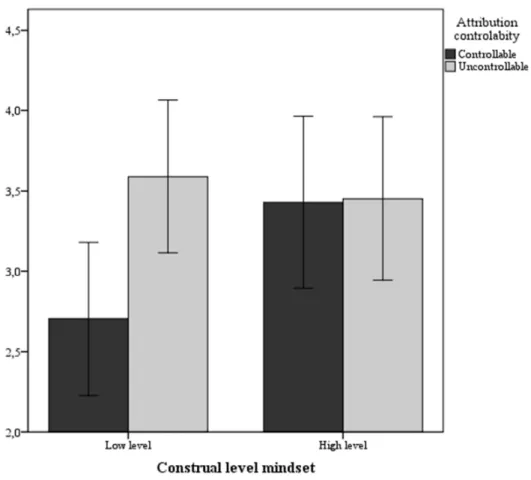
controllability-attribution by construal-level interaction effect, F(1, 128) = 5.17, p = .02, η2 = .04 (see Figure 3). 6
For Peer Review
Simple effects analyses revealed that in the low-level construal condition, trust was significantly
higher after an uncontrollable attribution, M = 3.10, SD = 1.58, than after a controllable
attribution, M = 2.11, SD = .93, F(1, 128) = 8.59, p < .01, η2 = .06. In the high-level construal
condition, the mean differences between controllable, M = 2.80, SD = 1.69, and uncontrollable
attributions, M = 2.71, SD = 1.21, were not significant, F(1, 128) = .06, p = .80, η2 <.01.
The same analyses without the misclassifying participants resulted in a slight drop in
significance of the interaction toward marginal significance: F(1, 81) = 3.43, p = .07, η2 = .04.
This drop is probably due to a drop in statistical power. We found a significant, p < .01, η2 = .06,
simple effect for attribution type in the low construal level condition. No effect was present in
the high construal level condition.
These results indicate that participants in low-level construal mindsets used
controllability information communicated by means of an apology to decide whether to trust a
trustee in the wake of a transgression. People in high construal level mindsets, by contrast, were
found to be indifferent to this type of attribution information in their trusting decision.
---Figure 2 about
here---STUDY 3
Stability, the third of the three attribution dimensions identified by Weiner (1986), is the
temporal persistence of a cause. A cause that is likely to be encountered in future situations is
more stable than a cause that is present in the current situation only (Weiner, 1986). Hence, in
the context of transgressions, stable (relative to unstable) attributions give the trustor more
reason to form negative expectations about the trustee’s future behavior, therefore decreasing
trust. Following from our construal level analysis, we expect the positive effect of unstable 6
For Peer Review
(relative to stable) attributions on trusting intentions following a transgression to be stronger for
low construal level trustors and weaker (or even absent) for high construal level trustors. Using
the same set-up as in Studies 1 and 2, we tested this prediction in Study 3.
Method
Participants and design. One hundred and sixty-one undergraduate business students,
Mage = 20.83, SD = 1.66, 70 women (43.5%), participated in this study for partial course credit.
They were randomly assigned to a 2 (construal level: high vs. low) × 2 (attribution stability:
stable vs. unstable) between-subjects factorial design.
Procedure. The procedure for this study was similar to that used in Studies 1 and 2, apart
from one exception. As in Study 1, we used Freitas and colleagues’ (2004) why/how priming
procedure to engender high-level versus low-level construal mindsets. However, in Study 3, the
apology of the trustee contained either a stable or an unstable attribution.
Stability attributions are typically operationalized as either causes that are exceptions to a
certain known normal situation (unstable attributions) or the normal situation itself (stable
attributions). Huang, Lin and Wen (2010), for instance, manipulated stability attributions by
telling participants to imagine themselves eating in a restaurant that is either always noisy (stable
cause) or generally quiet but found to be noisy once (unstable cause). In a similar way, Hess,
Ganesan, and Klein (2003) operationalized stability attributions by asking participants to imagine
that they either have (stable cause) or have never (unstable cause) had previous experiences with
failures from a service provider. The key element of these manipulations is not that stability
refers to past experiences but that stability is related to the known persistence of a certain cause.
Based on these examples and the definition of a stability attribution, we developed our 6
For Peer Review
own manipulation. In the stable condition, the transgressing follower admitted to finding it
difficult to resist temptations. The message said that the trustee was very sorry but that he/she
could “not promise that it would not happen again.” In the unstable condition, the trustee stated
quite clearly that it had been a one-off event that would not happen again. Thus, in the stable
condition, the perpetrator emphasized the probability of the same behavior occurring again,
while in the unstable condition, in keeping with Weiner’s (1986) description of this attribution
dimension, he or she stated explicitly that the same behavior would not occur again. Both
attributions, we argue, are internal and controllable (temptations can be resisted, even if it is
difficult to do so). Results of our pre-tests of this manipulation are available in the online
supplementary material to this paper.
Comprehension check. In keeping with the approach we used in Studies 1 and 2, we
used a comprehension check for our stability manipulation. We asked participants to indicate
whether the trustee had responded to the accusations 1) by apologizing and promising to do
better in the future, 2) by apologizing but indicating at the same time that they could not promise
to do better in the future, 3) by denying the accusations, or 4) by neither admitting nor denying
the accusations.
Dependent variable. We used the same trusting intentions measure as in Studies 1 and 2.
Results
Manipulation check. In the condition in which the trustee communicated a stable
attribution through her apology, 88.1% of the participants indicated that the transgressor had not
promised to do better in the future, while 10.7% indicated that the trustee had promised to do
better. In the condition in which the trustee communicated an unstable attribution through her 6
For Peer Review
apology, 97.4% indicated that the trustee had promised to do better in the future, while 2.6%
indicated that the trustee had not done so. One participant (in the stable attribution condition)
indicated that the trustee neither admitted nor denied the accusation. This participant was
excluded from further analysis. Significance levels and direction of effects were unaffected
whether this participant was included or not. As in Studies 1 and 2, we used binary logistic
regression to test for the success of our manipulation. This analysis revealed a significant main
effect of attribution stability, B = -5.15, SE = .865, Wald(1) = 35.37, p < .01, Odds Ratio = .01,
95% CI [.001, .032], but no significant effect of construal level, p = .87, or a significant
interaction effect, p = .99. In sum, participants in the stable attribution condition were much less
likely to indicate that the trustee had promised to do better in the future than participants in the
unstable attribution condition. Thus, our manipulation of attribution stability was successful.
Hypothesis test. ANOVA with attribution stability and construal level as independent
variables and trust as a dependent variable, revealed no main effect of attribution stability, F(1,
156) = .18, p = . 68, η2 < .01, or construal level, F(1, 156) = .24, p = .62, η2 < .01. The analysis
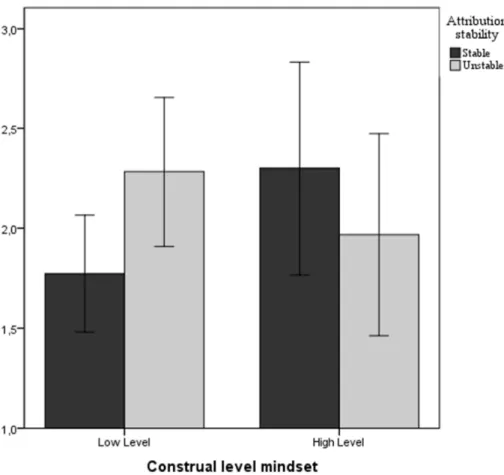
revealed an attribution stability by construal level interaction effect, F(1, 156) = 3.96, p = .048,
η2 = .03 (see Figure 4). Simple effects analyses revealed that for low construal level trustors, an
unstable attribution, M = 2.28, SD = 1.26, was marginally significantly more effective at
restoring trust, F(1, 156) = 3.32, p = .07, η2 = .02, than a stable attribution, M = 1.77, SD = .96.
For high construal level trustors, there was no significant difference between stable, M = 2.30,
SD = 1.67, and unstable attributions, M = 1.97, SD = 1.38, F(1, 156) = 1.10, p = .30, η2 = .01.
These results indicate that low-level construal makes people sensitive to variations along the
stability dimension in their decision to trust the trustee, whereas for high-level construal this was 6
For Peer Review
not the case.
The same analyses without the misclassifying participants resulted in a marginal drop in
significance of the interaction effect, F(1, 145) = 3.20, p = .08, η2 = .02, probably due to a drop
in statistical power. However, the simple effect for attribution type became fully significant, p <
.05, η2 = .03, for low construal level trustors. We did not find a significant simple effect for high
construal level trustors.
---Figure 3 about
here---STUDY 4
In Study 4 we studied an interaction between people of equal status, rather than an
interaction situated in a hierarchical setting. We also included a control condition, and measure
trusting behavior, rather than trusting intentions. In this way, we were able to address what saw
as three potential weaknesses of Studies 1–3: 1) the possibility, however slim, that differences in
perceived status between trustor and trustee may have played a role in obtaining our results; 2)
the fact that in Studies 1 – 3 we used trusting intentions rather than trusting behavior as an
outcome measure and 3) the absence of a control condition in our first three studies. Specifically,
we included a control condition in which participants received a statement of regret but no
attributional information. Our reasoning implies that attributions provide additional information
(i.e., additional to conveying regret). Low, but not high, construal level trustors are likely to use
such information to decide the extent to which they are willing to trust a trustee. Hence, the
absence of such information should be especially damaging for such trustors. We included this
control condition to test that prediction.
Method
For Peer Review
Participants and design. One hundred and forty undergraduate business students from a
medium-sized European university, Mage= 19.79, SD = 1.59, 81 women (54%), participated in a
study on “workplace behavior”. Participants were randomly assigned to one of six conditions in
a 2 (construal level: high vs. low) × 3 (attribution locus: internal vs. external, vs. control)
between-subjects factorial design.
Procedure. We used a trust game paradigm developed by Berg, et al. (1995). The trust
game is played by two players, the ‘initiator’ and the ‘responder’. The outcome for each player
depends on the actions of the other player. In this study, players played to earn points that
determined how many times they would participate in a lottery for a € 50 (approximately $ 56 at
the time of the study) gift certificate (1 point equaled one chance to win the gift certificate). After
the study, we raffled off the gift certificate in a lottery in which all participants had an equal
chance to win. We obtained permission from the IRB of the university where the study was run
for the use of this form of deception. The reason we used deception was twofold: we did not
obtain personal details of our participants and, therefore, could not use their performance in the
study as input in the raffle. Second, given that our manipulations are designed to affect, at least
to some extent, our participants’ performance within the trust game, we thought it fairer to give
each participant an equal shot at winning the prize.
In phase 1 of the game, the initiator received ten points from the experimenter, to be
divided between the initiator and the responder at the initiator’s discretion. In phase 2, the
number of points the initiator transferred to the responder was tripled. For example, if the
initiator transferred three points to the responder, the responder received nine points. If the
initiator decided to allocate his or her full endowment (ten points), the responder received thirty 6
For Peer Review
points. This information was relayed to the initiator via detailed instructions. The responder was
then free to decide how many points to give back to the initiator (phase 3). Because the outcomes
of both players are dependent on the actions of both, the initiator’s act of donating points to the
responder is clearly a trusting action (Pillutla, Malhotra, & Murnigham, 2003).
Unbeknownst to our participants, all of them were assigned to the initiator role. After we
communicated their role to them, we gave them instructions on how to play the game. We also
gave them some information about the responder: he or she was said to have played the game
once before with another player. During that game, (s)he had received thirty points from the
initiator and had returned none. This constituted the responder’s transgression. Studies indicate
that when the responder reallocates less than half of his/her points to the initiator, this constitutes
a breach of trust (Pillutla, et al., 2003). To reinforce this perception of a breach of trust, we
informed participants that, on average, responders return at least half of the received points to the
initiator. In reality, all the responder’s actions were pre-programmed.
After participants received instructions about the trust game, but before making an
allocation decision, they completed a construal level priming exercise. We used the Freitas et al.
(2004) why/how exercise that we also used in Studies 1 and 3.
After participants had completed the construal level prime, we informed them that they
had received a message from the responder in which (s)he apologized for his or her earlier
behavior. In the control condition, the initiator did not include any attribution information in his
or her apology, but simply informed the responder that he or she was sorry about his or her
behavior in the previous round. In the internal attribution condition, the responder added that the
behavior was due to the fact that he or she “simply wanted a better chance to win the prize 6
For Peer Review
myself”. In the external attribution condition, the initiator attributed the behavior to distraction:
“I forgot to turn off my phone and I got distracted when it rang. I accidentally clicked the wrong
key on the screen.” As our first three studies supported our hypothesis that low construal level
makes trustors base trusting decisions on attributional information, we expected the absence of
such information in the control condition to be especially damaging for these trustors.
After participants had read the responder’s apology, we asked them to transfer some or
all of their points to the responder. This constituted our dependent variable (Pillutla, et al., 2003).
Next, we administered a short scale consisting of two items (“To what extent did the responder
explain the way (s)he had acted in the previous study?”, “To what extent did the responder
justify the way (s)he had acted in the previous study?”, Cronbach’s α = .74) as manipulation
check (see Struthers et al., 2008, for a similar procedure). We used this manipulation check to
ensure that participants were able to differentiate between apologies (which contain attributional
information) and simple statements of regret (which do not contain such information).
Results
Initial inspection of the distribution on the dependent variable revealed that 29
participants had donated more points to the responder than they could spend (i.e., 11 points or
more). This turned out to be due to a computer error; no upward limit was imposed on the
number of points to be donated to the responder. We removed these participants from the dataset.
There was no difference on any of the demographic variables between the participants who were
removed from the dataset and those who stayed.
Manipulation check. ANOVA with our manipulation check scale as a dependent
variable revealed a significant main effect of attribution locus, F(1, 112) = 25.88, p < .001, η2 = 6
For Peer Review
.32. Post-hoc comparisons using Bonferroni correction show that means in the internal condition
(M = 4.35, SD = 1.35) were significantly higher than in the control condition (M = 2.68, SD =
1.37, p < .001). The same was true for the external condition (M = 4.91, SD = 1.46, p < .001).
The internal and external conditions did not differ significantly, p = .25. There was no significant
effect of construal level, F(1, 112) = .001, p = .98, η2 < .001, or a significant construal level by
attribution locus interaction, F(1, 112) = .14, p .87, η2 = .002.
In sum, participants in both the low and high construal level conditions successfully
distinguished between apologies that did vs. did not contain attributions. Variations in the level
of donations are therefore not due to a failure to notice attributional information but to whether a
participant bases the decision to trust the other on this information.
Hypothesis test. A Construal Level × Attribution Locus ANOVA with trust as a
dependent variable revealed no significant main effect of attribution locus, F (1, 112) = .27, p =
.76, η2 = .01 or of construal level, F (1, 112) = 2.18, p = .14, η2 = .02. We found a significant
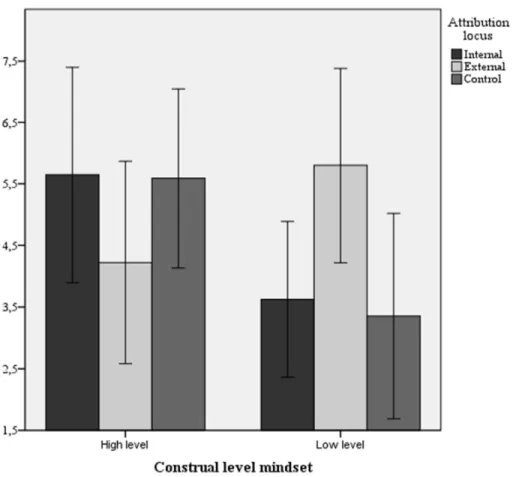
construal level by apology attribution locus interaction effect, F (1, 112) = 4.14, p = .02, η2 = .07
(See Figure 4). Simple effects analyses revealed no significant effect of attribution locus in the
high construal level conditions, F (2, 112) = 1.13, p = .33, η2 = .02. For participants in a high
level construal mindset, trust in the internal condition, M = 5.65, SD = 3.41, did not differ
significantly from trust in the external condition, M = 4.22, SD = 3.30, p = .20, or in the control
condition, M = 5.59, SD = 3.29, p = .96. However, we did find a significant effect of attribution
locus in the low construal level condition, F (2, 112) = 3.35, p =.04, η2 = .06. Inspection of the
mean differences in the low construal level condition revealed that participants in the internal
condition had significantly lower trust, M = 3.63, SD = 2.99, than participants in the external 6
For Peer Review
condition, M = 5.80, SD = 3.38, p = .03. Similarly, trust in the control condition was significantly
lower, M = 3.35, SD = 3.24, p = .03, than in the external condition but not significantly different
from the internal condition, p = .79. This indicates that for participants, external attributions in
apologies were more successful at promoting trust among low construal level trustors than both
internal attributions and a statement of regret in absence of an attribution. For high construal
level trustors, we did not find such a difference.
- Figure 4 about here
---Discussion
These results indicate that the effect we found in the first three studies on trusting
intentions also generalizes to trusting behavior. Secondly, Study 4 also shows conclusively that
under low-level construal, people use attributions to decide whether they are willing to trust the
trustee. Because an external attribution indicates that a trustee was not involved in bringing about
the transgression (or at least involved to a lesser extent), he or she is deemed more trustworthy
than a trustee who was causally involved (indicated by the use of an internal attribution). In line
with this, communicating no attributional information—as in our control condition—causes the
delivery of an apology to be at least as ineffective as communicating that oneself was responsible
(by means of an internal attribution) among trustors in a low-level construal mindset. High
construal level trustors do not differentiate between apologies with internal and external
attributions and statements of regret as regards the extent to which they are willing to trust
another person. Third, the results of our manipulation check indicate that this effect is not due to
a simple failure to notice attributional information. Instead, participants in the high construal
level condition noticed the attributional information but did not use it in their trusting decision. 6
For Peer Review
This finding is in line with the notion that people in high construal level mindsets are unlikely to
use attributional information to form any kind of interpersonal judgment because it is typically
relatively detailed and concrete (see also Ledgerwood, et al., 2010). Finally, in this study,
participants interacted with another person of equal status. The results of this study, therefore,
indicate that our effects generalize beyond the hierarchical contexts we used in Studies 1 to 3.
QUANTITATIVE INTEGRATION OF STUDIES
To establish the robustness, size and significance of the interaction effects reported in
Studies 1-4, we conducted meta-analyses using the Meta-Essentials workbooks developed by
Van Rhee, Suurmond, and Hak (2015). We followed recommendations to weight the effect sizes
by the inverse variance (Lipsey and Wilson, 2001). To increase comparability between the
studies, we excluded the observations in the control condition in Study 4 from the analyses.
These analyses revealed a robust and significant attribution dimension by construal level
interaction effect on trust across our four studies (point estimate = -1.12, SE = 0.34, Z = -3.30, p
< 0.01, Q = 3.74, pq = 0.29). This indicates that the interaction effect is stable and highly
significant across studies.
To further test the robustness of our obtained effects, we reran the same analysis but this
time included the participants we excluded in Studies 1-3 for misclassifying the apology type.
This analysis similarly revealed a similarly significant attribution dimension by construal level
interaction effect on trust (point estimate = -1.06, SE = 0.31, Z = -3.43, p < 0.01, Q = 3.45, pq =
0.33). This indicates that the exclusion of these participants did not substantially affect our
conclusions. 6
For Peer Review
Additionally, we conducted four meta-analyses for the simple effects across Studies 1-4
(i.e., the effect of attribution dimension among participants in a low level construal mindset, the
effect of attribution dimension among participants in a high level construal mindset, the effect of
construal level among participants in attribution conditions that should lower trust, and the effect
of construal level among participants in attribution conditions that should increase trust). The
meta-analyses using fixed effects models revealed that the effect of attribution dimension among
participants in a low level construal mindset was highly significant (mean d = -.58, SE = 0.14, p
< .01, Q = 2.05, pq= .56); however, the effect of attribution dimension among participants in a
high level construal mindset was not significant (mean d = -.24, SE = 0.14, p = .10, Q = .49, pq =
.92). For the simple effects of the construal level conditions, the effect of construal level among
participants in attribution conditions that should lower trust was significant (mean d = -.27, SE =
.14, p = .03, Q = 9.94, pq = .02). The effect was strongest in Study 1 (d = -.6, 95%CI [.03;1.17])
and weakest in Study 3 (d = -.4, 95%CI[.04; .83]). The effect of construal level among
participants in attribution conditions that should increase trust was not significant (mean d = -.16,
SE = .14, p = .57, Q = 4.72, pq = .19). Overall, these effects are comparable to the results we
uncovered in our individual studies.
GENERAL DISCUSSION
Four studies showed that trustors in a low construal level mindset use attributional
information embedded in apologies to decide upon the extent to which they were inclined to trust
the trustee. Conversely, trustors in high construal level mindsets were unaffected by the type of
attributions trustees used. We obtained evidence for this moderating effect of construal level
using two different construal level primes. The effect emerged regarding the trusting intentions 6
For Peer Review
of participants who interacted with a transgressing subordinate in a hierarchical setting (Studies 1
to 3) as well as on the trusting behavior of participants interacting with an equal status other in a
trust game (Study 4). Furthermore, we gathered evidence that the effects of all three of the
attribution dimensions identified by Weiner (1986), i.e., locus, controllability, and stability, are
contingent on trustor construal level. Study 4 further substantiated our argument that trustors in a
low level construal mindset value attributional information by showing that such trustors
responded negatively to the absence of such information. A mini meta-analysis of our four
studies showed that the effect we describe is robust and consistent across different empirical
contexts (Goh, et al., 2016)
Theoretical implications
By focusing excessively on trustee-side antecedents of the trust restoration effect of
apologies, such as sincerity and the type of attributions used, the literature sometimes gives the
impression that the trustor’s role is simply to passively react to anything the trustee says (Van
Dijke & De Cremer, 2011). A more realistic understanding of this process implies that we must
look at both the way a trustee phrases the apology and the way the trustor construes and
processes that information (see also Fehr & Gelfand, 2010). Specifically, our results indicate that
trust restoration for trustors in high construal level mindsets is not primarily driven by the
provision of attributional information because this kind of information is generally relatively
detailed and therefore relatively concrete. Research has already indicated that detailed
information fits better with a low, rather than high, construal level mindset (Berson, et al., 2014).
We extend this research by applying it to a trust restoration context.
Weiner’s (1986) attribution model implies that attributions are highly variable; 6
For Peer Review
attributions may vary along three dimensions simultaneously (although certain combinations are
more likely than others). The exclusive focus on the locus of causality attributions in previous
research (Kim et al., 2006; Struthers et al., 2008) has made it seem that the trustee must deflect
blame from him or herself to restore trust after a transgression of moral or social norms. Our
research implies that the trustee can also restore trust by communicating that causes for the
transgression were beyond his or her control (by using an uncontrollable rather than a
controllable attribution) or even by indicating that the transgression is unlikely to happen again
(by using an unstable rather than a stable attribution).
Construal-level theory has thus far been applied mainly to cognitive phenomena such as
evaluation of choice-options (Ledgerwood, et al., 2010) and to intra-personal phenomena such as
self-control (Fujita & Roberts, 2010). Research on the interpersonal effects of construal levels is
still scarce. In fact, we are unaware of any other research showing that construal levels are
relevant to interpersonal variables such as trust. Extending construal level theory to the trust
domain allows for a better understanding of how interpersonal processes are informed, and
sometimes even determined, by cognitive processes that are properly located at either side of the
dyad. Construal levels can thus be used to better connect research at both levels of analysis. By
the same token, this research also has implications for construal level research as such. For
example, we showed that construal levels have implications outside the cognitive and
intrapersonal domains, even for phenomena that are often considered not to be primarily
cognitive, such as trust (McAllister, 1995).
Practical implications
From a practical perspective, it is important to note that calibrating the right sort of 6
For Peer Review
attributional information is more important when dealing with a low—as opposed to a high—
construal level trustor: a low construal trustor is likely to use that information to decide about
trust, whereas the high construal trustor is not. Hence, when dealing with a high construal level
trustor, it is probably useless to spend time and effort to provide the trustor with much
attributional information. Casu quo, in such a case, one is advised to spend more time
emphasizing regret and remorse, making the apology into a statement of regret that is as effective
as possible. For low construal level trustors, by contrast, it is important both to convey regret and
to calibrate attributions to minimize their perceptions of the trustee’s causal involvement.
Be that as it may, it is often impossible for trustees to assess the construal level mindset
of a trustor. In such cases, trustees may need to rely on estimating a trustor’s construal level
mindset based on certain observable proxies. More specifically, research shows that
interpersonal distance affects construal levels in the sense that larger distances lead to higher
levels of construal (Trope & Liberman, 2010). The same has been shown for a high sense of
power (Smith & Trope, 2006). Hence, when a trustor is relatively distant (in time, space, or
socially) or seems to have a high sense of power, the trustor is likely to construe information
about the trustee on relatively high levels. In such cases, the trustee should probably not worry
too much about providing detailed attributional information as part of an apology. If, on the other
hand, the trustor is close or has a low sense of power, providing him or her with detailed
attributional information may be crucial for effectively restoring trust.
Limitations and future directions
The fact that trust is the result of complex social dynamics makes it difficult to devise
field tests that can test our predictions as effectively as is possible in the laboratory. For this 6
For Peer Review
reason, we studied the promotion of trust after a transgression using experiments. Studying trust
in the laboratory has several advantages, such as the high internal validity of findings
(Tomlinson, Dineen, & Lewicki, 2004). To maximize the external validity of our findings,
however, we created a realistic work-like hierarchical context in which transgressions and
responses to them could be studied. Of course, this cannot replace a field study devoted to this
subject. Additional field research is therefore needed to support the external validity of our
findings.
Across the four studies reported here, we found effect sizes that are traditionally (Cohen,
1992) considered small to medium. This fact may be reason for some to question the relevance
of our results. However, it should be noted that it is not at all unusual for empirical studies to
find that the sizes of the found effects fall within this small to medium range (Bosco, Aguinis,
Singh, Field, & Pierce, 2014). In fact, it has been argued that Cohen’s (1992) rules of thumb are
too strict for evaluating the relevance of empirical results in our field (Aguinis, Beaty, Boik, &
Pierce, 2005). Additionally, the meta-analytic results reported above show that our effects are
stable across studies and that the associated effect sizes are highly significant. Given that we
found comparable results in four studies, using a variety of attribution manipulations, construal
level primes, operationalizations of trust, and experimental procedures, we conclude that the
totality of evidence supports our claims.
In Studies 1, 3, and 4, we did not implement a manipulation check for our construal level
manipulations. It should be noted that no acceptable manipulation check of construal level
manipulations exists in the literature. The scale we used in Study 2, the BIF, is a dispositional
scale that we adapted to be used as manipulation check (see, e.g., Fujita & Roberts, 2009, for a 6
For Peer Review
similar approach). The BIF is imperfectly suited to detect temporal fluctuations in construal
levels (Vallacher & Wegener, 1989). We felt it would be improper not to report the results on the
BIF, even if it is really nothing but a suboptimal manipulation check. It is important to note that
both Lin et al. (1997; we used this procedure in Study 2) and Freitas et al. (2006; Studies 1, 3 and
4) show that the procedures they designed reliably produce a host of effects associated with
either high or low construal level mindsets.
Our results imply that for high construal level trustors, it is sufficient to promote trust that
an apology functions effectively as a statement of regret. Hence, one would expect that apologies
would not, or would to a lesser extent, affect the trust of high construal level trustors when they
no longer function as statements of regret. An example of an apology that does not function as a
statement of regret is an apology that is perceived as insincere (Schumann, 2012). An interesting
question, then, would be whether apology insincerity has a stronger effect on high, rather than
low, construal level trustors.
Previous research has established that attributions may work differently in the context of
non-volitional transgressions. For certain types of non-volitional transgressions, accepting more
rather than less blame may be an effective trust-restoration strategy, as it indicates the
willingness and ability to change (Kim et al., 2006). Based on the reasoning and results found in
this paper, we would expect this result to be more pronounced for low construal level trustors.
We leave the testing of that particular hypothesis to future research.
Conclusion
Trust, much like tango, takes two. This simple truth is often forgotten. The actions and
words of the trustee matter as much as how the trustor understands them. We hope the present 6
For Peer Review
research inspires others to develop a truly bilateral perspective on trust. 6
For Peer Review
Aguinis, H., Beaty, J. C., Boik, R. J., & Pierce, C. A. (2005). Effect size and power in assessing moderating effects of categorical variables using multiple regression: A 30-year review. Journal of Applied Psychology, 90, 94 - 107.
Bashford, T. E., Behrend, L. R., & Behrend, T. S. (2014). Please accept my sincerest apologies: Examining follower reactions to leader apology. Journal of Business Ethics, 119, 99 – 117. Berg, J., Dickhaut, J., & McCabe, K. (1995). Trust, reciprocity, and social history. Games and
economic behavior, 10, 122 - 142.
Berson, Y., Halevy, N., Shamir, B., & Erez, M. (2015). Leading from different psychological distances: A construal-level perspective on vision communication, goal setting, and follower motivation. The Leadership Quarterly, 26, 143 - 155.
Bosco, F. A., Aguinis, H., Singh, K., Field, J. G., & Pierce, C. A. (2014). Correlational effect size benchmarks. Journal of Applied Psychology, 100, 431- 449.
Burgoon, E. M., Henderson, M. D., & Markman, A. D. (2013). There are many ways to see the forest for the trees. A tour guide for abstraction. Social Psychology and Personality Science, 8, 501-520.
Cohen, J. (1992). A power primer. Psychological bulletin, 112, 155 - 159.
Davis, J. R., & Gold, G. J. (2011) An examination of emotional empathy, attributions of stability, and the link between perceived remorse and forgiveness. Personality and Individual
Differences, 50, 392-397.
Desmet, P. T. M., De Cremer, D., & Van Dijk, E. (2011). In money we trust? The use of financial compensations to repair trust in the aftermath of distributive harm. Organizational Behavior and Human Decision Processes, 114, 75-86.
Fehr, R., & Gelfand, M. J. (2010). When apologies work: How matching apology components to victims’ self-construals facilitates forgiveness. Organizational Behavior and Human Decision Processes, 113, 37-50.
Freitas, A. L., Gollwitzer, P., & Trope, Y. (2004). The influence of abstract and concrete
mindsets on anticipation and guiding others’ self-regulatory efforts. Journal of Experimental Social Psychology, 40, 739-752.
Fujita, K., & Roberts, J. C. (2010). Promoting prospective self-control through abstraction. Journal of Experimental Social Psychology, 46, 1049-1054.
Goh, J. X., Hall, J. A., and Rosenthal, R. (2016) Mini meta-analysis of your own studies: Some arguments on why and a primer on how. Social and Personality Psychology Compass, 10: 535–549.
Hess, R. L., Ganesan, S., & Klein, N. (2003). Service failure and recovery: The impact of relationship factors on customer satisfaction. Journal of the Academy of Marketing Science, 31, 127-145.
Huang, W. H., Lin, Y. C., & Wen, Y. C. (2010). Attributions and outcomes of customer misbehavior. Journal of Business Psychology, 25, 151-161.
For Peer Review
Kim, P. H., Dirks, K. T., & Cooper, C. D. (2009). The repair of trust: A dynamic bilateral perspective and multilevel conceptualization. Academy of Management Review, 34, 401-422. Kim, P. H., Dirks, K. T., Cooper, C. D., & Ferrin, D. L. (2006). When more blame is better than
less: The implications of internal versus external attributions for the repair of trust after a competence versus integrity based trust violation. Organizational Behavior and Human Decision Processes, 99, 49-65.
Ledgerwood, A., Trope, Y., & Liberman, N. (2010). Flexibility and consistency in evaluative responding: The function of construal level. Advances in Experimental Social Psychology, 43, 257-295.
Lee, A. Y., Keller, P. A., & Sternthal, B. (2010). Value from regulatory construal fit: The persuasive impact of fit between consumer goals and message concreteness. Journal of Consumer Research, 36, 735-747.
Lin, E. L., Murphy, G. L., & Shoben, E. J. (1997). The effects of prior processing episodes on basic level superiority. The Quarterly Journal of Experimental Psychology Section A, 50, 25-48.
Lipsey, M.W., & Wilson, D.B. (2000). Practical Meta-analysis. Thousand Oaks: Sage.
Lupfer, M. B., & Gingrich, B. E. (1999). When bad (good) things happen to good (bad) people: The impact of character appraisal and perceived controllability on judgments of
deservingness. Social Justice Research, 12, 165-188.
McAllister, D. J. (1995). Affect- and cognition-based trust as foundations for interpersonal cooperation in organizations. Academy of Management Journal, 38, 24-59.
McCrea, S.M., Wieber, F., & Myers, A.L. (2012). Construal level mind-sets moderate self- and social stereotyping. Journal of Personality and Social Psychology, 102, 51-68.
Pillutla, M. M., Malhotra, D., & Murnighan, J. K. (2003). Attributions of trust and the calculus of reciprocity. Journal of Experimental Social Psychology, 39, 448-455.
Shnabel, N., & Nadler, A. (2010). A needs-based model of reconciliation: Perpetrators need acceptance and victims need empowerment to reconcile. In M. Mikulincer, P. R. Shaver, M. Mikulincer, P. R. Shaver (Eds.), Prosocial motives, emotions, and behavior: The better angels of our nature (pp. 409-429). Washington, DC US: American Psychological Association. Schumann, K. (2012). Does love mean never having to say you’re sorry? Associations between
relationship satisfaction, perceived apology sincerity, and forgiveness. Journal of Social and Personal Relationships, 29, 997-1010.
Smith, P. K., & Trope, Y. (2006). You focus on the forest when you’re in charge of the trees: Power priming and abstract information processing. Journal of Personality and Social Psychology, 90, 578-596.
Struthers, C.W., Eaton, J., Santelli, A.G., & Uchiyama, M. (2008). The effects of attributions of intent and apology on forgiveness: When saying sorry may not help the story. Journal of Experimental Social Psychology, 44, 983-992.
For Peer Review
Tomlinson, E. C., Dineen, B. R., & Lewicki, R. J. (2004). The road to reconciliation: Antecedents of victim willingness to reconcile following a broken promise. Journal of Management, 30, 165-187.
Tomlinson, E. C., & Mayer, R. C. (2009). The role of causal attributions in trust repair. Academy of Management Review, 34, 85-104.
Torelli, C. J., & Kaikati, A. M. (2009). Values as predictors of judgments and behaviors: The role of abstract and concrete mindsets. Journal of Personality and Social Psychology, 96, 231-247.
Trope, Y. & Liberman, N. (2010). Construal-level theory of psychological distance. Psychological Review, 117, 440-463.
Vallacher, R. R., & Wegner, D. M. (1989). Levels of personal agency: Individual variation in action identification. Journal of Personality and Social Psychology, 57, 660- 671.
Van Dijke, M., & De Cremer, D. (2011). When social accounts promote acceptance of unfair ultimatum offers: The role of the victim’s stress responses to uncertainty and power position. Journal of Economic Psychology, 32, 468-479.
Van Houwelingen, G.G., Van Dijke, M., De Cremer, D. (2015). Getting it done and getting it right: Leader disciplinary reactions to followers’ moral transgressions are determined by construal level mindset. The Leadership Quarterly, 26, 878 – 891.
Van Rhee, H.J., Suurmond, R., & Hak, T. (2015). User manual for Meta-Essentials: Workbooks for meta-analyses (Version 1.0) Rotterdam, The Netherlands: Erasmus Research Institute of Management. Retrieved from www.erim.eur.nl/research-support/meta-essentials.
Weiner, B. (1986). An Attributional Theory of Motivation and Emotion. New York (NY): Springer-Verlag.
Weiner, B., Perry, R. P., & Magnusson, J (1988). An attributional analysis of reactions to stigmas. Journal of Personality and Social Psychology, 55, 738-748.
For Peer Review
Figure 1. Effect of construal level mindset and locus of control on willingness to allocate a
crucial task in Study 1. Error bars represent 95% CIs around the cell mean.