EFFECTIVENESS AND EFFICIENCY OF A CUSTOMIZED VERSUS CONVENTIONAL ORTHODONTIC BRACKET SYSTEM
Dennis J. Weber II
A thesis submitted to the faculty of the University of North Carolina at Chapel Hill in partial fulfillment of the requirements for the degree of Master of Science in the School
of Dentistry (Orthodontics).
Chapel Hill 2011
iii ABSTRACT
DENNIS J. WEBER II: Effectiveness and Efficiency of a Customized Versus Conventional Orthodontic Bracket System
(Under the direction of Dr. Lorne Koroluk)
The goal of this investigation was to compare the clinical effectiveness and efficiency of a customized versus a conventional orthodontic bracket system. Pre-treatment and post-Pre-treatment diagnostic records of 11 patients treated with conventional brackets and 35 patients treated with Ormco®’s InsigniaTM
appliance were analyzed. Initial PAR and age at start of treatment were used to ensure comparable groups. Data regarding total treatment time, number of scheduled appointments, emergency
appointments, de-bonded brackets, repositioned brackets and/or detailing bends, final PAR, and ABO score was collected and compared. InsigniaTM proved to be an effective
tooth-moving appliance based on final PAR score. Further, cases treated with InsigniaTM
had superior ABO scores compared to the similarly treated cases with conventional brackets. InsigniaTM was also more efficient in regards to total treatment time and number
iv
ACKNOWLEDGEMENTS
I would like to thank the following people:
My committee members: Dr. Koroluk, Dr. Proffit, and Dr. Ko for their guidance, mentorship, and support throughout this project.
Dr. Phillips for her insight and advice as well as her expertise regarding statistical analysis for this project.
Dr. Tung Nguyen for his input and counsel as well as the inspiration for this project.
Debbie Price for all her assistance with data input.
v
TABLE OF CONTENTS
LIST OF TABLES... ... vi
LIST OF FIGURES... ...vii
LIST OF ABBREVIATIONS ... viii
LIST OF SYMBOLS ... ix
Chapter I. INTRODUCTION ... 1 1
II. REVIEW OF LITERATURE ... 4
A. Straight Wire Appliance... 5 14 B. Variations of Andrews’ Straight Wire Appliance ... 9 14 C. Is a true Straight Wire Appliance possible? ... 12
D. Ormco®’s InsigniaTM ... 20 15 III. MANUSCRIPT ... 21
A. Introduction ... 21
B. Materials and Methods ... 22
C. Results ... 26
D. Discussion ... 27
E. Conclusions ... 32
vi
LIST OF TABLES
Table 1. T-Test Results Comparing the Two InsigniaTM Groups ... 34
Table 2. T-Test and ANCOVA Results Comparing the Two Treatment Groups ... 35 23 Table 3. Sample Demographics ... 36
vii
LIST OF FIGURES
viii
LIST OF ABBREVIATIONS
AAO American Association of Orthodontists ABO American Board of Orthodontics ANCOVA Analysis of Covariance
CEJ Cemento-Enamel Junction PAR Peer Assessment Rating S.D. Standard Deviation SWA Straight Wire Appliance
ix
LIST OF SYMBOLS
© Copyright Symbol ® Registered Trademark TM
x
I. INTRODUCTION
Orthodontists are continually searching for treatment techniques that are more effective and efficient. In today’s fast-paced, high-tech, convenience-driven society, patients expect rapid, high-quality results with minimal obligation on their part. Orthodontists benefit from increased efficiency by treating more patients in less time. The ideal orthodontic bracket system would allow the orthodontist to provide quality orthodontic care in less time, with fewer appointments, and decreased ―doctor chair-time‖ which would be advantageous to both orthodontists and their patients.
The quest for optimal efficiency and effectiveness is not new to orthodontics. Edward Angle increased effectiveness and control of tooth movement in all three planes of space by developing the Edgewise appliance.1 The ultimate contribution to increased efficiency came from Lawrence Andrews in the 1970’s with his development of the Straight Wire Appliance (SWA). This innovative system was developed not only to achieve outlined treatment objectives, but also to reliably and consistently obtain excellent esthetic and functional results by transferring repetitive, compensatory wire bends to the bracket.2
2 treatment into the appliance‖ 3
in which the required first, second, and third order movements to align teeth would be built into the bracket rather than requiring the clinician to bend arch wires to accomplish these movements. In regards to the increased efficiency of the SWA, Andrews claimed, ―Many users report that the SWA has reduced treatment time by one-third and chair time even more.‖4
Although the goal of the SWA is to ideally complete treatment with a straight wire in the slots of the pre-adjusted brackets, this rarely occurs as finishing bends in the wire and/or repositioned brackets are routinely required to achieve optimal results. Many studies argue that a true ―straight wire appliance‖ is practically and clinically not possible due to individual variations in tooth surface morphology, skeletal discrepancies, and inaccuracy of direct bonding techinques.5,6,7,8,9 Miethke and Melson concluded that, ―…it is unreasonable to anticipate that any straight wire appliance without individual
adjustments can be anticipated to lead to an optimal tooth alignment.‖7
At the same time they proposed, ―if the straight wire approach should be followed, the bracket would have to be custom made.‖7
This led to the question, could a combination of computer assisted virtual treatment planning and bracket placement, customized brackets individualized to each tooth, and indirect bonding procedures create the ultimate SWA that would decrease total treatment time, number of appointments, and possibly eliminate all finishing bends?
One orthodontic manufacturer, Ormco®
, has designed a bracket system, InsigniaTM, that may ultimately be a true SWA. The premise behind the system is to
virtually design the final occlusion and smile esthetics using computer assisted
3
the malocclusion to the designed final result. Bracket slots are customized based on bracket location to move each tooth to the ideal final position. Bracket position is transferred from the virtual work-up to the patient via an indirect bonding procedure using transfer jigs.
The company claims that because the appliance is custom-made for an individual patient, the efficiency of treatment is greatly increased through decreased total treatment time, number of visits and increased utilization of auxiliary staff. 10 Another advantage claimed is that the amount of interproximal reduction, expansion, and location of occlusal contacts can be planned and manipulated virtually on a computer prior to the actual start of treatment.10 With these advantages, Insigniamay theoretically be the next step in the development of a true straight wire appliance.
The goal of this investigation is to compare the clinical effectiveness and
4
II. REVIEW OF LITERATURE
The ancient Egyptians used metal bands and catgut to attempt tooth movement.1 This interest in straight teeth, whether for beauty or function, has led to a search over centuries for an effective tooth-moving appliance.
This quest has led to the development and use of many appliances over the years. Until the mid 1800’s, Western Europe was the center of orthodontic creativity, led by such men as Pierre Fauchard who developed the first expansion appliance, the bandolet, in 1723.1 By the late 1800’s, the United States became the mecca of orthodontic
development in the search for effective tooth-moving appliances.1
The 1900’s brought a number of new creations. Most of these, such as the Labiolingual appliance and the Twin Wire appliance, were merely ―tooth-tippers‖ and lacked torque control to manage root movements .2 Edward Angle developed four appliances in an effort to increase the effectiveness and control of tooth movement; culminating in the Edgewise appliance.2 This proved a significant breakthrough as it allowed simultaneous control of tooth movement in all three planes of space. In addition, Angle’s appliance proved to be well suited for tooth/root control during space closure and finishing. 2 Unfortunately, the Edgewise system lacked the efficiency and ease of use clinicians desired as compensatory bends for first, second, and third order relationships were required to finally position the teeth.
5
brackets on bands was recommended by Angle himself in 1928.11 Terwilliger was one of the first to adopt soldered brackets to create built in tip and torque.11 Holdaway, in 1952, suggested pre-angulating, or tipping, brackets before banding to help set up anchorage, parallel roots during and after space closure, and for artistic positioning of incisors.12 ―At the 1960 AAO meeting, Jarabak, with James A. Fizzell, demonstrated the first bracket to combine torque and angulation.‖11
But no one had developed a way to have compensations for all three planes of space—in/out, tip, and torque—built into the appliance.
In 1933, Raymond Begg, developed his own bracket, a modification of Angle’s ribbon arch, to better handle extraction treatment and also allow for controlled tooth movement in three planes of space.1,2 The Begg system became popular due to its increased efficiency compared to the Edgewise appliance despite the fact that it lacked torque control and finishing.2 By the 1960’s, there were two main systems in use; the Begg and Edgewise appliances.
The need for a complete appliance, capable of tooth/root movement in three planes of space, coupled with a desire for increased efficiency culminated in the 1970’s with Lawrence Andrews’ Straight Wire Appliance (SWA). This was an extension and modification of the Edgewise appliance and gave orthodontists the ultimate blend of effectiveness and efficiency.
Straight Wire Appliance
6
desired consistent, excellent orthodontic finishes, however, questioned the lack of
standardized treatment goals. This led him to analyze 1,150 orthodontically treated cases displayed at national meetings from 1965 to 1969.13 He observed inconsistent treatment results and occlusal schemes from one orthodontist to another. He declared that there was either a lack of clearly defined treatment goals, or something in the appliances of the day that made it extremely difficult to achieve the desired occlusion.13
In an effort to identify occlusal standards, Andrews analyzed 120 excellent non-treated occlusions and, based on those measurements, developed the ―Six Keys to Normal Occlusion.‖ He stated, ―…what nature does in its best products should be worthy of emulation.‖ 3
And so he identified these six characteristics as treatment objectives and further stated, ―…it should be feasible to develop an efficient appliance, economical in time and energy requirements, for getting to these goals.‖3
Armed with occlusal treatment goals and an effective tooth-moving appliance, the Edgewise appliance, Andrews sought to marry the two; and thus the Straight Wire
Appliance was born. This innovative system was developed not only to achieve outlined treatment objectives, but also to reliably and consistently obtain excellent esthetic and functional results based on the Six Keys by transferring the repetitive, compensatory wire bends to the bracket.4 Dr. Andrews stated, ―…there was much to be done in improving precision and consistency of results, and in transferring standardized, routine work from the chores of the doctor to the role of the appliance.‖ 4
7
therefore the clinician would not have to bend every archwire of every patient to accomplish these compensations.
In summary, Andrews changed the edgewise bracket in the following ways:3 1. Each bracket as well as bracket base was standardized for a particular tooth
type
2. Pre-angulated slots built mesiodistal tip into the appliance so the bracket could be placed square on the crown
3. Inclined bracket bases for each tooth type to achieve proper torque
4. Bracket bases that were contoured vertically as well as horizontally, to get a decent fit of the bracket onto the tooth
5. Varying the bracket thickness from the base of the slot to the base of the bracket to account for in/out requirements
6. Non-extraction and extraction series are manufactured
The SWA was designed to reduce human error and thus increase efficiency; guiding teeth to their final alignment more directly. Andrews recognized that proper bracket placement was crucial to conserving anchorage and reducing or eliminating unnecessary tooth movements. His thought was that the design and contours of the SWA bracket would aid in bracket placement thus reducing bonding errors. In addition, he felt that the necessary wire bending of previous appliances introduced error, led to
unnecessary tooth movements, and increased treatment time. By incorporating the first, second, and third order bends into the SWA, human error was reduced and more consistent and efficient treatment results were achieved.3
8
With the Straight-Wire Appliance, wirebending is minimized; so, therefore, are the variables. Each progressively larger archwire delivers a programmed amount of its deflected energy to each tooth. The built-in features of the SWA guide the teeth along direct vector lines, virtually eliminating jiggling, round-tripping and other excessive movements. In multiple-doctor offices the attending orthodontist knows better what his predecessor has done for the patient, adding to the efficiency and consistency of treatment. In short, the SWA gets more miles to the gallon by avoiding detours and wrong turns en route.3
In regards to the increased efficiency of the SWA, Andrews claimed, ―Many users report that the SWA has reduced treatment time by one-third and chair time even more.‖5 Melvin Mayerson wrote, ―the Straight Wire Appliance is the greatest improvement in time-motion or efficiency that I have seen developed in our profession…Various outstanding clinical orthodontists have estimated that the SWA can save 3-6months of active treatment time for the patient and 1-2 hours of chair time for the doctor‖14 He makes the point that each arch wire can be considered a finishing wire as the teeth are driven closer to the final occlusion with each consecutive wire. Further, the SWA is compatible with almost any edgewise treatment approach so no new biomechanical techniques need be applied.14
About the same time Andrews was developing the SWA and the Six Keys, Ronald Roth was analyzing occlusions from a gnathological standpoint. Roth stated, ―After having pantographically recorded and mounted a large number of post-treatment orthodontic cases on the Stuart articulator, my concept of idealized tooth positions to achieve centric relation closure, mutually protected occlusion and elimination of excursive interferences, came very close indeed to Andrews’ concept based on his anatomical study.‖13
9
advantages to the standard Edgewise appliance. He agreed that tooth position was better controlled and that more consistent results were achieved in less time, with less chair time for the patient and orthodontist.13
Overall, the SWA changed the face of orthodontics; increasing consistency, eliminating compensatory bends, and increasing clinical efficiency.
Variations of Andrews’ Straight Wire Appliance
Andrews continued to develop the SWA by building corrections into the bracket system for various special case types. For example, Andrews used traditional heavy edgewise forces for space closure which overpowered the arch wire and led to clinical results such as the bite deepening anteriorly and opening laterally which has been described as the ―rollercoaster effect.‖15 To overcome and prevent these unwanted side effects he built corrections into his extraction series of brackets with tip, anti-rotation, and power arms.15 He also developed three different incisor brackets with various degrees of torque for special clinical situations.15 Over time, Andrews’ system became cumbersome, confusing, and complicated with many bracket choices.
Over the years, a few practitioners have developed their own variation of Andrews’ SWA 15, 16, 17, 18, 19
10 Ronald Roth
Ronald Roth didn’t want the vast inventory required by Andrews. He wanted a single bracket system that could adequately handle extraction and non-extraction treatment.15
Roth was one of the first adopters of the SWA and quickly transformed his practice to SWA cases only. Over time, he reassessed SWA results using his treatment mechanics and had a few clinical observations: 1.) a need for routinely adding
accentuated curve of Spee and reverse curve of Spee to the Maxillary and Mandibular archwires, respectively and 2.) a need for careful anchorage control because the ―mesial inclination of the teeth in the buccal segments would tend to make those segments drift mesially during treatment.‖ 16 Also, he wasn’t concerned with translating teeth like Andrews and allowed for some tipping such that it could be recovered with a future continuous wire. Roth also believed in overcorrection to allow teeth to settle after appliance removal into their normal tooth position.16
His specific changes to the bracket prescription compared to Andrew’s original prescription values included: 5o more torque in the Maxillary incisors, less torque for the Maxillary canines (because of the increased torque of the Maxillary incisors), 2o more tip in the canines, 2o anti-rotation in canines and premolars to help with extraction cases, and 3o distal tip and distal rotation in the mandibular posteriors.16 To eliminate the need for accentuated and reverse curve of Spee bends, Roth bonded the anterior brackets more incisally. ―The Tru-Arch Form was developed to play a role in this overcorrection concept, because archform affects the rotational positioning of the teeth as well as the brackets.‖ 16
11
canine/premolar region, and a gentle curve at the posterior legs. Roth also added auxillary attachments and hooks in addition to the altered prescriptions for use with his treatment philosophy and mechanics.
As far as clinical efficiency and decreased treatment times, Roth stated that the SWA unquestionably shortened treatment times as well as doctor chair time by
eliminating lengthy appointments for the placement of compensatory bends in arch wires. ―When I take into account the SWA features, bonding, and the use of nickel titanium wires, I can honestly say the chair time required to treat a case in my office has decreased to 20% of what it was when we were using pre-torqued and pre-angulated edgewise appliances on bands and bending rectangular steel wire to detail tooth positions.‖ 16
McLaughlin, Bennett, and Trevisi
McLaughlin and Bennett also initially worked with the standard SWA brackets then, working with Trevisi, re-designed their entire bracket system to overcome the shortcomings of the original SWA prescription. While the original SWA used dots and dashes to identify individual brackets and the correct orientation, the MBT systems used laser numbering.15 The overall bracket shape was transformed from rectangular to rhomboidal to decrease the size of each bracket. In addition, standard size, mid-size, and clear forms of their brackets were also developed.15
12
measurements are based on Andrews’ original research figures, there is no compromise in ideal static occlusion. And if the condyles are in centric relation, there is no
compromise in ideal functional occlusion as described by Roth.‖15
Due to inefficiency in expressing torque, increased torque values were needed in the incisor and molar regions. Three torque values for Maxillary and Mandibular canines would be offered in two bracket prescriptions; merely inverting the negative degree torque bracket would make it usable as a positive degree torque bracket. In addition, McLaughlin, Bennett, and Trevisi recommended bracket positioning with gauges to increase accuracy and have developed three arch forms for tapered, square, and ovoid arches.
Roth and McLaughlin, Bennett, and Trevisi made minor adjustments to the original SWA to most effectively and efficiently treat cases according to their respective treatment philosophy and mechanics which is a testament to the versatility and power of the SWA. However a major deficiency in the system remained: even with these
modifications to the appliance, wire bends were still required in the majority of cases to establish ideal clinical results.
Is a true straight wire appliance possible?
13
normal dentition ―ideally‖ without some fine-tuning of the archwire during the later visits.‖3
Miethke and Melson concluded that, ―…it is unreasonable to anticipate that any straight wire appliance without individual adjustments can be anticipated to lead to an optimal tooth alignment‖7
and proposed, ―if the straight wire approach should be followed, the bracket would have to be custom made.‖7
Bernhard Schwaninger, in his article ―Evaluation of the straight arch wire
concept,‖ stressed the idea that even though the concept of the ―straight wire‖ appliances is to treat cases without the need of wire bends, bending wire will always be needed. He stressed that the clinician should understand what the system offers and gave examples of clinical situations where various first, second, and third order bends may be required, despite the use of a straight wire appliance. Schwaninger stated that first-order bends may be needed when severe rotations or malpositions in the first order are present.20
Extraction cases or cases with severe spacing in which teeth must be moved a long distance along the wire will tend to rotate the teeth, therefore anti-rotational bends may be indicated.20 Second-order bends, such as tip-back bends and artistic bends, may be needed depending on the clinicians biomechanic technique. 20 Third order bends may be needed in molar and incisor regions; especially if the four incisors are retracted as a group, to add torque to the archwire to compensate for the uprighting that occurs as the distalizing force is applied to the crowns of the teeth and not the center of resistance. 20 Moreover, Schwaninger claimed that ―variations in tooth morphology and bracket placement might also require additional bends in the ―straight‖ arch wire, usually at the finishing stage, to get a better end result.‖ 20
14
Numerous studies have analyzed the inadequacies of the SWA to determine why it cannot routinely deliver excellent finished results without additional archwire bends. Thomas Creekmore and Randy Kunik in their paper, ―Straight wire: the next generation,‖ offer a nice summary of the reasons most commonly stated in the literature. These are: ―inaccurate bracket placement, variations in tooth structure, variations in the
maxillary/mandibular relationships, tissue rebound, and mechanical deficiencies of edgewise orthodontic appliances.‖6
Inaccurate Bracket Placement
Due to the mesial-distal and occlusal-gingival facial curvature of teeth
inaccuracies in bonding will affect alignment. If the bracket position is off in a mesial-distal direction, rotation will result. If the bracket position is off in an occlusal/incisal-gingival direction, both the torque and height of the tooth will be off.
15
canines had the most variation in tip. Maxillary second premolars showed the most variation in the vertical dimension. Balut states, ―the error in placement seems to be more related to the skill of the operator, tooth structure, size of clinical crowns, and
malposition of the tooth in the dental arch.‖21
―The observed mean angular discrepancy of 5.54o plus the standard deviation of 4.32o indicates that a bracket error of 10o between bracket pairs…would occur with the same frequency as a bracket pair placed in perfect alignment.‖21
Balut concluded that acceptable treatment results are obtainable with either bracket repositioning or wire bending.
Some have argued that indirect bonding, bonding brackets to the dental cast then transferring the bracket position via a jig or tray to the patient’s mouth, leads to more accurate bracket placement.22 However, studies have shown that this is not entirely the case.23,24,25 Clinical investigations of vertical and angular bracket placement have shown no significant difference between the two bonding techniques for most teeth.23 One in vitro study stated that indirect bonding showed better vertical bracket placement compared to direct bonding.24 Another in vivo investigation declared that clinically satisfactory results in bracket placement can be obtained with both bonding procedures; however, direct bonding showed less flash which is a potential gingival irritant, and better bracket-tooth adaptation and circum-bracket seal.25
Variations in Tooth Structure
16
Miethke, in 1997, argued that a true SWA is not possible for two reasons. First, perfect alignment and occlusion can only result with a straight wire if every bracket is ideally positioned.26 Second, teeth can only be perfectly positioned by the appliance if facial tooth morphologies are identical to the teeth on which the appliance was created.26 Miethke stated that the facial surface, including the center of the clinical crown, can have great variability depending on ―tooth eruption, supra- and infraposition, tooth cusp height, enamel abrasion, and gingival hypertrophy or recession.‖26 In a simple yet effective study twenty-eight plaster casts of non-orthodontically treated northern
Europeans were bonded ideally at the center of the clinical crown. The bracket center and mesial and distal bracket base edge were all transferred via pencil to the plaster model. The models were then trimmed tooth by tooth to these marks and placed on a
photocopier. The surface was then enlarged eight times and placed on a 2mm digitized grid. A reference line was drawn from the incisal edge or cusp tip to the junction of the gingival and facial surface (CEJ). An x-axis was created as a perpendicular bisector to that reference line. Variations in bracket placement in the vertical plane were then
analyzed and showed that changes in torque varied ―on average between 1.3o (mandibular front teeth) and 3.3o (mandibular molars) for every 0.5mm of vertical deviation.‖26 Torque variation increased in both arches anteriorly to posteriorly due to the variation in crown curvatures, therefore any displacement of a bracket in the vertical direction would result in a change in torque expression for each tooth.
17
there is substantial variability in the facial contours of the various tooth types between individuals. The second variable is the vertical location of the bracket on the curve of the labial surface while the third variable is the collum angle, or the ―orientation of the long axis of the crown to the long axis of the root.‖27
The same authors27 analyzed 600 extracted teeth, 50 of each type from central incisors to first molars. Each tooth was radiographed from the proximal to allow
visualization of the facial contour and the image was magnified ten times via a projector to accurately trace the tooth contours. Landmarks on the images were identified and various measurements were obtained relative to these landmarks. Facial contours were quantified by measuring the angle between a tangent to the facial surface of the crown and the long axis of the crown. . Standard deviations for the measurements ranged from 2.6o for mandibular central incisors to 6.4o for mandibular first molars showing that facial contours are not consistent among similar teeth. This variability increases posteriorly in the dental arch from central incisor to molar. Vertical bracket placement errors of 1mm were also shown to change torque values up to 10o. In conclusion, the authors stated, ―All of these findings suggest that an ideal preadjusted appliance with a single faciolingual torque for all patients is not possible unless bracket slots are individually tailored.‖27
18
Variations in the Maxillary/Mandibular Relationships
Creekmore and Kunik state, ―Variations in the vertical and anteroposterior jaw relationships require variations in the positions of maxillary and mandibular incisors.‖6
In contrast to Class I skeletal relationships, Class II skeletal bases characteristically have more upright maxillary incisors and proclined mandibular incisors; while Class III skeletal bases show the inverse relationship, to allow a proper occlusal and esthetic finish. Ross et al.29 have shown variations up to 13 degrees in the angulation of maxillary incisors to the occlusal plane in high angle and low angle patients. Thus, the desired torque of incisors varies depending on the skeletal relationship of the patient.
Tissue Rebound
Orthodontists know the value of overcorrection as the ever-present gingival fibers place forces on teeth to move them back towards their original position. Zachrisson30, Roth31, and Swain32 all suggest overcorrection to allow tissue rebound in the gingival fibers to move teeth into the proper position.
Mechanical Deficiencies of Edgewise Orthodontic Appliances
Creekmore and Kunik6 suggested three mechanical deficiencies of edgewise appliances. The first is the biologic limits that require force application away from the center of resistance. Due to the location of the center of resistance within alveolar bone, and the need to bond brackets to the enamel of the clinical crown, unwanted ―extra‖ moments and couples are generated during orthodontic tooth movement
19
orthodontic brackets with a 0.018 inch stainless steel bracket slot, the engagement angle ranges from 31 degrees with a 0.016 x 0.016 inch stainless steel arch wire to 4.6 degrees with a 0.018 x 0.025 inch stainless steel arch wire. In a 0.022 inch stainless steel bracket slot, the engagement angle ranges from 18 degrees with a 0.018 x 0.025 inch stainless steel arch wire to 6 degrees with a 0.021 x 0.025 inch stainless steel arch wire.‖ The play even in ―full-dimension‖ arch wires is due to manufacturing tolerances and the clinical requirement for easy insertion and removal of arch wires. Most of the play is the torquing plane; however, there is also play in the vertical, rotational, and tipping planes.6
The third and final mechanical deficiency is force diminution; or ―the reduction in the force produced by an arch wire, deflected within its elastic limits, as it returns to its original shape.‖6
As a wire returns to its original shape, it will deliver a force to move the tooth until the force delivered does not meet the minimum threshold of force required for tooth movement and the tooth will stop moving before the wire has returned to its
original form to ideally position the tooth.6
20 Ormco®’s InsigniaTM
This led to the question, could a combination of computer assisted virtual treatment planning and bracket placement, customized brackets individualized to each tooth, and indirect bonding procedures create the ultimate SWA that would decrease total treatment time, number of appointments, and possibly eliminate all finishing bends? One orthodontic manufacturer, Ormco®, has designed a bracket system named Insignia that may meet the requirements of an ultimate SWA. The premise behind the system is to virtually design the final occlusion and smile esthetics using computer assisted
technology; then use reverse engineered custom-made brackets and arch wires to guide the malocclusion to the designed final result. Bracket slots are customized based on bracket location to move each tooth to the ideal final position identified by virtual technology. Bracket position is transferred from the virtual work-up to the patient via an indirect bonding procedure using transfer jigs.
The company claims that because the appliance is custom-made for an individual patient, the efficiency of treatment is greatly increased through decreased total treatment time, number of visits and increased utilization of auxiliary staff.10 Another suggested advantage is that the amount of interproximal reduction, expansion, and location of occlusal contacts can be planned and manipulated virtually on a computer prior to the actual start of treatment.10 With these advantages, Insignia may theoretically be the next step in the development of a true straight wire appliance.
The goal of this investigation is to compare the clinical effectiveness and
21
III. MANUSCRIPT
Introduction
Orthodontists are continually searching for treatment modalities that are more effective and efficient. In today’s fast-paced, high-tech, convenience-driven society, patients expect rapid, high-quality results in minimal time. The ideal orthodontic bracket system would allow orthodontists to provide quality orthodontic care in less time, with fewer appointments, and decreased ―doctor chair-time‖. Such a bracket system would be highly advantageous to both orthodontists and their patients.
Over the years, attempts have been made to devise such a system, beginning with Andrews’ Straight Wire Appliance (SWA) which increased the consistency of results as well as efficiency of treatment by incorporating first, second, and third order
compensations into the brackets4. However, finishing with a straight wire rarely occurs as detailing bends are required due to variations in tooth surface morphology6, 7, 9, 20, 26, 27, 28, inaccuracies of direct bonding6, 8, 20, 21, and mechanical deficiencies of edgewise
orthodontic appliances 6, 20, 33.
In an attempt to overcome most of these obstacles and achieve a true straight wire appliance, Ormco® has developed an innovative bracket system called InsigniaTM
. The Insignia system allows an orthodontist to virtually design the final occlusion and
22
customized to accommodate a straight wire and move each tooth to the ideal final position identified by the virtual setup. Bracket position is transferred from the virtual world to the patient via an indirect bonding procedure using transfer jigs.
The customized nature of the appliance is claimed to eliminate wire bends and greatly increase the efficiency of treatment. With these advantages, Insignia may theoretically be the next step in the development of a true straight wire appliance.
The goal of this investigation was to compare the clinical effectiveness and efficiency of the Insigniabracket system with a conventional SWA bracket system in the provision of orthodontic treatment.
Materials and Methods
Sample
This retrospective study included cases treated with the Insignia appliance from two community-based orthodontists who provided input regarding the ongoing
development of the appliance. In practice ―A‖, pre-treatment and post-treatment records
for subjects treated between September 2006 and June 2010 were examined using inclusion and exclusion criteria; while in practice ―B‖ consecutive cases treated between February 2008 and December 2009 were examined.
The records of patients from practice ―A‖ with malocclusions similar to those of the Insignia patients but treated with modified Roth prescription, conventional brackets in the same time period were reviewed for inclusion as a comparable control.
23
1) Comprehensive orthodontics with full maxillary and mandibular fixed appliances
2) Treatment plan included only intraoral, intra-arch, and/or inter-arch mechanics
3) All permanent teeth to be treated were erupted and present in the arch; except for 3rd molars
4) Complete pre-treatment and post-treatment records available (chart entries, pre-treatment and post-treatment casts, and post-treatment panorex)
Subjects were excluded if:
1) modification, extractions, temporary skeletal anchorage, or orthognathic surgery was part of the treatment plan
2) Restorative treatment (after orthodontic treatment) was required
Eighteen cases that originally met the inclusion criteria were excluded due to non-completion of treatment, unavailability of records, or inadequate quality of the records.
24
The pre-treatment diagnostic casts were analyzed using the Peer Assessment Rating (PAR)34 system to quantify the initial malocclusion. Final post-treatment casts and panorex were analyzed using both the PAR index and the American Board of
Orthodontics (ABO) grading system to quantify the final occlusion.35 The final PAR and ABO score were used as indicators of effectiveness.
During the chart review the following variables were recorded and used to assess the efficiency of the bracket systems:
1. Number of de-bonded brackets (those accidentally de-bonded by the patient, provider, or staff)
2. Number of repositioned brackets (those purposefully de-bonded and repositioned more ideally)
3. Number of finishing wire bends
4. Number of scheduled appointments
5. Number of emergency (unscheduled) appointments
6. Total treatment time (the number of months from initial bonding to debonding)
Intraexaminer Reliability
25
were then re-scored at least a week later. Reliability and systematic bias were assessed using intra-class correlation statistic and paired t-test, respectively.
Intra-class correlation statistic showed excellent consistency in PAR score between an existing gold standard available at the University of North Carolina and the examiner’s week 1 scores (p=0.96). Additionally, the examiner displayed excellent consistency between week 1 and week 2 PAR scores (p=0.99). Paired T-tests revealed no systematic difference between the gold standard and the examiner’s week 1 PAR scores (p=0.26); further, there was no significant difference between weeks 1 and 2 for PAR scores (p=0.09).
Intra-class correlation statistic showed excellent reliability between week 1 and week 2 ABO scores (p=0.96). Also, there was no systematic difference between week 1 and week 2 ABO scores (p=0.16) as shown by paired T-tests. The examiner showed reliability and consistency with both the PAR and ABO evaluation techniques.
Statistical Analysis
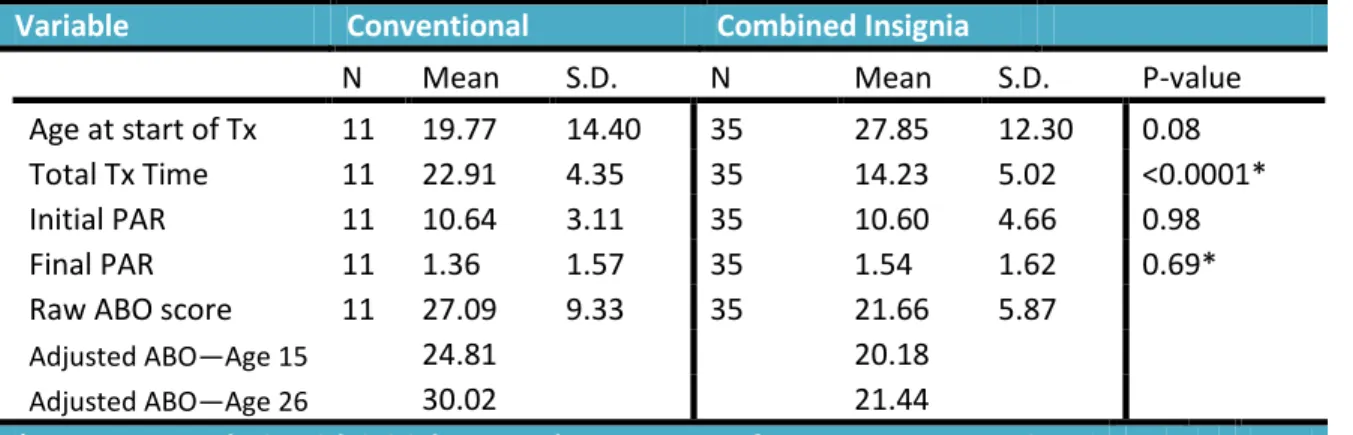
Unpaired T-tests were used to assess whether the two Insignia samples were similar, with respect to: 1) age at start of treatment, 2) initial PAR, 3) total treatment time, 4) final PAR, and 5) ABO score. There were no statistically significant differences, on average, and the two groups were combined (Table 1).
26
The effectiveness measures (final PAR and ABO score) of the Insignia sample and the conventional appliance sample were analyzed using analysis of covariance (ANCOVA) with age and pre-treatment PAR as covariates.
All statistical analyses were performed using SAS® version 9.1. The level of significance was set at p<.05 for all analyses.
Results
Sample demographics for all treatment groups are given in Table 3. The conventional bracket group consisted of 11 cases; 6 male (55%) and 5 female (45%), with an age range of 12.2 – 52.7 years. The Insigniagroup 1 consisted of 11 cases; 5 male (45%) and 6 female (55%), with an age range of 12.4 – 49.2 years. Insignia group 2 consisted of 24 cases; 17 male (48.6%) and 18 female (51.4%), with an age range of 12.0 – 51.8 years.
Effectiveness
27
criteria. Unadjusted component mean scores for each section of the ABO Cast and Radiographic Evaluation form are in Table 4.
Efficiency
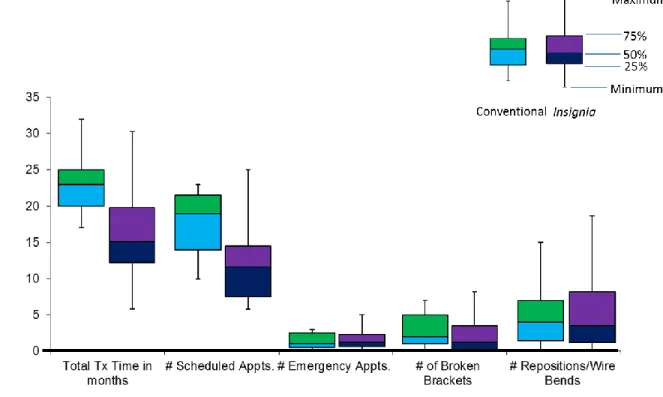
Data for efficiency measures for the Insignia and conventional patients are shown in Figure 1. The average adjusted treatment time was statistically significantly shorter (p<0.0001) for the Insignia patients,and they had approximately 7 fewer appointments on average. The number of unscheduled emergency appointments, de-bonded brackets, and repositioned brackets and/or wire bends were similar, on average, between the two treatment groups. In interpreting these data, however, it is beneficial to keep in mind the small sample size of the conventional appliance group as well as the variability noted by the box plot whiskers.
Discussion
This retrospective study analyzed 35 cases treated with Ormco’s Insignia and compared their clinical outcomes to 11 control cases treated with conventional twin brackets. The groups had comparable initial malocclusions based on age at start of treatment and initial PAR score. All cases were treated non-extraction with full fixed appliances. None of the cases required growth modification or orthognathic surgery.
The comparative findings in this study must be viewed with caution because of the small size of the conventional appliance group and the fact that these cases were selected to match the small group of Insignia patients from that practice who had
28
compelling. Keeping this limitation in mind, it is interesting to consider how the observed differences with Insignia might have been produced.
Effectiveness Measures
The final PAR scores, which were similar for the conventional and Insignia groups, suggest that Insignia is capable of achieving acceptable clinical results similar to a conventional edgewise appliance. The ABO scores, which focus more strongly on details of tooth position, were better for the Insignia patients in almost every area analyzed; especially, alignment/rotations, overjet (maintaining arch coordination), and root angulation (Table 4). The improved alignment is likely due to the customized bracket slot orientation and the ability to visualize the final occlusal setup at the
beginning of treatment. However, the transfer jigs must position the slot correctly on the patient’s tooth for optimal results. Any inaccuracy of the jigs or in the indirect bonding process will compromise the treatment outcomes. Archwires are contoured to the
29 Efficiency Measures
The decreased treatment time and decrease in number of appointments in the Insignia group has several possible explanations. It does not seem to be due to less
quality in finishing, since some measures of this showed the outcomes to be better. It may have been due in part to the relative difficulty of the conventional and Insignia cases, although the conventional cases were chosen to match the Insignia cases and both the initial and final PAR scores for the two groups were quite similar (Table 2). An
individual practice would have to decide if the additional laboratory fees associated with the Insignia appliance are offset by the decreased treatment time or possibly increase their fee for this custom appliance.
From the perspective of the characteristics of the Insignia method, since all aspects of tooth positions are designed virtually, it is possible that the teeth move in a more direct path to the final occlusion. Although the average number of wire bends and repositions was similar in the two groups, it is plausible that the alignment errors that were still present in the Insignia group toward the end of treatment were less severe and thus took less time to correct. For example, extruding a tooth to correct a small vertical discrepancy in tooth position would be faster than accomplishing root movement to correct a second order discrepancy.
While there was one case in the conventional group and 5 cases in the Insignia group that did not require bracket repositions or wire bends, overall, Insignia did not prove to be a true ―straight wire appliance‖. Possible reasons for this are: variable
30
deficiency in the tolerance between the bracket slot and the archwire. Further, it is possible that bends were needed to compensate for side effects from tooth movement, since the slot was designed from a static model of the final occlusion when in reality tooth movement is a dynamic process. For example, if a tooth needs to be intruded to get to its ideal position on the virtual setup, labial crown tip would need to be accounted for in the slot.
Many authors argue that a true SWA is practically and clinically not possible. The reasons most commonly stated in the literature are: inaccurate bracket placement6, 8, 20, 21, variations in tooth morphology6, 7, 9, 20, 26, 27, 28, skeletal discrepancies6, 29, tissue rebound6, 30, 31, 32
, and mechanical deficiencies of edgewise orthodontic appliances6, 20, 33. Miethke and Melson concluded that, ―…it is unreasonable to anticipate that any straight wire appliance without individual adjustments can be anticipated to lead to an optimal tooth alignment‖7
and proposed, ―if the straight wire approach should be followed, the bracket would have to be custom made.‖7
The Insignia appliance may have overcome the issue of variations in tooth
morphology by virtue of the manufacturing and bonding process. A standard bracket pad is used to hold the customized bracket and is virtually placed on the tooth to have at least 3 points of contact. The transfer jig allows the clinician to transfer the virtual bracket position to the mouth and holds the bracket in position so that the composite can create a ―custom bracket pad.‖ Although not a true custom bracket pad, this process does
31
determine if this process leads to fewer de-bonded brackets. In this study, Insignia had one fewer de-bonded bracket, on average, per case.
As with all current computer-assisted technologies, there are inadequacies with virtual treatment planning. A non-ideal virtual design of the alignment and occlusion can lead to wire bends and/or bracket repositions at the fault of the provider and not the appliance. This may have been the case in this study. It is likely that the more attention to detail and time spent perfecting the virtual setup, the less time will be required for
detailing later in treatment.
Another major inadequacy with virtual treatment planning is the lack of integration of soft tissue drape and occlusal plane angulation with the virtual setup. A ―SmileArc TM‖ feature in the Insignia software enables practitioners to vertically move the maxillary incisors while the lower incisors intrude or extrude to compensate. While this is a nice feature, clinical measurements are required to know much maxillary incisor
intrusion/extrusion is needed, since no photo or 3D image can currently be overlaid on the virtual setup. Also affecting smile arc and the incisor inclination is the angulation of the occlusal plane. Since there is no stable landmark, as you move and rotate the dentition on the computer screen, the smile arc and incisor inclination change. One could estimate the occlusal plane angulation by utilizing the lateral cephalogram, but having the
dentition oriented as it is in natural head position would be very beneficial.
32
the virtual setup was scrutinized and adjusted prior to fabrication of the appliance; this could lead to more repositions and wire bends in the Insignia group. Since the study was comprised of cases treated over a nearly 4-year period, various iterations of Insignia were used; newer versions may be superior to predecessors. It is also possible that inaccuracies were present in the wax bite and/or trimming errors in the final casts that would have an effect on the final PAR and ABO scores in a positive or negative light.
Perhaps the future of orthodontics will be a combination of intraoral scanners and customized computer-assisted treatment planning combining a 3-D extraoral image, cone beam CT radiograph, and a virtual occlusal setup. This combination would allow true soft tissue paradigm treatment planning as well as allow the patient to visualize and better understand the orthodontic process and outcome. The Insignia process could then be the bridge between the computer world and reality.
Future studies should be done to further analyze the effectiveness and efficiency of Insignia. Randomized clinical trials with consecutively treated patients and a larger sample size should be accomplished. Also, studies analyzing the accuracy of the bonding jigs in transferring virtual bracket position to the mouth would be beneficial.
Conclusions
Insignia did not prove to be a true Straight-Wire Appliance for every case;
however, it did prove to be an effective tooth-moving appliance, at least as effective as treatment with conventional brackets.
In this study, the cases treated with Insignia had superior ABO scores
33
particular, Insignia performed better in regards to alignment, maintaining arch coordination, and root alignment.
Compared to a sample of cases treated with conventional brackets,
34
Table 1. T-Test Results Comparing the Two Insignia Groups
Variable Insignia Group 1 Insignia Group 2
N Mean S.D. N Mean S.D. P-value
Age at start of Tx 11 28.44 15.69 24 28.21 10.83 0.80
Initial PAR 11 9.09 2.91 24 11.29 5.18 0.20
Total Tx Time 11 16.45 6.27 24 13.21 4.09 0.08
Final PAR 11 2.18 2.09 24 1.25 1.29 0.11
35
Table 2. T-Test and ANCOVA* Results Comparing the Two Treatment Groups
Variable Conventional Combined Insignia
N Mean S.D. N Mean S.D. P-value
Age at start of Tx 11 19.77 14.40 35 27.85 12.30 0.08
Total Tx Time 11 22.91 4.35 35 14.23 5.02 <0.0001*
Initial PAR 11 10.64 3.11 35 10.60 4.66 0.98
Final PAR 11 1.36 1.57 35 1.54 1.62 0.69*
Raw ABO score 11 27.09 9.33 35 21.66 5.87
Adjusted ABO—Age 15 24.81 20.18
Adjusted ABO—Age 26 30.02 21.44
36 Table 3. Sample Demographics
Conventional Insignia Group 1
Insignia Group 2
Combined Insignia N
Age range at start of treatment
11 12.2-52.7
11 12.4-49.2
24 12.0-51.8
35 12.0-51.8
Sex: Male (%) 6 (55%) 5 (45%) 12 (50%) 17 (48.6%)
37
Table 4. Comparison of Unadjusted Mean Score for Each Section of the ABO Cast & Radiographic Evaluation Form.
Alignment/Rotations Marginal Ridges
B-L Inclination
Overjet Occlusal Contacts
Occlusal Relationships
Interproximal Contacts
Root Angula tion
Conventional 4.64 4.00 2.82 4.27 4.09 4.36 0.73 2.18
38
39
IV. LITERATURE CITED:
1. Good, Phoebe. History of Orthodontic Appliances: From Ancient Times to Today. PCSO Bulletin. Summer 2006: 20-25.
2. Proffit WR, Fields HW, Sarver DM. Contemporary Orthodontics. 4th edition; pp407-409. Mosby Elsevier, 2007.
3. Andrews LF. The straight-wire appliance, origin, controversy, commentary. J Clin Orthod. 1976 Feb; 10(2):99-114.
4. Andrews LF. The straight-wire appliance. Explained and compared. J Clin Orthod. 1976 Mar; 10(3):174-95.
5. Andrews LF. The straight-wire appliance arch form, wire bending & an experiment. J Clin Orthod. 1976 Aug; 10(8):581-8.
6. Creekmore TD, Kunik RL. Straight wire: the next generation. Am J Orthod Dentofacial Orthop. 1993 Jul;104(1):8-20.
7. Miethke RR, Melsen B. Effect of variation in tooth morphology and bracket position on first and third order correction with preadjusted appliances. Am J Orthod Dentofacial Orthop. 1999 Sep;116(3):329-35.
8. Balut N, Klapper L, Sandrik J, Bowman D. Variations in bracket placement in the preadjusted orthodontic appliance. Am J Orthod Dentofacial Orthop. 1992 Nov;102(5):23A-24A.
9. Dellinger EL. A scientific assessment of the straight-wire appliance. Am J Orthod. 1978 Mar;73(3):290-9.
10.Increasing clinical performance with 3D interactive treatment planning and patient-specific appliances. Ormco®
, 2006.
11.Wahl N. Orthodontics in 3 millennia. Chapter 16: Late 20th-century fixed appliances. Am J Orthod Dentofac Orthop. 2008 Dec; 134(6): 827-830.
40
13.Roth R. Five Year Clinical Evaluation of the Andrews Straight Wire Appliance. J Clin Orthod. 1976 Nov; 10(11):836-850.
14.Mayerson M. Practice Management and the Straight Wire Appliance. J Clin Orthod. 1977 Mar; 11(3):207-212.
15.McLaughlin RP, Bennett JC, Trevisi HJ. Systemized Orthodontic Treatment Mechanics. 4-11. Mosby, 2002.
16.Roth RH. The Straight-Wire Appliance 17 Years Later. JCO. 1987 Sep; 21(9): 632-642.
17.Creekmore TD. The new torque appliance. J Clin Orthod. 1973 Sep; 7(9): 553-562.
18.Ricketts RM. Bioprogressive therapy as an answer to orthodontic needs. Part I. Am J Orthod. 1976 Sep; 70(3): 241-267.
19.Alexander RG. The varisimplex discipline. Part I. Concept and appliance design. J Clin Orthod. 1983 Jun; 17(6): 380-392.
20.Schwaninger B. Evaluation of the straight arch wire concept. Am J Orthod. 1978 Aug; 74(2): 188-196.
21.Balut N, et al. Variations in bracket placement in the preadjusted orthodontic appliance. Am J Orthod Dentofac Orthop. 1992 Jul; 102(1): 62-67.
22.Sondhi A. Efficient and effective indirect bonding. Am J Orthod Dentofac Orthop. 1999 Apr; 115(4): 352-359.
23.Aguirre MJ, King GJ, Waldron JM. Assessment of bracket placement and bond strength when comparing direct bonding to indirect bonding techniques. Am J Orthod. 1982 Oct; 82(4): 269-276.
24.Koo BC, Chung C, Vanarsdall RL. Comparison of the accuracy of bracket placement between direct and indirect bonding techniques. Am J Orthod Dentofac Orthop. 1999 Sep; 116(3): 346-351.
25.Zachrisson BU, Brobakken BO. Clinical comparison of direct versus indirect bonding with different bracket types and adhesives. Am J Orthod. 1978 Jul; 74(1): 62-78.
26.Miethke R. Third order tooth movements with straight wire appliances.
41
27.Germane N, Bentley BE, Isaacson RJ. Three biologic variables modifying faciolingual tooth angulation by straight-wire appliances. Am J Orthod Dentofac Orthop. 1989; 96(4): 342-319.
28.Bryant RM, Sadowsky PL, Hazelrig JB. Variability in three morphologic features of the permanent maxillary central incisor. Am J Orthod. 1984 Jul; 86(1): 25-32.
29.Ross V, Isaacson RJ, Germane N, Rubenstein LK. Influence of vertical growth pattern on faciolingual inclinations and treatment mechanics. Am J Orthod Dentofac Orthop. 1990 Nov; 98(5): 422-429.
30.Zachrisson BU. Interview on excellence in finishing. Part 2. J Clin Orthod. 1986 Aug; 20(8): 536-556.
31.Roth RH. Treatment mechanics for the Straight Wire Appliance. Graber TM, Swain BF, eds. Orthodontics: current principles and techniques. St Louis: CV Mosby, 1985.
32.Swain BF. Straight wire design strategies: five-year evaluation of the Roth modification of the Andrews straight wire appliance. Graber LW, ed. Orthodontics state of the art essence of the science. St Louis: CV Mosby, 1986.
33.Archambault A, et al. Torque Expression in stainless steel orthodontic brackets; A systematic review. Angle Orthod. 2010 Jan; 80(1): 201-210. 34.Richmond S, et al. The development of the PAR Index (Peer Assessment
Rating): reliability and validity. European Journal of Orthodontics 1992;(14):125-39.
35.The American Board of Orthodontics Grading System for Dental Casts and Panoramic Radiographs. Jun 2008.