ENTHUSIASTS, BACKUP PLANNERS, AND PROFESSIONALS: HOW COLLEGE STUDENTS APPROACH PARTICIPATION IN SERVICE PROGRAMS AFTER
GRADUATION
Alanna Gillis
A thesis submitted to the faculty at the University of North Carolina at Chapel Hill in partial fulfillment of the requirements for the degree of Master of Arts in the Department of Sociology.
Chapel Hill 2016
Approved by:
ii © 2016 Alanna Gillis
iii ABSTRACT
Alanna Gillis: Enthusiasts, Backup Planners, and Professionals: How College Students Approach Participation in Service Programs after Graduation
(Under the direction of Laura Lopez-Sanders)
How do college students who aspire to participate in service programs, such as Peace Corps or Teach for America, approach such participation? Previous research focuses on service programs as civic engagement while largely ignoring the transition to adulthood life course context. Using 30 in-depth interviews with juniors and seniors, I find three approaches: Enthusiasts prioritize participation as temporary and fulfilling work prior to careers. Backup Planners prefer beginning careers or graduate school but consider service programs good backup plans. Professionals view service programs as easy ways to enter their careers. While the
iv
TABLE OF CONTENTS
LIST OF TABLES………. vi
INTRODUCTION.………..1
Transition to Adulthood Changes………3
Changes in Elite Higher Education………..7
Service Programs………...10
Previous Service Program Frameworks……….13
DATA, METHODS, AND ANALYTIC STRATEGY……….17
Research Context………...19
Recruiting Strategy………22
Analytic Strategy………...27
Description of the Sample………..29
FINDINGS……….31
Enthusiasts……….32
Backup Planners………40
Professionals………..45
Aspirations versus Participation………49
DISCUSSION………55
CONCLUSION………..58
v
vi
LIST OF TABLES
1
INTRODUCTION
To our seniors, you are almost done with your undergraduate work. I think this is the most beautiful time of year in Research Heights1 and hope you will take time to enjoy our campus and your friends here as you prepare to take the next steps in your journey, whether you enter the job market, further your education or embark on public service.
-Chancellor Smith of Research Heights University (RHU), in an email to the RHU campus community
Chancellor Smith summarizes the three major pathways that college students can take after they graduate from college: they can enter the job market, they can pursue more education, or they can “embark on public service,” which I take to mean participating in a service program. This study shows that these three options seem clear to many of the students, faculty, and
administrators at an elite campus like RHU—a highly selective public research university and the setting of this study. However, scholars have largely devoted their attention to service programs as a form of civic engagement, as if it were simply a higher-commitment form of volunteering, rather than a distinct pathway with which to leave college after graduation and possibly a temporary replacement for seeking work or education. Given that the majority of participants in service programs in the US do so immediately after college graduation, and the vast majority seem to do so within a few years of college graduation (McAdam and Brandt 2009), the study of this participation needs to expand beyond investigations of civic engagement. Instead, it needs to be placed in the broader context of the delayed transition to adulthood to
1 Note that the name of the town, university, and all people used in this study have been changed to protect confidentiality. The Peace Corps, Teach for America, AmeriCorps, City Year, and Fulbright ETA have all retained their true names. All other service program organization names have been changed, as interest/participation in these other programs by RHU students is much smaller and using the real name could reveal the identity of the
2
understand the participation more fully in the young adults’ life course. It also needs to be understood relative to recent changes in elite higher education such that these colleges increasingly promote identity development and decreasingly emphasize
professional-occupational programs or other direct career development (Arum and Roksa 2014; Brint, Riddle, Turk-Bicakci, and Levy 2005; Armstrong and Hamilton 2013). Finally, it needs to be understood as an example of young adults taking time to explore after graduation in order to assess if this exploration period helps or hurts the trajectories of these college graduates—and the role that social class background plays in the determining whether the exploration hurts or helps.
By analyzing how college students who aspire to participate in service programs speak about such programs, we can better understand how they approach their participation during this period immediately after graduation. Service programs generally delay the timing of reaching the adulthood marker of career because they are short-term programs (though my research shows this is not the case for a small subset of young adults who actually use the programs to enter their careers). By studying how students interpret their own participation we can also understand their subjective interpretations of such a delay (Eliason, Mortimer, Vuolo 2015)—e.g., whether this is a conscious or intentional decision to delay career pursuit and whether they feel ready to be adults. Finally, many scholars seem concerned about the trend of delayed career seeking post-college, especially for young adults from less privileged backgrounds (Arum and Roksa 2014). Understanding how students talk about service programs relative to their career aspirations helps us understand whether service programs are an example of young adults wasting time or if they view them as a positive and strategic move—and if this might vary based on social class
3
years after college and still end up in middle to upper middle class trajectories while those from less privileged backgrounds are often hurt by this exploration time (Settersten and Ray 2010).
Using in-depth interviews with college juniors and seniors aspiring to participate in a service program, I answer the following research question: how do college students aspiring to participate in a service program after graduation explain and understand their possible future participation? In answering this question, I will also address the following: how is their
aspiration linked to career ideas? What do these aspirations tell us about the exploratory period after college graduation? How do young adults subjectively interpret their delayed pursuit of the adulthood marker of career? Are these aspirations examples of college students being adrift or do they seem to have strategic advantages for young adults and do these advantages vary by social class background? And, how do service programs connect to graduate school aspirations—might they possibly be a new pathway for some young adults to transition from college to graduate school? I review the literature on the delayed transition to adulthood, changes in elite higher education, and the literature on service programs. I also explain the four primary theoretical frameworks scholars have previously used to understand service program participation before reviewing my methods and findings that challenge these previous frameworks; describing the three approaches I found students use; and tying these findings back to literature on life course, education, and inequality.
Transition to Adulthood Changes
4
Settersten and Ray 2010). Each of these can be seen as markers of adulthood, such that life course scholars can analyze the timing by which young adults reach each marker, as well as their subjective interpretations of feeling like an adult or feeling ready for each marker (Eliason, Mortimer, Vuolo 2015). Once these five steps have been completed, then traditionally the person is seen as having fully transitioned to adult status. However, scholars have also widely
acknowledged that these traditional markers of the transition to adulthood need to be
complicated, as the transition has been delayed (Settersten and Ray 2010), has been made more subjective (Shanahan et al. 2005), occurs on a variety of different pathways (Osgood et al. 2005; Eliason, Mortimer, Vuolo 2015), and greatly varies by social class background (Shanahan 2000; Osgood et al. 2005; Schoeni and Ross 2005).
5
stage” (as opposed to immediate full financial adult responsibilities) might be one of the major mechanisms for reproducing class inequalities in today’s society.
Careers, like marriage, have been delayed so that college educated young adults can try out different opportunities and types of jobs before hopefully settling into a career. They seek jobs that are personally meaningful and fit with their identities, hoping to eventually find the perfect career for them (Arnett 2004; Settersten and Ray 2010). On average, young adults in their early twenties switch jobs once a year (Settersten and Ray 2010). However, even looking only at college graduates, this instability in jobs is generally only strategic for young adults from
privileged families. “Job-shopping” allows them to try increasingly better fitting and paying jobs, or ones that have great strategic advantages for future applications, rather than the “job-hopping” young adults from less privileged families participate in (Settersten and Ray 2010: 53). The job-hopping, by contrast, is often still motivated by the cultural shift in seeking fulfilling work. However, college graduates from less privileged families are generally less successful in finding meaningful jobs both temporarily in their early to mid-twenties and in using these varied jobs strategically to seek enjoyable and well-paid careers later (Settersten and Ray 2010).
Therefore, this slower path toward a career, as opposed to immediately after college graduation, has expanded what is strategic and necessary for professional careers. For instance, there has been a rise in internships both during and after college, and internships during college positively affect likelihood of employment immediately after graduation (Pascarella, Terenzini, Feldman 2005). These internships, though, often have little to no stipends available, so are often a strategic advantage accessible only to students whose parents support them financially
6
participation in internships, graduate school, service programs, and other more temporary jobs both helps students desiring to fulfill this cultural shift toward pursuit of varied and personally fulfilling opportunities during their twenties and gains strategic advantage in a changed job market where only having a bachelor’s degree and part-time work experience is not enough—at least for those who can afford to seek these opportunities (Armstrong and Hamilton 2013; Arum and Roksa 2014).
Considering the economic recession exacerbated this problem of few good career
7
young adults from working class or even lower middle class families will be hurt by this time adrift because they must settle for jobs that can pay the bills right now, and thus are unlikely to end up in professional careers in part due to massive student loan debt that they must struggle to pay back after graduation—if they make it to graduation at all (Armstrong and Hamilton 2013; Dwyer, McCloud, and Hodson 2012). They must prioritize paying off this debt and other personal or family bills when selecting jobs or graduate programs after college (Rothstein and Rouse 2011). Thus, due to changing cultural norms about marriage and jobs during the twenties and due to changing structural conditions requiring more than a college degree to enter more meaningful and higher-paid careers, there has been a rise in job-shopping in the twenties, for those who can afford it (Settersten and Ray 2010). This job-shopping involves using temporary jobs strategically and for personal fulfillment before settling down into careers, though it also increases inequality between college graduates from different social class backgrounds.
Changes in Elite Higher Education
Elite higher education has undergone shifts in the past few decades so that there is an increased focus on personal development of students and an emphasis on liberal arts over direct professional development. College students increasingly spend time in college engaging in identity development rather than intellectual development (Clydesdale 2007; Arum and Roksa 2011; Arum and Roksa 2014; Armstrong and Hamilton 2013). They do so through being primarily involved in socially-oriented rather than academically-oriented activities (Armstrong and Hamilton 2013; Arum and Roksa 2011; Clydesdale 2007). This focus on personal
8
are increasingly focused on the personal growth of students alongside their academic development (Arum and Roksa 2014: 9). The focus on personal development begins in the admissions process for selective colleges (Stevens 2007) and persists through the college
experience. The student service model results in increasing emphasis placed on student activities, organizations, sports, and dormitories to facilitate self-exploration and socializing with peers (Arum and Roksa 2014; Armstrong and Hamilton 2013). This institutional social priority comes at a price, such that the academic and professional development of students is underemphasized (Armstrong and Hamilton 2013; Arum and Roksa 2011).
At the same time, more selective colleges are turning further away from the
“occupational-professional degrees” that less selective colleges are increasingly emphasizing (Brint, Riddle, Turk-Bicakci, Levy 2005: 173). In other words, less selective colleges are putting more resources into the development of programs that train students directly for careers like education, nursing, or business. Meanwhile, more selective colleges are moving farther from these career-oriented approaches so that their college experiences are further removed from direct career development or transitions. Likewise, studies have found that students who attend these more selective colleges struggle to know how to transition to the labor market after graduation, unless they have specific mentors or helpful friends and family (Settersten and Ray 2010); resources are often lacking for students in career development at these institutions, especially along the mobility pathway for students from working class or lower middle class backgrounds (Armstrong and Hamilton 2013).
9
(2010) argue that successfully transitioning out of college on a good path (i.e., trajectory toward a middle or upper middle class profession) generally requires continued active parenting to help the young adult navigate this transition; for those students with uninvolved parents—or parents who do not have the necessary connections or knowledge to actively mentor them—the role of mentors, counselors, and professors in college is crucial. While some students certainly form these connections in college, it is often the students already on the professional pathway from upper middle class families who are well-versed in networking; students from lower class backgrounds find the mobility pathway underdeveloped relative to their needs (Armstrong and Hamilton 2013). Therefore, graduates from selective colleges still often leave without concrete long-term career plans, as they often feel unprepared to make career decisions (Settersten and Ray 2010; Arum and Roksa 2014).
10 Service Programs
Previous research on service programs has primarily focused on whether there are long-term civic engagement benefits after participating in a government-run program such as Teach for America (TFA) (McAdam and Brandt 2009) or AmeriCorps (Finlay, Flanagan, and Wray-Lake 2011).2 However, many elite colleges may be promoting a broader view of participation in service programs by linking them to career development and short-term work opportunities after college graduation. For instance, Southern Arts College,3 a liberal arts college in the southeast, posted on their Facebook page:
Making an Impact through Post Graduate Service - Do you value service?
- Hoping to gain greater clarity about your career interests?
- Seeking a short-term work experience that is professional & meaningful? Consider taking a “Year of Service” after graduation!
Come hear from Southern Arts alum, Ali Boyd ’11, as she shares her post graduate service experience working at the U.S.-Mexico border as a volunteer with the Border Servant Corps, an AmeriCorps affiliated program and how it has impacted her personal career path!
Likewise, RHU posted on its Facebook page: “Great news! RHU climbs to No. 14 among Peace Corps’ volunteer-producing colleges and universities! #RHU.”4 Southern Arts is hosting events encouraging its students to consider “taking a year of service” after graduation, and RHU is clearly boasting that so many of its students join the Peace Corps after graduation. Some colleges are using career services and social media resources to encourage their students to participate in these programs.
2 Previous research has also focused on the effects of the service program on the population being served such as TFA’s effect on education (Darling-Hammond, Holtzman, Gatlin, and Heilig 2005; Heilig and Jez 2014).
3 While no research was conducted at this university, I have changed the name of this university to also be consistent with the use of pseudonyms.
11
Therefore, as seen in the introductory quote by RHU’s chancellor and Southern Arts’s Facebook post, it is not just particular service programs that are being encouraged, but this pathway as a whole that Southern Arts calls a “year of service” and RHU’s chancellor calls “embark on public service.” Thus, studies that only look at participation in individual
programs—such as the Peace Corps (Starr 1994; Colmen 1966; Searles 1997) or TFA (McAdam and Brandt 2009) or participation in certain sectors of volunteering/service such as international development (Sherraden, Lough, and McBride 2008)—are missing the trend5 in recent
graduates’ aspirations to participate in these many varied service programs (Zakaria 2015) that collectively form a new pathway to transition out of college. While not all people who participate in these programs do so immediately after they graduate from college, a sizable number do (McAdam and Brandt 2009).6 In 2006, more than eleven percent of first-year college students said it was “essential” or “very important” that they “participat[e] in an organization like the Peace Corps or AmeriCorps/VISTA” after graduation (Higher Education Research Institute 2007: 3), and this number could possibly be higher if student had been primed to also think about non-governmental service programs.
This advertisement by colleges promoting participation in service programs broadly, including non-governmental programs, is not reflected in the literature. Likewise, the focus by colleges on using service programs for career exploration and development, instead of only an opportunity to develop good civic behaviors, is also underdeveloped. Thus, while scholars are
5 There is not systematic evidence for a rise in the overall trend across programs because there is no nationwide survey that has collected this data over time. However, increases in individual programs hint to a growing trend, especially since the economic recession in 2008. For instance, in 2014 Teach for America more than doubled the number of applications it received relative to 2008, receiving more than 50,000 (Zakaria 2015).
12
interested in understanding whether government-run service programs promote better citizens (McAdam and Brandt 2009; Finlay, Flanagan, and Wray-Lake 2011), they are missing how young adults themselves may interpret their participation in such programs. This participation may be related to themes colleges promote about service programs such as career exploration, to themes scholars have studied such as a commitment to service (McAdam and Brandt 2009), or to other themes not yet addressed. This participation also needs to be linked to the changes in the transition to adulthood and the increasing emphasis placed on identity development during college instead of explicit career development.
To reflect this broader investigation of service program aspirations for young adults, I define a service program as full-time program focused in some way on helping or serving a social need or community. The program must be undertaken instead of entering the labor market in a traditional way or graduate/professional school and is undertaken for a specific length of time. Therefore, unlike volunteering that could be once a month or whenever the volunteer wants to go, a service program is the major commitment that the young adult has during that year or two of her/his life: the participant generally will work at least forty hours a week and is expected to relocate to their placement site which she/he may or may not have been able to request. Also unlike volunteering which is generally unpaid, a service program may require fundraising, provide room and board, provide a stipend, or pay a wage/salary. If it is a position, like teaching, that could normally be considered a job, particularly if it has the same salary, it can be
13
meets the other criteria. Service programs include well-known government programs like Peace Corps, Teach for America, and AmeriCorps, but also include programs run by local, national, or international non-profits that can be secular or religious.
Previous Service Program Frameworks
14
post-college career and social class trajectories. However, this backup plan may only be available for students from upper middle class backgrounds.
Second, scholars have used the gap year argument. The gap year concept typically describes post-high school experiences before college. For instance, Jeffrey Arnett (2004: 164) defines a gap year as “taking a year or two after high school to mature and have other
experiences before entering tertiary education.” Gap years can include a variety of activities such as working a job, doing volunteer service, or travelling (Jones 2004; O’Reilly 2006). Despite the prevalence of gap years in countries like Britain, Germany, Australia, and Israel, it is still
relatively rare in the United States for a post-high school student to participate in a gap year before college (Arnett 2004; Settersten and Ray 2010). However, both Arnett (2004) and Settersten and Ray (2010) argue that gap years could solve the problem of so many American students entering college without a clear plan for study or career. Arnett extends this gap year framework to the post-college context to explain recent college graduates’ participation in
programs like AmeriCorps, TFA, and the Peace Corps: these programs serve as a “gap year, or at least a few gap months, once they graduate from college, before they enter a long-term job” (166). He argues that this time post-college is the time for them to do “unusual educational and work possibilities,” as well as having the “freedom” to relocate somewhere new (10). Therefore, the gap year framework argues that service programs serve to buffer the transition from college to the young adult’s next step—either a career or graduate school—by allowing them an
15
connection between college and graduate school, allowing a short break along this educational pathway.
Third, scholars have used the civic citizens argument. In McAdam and Brandt’s (2009: 950) longitudinal study of the civic behaviors of TFA applicants later in life, they argue that their study had an “obvious selection bias” because “the vast majority of applicants already share a serious commitment to service and civic life.” The evidence they provide of this commitment is that most did volunteer or activist work in college (McAdam and Brandt; Youniss 2009). Likewise, Youniss (2009: 973) argues TFA applicants “show interest in solving social issues.” Therefore, unlike the backup plan and gap year argument, the civic citizens argument states that the students who aspire to participate in a service program do so because of their intense
commitment to social issues. Unlike the majority of young adults who are not civically engaged in meaningful ways (Youniss 2009; Smith 2011; Oesterle, Kirkpatrick, and Motimer 2004), students who aspire to participate in service programs are young adults who are already deeply committed to civic engagement and will be civically engaged throughout young adulthood and beyond, even if they do not participate in a service program (McAdam and Brandt 2009). Due to this commitment to civic engagement, students aspire to participate in service programs as a way to act out their commitment to social issues.
16
17
DATA, METHODS, AND ANALYTIC STRATEGY
I conducted thirty in-depth semi-structured interviews with undergraduate juniors and seniors at RHU who had service program aspirations. The interviews lasted approximately one hour and forty minutes, though they varied from one hour and five minutes to two hours and thirty-eight minutes. Immediately following each interview, almost always within twenty-four hours, I wrote a memo about the interview. These memos included topics specific to each interview, including anything that stood out about the person’s experiences at RHU, the types of programs and post-grad options she/he considered, and her/his long-term career ideas. These writings aided me in generating preliminary analysis while I was still collecting data (Lofland et al. 2006; Charmaz 2014). I also used these post-interview memos to identify and develop themes emerging in the analysis (Lofland et al. 2006). These topics included themes that were emerging across multiple interviews, questions that would have been helpful to ask in retrospect, and puzzles that I had. I used this information both to generate analysis while still in the data collection phase as well as to influence future interviews, including asking questions that I had not previously thought to ask (Charmaz 2014).
Data collection occurred from March 2015 through April 2016.7 All data collection occurred in line with IRB protocols. Before each interview, I had the interviewee sign two written consent forms: the first consenting to participate in this interview and the second to store
18
her/his contact information so that I can contact her/him for a follow-up interview. Regarding the interviews for this study, I explained that everything said will remain confidential, that I will change their name, and that they have the choice to not answer any questions or to end the interview at any time. I also asked permission to digitally record the interview. Regarding the follow up interview, I had them write down their emails, phone numbers, and permanent
addresses. I stored this sensitive data in a separate locked location away from the rest of my data. After I transferred the digital recordings from my recorder to my password-protected computer, I deleted the audio file from the recorder. When I transcribed the interviews, I used the pseudonym for the participant so that their identifying information was kept in a separate location from their responses.
As I argue above, knowledge about service program aspirations is underdeveloped and therefore I used a mostly inductive approach. I began with a general interview guide informed by the research discussed above, common discussions of these programs in the media, and informal research I had previously conducted.8 I knew that I should focus on pre-college experiences, college experiences, and aspirations for immediate and long-term post-graduation plans.
However, I also allowed the interview guide to change and adapt to emergent themes (Charmaz 2014). For instance, I began this project calling the programs “volunteer programs” but within the first five interviews students consistently challenged this terminology. In response, I added a question to the interview guide specifically asking about the terminology. Through this
discussion I eventually settled on calling them “service programs” as it best captured what the majority of students articulated about the meaning of those terms and the meaning of these programs in their lives. I also followed Mario Small’s (2009) approach to seek “saturation”
19
whereby I continued interviewing students until I was no longer learning new information (25). I made adjustments to the semi-structured interview guide as I hit saturation on certain topics. For instance, as I progressed I decreased time spent discussing involvement in high school activities and organizations and used this additional time in the interview to pursue the new topics or themes that emerged from previous interviews. However, all interviews contained the same core topics of pre-college experiences, experiences in college, plans or aspirations for after
graduation, and long-term career plans. For a copy of my interview guide see the appendix. Interviews were the most appropriate method for this project because I wanted to explain how college students understand their own participation in service programs. While previous scholars have put forward four arguments with which to understand service programs, by and large they have not been based on the perspectives of the participants. In-depth interviews are the most effective method to analyze accounts of motivations, interpret meaning, and attempt to find common understandings or frameworks from the participants themselves.
Research Context
20
In order to provide further institutional context, I also conducted three interviews with key informants at RHU. First, I interviewed the RHU Peace Corps Recruiter. He is a graduate student at RHU but has an office in Career Services and hosts a number of meetings and events on campus to encourage RHU students to participate in the Peace Corps. Second, I informally interviewed the director of the social justice student activities center on campus, a full-time administration position. Third, I informally interviewed a staff member in Career Services who oversees the Peace Corps and TFA recruiters as well as advises students for other jobs, focusing on nonprofit and service jobs. These interviews are not counted in my total interview number of thirty.
21
organization the student organization is a part of) or informally through student networks in these organizations.
Overall, there are a number of resources on campus to connect students to traditional post-graduation plans of graduate school or other labor market outcomes. As mentioned above, RHU hosts career fairs and has an extensive Career Services office. Several mentoring programs exist for groups of students such as transfer students, minority students, academically
underperforming students, and students highly committed to service—and these four programs were represented by students in this study. Students who participated in these programs tended to speak highly of them, saying they aided their ability to navigate college and discuss
post-graduation options. However, students who were not part of these targeted mentoring programs often expressed that they felt advisors were unhelpful. By and large, these students relied on their friendship networks and family recommendations to navigate their transition out of college— much like a typical job search (Granovetter 1973) rather than using the college’s resources. At most, a few students mentioned a single meeting with a professor, advisor, teaching assistant, or other campus faculty or staff to discuss other post-graduation options, but students either felt the person was unhelpful or that they would be wasting that person’s time to follow up with any additional meetings. Therefore, while some institutional mechanisms do exist to help students transition to graduate school or the labor market, students in this study did not express that they felt sufficient support if they were not part of a specific mentoring program. They largely felt it was their job to collect the relevant information themselves through internet searches or
22
what they wanted to do for their career or because their career ideas were not in highly traditional fields like business that they assumed Career Services was focused on.
Recruiting Strategy
I interviewed juniors and seniors at RHU who fell into one of three categories: (1) has been accepted to and decided to participate in a service program (N=10), (2) is considering whether she/he wants to participate in a service program after graduation (N=17), or (3) very strongly considered participating in a service program after graduation but ultimately decided not to or was unable to participate in the program (at least started the application) (N=3). Each of these groups gives me different potential to learn more about service program aspirations in order to reveal more perspectives about the topic. The first group is clearly helpful because they are the students who have definitely decided to transition out of college via a service program. Therefore, I am able to analyze what they think future participation will mean for them.
23
plans. They will also have less retrospective bias about the other things they are considering post-graduation, because other opportunities are still being actively considered. Finally, the third group is helpful because I can hear the narratives of students who held service program
aspirations, but who ultimately were pulled or pushed away from actual participation including reasons such as good job offers, graduate school acceptance, rejection from the service program they applied to, or realizing the financial infeasibility.
This logic of selecting juniors and seniors prior to their transition out of college follows previous studies in this area. Scholars often study young people immediately prior to their transition of interest (in my case the transition out of college) rather than relying on retroactive accounts of participants after the transition is complete. Therefore, it is similar to the approach taken by McAdam and Brandt’s (2009) study using TFA applications and Clydesdale’s (2007) study observing and interviewing students in high school before following their transition during the first year of college.
While my sample is made up of students, my sampling frame was determined based on their possible participation in a service program. Thus, while I am not studying the programs themselves, the student’s inclusion in the study was dependent on what type of program they were considering. In order to not make pre-determined assumptions about what types of programs should make a student eligible for my study, I interviewed any student who self-selected into the study. This self-selection was generally based on a brief description like the following—taken from an email recruitment I used many times, such as when I was following up based on snowball referrals to friends of my study participants:
24
programs run by local, national, or international non-profits. Likewise, religious
programs, such as Jesuit Volunteer Corps or an extended mission trip, would also count. If this sounds like something you are thinking about doing, even if you're not sure that you will, and you might be willing to be interviewed, please email me so that I can contact you with more information.
The sample is confined to RHU students for this study. Because previous literature indicated that pathways throughout colleges vary based on the institution (i.e. Armstrong and Hamilton 2013; Arum and Roksa 2014; Pascarella and Terenzini 2005) it seemed likely that the service program pathways and interpretations may vary by university. For instance, RHU provides institutional space and legitimacy by allowing Peace Corps and Teach for America offices in Career Services and many service programs space during career fairs, so that students can use these resources to develop their aspirations. Therefore, by not interviewing students from a variety of universities, I am able to “control” for these institutional factors that vary between colleges, like Armstrong and Hamilton (2013) did in their study of the pathways of women who started college in the same dorm. I can focus on the interpretations students give for their aspirations, rather than focusing on this institutional variation.
In order to recruit students to participate in the study, I used three approaches: snowball sampling, listserv recruitment, and recruitment during classes. The primary approach I used was a referral-based recruitment method (Lofland et al. 2006; Weiss 1994). I used contacts I already had with undergraduate students at RHU in order to find the first few students to interview. After that, at the end of each interview I asked the student if she/he knew of any other students who were thinking about participating in a service program. As stated above, most interviews
25
the potential bias introduced by sampling within the same network, my recruiting strategy purposely drew from some groups that did not overlap, as they belonged to different extracurricular activities and organizations on campus. Because I already had contacts with undergraduate students in several different friendship networks, I was able to start the snowball process in multiple different positions to address this potential bias.
26
Clearly, the recruiting strategy I used did not generate a random sample of college students at RHU who are aspiring to participate in a service program. As Small (2009) argues, the benefits of compiling a random and representative sample would not have outweighed the limitations of doing so. My strategy involves several important advantages. For example, it allowed me to establish good rapport by building off my connections with student who referred me to the next.9 Building rapport with the participants was crucial so that the students felt less guarded and were willing to be more honest with me—producing valid and rich data. On multiple occasions, students stated that they were glad I was “changing [their] name” because they would not want their parents or others knowing some information they disclosed to me. Considering many discussed highly emotional topics such as severe family struggles, mental illness, or socially undesirable answers (such as explaining previous volunteering as primarily to help their resumé), establishing good rapport was essential. My recruiting strategy also aided in recruiting participants, which was especially crucial given that I did not know how to define a service program at the beginning of this project, nor had I decided on a term yet so it could be difficult to describe the project to students. Therefore, relying on my interviewees to aid in recruitment, after they already understood the study better through the process of being
27
interviewed, made recruitment feasible for a study that at the outset could be difficult to describe to potential participants. Additionally, I have the benefit of interviewing friends from the same network. Because participation in other types of volunteering and social activism often travels in networks (Musick and Wilson 2008), interviewing multiple friends in the same network allowed me to understand the processes at work better. Overall, following Small’s (2009) goal of
saturation through sequential interviewing was much more appropriate than the goal of finding a representative sample (see also Lofland et al. 2006; Weiss 1994; Charmaz 2014).
However, this nonrandom sample does provide a limitation—not all findings can be generalized. For instance, although the Professionals are very rare in my sample, only 2 of 30 students, I cannot assume that Professionals are rare among all college students who aspire to participate in a service program. The proportion size of these categories cannot be generalized. Nevertheless, given that I used strategies to ensure variability in my sample by starting my referrals in many different networks and by interviewing both juniors and seniors at different stages of their decision making process, the findings should be analytically generalizable (Small 2009). While I cannot know the size of each of the three categories I analytically derived, I can generalize that there are three approaches students use when considering service program participation: Enthusiasts, Backup Planners, and Professionals. These three approaches can be tested in future research for their prevalence. Therefore, the goal of this research—to understand approaches students use for service program aspirations—should be generalizable.
Analytic Strategy
28
wrote down anything that stood out to me that would not be captured by the recorder, such as body language, tone of the interviewee, and anything said before or after the recording device was on (Lofland et al. 2006). Then, as explained above, within twenty-four hours of conducting the interview, I freewrote anything that stood out to me about the interview, particularly
consistencies and inconsistencies in comparison to previous interviews conducted. I also used this time to evaluate whether there were any topics about which I had reached saturation, or any topics that I feel I still did not understand enough, so that I could make changes to the interview guide for the next interview (Charmaz 2014). While conducting interviews, I also occasionally freewrote or did structured brainstorming activities to analyze themes or findings across the sample. Next, as soon as possible, I transcribed each interview. As I transcribed, I sometimes paused to make notes of themes that stood out to me. After I transcribed each interview, I reread the entire transcript to ensure accuracy as well as reading with a specific eye toward writing about anything interesting, important, or confusing from the interview so that I could start to understand each account and possible connections across interviews.
After I completed the data collection, initial analysis, and transcription stages, I
29
individual pathways, noting commonalities among them to generate an initial theoretical
pathway. I then reviewed all memos, pathways, and codes to create a systematic coding scheme and codebook so that I could code the next twenty-two interviews in a more systematic way to test my theory. I wrote more memos and made revisions to the theoretical pathway as I
completed the coding process, including still writing out each individual’s pathway. This systematic coding and analysis process resulted in describing each of the thirty individuals’ pathways. I then used these pathways to analyze the different approaches students used to explain their service program aspirations, based on the coding already completed.
Description of the Sample
For a listing of all thirty participants in the sample, see the appendix which includes a table listing all participants’ pseudonyms, college major(s), gender, race/ethnicity, social class background, service program approach, current GPA, service program name (pseudonyms for some), long-term career aspiration(s), and reported likelihood of attending graduate or
30
disproportionally over-represents black students. Asian and Hispanics students are almost entirely missing from my sample, and students in “other” are slightly under represented.
There is more diversity by social class background than I had expected. I had assumed that almost all students would come from upper middle or upper class families, because previous literature indicated that students from less privileged backgrounds would not find these programs financially feasible after graduation (Armstrong and Hamilton 2013). However,50% were from upper middle or upper class families, 27% were from lower middle class families, and 23% were from working class or poor families. 10 This is roughly equivalent to the fact that approximately 20% of RHU undergraduate students are first-generation college students. Three of the students in my sample transferred to RHU from a community college, one transferred from a prestigious arts college, and one transferred from a state university in the Northeast. Twenty-seven of the 30 students have worked a job before (excluding internships).
31
FINDINGS
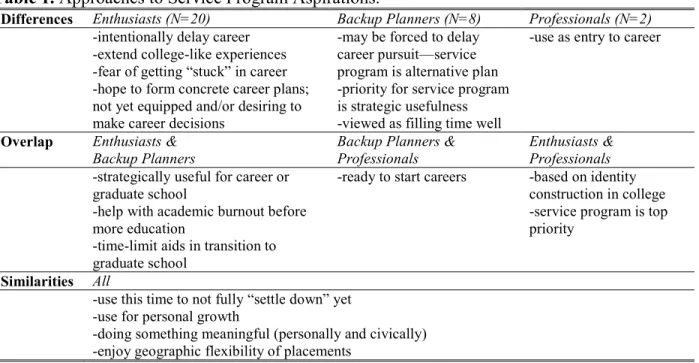
College students want to participate in a variety of service programs after they graduate for a variety of reasons, but their narratives reveal three approaches that they use to explain these service program aspirations. The Enthusiasts describe their service program aspiration as a culmination of their experiences and identity formation in college. For these students participating in a service program is their number one priority after they graduate. Backup Planners prefer either to be entering the labor market or further education, but for a variety of reasons conclude that participating in a service program is a good backup option in case their higher-priority aspiration does not work out. Finally, the Professionals do not see their participation in a service program as a short-term opportunity post-college, but aspire to use a service program as a step to enter their chosen professional career. These approaches, including the overlap between the approaches, are summarized in table 1.
Table 1. Approaches to Service Program Aspirations.
Differences Enthusiasts (N=20) Backup Planners (N=8) Professionals (N=2)
-intentionally delay career -extend college-like experiences -fear of getting “stuck” in career -hope to form concrete career plans; not yet equipped and/or desiring to make career decisions
-may be forced to delay career pursuit—service program is alternative plan -priority for service program is strategic usefulness -viewed as filling time well
-use as entry to career
Overlap Enthusiasts &
Backup Planners Backup Planners & Professionals Enthusiasts & Professionals
-strategically useful for career or graduate school
-help with academic burnout before more education
-time-limit aids in transition to graduate school
-ready to start careers -based on identity construction in college -service program is top priority
Similarities All
-use this time to not fully “settle down” yet -use for personal growth
32 Enthusiasts
The Enthusiasts passionately talk about participating in a service program after they graduate because they can follow their interests. If they are accepted to the service program(s) they applied for and can figure out the finances necessary for participation, then they say they definitely will participate. For instance, Emily, a white, upper class student, firmly stated, “Peace Corps is definitely number one.” Though she has looked at backup options in case she is not accepted to the Peace Corps, such as seeking out internship possibilities at “environmental firms” in Latin America and Spain, she hopes to be accepted to the Peace Corps. In the Peace Corps she plans to apply for an “environmental program that is focusing on agricultures in community, so it basically is the promotion of sustainable agriculture, which is something I can definitely get behind!” This passion was formed during an organic farming program in college when “I came away wanting to continue doing [sustainable agriculture] for the rest of my life.” Likewise, Jackson, a “half white, half Arab,” upper middle class student, prioritizes participating in a service program after graduation. Even though he has already accepted a job offer in the “financial services advisory,” he has also applied to teach English with the Fulbright English Teaching Assistant program because he wants to be a “cultural ambassador” in the Middle East. His employer said “I can push it back a year” and defer his job if he is accepted to Fulbright.
33
explained how she ended up choosing her major at RHU after she transferred from a community college saying, “I did it based on what interests me instead of what jobs it produces. And I don’t know if that’s maybe the smart thing, but that’s what I wanted to do.” She chose a Global Studies major because “I liked culture” and it had a “bunch of greatness throughout” its courses. Her discussion of following identity development over professional goals in choosing a major reflects the goals elite colleges promote, as discussed above. She also joined several student
organizations that focused on service and activism to try out different interests, but eventually, in her words, “stuck with some things that I really feel in my core, and that’s education.” She quit some organizations that she did not see as fitting with her core identity as a person passionate about education. After doing several “brainstorming activities” by herself, looking for “big themes” at the intersection of her “skills” and “interests,” she concluded that TFA or the
AmeriCorps Advising Program would best allow her to pursue her interest in education, culture, and service.
As Enthusiasts prioritized their pursuit of passions in college, these passions became an important part of the identity they constructed at college. For instance, John, a white, upper middle class man, described “all growing up I was involved in going to church and stuff,” but it was not until college when being a Christian became an active component of his identity. He was not even sure if he wanted to join a religious organization before he happened to go to an event because of the “free food.” Through his participation in a campus ministry group, the importance he gave to his identity as a Christian grew. He came to realize that the “Christian faith is
34
He described how this identity formation with his campus ministry group influenced his post-grad plans: “I’ve been involved with [Christian organization] for four years and … I’ve got a lot out of it and I definitely want other students to have the same experience. And so that’s kind of how I decided that I wanted to work for them, [the campus ministry organization], after
graduation. I’m doing it for at least one year now.” Like John, all Enthusiasts said they hoped to use their time in a service program as a means to continue the kinds of experiences they had in college—such as study abroad, internships at non-profits, or summer-long mission trips with their college religious organizations.
35
While Melanie and John had their service program aspirations emerge from their college experiences, other Enthusiasts intentionally designed their college experiences around their service program aspirations. For instance, Greg—a white poor/working class man interested in becoming a professor or museum curator—had been considering participating in the Peace Corps since high school, an aspiration that grew during college. After speaking to the Peace Corps recruiter on campus about what he could do “for them to say yes” to his application, the recruiter “suggested a number of things like teaching experience,” and so “I got involved in an
organization… working with community members” who wanted to learn English. Likewise, Emma admitted that part of the reason she participated in a program in college that allowed her to tutor refugees was for “my resumé for the Peace Corps, because they want to see volunteer, service hours” in those areas. Therefore, while all Enthusiasts use service programs to extend their passion-based identities constructed in college (generally in both academic and non-academic experiences), some Enthusiasts cultivated their college experiences in order to facilitate the pursuit of service program aspirations post-college.
36
woman, described the effect that the stress of making this decision had on her senior year, saying “I have gotten a little bit burned out this year just because there's so much going on and trying to figure out next year” on top of all of her academic and leadership obligations. She eventually realized it would be both easy and meaningful to do something with her campus ministry
organization from college. She found a service program through that organization that allows her to combine her Christian faith with her passion for “personal training” and this option became her priority—she is pursuing a program that is personally fulling while “helping people.”
Second, some students do not want to choose their long-term careers yet, instead following their passions to a service program and hoping that their participation will reveal to them what they should do next. Sofia, a working-class student from an immigrant family, does not want to plan out her future after TFA: “I’ve just been so fed up with people just always having this need of, like, you have to know every single step of your life... I’m kind of at a point where I’m like, I don’t care what I’m doing next. I just want to focus on what I’m going to do right now. And hopefully do the best that I can.” She argues that she will be doing critically important work for the community through TFA, which she sees as her immediate focus.
Steven, a Global Studies major, also does not know what comes next for him after his two-year religious service program, something that has been a great source of tension with his working-class family who frequently ask him, “Why are you not starting a career?” He says they think the service program “wasn’t a direct dividend from my investment into college from their eyes.” However, Steven bought into the belief, strongly promoted at RHU, that college is a time for pursuing one’s passions, such as “taking classes that I was actually interested in and not that I just wanted to force myself down a career path.” Now at the end of his senior year he is
37
what I, I enjoy it, I’m going to do it, I’ll see what doors are open at the end of it.” Hope, a white lower middle class woman, stated, “I don’t exactly know what I want to do after college. I figured [the Peace Corps] might give me a chance to figure out who I am” and what she wants to do next. These Enthusiasts do not necessarily want to plan their future careers, instead purposely remaining flexible so that they can allow the service programs to influence their future careers, possibly leading them in unexpected directions. In other words, they are being purposely adrift, but doing so in a way they view as strategic to find the perfect career (Settersten and Ray 2010).
Third, some Enthusiasts have vague ideas about future graduate school and career plans, though they do not believe that they are concrete enough to pursue them. Instead, they hope that participating in a service program can provide clarity for them without becoming committed to a career too soon, and ending up “stuck.” For instance, Tiffany, a white lower middle class
38
The fact that service programs are a specific time obligation helps students feel that they can more easily use this time to explore different opportunities. Melanie said she liked pursuing a “terminal program” because “when you’re going into something terminal like that, you offer two years of your time, of your service, of work, but then you can also regroup after that time and say, was this the right choice for me?” These terminal programs reduce the pressure to try out different jobs without having to quit jobs repeatedly if they do not enjoy them or want a new experience. For instance, Tiffany eventually wants to work on the “large scale” side of social problems, through research or legislation. But she wants some “hands on experience” in direct service first (many students echo this idea, that they feel ethically compelled to have direct experience with social problems before they begin careers in research or policy trying to solve the problems). She fears that if she sought a job with a non-profit—instead of participating in a service program—“I would worry that they would want me to stick around forever.” AmeriCorps is “more of an exploration type of thing,” so she would feel freer to go to graduate school after a year and would not be forced to “commit to one place or field so soon.”
39
Tiffany explains, “I don’t want to get in that rut that a lot of people describe where they just end up working and they just keep working and never go back to grad school.” However, service programs solve this problem by having a set end date so that young adults have a naturally built in time to move on from this exploration stage to begin graduate school or their careers.
Fifth, while strategic purposes of the service programs do not generally dominate the narratives of Enthusiasts, as they do for Backup Planners (see next section), they nevertheless do sometimes mention that they believe that they will gain skills and experiences that will help them become more successful in future graduate school and professional job applications. For
instance, Greg plans to get his PhD in archeology and has been told by his undergrad mentor, “no language no future.” His Peace Corps placement in the area of the world he hopes to do research in the future will allow him to begin learning a relatively rare language, which should boost his chances of getting into graduate school and accessing research opportunities. Sofia said while she eventually plans to become a researcher and will likely go to graduate school for sociology, she is burned out on school: “I just feel tired of school.” She hopes that taking time to pursue her passion with TFA will “get that flame going again” so that she will “get back to the point where I want to learn more.” Even Jackson’s corporate business job viewed his service program as providing him with valuable “job experience,” a contributing factor in his employer being willing to defer his start date by a year if he is accepted for Fulbright.
out-of-the-40
classroom setting. They are also strategically using them to develop and pursue future careers. They do not yet feel ready or prepared to commit to a long-term career, so instead they use service programs to figure out and build toward such a commitment. Therefore, service programs can prevent them from feeling adrift and lost after they graduate college. Even those Enthusiasts who have more concrete career plans still see strategic benefit in a service program post-college. They can develop skills and experiences that might aid their applications. Service programs allow them to experience a unique hands-on program they will enjoy and feel they are making a difference in before they feel like they must settle down into less exciting careers that may not involve travelling or solving social problems. They clearly reflect Settersten and Ray’s (2010) concept of “job-shopping” during the early to mid-20’s before settling into careers.
Backup Planners
41
program, so that “I can use it as a backup if I don’t get into OT school.” Her placement was in New York City as she requested, which she liked because her boyfriend, Justin, had a job offer there. Justin, a business major, also applied to TFA as a backup plan, in order to try to be near Michelle. Despite having a job offer from the communications corporation he interned for after his junior year, he applied to TFA indicating preferences near graduate schools she applied to, so that he could have “geographic flexibility” and they would not have to be “long distance.” Ultimately neither decided to participate in their backup service programs: Michelle was
accepted to graduate schools, but none near Justin’s TFA possibilities, and so both are pursuing their long-term career paths immediately after college and will be long-distance dating for her two year graduate program.
42
would allow him to get research experience to supplement his resumé, he also applied to two service programs as backup plans. One, France Tutoring Program, is tempting to him, as he did not get the chance to study abroad in a French-speaking country despite being a French double major. While he knows that the medical hospital program is “more geared toward my future interests,” he said that “if there were no financial constraints at all, I’d do the French thing, without a doubt.” However, because it only provides a small stipend he is not yet sure what he will do. Corey provides an example of a student considering using a service program as a means to take a break from school while doing something fun and civically helpful, even though he recognizes it is not as connected to his long-term career plans as other post-grad options. However, this is also a strategic decision on Corey’s part; like Sofia the Enthusiast, he is still able to use this time to reignite his passion for school so that he might be more successful in medical school. If he is right, then this service program could ensure better long-term success than going to medical school right after graduation.
43
These students are in a sense using service programs to avoid being adrift when the viability of their first preference was called into question. For instance, Michelle knew that “I just needed something to do after graduation” if she was not accepted to OT school. Because “I don’t have an option to go back home” after graduation due to a difficult family history, she knew she needed a well-formed backup plan that would allow her to make money to support herself while she worked on applications again. Her mom passed away from cancer when she was in middle school, and her dad’s alcoholism and bankruptcy caused her stepmom to leave him and move to a different state while Michelle was in college; her dad got a one-bedroom apartment which “I took personally” as a signal she could no longer stay with him over breaks or after graduation. Shaniqua, a lower middle class black woman, also talked about using service programs in order to make sure she did something after graduation: “I think the main point was it’ll give me two and a half years to decide what I want to do and I can actually focus on applying to grad school … because I was trying to do that last semester, and I just crashed and burned.” Shaniqua had been going back and forth during her senior year about whether to apply to graduate school or the Peace Corps after graduation, but she ultimately did not feel prepared to fill out the grad school applications. Instead, she turned her focus to applying for a travel
scholarship for the summer after graduation and then the Peace Corps after that—though for reasons discussed below, she ultimately did not submit this application, either.
44
alone in saying that she carefully planned the perfect college experience—which to her meant a yearlong study abroad program in Italy—but failed to make plans for after college graduation. When she returned to the US for her senior year, she realized that that there was “no more
swaddling comfort of knowing where I was going to be post-college,” yet she admits that she has still put post-college plans “on the backburner.” She added, “Honestly my research [on programs or jobs] has been pretty limited.” She regrets that she is so unfocused about her post-grad plans, but “a lot of my friends are doing service projects” after they graduate, so she has come to believe that participating in a “project like the Peace Corps” might prevent her from being adrift. She admits, “I don’t feel like I’m ready for a career. So this seems like a productive way to have kind of a gap. It’s not so scary. There’s an end date. I’m not committed to it for the rest of my life.” And it can “act as a buffer between now and the real world, and be a productive use of time.” While most of the students I interviewed were not as direct or clear about these ideas as Sarah, this idea of using the time “productively” and as a chance to “help” solve social problems in the meantime, before pursuing their longer-term plans, is a theme that resonated throughout many interviews for Backup Planners. For instance, Mathilde explained, “Well, if I don’t get into grad school or anything like that, why not use that time to do something beneficial [for others and myself] like Peace Corps?”
45
right now if I were to go to grad school or do anything right now, I’m not that competitive of a candidate. But I think having something like the Peace Corps... on a resumé is huge. I think it proves that you are adaptable, are a team player, are proactive and self-sufficient.” Therefore, Backup Planners aspire to use service programs strategically as something that will enhance their resumes in the future, given that they could not pursue their preferred career goals now, but secondarily for personal growth to ensure that they are doing something meaningful post-grad— a reversal from the Enthusiasts. Considering they often see the alternative as going back to their parents’ house (if that is an option) and possibly conducting an incredibly long and fruitless job-search period or ending up in a less fulfilling job (such as working in a restaurant or store like some did during summer breaks or during the school year), they are glad to have the service program alternative to prevent them from feeling adrift. Unlike the Enthusiasts, the Backup Planners do not want to delay the timing of the adulthood marker of career or completed education, but they may need to and view participation in a service program as the best alternative.
Professionals
46
profession.” Indeed, he perfectly sums up the difference between Professionals and
Enthusiasts/Backup Planners. Professionals use service programs in order to begin their long-term careers.
Professionals explain their preference for a service program as the means to enter their chosen career field for several reasons. First, they generally form these career aspirations later in college than is typical for other students wanting to enter that career. In the case of the two Professionals in this study, both realized that they wanted to be teachers once they were already juniors, after connecting it to the deep passion for racial justice that both developed during college. Robert stated, he “feel in love with [education]” but “once I discovered my passion was education… it was too late for me to apply for the School of Education here.” He “then found out about Teach for America” and said “this is the perfect avenue for me to get into teaching.” TFA has a large presence on RHU’s campus and both learned that they could use TFA to enter the teaching profession. Jayla explained, “TFA has such a huge presence on RHU's campus that it's kind of hard to get through RHU without hearing about TFA.” Therefore, Professionals are similar to Erica’s, a Backup Planner, approach of using her nonprofit service program as the first step of her career. However, Erica only participated in a service program because she could not get a traditional nonprofit job, while the Professionals actively choose to enter the career through a service program.
Second, the use of a service program rather than a more traditional way to enter the career can allow them to pursue their passion developed in college, because service programs typically have rhetoric of solving social problems more than jobs. For instance, both Jayla and Robert were enthusiastic about the TFA rhetoric that joining TFA would allow them to
47
“education gap.” While an individual teacher may be motivated in her career to be a teacher because of racial injustice, Jayla and Robert said TFA explicitly includes discussions of race and social class in its programming, so that the training they would receive would be targeted toward that goal. Likewise, they would be placed in schools perceived to have the greatest need, thus allowing them an opportunity to be hands on in trying to solve these school-related problems. Therefore, participating in TFA allows them to act on the identity they constructed during college as a person who cares deeply about racial justice, a theme that both emphasized throughout their interviews.
Third, Professionals feel lost and unsure about how to enter these professions through traditional means. Jayla explained, “I wasn’t sure how to go about” applying for teaching jobs on her own, an uncertainty Robert shared about “regular avenues of teaching.” They knew they were not qualified for teaching jobs at public schools, considering they did not major in education or take many education classes during college, and therefore did not know the best way to immediately jump into the classroom teaching post-college. However, “TFA just was really appealing” because “I had noooo idea what I was doing, [and] it was really nice to have something that had a little structure for me so that as someone who hasn't always been interested in teaching, I know exactly what I need to do.” It was easy: they simply needed to submit their applications to TFA and if they were accepted they would be placed in a location, grade level, and subject. They did not need to research lateral entry policies, submit applications with
48
instance, Robert applied as a junior; by the second semester of his senior year he had already taken the PRAXIS exam necessary to become certified, as well as other steps that made him ready to become a teacher in his Midwestern placement state. Therefore, the program fills the gap that students perceive about RHU’s underdeveloped career services and development tools. Because neither had mentors to walk them through this process, TFA can mentor them through the process of becoming a teacher without requiring much individual research.