WATERING THE ROMAN LEGION
Gabriel Moss
A thesis submitted to the faculty at the University of North Carolina at Chapel Hill in partial fulfillment of the requirements for the degree of Master of Arts
in the Department of History.
Chapel Hill 2015
© 2015 Gabriel Moss
ABSTRACT
Gabriel Moss: Watering the Roman Legion (Under the direction of Richard Talbert)
ACKNOWLEDGEMENTS
TABLE OF CONTENTS
LIST OF ABBREVIATIONS………...vi
1. INTRODUCTION………...………1
2. QUANTITATIVE ESTIMATES OF ROMAN WATER NEEDS………...………...…3
3. THE POSSIBILITY AND IMPROBABILITY OF TRANSPORTING WATER…….……...13
4. WATER “FORAGING” AND LOCAL WATER SOURCES………..29
5. TRIPOLITANIA, WATER LOGISTICS, AND STRATEGIC LIMITATIONS………..39
6. CONCLUSION……….…….55
MAPS………...…………57
LIST OF ABBREVIATIONS Appian, B.Civ. Bellum Civile / Civil Wars
———, B.Pun. Bellum Punicum / Punic Wars
BAtlas Barrington Atlas of the Greek and Roman World
Caesar, B.Afr. De Bello Africo / On the African War
———, B. Alex. De Bello Alexandrino / On the Alexandrine War
———, B. Civ. Commentarii de Bello Civili / Commentaries on the Civil War ———, B. Hisp. De Bello Hispaniensi / On the Spanish War
Enc.Berb. Encyclopédie Berbère
Enc.Brit. Encyclopedia Britannica
Frontinus, Strat. Strategemata / Stratagems
HA Historia Augusta / Augustan History
Josephus, BJ Bellum Iudaicum / Jewish Wars
OSHA Occupational Safety and Health Administration Pliny, NH Naturalis Historia / Natural History
Plutarch, Ant. The Life of Antony ———, Crass. The Life of Crassus ———, Luc. The Life of Lucullus
———, Paul. The Life of Aemilius Paulus ———, Pomp. The Life of Pompey
———, Sert. The Life of Sertorius
———, Hist. Historiae / Histories
1. Introduction
At its height, the Roman Empire’s borders stretched for thousands of kilometers around the Mediterranean world. Roughly half of these borders abutted deserts. From Gibraltar to Mesopotamia, the Roman frontier brushed against the vast arid zone stretching from the Sahara eastwards into Asia. As a result, the Romans’ ability to win and defend the huge sectors of territory to their south and east depended to a great extent on the ability of imperial armies to function in areas where water was scarce.
Given the importance of desert operations to imperial security, it is remarkable that no scholars have thoroughly addressed Roman military water logistics. Only two consider the question at all: Jonathan Roth briefly discusses water requirements and water provisioning methods as part of a longer monograph on Roman military logistics.1 Experimental
archaeologist Marcus Junkelmann provides valuable estimates of the amount of water required by Roman legionaries, but does not explore the implications of his figures at any length.2 A third scholar, Donald Engels, analyzes water logistics and military geography, and their combined effect on the strategy of Alexander’s eastern campaigns; though not about the Roman military, his work provides valuable comparanda and largely influences the methodological approach of
1Roth (1999).
2Junkelmann (1997), pp. 172-175.
this paper.3 Beyond the works of these three men, the historiography of ancient military water supply is deserted.
My thesis seeks to address this critical gap in our understanding of Roman military water logistics. Using a variety of modern comparative evidence, it will estimate the volume of water required by Roman units in the field. Analyzing literary sources and the quantitative limitations of ancient technology, it will evaluate the ability of Roman armies to operate independently of the water landscape by carrying large quantities of water with them. Concluding that Roman campaigns, particularly by large forces, were generally limited to areas where water was locally available, I discuss what types of water sources Roman troops could use, arguing that only rivers and springs could typically meet the water requirements of an ancient army. Finally, having constructed a general model of the techniques and limitations of Roman military water supply, I apply that model to an actual geographic landscape; using GIS analysis of water sources in Roman Tripolitania (the arid northwestern corner of modern Libya), I argue that the water
requirements of a Roman army severely limited its ability to defend the empire’s desert frontiers.
2. Quantitative Estimates of Roman Water Needs
Our first question is a scientific one: how much water did Roman troops (and their animals) require to remain fit for service? In principle, these figures should be simple to calculate. After all, Roman men and animals were not notably different from their modern counterparts in biological terms. Yet our calculations are complicated by the essential
physiology of dehydration. To put it bluntly, in order to know how much water a Roman soldier needed to drink, we need to know just how heavily he sweated.
A Roman soldier, like any other human, must consume enough water through food and fluids to match the water lost through urination, defecation, and perspiration. In the context of Roman desert warfare, we may safely ignore all factors except fluid intake and perspiration. Though the diet of Roman soldiers in garrisons included fruits, vegetables, and other water-rich foods, troops on desert marches carried “iron rations” of hardtack and pork-fat, foods which contributed little in the way of hydration.4 Except in cases of dysentery, water loss through defecation is minor, while urine output will drop below .5 L/day for humans in the desert heat.5 Thus, we may simplify our calculations by assuming that the small amounts of water taken in through food will cancel out the small amounts lost through urination and defecation.
Desert hydration, therefore, is a relatively simple matter of matching water intake to perspiration. When this balance is not maintained, dehydration begins. Even before the onset of
4Davies (1971).
any symptoms, dehydration may be evaluated by measuring weight loss: a soldier who sweats 2 L but drinks only 1 L will have lost 1 kg and have a 1 L water deficit. However, to judge the severity of dehydration it is necessary to measure weight loss as a percentage of total body mass: thus an 80 kg person who has lost 2 kg of water through perspiration will have roughly the same level of dehydration as a 40 kg person who has lost 1 kg.6
The symptoms of dehydration appear as the percentage of weight loss increases. Dehydration up to 10% of body weight can be severely unpleasant but not fatal.7 However, dehydration incapacitates around 10%. By 12% weight loss, humans become unable to swallow and can recover only through the medical administration of fluids. Dehydration is fatal when weight loss reaches between 15% and 25% of body weight; at these levels, the human body becomes unable to regulate its temperature through perspiration. Core temperature spikes above 100° F with fatal results.8
Given the physiology of dehydration, it is difficult to calculate a precise water requirement for the Roman soldier in the field. After all, this requirement depends on the soldier’s rate of perspiration, which is itself dependent on his level of exertion, on his armor and equipment, and on the climate in which he operates. Moreover, all evidence for the legionaries’ water needs must come by necessity from modern comparative data, all of it collected from subjects who were not (with a couple notable exceptions) working under the conditions of a Roman military campaign.
6Schmidt-Nielsen (1964), ch. 1. On this point, I follow Schmidt-Nielsen rather than U.S. Army (1961), which relates the severity of dehydration to the total volume of water lost regardless of body mass. 7Schmidt-Nielsen (1964), ch. 1. Though not technically related to dehydration, it is worth noting that the levels of perspiration high enough to produce 10% dehydration can also cause severe salt deficiency with its own debilitating symptoms. See Atkinson & Morgan (1987).
In the face of these methodological challenges, we should hardly fault Engels and Roth (the only major analysts of ancient military logistics to address water at all) for not adequately exploring their estimates of ancient water needs. Both historians claim that a soldier required two liters of water per day, with that requirement increasing with high temperatures and activity levels.9 This figure is problematic both in its scientific grounding and its general utility: in the deserts where water supply posed its greatest logistical challenge to ancient armies, soldiers required significantly more than 2 L/day.
Backtracking Engels and Roth’s citations reveals three sources for their 2 L/day figure. Engels cites the estimate in a 1930 Journal of Hellenic Studies article, in which Frederick Maurice analyzes the logistics of Xerxes’ 5th century invasion of Greece.10 Maurice gives no citation for his claim that slightly over 2 L of water would suffice for men marching in the heat of the Turkish summer; he presumably draws upon personal experience in the region during World War I.11 Roth takes his 2 L figure primarily from Engels himself, though it is tentatively suggested by two more sources. U.S. Army nutrition guidelines from the 1960s recommend that servicemen drink only 1 L/day (though this assumes that the soldier’s diet provides an additional 1.5 L of fluids).12 Based on estimates from our other sources, this figure must have been
intended only for relatively inactive troops in very temperate weather. Atkinson and Morgan, reporting on their experiments with Roman military reenactors, also suggest that 2 L/day would
9Engels (1978), p. 125; Roth (1999), pp. 35-40. 10Maurice (1930), 223.
11With Maurice (who gives his figure as 2 quarts) and all other sources, I have converted all
measurements to metric equivalent. Individual water requirements have been rounded to the nearest whole or half.
be an acceptable water ration for a Roman legionary.13 However, both sources indicate that troops performing strenuous work in hot environments would require far more than 2 L/day of water; Atkinson and Morgan found 2 L inadequate at temperatures over 70° F, while the Army stated that troops in hot environments could require up to 2.5 gallons (9.5 L) of water per day.
Of Engels’ and Roth’s sources on ancient water requirements, one (Maurice) is of questionable scientific validity. The other two readily admit that their numbers are not accurate for troops marching in the hot and dry environments where water logistics would present a serious problem to ancient generals. A more reasonable figure comes from Marcus Junkelmann, the leading German scholar of Roman military logistics, who claims that a Roman legionary on the march required between 4.5 and 8.5 L of water per day, with the higher figure holding true in high temperatures.14 Furthermore, he states that 2 L would only be sufficient for a soldier not engaged in strenuous activity such as marching, construction, or combat. Junkelmann bases these figures on his famous experimental recreation of a legion on the march, in which he led a small band of volunteers outfitted in reconstructed Roman equipment some 500 km from Verona over the Alps to Augsburg.15 As a result, his estimates should reflect the needs and
circumstances of the ancient Roman soldier more accurately than those based on the experiences of British soldiers in Asia Minor or American G.I.s in Korea.16
Junkelmann’s work suggests that Engels and Roth’s 2 L/day figure may be inadequate even for troops in temperate climes. A more recent nutritional report from the U.S. Army leads
13Atkinson & Morgan (1987), pp. 101-102. 14Junkelmann (1997), pp. 172-175.
15Junkelmann (1986).
to similar conclusions, stating that soldiers engaged in “light to moderate activity in a temperate climate” require 1 quart (.95 L) of water for every 1000 calories burned.17 By Roth’s own
estimate, the average legionary burned 3000 calories per day, and thus would require just under 3 L of water even in cool temperatures.18
Leaving water requirements in moderate climates aside, we may be quite sure that 2 L of water per day is woefully inadequate for troops on desert campaigns. Steven Sidebotham’s work on the ancient inhabitants of Egypt’s Eastern Desert indicates that 4-6 L/day is necessary in the Egyptian summer; more than 6 L may well have been necessary to maintain strenuous levels of physical activity (and marching under arms should certainly fall into this category).19
Sidebotham’s estimate is supported by a particularly valuable set of ostraka from Mons
Claudianus which lists the water rations for a community of 916 people at an early 2nd Century BCE mining site in the Eastern Desert. Rations ranged from 6.5 L to roughly 2 L per day; the lower numbers are presumably for children, and since the ostraka appear to give the water rations for winter months, summer water requirements may well be higher.20
Modern comparative data indicates that a 4-6 L/day water requirement for desert survival is, if anything, still too low for of our study of Roman legionaries. The 2001 U.S. Army
nutrition report cited above states that troops in warm environments require roughly 4-6 L of water per day, but that higher temperatures and activity levels can drive this number up.21 The
17U.S. Army (2001), p. 4. 18Roth (1999), p. 12.
19Sidebotham (2011), p. 12; Zitterkopf & Sidebotham (1989), p. 164. 20Cuvigny (2005); Sidebotham (2011), ch. 7; BAtlas (2000), 78 C4.
U.S. Occupational Safety and Health Administration (OSHA) recommends that manual laborers working in temperatures over 80° F consume roughly 1 L of water each hour, for a daily water requirement of 8-12 L.22 Schmidt-Nielsen draws a similar conclusion in his study of human physiology under high-temperature desert conditions. He records human perspiration rates (as noted above, the most important cause of water loss in the desert) of roughly 1 L/hour, producing a daily water requirement of about 12 L.23
In the face of these conflicting estimates, how may we best proceed to evaluate the water requirements of a Roman legionary? As argued above, we may safely claim that Engels’ and Roth’s 2 L/day figure is far too low for soldiers in hot climates, and probably too low even for troops in cooler conditions. Upon consideration of the available scholarship, 4-8 L/day seems a more adequate estimate, with the actual amount of water required depending on temperature and activity level. In accord with Sidebotham and the more recent U.S. Army Nutrition guide, we may suspect that 4-6 L/day would be enough for legionaries under most circumstances.24 That said, expanding the range up to 8 L (after Junkelmann) includes the water needs of soldiers operating in particularly high temperatures or at particularly high levels of activity.25 In addition, water needs greater than 8 L/day are certainly possible. 4 L/day is a relatively hard “floor”: less
22OSHA (2014).
23Schmidt-Nielsen (1964).
water will not suffice except for inactive troops in cool climes. But legions under the most grueling conditions of high-temperature combat could certainly surpass the 8 L/day “ceiling.”26
Though the bottom half of our 4-8 L/day range was usually sufficient to meet the legionaries’ water requirements, wise Roman commanders would have “played it safe” and planned to provision more than 4-6 L of water per day. Ancient generals could not predict the weather with anything near modern accuracy; on an unseasonably hot day, a commander who had only provisioned 4 L of water per man could rapidly find himself commanding a parched and ineffective army.27 Then as now, a general could not necessarily predict when combat would occur; he would need to be prepared for the exertion of melee fighting to sharply increase the water needs of his men. In short, an army’s water supply always needed to be adequate for exceptional conditions, not for typical ones. Out of necessary caution, Roman generals facing even the slightest threat of heat or combat would have been prudent to plan to provision at least 6 L if not 8 L/day of water.
*****
Thus far we have focused on the water requirement of the Roman soldier. However, a Roman general needed to provision water not only for his men, but also for the sizeable contingent of animals that accompanied his forces. An imperial legion was typically
accompanied by a contingent of 1,000 mules or donkeys and about 330 horses.28 The water
26The upper ranges of the Roman water requirement are suggested by Engels (1978), whose source in the Quartermasters Corps gave a water requirement of 10 L/day for desert campaigns. See also, OSHA (2014); Schmidt-Nielsen (1964); U.S. Army (1961) gives 9.5 L/day as its maximum requirement for troops in high temperatures.
27As illustration of this danger, see Plutarch, Ant. 47.
requirements of these animals dwarfed that of their human masters. Engels reports that equines (whether horse, donkey, or mule) have an average water requirement of 35 L/day.29 Roth gives figures of 15-30 L/day for horses and 20 L/day for mules and donkeys.30 Similarly, two
monographs on the Roman cavalry estimate the water requirement of a Roman horse at between 20 and 30 L/day.31 As with human water requirements, these estimates could certainly be inadequate for mounts and pack-animals in hot climates.
If we take these figures at face value, the water requirements of a legion’s animals seem as pressing of those of its men. Although soldiers outnumbered mounts and baggage animals by perhaps five to one, each beast’s water requirement far outstripped human needs. Yet equine physiology may have lightened the burdens animals placed on Roman military water logistics. Despite the high water requirements suggested above, some evidence suggests that horses and pack-animals may have proved quite resistant to dehydration. Anecdotal evidence from the First World War reports that British horses and mules could operate for impressive periods without water: near Darfur, one regiment “marched 90 miles in three nights and two days” without watering its mules. In Gaza, at least one unit “marched and fought for nine consecutive days, during which its horses were only watered three times.”32 Schmidt-Nielsen’s experiments on donkeys in desert conditions support these claims, observing that donkeys can work for up to
29Engels (1978), p. 127. This figure, which also appears in Maurice (1930), originates in Army Veterinary Department (1908), p. 129.
30Roth (1999), pp. 62, 66-67.
four days without drinking.33 Equine physiology provides some explanation for this remarkable tolerance of thirst: donkeys can withstand dehydration up to 20% of their body weight without observable adverse effects, and can survive dehydration of up to 30% of body weight (as opposed to humans, who suffer at less than 10% and perish starting at 15%).34
Equines’ ability to work without water for relatively long periods could have impacted the logistical calculations of Roman commanders. We should by no means assume that generals planned to water their beasts only once every 2-4 days, even though the evidence above suggests this might have been possible. As of yet, we have scanty evidence on how dehydration affected equine performance, and no evidence on whether an infrequent watering schedule was
sustainable in the long term. At least one ancient manual on agriculture and veterinary medicine gave advice for treating heat exhaustion and dehydration in overworked horses.35 Yet the resilience of donkeys and mules in particular may have added much needed flexibility to the Roman logistical apparatus in desert campaigns. Roman commanders who needed to cross wide stretches of waterless terrain could load multiple days’ worth of water onto pack-animals, delaying their need to replenish their water supply in the field.36 As I argue below, this tactic was incredibly costly and difficult, requiring the fullest exertion of the Romans’ logistical capacities. Yet carrying water across deserts must have been more manageable if a commander did not need to account for the water requirements of his pack-mules, trusting that the hardy
33Schmidt-Nielsen (1964), p. 89. Army Veterinary Department (1908), p. 270 similarly remarks that donkeys and mules are “tolerant of thirst.”
34Schmidt-Nielsen (1964), p. 89.
beasts could survive until the next water source without tapping into the very water-skins they carried.
In and of themselves, the human and equine water requirements presented above may not seem particularly challenging. Even in the desert, a knowledgeable and resourceful human can obtain the 4-8 L of water required to sustain life. Indeed, small groups of farmers and herders did just this in some of the most hostile locales along Rome’s southern frontier.37 Yet it was the sheer size of a Roman legion that made procuring adequate water in the desert such a daunting logistical challenge. The general of an imperial legion needed to provide water for some 5,000 legionaries, plus any auxiliary troops and noncombatant camp followers.38 As mentioned above, a single legion also travelled with some 1,330 mules, donkeys, and horses. Using the figures estimated above, a legion in the desert (even without auxiliaries or noncombatants) has a daily water requirement of 51,500-71,500 L/day, with more prudent commanders planning to have supplies of water closer to the higher volume.39 For the sake of scale, this is equivalent to 55-75 industrial pallets loaded with bottled water, and weighs roughly as much as an American M1 Abrams tank (roughly 65 metric tons). Such a vast quantity of water must have weighed heavily on the mind of any ancient commander; constrained by limited time and ancient technology, how would Roman armies best meet such imposing water requirements?
37Barker et al. (1996).
38On the size of the imperial legion, Le Bohec (1994), p. 35.
3. The Possibility and Improbability of Transporting Water
In terms of strategic flexibility, the best option was for a Roman army to carry several days’ worth of water with it, thereby removing its dependence on local water sources and operating (at least for a time) independently of the hydro-geographic landscape. Indeed, there is trustworthy textual evidence that on occasion sizeable Roman forces operated in areas without local sources of drinking water. However, such episodes of desert campaigning are ultimately exceptional. Both a preponderance of literary evidence and a quantitative analysis of ancient logistics technology suggest that while a Roman force could transport water over long distances to fulfill particularly crucial missions, it generally operated in near-constant proximity to potable water sources.
important a town he undertook to surmount all the difficulties and even to defeat Nature herself.”40 When Metellus successfully reached Thala, Jugurtha was so overawed that he fled from the city rather than fight a man capable of such a feat.41 Later, Sallust recounts Marius’ forced march across the Numidian desert to the town of Capsa; like Metellus, Marius ordered his troops to abandon all their equipment and load themselves and their pack-animals with water alone.42 Ammianus reports a similar desert crossing by the emperor Jovian on the eastern frontier. At the desert city of Hatra, “we learned that on a plain extending for seventy miles through dry regions only water that was salt and ill-smelling could be found…”43 Filling water vessels, the Romans crossed the wastes for six days before reaching the city of Ur.44
In addition to transporting their own water supplies for desert marches, Roman legions sometimes conscripted their subjects and allies to provide water along their route. Soldiers rushing to the battle of Metaurus in the Second Punic War may well have had their canteens refilled by the grateful citizens along their march.45 Metellus used just such a strategy in his aforementioned march to Thala: “he ordered all the people who dwelt near by (they had
40Sallust, Jug. 75: “quamquam inter Thalam flumenque proxumum in spatio milium quinquaginta loca
arida atque vasta esse cognoverat, tamen spe patrandi belli, si eius oppidi potitus foret, omnis asperitates supervadere ac naturam etiam vincere aggreditur.”BAtlas (2000), 33 C1 Thala.
41Sallust, Jug. 76.
42Sallust, Jug. 91; BAtlas (2000), 33 C4 Capsa (Iustiniana). Although Sallust reports that Marius ordered that his men and mule’s carry nothing except water, food was presumably transported as well, since Sallust himself reports in section 90 that there would be little chance for foraging on the desolate march to Capsa.
43Ammianus, 25.8.6: “cognito per porrectam planitiem ad usque lapidem septuagensimum in regionibus aridis nec aquam inveniri posse praeter salsam at faetidam.” BAtlas (2000), 91 D2 Hatra.
44Ammianus, 25.8.7; BAtlas (2000), 93 C3 Ur(i).
surrendered to Metellus after the flight of the king) to bring each as much water as he could, naming the day and the place where they were to appear.”46 According to Josephus, King Herod provided a similar service to Octavian during his campaigns in Egypt, providing “an abundance of water” for legions on the march near Pelusium.47
Whether by their own resources or by outside aid, Roman armies could evidently venture relatively brief desert crossings, operating at a distance from potable water sources for days at a time. Ancient authors also provide a handful of cases in which stationary legions in hostile and waterless areas (typically conducting siege operations) imported water to their positions over long distances. When Caesar was fighting in Alexandria and the Egyptian general Ganymedes rendered his water supplies undrinkable, he reassured his nervous troops that fresh water could be imported by sea: “since they held unfettered command of the sea, while their enemies had no fleet, they could not be prevented from seeking water daily in their ships."48 Pompey relied on similar tactics shortly before the Battle of Dyrrhachium during his civil war against Caesar; when
46Sallust, Jug. 75: “Ad hoc finitumis imperat, qui se post regis fugam Metello dederant, quam plurumum
quisque aquae portaret; diem locumque, ubi praesto fuerint, praedicit.” Though Sallust is somewhat unclear on this point, it appears that Metellus compelled locals to build a makeshift reservoir several days into his march, establishing a depot to replenish his water supplies.
47Josephus, BJ, 1.394-395: “προυνόησενδὲκαὶδιὰτῆςἀνύδρουπορευοµένοις µέχριΠηλουςίου παρασχεῖνὕδωρἄφθονονἐπανιοῦσίτεὁµοίως.” BAtlas (2000), 74 H2 Pelusium. According to
Herodotus, the Persians employed a similar strategy in Egypt, compelling the inhabitants of Memphis to fill amphorae with water and transport them to the Syrian desert in the north, thereby providing drinking water along the desiccated routes from the Persian core territories into Egypt. Herodotus, 3.6; BAtlas
(2000), 75 E1 Memphis.
48Caesar, B.Alex., 8: “quoniam mare libere tenerent, neque hostes classem haberent, prohiberi sese non
Cesarean troops prevented his fleet from landing to take on fresh water, “they were obliged to bring up by merchant-ships from Corcyra supplies of wood and water as of other stores…"49
Romans and their contemporaries were also capable of importing water by land, though the effort involved must have been prohibitive. When Herod built his eponymous fortress of Herodium on the Arabian frontier, “he had, at immense expense, an abundant supply of water brought into it from a distance."50 Roman troops as the siege of Masada, the last major action against the Jewish Rebellion in the first century C.E., faced a similar logistical challenge, “for not only were supplies conveyed from a distance, entailing hard labor for the Jews told off for this duty, but even water had to be brought into the camp, there being no spring in the
neighborhood."51 Even relying on conscripted labor, this water provisioning strategy must have been prohibitively difficult, a testament to the Roman commitment to crush the last remaining Jewish rebels.
This textual evidence indicates that in urgent situations it was certainly possible for Roman legions to overcome the logistical challenges of water provisioning in desert
environments. After all, Ammianus, Caesar, and Josephus are relatively reliable narrators with military experience. Sallust is less so, but even his accounts seem plausible. That said, we should not conclude that the campaigns recounted above were standard practice for the Roman military. Roman commanders in these instances braved the desert in pursuit of crucial
49Caesar, B.Civ., 3.15: “cogerentur sicuti reliquum commeatum ita ligna atque aquam Corcyra navibus onerariis supportare.” BAtlas (2000), 49 B2 Dyrrhachium, 54 A2 Corcyra.
50Josephus, BJ, 1.419-421: “πόρρωθενδὲ µεγίστοιςἀναλώµασινὑδάτωνπλῆθοςεἰσήγαγεν.” BAtlas (2000), 70 G2 Herodeion.
51Josephus, BJ, 7.276-279: “οὐγὰρἡτροφὴ µόνονπόρρωθενἐκοµίζετοκαὶσὺν µεγάλῃταλαιπωρίᾳτῶν ἐπὶτοῦτοτεταγµένωνἸουδαίων, ἀλλὰκαὶτὸποτὸνἦνἀγώγιµον [εἰςτὸστρατόπεδον] τοῦτόπου
objectives. Metellus crossed the North African desert in a bid to capture Jugurtha and avenge an embarrassing string of Roman defeats.52 Caesar considered importing water by sea while
battling for Alexandria, jewel of the Nile and the granary of Rome.53 And Roman forces besieged waterless Masada in a bid to end five years of catastrophic, intractable rebellion.54 These were missions that justified the greatest exertion of the legions’ logistical capabilities. For less important missions, the inefficiency of ancient technology and the strategic risks involved with transporting water supplies in desert areas compelled commanders to stay close to local water sources.
*****
Above, we estimated the vast water requirements of even a single Roman legion. The transportation resources necessary to carry such a volume of water would have been massive, and the literary descriptions of desert campaigns suggest that the army’s pack-animals would have borne the burden.55 How many pack-animals would a Roman general need to load down with water in order to march across waterless tracts of desert? Relying on a mix of modern and ancient evidence, Roth estimates the carrying capacity of a Roman mule at 135 kg and the capacity of a Roman donkey at 100 kg, although both figures would probably decrease on desert marches.56 Since each liter of water weighs one kilogram, a mule could carry 135 L of water, a
52Sallust, Jug. 75.
donkey could carry 100. For the purposes of this simulation, we will be generous and assume that the Romans were using the more efficient mules.
Suppose that our hypothetical desert crossing is undertaken by only a single imperial legion, travelling without auxiliaries or camp-followers. As described above, this legion consists of some 5,000 men, 1,000 mules, and 330 horses.57 Its daily water requirement on desert
campaign is somewhere between 51,500 L and 71,500 L, depending on temperature and activity level. To clearly demonstrate the calculations involved in estimating the transportation
requirements for this legion, let us begin with a very simplified simulation: our imperial legion is operating in a geographically anomalous desert, one which offers adequate supplies of food and fodder but no potable water. Therefore, pack-animals need only transport enough water to sustain the legion for the duration of its crossing.
To transport its water requirement for a single day, our legion would require between roughly 380 and 530 mules loaded solely with water skins. Since the 1,000 mules typically assigned to a legion were already loaded with the army’s other gear, a general would need either to acquire 380-530 extra mules, or to repurpose 380-530 of his own pack-animals by abandoning the fifty- to seventy-thousand kilograms of equipment those mules would otherwise carry.58 Obviously, multiple days of desert operations would increase the legions’ pack-animal
requirement accordingly: a general would require 760-1,060 mules for two days’ water supply, 1,140-1,590 for three, and so on.
Though daunting, these figures could certainly be achieved. Roman generals in the field had few qualms about requisitioning local resources; as long as our theoretical desert campaign
was launched from a reasonably well-populated area, its commander could potentially acquire the beasts he needed. However, as Engels points out in his study of Macedonian logistics, the math behind transporting consumable supplies is significantly more complicated than the simplified calculations above.59 After all, the mules carrying our legion’s water would
themselves need to be provisioned with water from the very water skins strapped to their backs. As a result, the actual carrying capacity of a mule decreases the longer it travels away from water. A mule crossing a desert for a single day can deliver 115 L of water (135 L – 20 L drunk along the way).60 A mule crossing for two days can deliver just 95 L, and so on.
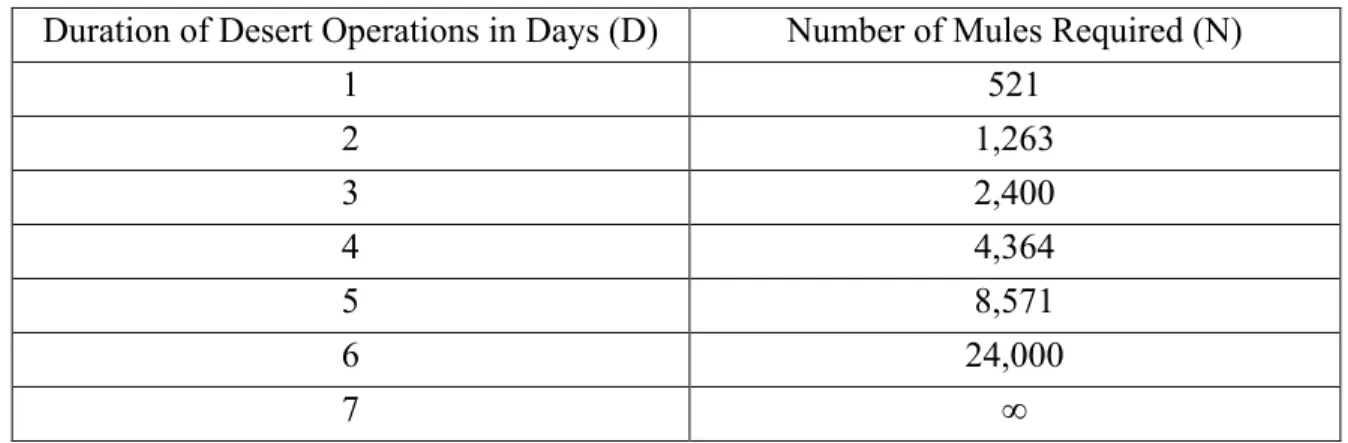
Since mules drink a portion of their carrying capacity each day they spend away from water, the number of mules (N) necessary to provision an army during a desert march is expressed by the following equation, where D is equal to the number of days the legion spends away from water supplies, W is equal to the total daily water ration of the legion, and M is equal to the daily water requirement of a pack mule:
N= (D * W)/(135 – (D * M))
Using 60,000 L/day as a moderate figure for the legion’s daily water requirement produces the following equation:
N= (D * 60,000)/(135-(D * 20)) The following table represents the relationship between D and N:
59Engels (1978), pp. 18-25.
Table 1: Mules Required for Water Transport in Desert Operations61
Duration of Desert Operations in Days (D) Number of Mules Required (N)
1 521
2 1,263
3 2,400
4 4,364
5 8,571
6 24,000
7 ∞
These numbers begin to indicate the scale of the logistical challenge posed by desert operations, particularly for longer campaigns. Thanks to the exponential growth in N, even two-day desert crossings presented significant difficulties, while longer treks rapidly became
prohibitive. Moreover, according to this simulation it was physically impossible for a Roman legion to operate for more than six days without somehow replenishing its water supplies; after roughly six days and 18 hours in the desert, each pack-mule would have consumed all 135 liters of water it set out with.
Moreover, it must be remembered that the numbers presented in Table 1 represent the requirements of a march through a very strange desert, one which provides adequate food and fodder but no potable water. Suppose that our legion ventures into more realistic terrain, a desert that offers neither water nor adequate supplies of food and fodder. The legion’s 5,000 soldiers could perhaps carry their own food requirements as prepared biscuit rations.62 However, mules would be required to carry sufficient fodder for themselves and the 330 cavalry mounts (horses
61This formula and calculations based on Engels (1978), p. 22.
require 9.5 kg of fodder per day, while mules require roughly 7.5 kg of fodder per day).63 For this more complex (but more accurate) simulation, we can recalculate the required number of pack-animals through a modified version of the previous formula, where D is the number of days spent in desert operations, W is the daily water requirement for the legion’s men and animals, F is the fodder requirement for 200 cavalry mounts and the 1,000 mules already loaded with the legion’s equipment, Mw is the daily water requirement of a mule, and Mf is the daily fodder requirement of a mule:
N = (D * (W + F))/(135 – (D * (Mw + Mf)))
Substituting in the correct figures (again using 60,000 L/day as the legion’s water requirement) produces the following formula:
N = (D * (60,000 + 10,635))/(135- (D * (20 + 7.5)))
The following table provides a more realistic calculation of the number of mules our legion would require for a desert campaign:
Table 2: Mules Required for Water and Fodder Transport in Desert Operations64 Duration of Desert Operations in Days (D) Number of Mules Required (N)
1 657
2 1,766
3 4,036
4 11,301
5 ∞
These figures are significantly more imposing. Desert campaigning for more than four days becomes impossible; Jovian’s water supplies during the six-day crossing from Hatra to Ur
63These figures are admittedly problematic. Roth is very hesitant to estimate animal rations even when grazing is available. Roth (1999), pp. 62-67.
(see above, p. 14) must have been supplemented by scattered wellsprings or local assistance.65 Any desert march longer than one day would surpass the carrying capacity of our legion’s standard contingent of mules. Even a single day of desert operations would require two thirds of the legion’s mules, requiring the commander to abandon vast quantities of materiel. The figures produced by this simulation suggest that transporting water for desert campaigns was not merely a daunting prospect, but a prohibitive one.
That said, the ability of horses and mules to work without water for several days at a time (tenuously suggested above, pp. 9-10) would potentially have made it much easier for Roman generals to transport water for their troops. Leaving out animal water needs, the legion’s 5,000 men need between 20,000 and 40,000 L of water per day. As such, one day’s supply of water could be carried by roughly 150-300 mules, two days’ supply could be carried by 300-600, and so on. These figures certainly look more attainable; a commander willing to temporarily dehydrate his animals could campaign with more freedom in desert environments. Yet as I suggested above, we should be very cautious before suggesting that such a policy of deliberate dehydration was a matter of general practice. First, this tactic could only be used for perhaps two days, four at the most.66 Second, repeatedly pushing animals up to their physiological breaking point could hardly be sustainable over the long term. Would a Roman general be willing to risk the health and productivity of his animals for a couple days of desert operations? In general, we may safely assume that he would not. Again, the difference between crucial missions and routine missions is key. Metellus or Marius may have tolerated the dehydration of
65Ammianus, 25.8.6-7.
their pack-mules in their exceptional cross-desert marches.67 Under more typical circumstances, such a risky strategy would probably have been avoided.
Though Roman commanders would be loath to intentionally dehydrate their
pack-animals, some might have struck upon an alternative method of water-transportation better suited to desert campaigning: camels. Camels can survive on far less water than equines; even in high temperatures, camels can easily go without water for more than a week provided there is
adequate grazing, and there are some reports of camels surviving 16 days of waterless marching.68 Even if grazing is impossible (bearing in mind that camels can consume desert plants inedible to equines), camels can work for 5-7 days without needing to drink.69 Moreover, camels can bear heavier loads than mules and donkeys, carrying roughly 250 kg compared to the mule’s 135.70 For these reasons and more, the use of camels as desert pack-animals had obvious advantages.71
The Romans would certainly have encountered domesticated camels along the arid fringes of their empire.72 And in several cases, Roman generals employed these dromedaries as pack animals in order to survive long marches across the desert. Corbulo used pack-camels in his campaign against the Parthians, while Jovian used the same tactic while returning from defeat
67Sallust, Jug. 75, 91.
68Gauthier-Pilters and Dagg (1981), p. 53. 69Irwin (2010), p. 19.
70Irwin (2010), p. 24; Zimmerle (2012). Irwin estimates 273 kg, Zimmerle estimates 240. Both estimates are for the one-humped dromedary camels that the Romans would have encountered. Bactrian camels, which dwell further east, could carry significantly more.
in Persia.73 According to Ammianus, the notorious Romanus demanded 4,000 camels from the citizens of Lepcis Magna, presumably for use in desert campaigning.74 The notoriously
unreliable Historia Augusta provides a third account of Roman pack-camels, claiming that Alexander Severus employed them in the early 3rd century.75 In each case, the camels’ prodigious ability to work without water must have significantly eased the burdens of water logistics.
One last set of calculations suggests just how useful camels would have been. Supposing that a legion replaced its entire contingent of pack-mules with camels, its daily water
requirement would drop to between 30,000 and 50,000 L.76 This daily water ration could be carried by between 120 and 200 camels. Moreover, because camels can survive without drinking from their own water-skins, the number of pack-camels required for multi-day desert crossings scales linearly, rather than exponentially. 240-400 camels can carry two days’ worth of water, 360-600 can carry three, and so on. Though these are not insignificant totals, they appear far more manageable than the logistical requirements of an army using pack-mules.
Despite their evident strengths, the Romans do not seem to have made camels their default beasts of burden for desert campaigns. With the exception of the four passages cited above, I have found no literary evidence that the Roman military used camels as pack-animals. Even the passages that mention this practice suggest its rarity: on Corbulo’s campaign, Tacitus writes, “Accompanying the army—apart from the usual war apparatus—was a large number of
73Ammianus, 25.8; Tacitus, Ann. 15.12. 74Ammianus, 28.6.
75HAAlexander Severus, 47.
76This total based on 5,000 men consuming 4-8 L/day, and 330 horses consuming 30 L/day. For
camels laden with grain, so Corbulo could ward off both hunger and the enemy.”77 Clearly, in Tacitus’ experience camels were not standard issue for the Roman baggage train. Similarly, both Ammianus and the Historia Augusta indicate that camels were used to supplement, not replace, traditional equine pack-animals.78 Even in situations where camels might have been more effective, pack-mules held on to their customary position in the Roman army—the men responsible for baggage trains took the title muliones, and "Mules were the most esteemed transport animals of the roman army."79 Camels may certainly have been employed more frequently by detachments of auxiliaries, who were more familiar with its use—Trajan and Hadrian evidently established auxiliary camel-cavalry units in Syria and Egypt.80 Yet in the large, legionary armies which waged the empire’s major wars, pack-camels appear to have been rare.
It is impossible to say for certain why the Romans did not make more frequent use of camels. The high purchase price of dromedaries may have played a role; papyri from Egypt suggest that a camels cost twice as much as mules, if not more.81 Institutional inertia may also have dissuaded innovation. An army that had soldiers experienced in handling mules, that had systems in place to procure and care for mules, and that by long tradition had grown accustomed to mules in its baggage train was not likely to adopt pack-camels except in situations of direst need. Whatever the reason, camels were rarely the Romans’ preferred baggage animal. In the
77Tacitus, Ann. 15.12. “comitabantur exercitum praeter alia sueta bello magna vis camelorum onusta frumenti ut simul hostem famemque depelleret.” Translation is from Yardley’s 2008 Oxford World Classics edition, not from the badly archaic Loeb. Emphasis is my own.
78Ammianus, 25.8; HAAlexander Severus, 47.
79Toplyn (2006), p. 493; Dixon and Southern (1992), p. 235. 80Bulliet (1975), p. 107; Irwin (2010), p. 144.
absence of specific evidence, we cannot be certain that any given desert campaign did not employ camels. At the same time, however, we should not imagine that the use of pack-camels was widespread, and that Roman armies could easily launch desert campaigns as a result. The Romans remained firmly bound by pre-industrial limits on the transportation of water, and shied away from all but the most critical desert campaigns as a result.
*****
This reconstruction of the harsh quantitative limits on ancient water transportation is reinforced by an array of textual evidence suggesting that Roman commanders avoided desert warfare even to the detriment of their military objectives. In a number of cases, generals retreated rather than risk water shortages. Faced with the threat of thirst during his North African campaigns, the normally decisive Julius Caesar was vacillating and ineffectual. Contemplating a siege of Thysdra in 46 BCE, “Caesar studied the characteristics of the town, and the lack of water discouraged him from attacking it: he then set out forthwith and pitched a camp some four miles away near water, only to quit it at the fourth watch.”82 Shortly thereafter, he retreated again despite the jeers of his foes: “realizing that it was equally impossible for him to pitch his own camp closer to the enemy owing to the poor supply of water, and perceiving that his opponents…were led to hold him in contempt by their reliance on the dearth of water, Caesar left Aggar on April 4th at the third watch."83
82Caesar, B.Afr., 76: “Caesar oppidi natura perspecta aquae inopia ab oppugnatione eius deterritus
protinus profectus circiter milia passuum IV ad aquam facit castra atque inde quarta vigilia egressus redit.”BAtlas (2000), 33 G2 Thysdrus.
83Caesar, B.Afr., 79: “neque ipse propius hostem castra ponere propter aquae penuriam se posse
Other passages describe certain towns as inaccessible to Roman troops due to a lack of water in their surrounding hinterlands. In Spain, Ursao was thoroughly isolated from military incursions: “apart from a single fountain in the town itself, there was no water to be found anywhere in the neighborhood under eight miles from the town; and this was a great advantage to the townsfolk."84 The town of Singara on Rome’s eastern frontier was similarly inaccessible thanks to its waterless surroundings, though Ammianus reports that this isolation worked against the beleaguered townsfolk, since “even in former days no one had ever been able to aid Singara when in trouble, since all the surrounding country was dried up from lack of water."85 If desert operations were commonplace, Caesar and Ammianus (two of our more strategically
knowledgeable authors) would hardly have considered Ursao and Singara beyond the reach of Roman legions.
The evidence above directly testifies to legionary commanders’ refusal to launch desert campaigns. It is obliquely supplemented by a wide variety of sources indicating the care that Roman commanders took to ensure their water supplies, and the likelihood that generals would not readily run the risk of desert operations. The threat of thirst motivated several maneuvers during Caesar’s civil wars: in North Africa, Scipio was forced to give battle when Caesar’s troops threatened the town of Uzitta, “on which [Scipio’s] army had been accustomed to rely for its water supply and all other means of support.”86 Three centuries later in a speech reported by
84Caesar, B.Hisp., 41: “Huc accedebat ut aqua praeter quam in ipso oppido unam circumcirca nusquam
reperiretur propius milia passuum VIII; quae res magno erat adiumento oppidanis.” BAtlas (2000), 27 A4 Urgao/Vircao.
85Ammianus, 20.6.8-9: “alioqui numquam labenti Singarae vel temporibus priscis quisquam ferre auxilium potuit aquarum penuria cunctis circum arentibus locis.” BAtlas (2000), 89 D4.
Ammianus, the Emperor Julian tried to temper his troops’ bloodlust just before his victory at Strasburg, worrying that thirst would handicap their performance: “the country is fairly ablaze with heat and relieved by no supply of water....What strength can we have, when our limbs are enfeebled with hunger, thirst, and toil, to offer resistance?"87
Commanders would rush or delay battle to secure their water supplies. They would forego military goals for fear of thirst. While so clearly aware of the importance of water provisioning, would they blithely undertake desert campaigns for anything less than the most crucial objectives? The answer must be no. A Roman general would have thought long and hard before leaving riverbanks or oases, weighing the cost and risk of desert campaigns. Except in the rare cases when the desert promised exceptional rewards, Roman legions stuck close to water sources, replenishing their water stores at least once a day, and desert campaigns remained a logistical possibility only rarely undertaken.
4. Water “Foraging” and Local Water Sources
Since transporting water was not a strategy the Romans were generally willing to
undertake, under normal circumstances the empire’s troops could only operate in areas with local water sources adequate to meet their needs. Before we attempt to locate such sites on a map, it is necessary to examine what types of water sources were actually available to a Roman army.
A thoroughly deficient literary record limits our understanding of what water sources legionaries could exploit. Ancient accounts of the Roman military understandably prefer narratives of cunning generalship and glorious combat to the humdrum technicalities of routine water provisioning. The few descriptions of water logistics we possess tend to discuss
exceptional cases, episodes in which remarkable Roman military ingenuity, “undertook even to defeat Nature herself.”88 Nevertheless, ancient literature is littered with scattered evidence for more routine water provisioning.89 The utility of this evidence is undeniably limited. It cannot say how any particular force gathered water at any particular location during any particular campaign. What this evidence can do, however, is lay out a set of preferences and possibilities. It suggests a general practice of Roman water supply, what most legions and their commanders
88Sallust, Jug. 75. See above, p. 13.
89A large number of these references do not mention what type of water source troops were exploiting. Nevertheless, these reports stress that in situ water gathering was a quotidian practice for the Roman army, and support the argument of this paper that areas without local water sources were generally inaccessible to Roman forces: Caesar, B.Afr., 24; B.Civ., 1.66, 73; B.Hisp., 21; Cassius Dio, 65.4; Frontinus, Strat., 1.8.9, 3.9.3; Josephus, B.J., 3.85-86; Plutarch, Sert., 7.3; Polybius, 6.27.3; Sallust, Jug.,
would choose to do under most circumstances. More importantly, this evidence illuminates the physical and physiological limits to the possibilities of Roman warfare: the in situ availability of drinking water was a critical factor in determining where a Roman army could campaign without incurring the heavy costs and risks of water transport.
As a general rule, Roman legions preferred water sources that were flowing and aboveground, namely rivers (and smaller watercourses) and naturally occurring springs. In Polybius’ account of the First Punic War, a giant serpent attacks Roman soldiers gathering water at an African river.90 Less colorful sources on the late Republic show Metellus securing a riverine water supply during the Jugurthine wars, Crassus’ army watering at a stream in Parthia, and Pompey’s forces seeking river water in Asia Minor.91 Finally, Trajan’s Column contains an image of a legionary filling a vessel with water at a riverbank; in what may well have been a standard practice, the soldier kneels upon wooden planks laid down at the bank to keep his boots from stirring up mud.92
Accounts of legions collecting spring-water are somewhat more rare than mentions of rivers, though not by enough to imply that legionaries definitely preferred one to the other. Nero’s general Corbulo, while fortifying the banks of the Euphrates, took care to secure local springs in order to both provision his forces and deny water to the enemy.93 Later in the first century during the siege of Jerusalem, the future emperor Titus relied on springs surrounding the
90Polybius, 4.12.
91Respectively: Sallust, Jug. 50; Plutarch, Crass., 23.4-5; Caesar, B.Civ.. 3.66.
92Webster (1985), p. 169. The image can also be viewed online via the Cheiron Project at McMaster University (cheiron.mcmaster.ca/~trajan), Scene 107.
city; Josephus reports that these normally temperamental water-sources flowed particularly strongly due to Titus’ abiding good fortune.94
The advantages of flowing surface-water, whether from watercourses or springs, are self-evident. These sources provide high volumes of water and require minimal labor on the part of the water-gatherer.95 Unlike wells, rivers and spring-fed oases can be accessed by many people and animals simultaneously, allowing water to be gathered quite efficiently. As I discuss below, gathering water for any sizeable force was a time-consuming chore, but the local availability of aboveground water made this task relatively manageable. For this reason, Hyginus’ military manual recommends that commanders locate their nightly camps near a spring or river.96
Though rivers and springs were evidently the legions’ preferred water source, they were not without their drawbacks. Not all rivers and springs are potable, and a Roman army operating in foreign territory would not necessarily know the quality of a given water source until it was too late. Thus Marc Antony suffered grievous casualties in his Parthian campaign when his troops, parched from a long and waterless march, found that the desperately needed river at the end of their journey was poisonous.97 In addition, since rivers and streams lie aboveground, they were easy for an enemy to poison. Jugurtha contaminated springs in Metellus’ path during Rome’s second century BCE wars in North Africa, and African locals used a similar tactic some
94Josephus, BJ, 5.409-410; BAtlas (2000), 70 G2 Ierusalem/Hierosolyma/Col. Aelia Capitolina. 95The labor involved in scooping drinking water into vessels was certainly not negligible, but paled in comparison to digging wells or transporting water over long distances (see below, pp. 31-33).
96Pseudo-Hyginus, 57. The authorship of this manual is uncertain, and it is ascribed here to Hyginus by convention only.
years later against Caesarean forces in the civil wars.98 A general with greater ambition (and more skilled engineers) could reroute watercourses entirely. Julius Caesar most famously employed this tactic shortly before the Battle of Dyrrhachium. As he himself recounts, “all the streams and all the rivulets which ran to the sea Caesar had either diverted or blocked by great works; and as the district was hilly and rugged he had dammed the narrow defiles by sinking piles into the ground and heaping up the earth, so as to keep in the water.”99
Despite their vulnerability to enemy action, flowing surface water remained the Romans’ primary source of drinking water. What then of wells? More flexible in their location, wells tapped reserves of groundwater which were nearly impossible for an enemy to pollute or disrupt. We could reasonably expect them to play a significant role in Roman water logistics. However, literary evidence suggests that the legions avoided well-digging if at all possible.
To be sure, our sources indicate that the Roman army was technically capable of provisioning water by digging wells. According to Caesar’s own account of the civil wars, Pompey sunk numerous wells as the two opponents jockeyed for position before the Battle of Dyrrhachium.100 Plutarch writes that Pompey used a similar tactic during the Mithridatic Wars, while Caesar evidently used wells on campaign in Alexandria and Africa.101 Finally, both Livy
98Sallust, Jug., 55; Appian, B.Civ.. 2.7.44.
99Caesar, B.Civ.. 3.49: “omnia enim flumina atque omnes rivos, qui ad mare pertinebant, Caesar aut averterat aut magnis operibus obstruxerat, atque ut erant loca montuosa et ad specus angustiae vallium, has sublicis in terram demissis praesepserat terramque adgesserat, ut aquam continerent.” BAtlas (2000), 49 B2 Dyrr(h)achium/Epidamnos.
100Caesar, B.Civ., 3.49.
and Plutarch report that Aemilius Paulus sunk wells to assuage his troops’ thirst during the Republic’s wars against Perseus.102
Although such evidence indicates that well digging was a possible method of water-provisioning in Roman warfare, we may be quite certain that it was not the legions’ preferred option. Indeed, Caesar’s commentary on Dyrrhachium (first discussed above) notes that Pompey turned to wells only because Caesar’s troops had diverted or dammed the streams flowing to his position, and that the labor of well-digging strained the Pompeians’ endurance.103 Appian comes to a similar conclusion on the undesirability of wells in his own history of the civil wars.
Narrating Antony’s campaign against the Republicans, he contrasts Cassius and Brutus’ outstanding campsite with Antony’s poor situation: “the former were on elevated ground, the latter on the plain; the former procured fuel from the mountains, the latter from the marshes; the former obtained water from a river, the latter from wells freshly dug.”104 Evidently, wells were the legion’s water-source of last resort, not of choice.
Ancient sources never explicitly explain why the legions preferred not to utilize well water, but we may hazard some reasonable guesses. The quality of well water could be suspect, particularly since troops digging a shaft for one night’s use could hardly be expected to properly line it with wood or stone so as not to muddy its water.105 Compared with rivers or springs, wells provide a small volume of water at a low rate of speed: little over 15 L/minute according to
102Livy, 44.33; Plutarch, Paul., 14.1. 103Caesar, B.Civ., 3.49.
104Appian, B.Civ., 4,107; Gilliver (1999), p. 71.
105On poor quality well water, see Appian, B.Pun. 7.40. The “villainous” (deterimma) water in Horace (Satires, 1.5.7-9) probably also came from local wells. It should be noted that Pliny praises the quality of well water (NH, 31.38-39). On lining wells, Vitruvius, De Arch., 8.6.12-15; Humphrey, Oleson, and Sherwood (1998), ch. 8; Wikander (2000), I.3.
modern estimates.106 Most importantly, well digging was labor intensive; note the fatigue of Pompey’s diggers at Dyrrhachium.107 Encamping at the end of a day’s march, legionaries already bore the burdens of foraging, food-preparation, maintenance of weapons and armor, and the fortification of the camp itself. Added to this list, the labor of well-digging would have been onerous.
The strenuous effort of well-digging limited the areas in which armies could feasibly sink wells. To conserve time and labor, wells could be dug only in spots with extremely shallow water tables. For a temporary well built under the time constraints of the campaign, a water table even a couple meters deep would have been out of the legions’ reach: according to Peace Corps training manuals, an experienced team of laborers using hand tools alone can sink only one meter of well-shaft in a day’s work.108 Determining where water could be struck at such a shallow depth strained the capacities of ancient science.109 Indeed, both Aemilius Paulus and Pompey are praised for their ability to “read” the landscape and locate sites where wells could easily hit water.110 We should not assume that the typical Roman commander was so skilled (or so lucky); in many areas well-digging would have proved both laborious and fruitless.
For all the reasons above, Roman commanders preferred not to dig wells on campaign. But what of preexisting wells, already constructed by the local population? What, for that
106Olley (2008), p. 6. See also, Wikander (2000), I.3. For a modern example of wells’ limited rates of water extraction hampering military logistics, see Preston (1921): during WWI in Syria, Preston’s mounted infantry unit did not have sufficient time to water all of its mounts at wells.
107Caesar, B.Civ., 3.49. 108Brush (1980), p. 15.
109On water divining, Vitruvius, De Arch., 8.1; Cassiodorus, Letters, 3.53.