AN EPIDEMIOLOGICAL TRANSITION IN THE CHINESE NORTHERN ZONE
Elizabeth S. Berger
A thesis submitted to the faculty of the University of North Carolina at Chapel Hill in partial fulfillment of the requirements for the degree of Master of Arts in the Department of
Anthropology.
Chapel Hill 2013
Approved by:
Dale Hutchinson
Paul Leslie
ii ABSTRACT
ELIZABETH BERGER: An Epidemiological Transition in the Northern Zone (Under the direction of Dale Hutchinson)
Bioarchaeological research has greatly contributed to an understanding of the health
consequences of the transition to agriculture in prehistory. This paper proposes that a similarly
dramatic transition in health accompanied the transition to pastoralism during the Bronze Age in
the Chinese Northern Zone. Bioarchaeological data, in combination with other types of data, can
be used to test the hypothesis that the advent of pastoralism and agropastoralism in the Northern
Zone was accompanied by a reduction in infectious diseases and dietary deficiencies, and an
improvement in population health. This work can build on previous work in the region by
moving beyond the consideration of human behavior change in its sociopolitical context, to
consider it in its ecological context. It will consider humans as one element in complex,
multi-scalar systems, and will examine the health consequences for humans when the cultural-natural
iii
TABLE OF CONTENTS
ABSTRACT ... ii
LIST OF TABLES ... v
LIST OF FIGURES ... vi
INTRODUCTION ... 1
Steppe pastoralism: a case study for epidemiological transitions ... 2
THEORETICAL BACKGROUND ... 5
Epidemiological transitions ... 5
What constitutes an “epidemiological transition”? ... 5
What evidence attests to epidemiological transitions in prehistory? ... 6
What factors contribute to epidemiological transitions? ... 7
Human ecology ... 10
Pastoralism ... 13
THE STUDY REGION ... 15
Definitions ... 15
Period ... 15
Region ... 16
Evidence for a subsistence transition in the early Bronze Age Northern Zone ... 18
Explanations for a subsistence transition in the early Bronze Age Northern Zone ... 21
METHODS FOR FUTURE RESEARCH ON AN EPIDEMIOLOGICAL TRANSITION IN THE BRONZE AGE NORTHERN ZONE... 23
What types of data are needed to test for this epidemiological transition? ... 23
Bioarchaeological evidence ... 25
Non-bioarchaeological evidence ... 25
Background of bioarchaeological methodology ... 27
Bioarchaeology of the transition to agriculture ... 27
Bioarchaeology of pastoralism ... 30
iv
Nutritional deficiencies and metabolic disruption ... 34
Infectious diseases... 36
Dental pathology ... 38
Degenerative joint disease ... 39
Trauma... 40
Paleodemographic data... 41
Stable isotope and trace element analysis ... 43
CONCLUSION ... 45
v
LIST OF TABLES
Tablevi
LIST OF FIGURES
Figure
INTRODUCTION
Mobile pastoralism has a powerful hold on the imaginations of sedentary peoples.
These settled outsiders, from ancient agricultural civilizations to modern industrial societies,
ascribe a range of both flattering and unflattering traits to the pastoralists. On the one hand,
pastoralists live harsh lives in unforgiving marginal environments; on the other, they are free,
indulging a fundamental human wanderlust and conquering as they go. These images have
arisen from millennia of interactions between sedentary peoples and mobile pastoralists: the
unconquerable Scythians of Herodotus’ Histories, the Golden Horde ruling Eurasia from the
Volga to the Danube, Sami herders coaxing a living from the reindeer herds of the subarctic.
The reality of pastoralism is of course far more complex than these romantic
stereotypes allow. It is practiced in a huge variety of ecological settings, from high altitude
zones like the Andes and the Himalayas to semi-arid East Africa. Pastoral groups may
exploit one dominant herd species such as sheep or cattle, though they often exploit a
“complex” or combination of species (Galaty and Johnson, 1990). Many pastoral groups
incorporate agriculture into their economic repertoire either habitually (agropastoralism) or
when needed, and rely heavily on trade with neighboring groups. Though pastoralism is often
associated with mobility, this mobility may take many forms, from full-scale nomadic
migration of entire communities to seasonal transhumance of only a few members of a group
(Wendrich and Barnard, 2008). Even sedentary commercial ranches like those in the
American West are a form of pastoralism (Galaty and Johnson, 1990).
The range of these behaviors offers a dramatic illustration of the plasticity of human
2
conditions, allowing groups to exploit marginal environments in which agriculture could not
support a human population (Crawford and Leonard, 2002). However, the adaptive nature of
this lifeway can only go so far in explaining its origins. Economic specialization and ethnic
identity play a role; pastoral groups often deliberately maintain an identity distinct from their
sedentary neighbors (Barth, 1961; Barth 1969; Frachetti, 2008a; Shelach, 2009; Spooner,
1973), of which herd animals and the pastoral lifestyle are potent symbols.
Mobile pastoralists also provide important comparative data for studying human
ecology and human-environment interaction. The human and natural systems of which these
groups are a part are often non-equilibrial in nature (Crawford and Leonard, 2002), and
provide a good case for examining the capacity of complex systems for adaptation and
transformation, and humans’ capacity for behavioral flexibility, especially when studied over
long time cycles and across multiple scales (Gunderson and Holling, 2002; Redman, 2005).
Steppe pastoralism: a case study for epidemiological transitions
Understanding the history of human health and disease is critical to understanding
both the trajectory of human history and current problems in public health and epidemiology
(McMichael, 2001; Roberts and Manchester, 2007; Rothschild, 2003). Evidence from
historical and archaeological sources, as well as biological evidence from human remains,
can shed light on the environmental, cultural, behavioral, biological, and evolutionary factors
that changed human health in the past, and therefore improve our understanding of these
3
A useful conceptual framework, which can be applied to both present and past human
experience, is that of epidemiological transitions. These are transitions in human health and
population structure that accompany dramatic changes in subsistence, technology, or lifeway.
Epidemiological transition theory combines an understanding of the multiple forces at work
in human population change into a comprehensive approach (Omran, 1971). In one scheme,
that of Barrett et al.(1998), the human species has undergone three large epidemiological
transitions in the course of our history. The first transition followed the rise of sedentary
agriculture, and involved an increase in density-dependent and non-vector parasitic and
infectious diseases, which humans encountered by living in larger permanent settlements,
disturbing novel habitats, and engaging in closer contact with domesticated animals; a
reduction in nutritional quality due to dependence on limited staple crops and overall reduced
dietary diversity; reduced stature and life expectancy; worse dental health; and an increase in
fertility. The second transition followed the advent of industrial modes of production and
broad public health and sanitation measures, which reduced the rate of mortality from
infectious diseases but left chronic, non-communicable diseases as the main source of
morbidity and mortality. This transition is still considered to be ongoing in many developing
countries. Finally, according to the authors, humans are currently experiencing a third
epidemiological transition, characterized by the rapid emergence of new infectious diseases,
the re-emergence of older diseases once thought to be in decline, the creation of a “global
disease ecology” (p. 248), and the diminishing effectiveness of antibiotic therapy.
Each of these transitions accompanied a dramatic change in human behavior and our
relationship to our environment: the advent of food production and dense settled life, the rise
4
into new ecological zones and the dramatic increase in the ease and speed of international
travel and trade. Experts in the fields of ecology, medical geography, archaeology, biological
anthropology, history, epidemiology, and many others can make critical contributions to the
study of these phenomena.
I propose in this paper that the theoretical framework of epidemiological transitions
can be applied more broadly, to detect and describe similarly dramatic transitions that occur
in smaller, regional contexts. I use as an example archaeological and other evidence that
attests to a dramatic transition from agriculture to pastoral and agropastoral production in
Inner Asia and the Chinese Northern Zone around the beginning of the Bronze Age
(1200-600 BCE). During this transition, the people of the region adopted animal husbandry and
mobile or semi-mobile lifeways, eventually developing a complex of behaviors, technology,
and material culture very distinct from the sedentary agricultural civilization of China to the
south.
Given the comprehensive nature of this change in human behavior, affecting
settlement density, diet, and activity patterns, I hypothesize that the people of the Northern
Zone underwent an epidemiological transition during this period. In this thesis I will first
review the theoretical and empirical background of the epidemiological transitions model. I
will then define the study area and period, and review archaeological and bioarchaeological
evidence from this region relating to ancient health and subsistence change. Finally, I will
suggest a bioarchaeological program of research to test the hypothesis of an epidemiological
5
THEORETICAL BACKGROUND
Epidemiological transitions
What constitutes an “epidemiological transition”?
As stated above, an epidemiological transition is a change in the health and
demographic structure of a population, brought about by a complex interaction between
multiple environmental, sociological, and economic factors (Barrett et al., 1998; Omran,
1971). Omran’s original scheme of three stages has been criticized as unilinear and
teleological, and for not considering the trade-offs in quality of life that accompany reduced
mortality and increased longevity in some populations. More recent critiques have also
attempted to account for the different experiences of groups according to gender, race, class,
and level of development, recognizing that these transitions and stages are not always, or
even not usually, global in their scope (Farmer, 1996; Popkin, 1994).
While many scholars have worked to reframe the idea of epidemiological transitions
to fit the diverse experiences of contemporary and recent historical populations, Barrett and
coworkers (1998) proposed an expansion of this framework backwards in time to include the
changes in health observed by biological anthropologists with the origins of agriculture.
It is clear that in the past, more than in the present, dramatic epidemiological,
sociological, and demographic changes were regional or local rather than global. McNeill
(1989) propose regional infectious disease pools after contact between state-level societies in
the 5th century CE, and other regional changes in lifeway before this time also likely had a
profound impact on human health. Recent work on the origins of agriculture, for example,
6
which point to the diversity of the human experience and the regionally specific conditions of
this experience (Douglas and Pietrusewsky, 2007; Stock and Pinhasi, 2010).
It is also important to recognize the difference between health and evolutionary
fitness. Given that the overall health of many populations deteriorated with the advent of
sedentary agriculture, researchers might well ask why the practice persisted and led to
population growth. One possible solution lies in the fact that though health declined, fertility
increased, meaning that one effect of the transition to agriculture was to increase the
reproductive fitness of individuals and the populations to which they belonged (Lambert,
2009).
What evidence attests to epidemiological transitions in prehistory?
The best evidence for epidemiological transitions in prehistory comes from human
remains, as they can attest directly to the state of health of individuals in a population. It is
rare to find soft tissue from ancient contexts, and so the vast majority of human remains
available for bioarchaeological research are skeletonized. It should be borne in mind that
these remains can only provide information about diseases that affect the skeleton, and only
if the disease process continued long enough to do so. In addition, disease processes often do
not leave skeletal lesions distinct enough for differential diagnosis (Wood et al., 1992). For
this reason, relative rates of lesions over time or between populations provide a more reliable
measure of overall population health than absolute rates (Cohen and Crane-Kramer, 2003).
Some specific signs of relative population health include skeletal evidence of
7
women and lower socioeconomic classes; reduced stature, when population continuity is
relatively certain; increased rates of dental pathology; and worse children’s health, including
higher mortality, more dental defects, and impaired bone growth (Barrett et al., 1998; Cohen,
1997; Cohen and Armelagos, 1984; Larsen, 1997; Steckel and Rose, 2002a). While there is a
recent trend in bioarchaeological research towards reconstructing individual life histories
(Barrett and Blakey, 2011), to answer questions relating to epidemiological transitions
researchers must rely on population-level data, including relative rates of the
above-mentioned pathological lesions, and the population’s demographic structure (including death
tables, though there are epistemological limitations to this as well, discussed below)
(Ubelaker, 2003). In the case of historical populations, written records of health and disease
are also extremely valuable.
Specific skeletal markers of health and disease are discussed in more detail below.
What factors contribute to epidemiological transitions?
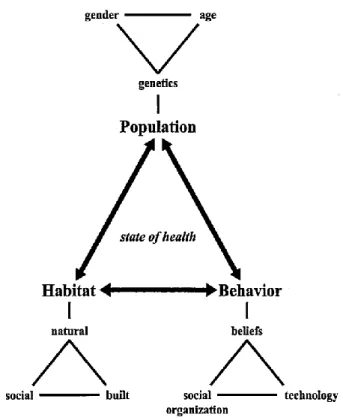
Many factors can contribute to an epidemiological transition. If we take the triangle
of human ecology as a framework (see Figure 1), we can see that the three primary factors
that contribute to human health status—population, habitat, and behavior—may all play a
8
Figure 1 The triangle of human ecology (Meade and Emch, 2010, p. 31)
Take the three epidemiological transitions of Barrett et al. (1998) as examples. In the
case of the first epidemiological transition, which occurred at the advent of sedentary
agriculture, changes included:
Habitat: a new built environment that included both dense permanent villages where
human waste could accumulate, and irrigation canals that held standing water, which
increased disease transmission;
Behavior: new technology that allowed agriculture to predominate as a subsistence
strategy, which led to more nutritional deficiencies and dental pathologies and
increased labor demands; and
Population: higher birth rates and lower life expectancy, which changed population
structure and led to dramatic population expansion.
9
Habitat: ever larger and denser settlements, with worse pollution in both urban and
rural areas;
Behavior: improved public health measures and medical knowledge, which has
reduced the prevalence of infectious diseases; and
Population: longer life expectancy, which increased the prevalence of chronic
diseases.
Finally, the latest, or third, transition has included:
Habitat: accelerating encounters with novel environments, leading to human
contraction of novel infections;
Behavior: ever easier global travel and commerce, creating a worldwide disease pool,
and a breakdown in public health measures, leading to the evolution of
antibiotic-resistant pathogens; and
Population: ever-increasing life expectancy and incidence of chronic
non-communicable diseases.
I hypothesize that in the case of the transition to pastoralism in the Bronze Age Northern
Zone, changes would have included:
Habitat: sparser and less permanent settlements, hampering the spread of
communicable diseases;
Behavior: a diet high in animal protein, leading to better nutrition, but more
horseback riding and contact with herd animals, increasing the risk of zoonotic
infections and traumatic injury; and
Population: demographic flexibility, allowing populations to cope with
10
Table 1: Correlates of epidemiological transitions with sedentary agriculture and mobile pastoralism
“First epidemiological transition”: sedentary agriculture
Proposed epidemiological transition: mobile pastoralism
H
abi
ta
t
Low mobility and high population density:
interpersonal contact, accumulation of waste, contaminated water sources, high incidence of non-vector density-dependent infectious diseases and parasites
Irrigation: habitat for disease vectors
High mobility and low population density: less contamination of water sources, fewer non-vector infectious diseases and parasites
B
ehavi
o
r
Reliance on starchy staple crop: low dietary diversity, higher incidence of dietary
deficiencies and dental pathologies
Contact with domesticated animals: some accidental trauma, zoonotic diseases
Reliance on both animal products and agricultural foods: greater dietary diversity, high intake of protein, reduced incidence of dietary deficiencies and dental pathologies High contact with domesticated animals and horseback riding: higher incidence of trauma, zoonotic diseases
Pop
ulat
ion
High birth rate: population growth, high age-specific mortality especially among women of childbearing age
Demographic flexibility: birth rate and outmigration respond to economic and ecological conditions
Some work has already addressed this hypothesis for a few Asian skeletal
populations, and suggests these changes did indeed occur (Eng, 2007; Walker and Yablonski,
1997). However, there is much more data yet to be analyzed, and greater sample sizes will
allow for more confidence in the conclusions, as well as more nuanced analysis of
differences between ecological zones and periods.
Human ecology
Recent developments in the field of ecology have emphasized the importance of
principles such as uncertainty, complexity, resilience, and non-equilibrium for understanding
11
suggest better management practices, but can also be applied to data from the past to better
understand the evolution of human-environment interactions and their influence on the
course of human biological and cultural history. Resilience theory in particular provides a
helpful way to understand dramatic reorganizations of complex systems, including those of
which humans are a part (Redman, 2005).
As defined in the ecological literature, resilience is the ability of a system to absorb
changes or disturbances and still retain its identity, i.e. its defining properties (Gunderson and
Holling, 2002; Holling, 1973; Moran, 2008). Paradoxically, certain non-equilibrial systems,
which cycle between periods of stability and transformation, may exhibit the greatest
resilience (Redman, 2005; Gunderson and Holling, 2002). Systems exhibiting this tendency
to transform are termed complex adaptive systems, and recent work aims to understand them
in terms of multiple scales, spatial variants, system memory, complexity, and episodic
change. In this model, when a disturbance is too great, a system will reorganize and exhibit
new properties.
Complex adaptive systems and resilience theory are particularly helpful for
understanding marginal environments such as semi-arid grasslands or high mountain zones,
in which many pastoral and agropastoral modes of subsistence have developed (Crawford
and Leonard, 2002; Goldstein and Beall, 2002; Gray et al., 2002; Gunderson and Holling,
2002; Holling, 1973; Moran, 2008). They can describe the yearly fluctuation of conditions in
these environments more accurately than older ecological models based on equilibrium. They
are also helpful for understanding human-environment systems on a longer time scale: a
12
Zone, when social and ecological conditions shifted enough to disturb the agricultural system
of the late Neolithic and provoke the transformation to pastoralism.
Archaeological and paleoenvironmental data are important for the study of human
ecology because of the deep time perspective they provide (Redman, 2005). It is widely
agreed that multidisciplinary, long-term studies are needed to understand the dynamics of
human populations and their adaptive mechanisms (Little, 2002), and archaeological and
bioarchaeological research are therefore valuable for these research programs. In the spirit of
multidisciplinarity, research into the human ecology of the past may include data and
expertise drawn from the fields of paleoenvironmental studies, historical archaeology,
landscape archaeology, geoarchaeology, zooarchaeology, paleobotany, and bioarchaeology.
It is also important to recognize that typological, binary, or linear models cannot
accurately describe the complexity and stochasticity of human cultural evolution and
adaptation, including the emergence of pastoralism (Barker, 2000; Barker and Gilbertson,
2000; Salzman, 2004; Wendrich and Barnard, 2008). In other words, the progression from
nomadic foraging to sedentary agriculture to industrialism is by no means universal; even in
the places where this progression did take place, it proceeded at different paces and in
response to different factors. Mobile pastoralism did not arise as a step “backwards” from
sedentary agriculture, nor did Northern Zone pastoralists become “stuck” at an earlier stage
of cultural evolution as their Chinese neighbors advanced to complex state-level societies.
Their pastoral lifeway should rather be investigated as a response, presumably adaptive, to
local cultural and ecological factors. Only by treating the data from this period and region
independently of typological models, and attempting to understand this way of life on its own
13
Pastoralism
As described in the opening of this thesis, there are very few universals among
pastoralist societies (Dyson-Hudson and Dyson-Hudson, 1980) or among mobile groups
(Spooner, 1973). Many pastoralist groups practice some form of mobility (nomadism or
transhumance), though properly defined these are separate dimensions of a lifeway, one
referring to subsistence strategy and one to degree of movement (Barfield, 1993; Cribb,
1991). The most basic definition of pastoralism is a way of life that relies heavily on products
of domesticated animals for subsistence, which may include meat, milk, and blood (Cribb,
1991). In this paper, agropastoralism will be used to refer to subsistence strategies in which
domesticated herd animals figure prominently, but in which agriculture is also regularly
practiced.
The literature on living mobile pastoralist groups demonstrates the wide variety of
adaptations that fall under the heading of pastoralism. Many pastoralist groups have adopted
the practice as a way of exploiting marginal environments and buffering against risk (Abdi,
2003), fulfilling the role of specialists within larger complex societies and regional or even
global economies, and often entering into both trade and hostile relations with neighboring
settled populations (Wendrich and Barnard, 2008; Galaty and Johnson, 1990). This dual
economic and conflict relationship came to define the interaction between Northern Zone
pastoralists and settled Chinese civilization early in their development, and has persisted into
the modern era (Di Cosmo, 2002; Crawford and Leonard, 2002; Shelach, 1999, 2009).
In addition, many pastoral groups exhibit cyclical and flexible behavior, periodically
turning to agricultural pursuits when economic and ecological conditions permit, once again
14
(Chang, 2008; Salzman, 1980). Finally, the formation of ethnic or ethnic-like identity also
plays a role in the development and maintenance of mobile and/or pastoralist practices. Such
identities are defined by economic niche or other aspects of a pastoralist society, and are
often also defined in direct opposition to neighboring settled peoples (Barth, 1961, 1969;
Frachetti, 2008a; Shelach, 2009; Spooner, 1973).
Work by biological anthropologists and others has clarified some of the biological
consequences of adopting a pastoralist lifestyle. In general, pastoral societies exhibit only
small differences in energy expenditure between the sexes (Leonard et al., 2002). Also,
among the Turkana, who rely on a relatively extreme form of mobile pastoralism, researchers
have found low overall energy intake, high protein consumption, high fertility rates,
moderate rates of infant mortality, slow growth in childhood but attainment of stature
comparable to other populations, seasonal fluctuation in body weight, and possible
immunosuppression in children due to seasonal food shortages (Little, 2002). Of course, we
cannot expect to find exactly these patterns in ancient Northern Zone populations, as the
economic, social, and ecological conditions were very different from those of African study
populations. Additionally, in many contemporary and recent historical populations health
status depends mostly on the larger political context of which the pastoralists are a part, and
on the level of disruption of the local ecosystem and its retention of resilience (Eng, 2007;
Gray et al., 2002).
In addition to looking for direct evidence of an epidemiological transition (i.e.
changes in human health), it will also be helpful to look for the precipitating factors of the
transition, that is, the specific dimensions of early Northern Zone pastoralism and the way in
15
typological thinking, though sometimes a useful heuristic device, will likely be
counterproductive (Salzman, 2004; Shelach, 2009; Wendrich and Barnard, 2008). Schema
that define pastoralist societies in terms of level of mobility, type of mobility, environment,
animals reared, etc. can be useful for interregional comparisons, but the spatial and temporal
differences that are relevant for the Northern Zone subsistence transition are still too poorly
understood and likely too complex to be clarified by attempts at typologizing. This also holds
true for attempts to define bounded ethnic groups for the purposes of comparison: rather than
search for boundaries, scholars may gain more insight by focusing on agent-centered
approaches and allowing for the dynamic nature of lifeway and group identity (Frachetti,
2008b; Smith, 2008). Given these goals, it will be most fruitful to compare individual
representative sites from within the Northern Zone.
Of most interest as causative factors of epidemiological transitions are specific,
quantitative changes such as changes in diet (e.g. consumption of animal protein), changes in
the intensity or nature of exploitation of animal resources, settlement density, and intergroup
interactions relating to trade and warfare. These variables can be investigated through
bioarchaeological and archaeological methods, without recourse to typology or discrete
categories. In other words, the goal of the research should not be to assign each site or
cemetery population to an ethnic group or to a “type” of pastoralism, but to investigate each
one in terms of a series of relevant variables, and then to identify patterns in these data.
THE STUDY REGION
Definitions
16
According to archaeological evidence, the Neolithic farming communities of the
Northern Zone became pastoralists and agropastoralists over a period of about 600 years,
spanning the end of the Neolithic and the beginning of the Bronze Age (1200-600 CE)
(Shelach, 2009). By about 100 BCE, the cultural and political distinction between China and
the Northern Zone was firmly established, and is evidenced in Chinese historical writings of
the time. These include proto-ethnographic accounts of the differences between the Chinese
people and their Northern Zone neighbors, who are described as milk-drinking nomads (Di
Cosmo, 2002).
Region
The relevant area for this study is the zone of contact between the Chinese civilization
and the steppe immediately to the north. Confining the area of study to this zone is a
somewhat artificial distinction, as the changes taking place in the Northern Zone (or beifang
北方 in Chinese) reflect a way of life that was emerging across the larger region of Inner
Asia (Di Cosmo, 2002). However, this process was probably not identical across the region,
and so it is logical to begin the research with a sub-region of Inner Asia—in this case, the
Northern Zone.
I recognize that the label of “Northern Zone” privileges the Chinese perspective.
However, it is the most cohesive label for the region, and acknowledges that one of the
region’s defining characteristics is its proximity to but distinctiveness from Chinese
civilization. In addition, I recognize that calling the Yellow River valley civilization of this
time period “China” is problematic, as the concept of a unified Chinese civilization did not
17
does reflect that a common way of life, eventually encompassing language, material culture,
and political organization, was emerging in the Chinese heartland at this time.
This part of Inner Asia can usefully be divided into sub-regions, defined by
geographic features and climatic conditions. In one scheme, these include: north China and,
from east to west, Manchuria, Mongolia (including Inner Mongolia), and Xinjiang (Barfield,
1989). In another scheme, they include, again from east to west: Manchuria, the Chifeng
region (in Inner Mongolia), the Ordos region, and the Gansu corridor (Shelach, 2009). For
the purposes of this research, I propose the use of three sub-regions: Manchuria, Inner
Mongolia, and Xinjiang (after Eng, 2007, derived from Barfield, 1989) (Figure 2). Any
investigation of the subsistence transition should keep these general divisions in mind, to
acknowledge that ecological and other conditions were not constant, and that the transition is
unlikely to have proceeded in the same way or at the same speed across the entire Northern
Zone. Indeed, archaeological evidence points to this lack of homogeneity.
18
Evidence for a subsistence transition in the early Bronze Age Northern Zone
Before the first millennium BCE, in much of northeast Asia, including the Northern
Zone and what would later become China, populations relied predominantly on agricultural
production for their subsistence. Social stratification and even stratified settlement systems
had developed in much of the region (Shelach, 2009).
By the end of the first millennium BCE, a dramatic contrast had emerged between the
societies centered on China’s Yellow River valley and those of the Northern Zone. An
increasingly stratified settlement system and political structure continued to develop in the
Chinese heartland, reliant on intensive irrigation agriculture (McNeill, 1989; Shelach, 2009).
Meanwhile, in the Northern Zone, a very distinct way of life had emerged, relying on mobile
or semi-mobile animal husbandry, usually supplemented by agriculture. The economic base
in this region was more diverse, and the social structure was less stratified, though a high
degree of political centralization would eventually develop here (Shelach, 2009).
What emerged in this period is the famous dichotomy of “the steppe and the sown.”
Though it is a crude distinction and a simplification of both the Northern Zone and Chinese
societies, it has been an enduring trope in East Asian history, culture, and political relations
throughout the centuries since the Bronze Age (Lattimore, 1940; Shelach, 2009; Di Cosmo,
19
Table 2: Chronology of China and peoples of the Northern Zone (Eng, 2007 p. 10). Names of Northern Zone peoples are archaeological cultures or names used by Chinese historians.
This transition is evidenced by data from material culture, especially artistic styles
and artifacts associated with horse riding that are common across the region, and by animal
remains, which are often excavated from mortuary contexts (Barfield, 1989; Di Cosmo,
2002; Shelach, 2009). In addition, preliminary evidence suggests that the settlement structure
of the Northern Zone changed dramatically in this period: the one systematic regional survey
so far conducted (in the Chifeng area of Inner Mongolia) showed that the three-tiered
settlement system that had emerged in the Neolithic, along with the permanent stone
architecture of the largest settlements, disappeared with the advent of pastoralism, to be
replaced by smaller and less permanent settlements (Chifeng, 2003; Linduff et al., 2002). The
relative number of animal remains at various sites suggests that the transition was more
dramatic in the western part of the Northern Zone (Xinjiang) and perhaps less dramatic or
more gradual in the eastern part (Manchuria and eastern Inner Mongolia).
A study of different lines of evidence from the Gumugou cemetery in Xinjiang
20
around 1800 BCE. This is at the early end of the period during which archaeological
evidence shows the transition to have occurred farther east, again illustrating the
heterogeneity of the transition across the Northern Zone. Nitrogen stable isotope analysis of
human bones from the site revealed humans to have a δ15N concentration of approximately
13 ‰—15 ‰, in the expected range for carnivores, indicating a high level of consumption of
meat and dairy. Based on animal remains, bone objects, and felt and leather grave goods, the
researchers concluded that the people at Gumugou consumed significant quantities of mutton
and beef, supplemented by hunted meat. The isotope analysis also revealed a higher
proportion of C3 than C4 plants1, which, in combination with paleobotanical remains
recovered at the site, led the researchers to conclude that the predominant grain consumed by
the population at Gumugou was wheat, and that the agricultural component of their diet was
less in quantity and diversity than that of the population at the nearby contemporaneous
Xiaohe cemetery. The authors call for further analysis of human remains from different sites
and periods within this area to clarify the Bronze Age human diet.
Finally, written records from China, the earliest relevant examples of which date from
the first century BCE (Sima Qian’s Shi Ji 史记, or the Records of the Grand Historian,
composed during the Western Han Dynasty), provide descriptions (albeit prejudiced) of the
nomadic herding society of the Northern Zone (Di Cosmo, 2002), which had fully emerged
by this time.
This transition is unusual among large subsistence shifts in prehistory, allowing for an
interesting test case for the broader applicability of the epidemiological transitions model,
1
The average concentration of δ13C in individuals at the site was between -18.39‰ and -17.85‰, which, when adjusted for the +5‰ enrichment between the diet and human bone collagen, is in the range for C3
21
specifically to describe additional, region-specific epidemiological transitions. Complicating
the investigation is the fact that this transition was a complex and gradual phenomenon.
Rather than the abrupt or catastrophic change envisioned by some scholars, it appears to have
occurred gradually, over several centuries at least, and occurred at different speeds and to
different degrees in different ecological zones (Shelach 1999, 2009). In addition, most
populations in the region developed mixed economies that did not depend exclusively on
mobile pastoralism. This does not negate the possibility of an epidemiological transition, but
suggests that finding appropriate study populations may be a challenge.
Explanations for a subsistence transition in the early Bronze Age Northern
Zone
Several different explanations are offered in the literature for the origins of
pastoralism in the Northern Zone. The primary hypotheses are, first, a replacement of the
region's population with one that practiced pastoralism, and second, a climatic shift that
forced the population to adopt animal husbandry as a buffer against environmental
uncertainty, or to supplement insufficient agricultural foods (Shelach, 2009). Researchers
point out that material culture associated with daily tasks did not change dramatically during
this period, rendering unlikely the scenario of large-scale population replacement.
Additionally, one study has found that worldwide, the cultural trait of pastoralism is
correlated with the genetic relatedness of modern populations—in other words, pastoralism
tends to be practiced by genetically related groups, suggesting they inherited the practice
from common ancestral groups; however, there is no additional effect from geographic
22
neighboring populations (Holden and Mace, 2002). These lines of evidence appear somewhat
contradictory, but taken together they seem to suggest that indigenous processes played a
major role in the development of pastoralism in the Northern Zone.
As for the second, climatic, explanation, paleoclimate data do not support this
hypothesis: though the climate of this region did become slightly cooler and drier in this
period, the shift was not dramatic enough to preclude the practice of agriculture. A lower
temperature may have offset the effect of lower rainfall, and the region may even have been
moister than today, though irrigation agriculture is still practiced in the region today
(Shelach, 2009). The variability of rainfall between years would also have been an important
climatological factor in human subsistence behavior. However, archaeological evidence
points to the continued practice of agriculture as a “supplemental activity” even after the
advent of mounted pastoralism in the region, continuously to the present day (Di Cosmo,
1994 p. 1094). Therefore, the shift towards pastoralism was probably not solely a reaction to
climatic pressures. Rather, a combination of climatic, economic, and social factors was
probably responsible for the greater adoption of animal husbandry in this period. These
factors may include the formation of ethnic-like identities2 and the self-definition of groups
in opposition to their agriculturalist neighbors, opportunities for trade and economic
specialization (Cribb, 1991; Lee and Bates, 1974; Rosen, 2003; Shelach, 2009), and possibly
the introduction of certain technologies and practices from other Inner Asian societies (Di
Cosmo, 2002) .
If the transition was necessitated by environmental stressors, I would expect to see
evidence of dietary and/or physiological stress in populations near the beginning of the
2 This term is used by Shelach (2009) to distinguish his favored approach (ascribing identities to ancient
23
transition, and an improvement in diet and health once the transition was underway, or a at
least a change in health problems after the transition. On the other hand, if the transition was
part of broader social changes such as the formation of ethnic or ethnic-like identities,
humans’ dietary changes should accompany changes in material culture (such as grave goods
and bodily decorations) that indicate identity formation (Shelach, 2009).
The transition was likely due to a combination of these factors, and the
bioarchaeological data may be helpful in determining the relative importance of each of them
in the various sub-regions of the Northern Zone. Whatever the causative factors that led to
the transition, the resultant changes in subsistence, settlement, and activity patterns likely
precipitated dramatic changes in human health.
METHODS FOR FUTURE RESEARCH ON AN EPIDEMIOLOGICAL TRANSITION IN
THE BRONZE AGE NORTHERN ZONE
What types of data are needed to test for this epidemiological transition?
While human remains recovered in archaeological excavations within China are often
assessed for age and sex, and studied for ethnic or racial affiliation, relatively little collection
of paleopathological data has so far been attempted with the human remains from the
Northern Zone. There is a large body of excavated material potentially available for study,
which will be crucial in investigating the possibility of an epidemiological transition
accompanying the Bronze Age subsistence transition. These remains will also be important
in illuminating the speed of the transition through dietary reconstruction, and for testing
24
As discussed above, in studies of mortuary populations, relative rates of pathological
lesions are more reliable than absolute rates as indications of population health. Also, in
order to test the hypothesis of an additional epidemiological transition in the Northern Zone,
the health status of the population both before and after the Bronze Age subsistence transition
must be understood. Therefore, it is important to gather data from different time periods, and
also to be able to conduct interregional comparisons between populations practicing different
subsistence strategies in the same period.
An ideal sample would include pre-agricultural populations and post-agricultural
populations from the Northern Zone, to test for the presence of the first epidemiological
transition with the beginnings of agriculture; pastoralist and agropastoralist populations from
each of the three sub-regions discussed above (Manchuria, Inner Mongolia, and Xinjiang) to
investigate the effects of ecological variation on the transition; and Bronze Age populations
from the Chinese area to the south, to compare the health of a contemporaneous population
practicing a very different subsistence strategy under a different system of social and political
organization.
Of course, an ideal sample may not be currently available. As excavations across the
Northern Zone continue under the auspices of the Chinese Academy of Social Sciences,
provincial archaeological institutes, and university departments, more skeletal samples will
become available. For now, the research can begin with the available specimens. For
example, if good comparative samples of pre-agricultural and post-agricultural populations
from the Northern Zone are not available, data from the start of millet agriculture in the
25
2002), may be an analogous case for studying the first epidemiological transition in north
Asia, as a baseline for the proposed additional transition in the Northern Zone.
Research into the human past is usually best approached as an interdisciplinary effort,
and this applies also to the study of epidemiological transitions. To that end, while
bioarchaeological data is the most direct evidence, it should be tested and correlated with
archaeological, environmental, zooarchaeological, paleobotanical, and other data (Shelach,
1999; Ubelaker, 2003).
Bioarchaeological evidence
As human remains provide the most direct record of the ancient disease experience
(Ubelaker, 2003), bioarchaeological data is the primary source of evidence for
epidemiological transitions in prehistory. It is important to combine multiple
bioarchaeological methods, including both quantitative and qualitative data where possible—
for example, using both the presence of plant and animal remains (qualitative) and bone
chemistry analysis (quantitative) in dietary reconstruction (Sanford, 1993).
Paleodemographic and paleopathological data are both important, and are described in more
detail below.
Non-bioarchaeological evidence
Paleoenvironmental data will help to evaluate whether the subsistence changes
recorded for the early Bronze Age in the Northern Zone were necessitated by climate change.
26
is still important to look for evidence of possible environmental factors that may have
influenced human behavior, caused stress, or impacted human health and demography.
Archaeological evidence—the physical remains of human settlements and cultural
practices—has so far been the main source of evidence for the subsistence transition in this
region. These data may include material culture such as art and personal decorations;
mortuary practices; technology relating to subsistence; trade goods as evidence of
interregional contact; and the size, type, and distribution of human settlements. The art of this
period is evidence of the importance attached by the people to horses and other animals, and
bronze horse-riding accoutrements are evidence of increasing mobility (Shelach, 2009).
Mortuary practices and personal decorations in graves show a shift in ethnic-like identity that
defined the Northern Zone populations in opposition to their southern neighbors. Finally,
settlement data, though more is certainly needed from across the Northern Zone, so far
suggests that there was a profound shift during this period, toward less permanent and more
dispersed settlements, which is consistent with pastoral and agropastoral practices (Chifeng,
2003; Shelach 1999, 2009).
Aside from dietary reconstruction carried out on human bones themselves,
paleobotanical and zooarchaeological remains are the most important source of data for
dietary reconstruction. So far, very little paleobotanical research has been conducted in this
region, but it will be important in future research to determine the continuing role of
agriculture in the Northern Zone and the plant components of the human diet. Most of the
zooarchaeological remains so far recovered from this region were found in mortuary
27
patterns. However, they probably suggest the increasing importance of domesticated animals
during this period, especially sheep/goats and horses (Shelach, 2009).
Mashkour (2003) has reported some success in determining nitrogen and oxygen
stable isotopic signatures of vertical seasonal transhumance in the tooth enamel of sheep and
goats culled from the herds of modern-day Iranian pastoralists. The ratios of oxygen and
nitrogen stable isotopes in the animals’ diet are affected by temperature and plant types,
which are in turn determined by the ecological zones through which the animals moved
during the period in which their tooth enamel was forming. This project has clearly valuable
potential applications for dating the beginnings of mobile or transhumant pastoralism in a
given area, and for inferring seasonal mobility of a group of people, at least in contexts of
vertical transhumance (seasonal movement between lower and higher altitudes).
Background of bioarchaeological methodology
Bioarchaeology of the transition to agriculture
Previous bioarchaeological research on human subsistence and health transitions has
focused primarily on the consequences of the transition to agriculture in different regions of
the world (Lambert, 2000; Larsen, 1997; Steckel and Rose, 2002a; Stock and Pinhasi, 2010),
constituting the first epidemiological transition. As described above, this transition often
entailed increased fertility but an overall decline in health. Thus, shorter stature, higher
prevalence of dental caries, more nutritional deficiencies, and a higher burden of infectious
diseases characterize many early agricultural societies (Cohen and Armelagos, 1984; Larsen,
28
methodology for the study of the human health consequences of other large prehistoric
subsistence shifts.
The first epidemiological transition has been documented in archaeological
populations for most regions in the world in which agriculture arose in prehistory. This
includes Egypt (Starling and Stock, 2007), South America (Ubelaker and Newson, 2002),
Mesoamerica (Norr, 1984), North China (Pechenkina et al., 2002, 2007), Southwest Asia
(Rathbun, 1984), and others. However, complexity and local variation are frequently
apparent. For example, research in Southeast Asia suggests that the negative health
consequences observed in populations of early cultivators of maize, wheat, and millet are not
always evident in early cultivators of rice (Dommett and Tayles, 2007; Douglas and
Pietrusewsky, 2007; Krigbaum, 2007). This may be due to several factors, including the high
nutritive value and low cariogenicity of rice, that rice cultivation in Southeast Asia was often
accompanied by continuing foraging and fishing, and that it was adopted relatively gradually;
or perhaps this merely indicates that wet rice agriculture led to a different suite of health
problems that bioarchaeologists have yet to identify, for example increased parasite loads
from the presence of standing water in rice paddies. The complex interaction of factors in
these transitions means that there is significant regional variation in human biological
reactions to subsistence change (Stock and Pinhasi, 2010), again emphasizing the need for
studying epidemiological transitions as region-specific and diverse phenomena.
While there are still calls by researchers in the field for greater standardization of
methods and training (Ortner, 1992; Steckel and Rose, 2002b; Ubelaker, 2003), the
Standards for Data Collection from Human Skeletal Remains by Buikstra and Ubelaker
29
Project, which aims to collect paleopathological data from around the world to facilitate large
interregional and diachronic studies of the history of human health (Steckel and Rose, 2002b;
Steckel et al., 2004). As this set of standards is the most widely use and agreed-upon in the
field, and as comparative data is important in the study of human health history, it should be
adopted in the proposed research. In addition, the methodology used in the research must be
published in detail to allow for comparative inter- and intra-regional analysis (Ubelaker,
2003).
One further advantage of bioarchaeological methodology is the focus on a biocultural
approach. This approach is emphasized in many branches of biological anthropology today,
and aims to put biological data about human life within its cultural context and vice versa
(Larsen, 1997; Steckel and Rose, 2002b). This integrated perspective can more fully account
for the wide range of human adaptation and behavior, and for changes in human populations
such as health transitions.
It is important in this research to acknowledge, and address where possible, the
limitations inherent in using mortuary populations to reconstruct the health and demography
of the living populations to which they belonged. These limitations are often referred to as
the “osteological paradox” (Cohen, 1997; Wood et al., 1992). These limitations include the
failure of certain diseases to leave any evidence on dry human bone; the tendency of certain
diseases only to leave evidence after long infection, indicating that individuals displaying
disease lesions may in fact have been the stronger ones, able to withstand the infection for
longer; and the effect of “demographic nonstationarity” (Wood et al.,1992 p. 344) on the age
composition of a mortuary population. While these issues are difficult to address, especially
30
findings. They suggest that rates of diseases, trauma, and other pathologies are most reliable
when reported as relative rates, allowing comparisons between populations or through time,
and suggest that reconstruction of absolute rates of pathology in living populations are not
usually possible from mortuary remains (Cohen and Crane-Kramer, 2003). These concerns
also make it imperative to seek out other lines of evidence to support conclusions drawn from
bioarchaeological data.
Bioarchaeology of pastoralism
Examples in the literature of bioarchaeological work being carried out on pastoralist
populations are somewhat limited, especially compared to the extensive work conducted on
agricultural populations; however, these studies have so far produced very interesting results.
One project has investigated stable isotope ratios in human populations from historic
and Neolithic periods in Kenya, Tanzania, and South Africa (Ambrose, 1986; Ambrose and
Deniro, 1986). The researchers found that carbon and nitrogen isotopes could reliably be
used to distinguish pastoral from agricultural populations, and could even distinguish
pastoralists dependent on different animals and agriculturalists dependent on different crops.3
However, variation between and within habitats that cannot be explained with current data
indicates the need for more work on physiological and micro-environmental influences on
bone chemistry. This work also emphasizes how important it is to have a baseline of animal
carnivores and herbivores for quantitative analysis of human diet.
3 For example, among the historical populations investigated, pastoralist populations had δ15N values of
10.4‰ to 15.2‰, while agriculturalist populations had averages values between 7.7‰ and 10.4‰. An agriculturalist population dependent on C4 plants had average δ13C values of –6.4‰, while populations
dependent on both C3 and C4 plants had values between –10.6‰ and –12.7‰ (Ambrose, 1986; Ambrose and
31
Bocherens et al. (2006) investigated stable carbon and nitrogen isotopes from Iron
Age and Historical periods in Turkmenistan, and found that the mixed diet of the earlier
period persisted into the later4. The authors state that milk and meat consumption should
produce the same signature in bones, as milk contains the same isotopic signature as the bulk
proteins. They also demonstrated the agreement of zooarchaeological (qualitative) and
isotopic (quantitative) data for dietary reconstruction in this area. Similarly, Murphy (2011)
analyzed human remains from Iron Age sites in Botswana. Archaeological evidence had
attested to the presence of herd animals and not domesticated plants, but the stable isotope
data indicated a mixed diet including C4 plants as a major protein source5, as well as
intriguing inter- and intra-site variation in human diet.
Walker and Yablonski (1997) reported a change in the health of pastoralists in the
south Aral Sea area of Central Asia in the first millennium BCE. The pastoralists in the study
originally exhibited excellent health, which the authors attribute to a high-protein diet and to
mobility, which allowed the pastoralists to avoid the high burden of infectious diseases
experienced by sedentary populations. However, after around 200 BCE, when the pastoralists
became less mobile and increased their interaction with the sedentary agriculturalists, their
health declined, a change measurable in rates of porotic hyperostosis (see below for
discussion of this condition).
Some recent work has been done on the paleopathology and diet of Inner Asian
pastoralists. Eng (2007) compared the health of pastoralists, agropastoralists, and sedentary
agriculturalists in the Northern Zone. The study covered a long time span, including periods
4 Two individuals from the Iron Age and one from a historical period were analyzed. They all exhibited low
δ13C value (~ –20‰) consistent with consumption of C
3 plant foods, and high δ15N values (~14‰) similar to
specimens of dog and wild carnivores tested from the area (Bocherens et al., 2006).
5 Individuals from the two study sites had δ13C values of –8.93‰ and –7.70‰, respectively, which is
32
well after the origins of pastoralism, and aimed to examine the effect of political relations on
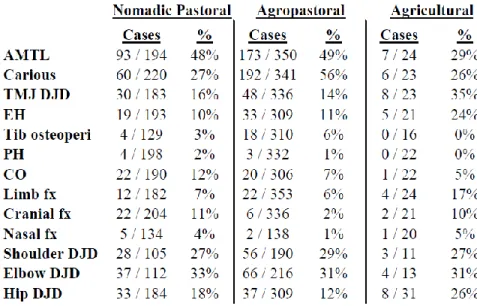
population health. The study produced complex but very interesting preliminary results for
health in the Northern Zone (see Table 3 below). Eng found overall better health in
pastoralist populations, including lower levels of generalized stress, nutritional deficiencies,
dental pathologies, and infectious disease lesions in bone, along with greater stature. By most
measures, the agropastoralist populations showed a health status intermediate between that of
the pastoralists and the agriculturalists. Some of these findings were not at the level of
statistical significance, indicating the need for further data collection to evaluate their
validity. Also, her agropastoralist sample came from a single large cemetery site, and her
samples of agriculturalists and pastoralists were pooled samples from sites of different time
periods. Even given the sampling limitations, however, this research indicates what findings
might be expected from future research on pastoral and agropastoral populations in the
Northern Zone.
33
Work is beginning on quantitative dietary reconstruction in this region through stable
isotope analysis. A study of a small sample of pastoralists and associated caprid (sheep/goat)
remains from three Late Bronze Age and Early Iron Age sites in Xinjiang (Eng et al., 2009)
showed a slight change in dietary composition over time, indicating human consumption of
lower trophic level animals at the later two sites6. The results also suggest that the people at
these sites and their animals consumed mostly C3 plants (though the authors do not specify,
this was most likely wheat). The authors compared their results to published isotope data
from Chinese Neolithic sites, at which the population relied mostly on millet (a C4 plant).
Another recent paper from China (Zhang et al., 2010) examined the isotopic
composition of human bones from the Neolithic (pre-pastoralist) Miaozigou site in Inner
Mongolia. Based this data, in addition to tools and wild animal bones found at the site, the
authors concluded that C4 plants, most likely millet, made up the bulk of the diet of this
population, though hunting, gathering, and fishing were also important in their economy7.
The work proposed in this paper will expand on the work of Eng (2007) and the other
studies mentioned above by first, increasing the amount of paleopathological data available
for analysis, allowing for more robust conclusions; and second, moving beyond the
consideration of human behavior change in its sociopolitical context, to consider it in its
ecological context. It will consider humans as one element in complex, multi-scalar systems,
and will look at the health consequences for humans when the cultural-natural systems of
which they are a part undergo reorganization and transformation.
6 The average δ15N concentration in the Late Bronze Age site studied was 15.36‰, while the concentration
at the two Early Iron Age sites was 13.00‰ and 12.69‰, respectively (Eng et al., 2009).
7 The average δ13C concentration of individuals at the site was –7.19‰, within the range of consumption of
C4 plants (or animals fed on C4 plants). Individuals from the site also had an average δ15N concentration of
34
Bioarchaeological methodology
As described above, to assess the hypothesis of a regional epidemiological transition
in the Bronze Age Northern Zone, standard measures of paleopathology as outlined in
Standards for Data Collection from Human Skeletal Remains (Buikstra and Ubelaker, 1994)
and the Global History of Health Project (Steckel et al., 2004) should be employed, in order
to facilitate cross-regional and diachronic comparisons. Below are predictions for what might
be observed in skeletal populations from this time period with regards to different types of
bioarchaeological data.
Nutritional deficiencies and metabolic disruption
Specific nutritional deficiencies, general nutritional deprivation, and other metabolic
disruptions such as fever and infection with intestinal parasites may all leave visible evidence
in the human skeleton. Such evidence include hypoplastic lesions (in cases of general
metabolic disruptions, iron deficiency anemia, and scurvy); growth disruption in teeth or
bones, including linear enamel hypoplasias or other defects in teeth, and radiopaque “Harris
lines” in bones; and undermineralization or malformation of bones (in cases of rickets and
osteomalacia) (Larsen, 1997; Ortner, 2003). Differential diagnosis of these pathologies is
often very difficult, but even without knowing their specific etiologies, the presence of the
signs described above can serve as general indicators of stress and dietary deficiencies.
Low-protein or other nutritionally poor diets can impact growth attainment as well
(Larsen, 1997). By comparing long bone length to dental age researchers can determine
35
periods (in cases of population continuity), it is possible to identify periods of relative
deprivation and stress. To a lesser extent, terminal stature may also be influence by other
stressors, most notably infectious disease load.
Porotic hyperostosis and cribra orbitalia are usually taken as signs of iron deficiency
anemia in an individual (Larsen, 1997). Iron deficiency can arise from a dietary deficiency of
bioavailable iron or, as some researchers believe, from intestinal parasites or other intestinal
infection. In fact, the latter may be a more common cause of iron deficiency anemia than
dietary deficiency (Kent, 1986; Larsen and Sering, 2000). However, Walker et al. (2009)
suggest that iron deficiency anemia is unlikely to be the cause of the marrow hypertrophy
seen in porotic hyperostosis, suggesting instead that these conditions are caused by hemolytic
or megaloblastic anemia, and that cribra orbitalia has a more complex etiology, often
including nutritional deficiencies such as scurvy.
I would expect the occurrence of these pathologies to be lower in pastoralist
communities than in agriculturalist ones. Though diet can only be inferred indirectly without
dietary reconstruction by chemical methods, it can be reasonably assumed that pastoralists’
consumption of meat and dairy products provided a high-protein diet, as well as a diet rich in
bioavailable iron (Larsen and Sering, 2000). Pastoralists would also be expected to have a
lower rate of intestinal parasitic diseases, given their more dispersed settlement pattern and
therefore presumably less contaminated water sources. It is also possible, however, that some
parasite species contracted by eating or handling undercooked meat would have a greater
36
Infectious diseases
As with metabolic diseases, infectious lesions on bone are difficult to diagnose
differentially. Many infectious diseases also do not leave visible evidence on dry skeletal
remains, because the infected individual dies before these can develop, or because the lesions
heal over time (Larsen, 1997; Ortner, 2003). Nonetheless, some chronic infectious diseases
leave characteristic distributions of lesions on the skeleton. Specific infectious diseases
discernible in human skeletal remains include tuberculosis, leprosy, and treponemal
infections such as syphilis (Roberts and Manchester, 2007).
Nonspecific infections of bone (periostitis and osteomyelitis) are also important
indicators of the health of a population, as they may reflect poor nutritional status, a high
burden of other infectious diseases, or trauma. Rates of nonspecific infection are often taken
as indications of the overall health of a population. For example, an increased rate of
nonspecific infection has been documented in populations from the Woodland to the
Mississippian periods in the Eastern Woodlands of North American, coinciding with greater
reliance on maize agriculture and congregation of the population into larger settlements
(Larsen, 1997).
Many human diseases may have originated as zoonotic infections (Barrett et al.,
1998; Roberts and Manchester, 2007). For this reason, it may be expected that some novel
infections, or perhaps a higher rate of infections acquired from domesticated animals (such as
brucellosis and some forms of tuberculosis), may have made their way into human
populations after the advent of pastoralism in the Northern Zone. For example, evidence
from North America suggests that rates of tuberculosis increased at the start of sedentism, as
37
bacterium Micobacterium tuberculosis probably predates animal domestication, some
Micobacterium species primarily infect non-human animals and only secondarily infect
humans, so that contact with animals is required for infection) (Roberts and Manchester,
2007). One would therefore expect the prevalence of tuberculosis to increase in pastoral
populations, given their greater contact with herd animals.
Despite the risk of zoonotic infection, pastoralists probably experienced an overall
decline in the rate of infectious diseases, especially density-dependent and water-borne
diseases, due to the decrease in settlement size and attendant decrease in unsanitary
conditions and water supply contamination. Pastoralists also likely had to contend with fewer
soil-borne fungal infections (mycoses), though agropastoralists would still have been at risk
for these.
Intestinal parasites have a large impact in human health in many populations around
the world. They are difficult to study in ancient populations, as they do not directly impact
the hard tissues of the body. Some researchers have proposed using rates of porotic
hyperostosis, as evidence of iron deficiency anemia, as a sign of infection with intestinal
parasites (Cohen and Crane-Kramer, 2003; Larsen and Sering, 2000). Where available,
coprolites can also be used to test for the presence of parasites in a population. Both
theoretical predictions and comparative ethnographic research suggest that nomadic foragers
have fewer parasites and lower rates of anemia than sedentary farmers (Cohen and
Crane-Kramer, 2003), and I would expect this to hold true for early pastoralists in the Northern