EINSTEIN, MODERNISM, AND MUSICAL LIFE IN AMERICA, 1921–1945
Allison Kerbe Portnow
A dissertation submitted to the faculty of the University of North Carolina at Chapel Hill in partial fulfillment of the requirements for the degree of Doctor of Philosophy in the Department of Music.
Chapel Hill 2011
Approved by:
Annegret Fauser, Chair
Brigid Cohen
Jon W. Finson
Mark Katz
ABSTRACT
ALLISON KERBE PORTNOW: Einstein, Modernism, and Musical Life in America, 1921–1945
(Under the direction of Annegret Fauser)
This dissertation explores the relationship between Einstein’s theories of relativity
and the concepts and products of musical modernism in the United States from 1921 to
1945. The interactions of the musical world with this particular area of scientific thought
are traced from the time that Einstein became famous in America until the end of World
War II, when the scientist’s public persona expanded to include his political activism.
During this period, modernist composers working in America took part in the cultural
phenomena of Einstein and relativity’s celebrity, invoking scientific rhetoric related to
relativity in their writings about music and participating in the larger cultural discourse
surrounding science, modernism, and life in early-twentieth century America.
My research is divided into three large chapters, each tracing one facet of
Einstein’s reception and incorporation into modernist musical life. Following an
introductory outline of the relationship between music-making and science in general in
―Chapter 1: Introduction,‖ ―Chapter 2: Einstein‖ explores the reception of Einstein the
man. I look at the elements of Einstein’s public persona, including his representation as a
rebel or revolutionary, as a hero or savior, as a genius, as an understandable intellectual,
and finally as a musician. I explore the perceived and carefully constructed parallels
examine the use of Einstein’s relativity theories as models for modernist theories of
music, both in terms of methodology and as a source of inspiration for new ideas in
music theory. I look especially at how Einsteinian ideas of space and time inspired new
theories about the relationships between pitch and rhythm in modernist musical
aesthetics. In ―Chapter 4: Space-Time‖ I delve further into how changing notions of
musical space and time, inspired by Einstein and his new theories, shaped musical
compositions of this period. I conclude my dissertation in ―Chapter 5: Conclusions‖ with
an overview of the relationship between music and science after Einstein, which offers an
avenue for further investigations. It also serves as a point of contextualization for the
For all scientist-musicians and musician-scientists,
ACKNOWLEDGEMENTS
I owe a great many ―thank yous‖ to the people and institutions that have helped
this dissertation come to fruition. Every member of my dissertation committee has
contributed an enormous amount through their guidance on both the process of research
and the craft of writing. I have to thank Sy Mauskopf for his careful steering into the
realm of the history of science and his constant enthusiasm for music. I must thank Jon
Finson for his perpetual encouragement, especially in the form of Scientific American
issues left in my mailbox. Thanks to Brigid Cohen for her early readings and great
brainstorming sessions. Thanks to Mark Katz for his critical eye and sympathetic ear
(often on the bus) for writing. And, of course, thank you to my advisor Annegret Fauser
for so many things, not the least of which was her ability to morph into just the advisor I
needed at any given moment.
In addition to my committee, a number of faculty members in the Music
Department at the University of North Carolina at Chapel Hill have gone out of their way
to help with this dissertation, especially Tim Carter, Jocelyn Neal, and Severine Neff. I
am also indebted to the Ackland Art Museum, and in particular Carolyn Allmendinger
and Amanda Hughes, for giving me the opportunity to serve as a graduate intern;
working at the Museum has nurtured a kind of interdisciplinary thinking that has
profoundly shaped my dissertation. I must also thank the Graduate School at
Fellowship, which allowed me to complete my research and writing during the summer
of 2010. It was through this grant that I was able to conduct research at the New York
Public Library where, with the help of Jonathan Hiam, I was able to find the materials to
weave together the final threads of my dissertation.
I cannot thank my colleagues, friends, and family enough for the many things
they have done—great and small—to make this dissertation what it is. Thanks to Jeff
Wright, Kimberly Francis, Molly Breckling, Will Gibbons, Kevin Bartig, Alicia Levin,
Amanda Bryan, Catherine Steele, and many others for being—at times—both skeptics
and enthusiasts of this project, and for all the little things that have helped me
enormously. Thank you to my family, especially those close enough to come for the
Saturday dinners that always put things in perspective. Most of all, thank you to my sister
Lauren Portnow and my mom Kit Portnow. I couldn’t have done any of this without their
TABLE OF CONTENTS
List of Figures...xi
List of Musical Examples...xii
Chapter 1: Introduction... 1
I. Music in the Machine Age...4
Critics of Modern Music and Technology... 5
The Music of the Machine Age... 9
Scientific and Technological Influence... 12
II. The Composer as Scientist... 15
III. Composition in the Musical Laboratory... 20
Metaphorical Musical Laboratories... 26
At Work in the American Musical Laboratory... 29
IV. The Case for Einstein, Modernism, and Music... 34
Existing Research on Science and Modernism... 35
Existing Research on Science and Music... 37
Existing Research on Einstein, Modernism, and Music... 41
Einstein, Modernism, and Music in a Nutshell...43
Chapter 2: Einstein...51
I. The World Meets Einstein...54
German Reception... 63
French Reception... 66
American Reception, November 1919 to April 1921... 69
II. Einstein in America...79
Einstein the Rebel/Revolutionary... 82
Einstein the Hero/Savior... 84
Einstein the Genius... 87
Einstein the Understandable Intellectual... 87
III. Einstein the Musician...90
Einstein the Violinist...90
Einstein’s Taste in Music...93
The Look of an Artist...95
Music and Science Intertwined for Einstein... 101
IV. Einstein for Music...105
A Revolutionary for Music... 105
A Hero/Savior for Music... 108
A Genius for Music...109
An Understandable Intellectual for Music... 111
A Musician for Music... 112
Chapter 3: Relativity... 117
I. Relativity: A Revolution in Science... 121
Relativity in the News...122
Relativity in the Movies...134
II. Reception of Relativity in the Arts...138
Visual Art...138
Literary Arts...146
III. Theories of Musical Relativity...150
Musical Revolutions: Dane Rudhyar and Relativity... 153
Joseph Schillinger’s General and Special Theories of Harmony...160
Charles Seeger and Unified Field Theories... 167
Henry Cowell’s Theory of Musical Relativity...176
Pound and the Supremacy of Musical Time... 190
Chapter 4: Space-Time... 201
I. Space and Time Before and After Einstein... 204
Classical Space and Time: Newton and Bach...204
Einstein’s Space and Time...207
Rhythm and Time... 216
Pitch and Space... 221
II. Recognizing Space-Time in Music... 225
Simultaneous Musical Realms: Time and Space in Ives... 227
Collapsing Space and Time: Cowell’s Tone Clusters...234
Condensing Time: Stravinsky’s Cubist Poly-Music...240
Twelve-Tone Relativity... 253
III. Composing Space-Time in Music...270
Time-Space: George Antheil and the Ballet Mécanique... 288
Chapter 5: Conclusions... 307
I. Pop Einstein, Pop Music?...313
II. New Directions in Space-Time... 319
III. Music and Science Post-Einstein... 324
IV. Conclusions...327
Bibliography... 329
Primary Sources... 329
LIST OF FIGURES
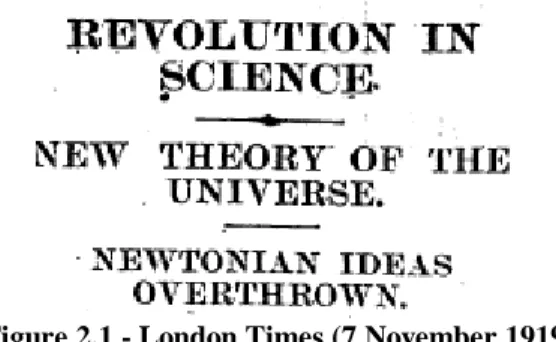
2.1 - London Times (7 November 1919)...59
2.2 - London Times (8 November 1919)...59
2.3 - New York Times (9 November 1919)... 71
2.4 - New York Times (10 November 1919)... 72
2.5 - Current Opinion (May 1920)... 78
2.6 - Washington Post (17 April 1921)...81
2.7 - Current Opinion (June 1921)... 83
2.8 - New York Times (April 1934)...92
2.9 - New York Times (10 March 1929)...97
2.10 - Julius C. Turner, "Beethoven on the Mountain" (undated)... 97
2.11 - Arthur Heintzelman, "Beethoven: 'Vieux Lion Fatigué'" (1929)... 98
2.12 - Joseph Karl Stieler, Louis van Beethoven (1820)...99
3.1 - New York Times (9 November 1919)... 123
3.2 - New York Times (10 February 1923)...136
3.3 - New York Times (18 February 1923)...136
3.4 - Luigi Russolo, Music (1911)... 144
3.5 - Giacomo Balla, Rhythm of the Bow (1912)... 145
3.6 - The Baltimore Sun (10 August 1941)... 161
4.1 - New York Times (3 December 1919)...207
4.2 - New York Times (4 December 1919)...208
4.3 - Albert Gleizes, Portrait of Igor Stravinsky (1914)...247
LIST OF MUSICAL EXAMPLES
3.1 - Schillinger, Graph of Bach’s Two-Part Invention No. 8 (1946)... 164
4.1 - Edward Cone, analysis excerpt (1962)... 249
4.2 - Antheil, Ballet Mécanique, eight measures before Reh. 50... 301
4.3 - Antheil, Ballet Mécanique, excerpt from Reh. 51... 302
4.4 - Antheil, Ballet Mécanique, eight measures after Reh. 51... 303
CHAPTER 1
INTRODUCTION
The reason in reviewing certain scientific and historical aspects of music is not to bring out new facts, but to present these facts in a new light...
- Henry Cowell, New Musical Resources, 19301
When people ask me about this project—about Albert Einstein, modernism, and musical
life in America—our discussion of my work generally goes in one of two ways. The first
stance is curious skepticism: While they consider my dissertation‘s title plausible and the
topic interesting, they wonder about the connection between music, modernism, and
Einstein and ask for more information—in a nutshell. The second stance is a more
indignant one: these scholars (and they are usually scholars) question whether there is
really some connection between Einstein and modernist music. After all, if this were so,
it should be known by now. I understand both initial responses and I think that there is
something truly valuable in exploring the rationale behind each.
As I respond to the first reaction, I must address not only Einstein, relativity, and
space-time in a nutshell, but also what any of those might have to do with music, and
abstract modernist music at that. In asking for the elevator-pitch version of my
dissertation, this group of enquirers has hit on something that I contend with in the
historical material that I research. Just like my kind skeptics, who want me to sate their
1
curiosity with a few sentences about scientific revolutions and modernist artistic
upheavals, the musicians, composers, music-writers, and critics who take center stage in
my dissertation often had usually only a cursory understanding of Einstein and relativity
theory. Yet these musicians‘ surface-level understanding sparked something in their
imagination that led them to discover, uncover, and create connections between the
scientific world and their musical one. Modernists‘ fascination with and curiosity about
Einstein and his theories led them into a broader cultural dialogue about modernist art,
modern life, and the scientific and technological concerns that formed both. Modernist
musicians and music-writers both shaped, and were shaped by, this larger discourse.
They did not see themselves as separate from the scientific world or other cultural
spheres; rather, they were part of a cultural project that explored all realms of modernity.
This type of deeper cultural awareness is what I hope to provide for my colleagues,
acquaintances, and now readers in the first category. Whether these readers are
musicians, scientists, historians, or regular folks (and I have encountered this reaction by
all of the above), I hope that by exploring how musicians‘ basic curiosity in scientific
culture shaped musical life as much as it did, they begin to make interdisciplinary
connections in their own scholarly and non-scholarly lives.
With the second reaction to my topic, people wonder whether there is any validity
in my topic at all, having seen no evidence themselves. I understand this indignant
reaction well; with so much insightful research being conducted on modernist musical
life in America, it seems unlikely that the infiltration of complex scientific ideas into
musical discourse could have been missed. In this case, I defer to the wise words of
repeating here: ―The reason in reviewing certain scientific and historical aspects of music
is not to bring out new facts, but to present these facts in a new light.‖ I feel that I am
undertaking a similar project: rather than uncovering new musical artifacts or historical
events, I am reexamining well-known documents of modernist music in America—
scores, books, articles—and, in doing so, unveiling previously overlooked connections.
These documents contain references to Einstein, relativity, and space-time that have gone
unnoticed or unremarked upon by previous scholars. This has happened for a number of
reasons. For one, musicology as a discipline has had very little contact with the history of
science whence the type of interdisciplinary scholarship necessary for uncovering this
aspect of American modernist life has barely been explored.2 Another reason lies in the
fact that few scholars of American modernisms have been looking for these details; with their sights aimed on other aspects of musical life in the early part of the twentieth
century, musicologists have simply passed over certain pieces of textual evidence.
Most importantly, however, many of the instances of the intermingling scientific
with musical thought in texts of this period appear at first to be insignificant. In certain
cases, only a few references to Einstein or relativity can be found in a given prose or
musical text, as significant as these details might be upon careful inspection. In other
cases, the references may seem like surface-level statements that simply come with the
historical territory, textual objects that popped into the text and seen to us now like quaint
reminders of contemporary culture. By examining more closely both of these
incidences—which do in fact constitute the majority of the references to Einstein and
relativity that I have encountered—my dissertation makes significant scholarly headway.
Even if references to Einstein and relativity occur few and far between in a given text, in
2
the broader context of American modernist cultural debates, I am able to show that what
appear to be insignificant elements on their own actually form portions of a much larger
network of ideas about modernism, science, and the arts. With the necessary
musicological and science-historical tools, I build up a new picture of musical life,
documenting a significant cultural movement that created and then was defined by the
parallel revolutions of Einsteinian physics and modernist musical aesthetics.
I. Music in the Machine Age
It is a truism that life in the early twentieth century was affected by the technological
developments of the times. Modes of communication, travel, education, and commerce
were all influenced by inventions like city-wide electricity, the phonograph, telephone,
personal camera, and new forms of individual and mass transportation. And although we
can imagine the extent to which these inventions and technological developments shaped
musical life in, as André Coeuroy called it, ―an era of velocity,‖ it is worth reviewing this
idea here.3 Composers and critics frequently spoke of the impact of technology on
music.4 Furthermore, many of the composers and critics who play a key role in this
dissertation perceived technology and science as intimately connected. Ezra Pound, for
example, saw George Antheil‘s upbringing in an industrial setting as a formative aspect
of the composer‘s later scientifically-oriented compositions.
3André Coeuroy, ―The Aesthetics of Contemporary Music,‖ trans. Theodore Baker, Musical Quarterly 15/2
(April 1929), 252.
4
Critics of Modern Music and Technology
Aaron Copland, whose music criticism figures more centrally in my dissertation than his
compositions do, wrote about connection between modern music and life. In the
introductory pages of Our New Music (1941), Copland gives an overview of modern music‘s break with its romantic (and specifically German, nineteenth-century) roots. He
argues that the aesthetic differences present in new music result from the specific
conditions of the modern era:
The twentieth-century composer seeks a more universal ideal. He tends to be more objective and impersonal in his music. . . . The tempo of modern times calls for a music that is more matter-of-fact, more concise—and, especially, less patently emotional.5
Copland sees the aesthetic focus on objectivity as linked to the nature of the modern era.6
It is an artistic imperative, it seems, for modern music to engage with the fast pace of
modern life in the city. Composers answer this call intuitively:
Modern music, in a word, is principally the expression in terms of an enriched musical language of a new spirit of objectivity, attuned to our own times. It is the music of the composer of today—in other words—our
music.7
Composers of new music, then, are directly engaged with their environment, composing
music to match the ―tempo‖ of life in the early twentieth century.
Another important critic of modernist musical life in America, Paul Rosenfeld,
documented the ways in which certain avant-garde composers‘ works were connected
5
Aaron Copland, Our New Music; Leading Composers in Europe and America (New York: McGraw-Hill Book Company, 1941), 4.
6
Copland is expressing a view held by many at this time, both in America and abroad.
7
with the technological developments that surrounded them.8 For Rosenfeld, who adopts
the voice of a collective audience in his criticism, the connection between modern
composers and modern technology occurred at the level of interpretation. Rosenfeld is
careful not to argue that a composer of new music attempted imitate the sounds of life in
the modern city, although he admits that certain environmental factors shaped the modern
composer‘s aesthetic stance. Instead, he offers an analytic view from the perspective of
the listener. The idea that both the composer and the listener have a relationship with the
technological developments in their everyday lives separates Rosenfeld‘s commentary
from other, more socially-removed critics (including Copland).
In discussing the music of Edgard Varèse in An Hour with American Music
(1929), Rosenfeld offers critical commentary on a number of the émigré composer‘s
works and an overview of his distinctly modern attitudes to composition as heard by
audiences. One particularly poetic passage compares the music of Varèse to the sounds of
the ―monster town,‖ a dystopian sounding metaphor for the modern city—though
Rosenfeld seems more enthralled with the monster town, than terrified by it.9 He
describes Varèse‘s relationship with the distinctly American-sounding megacity as
similar to Picasso‘s one with Paris. And, even though he suggests a type of influence
garnered from the cityscapes surrounding each artist, the experience of the sensations of
modern life come from the audience‘s perspective. He describes listening to Varèse‘s
works as performed in a concert hall:
8
Rosenfeld was an important critic for The Dial and actually grew to be friends with Copland, introducing the composer to a number of other artistic figures. See Elizabeth Bergman Crist, Music for the Common Man: Aaron Copland During the Depression and War (Oxford: Oxford University Press, 2005), 16.
9
For the concert-hall just quit, overtones and timbres and rhythms
corresponding to the blasts and calls of the monster town had formed part of a clear, hard musical composition; a strange symphony of new sounds, new stridencies, new abrupt accents, new acrid opulencies of harmony. Varèse has done with the auditory sensations of giant cities and the industrial phantasmagoria, their distillation of strange tones and timbres much what Picasso has done with the corresponding visual ones. He has formed his style of them. Or, rather, they have transformed musical style in him by their effect on his ears and his imagination; much as Picasso‘s city walls, billboards, newspapers, and chimney-pots have helped the Parisian magician to his original and intensely personal idiom.10
In analyzing what he and other audience members heard in Varèse‘s music, Rosenfeld
describes the shared experience of modern life, an experience that affects both composers
and their listeners.
As Rosenfeld begins to discuss specific works of Varèse‘s in An Hour with American Music, he focuses on works composed while the Paris native was living in the United States in the 1920s. What was only suggested in the description of the general
character of Varèse‘s modernist works—that their relationship with the ―monster town‖
was a uniquely American modernist perspective—is reiterated with certainty in
Rosenfeld‘s analyses of Varèse‘s works composed on American soil. His testimony about
the first performance of Varèse‘s Intégrales (in 1925 in New York) conveys the
experience of listening to the sound of modern, urban, American life:
The memorable evening of its baptism, Intégrales resembled nothing so strongly as shining tubes of freshest, brightest brass and steel set in abrupt pulsing motion. And for one impressionable instant, they were strangely symbolic. They were not merely sounds like metals. They were sounds strangely related to the massive feeling of American life, with its crowds, city piles, colossal organization, mass production, forces and interests intricately welded; sounds that for a moment revealed them throbbing, moving, swinging, glowing with clean, daring, audacious life. A new power exulted in them. Majestic skyscraper chords, grandly resisting and
10
progressing volumes, ruddy sonorities and mastered ferocious outbursts, sung it forth.11
The piece and its performance take on a machine-like quality and, for Rosenfeld, the
unique sounds were not merely metal instruments making metallic sounds. Rather than
imitating city life, the ―strangely symbolic‖ music acted as a musical metaphor for
America. Rosenfeld makes it clear that the modernist compositions of the émigré Varèse
are a part of a uniquely American—that is, non-European—brand of modernism.
Elsewhere in the Varèse chapter he states:
[Varèse‘s] music significantly orientates us to a kind of world to which America is closer than Europe is, a new world not only of the new scientific and mathematical perspectives but of the latent, the immanent, free of prejudice and habit and dogma: the whole glittering region of the unrealized.12
The scientific world brought to life in the music of Varèse is modern, objective, and
distinctly American. As we will see in discussing the writings and music of other
immigrants, the break with the romantic and romanticized European past was an
important rhetorical gesture for presenting oneself as imbued with an American,
scientific, and modernist aesthetic.
There were, apart from Varèse, a number of composers working in America—
born both in and out of the United States—that espoused an urbanized if not mechanistic
aesthetic in their works. The New Jersey native George Antheil played a key role in this
techno-centric movement. For Ezra Pound, Antheil‘s first significant champion and
biographer, the composer‘s focus on the machine aesthetic was the only valid artistic
choice in a modern world dominated by technology.
11
Paul Rosenfeld, An Hour with American Music, 174.
12
I take it that music is the art most fit to express the fine quality of
machines. Machines are now a part of life, it is proper that men should feel something about them; there would be something weak about art if it couldn‘t deal with this new content.13
Pound insists that machines must be a part of artistic life for art form to remain relevant.
As a poet, Pound even appeared jealous of the ease with which musical composition
could replicate machine sounds. ―Machines are not literary or poetic,‖ he said, ―…
Machines are musical.‖14
Pound made these comments in his book on Antheil written in
1924—at the height of Antheil‘s ―mechanical period‖ and shortly after the poet had met
the enfant terrible in Paris. Pound praised Antheil‘s music not only because it was able to
replicate a mechanistic sound, but also because of the composer‘s inclusion of various
mechanical instruments and his appropriation of noise-making machines in works such as
the Ballet Mécanique (1924-5).
The Music of the Machine Age
Apart from Ballet Mécanique,a number of other works written in the 1920s and 30s reflected on life in the big city in the United States as a uniquely American experience.15
The prevalence of such works speaks to the poignancy of experiencing the increasingly
industrialized cities in the U.S. One such work is John Alden Carpenter‘s ballet
13
Ezra Pound, Antheil and the Treatise On Harmony (Chicago: Pascal Covici, 1927), 53.
14
Ezra Pound, Antheil and the Treatise On Harmony, 51.
15
―Skyscrapers‖ (1923–1924) written originally for Diaghilev,16
but premiered instead at
the Metropolitan Opera in February 1926.17 The ballet ―presents a view of American life
as a mechanical alternation of work and play‖—in other words, it depicts the rhythm and
pace of American life as mechanical.18 Renowned music critic Olin Downes praised the
ballet and its reflection of life in urban New York City: ―There is the vibration, as it
seems, in this music of exhaustion, of nervous and harried merriment, of heavy dreams,
all caught up in a current of electricity and noise and quest.‖19 Downes‘ use of a
technological metaphor (―a current of electricity‖) in describing this stage work that
depicts modern life reveals the porousness of the boundaries between art and life at this
time. Carpenter‘s ballet portrayed the technological developments at the time, displayed
the rhythm of modern life in comparable musical rhythms, and prompted existential
reflections on the nature of modern life.
Aaron Copland‘s score for The City (1937) had a similar aesthetic in its musical depictions of urban life as mechanistic and harried. In this film, directed by Ralph
Steiner, Copland is able to juxtapose the aesthetics of country and city life as the film
moves from the pastoral setting of the opening into a portion called, in Copland‘s film
16
This work was intended for Diaghilev in the same season in which the Ballet Suédois produced a double bill of Darius Milhaud‘s Création du Monde and Cole Porter‘s relatively unsuccessful ballet about New York City, Within the Quota (premiered Paris, 25 Oct. 1923).
17
The exact date was February 19, 1926. It was produced in 1928 in Munich as well. Felix Borowski, ―John Alden Carpenter,‖ Musical Quarterly 16/4 (Oct. 1930), 453. See also Howard Pollack, Skyscraper Lullaby: The Life and Music of John Alden Carpenter (Washington: Smithsonian Institution Press, 1995).
18
Fred Hauptman, ―Review of John Alden Carpenter. Skyscrapers, etc. London Symphony Orchestra; Kenneth Klein, conductor. 1987. Angel DS 49263,‖ American Music 7/2 (Summer 1989), 229.
19
cue, ―Sunday Traffic.‖20
Like Carpenter‘s ballet, Steiner and Copland are able to depict
both visually and musically the idea that even in leisure, American life is hectic.
Accompanying visions of pedestrian-packed city streets and interminable highway
bottlenecks, Copland‘s brass-driven score rhythmically pounds out the pace of an
American life where humans and machines work mechanistically in unison (in an
aesthetic moment highly reminiscent of the factory scene in Fritz Lang‘s 1927
expressionist film Metropolis). Even though the on-screen motion is not (intentionally) matched to the rhythmic pulse of the score, the viewer/listener cannot help but join the
two cognitively while watching the film. The result is a score that seems to imitate the
sound of technology, creating a machine aesthetic.21 Copland‘s score came on the heels
of Colin McPhee‘s for another Steiner film, Mechanical Principles (1931) that in Bauer‘s
words ―was an extraordinary realization of the spirit of the mechanical age imprisoned in
an art expression.‖22
Both Carpenter‘s and Copland‘s compositions accompany larger works that
contain both visual and narrative elements, but there were also instrumental concert
works that addressed themes of the city and machine life. In her comprehensive survey of
20
In his PhD dissertation, Neil Lerner discusses another of Copland‘s documentary film scores in depth: that composed for The Cummington Story (produced in 1945 for the Office of War Information). This short propagandistic film does not address much of city life and instead contains more of Copland‘s pastoral sound. Neil Lerner, ―The Classical Documentary Score in American Films of Persuasion: Contexts and Case Studies, 1936–1945,‖ PhD Dissertation, Duke University, 1997. See also Neil Lerner, ―Aaron Copland, Norman Rockwell, and the ‗Four Freedoms‘,‖ in Aaron Copland and His World, Eds. Carol J. Oja and Judith Tick (Princeton: Princeton University Press, 2005), 351–77.
21
Interestingly, Howard Pollack notes that, ―The Sunday outing music is a close if more sardonic cousin to the finale of From Sorcery to Science, a 1939 puppet show that Copland produced incidental music for.‖ Howard Pollack, Aaron Copland: The Life and Work of an Uncommon Man (New York: Henry Holt and Company, 2000), 341.
22
early twentieth-century compositions, Claire Reis mentions a few lesser-known works
along these lines.23 Carl Eppert composed A Symphony of the City, a ―grand symphonic
cycle in four parts,‖ in 1934. Arthur Cohn wrote a piece for two pianos called ―Machine
Music‖ (Op. 20, No. 2) in 1937. Perhaps the ephemeral nature of these pieces‘ renown
speaks to the trendiness of this topic in the 1930s. But some works that echoed the sounds
of the city did survive the test of time including, of course, George Gershwin‘s An American in Paris (1928) and ―Rhapsody in Blue‖ (1924).
Scientific and Technological Influence
For some, the influence of machines on music and the proliferation of machine-themed
music was nothing but a trend; even in 1932, composer, critic, and music publisher
Arthur Farwell called this development in music history a ―passing phase which worships
the machine.‖24
Marion Bauer discussed this time saying ―we speak of this as the
Mechanical Age‖ and described the significance that machines and the world of
technology had on art:
Not only the power of the machine grows, but man‘s worship of its power and his respect for the mechanical principle increase. He finds beauty in the perfection of its mechanism, and in the rhythm of its movement. He personifies the Machine in literature, painting, drama, dance, and music. It has changed the face of the physical world and has created ―a new mental attitude toward the world of the spirit,‖ Thomas Craven says in Men of Art. ―America is the land of machines. . .‖25
23
Claire Reis, Composers in America: Biographical Sketches of Contemporary Composers with a Record of Their Works (New York: MacMillan, 1947).
24
Farwell uses this phrase to contrast the innovative and long-lasting work of Roy Harris in an article about the composer. Arthur Farwell, ―Roy Harris,‖ Musical Quarterly 18/1 (Jan. 1932), 19.
25
After this passage, Bauer discusses the particular musical elements that reveal this
American, machine-dominated aesthetic and ideological stance. She sums up by saying,
―The science of composition seems of greater import than the art of composing.‖26
This sudden flourishing of machine-music is evidence of the prominence of
technology in composers‘ thoughts. Interestingly, it was not just the work of composers
and other artists that was shaped by the machine age. Science historians have
acknowledged the debt that Einstein‘s theories owe to his personal relationship with a
techno-centric environment. In his ground-breaking work on Einstein, Peter Galison has
offered a view of the physicist beyond the disembodied brain in a jar that Roland Barthes
described in Mythologies.27 Galison breaks down the portrayal of Einstein as a genius scientist-philosopher working apart from society in solitude and, instead, explores the
ways in which Einstein‘s techno-centric environment allowed the scientist to theorize in
the way he did.28 While working in a Swiss patent office processing new electronic
technologies, Einstein developed a fascination with the idea of the synchronization of
clocks. Among his duties as a patent officer was the assessment of new technological
developments that could aid in the synchronization of clocks, including devices that
communicated by sending signals at the speed of light.29 Einstein often worked out
thought experiments related to moving trains and clocks that he used both in his
published scientific papers and in later explanations of his theories before lay
26
Marion Bauer, Twentieth Century Music, 397.
27
Roland Barthes, ―The Brain of Einstein,‖ in Mythologies, trans. Annette Lavers (New York: Hill and Wang, 1972), 68–70.
28 Peter Galison, Einstein’s Clocks, Poincaré’s Maps: Empires of Time (New York: W. W. Norton &
Company, 2003).
29
audiences.30 For Einstein, who had been thinking about some of the larger inconsistencies
he saw in existing ideas about physics, his theorizing about synchronizing clocks and the
perception of simultaneity was the push he needed to get his theory of relativity off the
ground in 1905, his so-called annus mirabilis. Galison writes:
For Einstein clock coordination was the turn of the key that would at last set in motion the theory machine that he had struggled for a decade to assemble. There was no ether; there were actual fields and particles, and there were but real times given by clocks.31
The machines around him—clocks, trains, and the many devices used to power them that
he encountered in the patent office—shaped Einstein‘s thinking in a radical way.
Galison‘s historiographic contributions to our understanding of Einstein are significant;
his work counteracts a portrayal of the physicist as a god-like figure embraced by
multiple Einstein biographers in the decades after his death in 1955. But during Einstein‘s
own time, the techno-centric metaphors and frequently-cited thought experiments dealing
with train travel, clocks, and the problems of simultaneity might have made it apparent to
even a lay audience that, especially in Einstein‘s case, technology had a crucial role in
shaping scientific thought.
Just as Einstein was influenced by his exposure to new technologies, composers,
critics, and audience members espoused and encountered new technologies that helped
create and inform their ideological and aesthetic concerns about modernist music. Their
machine-based aesthetic was part of a larger interest in considering the place of science in
a musical discourse. For modernists, science and technology were bound together. On the
30
In one, he pondered what would happen if lightning struck simultaneously at two different points along the embankment of a set of train tracks. From the ground, the two events would appear simultaneous. But what would an observer on a fast-moving train rushing towards one of the two points observe? Summarized from Walter Isaacson, Einstein: His Life and Universe, 123–124.
one hand, technological developments were seen as the practical application of scientific
ideas, and, on the other, technologies could be cast as shaping scientific (in addition to
artistic) progress. This attitude is reflected in the similarly bidirectional relationship many
modernists saw in burgeoning field of electronic music at this time, which they
considered both a scientific and technological development.32 New scientific research on
music and musical acoustics prompted modernists to build and commission new
instruments that would be able to express their scientific ideas about music.33 This is
what encouraged Cowell to commission the production of the Rhythmicon. On the other
side, certain new technological innovations, like the Theremin, prompted composers like
Varèse and Schillinger to compose new, scientifically-oriented pieces that could use this
instrument. Thus even in the most literal responses to music in the machine age, the give
and take of science and technology and their interrelation played a part in modernist
musical thought.
II. The Composer as Scientist
Modernist composers were often discussed in scientific terms by their contemporaries—
from fellow composers and critics to regular folks. On the surface, the link between those
who were musically experimental and those that experimented by trade seems obvious.
32
This trend began with musicians‘ and composers‘ interest in the writings of Herman von Helmholtz, whose massive treatise On the Sensations of Tone as a Physiological Basis for the Theory of Music (published originally in German in 1877 and subsequently translated) piqued the interest of a number of composers. Benjamin Steege‘s dissertation speaks to the inherently modernist elements of Helmholtz‘s scientific and musical treatise. Benjamin Steege, ―Material Ears: Hermann von Helmholtz, Attention, and Modern Aurality,‖ (PhD Dissertation, Harvard University, 2007).
33
But, further than that, modernist composers possessed, or were perceived as being
possessed of, a number of traits similar to those associated with scientists. Composers
used strict methods in which the elements of music were subjected to an outside process.
Schoenberg‘s twelve-tone compositional method or Cowell‘s dissonant counterpoint and
its regulations made easy examples for this methodical approach to composition. These
calculated, rather than intuitive processes differentiated their creators in the popular
imagination from their romantic, neo-romantic, and even neo-classical compositional
peers. Indeed, modernist composers were seen as treating composition as an experimental
process.
On the other side of the comparative coin, composers shared the negative
connotations of scientism in the early twentieth century. Scientists were often portrayed
as socially-removed individuals who nevertheless had a tremendous impact upon society
through their role in the creation of new technologies. The same caricatures of the
scientists of the day—their cold, calculating ways—were applied to contemporary
composers, most often by those who disliked their music or the artistic,
anti-establishment sentiments. In these negatively-oriented scientific associations between
composer and scientist, the false dichotomy of what C. P. Snow called ―the two
cultures‖—that is, the arts and the sciences—was often invoked.34
When scientific
language was employed to criticize a composer‘s work negatively, it was often related as
a predominance of scientific objectivism at the expensive of (seemingly more desirable)
34
artistic subjectivity. Yet while this negative use of science in describing a composer was
present at times, more often than not, the scientific associations bestowed upon a
composer—especially by the composer‘s peers—were overwhelmingly positive.
The associations between scientists and composers were made by critics, fellow
composers, and by composers speaking of themselves. Certain scientific themes recur
frequently in articles describing new composers on the American music scene:
experimentation, invention, innovation, and theorization. The scientific composer or
scientific musician was a figure necessary for modern music, according to Marion Bauer,
because of the breakdown of the established rules of the tonal system, an idea central to
almost all brands of modernist music aesthetics. She writes:
A new tonal system must be subjected to a period of experimentation before it can become established; it must be established before the
theorists can study it scientifically, and it takes a long time before the new idea, established by the composer and explained by the scientist, reaches the classroom or the public.35
She asserts that the theoretical study of music done by musical scientists is necessary for
understanding new music. She even allows for the possibility that, in some cases, the two
figures are combined: ―Occasionally composer and theorist is one person, as is the case
with Schoenberg.‖36
In fact, Arnold Schoenberg was often singled out as a
composer-scientist, both in his capacity as analyst and as a scientifically-minded composer.
American music critics characterized Schoenberg as a scientific composer both
before and after he emigrated to the United States. In Paul Rosenfeld‘s Musical Portraits: Interpretations of Twenty Modern Composers (1920), the author links the Viennese
35
Marion Bauer, Twentieth Century Music, 114.
36
composer with experimentation and intellectualism in music. In this case, Rosenfeld
makes the parallel between scientist and composer with more than a hint of negativity.
About Schoenberg‘s compositions, he says:
Indeed, it is only as experiments, as the incorporation in tone of an abstract and intellectualized conception of forms, that one can at all comprehend them. And it is only in regarding him as primarily an experimenter that the later Schoenberg loses his incomprehensibility and comes somewhat nearer to us.37
Rosenfeld seems to be arguing that Schoenberg‘s compositions only have value inasmuch
as they represent scientific experimentation in the art of music. It is also worth noting that
Schoenberg and his music are bound up as one in the same entity—when Rosenfeld states
that it is only when ―regarding him as primarily an experimenter‖ that we can
comprehend ―the later Schoenberg,‖ the author slips effortlessly from composer to his
music, turning the music‘s scientific air into a personality trait of its creator.
Later in the same chapter on Schoenberg, Rosenfeld concretized the link between
the composer‘s scientific music and his scientific persona. He says:
But, for the present, Schoenberg, the composer, is almost completely obscured by Schoenberg, the experimenter. For the present, he is the great theoretician combating other theoreticians, the Doctor of Music
annihilating doctor-made laws. As such his usefulness is by no means small. He speaks with an authority no less than that of his adversaries, the other and less radical professors. He, too, has invented a system and a method; his ―Harmonielehre,‖ for instance, is as irrefragable as theirs; he can quote the scripture with the devil.38
This charge of ivory-tower elitism might come as no surprise, but the clear link
established between Schoenberg and the scientific intelligentsia is unique to this period of
37
Paul Rosenfeld, Musical Portraits; Interpretations of Twenty Modern Composers (New York: Harcourt, Brace, and Howe, 1920), 234.
38
modernist musical criticism. Schoenberg, like other moderns, is recognized for his
intellectual kinship with the scientific world. And although in this case the link is meant
to reiterate a negative aspect of the composer‘s artistic personality and agenda, the
connection made by Rosenfeld reveals the pervasive attitude that grouped scientists and
modernists together.
The young Henry Cowell was also described by his peers in scientific terms.
Aaron Copland positioned the upstart using distinctly ambivalent scientific language in
an article about ―America‘s Young Men of Promise‖ in a 1926 issue of Modern Music. Copland notes that Cowell was ―an inventor, not a composer‖ and links the young
composer‘s personality explicitly with Schoenberg‘s.
Like Schoenberg, Cowell is a self-taught musician, with the auto-didact‘s keen mind and all-inclusive knowledge.
But Cowell is essentially an inventor, not a composer. He has discovered ―tone clusters,‖ playing piano with the fore-arm, and the string piano. Yet from a purely musical standpoint his melodies are banal, his dissonances do not ―sound,‖ his rhythms are uninteresting. Cowell must steel himself for the fate of the
pioneer, opposition and ridicule on the one hand, exploitation and ingratitude on the other. His most interesting experiments have been those utilizing the strings of the piano.39
While Copland praises Cowell as inventive, he nevertheless dismisses Cowell‘s
experiments as mostly boring and unmusical. The exceptions to that aesthetic judgment
are actually Cowell‘s most avant-garde works, ―those utilizing the strings of the piano‖—
these purely experimental pieces strike Copland, it seems, as worthwhile intellectual
pursuits. While Copland put a negative spin on Cowell‘s scientific persona, Marion Bauer
keeps her assessment of the young composer value-neutral, while echoing many of
39
Copland‘s sentiments: ―Henry Cowell is first and foremost an experimenter whose keen
mind keeps him on the jump from one problem to the next.‖40
In examining the reception of Schoenberg and Cowell as scientific composers, it
is clear that in adopting this metaphor fellow composers and critics employed both the
positive and negative connotations of the scientific persona. In either case, the scientific
associations both responded to and shaped responses of the composers‘ works.
Schoenberg‘s scientific persona was perceived as being formed by his calculated
twelve-tone compositions, for example, and added to his portrayal as an icy, academic
composer.41 Conversely, Cowell‘s more inherently scientific persona was seen as
molding his pieces, which were considered ―mere‖ experiments in sound design by some.
With this duality of composer-as-scientist in mind, we can see why the ambivalent
position was easiest to adopt. For both composers, the negative associations with their
scientific persona justified their sometimes ascetic works. Yet for those critics and
listeners who aligned themselves with the modernist musical agenda of progress, these
apparently cold and difficult works could be praised for their experimentalism alone.
Even if Cowell‘s or Schoenberg‘s works were not the most ear-pleasing compositions in
concert halls, they were intellectually stimulating and culturally relevant.
III. Composition in the Musical Laboratories
Modernist composers developed hypotheses about new music, based on their concerns
with older methods of composition and the place of those methods in modern art and
40
Marion Bauer, Twentieth Century Music, 335.
41
society. And composers, like scientists, tested these hypotheses by working in a type of
laboratory. The metaphor of the musical laboratory, as the place in which aesthetic
hypotheses about new music were put to experiments, became an important one for
composers and critics of modernist music. Writing in 1929 in Musical Quarterly, André Coeuroy described the musical laboratory as the primary site for new developments in
modern music:
Our young musicians—I mean those who have something to say—our young musicians, immured in their laboratories, are trying to discover a music wholly free from extra-musical appeal; just as our painters envisage a painting that shall obey the laws of line and color only. This is the real objective of their experiments, and, even when they fail, they never weary of beginning over again.42
Although earlier in the article he criticizes ―modern esthetes‖ for their ―would-be
scientific language,‖ Coeuroy nevertheless adopts this language and, in using it, offers in
this passage a summation of the entire relationship between science and modernism in
music: These young musicians conduct experiments in their laboratories to try to find,
prove, and compose using objective laws of music.43
As with the idea of the composer-as-scientist, the notion that musical composition
took place in a laboratory setting was used with both positive and negative cultural
associations, and often with ambivalence. Marion Bauer, who sees experimentation in
music in a generally positive light, reveals the driving sentiment behind the ambivalence
towards composition in the musical laboratory:
42
André Coeuroy, ―The Aesthetics of Contemporary Music,‖ 247.
43
Under the cloak of experimentation, composers have occasionally tried to palm off glitter for gold, and many crimes have been perpetrated against the listening public in the name of ―modernism.‖ We do not need to worry about the effect of these experiments on the future of music because posterity will retain what it needs and desires, and the rest will be lost through ―innocuous desuetude.‖44
Bauer thus met the idea of experimentation and invention in a musical laboratory with
mixed, yet realistic feelings. However, in an earlier article in 1928, Bauer argued for the
importance of a musical laboratory in her article, ―The Case for a Music Laboratory,‖ in
Modern Music.45 Perhaps the later view expressed by Bauer in her book, then, was a tempering of an earlier optimism about musical laboratories—one that was shared by
many.
John Redfield‘s Music: A Science and an Art was one of the most influential
books on music-making and the scientific method. Redfield was a professor of physics at
Columbia University, focusing his research and course offerings on the physics of music
(a rather new field in the 1920s).46 Redfield was described by his contemporaries as a
―keen scientist,‖ an ―uncommonly good musician,‖ and a ―champion of music.‖47
Redfield convened, along with fellow ―organizing members‖ Henry Cowell, Otto
Kinkeldey, Lazare Saminsky, Joseph Schillinger, Charles Seeger, and Joseph Yasser, the
first meeting of ―The Group Interested in the Rapprochement of Science and Music‖ on
44
Marion Bauer, Twentieth Century Music, 374.
45
Marion Bauer, ―The Case for a Music Laboratory,‖ Modern Music 5/4 (May 1928), 36-38.
46 Redfield‘s position is mentioned in a review of his book featured in the Music Supervisors’ Journal in
1928. See Will Earhart, ―Review of Music: A Science and An Art,‖ Music Supervisors’ Journal 15/1 (Oct. 1928), 89.
47 Will Earhart, ―Review of Music: A Science and An Art,‖ Music Supervisors’ Journal 15/1 (Oct. 1928),
29 January 1930.48 After a sustained naming-debate, in which the alternate titles ―Society
for Musico-Scientific Research,‖ the ―Musico-Scientific Society,‖ and the ―Society for
Experimental and Speculative Musicology‖ were ruled out, the group was finally dubbed
the ―New York Musicological Society.‖49
The society (which would later evolve into the
American Musicological Society)50 was one of the first of its kind, and it was linked with
and forged from the musical salons held by Charles Seeger and Ruth Crawford (attendees
of which included Cowell, Carl Ruggles, Richard Buhlig, Dane Rudhyar, and more
occasionally Edgard Varèse and Carlos Salzedo).51 The physicist also presented
numerous papers before the ―New York Musicological Society‖ in the early 1930s.52 In
other words, Redfield, a physicist, was well-connected with the musical world. He knew
personally many of the main figures in this modernist circle (and this dissertation) and
worked closely with them to integrate musical and scientific study.
Redfield‘s monograph was first published in 1928 and drew the direct attention of
numerous modernist composers, including Henry Cowell and Edgard Varèse, who cited
48
See footnote 10 of Nancy Yunhwa Rao, ―Partnership in Modern Music: Charles Seeger and Ruth Crawford, 1929-31,‖ American Music 15/3 (Autumn 1997), 376.
49
For more on the young society, its members, and the papers given under its auspices see Nancy Yunhwa Rao, ―American Compositional Theory in the 1930s: Scale and Exoticism in ‗The Nature of Melody‘ by Henry Cowell,‖ Musical Quarterly 85/4 (2001), 596–600.
50
Richard Crawford, ―American Musicology Comes of Age: The Founding of the AMS,‖ in The American Musicological Society, 1934–1984: An Anniversary Essay by Richard Crawford (Philadelphia: The American Musicological Society, 1984), 8.
51
Nancy Yunhwa Rao, ―Partnership in Modern Music,‖ 354. For more on this circle, especially Ruth Crawford‘s involvement, see Judith Tick, Ruth Crawford Seeger: A Composer’s Search for American Music (New York: Oxford University Press, 1997), 105–28. See also Suzanne G. Cusick, ―Gender, Musicology, and Feminism,‖ in Rethinking Music, ed. Nicholas Cook and Mark Everist (Oxford: Oxford University Press, 1999), 471–98.
52
the book and its main themes in their own writings and lectures.53 As Will Earhart, one
reviewer of Redfield‘s text, notes, the author‘s unique position as scientist and musician
(and his vivid writing style), endeared the book to fellow musicians rather than angered
them, a potential pitfall given the book‘s focus on the musical world‘s scientific
ignorance.54 Earhart wrote:
Were it scorn for music and musicians because of our lack of scientific knowledge that motivated his criticisms, we should become indignant; but he writes rather as one of us who flays the world because it has permitted scientific thought to neglect music, leaving it to creep and muddle along with only sentiment, tradition and senseless convention for its guides, and at the same time lavish treasures of thought and experimentation upon far less worthy and beautiful things.55
Earhart‘s assessment makes clear the reasons why musicians like Cowell were not
offended by Redfield‘s call-to-arms. It also brings out one of the primary reasons why
Cowell and his contemporaries did pick up the book: Redfield offered the first step in the intellectual revolution that would remove the ―sentiment, tradition and senseless
convention‖ that music had been seen as wallowing in without the intellectual rigor of
scientific study.
In Music: A Science and an Art, Redfield expressed one of the paramount concerns of modernists in America: music and science must work in tandem for an
artistic and intellectual revolution to take place in musical culture. The main premise of
53
Cowell points out the remarkable singularity of this book in his introduction to New Musical Resources. Henry Cowell, New Musical Resources (New York: Cambridge University Press, 1996). Varèse quotes from Redfield‘s book in his lectures given in Santa Fe in 1936 and bases some of his own ideas about science and music on Redfield‘s notion of the musical laboratory. See John D. Anderson, ―Varèse and the Lyricism of the New Physics,‖ Musical Quarterly 75/1 (Spring 1991), 39.
54
Earhart was an early leader in American music education and its main organizations. He was a long-time member of the Music Educators National Conference and served as its president in 1915. See Michael L. Mark, A History of American Music Education (Lanham, MD: Rowman & Littlefield Education, 2007).
55 Will Earhart, ―Review of Music: A Science and An Art,‖ Music Supervisors’ Journal 15/1 (Oct. 1928),
the book is that the science of music, having undergone very limited previous study, must
be integrated into any current discussion of music. Redfield sums this up eloquently:
That there is an art of music will be readily conceded. That there is a science of music as well is not quite so obvious; yet such is undoubtedly the case. And that music as an art can not attain the full growth of which it is capable unless fostered and nurtured by science, is equally true.56
Redfield acknowledges the commonly held belief that there exists a separation between
art and science, and yet, he argues that for music to grow as an art, it must be examined and conceived of scientifically.
For Redfield, the work of blending music and science was primarily achieved in
the examination of musical acoustics in tandem with a study of aesthetics. But apart from
offering insight into the nature of sound and musical beauty in lay terms, Redfield‘s book
is prescriptive. The author is not content to have his book sit on the shelf as the sole
example of the blending of music and science; rather, he offers specific suggestions for
the further study of music as a science. Naturally, this study takes place in a ―musical
laboratory.‖ He states:
The central feature of a school of music should be the musical laboratory. There is no other means or instrumentality by which music can be so quickly, so effectively, or so economically advanced, and so surely placed upon a solid and enduring foundation. Sound is the raw material out of which the musician fashions the finished product called music, and his efforts would be much more effective if he thoroughly understood the material with which he works.57
The study of music in a musical laboratory, a place in which sound itself is analyzed and
explored, is the most effective way to get to the heart of music. For Redfield, therefore,
the objective, calculated study of sound production does not contradict the artful
56
John Redfield, Music: A Science and An Art (New York: Tudor Publishing Co., 1928, 1949), 1.
57
composition of music. Instead, it is only through the careful examination of the nature of
tone and rhythm that the musician (and thus the audience) gains access to the beauty of
music at all. His book concludes with a hopeful note:
…the persons who will hereafter most improve the music of the world will be those who give their lives to the scientific study of it, and those who make that scientific study possible through the establishment of a musical laboratory in which such studies may be pursued.58
For Redfield, the scientific study of music is the most important task for the future of music. Redfield‘s idea of a musical laboratory—both metaphorical and actual—was
shared by a number of composers and critics, some of whom directly borrowed the
concept from the physicist.
Metaphorical Musical Laboratories
Edgard Varèse had a particular fascination with laboratories, and he spoke more than
once about the creation of a musical version of the scientific locale. He was most
certainly influenced by Redfield‘s book, as he referred to it in a number of his lectures
given in 1936 in New Mexico. In 1939, in a lecture given at the University of Southern
California, Varèse even paraphrased the title of his talk from Redfield: Redfield‘s Music:
A Science and an Art became Varèse‘s ―Music as an Art Science.‖59 John D. Anderson noted that Varèse also directly quoted from Redfield‘s book in one of his 1936 Santa Fe
lectures. The topic of the chosen passage was the creation of musical laboratories.
There should be at least one laboratory in the world where the fundamental facts of music could be investigated under conditions reasonably conducive to success. The interest in music is so widespread
58
John Redfield, Music: A Science and An Art, 306–307.
59
and intense, its appeal so intimate and poignant, and its significance for mankind so potent and profound, that it becomes unwise not to devote some portion of the enormous outlay for music to research its fundamental questions.60
Varèse was so fascinated by the concept of a musical laboratory that, in 1932, he
contacted the acoustician at Western Electric (what would become Bell Telephone
Laboratories) and asked to collaborate on sound experiments at their laboratories. He
actually met with the acoustician, Henry Fletcher, several times in 1933.61 Louise Varèse
recalled that ―it may be imagined how Varèse, with his hunger for more and more
knowledge of acoustics and his passionate interest in the voyaging of sounds in space,
lived for those visits to the laboratory as though he were going to a Socratic banquet.‖62
For Varèse, the relationship between his own music and the musical laboratory was
primarily a metaphorical one, but he was equally fascinated with the real application of
scientific and technological developments.
Schoenberg was also tied to the concept of the musical laboratory. In his case, it
was the purely metaphorical space in which he, the scientist-composer, carried out his
experiments. Unlike Varèse, however, Schoenberg did not describe himself in this
metaphorical musical laboratory—that was left up to his critics (many of whom discussed
the composer in scientific terms). Rosenfeld, in a portion of his criticism of Schoenberg
―the experimenter,‖ extends the metaphor of Schoenberg-as-scientist to describe the
60
This borrowing is noted in Anderson‘s dissertation, and the author cites the Redfield properly, but he does not give the source for the Varèse. We can assume that this quotation became part of one of the 1936 New Mexico lectures. See John D. Anderson, ―The Influence of Scientific Concepts on the Music and Thought of Edgard Varèse‖ (Dissertation, University of North Colorado: 1984), 100.
61
Olivia Mattis, ―Varèse‘s Multimedia Conception of ‗Deserts‘,‖ Musical Quarterly 76/4 (Winter 1992), 566.
62
creation of the composer‘s works within a musical laboratory, complete with a discussion
of scientific methods of composition. The first mention of the musical ―laboratory‖ is
couched within a passage that criticizes—not surprisingly—the lack of artistic merit the
author finds in Schoenberg‘s works.
Unfortunately, the magnificent passages are interspersed with unmusical ones. It is not only that the work does not quite ―conceal art,‖ that it smells overmuch of the laboratory. It is that portions of it are scarcely ―felt‖ at all, are only too obviously carpentered. The work is full of music that addresses itself primarily to professors of theory. It is full of writing dictated by arbitrary and intellectual conception of form. ... It is Schoenberg the intellectualist, Schoenberg the Doctor of Music, not Schoenberg the artist, who obtains here.63
The unmusical, for Rosenfeld, reeks of the laboratory and of over-intellectualism. He
continues with a description of the working methods of Schoenberg‘s musical lab, which
includes a ―process of consideration‖ before arriving at a conclusion.
These latter have all the airlessness, the want of poetry, the frigidity of things constructed after a formula, daring and brilliant though that formula is. They make it seem as though Schoenberg had, through a process of consideration and thought and study, arrived at the conclusion that the music of the future would, in the logic of things, take such and such a turn, that tonality as it is understood was doomed to disappear, that part-writing would attain a new independence, that new conceptions of harmony would result, that rhythm would attain a new freedom through the influence of the new mechanical body of man, and had proceeded to incorporate his theories in tone. One finds the experimental and methodical at every turn throughout these compositions.64
The allegory of Schoenberg‘s music being concocted in a laboratory setting was so wide
spread that we can find it in sources not dealing explicitly with music. For example, in a
1920 article about modernist poetry, there is mention of ―Schoenberg‘s interminable
63
Paul Rosenfeld, Musical Portraits; Interpretations of Twenty Modern Composers, 238–9
64
laboratory expositions.‖65
These uses are overwhelmingly negative, but not all references
carried this connotation.
In reviewing Alfredo Casella‘s book on the future of music, The Evolution of Music Through the History of the Perfect Cadence (1924),Olin Downes brings Casella‘s thoughts about Schoenberg to the American public‘s attention. Casella, whom Downes
describes as ―a modern, out for blood,‖ makes the argument that current technological
developments in the science of sound make Schoenberg‘s earliest aesthetic experiments a
reality.
If one considers the countless possibilities of invention and improvement of which modern instrument-making is physically and mechanically capable, it is difficult to deny that the science of tone color—a science so closely resembling chemistry—is at present the most powerful and
progressive mainspring in music. . . . The melodies of tone color predicted by Schoenberg in his ―Harmonielehre‖ no longer strike us as the vision of a laboratory.66
Casella is able to rehabilitate the negative associations of Schoenberg‘s compositions in a
musical laboratory and turn them into prescient scientific experiments. Because of
Casella‘s own modernist (and sometimes techno-centric) leanings, this reconciliation of
Schoenberg‘s lab with the ideas of experimentation and modernist aesthetics is not
surprising.
At Work in the American Musical Laboratory
Above all, the musical laboratory was seen as an American compositional and
educational environment. Three years before Redfield published Music: A Science and
65
Amy Lowell, ―Some Musical Analogies in Modern Poetry,‖ Musical Quarterly 6/1 (January 1920), 134.
66 Alfredo Casella, Evolution of Music, quoted and reviewed in Olin Downes, ―Alfredo Casella Surveys the
An Art, Eugene A. Noble, the secretary of the Juilliard Foundation, argued in the New York Times that what America needed to compete as a ―musical nation‖ with Europe‘s compositional and performative prowess was a ―musical laboratory.‖67
For Noble, the
laboratory, in which young performers and conductors would learn musical techniques in
a scientific manner and with scientific guidance, was a matter of national musical pride.
Often the idea of a musical laboratory was connected, as it was for Noble, with a
specific educational setting. Answering the Juilliard secretary‘s nationalist plea, musical
laboratories were founded across the country. Howard Hanson, as the director of the
Eastman School of Music, provided and sustained ―a composer‘s experimental
laboratory‖ in which young composers could learn about composition, write new works,
and hear them performed. In Capturing Sound: How Technology Changed Music, Mark Katz argues that the phonograph served as technological vehicle for transporting culture,
specifically ―good music‖ to the U.S. One of the destinations for this ―good music‖ was
the American classroom. Katz notes that the inherent objectivity of the phonograph made
it ideal for classroom at this time:
With [the phonograph], the type of music and level of performance heard in the classroom were not limited by the talents of the teachers, students, or available musicians. Nor did a school‘s ability to bring classical music to its students depend on its wealth or location. ―A talking machine and a few records,‖ suggested Musician magazine in 1919, could turn any classroom into a ―world-laboratory and Musical History Museum at small cost, no matter how remote . . . from the acknowledged centers of
music.‖68
67
Eugene A. Noble, ―American Ideal Seen as Big Need in Making Us a Musical Nation,‖ New York Times (11 March 1923), X13.
68