Examining Construct Validity And Reliability Of
Social Anxiety Scale
Rika Afrianti, Fatwa Tentama
Abstract: The purpose of this study is to examine the validity and reliability of the social anxiety scale and examine the aspects and indicators that can form social anxiety variable. Social anxiety is measured by three aspects, namely fear of negative evaluation, social avoidance specific to new situations and social avoidance and distress in general. The population in this study were all semester two students at "X" University in Yogyakarta. The sample in this study were 60 overseas students in semester two at the "X" University in Yogyakarta. The sampling technique used was purposive sampling. The data collection method uses social anxiety scale. The research data were analyzed with Structural Equation Modeling (SEM) through the SmartPLS 3.2.8 program. Based on the results of data analysis, aspects and indicators forming social anxiety variables are declared valid and reliable. The most dominant aspect that reflects social anxiety is the fear of negative evaluation with a loading factor of 0.870. The weakest aspect that reflects social anxiety is the aspect of social avoidance and distress in general, with a factor loading value of 0.810. This shows that all aspects and indicators are able to reflect and shape social anxiety variables. Thus, the structural model can be accepted because the theory that describes social anxiety is in accordance with empirical data obtained from the subject.
Keywords: Construct Reliability, Construct Validity, Distress in General, Fear of Negative Evaluation, Social Anxiety, Social Avoidance, Structural Equation Modeling
————————————————————
1.
INTRODUCTION
Humans are social creatures [1] who always interact with one another. Social interaction can be done anywhere and with anyone. However, often these interactions become limited because individuals feel negative emotions when interacting with others. According to Yang, Guo, and Xu [2], 11.13 percent of students could not find suitable roles when interacting with groups and felt pressured because they could not interact well with their friends and lecturers. One result of the inability to interact is that students feel social anxiety. This is by the research of Wen and Lin [3] who found that social anxiety can be experienced by an individual when he enters college. According to Russell and Shaw [4], 10 percent of students even report severe social anxiety. Individuals at the time of entering the lecture are in the majority of the transition phase of the development phase from late adolescence to early adulthood, in this phase the individual seeks to build interpersonal relationships with others [5].
According to Greca and Lopez [6], social anxiety is a persistent fear of social situations, which are related to self-performance in the face of evaluations from others, in this situation individuals feel afraid to be observed, and humiliated. According to Greca and Harrison [7], individuals who have social anxiety cannot interact well with the surrounding environment, be it peers, opposite-sex friends, close friends and people around him. Hofman [8] says that individuals with social anxiety tend to view themselves negatively, cannot control their emotions, and avoid the social situations they face. Social anxiety can stop someone doing what they want and or can do, and usually, people who experience social anxiety do a lot of avoidance from social situations. If in the long term, there is no handling, it can affect social relationships, work success, education, and other activities [9]. According to Beard, and Amir, [10], social anxiety has an impact on an individual's state of anxiety, this is because there is an interpretation bias done by individuals with social anxiety.
High social anxiety is positively correlated with social avoidance behaviour [11], low social competence [12], low quality of friendship and social support [13], increasing internet addiction [14], and increased cannabis use [15]. In students, social anxiety negatively impacts academic achievement and perseverance in learning [16] and is at higher risk for dropping out of school [17]. Murphy and Leighton [18] explain that people who experience social anxiety will feel afraid to ask strangers, afraid to talk to people who have a higher position, afraid to appear in public, or even scared to eat or drink in public places. According to Martin and Fox [19], social anxiety can be caused by a highly evaluative teacher leadership style. Fear of negative evaluations can be described by shame which can ultimately cause social anxiety [20], [21]. Social anxiety can also be caused by the physical appearance that is felt unattractive [22], which is then aggravated by a negative self-image [23], [24]. Based on the results of interviews with students who are in semester 2 of the University of "X" in Yogyakarta, of eight students there were five students who avoided doing group assignments and did not want to be asked to present their assignments in front of the class. When asked, he said that he did not dare to appear in front of the class and felt ashamed if he received a bad evaluation from his friends. Based on these initial observations, the researchers conducted a study of social anxiety. Social anxiety is a term used to describe someone‘s feeling that is characterized by emotional discomfort, fear and worry regarding certain social situations [25]. In simpler language, social anxiety is a feeling of shame being valued or cared for by others because of the prejudice that other people give negative judgments on themselves [26]. Theories about social anxiety continue to develop. Leary [27] developed social anxiety in terms of personality and clinical perspective. Greca and Lopez [28] developed a scale of social anxiety for adolescents, and they also examined the relationship between adolescent social anxiety with peer relationships, friendship, and social functions. Then Hackmann, Clark and McManus [29] associate social anxiety with evaluating negative self-image. Xu, Schneier, Heimberg, Princisvalle, Liebowitz, Wang, and Blanco [30] developed anxiety disorders in alcohol users. Social anxiety can be defined as anxiety that results from the possibility of real interpersonal evaluations or imagining social ————————————————
Rika Afrianti, Master in Psychology, Ahmad Dahlan University, Yogyakarta. PH-082135990855. E-mail: [email protected]
6089 situations [31]. According to Greca and Lopez [28], social
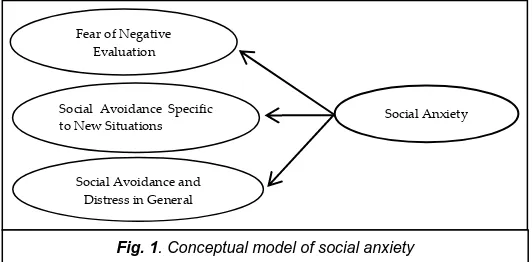
anxiety is a persistent fear of social situations, which is related to feelings of being observed, fear of being humiliated and humiliated for self-performance in the face of evaluations from others. In DSM IV-TR [32] social anxiety is defined as a set of behaviours related to fear of situations and social performance that is felt to be embarrassing, this includes several situations, such as public speaking, withdrawing from conversations with strangers or authority figure, showing assertive behaviour with different individuals, and not eating and drinking in front of a group of people. According to Russell and Shaw [33], social anxiety is a mental disorder characterized by extreme fear when meeting new people and is afraid of supervision in various interactional situations. Vertue [34] defines social anxiety as behaviour related to fear of situations and social performance that is felt to be embarrassing. It includes several situations such as speaking in public and withdrawing from conversations with strangers. Social anxiety is often chronic and persistent and can have consequences in the form of decreased quality of life [35]. In the last decade, empirical studies have shown that social anxiety interferes with the development and quality of friendships [36]. Other studies have found that social anxiety affects emotional expression. Someone with excessive social anxiety tends to express more with negative emotions such as excessive embarrassment [37]. Changes in facial expressions are social cues that are conveyed, as important information about interpersonal evaluation [38]. Negative self-image in a person can also affect social anxiety [39]. Greca and Lopez [28] suggested three aspects of social anxiety namely; 1) Fear of negative evaluation, individuals feel worried to do or say something embarrassing or make themselves feel humiliated, other than that individuals will feel that other people are watching carefully every move they do. 2) Social avoidance specific to new situations, individuals feel nervous when talking and do not understand why it can happen he will also feel embarrassed when close to others, nervous when meeting someone new, and feel worried when doing something new in front of others. 3) Social avoidance and distress in general, which is a feeling of general pressure experienced by people who are known as being reluctant to invite others for fear of rejection, find it difficult to ask others, and feel ashamed when there is group work.
Based on Figure 1 above, the hypothesis in this study is the aspect of fear of negative evaluation, social avoidance specific to new situations and social avoidance and distress, in general, are able to form social anxiety variables. One approach that can be used in testing the construct of a measuring instrument is Confirmatory Factor Analysis (CFA).
Confirmatory Factor Analysis (CFA) is one of the main approaches in factor analysis. Confirmatory Factor Analysis (CFA) can be used to test aspects of a construct. This test is used to perform model measurements so that it can describe aspects and indicators of behavior in reflecting latent variables, namely social anxiety by looking at the loading factors of each aspect that form a construct. Confirmatory Factor Analysis (CFA) is also used to test the construct validity and construct reliability of the indicators (items) forming latent variables [40]. Confirmatory Factor Analysis (CFA) used in this study is the second order confirmatory factor analysis (2nd Order CFA), a measurement model that consists of two levels. The first level of analysis is carried out from aspects to its indicators, and the second analysis is carried out from latent variables to aspects [40]. Based on the description above, the problem formulations in this study are 1) Is the social anxiety scale valid and reliable?; 2) Are the aspects of fear of negative evaluation, social avoidance specific to new situations, and social avoidance and distress in general capable of forming social anxiety variables?. The purpose of this study is to: 1) Test the validity and reliability of scale social anxiety and 2) Test the aspects and indicators that can form social anxiety variables.
2.
RESEARCH
METHOD
2.1 Population, Sample, and Sampling Technique
The population in this study were all semester two students at "X" University in Yogyakarta. The sample in this study were 60 overseas students in semester two at the "X" University in Yogyakarta, with age criteria 17-25 years. The sampling technique used is purposive sampling.
2.2 Data Collection Method
Social anxiety is measured using a social anxiety scale with a semantic differential scale. The scale of this study was compiled by researchers with reference to aspects of social anxiety according to Lagreca and Lopez [28], namely fear of negative evaluation, social avoidance specific to new situations, and social avoidance and distress in general. Examples of items from each aspect can be seen in the following table:
TABLE1SAMPLE ITEM OF FEAR OF NEGATIVE EVALUATION When someone criticizes me, I……
Accept it
1 2 3 4 5 Refuse it
Am happy 1 2 3 4 5 Am sad
TABLE2SAMPLE ITEM OF SOCIAL AVOIDANCE SPECIFIC TO NEW SITUATIONS When in a situation I am....
Easy to adapt 1 2 3 4 5 Difficult to adapt Feeling relax 1 2 3 4 5 Feeling afraid
TABLE3SAMPLE ITEM OF SOCIAL AVOIDANCE AND DISTRESS IN GENERAL In a social community, I....
Feel passionate 1 2 3 4 5 Feel anxious Talk a lot 1 2 3 4 5 Keep silent
The blueprint that is used as a reference in the preparation of the scale can be seen in table 4.
Social Anxiety Fear of Negative
Evaluation
Social Avoidance and Distress in General Social Avoidance Specific to New Situations
TABLE4BLUEPRINT OF THE SOCIAL ANXIETY SCALE
Aspect Indicator Item
Numbers Total
Fear of Negative Evaluation
a.Fear of getting bad comments from other people
b.Feeling you will be laughed at by others
1,2,3,4,5,6 6
Social Avoidance Specific to New Situations
a.Difficult to adapt to a new place. b.Not confident facing other people
7,8,9,10,1
1,12 6
Social Avoidance and Distress in General
a.Feel ashamed if doing a task in group
b.It's hard to socialize with people that known
13,14,15,1 6,17,18 6
Total 18 18
2.3 Validity and Reliability
To test the construct validity and reliability in this study used the outer model testing through the smartPLS 3.2.8 program. Validity testing consists of tests of convergent validity and discriminant validity. The convergence validity can be seen from the loading factor value > 0.5 and the value of Average Variance Extracted (AVE) > 0.5 [41], while the discriminant validity can be seen from the roots comparison of Average Variance Extracted (AVE) in which the aspects must be higher than correlation with other aspects [41]. While reliability testing consists of Cronbach alpha test and composite reliability > 0.7 [41].
2.4 Data Analysis
The data in this study were analyzed using the 2nd Order CFA through the SmartPLS 3.2.8 program. According to Abdillah and Hartono [42], PLS is a variant-based Structural Equation Model (SEM) that can simultaneously test measurement models to test validity and reliability.
3.
RESULT
Based on the analysis of the outer model test on the social anxiety scale conducted using the SmartPLS 3.2.8 program, the result can be seen in Figure 2 below.
Fig. 2. Output outer model of social anxiety scale
3.1The Construct Validity Test Result
3.1.1 Convergent Validity
Based on the convergent validity test on the outer model, it was found that the value of factor loading from variables to aspects has a value of > 0.5, which means the results of the validity test of social anxiety construct can be said to be valid because it meets the criteria of factor loading values > 0.5. The results can be seen in table 5.
TABLE5 LOADING FACTOR VALUES (VARIABLE-ASPECT) Aspect Loading factor Explanation
FNE 0.870 Valid
SAS 0.838 Valid
SAD 0.810 Valid
Based on the test of convergent validity on the outer model, it was found that the loading factor value from aspects to indicators has a value of > 0.5 shown in table 6.
TABLE6LOADING FACTOR VALUE (INDICATOR-ASPECT)
Item Loading factor Explanation
FNE1 0.816 Valid
FNE2 0.806 Valid
FNE3 0.752 Valid
FNE4 0.653 Valid
FNE5 0.824 Valid
FNE6 0.622 Valid
SAS7 0.785 Valid
SAS8 0.877 Valid
SAS9 0.515 Valid
SAS10 0.772 Valid
SAS11 0.822 Valid
SAS12 0.773 Valid
SAD13 0.779 Valid
SAD14 0.742 Valid
SAD15 0.807 Valid
SAD16 0.763 Valid
SAD17 0.821 Valid
SAD18 0.857 Valid
Convergent validity test results show the value of Average Variance Extracted (AVE)> 0.5. The Average Variance Extracted (AVE) value of the social anxiety variable is 0.508 and the Average Variance Extracted (AVE) value of each aspect can be seen in table 7.
TABLE7THE AVE VALUE OF SOCIAL ANXIETY VARIABLE
Aspect AVE Explanation
FNE 0.562 Valid
SAS 0.587 Valid
SAD 0.633 Valid
3.1.2 Discriminant Validity
Based on the discriminant validity test values, the root results of the Average Variance Extracted (AVE) in each aspect are higher than the AVE in other aspects, so that the discriminant validity criteria are met. Root Average Variance Extracted (AVE) values for social anxiety variables can be seen in table 8.
TABLE8AVERAGE VARIANCE EXTRACTED (AVE) ROOT VALUE OF SOCIAL ANXIETY
Aspect FNE SAS SAD
FNE 0.750 0.677 0.646
SAS 0.677 0.766 0. 646
6091
3.2The Construct Reliability Test Result
The results of the construct reliability test suggested that the composite reliability and Cronbach alpha > 0.7 are obtained so that it can be stated that the items used in this study are reliable.
TABLE9 THE VALUE OF COMPOSITE CONSTRUCT RELIABILITY AND CRONBACH ALPHA OF SOCIAL ANXIETY
Variable Composite
Reliability Value Cronbach Alpha Value Explanation Social
Anxiety 0.911 0.889 Reliable
The results of construct reliability testing with the 2nd Order Confirmatory Factor Analysis (CFA) in table 9 show that the social anxiety scale has good reliability and means that aspects that measure social anxiety variables meet unidimensional criteria [43]. This is indicated by the value of the reliability composite of 0.911 and Cronbach alpha of 0.889 The construct validity and reliability tests produce valid and reliable items that are able to reflect social anxiety variables, namely items 1,2,3,4,5,6,7,8,9,10,11,12,13,14 , 15,16,17,18,19,20,21,22,23,24. The results of the analysis of research data using the 2nd Order Confirmatory Factor Analysis (CFA), shows that the measurement model can be accepted because all aspects can reflect the variables formed.
4
DISCUSSION
Based on the results of the analysis of the construct validity and the construct reliability, the aspects and indicators that make up the social anxiety scale are declared valid and reliable. This shows that all aspects and indicators can reflect and shape social anxiety variables. The most dominant aspect that can reflect social anxiety is the fear of negative evaluation with a loading factor of 0.870. Indicators of fear show this if someone gets bad comments from others and feel embarrassed by others. The findings at the study site showed that many students refused to appear in public for fear of making mistakes and being laughed at. Students feel ashamed to present their assignments in front of their friends for fear of making mistakes and being laughed at by others. This fear of getting a negative evaluation affects social anxiety. The lowest aspect that reflects social anxiety is the aspect of social avoidance and distress in general, with a loading factor of 0.810. This is shown by feeling ashamed if there is group work, and it is difficult to get along with people known. The findings at the research site show that many students are easier to communicate with, and discuss with someone they already know than people who are not yet known, even though in their group assignments students are passive. Findings from relevant studies show that social anxiety variables meet reliability requirements with Cronbach alpha value of 0.820 [44]. Furthermore, the results of the study of Greca and Lopez [45] has also shown a Cronbach alpha value of 0.690. Similarly, the study from Fresco, Coles, Heimberg, Liebowitz, Hami, Stein, and Goetz [46] shows Cronbach alpha value of 0.740 and other findings by Heeren, Jones, and McNally [47] with a Cronbach alpha value of 0.810. Whereas in this study, the Cronbach alpha value obtained was 0.880. The results of this study are expected to provide an overview of the validity and reliability of the social anxiety constructs of new semester two students so that it can be used as a reference in subsequent studies related to social anxiety.
5
CONCLUSION
Based on the analysis and discussion, it can be concluded that: 1) Social anxiety scale meets validity and reliability 2) All aspects and indicators can form social anxiety variables, namely fear of negative evaluation, social avoidance specific to new situations, and social avoidance and distress in general. The aspect that has a dominant influence on social anxiety is the fear of negative evaluation and the weakest aspect describing social anxiety variables is social avoidance and distress in general. In this study, a social anxiety scale measurement model was formed that was in accordance with empirical data obtained from subjects at the study site.
ACKNOWLEDGEMENT
The author would like to thank Ahmad Dahlan University and the Master of Psychology Programme University of Ahmad Dahlan for supporting the implementation of this research
REFERENCES
[1] D. Tayouri, ―The Human Factor in the Social Media Security– Combining Education and Technology to Reduce Social Engineering Risks and Damages,‘‘ Procedia Manufacturing, vol. 3, pp. 1096-1100, 2015).
[2] Z. Yang, J. Guo, Z. Xu, Z, Investigation and Analysis of Social Anxiety of College Students, 2019.
[3] M. Wen, and D. Lin, ‗‘Does Psychological Capital Combat Learning and Adaptive Stress of College Freshmen,‘‘ Journal of Studies In Education, vol. 4, no. 1, 25-42, 2014.
[4] G. Russell, and S. Shaw, ―A Study to Investigate the Prevalence of Social Anxiety in A Sample of Higher Education Students in The United Kingdom,‘‘ Journal of Mental Health, vol. 18, no. 3, pp. 198-206, 2009.
[5] J.W. Santrock, Adolescence (in Indonesia). Jakarta: Penerbit Erlangga, 2003.
[6] L.A.M. Greca, and N. Lopez, ‗‘Social Anxiety Among Adolescents: Linkages with Peer Relations and Friendships,‘‘ Journal of Abnormal Child Psychology, vol. 26, no. 2, pp. 83-94, 1998.
[7] L.A.M. Greca, and H.M. Harrison, ―Adolescent Peer Relations, Friendships, and Romantic Relationships: Do They Predict Social Anxiety and Depression?,‘‘ Journal of Clinical Child and Adolescent Psychology, vol. 34, no. 1, pp. 49-61, 2005.
[8] S.G. Hofmann, ‗‘Cognitive Factors that Maintain Social Anxiety Disorder: A Comprehensive Model and its Treatment Implications,‘‘ Cognitive Behaviour Therapy, vol. 36, no. 4, pp. 193-209, 2007.
[9] M.M. Antony, and R.P. Swinson, ―The Shyness & Social Anxiety Workbook: Proven Techniques for Overcoming Your Fears,‘‘ New Harbinger Publications, 2000.
[10]C. Beard, and N. Amir, ―Negative Interpretation Bias Mediates the Effect of Social Anxiety on State Anxiety,‘‘ Cognitive Therapy and Research, vol. 34, no. 3, pp. 292-296, 2010. [11]K. Mogg, and B.P. Bradley, ―Selective Orienting of Attention to
Masked Threat Faces in Social Anxiety,‘‘ Behaviour Research and Therapy, vol. 40, no. 12, pp. 1403-1414, 2002.
[12]M.R. Leary, and J.K.P. Sereno, ―Social Anxiety as an Early Warning System: A Refinement and Extension of The Self-Presentation Theory of Social Anxiety,‖ Social Anxiety, pp. 579–597, 2014, doi:10.1016/B978-0-12-394427-6.00020-0 [13]S. Cuming, and R.M. Rapee, ―Social Anxiety and
Self-Protective Communication Style in Close Relationships,‖ Behaviour Research and Therapy, vol. 48, 87–96, 2010. [14]A. Weinstein, D. Dorani, R. Elhadif, Y. Bukovza, A. Yarmulnik,
Anxiety in Young Adults,‖ Annals of Clinical Psychiatry, vol. 27, no. 1, pp. 4-9, 2015.
[15]J.D. Buckner, and N.B. Schmidt, ―Marijuana Effect Expectancies: Relations to Social Anxiety and Marijuana Use Problems,‖ Addictive Behaviors, vol. 33, no. 11, pp. 1477-1483, 2008.
[16]A.H. Nordstrom, L.M.S. Goguen, and M. Hiester, ―The Effect of Social Anxiety and Self‐Esteem on College Adjustment, Academics, and Retention,‖ Journal of College Counseling, vol. 17, no. 1, pp. 48-63, 2014.
[17]V.M. Ameringen, C. Mancini, and P. Farvolden, ―The Impact of Anxiety Disorders on Educational Achievement,‖ Journal of Anxiety Disorders, vol. 17, pp. 561–571, 2003.
[18]J.M. Murphy, and A.H. Leighton, ―Anxiety: Its Role in The History of Psychiatric Epidemiology,‖ Psychological Medicine, vol. 39, no. 7, pp. 1055-1064, 2009.
[19]K.A. Martin, and L.D. Fox, ―Group and Leadership Effects on Social Anxiety Experienced During an Exercise Class 1,‖ Journal of Applied Social Psychology, vol. 31, no. 5, pp. 1000-1016, 2001.
[20]P. Gilbert, ―The Relationship of Shame, Social Anxiety and Depression: The Role of The Evaluation of Social Rank,‖ Clinical Psychology & Psychotherapy, vol. 7, no. 3, pp. 174– 189, 2000, doi:10.1002/1099-0879.
[21]M. Matos, J. Pinto‐Gouveia, and P. Gilbert, ―The Effect of Shame and Shame Memories on Paranoid Ideation and Social Anxiety. Clinical Psychology & Psychotherapy, vol. 20, no. 4, pp. 334-349, 2013.
[22]R. Ando, and A. Sakamoto, ―The Effect of Cyber-Friends on Loneliness and Social Anxiety: Differences Between High and Low Self-Evaluated Physical Attractiveness Groups,‖ Computers in Human Behavior, vol. 24, no. 3, pp. 993-1009, 2008.
[23]L. George, and L. Stopa, ―Private and Public Self-Awareness in Social Anxiety,‖ Journal of Behavior Therapy and Experimental Psychiatry, vol. 39, no. 1, pp. 57-72, 2008. [24]J.E. Nilsson, L.G. Lundh, and G. Viborg, ―Imagery Rescripting
of Early Memories in Social Anxiety Disorder: An Experimental Study,‖ Behaviour Research and Therapy, vol. 50, no. 6, pp. 387-392, 2012.
[25]K. Button, G. Lewis, I. Penton-Voak, and M. Munafò, ―Social Anxiety is Associated with General but not Specific Biases in Emotion Recognition,‖ Psychiatry Research, vol. 210, no. 1, pp. 199-207, 2013.
[26]F.M. Vertue, ―From Adaptive Emotion to Dysfunction: An Attachment Perspective on Social Anxiety Disorder,‖ Personality and Social Psychology Review, vol. 7, no. 2, pp. 170-191, 2003.
[27]M.R. Leary, and S.E. Dobbins, ―Social Anxiety, Sexual Behavior, and Contraceptive Use,‖ Journal of Personality and Social Psychology, vol. 45, no. 6, pp. 1347, 1983.
[28]A.M. Greca, and N. Lopez, ―Social Anxiety Among Adolescents: Linkages with Peer Relations and Friendships,‖ Journal of Abnormal Child Psychology, vol. 26, no. 2, pp. 83-94, 1998.
[29]A. Hackmann, D.M. Clark, and F. Mcmanus, ―Recurrent Images and Early Memories in Social Phobia,‖ Behaviour Research and Therapy, vol. 38, no. 6, pp. 601-610, 2000. [30]Y. Xu, F. Schneier, R.G. Heimberg, K. Princisvalle, M.R.
Liebowitz, S. Wang, and C. Blanco, ―Gender Differences in Social Anxiety Disorder: Results from The National Epidemiologic Sample on Alcohol and Related Conditions,‖ Journal of Anxiety Disorders, vol. 26, no. 1, pp. 12-19, 2012. [31]M.R. Leary, and R.M. Kowalski, Social Anxiety. Guilford
Press, 1997.
[32]APA, Diagnostic and Statistical Manual of Mental Disorder, 4th Edn., Text Revision. Washingthon : American Psychiatric
Association, 2000.
[33]G. Russell, and S. Shaw, ―A Study to Investigate The Prevalence of Social Anxiety in A Sample of Higher Education Students in The United Kingdom‖ Journal of Mental Health, vol. 18, no. 3, pp. 198-206, 2009.
[34]F.M. Vertue, ―From Adaptive Emotion to Dysfunction: An Attachment Perspective on Social Anxiety Disorder,‖ Personality and Social Psychology Review, vol. 7, no. 2, pp. 170-191, 2003.
[35]C.J. Parr, and S. Cartwright‐Hatton, ―Social Anxiety in Adolescents: The Effect of Video Feedback on Anxiety and The Self‐Evaluation of Performance,‖ Clinical Psychology & Psychotherapy: An International Journal of Theory & Practice, vol. 16, no. 1, pp. 46-54, 2009.
[36]A.R. Glickman, and A.M. La Greca, ―The Dating Anxiety Scale for Adolescents: Scale Development and Associations with Adolescent Functioning,‖ Journal of Clinical Child and Adolescent Psychology, vol. 33, no. 3, pp. 566-578, 2004. [37]K. Button, G. Lewis, I. Penton-Voak, and M. Munafò, ―Social
Anxiety Is Associated with General but Not Specific Biases in Emotion Recognition,‖ Psychiatry Research, vol. 210, no. 1, pp. 199-207, 2013.
[38]V. Peschard, P. Philippot, F. Joassin, and M. Rossignol, ―The Impact of the Stimulus Features and Task Instructions on Facial Processing in Social Anxiety: An Erp Investigation,‖ Biological Psychology, vol. 93, no. 1, pp. 88-96, 2013. [39]J.E. Nilsson, L.G. Lundh, and G. Viborg, ―Effects of Analytical
and Experiential Self-Focus on Rumination After A Stress Induction in Patients with Social Anxiety Disorder: A Pilot Study,‖ Cognitive Behaviour Therapy, vol. 41, no. 4, pp. 310-320, 2012.
[40]H. Latan, Structural Equation Modeling Concepts and Applications using LISREL 8,80 (in Indonesia). Bandung: Alfabeta, 2012. [41] H.M. Jogiyanto, The Concept and Application of Variance-Based
Structural Equation Modeling in Business Research (in Indonesia). Yogyakarta: UPP STIM YKPN, 2011.
[42]W. Abdillah, and J. Hartono, Partial Least Square (PLS): Alternative of Structural Equation Modeling (SEM) in Business Research (in Indonesia). Yogyakarta: Penerbit Andi, 2015.
[43]Jr.J.F. Hair, G.T.M. Hult, C. Ringle, and M. Sarstedt, A Primer on Partial Least Squares Structural Equation Modeling (PLS-SEM). New York: Sage Publications, 2016.
[44]J.S. March, J.D. Parker, K. Sullivan, P. Stallings, and C.K. Conners, ―The Multidimensional Anxiety Scale for Children (Masc): Factor Structure, Reliability, and Validity,‖ Journal of The American Academy of Child & Adolescent Psychiatry, vol. 36, no. 4, pp. 554-565, 1997.
[45]A.M. La Greca, and N. Lopez, ―Social Anxiety Among Adolescents: Linkages with Peer Relations and Friendships,‖ Journal of Abnormal Child Psychology, vol. 26, no. 2, pp. 83-94, 1998.
[46]D.M. Fresco, M.E. Coles, R.G. Heimberg, M.R. Liebowitz, S. Hami, M.B. Stein, and D. Goetz, ―The Liebowitz Social Anxiety Scale: A Comparison of The Psychometric Properties of Self-Report and Clinician-Administered Formats,‖ Psychological Medicine, vol. 31, no. 6, pp. 1025-1035, 2001. [47]A. Heeren, P.J. Jones, and R.J. Mcnally, ―Mapping Network