Abstract—The Internet of Things (IoT) and the world of Smart Systems are ushering in an era where people, machines, devices (e.g. sensors) and processes are all interconnected and able to interact seamlessly with one another. Business and IT leaders predict they will see an increase of more than one-third (33%) in revenues from the use of smart technologies over the next five years. Smart system is the future of technology with so many different applications to it. We present in this project a system developed for a more convenient outdoor navigation. It involves the development of a power harnessing smart shoe to aid navigation and reduce the dependency of individuals on maps i.e. the need to constantly look at the maps for direction rather than focusing on the road. The project uses the Arduino UNO microcontroller as the brain box of the designed system. The microcontroller was programed to achieve the various tasks needed in this project. The smart shoe is fitted with piezo-electric crystals which are pressure sensors generating the power required for the system, a Bluetooth module to interface with the mobile application which was programmed specifically for the shoe, and also vibrator motors which act as the output signal that is felt by the user to help inform them which way to turn. This project proffers solutions to the setbacks in navigation of the user with accuracy and focus.
Index Terms—Arduino UNO, IoT, Navigation, Sensors, Cyber-physical Systems (CPS)
I. INTRODUCTION
HE word “smart” is not a new word in the 21st century – it is a word used to describe a system created to reduce the effort of human labour to the bare minimum. For example, a smart phone which has made human interaction over several kilometers seem so simple, with various interacting applications in it. These kind of systems are referred to as Cyber-physical systems [1]. Footwear is an irreplaceable part of human life across the globe. While the initial necessity was purely to protect the feet, they have also become a symbol of style and personality. Footwear acts as
Manuscript received July 16, 2017.
This work was supported in part by Covenant University Center for Research, Innovation and Discovery (CUCRID), Covenant University, Ogun State, Nigeria.
Oluwadamilola Oshin is with the Dept. of Electrical and Information Engineering, Covenant University, Ogun State, Nigeria (phone: +2347087907028; e-mail: [email protected],ng).
Simisola Sobowale is with the Deptartment of Electrical and Information Engineering, Covenant University, Ogun State, Nigeria (e-mail: [email protected]).
Oluyinka Oni is with the Department of Electrical and Information Engineering, Covenant University, Ogun State, Nigeria (e-mail: [email protected]).
the interface between the ground and the wearer’s foot [2]. Smart shoe is a technology in which the shoe or its insoles are connected to a smartphone application that uses Google maps, and then vibrate to tell users when and where to turn to reach their destination [3].
Navigation Systems (GPS) was originally developed as a military navigation tool. However the technology has grown along with a sub set of supporting technologies to serve other requirements. The principle behind GPS is very simple- it works by providing a set of geographical coordinates such as a place’s latitude, longitude and elevation on Earth. The GPS device also gives out very accurate time. The basic functionality of GPS technology is limited to receiving satellite signals and calculating position information. Once a user is located through GPS, the location can be identified on a map. This is useful for tasks like locating a unit, finding a route from point A to B or selecting a suitable route in real time. We have gotten to the age where navigation has been made very easy with the use of our smart phones coupled up with some applications which can lead you exactly where you want to go in real-time [4]. Pedestrian Navigation consists in the navigation of pedestrians usually in urban environments. Pedestrian Navigation often offers pedestrian specific maps and multimodal navigation [5]. This project would incorporate that feature into it but adding a twist into the idea and implementing it into a shoe, this shoe would work with vibration motors embedded there in to give the user directions based on the location the user puts into the app on the phone.
Piezoelectric Effect is the ability of certain materials to generate an electric charge in response to applied mechanical stress. The word Piezoelectric is derived from the Greek “piezein”, which means to squeeze or press, and piezo, which is Greek for “push” [6]. Conversely, a mechanical deformation (the substance shrinks or expands) is produced when an electric field is applied. This effect is formed in crystals that have no center of symmetry [7]. When piezoelectric material is placed under mechanical stress, a shifting of the positive and negative charge centers in the material takes place, which then results in an external electrical field [6].
In this project we present a method for harnessing power from the movement of the feet using piezoelectric crystals to charge up the shoe. When a person walks, he loses energy to the road surface in the form of impact, vibration, and sound, Aderemi Atayero is with the Department of Electrical and Information Engineering, Covenant University, Ogun State, Nigeria (e-mail: [email protected]).
Development of a Power-harnessing Smart Shoe
System with Outdoor Navigation
Oluwadamilola Oshin, Simisola Sobowale, Oluyinka Oni and Aderemi Atayero
Members, IAENG
due to the transfer of his weight to the road surface through how the foot falls on the ground during each step. This energy can be tapped and converted in the usable form such as in electrical form. The principle behind this is piezoelectricity.
In short, the aim of this project is to design and construct a smart shoe which generates its own power through walking and also has real-time outdoor navigation.
II. LITERATURE REVIEW
A. History of Smart Systems
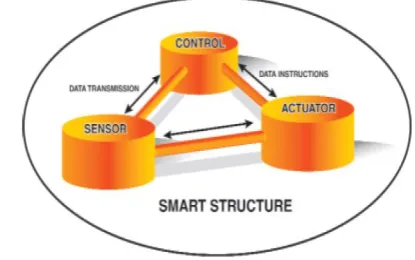
Smart systems trace their origin to a field of research that envisioned devices and materials that could mimic human muscular and nervous systems. The essential idea is to produce non-biological systems that will achieve the optimum functionality observed in biological systems through emulation of their adaptive capabilities and integrated design. A smart structure is a system that incorporates particular functions of sensing and actuation to perform smart actions in an ingenious way. There are certain basic components of a smart structure: Data Acquisition, Data Transmission, Control Unit, Instructions. Each have smart systems representing them and can be summarized into Sensors, Actuators and Control Systems as seen in figure 1 [8].
There are various generations in which the smart system has evolved over time;
First Generation Smart Systems integrate sensing and or actuation as well as signal processing to enable various types of actions. Such systems have already been successfully deployed in many application domains, e.g., personal devices to monitor the health status of persons or safety systems in automotive applications [9].
Second Generation Smart Systems add perception features and are predictive and adaptive systems, possibly with self-test capabilities. Moreover, they include network connectivity of some type and advanced energy scavenging and management capabilities [9].
Third Generation Smart Systems add human-like perception on top of second generation systems. They interact independently and without external control or decision, and implement systematically features like self-calibration, self-test, and self-healing [9].
B. Related Works
In [10] all communications are connected through Bluetooth and are monitored through a smart phone, and it constantly communicates two-ways through the app, just by taping a point on the screen the shoe can provide heating and the temperature can be regulated for each sole, you can also track your steps, the distance covered and the calories burnt. It can also monitor and analyze your strides in 3D and it has auto-lacing technology where with just a tap of the phone the laces can tie-up themselves.
In [11] the idea is to give Google map directions by the vibrating of the left or right shoe to indicate the directions and it was majorly implemented for visually impaired
individuals. It has expanded to track distance travelled and number of calories burnt which is useful for joggers and bikers who are prone to getting lost or can have need for alternative route at any point in their journey. Here they implemented the technology to serve both a shoe and also the insole of a shoe so it can be swiped out for various shoes. The shoe has a customized battery source which has a good battery life and can be removed at the end of the day and recharged.
In [12] the shoe is a discreet wearable monitoring and recovery solution for wandering. It uses the same cellular and GPS technology as a smartphone, the technology is implemented in the insoles only which can be swiped out from shoe to shoe and also the insole can be recharged and it has a good battery life. It was invented majorly for senior citizens that suffer from Alzheimer’s or dementia.
In [13] the shoes were made specifically for tourists in Barcelona and it works hand-in-hand with the airline ‘EasyJet” to provide their customers with the shoe to aid in their navigation around town. The shoe has an app that can be downloaded to their smart phones and it gets directions from Google maps which is sent as vibrations to the shoe to indicate turns.
[image:2.595.320.528.415.545.2]In [14] the idea here is to create work boots that use your footsteps to power embedded lights, GPS, sensors etc. that are embedded within the shoe. They are also working with the US army to produce self-sustaining power sources for the soldiers.
[image:2.595.314.539.575.761.2]Fig. 1. Diagram of a Smart System Structure
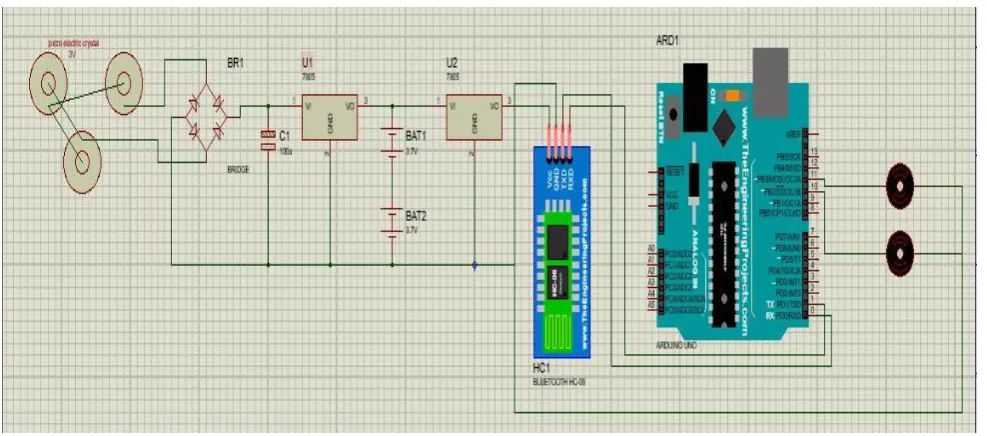
Fig. 3. Circuit diagram
III. SYSTEM DESIGN AND IMPLEMENTATION
This work seeks to overcome the way navigation information is relayed through the use of smart phones by implementing it into a wearable device which in this case is a shoe. A prototype is developed using the block diagram in figure 2; it can pair up the Bluetooth module embedded in the shoe with the mobile application on the smartphone to relay navigation instructions through the vibration motors in the shoe. That is, the shoes will give indications by vibrating to inform the wearer when to turn, where to take the turn and the nature of the turn and all the information is being relayed by the vibration motors located at the left and right segments of the shoe indicating the various directions one can move in. There would be a microcontroller connected to the Bluetooth module that would send signals to the vibration motors based on the instructions received.
The idea of making the shoe generate its own electricity to charge the components embedded in the shoe is a great one, in the sense that the act of expelling energy by walking around shouldn’t just be wasted but it can be converted to electricity. Ever since man came to earth we have needed and made use of energy at an increasing rate for our sustenance and wellbeing and to this fact we have exhausted and wasted various forms of it so for our continual survival a non-conventional energy source needs to be implemented which is what we aim to achieve.
Figure 3 shows the circuit diagram of this work. A. Power Supply
The components of the power unit includes: Piezoelectric Crystals, Diodes, Voltage Regulator, Capacitors and Rechargeable Lithium Battery.
For power generation a piezoelectric transducer is used. Piezoelectric transducers are a type of electroacoustic transducer that convert the electrical charges produced by some forms of solid materials into energy. The electric signals from a piezoelectric transducer is in alternating current (AC) and it needs to be rectified into a direct current (DC) which is to be fed into the circuit.
For the power supply stage there are various stages which the power supply from the piezoelectric crystals must pass through before it can be fed into the main circuit. These stages include: Rectification, Filtration and Regulation
B. Microcontroller (Arduino)
The Arduino-Uno board was used in this project as the data processing unit. The Arduino-Uno is a microcontroller board based on the ATmega328P. It has 14 digital input/output pins (of which 6 can be used as PWM outputs), 6 analog inputs, a 16 MHz quartz crystal, a USB connection, a power jack, an ICSP header and a reset button. It contains everything needed to support the microcontroller. The Uno can be programmed in with the Arduino Software (IDE). The ATmega328 on the Uno comes preprogrammed with a boot loader that allows you to upload new code to it without the use of an external hardware programmer.
C. Bluetooth Module
Bluetooth is a standardized protocol for sending and receiving data via a 2.4GHz wireless link. It is a secure protocol and it is perfect for short-range, low power, low-cost, wireless transmissions between electronic devices. The Bluetooth protocol operates at 2.4GHz in the same unlicensed ISM frequency band where RF protocols like ZigBee and Wi-Fi also exist. It has a standardized set of rules that differentiates it from other protocols.
D. Vibration Motors
Vibration motor is a compact size coreless DC motor used to informs the users of receiving the signal by vibrating, no sound. Vibration motors are widely used in a variety of applications including cell phones, handsets, pagers, and so on. A coin vibrator motor is being used for the project, it is also known as pancake vibrator motor. They are compact and convenient to use due to their small size they integrate easily into many designs because they have no external moving parts. Enclosures for the coin vibrator can be easily molded and the coin placed there.
E. MOBILE APP
app was costumed to the specifications of the smart shoe. The app is made to work alongside the shoe giving and receiving constant commands to and fro.
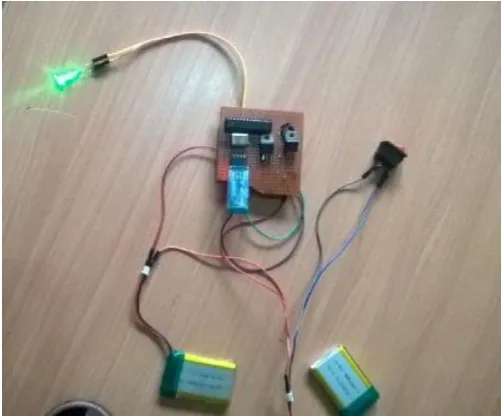
The Flow between them are as follows, represented by the flowchart in figure 4 and the implementation of this project is illustrated in figures 5, 6, 7 and 8:
i.Open app.
ii.Check for Bluetooth module. iii.If yes, switch Bluetooth on.
iv.Else, redirect the person to settings page to put on Bluetooth.
v.Return to re-open the app.
vi.Show a list of Bluetooth devices, devices shown are devices in the paired devices section.
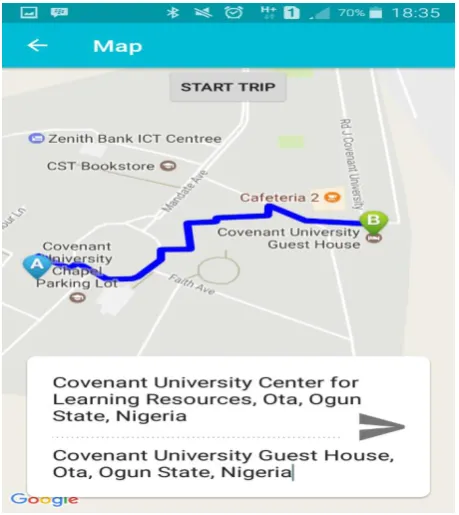
vii.Out of the shown devices, select one to be paired (i.e. shoe’s Bluetooth) and then taken to the next page. viii.Put in the starting point and destination point.
ix.Search for route between two locations. x.Start the trip.
xi.Connect to Bluetooth devices specified.
xii.When the device is connected, the turn-by-turn location navigator continuously keeps checking for next direction to go.
[image:4.595.305.550.83.260.2]xiii.If left, send left to device; If right, send right to device.
Fig. 4. Systems Flowchart
G. Implementation of the Project
[image:4.595.304.556.312.520.2]Fig. 5. Breadboard Implementation
[image:4.595.50.292.363.764.2]Fig. 6. Patched Circuit Diagram
[image:4.595.304.551.554.706.2]Fig. 8. Mobile Application Interface with a Specified Route
IV. CONCLUSION
This smart shoe technology is fully representative of where the world is headed – Internet of Everything (IoE), where every atom is connected with its unique IP address and interaction are occurring over the network.
Even with a working model, we see the chance to improve upon the design as this product has room to grow in many areas to suit personal or industry needs. During the testing and evaluation of the system it became apparent that certain features or changes to the project would have been neither useful nor desirable. Although all of these features or changes don’t affect the success of the present developed system, they show directions in which the project could have gone.
REFERENCES
[1] Radhakisan Baheti and Helen Gill, “Cyber-physical Systems,” The Impact of Control Technology, T. Samad and A.M. Annaswamy (eds.), 2011. Available at www.ieeecss.org.
[2] M. B. a. E. S. Nagaraj Hegde, "A Comparative Review of Footwear-Based wearable system," 2016.
[3] J. McGregor, "Indian's take on google glass; a vibrating smart shoe," 25 January 2014. [Online]. Available: http://www.forbes.com/sites/jaymcgregor/2014/07/25/indias-take-on-google-glass-a-vibrating-smartshoe/. [Accessed 25 January 2017]. [4] Roseindia, "Roseindia.net," [Online]. Available:
http://r.search.yahoo.com/_ylt=A0LEVxJE9IhYtHcA.UVXNyoA;_yl u=X3oDMTEyNGxzdnZ1BGNvbG8DYmYxBHBvcwMyBHZ0aWQ
DQjMyMTlfMQRzZWMDc3I-/RV=2/RE=1485399237/RO=10/RU=http%3a%2f%2froseindia.net
%2ftechnology%2fgps%2fbenefits-of-gps.shtml/RK=0/RS=HvvpYr1X5KhEi4V9_5HpOL6. [Accessed 25 January 2017].
[5] S. writers, "Gps Daily," 14 October 2008. [Online]. Available: http://www.gpsdaily.com/reports/Mobile_Navigation_Services_Takin g_Off_In_North_America_And_Europe_999.html. [Accessed 26 January 2017].
[6] J. Electric, "Nanomotion," [Online]. Available:
http://www.nanomotion.com/piezo-ceramic-motor-technology/piezoelectric-effect/. [Accessed 26 January 2017].
[7] P. A. Manual, "Aurelienr," [Online]. Available:
http://www.nanomotion.com/piezo-ceramic-motor-technology/piezoelectric-effect/. [Accessed 26 January 2017]. [8] G. Akhars, "Smart Materials And Smart Systems For The Future,"
Canadian Military Journal, pp. 25-32, 2000.
[9] M. G. M. P. M. Alessandro Sassone, "Smart Electronic Systems: An Overview," in Smart Systems Integration and Simulation,, Torino, Italy, Springer International Publishing Switzerland, 2016, pp. 5-21. [10] Digitsole, "Digitsole," 2016. [Online]. Available:
http://www.digitsole.com/. [Accessed 25 February 2017].
[11] McGregor, "India's take on Google Glass, A vibrating smart shoe," Forbes, 2014 July 25. [Online]. Available: https://www.forbes.com/forbes/welcome/?toURL=https://www.forbes .com/sites/jaymcgregor/2014/07/25/indias-take-on-google-glass-a-
vibrating-smartshoe/&refURL=https://en.wikipedia.org&referrer=https://en.wik ipedia.org. [Accessed 25 February 2017].
[12] G. SmartSole, "Fox News Channel," [Online]. Available: http://gpssmartsole.com/gpssmartsole/. [Accessed 25 February 2017]. [13] M. Pesce, "wired," 16 May 2016. [Online]. Available:
https://www.wired.com/2016/05/easy-jet-sneakairs-smart-shoes/. [Accessed 25 February 2017].