211
Personal Effectiveness : A Case Study
Dr Kedar Narayan Choudhary
Abstract: Many of us do not know whether we are effective or ineffective, even if we know that we are unable to perform still we do not know where to improve and how to improve. This paper will help individual to evaluate themselves and find a self-solution to become effective.
Index Terms: Confidence and effectiveness, Categorization of personal effectiveness, persistence, Parameters used in personal effectiveness, Personal effectiveness, Personal effectiveness scale, Self-motivation,.
————————————————————
1
I
NTRODUCTIONIt evolved from the self-help movement which was focused on how to get success, how to set goals, and related to similar concepts . Personal effectiveness was developed by using positive thinking and positive psychology. Personal Effectiveness is now more scientific and it is based on systematic approach including a number of factors which has got direct impact on the personal effectiveness. The approach to evaluate personal effectiveness may be different for different group of people it may be business process management techniques or holistic spiritual and physical wellness approach. People who are personally effective make better use of their skills. They use them to achieve their goals and adapt a way that is efficient and cost effective. To become personal effective one should know their category to which individuals belong to.
Personal Effectiveness and Confidence :
It is assumed that a confident person is more effective, lack of confidence leads to dissatisfactory outcome. Our confidence grows when we use our strengths and we have a winning attitude. Mostly we blame the circumstances under which we work. We try to find some cause outside for our own failure. Generally we do not search within ourselves but sometimes we are blaming ourselves without analysing which leads perceived as negative attitude person. To build and maintain strong self-confidence, it's important to say positive things to yourself. Many times we also criticize ourselves, we must stop and say some positive things, like recalling our good qualities, things we have achieved or things we have done for others. We should not compare ourselves to others, who have achieved high goals, otherwise we are criticizing ourselves. It's good to have role models but there's no use beating yourself if you can't be like your favourite icons. Role models can help us in goal setting but at the same time we should not forget to compare yourself with people who aren't doing as well as you. Even if you haven't achieved much in your life, try to do nice things for others. It will give you a feeling of satisfaction and proudness. Blaming contentiously to ourselves will lead to frustration and dissatisfaction, hence it is better to start with positive thinking and then set a a achievable but stretched goal for ourselves. Many times we feel so bad about ourselves that we lash out at everyone around us, which just ensures that we will remain in the same environment which has worst impact on us. The easiest way to raise ourselves up is to start doing nice things for other people. We will start feeling better about ourselves and then we can start taking on bigger challenges. We fail many times, it is not new anyone rather everyone does, but we should keep a diary to keep track of everything we achieve, even little things and we must review it regularly to celebrate our success. Self-confidence and personal effectiveness is a gradual process and it can be built on past
successes, which will lead to better success rate. Most of the people in this world do not have long term goal but we can start working on it from now only. We have to push ourselves beyond the comfort zone. Every success or failure gives us something to learn and this only helps us to building blocks for future goals. Generally Personal effective people possess following traits : It is not hard and fast that they must have these traits, however it is found that they have these quality.
Determination : This is one of the property, which helps them to remain focused on the presided goals. It reduces distraction, which lead to success. They are generally disciplined people.
Self-confidence: This was already discussed in the beginning
and it is not required to discussed again.
Optimism : Effective people believes that there is always a way to solve any problem, hence hope is always alive, which energies them to accept challenges and supply the energy to lead the group.
Managing stress : Stress is detrimental factor for
effectiveness. Successful people are able to manage their
stress by their own techniques.Once you are under stress you
are suboptimal and your performance will be low only.
Persistence :
Many time we are unable to strike back because of lack of persistence. A failure story is only lack of persistence, failure is part of reality but only those can write a story, who will try again and again. Failure gives us lesson, and we have to learn from every failure.
Problem - solving :
This the way one can become effective, it is spirit to work to find a solution, there is no way to leave them. Always we have
to find a way to move ahead.
Time Management :
It is greatest art to be more effective, spending time or allocating time is crucial, generally after failure we are frustrated or not interested to work further but we must be able to allocate some time to relook the cause of failure and
analyze to find a better solution.
Planning :
It is backbone of any story, a well panned system can be executed easily but it is said unplanned work leads to a
planned failure.
212
Creativity :
Individuals has to be creative, it is something to think beyond, generally we think stereo type where we have limited understanding and we continue within our own boundary, which leads to limited solution and it reduces feasibility.
Self-motivation :
Motivation plays a role in your success, a self-motivated person need not be informed about what is required to be done rather they find the problem and try to get a better solution. They are able to challenge the existing process to improve it.
Case study :
We conducted a workshop on the personal effectiveness in one of the Engineering College in Pune, where several staff members from nearby Engineering Colleges participated in the workshop. In the workshop the whole concept of personal effectiveness was discussed in around four hours and then we requested the participant to participate in evaluation of personal effectiveness. The scale use for personal effectiveness is as mentioned below. Personal Effectiveness Scale used for case study:
Table-1 (Guidelines to assign score against each parameter)
Statement Score
If it is most characteristic of you, or if you always or most often behave of feel this way
4
If it is fairly true of you, or you quite often behave or feel this way
3
If it is somewhat true in your life 2 If it is not true of you, or if you only occasionally feel or behave this way
1
If it is not at all characteristic of you, or you seldom feel or behave this way
0
Table-2 (Parameter in Score card for individuals)
Sl No
Statement Direct score
Reverse score*
1 I find it difficult to be frank with people unless I know them very well 2 I listen carefully to others’ opinions
about my behavior
3 I tend to say things that turn out to be out of place
4 Generally, I hesitate to express my feelings to others
5 When someone directly tell me how he feels about my behavior, I tend to close up and stop listening
6 On hindsight, I regret why I said something tactlessly
7 I express my opinions in a group or to a person without hesitation 8 I take steps to find how my behavior
has been perceived by the person with whom I have been interacting 9 I deliberately observe how a person
will take what I am going to tell him, and accordingly communicate him 10 When someone discusses his
problems, I do not spontaneously
share my experience and personal problems, of a similar nature with him
11 If someone criticizes me, I hear him at that time but do not bother myself about it later.
12 I fail to pickup cues about others’ feelings and reactions when I am involved in an argument or a conversation
13 I enjoy talking with others about my personal concerns and maters 14 I value what people have to say
about my style, behavior, etc. 15 I am often surprised to discover (or
213
Table-3 (Final Score sheet used for case study for determination of High or Low score) Enter your score normally unless it is * marked. * marked should be filled with reverse score.
Item Response Item Response Item Response
1* 2 3*
4* 5* 6*
7 8 9
10* 11* 12*
13 14 15*
Total Total Total
If total is >11 put H or put
L
Self-discloser
If total is >11 put H or put L
Openness to feedback
If total is >11 put
H or put L
Perceptiveness
Table-4 (Categorization to be found from this table)
Sl No Category Self-discloser Openness to feedback Perceptiveness
1 Effective High High High
2 Insensitive High High Low
3 Egocentric High Low Low
4 Dogmatic High Low High
5 Secretive Low High High
6 Task-obsessed Low High Low
7 Lonely empathic Low Low High
8 Ineffective Low Low Low
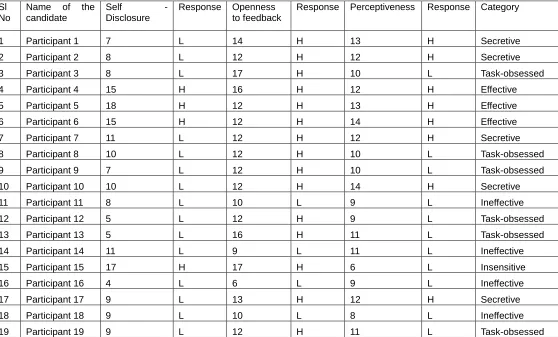
There were 55 participants in the workshop but only 33 of them opted to share their score. The participants are numbered as participant 1 to participant 33 to hide their individual names. The score card is as follows:
Table – 5 (Score) Sl
No
Name of the candidate
Self
-Disclosure
Response Openness to feedback
Response Perceptiveness Response Category
1 Participant 1 7 L 14 H 13 H Secretive
2 Participant 2 8 L 12 H 12 H Secretive
3 Participant 3 8 L 17 H 10 L Task-obsessed
4 Participant 4 15 H 16 H 12 H Effective
5 Participant 5 18 H 12 H 13 H Effective
6 Participant 6 15 H 12 H 14 H Effective
7 Participant 7 11 L 12 H 12 H Secretive
8 Participant 8 10 L 12 H 10 L Task-obsessed
9 Participant 9 7 L 12 H 10 L Task-obsessed
10 Participant 10 10 L 12 H 14 H Secretive
11 Participant 11 8 L 10 L 9 L Ineffective
12 Participant 12 5 L 12 H 9 L Task-obsessed
13 Participant 13 5 L 16 H 11 L Task-obsessed
14 Participant 14 11 L 9 L 11 L Ineffective
15 Participant 15 17 H 17 H 6 L Insensitive
16 Participant 16 4 L 6 L 9 L Ineffective
17 Participant 17 9 L 13 H 12 H Secretive
18 Participant 18 9 L 10 L 8 L Ineffective
214
20 Participant 20 12 H 17 H 9 L Insensitive
21 Participant 21 7 L 12 H 8 L Task-obsessed
22 Participant 22 2 L 8 L 9 L Ineffective
23 Participant 23 6 L 15 H 8 L Task-obsessed
24 Participant 24 16 H 15 H 11 L Insensitive
25 Participant 25 6 L 19 H 12 H Secretive
26 Participant 26 14 H 16 H 10 L Insensitive
27 Participant 27 12 H 14 H 12 H Effective
28 Participant 28 11 L 19 H 15 H Secretive
29 Participant 29 15 H 16 H 12 H Effective
30 Participant 30 12 H 7 L 10 L Egocentric
31 Participant 31 11 L 11 L 11 L Ineffective
32 Participant 32 10 L 14 H 11 L Task-obsessed
33 Participant 33 12 H 14 H 8 L Insensitive
Table-6 (The summary)
Sl No Category No of
participants
1 Effective 5
2 Ineffective 6
3 Insensitive 5
4 Egocentric 1
5 Secretive 7
6 Task-obsessed 9
Conlusion :
1. After analysis of the data the highest no of staff are task-obsessed and same thing reflects when we talk to any employee. The employees will always complain about the workload is too high and they are not able to perform as per the expectation of their bosses. They do not know their own problems, in which area one has to improve. These people are open for feedback but they are not open to self-discloser and perceptiveness. From this table one can find where improvement is required and then one can target to improve. The simple guideline is, in case we get score 2 or less in any head under score card he / she should try to improve.
2. Second highest is secretive, which means in self discloser sore is quite low. This leads to keep the real feedback away from the person. We have Johari windows which suggest there are different known and unknown factors of individuals and unless and until we know the factors we are unable to understand what to do and how to improve ourselves.
3. Effective and ineffective are close to each other, which seem to be reality. Any organization is run by effective people only, they are the backbone of any organization and due to their efforts organisations are able to compete in the market and leads the market but at the same time we can find many people are counterproductive and they
are not appreciated by organization. This opposite nature people makes organization to function as an average effective because they are counterproductive to each other. Individual must know their own difficulty to improve.
4. Insensitive people are scoring less in perceptiveness, which is obvious they do not bother about what other think about them, but they do not know how it is harmful to them.
5. In our sample only one is egocentric, who only speak but not willing to receive feedback, hence the person creates his / her own image outside the circle.
About Author : Dr Kedar Narayan Choudhary is a Professor, in the Department of Mechanical Engineering at Sanghavi College of Engineering, Nashik. His areas of interest are Production Engineering, Industrial Engineering, HRD, Management .
Reference :
[1] Anne Jacot, Isabel Raemdonck, Mariane Frenay, A review of motivational constructs in learning and training transfer, Zeitschrift für Erziehungswissenschaft, 2015, 18, S1, 201.
[2] Korabik, Karen & Ayman, Roya (1990) Androgyny and Leadership Style: Toward a Conceptual Synthesis. Journal of Business Ethics; 9:4, 283-292.
[3] Norlander, T., Erixon, A., Archer, T. (2000) Psychological androgyny and creativity: Dynamics of gender-role and personality trait. Social Behavior and Personality; 12, 34-39.
215 [5] Thomas N. Garavan, Khalil M. Dirani, Professional training
as a strategy for staff development, European Journal of Training and Development, 2012, 36, 2/3, 158.