IJEDR1802065
International Journal of Engineering Development and Research (
www.ijedr.org
)
375
A Case Study On Employee Perception Towards
E-Banking
1Nayana. N., 2Dr. Veena K.P 1Assistant Professor, 2Associate Professor,
1Acharya Bangalore B-School, Andrahalli Main Road, Off Magadi Road, Bengaluru - 560 091 2Department of MBA, Visvesvaraya Technological University, Regional Centre, Mysore - 570 019.
____________________________________________________________________________________________
Abstract - Every day more and more people are turning to the Technology for their personal banking. E-banking making it safe, secure, convenient and fulfill the requirement to shop for financial services. Every one of us has always enjoyed a special relationship with their neighborhood bank. The study focused on the perception of Bank employee towards E-banking in Bangalore region. The respondent of the paper is 50 and tries to analyze using likert scale method about perception of E-banking. However paper applied descriptive statistics focused on overall perception of E-banking. Hypothesis is constructed for the study whether age has any significance difference between overall perceptions. It result H0 is accepted in this examination of the study. Finally, paper concludes that Automation of banks which helps the
employees to reduce the paper, EDI, Core banking as a single entity to more transparent and more reliable also.
Keyword - EDI, Core banking, Benefits
____________________________________________________________________________________________
INTRODUCTION
E-banking provides consumers with a convenient method of conducting bank business from the comfort and security of their own home and personal computer. Consumers can check account balances and review other account information any time of the day or night. Online banking has changed the face of transactional business and affects commerce across many trades and industries.
E-banking also known as internet banking, e-banking, or virtual banking, is an electronic payment system that enables customers of a bank or other financial institution to conduct a range of financial transactions through the financial institution's website. Internet banking is a term used to describe the process whereby a client executes banking transactions via electronic means. This type of banking uses the internet as the chief medium of delivery by which banking activities are executed. The activities clients are able to carry out are can be classified to as transactional and non transactional.
Back Office Application
The first step of RBI towards bank computerization was implementation of the Back office application in the Indian banking sector. The Back office application uses computers only for data entry operations and a few calculative operations .It also stores customer’s data and uses dos base FoxPro to calculate interest and develop the pay roll system to calculate the employees’ salary. This application was not beneficial to the banks customers because it was not providing them any kind of service. Due to this system the working hours of bank employees were increased due to daily data entry of all / few manual transactions. It is also observed that in this system daily / weekly / monthly back up was required. In case of failure in backup files, management may not get proper information at a given point of time.
Branch Automation
Another step taken by RBI was Total Branch Automation in which the bank should have TBA s/w being used in branches that are covering 80% of the total business of a bank. These branches should have a single customer ID concept using which all the accounts of the customer can be retrieved. The bank should start collecting the customer-related information for customer information system. Also training the employees in the areas of customer relationship, marketing at the customer touch points should be started. In case of TBA bank can also provide ATM facility, but that ATM facility is restricted to that branch only which is provide ATM centers. Because in TBA data centre is not established so customer’s data is available only at particular branch. So customer can withdraw their cash only at particular branch’s ATM centre in which the customer has his/her account. Due to this restriction although the ATM facility is available customer cannot take the advantage of any where banking. Core banking Solution
After the turn of consolidated databases (Back office Application) and networks (Total Branch Automation) the next term is core banking applications. Core banking applications (CBS) in Banks provide the complete front-end and backend automation of banks. These applications also help the banks to achieve centralized processing of each and every service of the customer. OBJECTIVE OF THE STUDY
1. To study the perception of Employee perception towards E-Banking. 2. To analysis Employee Perception on Electronic Data Interchange. 3. To analysis Employee Perception on Benefits of E-banking. 4. To examine Employees Perception on Core Banking Solution. NEED OF THE STUDY
IJEDR1802065
International Journal of Engineering Development and Research (
www.ijedr.org
)
376
analyzes the other end of users i.e., Employee end whether they are using e-banking services, EBI, do e-banking is Benefits, and with core banking solution also, along with this over all perception towards E- banking.STATEMENT OF THE PROBLEM
In spite of all the advancements & improvements of E-banking it has some risks and problems. This paper tries an attempt to measure the effectiveness of banking among branch employees to determine the perception level of employees towards E-banking.
M.E.DoddaRaju & Dr.T.NarayanaReddy (2014)Customer Perception Study-Towards EBanking Services Of Public and Private Sector Banks - With Special Reference to Chittor District of Andra Pradesh, E- Banking for better customer services, Indian banking industry has suddenly witnessed a major boom. Being a globalized market, the customers seek and demand world class products. In today’s global market, the competitive advantage lies in delivering high quality service to the customers. The need to achieve customer satisfaction lies in its ability to deliver products quickly and better to the customers. The purpose of this paper is to determine the customer’s perception toward the e-banking services. A total number of customers taken for the study are 196. Analysis of variance technique is employed to study the significant relationship between the occupation and customer perception of e-banking services and significant relationship between the age and customer perception of e-banking services. The result of the study clearly shows that different age group of customer and different occupation group of customers have different perception toward the e-banking services. The results also propose that demographic factors impact significantly internet banking behavior, specifically, occupation and age. Finally, this paper suggests that an understanding about the customer’s perception regarding the e-banking services of public and private sector banks in Chittoor dist of Andrapradesh it will help to the bankers to understand the customers need in better way.
S.Ramya, K. Rajam & Dr. D. Sivasubramanian (2013), STUDY ON EMPLOYEES’ PERCEPTION OF CUSTOMER RELATIONSHIP MANAGEMENT IN E-BANKING,
Banking services using the banks namely: State Bank of India and ICICI Customer relationship management effect on E-Banking products, services and improve the working environment of Bank employees.. Survey research design was applied in which structured questionnaire was used to generate primary data from among the two banks examined while secondary data were collected from the articles, books and the relating website of the banks. A sample size of 20 junior, middle and senior managers from each of the banks were given questionnaire instrument for completion. It was discovered that customer relationship management impact on the two banks. Therefore, it was suggested that banks should intensify efforts in their customer relationship efforts and back it up with up to date information and communication technology.
Dr. M. Rifaya Meera1, M. Valli Mayil and R. Padmaja3(2016), A STUDY ON PERCEPTION OF EMPLOYEES
TOWARDS E-BANKING SERVICES - WITH REFERENCE TO PUBLIC SECTOR BANKS IN SIVAKASI, E –
Banking is scattering rapidly in public and private sector banks of India. They are delivering their established products as well as designing and developing new products to encourage customer participation in e-commerce. However it poses challenges as well as opportunities .The basic purpose of the study is to understand banker’s perspective on e-banking and the perception of the employees towards e-banking based services and its efficacy. The research is exploratory and analytical in nature. The purpose of this paper is to determine the employee’s perception towards the e-banking services in public sector banks only. A total of number of employees taken for the study is 205. A well structured questionnaire has used to collect the information from the respondents (bank employees). The researcher has adopted census method for this study. The data are analyzed using the simple percentage analysis, Garrett ranking technique and Mann Whitney U test.
JAMEELA M K1 SALMA C T(2016), A STUDY ON EMPLOYEE PERCEPTION TOWARDS E-BANKING:WITH
SPECIAL REFERENCE TO SBT IN PALAKKAD DISTRICT, E banking is the term that signifies and encompasses the
entire fear of technology
initiatives that have taken place in banking field. E banking refers to doing of banking transactions through secured internet applications. It is the provision of information or services by a bank to its customers through electronic devices. E-banking can be offered in two ways; that is an existing bank can do activities through their physical offices and also they can establish an online site for providing services to its customers through electronic banking banks can cut their operating costs and offer higher deposit rates to its customers. This paper is the result of an empirical study conducted with the objective of identifying employees level of perception towards e banking and also the impact of e banking on banks. The investigators were collected the data through questionnaire given to thirty employees of SBT in Palakkad District. From this study investigators understood that employee‟s perception on e -banking and impact of e-banking on banks were quite effective.
Jelena Titko, Natalja Lace(2011), Bank Customers’ and Employees’ perceptions of Value, The integral goal of any company, including financial institutions, should be value creation for shareholders. Value can be created when a company has a competitive advantage, i.e., customers choose to buy goods or services from this company instead of from its competitors. However, customers do not buy goods and services, they buy value. The goal of the research is to examine the gaps in customers’ and employees’ perceptions of a bank value. The goal of the paper is to develop the theoretical basis for the research and to work out two questionnaires: for bank customers and for bank employees
Dr. Uday Singh Rajput(2015), Customer Perception on E-Banking Service, Pacific Business Review International Volume 8,
IJEDR1802065
International Journal of Engineering Development and Research (
www.ijedr.org
)
377
income play an important role in usage of online banking. The research corroborated the conceptual framework stating that if skills can be upgraded there will be greater will to use online banking by consumersDr. Minakshi D. Bhosale(2017), Customer and Employee Perception towards Internet Banking Risk Assessment, One part of
this which is growing rapidly is Internet Banking. The quick spread of Internet banking everywhere throughout the world is its acceptance as an extremely cost. Successful conveyance channel of banking services when contrasted with other existing channels. However, internet is not an unmixed blessing to the banking sector. Along with reduction in cost of transactions, Proceeding with innovation advancements and developments are having noteworthy effect in transit banks cooperate with their clients, suppliers and counterparties, and how they attempt their operations. Banks confront the test of adjusting, enhancing and reacting to the open doors postured by PC frameworks, media communications, systems and other innovation related answers for drive their organizations in an undeniably aggressive residential and worldwide business sector.The growth of electronic banking has created a new basis with regard to the degree of exposure to the risk and therefore consequently the need of not only a differentiated regulating frame, but also mechanisms of monitoring to be formed, which has already begun to be shaped in the fields of Basle Committee of Banking Supervision. The above research paper focused on technological risk assessment from customer and employee point of view.
RESEARCH METHODOLOGY
The study on Employee perception towards E-banking for 50 respondents to answer the questionnaires. The study which is descriptive in nature is designed to examine the relationship between the employee’s perception towards E-banking among the banks and demographic factors. Data were collected through survey method using a set of structured questionnaire distributed to different selected public and private bank employees. The study made on both public and private banks branch in Bangalore District. The details of the measurement for demographic factors are Gender, Age, Education Level, and E-Banking usages among the selected bank employees. Perceptions on E-banking are measured by using five scale as follows: 1=Strongly Agree, 2= Agree, 3=Neutral, 4=Strongly Disagree, 5=Disagree. Simple statistical tools and test were conducted to get the reliable inferences.
H0=There is no significance relationship between age level and perception towards E-banking. HA= There is significance relationship between age level and perception towards E-banking. ANALYSIS OF DATA
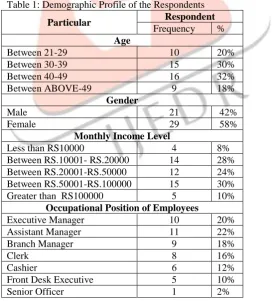
Demographic factors of the Selected Bank Employees Table 1 shows the result of respondents‟ profile for this study. Majority of the respondents are Female (58%). The income level between Rs.50001-Rs.100000 is (15%). Most of the employees are assistant managers (22%).
Table 1: Demographic Profile of the Respondents
Particular Respondent
Frequency % Age
Between 21-29 10 20%
Between 30-39 15 30%
Between 40-49 16 32%
Between ABOVE-49 9 18%
Gender
Male 21 42%
Female 29 58%
Monthly Income Level
Less than RS10000 4 8%
Between RS.10001- RS.20000 14 28%
Between RS.20001-RS.50000 12 24%
Between RS.50001-RS.100000 15 30%
Greater than RS100000 5 10%
Occupational Position of Employees
Executive Manager 10 20%
Assistant Manager 11 22%
Branch Manager 9 18%
Clerk 8 16%
Cashier 6 12%
Front Desk Executive 5 10%
Senior Officer 1 2%
Tale 2: Employee Perception on Electronic Data Interchange
Slno Statement Strongly Agree Agree Neutral Disagree Strongly Disagree 1 Less Human Interpretation 20 40.00 15 30.00 0 0.00 11 22.00 4 8.00 2 Paper less transaction 24 48.00 11 22.00 8 16.00 7 14.00 0 0.00
3 Reduce mailing cost 27 54.00 10 20.00 4 8.00 9 18.00 0 0.00
4 Inventory Holding will be reduced 20 40.00 15 30.00 0 0.00 11 22.00 4 8.00
IJEDR1802065
International Journal of Engineering Development and Research (
www.ijedr.org
)
378
Table 2 employee perception on Electronic Data Interchange where most respondents interprets that less human interpretation (22%) Disagree. The paper less transaction is Strongly agreed (48%).EDI reduces mailing cost (54%), inventory holding will be reduced (40%), fast recovery (56%).Slno Statement Strongly Agree Agree Neutral Disagree Strongly Disagree
1 Rush of Customers in Bank 20 40.00 15 30.00 0 0.00 11 22.00 4 8.00 2 Increase in branch Productivity 24 48.00 11 22.00 8 16.00 7 14.00 0 0.00
3 Updated information 20 40.00 15 30.00 0 0.00 11 22.00 4 8.00
4 Increase in employee Productivity 28 56.00 18 36.00 4 8.00 0 0.00 0 0.00 5 Innovation in Products & Services 30 60.00 10 20.00 10 20.00 0 0.00 0 0.00
Table 3 Employee Perception on Benefits of E-banking where most respondents interprets that Rush of Customers in Bank (22%) Disagree, Increase in branch Productivity is strongly agreed (48%). Updated information (40%) of the respondent is strongly agreed, Increase in employee Productivity (56%) of the respondent is strongly agreed, Innovation in Products & Services (60%) strongly agreed.
Tale 4: Employees Perception on Core Banking Solution
Slno Statement Strongly Agree Agree Neutral Disagree Strongly Disagree
1 Reduce load on other branches 27 54.00 21 42.00 2 4.00 0 0.00 0 0.00
2 Time Reduction 28 56.00 18 36.00 4 8.00 0 0.00 0 0.00
3 Bank Branching with any time 24 48.00 11 22.00 8 16.00 7 14.00 0 0.00 4 Facilitate Centralized Data Base 28 56.00 11 22.00 3 6.00 7 14.00 1 2.00
5 New product Launch 20 40.00 15 30.00 0 0.00 11 22.00 4 8.00
6 Online-Real -Time Data Availability 27 54.00 10 20.00 4 8.00 9 18.00 0 0.00
Table 4 Employees Perception on Core Banking Solution where most respondents-Reduce load on other branches (54%) Strongly agree, Time Reduction (56%) of the respondents strongly agrees, Bank Branching with any time(48%) Strongly agrees, Facilitate Centralized Data Base(56%) Strongly agrees by the respondent. New product Launch(40%) strongly agreed, Online-Real -Time Data Availability(54%) strongly agreed.
Table5 : Shows the overall perception towards E-banking OVERALL PERCEPTION TOWARDS E-BANKING
Mean 3.3
Standard Error 0.125356634
Median 3.5
Mode 4
Standard Deviation 0.88640526
Sample Variance 0.785714286
Kurtosis 1.433268859
Skewness -1.37356187
Range 3
Minimum 1
Maximum 4
Sum 165
Count 50
Confidence Level(95.0%) 0.251913583
Table6 : Shows the Regression overall perception towards E-banking Regression Statistics
Multiple R 0.232240166
R Square 0.83935495
Adjusted R Square 0.034225817 Standard Error 0.871104226
Observations 50
ANOVA
F Significance F
Regression 2.736498119 0.104605 Residual
Total
IJEDR1802065
International Journal of Engineering Development and Research (
www.ijedr.org
)
379
From the above table 6 show the regression on age and perception towards E-banking. Where multiple R is 0.232, R square s 83.9%, adjusted R square is 3.4%, from this analysis H0 is accepted that there is no significance between age level and perception towards E-banking. The age factors are not influencing perception towards E-banking.FINDINGS
‒ Demographic factors of the Selected Bank Employees Table 1 shows the result of respondents‟ profile for this study. Majority of the respondents are Female (58%).
‒ The income level between Rs.50001-Rs.100000 is (15%). Most of the employees are assistant managers (22%). ‒ Electronic Data Interchange where most respondents interprets that less human interpretation (22%) Disagree.
‒ The paper less transaction is Strongly agreed (48%).EDI reduces mailing cost (54%), inventory holding will be reduced (40%), fast recovery (56%).
‒ Employee Perception on Benefits of E-banking where most respondents interprets that Rush of Customers in Bank (22%) Disagree, Increase in branch Productivity is strongly agreed (48%). Updated information (40%) of the respondent is strongly agreed,
‒ Increase in employee Productivity (56%) of the respondent is strongly agreed, Innovation in Products & Services (60%) strongly agreed.
‒ Table 4 Employees Perception on Core Banking Solution where most respondents-Reduce load on other branches (54%) Strongly agree, Time Reduction (56%) of the respondents strongly agrees,
‒ Bank Branching with any time(48%) Strongly agrees, Facilitate Centralized Data Base(56%) Strongly agrees by the respondent. New product Launch(40%) strongly agreed, Online-Real -Time Data Availability(54%) strongly agreed. ‒ From the above table 6 shows the regression on age and perception towards E-banking. Where multiple R is 0.232, R square
s 83.9%, adjusted R square is 3.4%, from this analysis H0 is accepted that there is no significance between age level and perception towards E-banking. The age factors are not influencing perception towards E-banking.
SUGGESTION
‒ The ability to do banking at anywhere and anytime is one of the convenience factor. ‒ Electronic banking also created a more mobile bank for customers that are portability. ‒ E-banking offers some cost-saving opportunities for customers.
‒ Some bank customers who previously did little to no budgeting now monitor basic spending habit using spending tracks which is given by the online banks.
‒ Bank can spend some more training programs for the Employee.
CONCLUSION
The overall analysis of employee perception towards E-banking leads to conclusion that employees of each bank perceive that age factors have no significance relationship between overall perceptions of E-banking, Hence H0 is accepted. The Employees in Public and private banks of the Selected Bank most of them are female. Employee interprets that more human interpretation required for EDI. Due to Technology implication paper less transaction is more according to respondents. Computerization of RBI made drastic change in the Indian Banking sector. Hence, the working hours of bank employees were increased due to daily data entry of all transaction. Overall observation is that, the back office application was not that beneficial to bank employees as well as bank customers.
REFERENCE
[1] S.Ramya, K. Rajam, & Dr. D. Sivasubramanian (2013), STUDY ON EMPLOYEES’ PERCEPTION OF CUSTOMER RELATIONSHIP MANAGEMENT IN E-BANKING, September 2013, Volume: I, Issue: IX, APJR
[2] M.E.DoddaRaju Dr.T.NarayanaReddy (2014), Customer Perception Study-Towards EBanking Services Of Public and Private Sector Banks - With Special Reference to Chittor District of Andra Pradesh IFSMRC AIJRM Volume-02 Issue-03 Jan-Jun-2014 Online ISSN: 2308-1341 Print ISSN: 2308-3034
[3] Dr. M. Rifaya Meera1, M. Valli Mayil and R. Padmaja3(2016), A STUDY ON PERCEPTION OF EMPLOYEES TOWARDS E-BANKING SERVICES - WITH REFERENCE TO PUBLIC SECTOR BANKS IN SIVAKASI, Asia Pacific Journal of Research ISSN (Print) : 2320-5504 ISSN (Online) : 2347-4793, www.apjor.com Vol: I. Issue XLVI, December 2016
[4] JAMEELA M K1 SALMA C T(2016), A STUDY ON EMPLOYEE PERCEPTION TOWARDS E-BANKING:WITH SPECIAL REFERENCE TO SBT IN PALAKKAD DISTRICT, INTERCONTINENTAL JOURNAL OF MARKETING RESEARCH REVIEW ISSN:2321-0346 - ONLINE ISSN:2347-1670 - PRINT -IMPACT FACTOR :1.590 VOLUME 4, ISSUE 2, FEBRUARY 2016
[5] Jelena Titko1, Natalja Lace2, Bank Customers’ and employees’ perceptions of Value, Scientific Journal of Riga Technical University, Economics and Business2011, Volume 21, Dr. Uday Singh Rajput(2015), Customer Perception on E-Banking Service, Pacific Business Review International Volume 8, Issue 4, October 2015,