Predicting Neonatal Intubation
Competency in Trainees
Stephen D. DeMeo, DOa, Lakshmi Katakam, MD, MPHb, Ronald N. Goldberg, MDa, David Tanaka, MDa
abstract
BACKGROUND AND OBJECTIVES:Pediatric residency training programs are graduating residents who are not competent in neonatal intubation, a vital skill needed for any pediatrician involved in delivery room resuscitations. However, a precise definition of competency during training is lacking. The objective of this study was to more precisely define the trajectory toward competency in neonatal intubation for pediatric residents, as a framework for later evaluating complementary training tools.
METHODS:This is a retrospective single-center observational study of resident-performed neonatal intubations at Duke University Medical Center between 2005 and 2013. Using a Bayesian statistical model, intubation competency was defined when the resident attained a 75% likelihood of intubating their next patient successfully.
RESULTS:A total of 477 unique intubation attempts by 105 residents were analyzed. The path to proficiency was defined by a categorical or milestone learning event after which all learners move toward competency in a similar manner. In our cohort, 4 cumulative successes were needed to achieve competency. Only 24 of 105 (23%) achieved competency during the study period. Residents who failed theirfirst 2 opportunities, compared with those successful on theirfirst 2 opportunities, needed nearly double the intubation exposure to achieve competency.
CONCLUSIONS:Bayesian statistics may be useful to more precisely describe neonatal intubation competency in residents. Achieving competency in neonatal intubation appears to be a categorical or milestone learning event whose timing varies between residents. The current educational environment does not provide adequate procedural exposure to achieve
competency for most residents.
WHAT’S KNOWN ON THIS SUBJECT:Pediatric residents may not be achieving competency in neonatal intubation. Opportunities for intubation during residency are decreasing. A precise definition of competency during training is lacking.
WHAT THIS STUDY ADDS:Bayesian statistics may be used to describe neonatal intubation competency in residents. At least 4 successful intubations are needed to achieve competency. Thefirst 2 intubation opportunities appear to predict how many intubation opportunities are ultimately needed to achieve competency. a
Division of Neonatology, Duke University Medical Center, Durham, North Carolina; andbDivision of Neonatology, University of Texas, Houston, Texas
Dr DeMeo conceptualized and designed the study and drafted the initial manuscript; Dr Tanaka conceptualized and designed the study, performed the statistical analyses, and reviewed and revised the manuscript; Drs Katakam and Goldberg reviewed and revised the manuscript; and all authors approved thefinal manuscript for submission.
www.pediatrics.org/cgi/doi/10.1542/peds.2014-3700
DOI:10.1542/peds.2014-3700 Accepted for publication Jan 29, 2015
Address correspondence to Stephen D. DeMeo, DO, Division of Neonatology, Duke University Medical Center, 2424 Erwin Rd, Suite 504, Durham, NC 27715. E-mail: [email protected]
PEDIATRICS (ISSN Numbers: Print, 0031-4005; Online, 1098-4275).
Copyright © 2015 by the American Academy of Pediatrics
FINANCIAL DISCLOSURE:The authors have indicated they have nofinancial relationships relevant to this article to disclose.
FUNDING:Supported by a grant from the Duke University Graduate Medical Education Innovation Fund.
POTENTIAL CONFLICT OF INTEREST:The authors have indicated they have no potential conflicts of interest to disclose.
Current trainees in pediatric residency programs are graduating without achieving competency in procedures such as neonatal intubation.1–5Neonatal intubation
remains a critical skill for the general pediatrician charged with delivery room (DR) and nursery coverage. The amount of exposure for pediatric residents to neonatal intubation in the NICU has decreased over time for several reasons, including the following: the more frequent use of noninvasive mechanical ventilation,6,7
recent changes to duty hour regulations, and the expansion of nonphysician providers such as neonatal nurse practitioners in many academic medical centers.8With the
emergence of the Accreditation Council for Graduate Medical Education’s (ACGME) Next Accreditation System9–11and an
ongoing movement toward
competency-based graduate medical education (GME), there is a great need to describe the real-world attainment of the psychomotor skills necessary for performing neonatal intubations.
Further complicating this problem is the absence of a practical definition of competence in neonatal intubation and the lack of useful predictors to identify those trainees in need of additional training opportunities before theirfinal year of residency. Currently, there is no consensus definition of intubation competency, although many training programs have identified deficiencies in procedural competence among their recent trainees. A study in 2005 evaluated 3719 intubation attempts by pediatric residents over a 10-year period and revealed that these residents were provided inadequate opportunity to become proficient in intubation, based on number of total procedures attempted and rates of success.12A similar study attempted
to define a successful intubation as occurring on thefirst or second attempt.80% of the time,13which
was based on a definition used in previous gastroenterology
literature.14None of their resident
groups met this definition of competence, though likelihood of success improved marginally through advancement in training years. These previous studies have all focused on outcomes related to neonatal intubation such as resident success rate, time to intubation, and total number of intubations by
residents.1–4,12,13,15Using a Bayesian
statistical model, the objective of this study is to define the path to competency in neonatal intubation more precisely, as a framework for later evaluating complementary training tools and improving intubation training.
METHODS
Records of endotracheal intubations performed by pediatric and
medicine–pediatric residents, neonatology fellows, neonatal nurse practitioners, and respiratory therapists in the DR and NICU at a single academic medical center have been collected as a quality assurance (QA) measure since 2005. A
standardized data collection form records resident postgraduate year (PGY), procedure dates, use of rapid sequence intubation (RSI), total number of attempts, and outcome of each attempt for each intubation opportunity. For this study, we only analyzed a cohort of pediatric and combined medicine–pediatric residents, who had completed 3 full academic years of residency, from the 2005–2006 to the 2011–2012 academic year. Categorical pediatric residents have in general a total of 3 months in NICU rotation time during residency. Combined medicine–pediatric residents have 1 less month of rotation time than categorical pediatric residents. With the ACGME duty hours changing during the study period, PGY-1 residents no longer rotated at night starting in the 2011 academic year,
with PGY-2 residents covering the unit in alternating night shifts. The Duke University Institutional Review Board approved this study.
Residents receive no specific intubation training curriculum, besides the mandatory certification through the neonatal resuscitation program. We defined an intubation opportunity as any procedural opportunity where the resident inserted a laryngoscope blade into the oropharynx of an infant, regardless of whether an attempt at passing an endotracheal tube was made. Guidelines exist in our NICU that restrict residents from intubating infants who are,1000 g at the time of the procedure. Although chest auscultation and end tidal carbon dioxide detectors provided the most immediate clinical feedback on outcome of the procedure attempt, final determination of successful placement of the endotracheal tube was confirmed by a chest radiograph. The number of attempts allowed was at the discretion of the supervising physician. There was no time limit for attempts. A second attempt on the same patient was allowed, and treated as belonging to the same opportunity, meaning success on the second attempt would be considered a success for that opportunity. DR intubations performed for meconium stained amnioticfluid were not included in this study, because confirmation of endotracheal tube placement was not possible. Most resident intubations occur in the NICU and not the DR, because unit policy calls for the most experienced intubator to perform the procedure in the DR.
Achievement of intubation competency was defined by using a Bayesian statistical model. Bayesian statistics have been used in a variety of medical education paradigms including analyzing progress test scores, medical simulation, and health care analyses in general.16–18
investigation for several reasons. Intubation is a skill for which previous experience is a determinant of future success. Bayesian models are better able to analyze how previous success or failure will affect future performance. In Bayesian statistics, outcomes can be predicted by using what are known as previous distributions. Previous distributions are known objective or subjective observations about a phenomenon that can be used to predict the likelihood of future outcomes.
For this analysis, we used the observed previous distribution of our novice learners’known success or failure of intubation attempts on their first attempt as collected before this study in our QA database and thus defined our novice cohort as having a 30% likelihood of intubating the next patient. Our statistical model then assigned each resident at any given intubation opportunity, a Bayesian likelihood score (how likely they were to successfully intubate the next patient) based on their performance before that opportunity. The model was used to define how long it took a resident to move from the novice cohort toward the competent cohort, as a function of number of intubation opportunities encountered and their cumulative intubation successes over the course of their residency training. To ensure reliability of the Bayesian model, the Bayesian likelihood score (the predicted likelihood of success at the next intubation opportunity) was compared retrospectively, using logistic regression, to the actual outcome of the resident’s next opportunity captured in the database. Competency was defined when the provider was 75% likely to intubate the next patient successfully (at the next opportunity, whether thefirst or second attempt).
We then sought to determine if early intubation opportunities could be used to predict the number of intubation opportunities needed to
achieve competency. To do so, we selected a cohort of residents who had achieved competency in intubation as defined by the parameters mentioned previously. Using a bivariate regression, we compared the number of cumulative successes required to become competent for residents in the competent cohort to the outcomes of theirfirst 2 intubation opportunities.
RESULTS
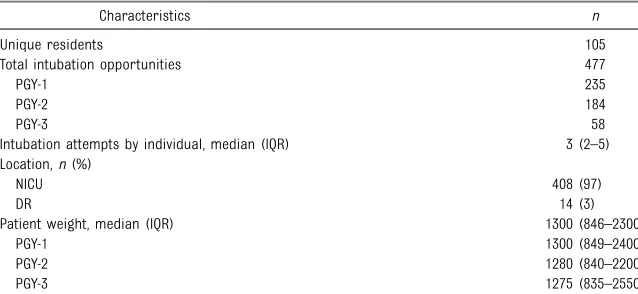
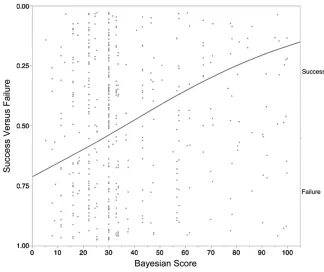
A total of 477 unique intubation opportunities by 105 residents were analyzed (Table 1). The majority of intubation opportunities that included location information occurred in the NICU (97%). The number of opportunities per training year varied in our cohort with a reduction in overall attempts in the PGY-3 year as compared with the PGY-1 or PGY-2 years. The median number of intubation opportunities for any 1 individual over his or her training period was 3, (range, 1–13; interquartile range [IQR], 2–5). We validated the Bayesian scoring method by comparing the Bayesian likelihood score assigned at any given opportunity to the actual future outcome of the next recorded intubation opportunity, by logistic regression. This revealed that a Bayesian score of 80 reflected a 75% likelihood of successful
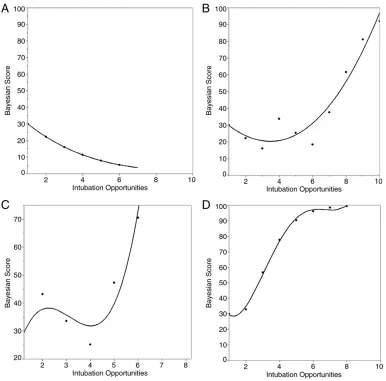
intubation of the next patient, our agreed upon definition of competency (Fig 1). To visualize the learning curves of individual residents, we plotted individual residents’Bayesian scores over time with each
opportunity (Fig 2). A negative slope represents decreasing Bayesian scores as residents demonstrate failed attempts, whereas a positive slope represents increasing Bayesian scores as successful attempts are achieved over time. Some residents never begin the process of attaining competency (Fig 2, resident A). Others, after mixed early outcomes, need varying exposure to
opportunities before beginning to attain competency (Fig 2, residents B and C). Other residents begin the attainment of competency immediately, showing successes starting with theirfirst 2 opportunities (Fig 2, resident D).
Having established 80 as the Bayesian score needed to achieve competency, we determined that 24 of 105 residents (23%) achieved competency during the study period. Of this competent group, 5 of 24 (21%) residents achieved competency during the PGY-1 year, 14 of 24 (58%) during the PGY-2 year, and 5 of 24 (21%) during the PGY-3 year. The competent cohort had a higher median number of intubation opportunities than the entire cohort, 7, ranging from 4 to 14 opportunities (IQR, 6–10). Further
TABLE 1 Characteristics of the Study Cohort
Characteristics n
Unique residents 105
Total intubation opportunities 477
PGY-1 235
PGY-2 184
PGY-3 58
Intubation attempts by individual, median (IQR) 3 (2–5)
Location,n(%)
NICU 408 (97)
DR 14 (3)
Patient weight, median (IQR) 1300 (846–2300)
PGY-1 1300 (849–2400)
PGY-2 1280 (840–2200)
PGY-3 1275 (835–2550)
analysis of the competent cohort by logistic regression determined that the number of cumulative successful intubations needed to achieve a Bayesian score of 80 was at least 4 (Fig 3). We then grouped competent residents by the outcome of theirfirst 2 intubation opportunities and analyzed their path to achieving 4 cumulative successes (Fig 4). Success during thefirst 2 intubation
opportunities was directly related to the number of opportunities needed to achieve 4 cumulative successes. Residents successful on both of their first 2 opportunities only needed∼5 opportunities to achieve competency. Residents only successful on 1 of 2 first opportunities needed 7 opportunities. Residents who failed both of theirfirst 2 opportunities needed at least 8 opportunities to achieve the same number of cumulative successes as the other 2 groups.
DISCUSSION
A need for better understanding of the intubation learning process is of great importance in the current GME training environment, given the development of the Next Accreditation System and a trend toward
competency-based programs in GME. The ACGME pediatric program requirements state that pediatric residents must have sufficient training in endotracheal intubation before completion of their training program.19However, a clear and
consistent definition of sufficient training has not been specified. Although previous studies have linked educational theory to procedural tasks and the acquisition of psychomotor skills in medical education,20–22few
have described a precise definition of a competency in procedural skills.
We have shown that Bayesian statistics may be used to define
competency in neonatal intubation, and that we may be able to predict likelihood of future intubation success. In our cohort, a Bayesian score of 80 represented a 75% likelihood to intubate the next patient, which we believe to be a reasonable measure of competency for pediatric trainees to achieve before the completion of their training. Most residents begin intubation training with a series of failures or inconsistent successes. Each resident then, at a different point in training, arrives at a categorical learning milestone, after which they begin a steady climb toward competency. The learning curves of intermediate learners, the majority of residents in our cohort, demonstrates a“hockey stick”appearance, with early failures causing a downward slope followed by an upward infection at the categorical learning milestone. Some residents in our study begin the attainment competency after only 1 or 2 opportunities. For others, this upward climb did not begin until well after 6 or 7 opportunities. We hypothesize that the clinical relevance of the observation of this categorical learning moment is in fact the point at which the resident is reliably able to identify the anatomy of the neonatal airway, which is critical for successful intubation. Many residents never achieve this categorical learning event and subsequently fail to become competent. In fact, only 23% of residents in our cohort achieved this definition of competency. Given the nature of this retrospective study, we were not able to ascertain how intrinsic personal characteristics, such as confidence or persistence, may aid residents in this learning process, especially if faced with early failures. The initial feedback that is given to the resident regarding identification of the airway anatomy may be a key factor determining which residents achieve competency more rapidly. Future prospective studies investigating how immediate feedback to the learner at the bedside impacts intubation training would be timely.
FIGURE 1
In our cohort, at least 4 consecutive successful intubations were needed to become competent. The outcome of a resident’sfirst 2 intubation opportunities appear to have a major impact on how many total
opportunities are then subsequently needed to achieve competency. A group of residents failing on both of theirfirst 2 opportunities needed nearly double the amount of exposure to intubation opportunities compared with the group who was successful on both theirfirst 2 attempts. Unfortunately, the median number of total intubation
opportunities for any 1 trainee
during residency in our cohort was only 3, though some residents recorded many more. The competent cohort had a much higher number of opportunities than the whole cohort. Therefore, the major barrier to producing competent intubators may be simply lack of procedure
opportunity. Although the“ real-world”difference between a resident having 5 vs 7 vs 8 opportunities may not be obvious, we argue that for program directors, this relates back to the problem of too few
opportunities occurring during the training years. Had we found that our residents were being exposed to
many more opportunities during training (such as with anesthesia residents23,24), this small difference
in exposure may not be a major one. However, we see pediatric residents as a completely different group of learners, and with most residents having so few opportunities for success, the small difference in the number needed to become
competent becomes hugely relevant.
Our study offers evidence that by using outcomes of early
opportunities, educators might be able to predict which residents will need supplemental training to achieve competency. As more
FIGURE 2
residents complete postgraduate training programs without adequate procedural skills, demand for procedural experience falls more often to the postgraduate fellow, in turn causing fewer opportunities for residents.25,26In the future, the goal
of educators may not be to increase the total number of intubation opportunities, but rather increase the quality of intubation attempts by helping residents identify the landmarks of the neonatal airway more easily, allowing them the opportunity to move toward procedural competency sooner. Prospective studies may allow researchers to investigate additional factors that impact intubation training, including those intrinsic to the learner such as learner confidence or learner persistence, visual acuity of the learner, supervision by faculty, and infant characteristics such as gestational age, weight, and emergent versus elective intubations. Although some small studies have only shown minimal improvement,27,28
complementary training measures such as video laryngoscopy, high fidelity simulation, video archival of intubations, and subsequent formatted feedback and debriefing may emerge as strategies to enhance the path to resident competency. Video laryngoscopy technology has been shown to shorten intubation procedure time and improve success rates in pediatric patients by inexperienced intubators when compared with standard
laryngoscope blades.29Improving
other clinical conditions may be helpful, because a recent study revealed that resident intubation success improved after RSI versus intubations using no premedication.30
In the current study, we did not perform a factor analysis to determine how RSI may affect resident intubation competency, because RSI was not routine practice in our NICU until the 2012 academic year.
Bayesian statistics are useful in this analysis because they are able to
capture how previous events may influence future outcomes. In contrast, standard statistical methods would treat each intubation
opportunity as an independent event, which is not a true reflection of real-life psychomotor skills training. Although concerns exist regarding the validity of Bayesian prediction models, our model benefits from a degree of internal validity. As we tracked individual residents over time, we were able to validate the Bayesian scoring by comparing the predicted success/failure on the next opportunity to the actual procedure outcome. We believe that the Bayesian score is a better measure of resident competency as opposed to commonly published outcomes such asfirst pass intubation success rates or overall success rates.
One major drawback of this analysis is that time between opportunities was not analyzed. There is reason to believe that a significant degradation of skill may occur over time, and it has been hypothesized that novice learners are much more sensitive to this degradation than experts. In the future, we plan to investigate how length of time between procedure attempts may affect future success. Another weakness of this study is that the QA database may not capture all intubations in the NICU. We also did not capture information about procedural difficulty or grading of airway view, and therefore cannot comment on how residents may be affected by difficult intubations. However, a previous study that did analyze the effect of difficulty of intubation on resident success revealed overall poor success rates whether the intubation was graded difficult or not.4Lastly, at our center,
residents have some exposure to neonatal intubations in other areas of training including emergency medicine or pediatric intensive care and our data may not represent the full extent of intubation experience throughout a pediatric residency program.
FIGURE 3
CONCLUSIONS
In a GME environment moving toward competency-based training, few objective measures of procedural competence have been described. Bayesian statistics may be useful to more precisely describe neonatal intubation competency in pediatric residents. Achieving competency in neonatal intubation appears to be dependent on a categorical or
milestone learning event whose timing varies between residents. Four cumulative successes were needed to achieve competency in our cohort. The outcome of a resident’sfirst 2
intubation opportunities may have a major impact on how many
intubation opportunities are ultimately needed to achieve competency.
REFERENCES
1. Downes KJ, Narendran V, Meinzen-Derr J, McClanahan S, Akinbi HT. The lost art of
intubation: assessing opportunities for residents to perform neonatal intubation.J Perinatol. 2012;32(12): 927–932
2. Bismilla Z, Finan E, McNamara PJ, LeBlanc V, Jefferies A, Whyte H. Failure of pediatric and neonatal trainees to meet Canadian Neonatal Resuscitation Program standards for neonatal intubation.J Perinatol. 2010;30(3):182–187
3. Haubner LY, Barry JS, Johnston LC, et al. Neonatal intubation performance: room for improvement in tertiary neonatal intensive care units.Resuscitation. 2013; 84(10):1359–1364
4. Sanders RC Jr, Giuliano JS Jr, Sullivan JE, et al; National Emergency Airway Registry for Children Investigators and Pediatric Acute Lung Injury and Sepsis
Investigators Network. Level of trainee and tracheal intubation outcomes. Pediatrics. 2013;131(3). Available at: www. pediatrics.org/cgi/content/full/131/3/e821
5. Kamlin CO, O’Connell LA, Morley CJ, et al. A randomized trial of stylets for
intubating newborn infants.Pediatrics. 2013;131(1). Available at: www.pediatrics. org/cgi/content/full/131/1/e198
6. Finer NN, Carlo WA, Duara S, et al; National Institute of Child Health and Human Development Neonatal Research Network. Delivery room continuous positive airway pressure/positive end-expiratory pressure in extremely low birth weight infants: a feasibility trial. Pediatrics. 2004;114(3):651–657
7. Lindner W, Vobeck S, Hummler H, Pohlandt F. Delivery room management of extremely low birth weight infants: spontaneous breathing or intubation? Pediatrics. 1999;103(5):961–967
8. Smith SL, Hall MA. Advanced neonatal nurse practitioners in the workforce: a review of the evidence to date.Arch Dis Child Fetal Neonatal Ed. 2011;96(2): F151–F155
9. Nasca TJ, Weiss KB, Bagian JP, Brigham TP. The accreditation system after the
“next accreditation system.”Acad Med. 2014;89(1):27–29
10. Schumacher DJ, Spector ND, Calaman S, et al. Putting the pediatrics milestones into practice: a consensus roadmap and resource analysis.Pediatrics. 2014; 133(5):898–906
11. Nasca TJMDM, Philibert I, Brigham T, Flynn TCMD. The next GME accreditation system—rationale and benefits.N Engl J Med. 2012;366(11):1051–1056
12. Leone TA, Rich W, Finer NN. Neonatal intubation: success of pediatric trainees. J Pediatr. 2005;146(5):638–641
13. Falck AJEM, Escobedo MB, Baillargeon JG, Villard LG, Gunkel JH. Proficiency of pediatric residents in performing neonatal endotracheal intubation. Pediatrics. 2003;112(6 pt 1):1242–1247
14. Jowell PS, Baillie J, Stanley Branch M, Affronti J, Browning CL, Bute BP. Quantitative assessment of procedural competence: a prospective study of training in endoscopic retrograde cholangiopancreatography.Ann Intern Med. 1996;125(12):983–989
15. O’Donnell CP, Kamlin CO, Davis PG, Morley CJ. Endotracheal intubation attempts during neonatal resuscitation: success rates, duration, and adverse effects. Pediatrics. 2006;117(1). Available at: www.pediatrics.org/cgi/content/full/117/ 1/e16
FIGURE 4
16. Ricketts C, Moyeed R. Improving progress test score estimation using Bayesian statistics.Med Educ. 2011; 45(6):570–577
17. Cai L. Potential applications of latent variable modeling for the psychometrics of medical simulation.Mil Med. 2013;178 (suppl 10):115–120
18. Winkler RL. Why Bayesian analysis hasn’t caught on in healthcare decision making.Int J Technol Assess Health Care. 2001;17(1):56–66
19. ACGME Program Requirements for Graduate Medical Education in Pediatrics. https://www.acgme.org/ acgmeweb/Portals/0/PFAssets/2013-PR-FAQ-PIF/320_pediatrics_07012013.pdf. Accessed February 9, 2014
20. Raman M, Donnon T. Procedural skills education—colonoscopy as a model. Can J Gastroenterol. 2008;22(9):767–770
21. Boehler ML, Schwind CJ, Rogers DA, et al. A theory-based curriculum for
enhancing surgical skillfulness.J Am Coll Surg. 2007;205(3):492–497
22. Van Hove C, Perry KA, Spight DH, et al. Predictors of technical skill acquisition among resident trainees in
a laparoscopic skills education program. World J Surg. 2008;32(9):1917–1921
23. Konrad C, Schüpfer G, Wietlisbach M, Gerber H. Learning manual skills in anesthesiology: Is there a recommended number of cases for anesthetic procedures?Anesth Analg. 1998;86(3): 635–639
24. de Oliveira Filho GR. The construction of learning curves for basic skills in anesthetic procedures: an application for the cumulative sum method.Anesth Analg. 2002;95(2):411–416
25. Gaies MG, Landrigan CP, Hafler JP, Sandora TJ. Assessing procedural skills training in pediatric residency programs.Pediatrics. 2007;120(4): 715–722
26. Halamek LP, Kaegi DM. Who’s teaching neonatal resuscitation to housestaff? Results of a national survey.Pediatrics. 2001;107(2):249–255
27. Sylvia MJ, Maranda L, Harris KL, Thompson J, Walsh BM. Comparison of success rates using video laryngoscopy versus direct laryngoscopy by residents during a simulated pediatric emergency. Simul Healthc. 2013;8(3):155–161
28. Fonte M, Oulego-Erroz I, Nadkarni L, Sanchez-Santos L, Iglesias-Vasquez A, Rodriguez-Nunez A. A randomized comparison of the GlideScope videolaryngoscope to the standard laryngoscopy for intubation by pediatric residents in simulated easy and difficult infant airway scenarios.Pediatr Emer Care. 2011;27(5):398–402
29. Kalbhenn J, Boelke AK, Steinmann D. Prospective model-based comparison of different laryngoscopes for difficult intubation in infants.Paediatr Anaesth. 2012;22(8):776–780
30. Le CN, Garey DM, Leone TA, Goodmar JK, Rich W, Finer NN. Impact of
DOI: 10.1542/peds.2014-3700 originally published online April 6, 2015;
2015;135;e1229
Pediatrics
Stephen D. DeMeo, Lakshmi Katakam, Ronald N. Goldberg and David Tanaka
Predicting Neonatal Intubation Competency in Trainees
Services
Updated Information &
http://pediatrics.aappublications.org/content/135/5/e1229 including high resolution figures, can be found at:
References
http://pediatrics.aappublications.org/content/135/5/e1229#BIBL This article cites 29 articles, 9 of which you can access for free at:
Subspecialty Collections
http://www.aappublications.org/cgi/collection/neonatology_sub Neonatology
sub
http://www.aappublications.org/cgi/collection/fetus:newborn_infant_ Fetus/Newborn Infant
b
http://www.aappublications.org/cgi/collection/medical_education_su Medical Education
following collection(s):
This article, along with others on similar topics, appears in the
Permissions & Licensing
http://www.aappublications.org/site/misc/Permissions.xhtml in its entirety can be found online at:
Information about reproducing this article in parts (figures, tables) or
Reprints
DOI: 10.1542/peds.2014-3700 originally published online April 6, 2015;
2015;135;e1229
Pediatrics
Stephen D. DeMeo, Lakshmi Katakam, Ronald N. Goldberg and David Tanaka
Predicting Neonatal Intubation Competency in Trainees
http://pediatrics.aappublications.org/content/135/5/e1229
located on the World Wide Web at:
The online version of this article, along with updated information and services, is
by the American Academy of Pediatrics. All rights reserved. Print ISSN: 1073-0397.