R E S E A R C H
Open Access
Comparative analysis of knowledge representation
and reasoning requirements across a range of life
sciences textbooks
Vinay K Chaudhri
1*, Daniel Elenius
1, Andrew Goldenkranz
2, Allison Gong
3, Maryann E Martone
4, William Webb
5and Neil Yorke-Smith
6,7Abstract
Background:Using knowledge representation for biomedical projects is now commonplace. In previous work, we represented the knowledge found in a college-level biology textbook in a fashion useful for answering questions. We showed that embedding the knowledge representation and question-answering abilities in an electronic textbook helped to engage student interest and improve learning. A natural question that arises from this success, and this paper’s primary focus, is whether a similar approach is applicable across a range of life science textbooks. To answer that question, we considered four different textbooks, ranging from a below-introductory college biology text to an advanced, graduate-level neuroscience textbook. For these textbooks, we investigated the following questions: (1) To what extent is knowledge shared between the different textbooks? (2) To what extent can the same upper ontology be used to represent the knowledge found in different textbooks? (3) To what extent can the questions of interest for a range of textbooks be answered by using the same reasoning mechanisms?
Results: Our existing modeling and reasoning methods apply especially well both to a textbook that is comparable in level to the text studied in our previous work (i.e., an introductory-level text) and to a textbook at a lower level, suggesting potential for a high degree of portability. Even for the overlapping knowledge found across the textbooks, the level of detail covered in each textbook was different, which requires that the representations must be customized for each textbook. We also found that for advanced textbooks, representing models and scientific reasoning processes was particularly important.
Conclusions:With some additional work, our representation methodology would be applicable to a range of textbooks. The requirements for knowledge representation are common across textbooks, suggesting that a shared semantic infrastructure for the life sciences is feasible. Because our representation overlaps heavily with those already being used for biomedical ontologies, this work suggests a natural pathway to include such representations as part of the life sciences curriculum at different grade levels.
Keywords: Ontology, Textbook knowledge, Knowledge representation, Reasoning, Question answering, Semantic infrastructure
* Correspondence:[email protected]
1SRI International, Menlo Park, CA 94025, USA
Full list of author information is available at the end of the article
Background
Using knowledge representation is now commonplace across a range of biomedical projects [1-3]. This usage is evidenced by the success of the National Center of Biomedical Ontologies, which, as of 2014, publishes and disseminates more than 350 ontologies [4]. Despite this widespread application of knowledge representation in biomedical projects, further significant value could be reaped: The Journal of Nucleic Acids Research catalogues thousands of databases that could substantially benefit if they were accompanied by an explicit ontology [5]. We anticipate that knowledge representation will play a cru-cial role in future biomedical research, especru-cially for exploiting, leveraging, and understanding big data.
During an artificial intelligence (AI) project called Project Halo, we developed an intelligent textbook technology that leverages an explicit ontology and a question-answering system, and that helps students learn better [6]. Obvious overlaps exist between the technologies used in our project and the methods that are commonplace for bio-medical ontologies [7,8]. This convergence presents an unprecedented pathway for synergy between work on on-tologies and life sciences education. If textbook knowledge could be represented and encoded in an educational con-text, as we propose here, then it could eventually be more widely incorporated into biomedical projects, thus com-plementing the existing knowledge resources.
Our work on the intelligent textbook [6] focused on an introductory college-level biology textbook called
Campbell Biology [9]. We encoded substantial portions of Campbell and then used this knowledge representa-tion as a basis for an intelligent textbook called Inquire, which enables students to explore topics across multiple levels of organization and to pose their own questions, which are then answered by machine reasoning. The intelligent textbook is a powerful learning tool that both gives students information such as definitions and de-scriptions of terms, and enables them to explore structure, function, and concepts across different levels of biological organization.
The current paper’s focus is on investigating the ques-tion: To what extent can a generic methodology for cap-turing textbook knowledge be developed that is applicable across a range of life sciences textbooks? We have broken this high-level question into three sub-questions: (1) To what extent is knowledge shared between the different textbooks? (2) To what extent can the same upper ontol-ogy be used to represent the knowledge found in different textbooks? (3) To what extent can the questions of inter-est for a range of textbooks be answered by using the same reasoning mechanisms? A desired outcome is quan-tifying the extent to which the already developed methods apply to different textbooks and quantifying any differ-ences or novel requirements across textbooks. These
questions are important, because if we could apply the same methodology to textbooks at both lower and higher grade levels, then this generalizability would enable mak-ing semantics integral to science textbooks. The answers to these questions will also be informative to others as they seek insights both into generic techniques for ontol-ogy design and into the requirements that differ across domains.
For the remainder of this section, we give an overview of our project, review the prior work on knowledge repre-sentation, describe the ontology, and provide the rationale for the textbooks that were selected for comparison. We follow that by a description of our methods and results.
Context of Project Halo
Project Halo was an AI project funded by Vulcan, Inc., with the goal of creating a system calledDigital Aristotle
that could answer questions on a wide variety of science topics. SRI International participated in this project from 2003–2013 [6,10,11]. During this period, we advanced the state of the art in knowledge base (KB) systems by enabling domain experts with little background in know-ledge representation to author knowknow-ledge that could be used for answering questions. This work’s results are embodied in a knowledge-authoring system calledAURA
[11]. To demonstrate the scalability of the approach, we used AURA to encode substantial fractions of Campbell Biology [9], which resulted in the knowledge base KB Bio 101 [12]. A team of biologists trained in AURA but having no background in knowledge representation per-formed the encoding work. We designed a knowledge-factory process that the biologists used to systematically convert the textbook content into KB Bio 101 [12]. Al-though accurately assessing the total effort invested in the encoding is difficult, we estimate that the effort was at least twelve person years. KB Bio 101 represents a substantial fraction of Campbell Biology and contains more than 100,000 axioms [13].
We incorporated KB Bio 101 into an electronic textbook application calledInquire, which helps students with read-ing and homework problem solvread-ing [6]. An evaluation of
Inquire with students showed the practical utility of in-corporating a KB into an electronic textbook, as the
Inquirestudents exhibited higher scores than did the con-trol group and received no grades D or F, while these lower grades were seen in the control group. A video based onInquirewon the best video award at the annual confer-ence of the Association for Advancement of Artificial Intelligence (AAAI) in 2012a.
Knowledge representation in AURA
The AURA knowledge-authoring system uses Knowledge
features such as classes; individuals; class-subclass hier-archy; disjointness; slots; slot hierhier-archy; necessary and suf-ficient properties; and deductive rules. The representation in KM can be formally understood as first-order logic with equality. Uniquely, KM’s representation supports graph-structured class descriptions. We illustrate KM in the following example.
Suppose we wish to represent the statement:“Every cell is an entity that has a ribosome and a chromosome as its parts”. We can express this statement in first-order logic as follows. (We implicitly assume that the statements hold over all times).
Axiom A1:
∀x :Cell xð Þ→∃y1;y2:Entity xð Þ
∧has‐partðx;y1Þ∧has‐partðx;y2Þ
∧Ribosome yð Þ1 ∧Chromosome yð Þ2
Next, suppose we wish to represent:“Every eukaryotic cell has as parts a ribosome,a nucleus,and a eukaryotic chromosome such that the chromosome is inside the nucleusb”. We can capture this statement in first-order logic as follows:
Axiom A2:
∀x :Eukaryotic‐Cell xð Þ→∃y1;y2; y3:Cell xð Þ
∧ has‐partðx;y1Þ∧has‐partðx;y2Þ
∧ has‐partðx;y3Þ∧ is‐insideðy2;y3Þ
∧ Ribosome yð Þ1 ∧Eukaryotic‐Chromosome yð Þ2
∧ Nucleus yð Þ3
In the class definition of a Eukaryotic-Cell, specifying the is-insiderelationship between the Chromosomeand the Nucleus violates the tree model property [15]. In models satisfying tree model property, each node has (at most) a unique direct predecessor, and in general, it is a good indicator of decidability. To see how the valid models for A2 violate the tree model property, we create a directed graph as follows: each variable in the axiom is represented by a node, and a directed edge exists be-tween the nodes representing a variablexand a variable
yif they both participate in the same predicate such that
x appears in the first position andy appears in the sec-ond position. (Because DLs are limited to binary predi-cates, we limit our discussion to only binary predicates.) For a graph for axiom A2, the node y3has two incoming edges from x and y2, and thus, violates the tree model property. DL systems achieve decidable reasoning by limiting the representation to only allow tree models, and this limitation is well known [16]. Active research is in progress to address this limitation [17-20].
Next, suppose we wish to explicitly state the inherit-ance relationships in our representation by asserting that a Eukaryotic-Cell inherits a Chromosome and Ribosome
from a Cell, and further, by specifying the inherited
Chromosomeas a Eukaryotic-Chromosome. We can cap-ture such relationships if we rewrite A1 and A2 by using Skolemization, a well-known technique to approximate existential variables in the antecedent of an axiom [21]. With Skolemization, in an axiom of the form∀Y1…Yn∃ X…φ, the existential variableXcan be removed and re-placed everywhere in φ with the function term f(Y1… Yn), where f is a new function symbol that does not occur anywhere else in the axiom. The rationale for such a substitution is that, for any query, the original axiom is unsatisfiable if and only if the transformed axiom is unsatisfiable [21]. This implies that a query with an ori-ginal axiom in the KB can be answered if and only if it can be answered when posed against the KB with the Skolemized version of the same axiom. However, from the point of view of logical entailment, the Skolemized KB is stronger than the original one, which is why we say that Skolemization only approximates existential quantification and is not equivalent to it. Skolemization of A1 and A2 enables referring to the Skolem functions introduced in them outside the scope of the existential quantifier. In the Skolemized versions of axioms A1 and A2 shown below, we can see that A4 refers to the Skolem functions introduced in A3.
Axiom A3:
∀x :Cell xð Þ→Entity xð Þ∧
has‐partðx;fcell1ð ÞxÞ∧has‐partðx;fcell2ð ÞxÞ
∧Ribosome fð cell1ð Þx Þ∧Chromosome fð cell2ð Þx Þ
Axiom A4:
∀x :Eukaryotic‐Cell xð Þ→Cell xð Þ ∧
has‐partðx;fecell1ð Þx Þ∧has‐partðx;fecell2ð Þx Þ
∧ has‐partðx;fecell3ð Þx Þ
∧ Eukaryotic‐Chromosome fð ecell3ð Þx Þ
∧ Nucleus fð ecell1ð Þx Þ∧ Ribosome fð ecell2ð ÞxÞ
∧is‐insideðfecell3ð Þx ;fecell1ð Þx Þ
∧ fecell3ð Þ ¼x fcell2ð Þx ∧ fecell2ð Þ ¼x fcell1ð Þx
The equality statement used in A4 proves to be a power-ful tool that explicitly shows the inheritance relationship. In some cases, equality statements can be inferred. For ex-ample, if a cardinality constraint asserts that a Cell has exactly one Chromosome, then one can deductively con-clude that theEukaryotic-Chromosomemust be the same as the inherited Chromosome. However, associating such constraints is incorrect in many situations, as is the case for aEukaryotic-Cell.
Proving syntaxd. The translation into OWL2 is lossy, as it cannot fully capture the graph structures represented in the KB; the other translations are non-lossy. These trans-lations are available through our websitee, and an OWL version is available through BioPortalf.
Upper ontology in AURA
AURA uses an upper ontology calledComponent Library
or CLIB [26]. CLIB is a linguistically motivated ontology designed to support representation of knowledge for au-tomated reasoning. CLIB uses four simple, upper-level distinctions: (1)Entity(things that are); (2) Event(things that happen); (3) Relation (associations between things); and (4)Role(ways in which entities participate in events).
A unique feature of CLIB is that it provides a vocabu-lary of actions for modeling biological processes. An Ac-tionis a subclass of Event.In CLIB, the class Actionhas 42 direct subclasses, with 147 subclasses in all. Examples of direct subclasses include Attach, Impair, and Move. Other subclasses include Move-Through(which is a sub-class ofMove) andBreak(which is a subclass ofDamage, which is a subclass ofImpair). To ensure generality, these subclasses were developed by consulting lexical resources, such as WordNet [27]; the Longman Dictionary of Con-temporary English[28]; andRoget’s Thesaurus[29].
CLIB provides semantic relationships to define the participants of an action. These relations are based on a comprehensive study of case roles in linguistics [30] and includeagent,object,instrument,raw-material,result, source, destination, and site. (The syntactic and se-mantic definitions that we developed for these relations are available elsewhere [31].) As an example, we consider
the definition ofraw-material. The semantic definition of raw-materialis any entity that is consumed as an input to a process. The syntactic definition ofraw-material is ei-ther it is the grammatical object of verbs such as“to use” or“to consume”, or the word“using”precedes it.
CLIB also provides the vocabulary needed to define the relationships that exist between entities, and between entities and events, and to associate properties with both entities and events. For example, the most frequent rela-tionships help define the structural relarela-tionships that exist between entities [32]. We use such relationships for representing structure: has-part, has-region, material, element, andpossesses. We have developed detailed defi-nitions and guidelines for their usage. For example, we say thatXhas-regionYifYis a region of space or aSpatial
-Entitydefined only in relation toX. The complete defini-tions of the CLIB concepts and reladefini-tionships are available onlineg.
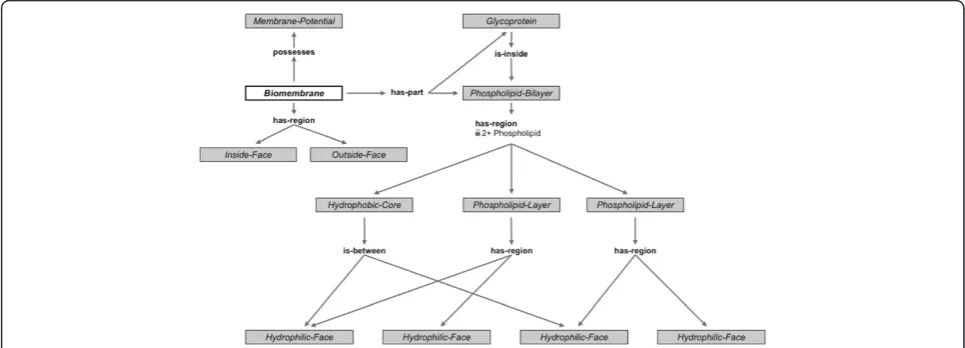
As an illustration of the use of CLIB, in Figure 1, we show a simplified representation of the structure of a
Biomembrane. From the representational point of view, the graph in Figure 1 represents an existential rule of the sort seen in axioms 1 and 2. In this figure, the node shown in white is universally quantified, and every other node, shown in gray, is existentially quantified. Therefore, we can read a portion of Figure 1 as follows: for every instance of
Biomembrane, there exists an instance of Phospholipid
-Bilayerand an instance ofGlycoproteinthat are inhas-part relationship to it, and further the instance ofGlycoprotein
is-inside the instance of Phospholipid-Bilayer. In the context of the relationships used in biomedical ontol-ogies, our usage of has-part and other relationships
corresponds to instance-instance relationships [33]. The arrows go from the first argument of a predicate to the sec-ond argument. For example, an arrow fromBiomembrane
to aPhospholipid-Bilayerlabeled ashas-partcorresponds to the predicatehas-part(b,p), whereb is an instance of a
Biomembrane, andpis an instance of aGlycoprotein. The numbers on some of the edges indicate cardinality constraints. For example, the instance of Phospholipid
-Bilayer in Figure 1 has exactly two phospholipid layers that are in a has-region relationship to it. In Figure 2, we show the functions of a Biomembrane. A portion of this figure can be read analogously to Figure 1 as fol-lows: for every instance of aBiomembrane, there exists a function Block in which the agent is a Hydrophobic
-Core, the object is a Hydrophilic-Compound, and an instrument is aFatty-Acid-Tail. More details about our representation of functions are available elsewhere [32].
Reasoning in AURA
The KM system [14] provided the core reasoning ser-vices for AURA. KM’s reasoning combines description-logic-style classification [34] with backward chaining on rules. We extended KM’s basic reasoning with sev-eral higher-level reasoning methods to answer ques-tions [24,25]. AURA also contained a natural language processing interface that processed an input English ques-tion and converted it to a formal representaques-tion for evalu-ation by the reasoner [11]. We list below several abstract question templates, each followed by an example of its instantiation. A detailed formalization of different rea-soning processes in AURA has been published else-where [24,25]. To make this paper self-contained, we follow each question either by giving a high-level de-scription of how that question was formalized or by specifying a logical query that could be evaluated by a general-purpose reasoner.
Q1.What are the R of X? (e.g.,What are the parts of a cell?)
Q1 is a very common and basic form of query with numerous variations. Because the relevant knowledge to answer Q1 is in the form of axioms such as A1, the formalization of Q1 contains a premise that extends the KB to KB’ by creating a sample instance of Cell. For ex-ample, for the classCell, and corresponding to the axiom A1, KB’ will contain the individualc1. By the application of A1, KB’is further extended by addingr1andch1such that they are instances of Ribosomeand a Chromosome, respectively, and by adding the assertions (has-partc1 r1) and (has-part c1 ch1), which are conclusions derived by using A1. To answer Q1, we query for all literals matching (has-partc1?x), returningc1andch1as answers. In more complex examples, query evaluation can involve inheriting information from super-classes and applying multiple rules.
Some instantiations of Q1 leverage the relation hier-archy in the KB. For example, “What is the structure of a cell?” Here, the wordstructuremaps to thehas- struc-ture relationship in our ontology, which has four sub-relations:has-part,has-region,material, andpossesses. For the values returned for each of these relationships, the system further retrieves spatial relationships to complete the structural description.
In more complex forms of Q1, further constraints on the values returned can exist. For example, consider: What does X do during Y? Assuming that we are interested in those steps such that X is a raw-material, those steps must also satisfy an additional constraint that they must be sub-steps of Y. Here, steps correspond to the phases of a process.
Q2.What are the subclasses of X? (e.g.,What are the subclasses of a eukaryotic cell?)
Q2 is an example of a taxonomic query that queries for all subclass relationships for a class. In AURA, this query is answered by traversing the class-subclass hier-archy. Other queries similar to Q2 are: What are the super-classes of X? IsXa subclass ofY?
Q3.How many X does a Y have for a relation R? (e.g.,
How many chromosomes does a human cell have as its part?)
Q3 queries for the cardinality constraints on thehas-part relationship for a human cell. AURA answers this query by a straightforward lookup of cardinality constraints.
Q4.Describe X? (e.g.,Describe a Cell?)
To answer Q4, AURA computes all the facts known about a class. The facts about a class include taxonomic re-lationships (i.e., its super-classes and subclasses as com-puted in Q2); its relation values (as comcom-puted in Q1); and its cardinality constraints (as computed in Q3). AURA evaluates Q4 by issuing Q1, Q2, and Q3 as sub-queries, and then organizes the results in a concept description page.
Q5.What is the difference/similarity between X and Y? (e.g.,What is the difference/similarity between an integral protein and a peripheral protein?)
AURA computes the answer to Q5 in three steps: (1) computing descriptions of X and Yas explained in Q4, (2) computing the similarities and differences between the two descriptions, and (3) then summarizing the re-sults. We have described the details of the computations in a previous paper [25].
AURA supports more specific forms of Q5. For example: “What are the structural differences between X and Y?”; “What is the difference between the size of X and size of Y?”; etc.
Q6.What is the relationship between X and Y? (e.g.,What is the relationship between DNA and a gene?)
Here, we are interested in computing how the individual instances of X and Yare related to each other. For ex-ample, how is an individual instance of aDNA-Molecule
related to an individual instance of a Gene. One possible answer to this question is that aDNA-Moleculehas as its part aDNA-Strand, which in turn, has as its part aGene. To answer Q6, AURA first creates an individual instance of X and recursively computes its relation values (as in Q1) until it encounters an instance ofY. In general, mul-tiple such relationships exist in the KB that should be ranked in the order of interest. AURA uses a variety of
heuristics to limit the search process (for example, first searching the taxonomic relationships, preferring struc-tural relationships, etc.).
AURA supports several questions that leverage the computation supported in Q6. Examples include:“What are structural relationships between X and Y?”;“X is to Y as A is to what?”; and “Why is it important that X has property Y?”To answer the question“X is to Y as A is to what?”, AURA first computes a path between X and Y, and then starting fromA, traverses the same path to de-termine the answer [32]. An example formulation of the question“Why is it important that X has property Y?”is
“How does the selective permeability of membranes facili-tates its function?”To answer this question, AURA com-putes a path that begins from the permeability of a membrane and ends at the function of the Membrane, and that involves the relationfacilitates[32].
We have implemented these reasoning methods in AURA and have extensively tested them. In the first stage of testing, we conducted a trial with students studying fromInquire. This initial test was done for the chapter on membranes. The results showed that the question tem-plates were useful to the students, as the students using the facility achieved higher scores than the students study-ing from traditional methods, validatstudy-ing the choice of question templates [6]. Once the question templates were validated, we instantiated them for the first eleven chap-ters. The test suite for each chapter was spread across the content of the chapter and consisted of approximately 150 questions each. We executed the questions against AURA, and the domain experts rated the answers for correctness. From the 1,836 questions that we tested, the system cor-rectly answered 1,540 questions, giving an overall correct-ness score of approximately 85%. These results showed a very high degree of system competence for answering questions. (For example, IBM’s Watson system that won the television game show Jeopardy! had a passing rate in mid-seventies [35].)
Textbooks used for comparison
We chose to compare four textbooks spanning a range of breadth and depth of coverage (i.e., scope) based on the fol-lowing rationale: choose one textbook comparable to
Campbell, one textbook at a grade level lower, one textbook at a grade level higher, and one textbook at the advanced graduate level. Specifically, we used (1)Raven, which rep-resents a textbook with a similar scope toCampbell[36]; (2)Levine, which offers both less breadth and depth than
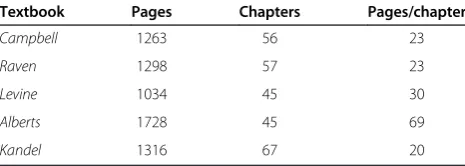
field of neuroscience, and is therefore, narrower in breadth but has greater depth than Campbell, and also contains additional topics such as cognitive scienceh[39].Kandelis a textbook written for advanced undergraduates, graduate students, and medical students studying neuroscience, a specialized field that is largely biological, but also concerns itself with psychology and cognitive science.Kandeldiffers from the other textbooks in that different authors who are experts in their respective fields contributed most of the individual chapters. This approach may lead to a less-uniform treatment across the book than the other text-books, which are each written by a small team of authors. Data comparing the relative lengths of these four text-books is summarized in Table 1 below.
Goals of research
We divided the high-level goal of investigating to what extent do our current process and methodology for cap-turing the semantics of textbook knowledge generalize to a range of life sciences textbooks into the following three more-specific questions: (1) To what extent is knowledge shared between the different textbooks? (2) To what extent can the same ontology be used to represent the knowledge found in different textbooks? (Based on our work withCampbell Biology, we were aware of many of CLIB’s limitations, especially because, from an AI perspec-tive, fully capturing natural language text is an extremely difficult problem. Our goal here was to quantify the extent to which we could represent knowledge by using the exist-ing CLIB vs. extendexist-ing it to address any new require-ments as we model different textbooks.) (3) To what extent can the questions of interest for a new textbook be answered by using the reasoning mechanisms already available in AURA? Because the foundational set of ques-tions is expected to be similar in all domains, we expected good generality, but we wished to quantify it against each textbook.
Methods
We now consider our methods for answering each of the three specific questions introduced in the previous section.
Domain analysis
The goal of domain analysis is to answer the question: To what extent is knowledge shared between the differ-ent textbooks? More specifically, we were interested in understanding whether KB creation for each new book should start from scratch or some knowledge from one book could be shared from another. Answering this question for the topics that appear in one textbook but not in another is straightforward. Therefore, we selected the topics of action potential and membrane structure, which appeared in each of the four textbooks. The team undertook a coarse analysis of the selected material and selected a few paragraphs for detailed analysis. The team compiled information such as the length of coverage, the actual biological content covered, figures, and the type of language used for describing the material. Such com-parison gave us insight into the commonality of know-ledge across different textbooks, and that information guided us as to what extent we could share the domain-specific content across the KBs for different textbooks.
Knowledge representation analysis
The goal of the knowledge representation analysis was to answer the question: To what extent can the same upper ontology be used to represent the knowledge found in dif-ferent textbooks? Next, we give an overview of the AURA knowledge-engineering process that was the basis of the representation analysis, we provide an approach for deal-ing with subject matter consensus, and we introduce categories of representation requirements.
AURA knowledge-engineering process
We used an already established knowledge-engineering process to represent the content of a textbook [31] as the basis of this analysis. This process has two distinct phases: (1) representation design and (2) knowledge encoding. For the representation-requirements analysis, we performed only the representation design phase, which includes the following three steps: (1) determining relevance: analyze each sentence in the textbook for its relevance for answer-ing questions; (2) writanswer-inguniversal truths (UTs): for each relevant sentence, paraphrase it as a universally true state-ment about a specific entity or an event; and (3) develop-ing action items for encoddevelop-ing: for each universally true statement, identify the concepts and relations that will be used for representing it.
We illustrate the above process by considering an ex-ample sentence: “Many cells, including most prokaryotes,
also produce a strong supporting layer around the mem-brane known as a cell wall”. Multiple UTs can be derived from this sentence. One UT is:“Many cells produce a cell wall”. The use of wordmanyis also indicative of the fact that there are some exceptions to this UT. To handle such exceptions, our knowledge-engineering process dictates Table 1 Data on page length and chapters in selected
textbooks
Textbook Pages Chapters Pages/chapter
Campbell 1263 56 23
Raven 1298 57 23
Levine 1034 45 30
Alberts 1728 45 69
that this statement should be further specialized for cells (for example, plant cells always produce a cell wall). Thus, the UT will be reformulated as“All plant cells produce a cell wall”.
Our general strategy to deal with exceptions is finding a class for which that statement is applicable as a universal truth. We ignore any exceptions that cannot be dealt with by using such a strategy. With the CLIB ontology, the UT under consideration will be represented by asserting that everyPlant-Cellis anagentof a process calledSynthesis
-of-Cell-Wall, which has a result of Cell-Wall which is -part-ofthePlant-Cell. Here,agent,result, andis-part-of are relations from the CLIB ontology. As a second ex-ample, consider the UT:“Every plant cell has a cell wall that is a strong supporting layer”. This UT will be repre-sented by asserting that everyPlant-Cellhas-partaCell
-Wallthathas-functionaSupportthat has anobjectthe
Plant-Cell itself, and has an intensity value of strong. Here,has-function,object, andintensityare relations in the CLIB ontology. As a final example, consider the fol-lowing sentence:“A protoplast is a plant cell without a cell wall”. The UT for this sentence will be:“Every protoplast is a cell without a cell wall”. Clearly, the sentence frag-ment “every protoplast is a plant cell” cannot be univer-sally true in our representation, because in that case,
Protoplastwill inherit all the properties of aPlant-Cell in-cluding a Cell-Wall. We will define Protoplast as a sub-class of Cell in our class hierarchy. The relationship between aPlant-Celland aProtoplastwill be captured by other means.
Another central feature of AURA’s knowledge-engineering process is the division of labor between knowledge engi-neers and domain experts: the knowledge engiengi-neers have access to the full power of the representation language— which, as was explained earlier, is comparable to first-order logic with equality—but the domain experts create only new classes, declare classes to be disjoint, specify cardinality constraints, and, most importantly, author existential rules of the sort visualized in Figures 1 and 2.
Achieving consensus among domain experts
Our approach to achieving consensus among the differ-ent domain experts working on the project is driven by the following observations: (1) Even for biological know-ledge at the level of an introductory college course, no two textbooks are exactly the same. (2) A textbook such as Campbell has a large number of reviewers who are able to approve the content of the textbook. (3) Despite the differences in the textbooks, the students can be evaluated using a common test, and their answers can be rated. The key lessons that we drew from the textbook-authoring process is to aim for a process in which the project experts could review a representation and have an objective test for evaluating the knowledge in the
system. We developed an extensive set of knowledge-engineering guidelines that prescribe how the domain experts should go about capturing textbook knowledge [31,40]. Just as a textbook undergoes a review process, the representations undergo a review process that ensures an adequate application of the guidelines. This review does not mean that a representation meets an expert’s personal view on how the knowledge should be modeled, but ra-ther ensures that the established encoding guidelines are adequately applied. Question and answer pairs stated in English provide a natural objective test to check the ad-equacy of the representation in the same way as students can be objectively tested on an exam.
Inventory of representation requirements
The representation requirements can be put into two categories: (1) requirements that are already supported in CLIB and (2) requirement that are not currently sup-ported. When we cannot model a universal truth in a straightforward manner by using the constructs available in the CLIB, we note this as a new KR requirement. The new KR requirements are strongly dependent on the state of CLIB at the time of the analysis. For answering the question of whether the same upper ontology could be used across multiple textbooks, however, the primary issue is the applicability of the representations supported in CLIB and the commonality of each new requirement across different textbooks.
KR requirements can arise due to the following rea-sons: (1) The knowledge can be represented by using the current features of the representation language and CLIB, but no established knowledge-engineering guide-lines exist to handle it. We refer to the challenges arising due to this reason asprocess issues. (2) Representing the knowledge requires intervention from a knowledge engin-eer to extend the upper ontology. We refer to the issues arising due to this reason asrequiring knowledge-engineer support. (3) Representing the knowledge is a topic of current and future research, and the current research has not yet been incorporated into the project. We refer to such issues asrequiring research and application. We now give an inventory of the KR requirements that were en-countered during the process, and we indicate into which of the above three categories each requirement fell.
Negative information
We say that a UT has a negative information KR issue if it cannot be modeled by using any of the four existing methods for handling negative information: (1) disjoint-ness between classes, (2) cardinality constraints, (3) rela-tions with negative meaning, and (4) negative values. As an illustration, consider the following sentence from
not water-soluble”. Here, we can state that a polar mol-ecule is disjoint from a nonpolar molmol-ecule (to capture the nonpolarity), and we can assign a value of“insoluble” to the property solubility-in-water. In principle, one could introduce a slot with negative meaning (for example, does-not-form, or use a qualified number constraint on allCreateprocesses in whichNonpolar-Chainsparticipate that asserts that theresultcontains exactly zeroHydrogen
-Bonds). However, no established methodology exists re-garding which approach to use. Therefore, dealing with the example of negative information considered here is a process issue.
Missing relationships
We say that a UT cannot be expressed because of a missing relationship if the necessary relationship is missing from the vocabulary. An issue already known based on our work with Campbell is the lack of certain spatial relationships. As an illustration of this issue, consider the following sen-tence fromRaven:“Although the distribution of membrane lipids is symmetrical in the ER where they are synthesized,
this distribution is asymmetrical in the plasma membrane,
Golgi apparatus, and endosomes”. Here, we need a new relation to capture asymmetrical distribution. Missing rela-tionships require knowledge-engineer support.
Inability to state graded quantifiers
Recall that whenever the textbook uses words such as
“many”, “most”, “typically”, etc., our KE strategy is to find a more-specific subclass for which the statement is universally true. This strategy breaks down when the textbook does not contain information about such a spe-cific subclass. For example, consider the following sentence fromLevine:“Most prokaryotes and many eukaryotes have cell walls”. The main difference between this sentence and the sentence:“Many cells,including most prokaryotes,also produce a strong supporting layer around the membrane known as a cell wall”, which we considered earlier, is the that Levine does not offer any specific examples of cells that do contain cell walls, so we cannot apply our KE strat-egy that worked for the earlier sentence. Whenever we encounter such a situation, we label it as an inability to state graded quantifiers, and it is a research and applica-tion issue.
Modeling biological models and reified statements
The textbooks frequently describe models and theories about natural phenomena. The statements about models are not universally true statements, but instead are contextual statements that hold true only in the context of that model. As an illustration, consider the following state-ment fromAlberts: “These regions cannot be identified in hydropathy plots and are only revealed by x-ray crystallog-raphy, electron diffraction (a technique similar to x-ray
diffraction but performed on two-dimensional arrays of proteins),or NMR studies of the protein's three-dimensional structure”. Here, the presence of the regions is contextual to a particular set of techniques. Such knowledge can be captured in AURA, but the relevant guidelines have not been developed yet, and therefore, it is a process issue.
Property value comparison
A need frequently exists to compare property values. The CLIB ontology contains several comparison operators for properties, but we saw some examples where none of the existing operators were directly applicable to some sen-tences in the new textbooks. For example, consider the fol-lowing sentence fromRaven:“However,at the end of each action potential, the cytoplasm contains a little more so-dium and a little less K than it did at rest”. Here, we need qualitative operators to capture relationships such as “little more” and “little less”. This issue requires knowledge-engineer support.
Causation
The notion of causality associated in the context of pro-cesses where causal relationships of events are of primary interest is already supported in CLIB. The textbook very often explains things by using the words such as “ be-cause”, “causes”, etc. We use the category label of caus-ation to capture such issues as the current CLIB does not provide support to model such information. For example, consider the following sentence from Alberts:“The shape and amphiphilic nature of the phospholipid molecules cause them to form bilayers spontaneously in aqueous environments”. This KR requirement requires both research and application.
Disjunction
A need arises to capture two or more alternatives in a UT that cannot be modeled by another means. For example, consider the following sentence from Alberts:
“Hydrophilic molecules dissolve readily in water because they contain charged groups or uncharged polar groups that can form either favorable electrostatic interactions or hydrogen bonds with water molecules”. This KR require-ment requires both research and application.
Conditionality
example, consider the following sentence from Alberts:
“This change of state is called a phase transition,and the temperature at which it occurs is lower(that is,the mem-brane becomes more difficult to freeze)if the hydrocarbon chains are short or have double bonds”. Here the condi-tionality is between the temperature and the properties of hydrocarbon chains. If we model this knowledge by using sufficient properties, then creating unnatural classes, such as phase transition for short hydrocarbon chains, would be necessary. Handling this requirement is a process issue.
Possibility
Many sentences make statements of the form “A can B”, without necessarily stating that “A always does B”. We refer to the representation needs of such sentences as
possibility. For example, consider the following sen-tence from Alberts: “The free hydroxyl group contrib-utes to the polar properties of the adjacent head group, as it can form hydrogen bonds with the head group of a neighboring lipid, with a water molecule,
or with a membrane protein”. Dealing with this KR requirement is a research and application. Initial steps in this direction could be undertaken by using research result on representing dispositions [41].
Data interpretation
In the advanced textbooks, figures are shown that contain representative data. The text then describes the form of the data and what conclusions either were or could be derived from this data. Thus, the figures are not just meant to illustrate a model but also to teach students how the actual data led to a set of conclusions. As an illustration, consider the following sentence from
Alberts: “In a normal unclamped axon, an inrush of Na+through the opened Na channels produces the spike of the action potential; inactivation of Na chan-nels and opening of K chanchan-nels bring the membrane rapidly back down to the resting potential”. Dealing with this requirement is a research and application issue.
Science as a process
Particularly in Kandel and also in Alberts, many of the biological concepts are presented in the context of the process of science, i.e., scientists go through a process of testing, interpreting data, and developing hypotheses that are then tested again. For example, consider the following sentence fromKandel:“A simple interpretation of these results is that the depolarizing voltage step se-quentially turns on active conductance channels for two separate ions:one type of channel for inward current and another for outward current”. Dealing with this require-ment is a research and application issue.
Qualitative number constraint
Our current representation approach enables quantita-tive number constraints. We saw several examples in the textbooks where the constraint values are qualitative, and no other encoding approach sufficed. For example, con-sider the following example from Raven: “Mammalian membranes, for example, contain hundreds of chemically distinct species of lipids”. Dealing with this requirement requires knowledge-engineer support.
Mathematical reasoning
CLIB provides two different representations to facilitate mathematical reasoning: (1) simple qualitative relationships such as direct proportionality and (2) reasoning with math-ematical equations. However, Kandelpresents more com-plicated equations beyond CLIB’s current representational and reasoning capabilities.Kandelalso includes derivations of mathematical formulas that cannot be represented by using current capabilities. For example, consider the follow-ing sentences fromKandel:“When tetraethylammonium is applied to the axon to block the K+ channels, the total membrane current lm,consists of lc,lvand lNa.This outward current reaches a plateau that is maintained for the dur-ation of the pulse (Figure nine-3B)”. Dealing with this re-quirement requires knowledge-engineer support.
Vagueness/ambiguity
Advanced textbooks cover frontiers of our knowledge, and hence, this vagueness or ambiguity is not due to pedagogical presentation. However, it can lead to a uni-versally true statement that is relevant but too vague to properly encode. These sentences are found across all
textbooks, and seem to be more common in Alberts.
(For example: “Membrane attachment through a single lipid anchor is not very strong, however, and a second lipid group is often added to anchor proteins more firmly to a membrane”.) Dealing with this requirement requires research and application.
Other issues
We use the KR category of other issuesfor representation problems that do not clearly fit into any of the previous cat-egory. For example, consider the following sentence from
and relationship questions, a representation based on sufficient properties is adequate.
Reasoning requirements analysis
The goal of the reasoning requirements analysis was answering the question: to what extent can the questions of interest for a new textbook be answered by using the reasoning mechanisms already available in AURA? We wanted to confirm that as we move across textbooks, we would not have to develop new sets of reasoning methods for answering questions. To perform the analysis, the domain-expert team developed sample questions about membrane structure and action potential for each of the four textbooks. The overall guidance was to focus on the kinds of questions that a student studying from the book might have. The biologists had access to the examples of educationally useful questions that we had previously developed forCampbell. Some variability in the style and difficulty of questions potentially exists, because we did not have a mutual validation of question sets authored by different biologists. The possibility also exists that we biased their question-authoring effort by showing them the questions from the prior effort onCampbell. However, because the questions from the previous effort received extensive feedback from multiple teachers and students, we believe that they were a good guideline for this exercise. The domain-expert team and the knowledge-engineering team jointly analyzed the questions.
The questions stated in English needed to be translated into the question templates supported by the system. Such translation is done by AURA’s question-understanding module [42]. In many cases, the English statement of a question is not very helpful for determining the computa-tion that must be performed in answering that quescomputa-tion. For example, consider the question: “How does the pos-ition of the gates in gated proteins cause the blocking of the movement of ions across the membrane?” We can re-formulate this question as: “What is the causal relation-ship between the position of the gates in gated proteins and the blocking of the movement of ions across the mem-brane?” Another formulation of the same question is:
“How are the position of the gates in gated proteins and the blocking of the movement of ions across the membrane causally related?” In AURA, both of these formulations will be handled by using Q6, in which we search for the causal relationships between the two entities in the question, and we expect the answer to be contained in the retrieved path. To develop such reformulations, the knowledge engineers must extensively rely on their know-ledge of AURA to determine whether a given question in the corpus could be translated into one of the existing templates. This approach introduces some imprecision into the analysis, but this is unavoidable without undertak-ing the actual implementation.
Results and discussion
We now consider the results of our analysis of domain knowledge, and representation and reasoning require-ments, for the four textbooks.
Results and discussion on domain knowledge analysis
We first analyze the two topics that we chose for compari-son: action potential and membrane structure, and then offer conclusions based on the analysis.
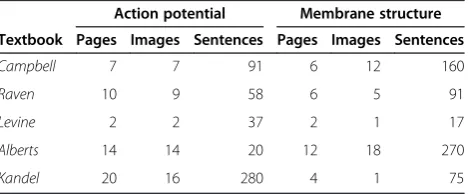
In Table 2, we summarize data about the length of de-scription of the different topics across the five textbooks. To the extent that different textbooks emphasize differ-ent levels of detail, the corresponding KBs need to match that level of detail. To make this observation concrete, we consider below specific example comparisons of content across the three textbooks.
Campbellcovers membrane structure in greater depth than Levine, Raven, or Kandel, but is limited in its description of the molecular structure of phospholipids.
Raven and Alberts devote more detail to the molecular structure of phospholipids. Levine introduces lipids but has no mention of their more specific forms, such as glycolipids, which are mentioned in the other textbooks. In Kandel, membrane structure is not a major topic (it is more a topic in general biology than in neuroscience).
Campbelldescribes equilibrium potential by providing a definition and presenting an equation for the mathemat-ical model known as the Nernst equation, along with two examples using this equation. Raven provides a similar amount of information toCampbell, but omits any exam-ples using the Nernst equation.Alberts provides a defin-ition, derives the Nernst equation, and shows several examples.Kandelprovides the greatest breadth and depth for membrane potential, and devotes an entire chapter (Chapter 8) to the passive electrical properties of the neuron that are important for understanding the influence of neuronal structure and other properties on short and long-range signaling.Kandel also covers the contribution of different types of membrane channels to the signaling properties of different parts of the neuron.
Next, we consider the biological themes that occur inconsistently across our sample of textbooks: evolution,
Table 2 Data on the length of description of action potential and membrane potential
Action potential Membrane structure
Textbook Pages Images Sentences Pages Images Sentences
Campbell 7 7 91 6 12 160
Raven 10 9 58 6 5 91
Levine 2 2 37 2 1 17
Alberts 14 14 20 12 18 270
disorders/disease, scientific uncertainty, and animal models.
Campbell,Raven, andLevinedo not mention evolution in the context of action potential, but Alberts and Kandel
discuss evolution of action potential function and structure of membrane proteins, respectively. Although Campbell
andRavenomit discussion of disease,Levine,Alberts, and
Kandel provide examples of diseases that affect normal functioning of action potentials. The presentation of scientific uncertainty also varies considerably across text-books.Ravenomits any mention of scientific uncertainty in the context of action potential, while Campbell and
Levine simply report its existence. Alberts suggests that scientists will resolve uncertainty without exception, but
Kandel presents scientific inquiry with respect to action potential as an iterative process with some degree of un-certainty. Animal models for the study of action potential are not described in Levine, and a single experimental model is described in bothRavenandCampbell. Although
Kandel describes a single experimental model, the giant squid axon, this text also emphasizes experimental tech-niques and their specific role in elucidating aspects of the action potential. Alberts describes multiple experimental models for the study of action potential.
The examples above suggest a great deal of common-ality as well as differences in how different topics are de-scribed across the textbooks. For example, on the topic of membrane structure, the KB for Levine will contain far fewer terms than the other KBs (e.g., terms such as Glycolipid would need to be omitted.) Similarly, the KB forAlbertsandRavenwill provide a much more detailed account of phospholipid structure than the KB for
Campbell. Similarly, while the Nernst equation will exist in all the KBs, the example associated with its use (as inAlberts), and a description of electrical properties (as inKandel), will be specific to the KBs for those textbooks only. Differences in how to handle evolution, uncertainty, diseases, and animal models can have major repercussions in KB design.
Our analysis above suggests that a great deal of com-monality across textbooks can be leveraged in creating a KB for each of them. At the minimum, the experience and representation approaches developed for one textbook can contribute toward a faster design of representations for a different textbook. Our analysis does not provide sufficient information about whether the domain-specific axiom writing for the textbook for a new KB should begin from scratch or should reuse the axioms from the previous ones. Clearly, some reuse should be possible, but the ex-tent of reuse and its cost effectiveness is an open question. Further, our analysis provides concrete examples of where the textbooks have substantial differences requiring repre-sentation design that is specific to that textbook.
Results and discussion on knowledge representation requirements
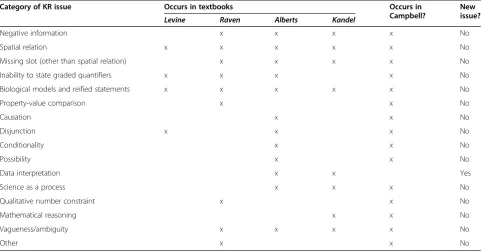
In Table 3 below, we summarize all the KR issues along with the textbooks for which the issue was encountered. The column labeled as “New issue” indicates an issue that we have not encountered or so far addressed in our work withCampbell Biology.
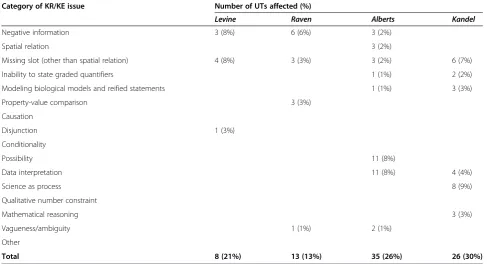
In Table 4 below, we show the results that indicate the number of UTs for each of the textbooks that could not
Table 3 Observed knowledge representation issues
Category of KR issue Occurs in textbooks Occurs in Campbell?
New issue?
Levine Raven Alberts Kandel
Negative information x x x x No
Spatial relation x x x x x No
Missing slot (other than spatial relation) x x x x No
Inability to state graded quantifiers x x x x No
Biological models and reified statements x x x x x No
Property-value comparison x x No
Causation x x No
Disjunction x x x No
Conditionality x x No
Possibility x x No
Data interpretation x x Yes
Science as a process x x x No
Qualitative number constraint x x No
Mathematical reasoning x x No
Vagueness/ambiguity x x x x No
be adequately represented for the topic of action poten-tial. For each UT that could not be represented, we iden-tify a knowledge representation category to indicate the nature of requirement. We next explain these results for each of the textbooks.
For Levine, approximately 20% of UTs for action po-tential had new KR requirements. In addition, negative information that could not be adequately encoded oc-curred for action potential, and we encountered one instance of disjunction that could not be adequately encoded. The issues of lack of specificity and models did not arise for action potential for this text. For theRaven
textbook, 13% of the UTs were problematic. ForAlberts, approximately 25% of UTs presented new KR requirements for action potential. In addition, the new KR requirement of data interpretation arose. InKandel, approximately 30% of UTs presented new KR requirements. Thus, likeLevine
but unlike Raven and Alberts, Kandel presented propor-tionally more issues for action potential. For example, data interpretation issues and science as process issues arose frequently. Further, for action potential,Kandelcontained sentences outside AURA’s current mathematical represen-tation and reasoning capabilities.
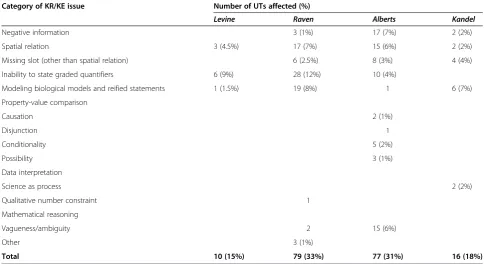
In Table 5 below, we show our results of how well we could represent the topic of membrane structure for each of the four textbooks. Detailed explanations follow.
ForLevine, we encoded approximately 85% of UTs with-out any facing any new requirements. The most common new KR requirements were missing relations (namely, spatial relations), and the inability to identify a sufficiently
specific concept, as illustrated in the earlier example.
Raven exhibits a greater percentage and breadth of new KR requirements thanLevine. Nearly 35% of UTs did have new KR requirements. The most common KR require-ments were, again, specificity of concepts and missing slots. A common requirement forRavenwas representing biological models. Raven (and the other textbooks) had several examples of negative information of a form that cannot be represented with AURA’s current capabilities.
Alberts has a similar percentage of new KR requirements toRavenand a greater breadth. Again, more than 30% of UTs posed some new KR requirement. Further require-ments come from conditionality, causation, and possibility. Because Alberts is a research-oriented textbook, it de-scribes topics at the limit of current biological knowledge. This leads to the greater number of UTs with the KR issues of vagueness compared to other textbooks. For Kandel, more than 80% of UTs were encoded without facing any new KR requirement, and no new requirements arose that did not arise for another textbook, except the need to represent knowledge about science as a process. Hence, in terms of number of issues,Kandelproved amenable to our KE process despite its more advanced nature.
Let us now consider how these results address the ques-tion: to what extent can the same upper ontology be used to model knowledge across a range of life science text-books? The results in Table 3 suggest that all the require-ments that were identified for the new textbooks, with the exception of data interpretation, were also requirements for Campbell. This finding is strong evidence in support Table 4 KR requirements by category, for the topic action potential
Category of KR/KE issue Number of UTs affected (%)
Levine Raven Alberts Kandel
Negative information 3 (8%) 6 (6%) 3 (2%)
Spatial relation 3 (2%)
Missing slot (other than spatial relation) 4 (8%) 3 (3%) 3 (2%) 6 (7%)
Inability to state graded quantifiers 1 (1%) 2 (2%)
Modeling biological models and reified statements 1 (1%) 3 (3%)
Property-value comparison 3 (3%)
Causation
Disjunction 1 (3%)
Conditionality
Possibility 11 (8%)
Data interpretation 11 (8%) 4 (4%)
Science as process 8 (9%)
Qualitative number constraint
Mathematical reasoning 3 (3%)
Vagueness/ambiguity 1 (1%) 2 (1%)
Other
of the claim that if these requirements were supported in an upper ontology, such ontology would be applicable across multiple textbooks. From Table 3, we also see that spatial relationships and biological models are the require-ments that occur most uniformly across the textbooks, followed by negative information, graded quantifiers, and science as a process. These constitute high-priority areas for extending the CLIB ontology.
From Tables 4 and 5, we see that the existing upper ontology enabled us to capture at least 67% of all the UTs across all topics and across all the textbooks. In some cases, the coverage was as high as 87%. Based on these re-sults, we can conclude that CLIB already provides a good foundation for representing knowledge across the range of life science textbooks considered here.
Results and discussion on reasoning requirements Recall that our high-level question regarding reasoning requirements was: To what extent can the questions of interest for a new textbook be answered by using the reasoning mechanisms already available in AURA? We gave an overview of the current questions supported in an earlier section.
To answer the above question, we assembled a suite of new questions for each of the four textbooks and put them into two different categories: (1) answerable with existing system capabilities, or minor extensions of them, supposing that the requisite concepts are encoded; and (2) require new reasoning capabilities, or major extensions
of existing capabilities, or beyond anticipated feasible reasoning, or contingent on significant new research. We will now present the results of our analysis and will illustrate the questions that fall into each of these categories.
In Table 6 below, we summarize the overall analysis of questions about action potential and membrane structure.
Across the four textbooks on average, we observe that for action potential, approximately 85% of the questions are category 1 (existing capability), and 15% are category 2 (representational extension or significant reasoning re-quirements). For membrane structure, nearly 90% of the questions are category 1 (existing capability), and 10% are category 2 (representational extensions or significant reasoning requirements).
From each of the four textbooks, we now give example question forms that could be answered by using the exist-ing capability. For each question form, we give an example question, its model answer if provided, and a reformula-tion of the quesreformula-tion. Because each of these quesreformula-tion forms can be answered by using the existing capability (or a minor extension of it) through the given reformulations, new question templates are not required.
●Question template in English:What is the role of X
(in context Y)?
○Example instantiation from the sample question set:
“In the equivalent electrical circuit model,what cellular element serves as the resistor?”[Kandel]
Table 5 KR issues by category, for the topic membrane structure
Category of KR/KE issue Number of UTs affected (%)
Levine Raven Alberts Kandel
Negative information 3 (1%) 17 (7%) 2 (2%)
Spatial relation 3 (4.5%) 17 (7%) 15 (6%) 2 (2%)
Missing slot (other than spatial relation) 6 (2.5%) 8 (3%) 4 (4%)
Inability to state graded quantifiers 6 (9%) 28 (12%) 10 (4%)
Modeling biological models and reified statements 1 (1.5%) 19 (8%) 1 6 (7%)
Property-value comparison
Causation 2 (1%)
Disjunction 1
Conditionality 5 (2%)
Possibility 3 (1%)
Data interpretation
Science as process 2 (2%)
Qualitative number constraint 1
Mathematical reasoning
Vagueness/ambiguity 2 15 (6%)
Other 3 (1%)
●Question template in English:Why is it important that X has property Y?
○Example instantiation from the sample question set:
“Why is it important that membranes are selectively permeable?”[Levine]
○Reformulate as:“How does the selective
permeability of membranes facilitate its function?”
●Question template in English:What kinds of X are common in Y?
○Example instantiation from the sample question set:
“What kinds of lipids are common in cell membranes?”[Levine]
○Reformulate as:“What are the lipid parts of a cell membrane?”
●Question template in English:What does X do during Y?
○Example instantiation from the sample question set:
“What is the sodium potassium pump doing during an action potential?”[Levine]
○Reformulate as:“What does sodium potassium do during an action potential?”
●Question template in English:What features of X affects its role in Y?
○Example instantiation from the sample question set:
“What features of the voltage-gated sodium channel affect its role in an action potential?”[Raven]
○ Reformulate as: “What is the relationship between a voltage-grated sodium channel and action potential?” (This reformulation is approximate as it does not specifically ask for the relationship to role in the action potential.)
We now consider example questions that require new question templates. For each, we give an example ques-tion template and its instantiaques-tion.
●Question template in English:What is the importance of X?
○Example instantiation from the sample question set:
“What is the importance of plasma membrane fluidity?”[Alberts]
●Question template in English:What aspects of X can be seen by Y? (where Y is a inspection technique, instrument, or process)
○Example instantiation from the sample question set:
“What aspects of the plasma membrane can be seen by transmission electron microscopy(TEM)?”[Raven]
●Question template in English: What properties of X contribute to the property Z of Y?
○Example instantiation from the sample question set:
“What characteristic of phospholipids contributes most to the membrane-forming properties of these molecules?”[Alberts]
●Question template in English:Given that X does Y,
why does Z also not do Y?
○Example instantiation from the sample question set:
“Given that the sodium-potassium pump results in a net transport of positive ions from the inside of the cell to the outside,why don't negative ions also leave the cell to balance out the charge difference?”[Raven]
●Question template in English:Which strategy does X use to achieve Y?
○Example instantiation from the sample question set:
“Vertebrate systems generally rely on what adaptive strategy for increasing the rate of axonal
conduction?”[Kandel]
The quantitative results in Table 6 support the conclu-sion that a large fraction of the questions in the test suite assembled by the domain experts (greater than 85%) for a new textbook could be answered by using the reasoning mechanisms already available in AURA. This finding is an extremely positive result that attests to the generality of the already-implemented reasoning mecha-nisms. However, we would like to emphasize that given the bias introduced by exposing the domain experts to the existing capabilities, we should not take these results to conclude that the existing capabilities could answer greater than 85% of all possible questions posed against these textbooks. These results are applicable to only to a specific style of educationally useful questions that have Table 6 Reasoning requirements analysis for action potential and membrane structure
Action potential Membrane structure
Textbook Questions Existing Research Questions Existing Research
Raven 16 12 4 21 17 4
Levine 53 43 10 32 25 7
Alberts 19 16 3 48 47 1
Kandel 50 43 7 29 26 3
Total 138 114 22 130 115 15
been found helpful in our work on the intelligent text-book. These results show that such questions have a high degree of generality and applicability across the range of textbooks considered in this analysis.
Comparison to related work and broader impacts
In this section, we relate the work presented here to re-lated efforts in modeling knowledge by using OWL and other biomedical ontology development efforts. We also comment on how our work can be exploited by others.
Most of the representation features used in AURA are also found in OWL (for example, classes; class-subclass relationships; disjoint statements between classes; domain; range; qualified number constraints; etc.). Our work to capture graph-structured knowledge of the sort illustrated in axioms A1–A4 is closely related to recent efforts to extend OWL to capture graph-structured descriptions [17]. Others have recognized the need to support graph-structured descriptions to capture chemical structures [16], and active research is underway to address it [17-20]. KB Bio 101 already contains several hundred examples of complex concepts that utilize such graph-structured repre-sentation [13], such as the ones shown in Figures 1 and 2. One possible technique to achieve decidable reasoning in a KB with graph-structured descriptions is to avoid certain kinds of cyclical dependence among concepts [17], but no empirical evaluation exists of such a technique on a realistic, large-scale dataset. KB Bio 101 is an excellent candidate data set for undertaking such evaluation. More generally, KB Bio 101 can be used as a dataset for testing techniques for ontology modularization, ontology map-ping, ontology evaluation, development of ontology design patterns, etc.
In several prior publications, we related the represen-tations supported in CLIB with the ones adopted for bio-medical ontologies (for example, in [32], we describe our representation for structure and function; in [43], we de-scribe representation of roles; and in [44], we dede-scribe the representation of genetic entities). Gene Ontology or GO [45] is a closely related community-wide effort that sup-ports molecular-level and cellular-level representations for gene function. Because life science textbooks cover know-ledge at organismal, species, and population levels, the scope of knowledge represented in KB Bio 101 is much broader than the knowledge represented in GO.
A unique feature of our ontology that none of the other biomedical ontologies supports is a vocabulary of process classes (e.g.,Move,Attach,Release, etc.) and their detailed definitions using semantic relationships (e.g., agent, object, source, destination, etc.). Due to lack of such vocabulary, ontologies such as GO define functions using only textual strings and functions are not compositionally defined to capture their complete meaning. The CLIB approach to modeling processes and their participants
can be readily exploited by biomedical ontologies to achieve a much greater depth of knowledge capture for biological functions.
A driving use case for GO, and a major contributor to its success, has been its use in annotation projects. The question templates Q1–Q6 introduced in our work can provide another compelling use case for exploiting GO and other biomedical ontologies. Although Q1–Q6 were driven by the needs of education applications, similar reasoning can be useful for biological discovery applica-tions such as [46].
Many educational innovations begin at the graduate level, and slowly find their way to undergraduate and precollege-level education. Therefore, perhaps, the most impactful way to exploit this work is using it as an ex-ample to start incorporating biomedical ontologies into undergraduate and high-school-level curricula for life sci-ence education. Future life scisci-ences graduates will need to routinely use ontology resources, and some of these gradu-ates will need to help create new ones. However, ontologies are not yet a standard part of the life sciences curriculum. Students are not normally exposed to ontologies unless they enter a graduate program in bioinformatics. We believe that now is the time to begin making training in formal languages and their ontological commitments an integral part of the life sciences curriculum. Wider use of ontologies in the life sciences will lead to better under-standing and communication of knowledge by teachers and students. Such explicit usage of ontologies is different from the methods used by search tools such as Google, which are excellent for retrieval but do little to improve our understanding of the subject matter.
Conclusions
We present our conclusions for each of the three major analyses presented here: (1) domain knowledge require-ments, (2) knowledge representation requirerequire-ments, and (3) reasoning requirements. We acknowledge at the out-set that our conclusions are based on the data gathered for the topics of action potential and membrane struc-ture. Our generalized conclusions are based on the hy-pothesis that these data could be generalized to other biological topics in the textbook.
The results of ourdomain requirementsanalysis show that, as expected, theLevinetextbook, which is aimed at a lower instructional level thanCampbell, presents material from a more general perspective, omitting details that
Campbell and Raven include. Likewise, the textbooks aimed at a higher instructional level thanCampbellpresent details thatCampbell does not. The breadth and depth of coverage for action potential and membrane structure appear most similar betweenCampbellandRaven. We also found that the textbooks for instruction levels higher than