76
Comparison And Analysis Of Channel Estimation
Algorithms In OFDM Systems
Vineetha Mathai, K. Martin SagayamAbstract: - The channel estimation can be performed for analyzing effect of channel on signal by either inserting pilot tones into all of the subcarriers of OFDM symbols with a specific period or inserting pilot tones into each OFDM symbol. The block type pilot channel estimation h as been developed under the assumption of slow fading channel. When the data is transmitted at high bit rates, the channel impulse response can extend over many symbol periods, it leads to inter symbol interference. Orthogonal Frequency Division Multiplexing is one of the promising candidate to mitigate the ISI. This work improved various channel performance measures based on the comparison of various channel estimation algorithms and suggest a new technique which provides better performance.
Keywords: - OFDM, Block Pilot symbols, Channel estimation, Linear minimum mean square error (LMMSE), Mean square error (MSE), Bit error rate (BER)
————————————————————
I.
I
NTRODUCTIONOrthogonal Frequency Division Multiplexing (OFDM) is a very attractive technique for high bit-rate transmission in 4G wireless communication systems, where bandwidth is very precious, and service providers are continuously met with the challenges of including more number of users with in a limited allocated bandwidth. OFDM is a multicarrier modulation technique which provides an efficient means to handle high speed data streams on a multipath fading environment that causes intersymbol interference (ISI). In order to avoid it, cyclic prefix is added. Channel estimation is required for analyzing the effect of channel on the transmitted symbols [2]. Channel estimation methods mainly include blind channel estimation and pilot-based channel estimation. The blind channel estimation methods require a large amount of data and the convergence rate is very slow. Hence, it goes against the real-time channel estimation methods. So block pilot [6] based estimation came into our preference. In this method, the transmitted signal is known at the receiver. There are two modes: the block pilot mode and the comb pilot mode. In the block pilot mode, all the subcarriers of an OFDM symbol are dedicated to the known pilots. In the comb pilot mode, only a few subcarriers are used for the initial estimation process.
II.
C
HANNELE
STIMATIONChannel estimation is used to obtain the channel state information to know the channel properties using blind channel estimation and pilot-based channel estimation [2]. This information describes how a signal gets propagate from the transmitter to the receiver and represents the combined effect of fading, scattering etc. and power decay with distance. The Channel State Information (CSI) makes it possible to adapt transmissions to current channel conditions, which is crucial for achieving reliable communication. In this paper, only the block pilot based channel estimation technique is investigated. Channel estimation can be performed by either inserting pilot tones into all of the subcarriers of OFDM symbols with a specific period or inserting pilot tones into each OFDM symbol. The block type pilot channel estimation, is developed under the assumption of slow fading channel.
III.
S
YSTEMM
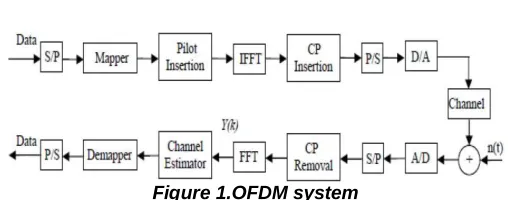
ODELFigure 1.OFDM system
In a wireless multipath environment, the transmitted signal gets reflected from several objects. The resulted multiple delayed versions of the transmitted signal arrive at the receiver at different time. This cause the received signal to be distorted. If only the first few samples of the symbol are distorted, we can consider the use of a cyclic prefix to remove the effect of intersymbol interference. The cyclic prefix would be of all zero samples transmitted in front of each OFDM symbol. It does not contain any useful data, it would be discarded at the receiver. The length of the guard interval should be longer than the time span of the channel, such that the OFDM symbol itself will not be distorted. Thus, by eliminating the guard interval, the impacts of intersymbol interference can be removed.
IV.
OFDM
M
ODELFig. l shows the OFDM baseband model used. It is assumed that the cyclic prefix is longer than the maximum propagation delay. So the orthogonality between subcarriers and non intersymbol interference can be preserved [1].The number of subcarriers and multipaths is K and L in the system, respectively. The received signal is obtained as:
Y=XH+N (1)
V.
C
HANNELM
ODELIt is assumed that the signal is transmitted over a multi path Rayleigh fading channel characterized by
) ( ) ( 1 0 i L i i
h
(2)
where T is the time delays of the different paths and L is the number of multipaths.
At the receiver, the synchronization is perfect so that transmitted data can be extracted. So that we make an assumption that the cyclic prefix is longer than the channel maximum excess delay.
VI.
C
HANNELE
STIMATIONM
ETHODSA.Least Square Estimator (LSE)
The Least square [3] estimate of the channel can be expressed as:
^
LS
H
= arg {min{(Y-XH
LS^ )H(Y-XH
LS^ )}} (3)Where
H
LS^ is the channel estimate for the LS methodHence, X N H X Y HLS
^ (4)
This algorithm is very simple, because it is not considering any channel statistical parameters it is prone to the noise. So the performance is worse.
B. Minimum Mean Square Estimator (MMSE)
The MMSE [5] estimate of the channel can be expressed as
Y
R
FR
Fh
H
MMSE^
MMSE^
hy YY1(5) Where H H hh H
hy
E
hY
R
F
X
R
[
]
(6)N n H H hh H
I
X
F
XFR
YY
E
Ryy
[
]
2(7)
Y
I
X
F
XFR
X
F
FR
H
MMSE^
hh H H(
hh H H
n2 N)
1 (8)Where
R
hh
E
[
hh
H]
is the channel auto- correlation matrix,2
n
is the noise variance, [ nk] K WF is the DFT matrix with
K nk j nk K e K
W 1 2 .
C. DFT based Channel Estimator (DFT based CE) DFT-CE is based on the property that the energy of the channel is very concentrated in the time domain [3]. The channel estimate Hˆ (k) can be derived in frequency domain based on LS estimation firstly. It is then converted to the time domain with IDFT:
1 0 ], 2 exp[ ) ( 1 ) ( 1 0 ^ ^
K n K nk j K H K n h K k (9)The cyclic prefix is always larger than the channel impulse response L in OFDM systems. The energy is concentrated in a few paths, while noise energy exist in the remaining paths. In order to reduce the effect of the noise, the channel impulse response are put to zeros. Only the channel impulse response in the paths within the cyclic prefix is remained.
(
)
)
(
' ^n
h
n
h
0
n
L
g
1
0
otherwiseIt is then converted to the frequency domain using DFT
1 0 ], 2 exp[ ) ( 1 ) ( 1 0 ' ^ ' ^
K n K nk j n h K K H K k (10)The accuracy of the estimation can be improved and the complexity is reduced, because the IDFT/DFT transforms can be implemented with the fast algorithms IFFT/FFT.
D. Linear Minimum Mean Square Estimator (LMMSE) The LMMSE channel estimator [1] tries to minimize the mean square error between the actual and estimated channels, obtained by applying the Wiener–Hof equation:
y
R
R
h
lmmse
hy yy1(11)
where the cross-correlation matrix is:
H hh H
hy
E
hy
R
X
R
[
]
(12)
the autocorrelation of received signal y is:
I
X
XR
yy
E
R
yy
[
H]
hh H
n2(13)
the LMMSE estimator can be obtained as:
ls H
n hh hh
lmmse
R
R
XX
h
h
[
2(
)
1]
1 (14)78 E. Dual Diagonal Linear Minimum Mean Square
Estimator (DD-LMMSE)
In DD-LMMSE [1],[7],[8] in order to reduce the mean square error only the diagonals of the LMMSE matrix is considered. The DD-LMMSE estimate can be obtained by:
1
)
)
((
)
(
C
y diagC
yy diagA
(15) 1)
)
((
)
(
C
hhD diagC
hDhD diagB
(16) Ay FBF FBF Fh N H D H DDDD
^ ^
2 1
^
(17)
where F is the DFT matrix and A and B are diagonal matrices
VII.
P
ROPOSEDW
ORKThe LMMSE estimator needs the channel statistical properties which are unknown in practice. The DFT based CE can improve the performance through DFT and IDFT based LS algorithm. In the LMMSE algorithm, the channel statistical parameters like the channel autocorrelation matrix and the noise variance is obtained. The channel energy is concentrated in the time domain, so the hˆ(n) should be noise. So the noise variance can be estimated. We obtained the channel autocorrelation matrix from the hˆ' (n) estimated in LMMSE algorithm. So by combining these two algorithms an optimized algorithm is obtained. The channel frequency response Hˆ (k) is estimated by LS estimator. Then the noise variance can be found out by
2 ^ 1
2
^ 1 |h(n) | L K K L n g n g
(18)The channel autocorrelation matrix is obtained by:
]
)
)
(
(
)
(
[
' ^ ' ^ Hhh
E
h
n
h
n
R
(19)
Then the estimate is obtained as:
1 0 ], 2 exp[ ) ( 1 ) ( 1 0 ^ ^
K n K nk j K H K n h K k (20)
Here the complexity is reduced and this algorithm is giving the best performance when the SNR is high and it is almost identical to the ideal LMMSE estimator.
VIII.
R
ESULTS ANDD
ISCUSSIONMATLAB simulations were carried out to evaluate the performance of the OFDM system.Various parameters considered are listed in the table.
Table 1. OFDM Simulation Parameters PARAMETERS SPECIFICATIONS
Number of active carriers 256 Pilot Ratio 1/8 Guard interval 256
Guard type Cyclic extension Channel Model Rayleigh fading
A. MSE Comparison
The MSE performance of the LS estimation, DFT based CE and MMSE estimation, LMMSE estimation, DD-LMMSE, Proposed Algorithm is shown in the Figure 4. The performance of the LS estimator is the worst due to the noise. The DFT based CE is having better performance since it eliminates the effect of the noise in time domain. The ideal LMMSE estimator has the best performance since it has the accurate channel statistical parameters. But the computational complexity of LMMSE is high. The performance of the proposed method is closed to the ideal LMMSE estimation and better than the LS and DFT based CE, because it uses the channel autocorrelation matrix and the noise variance which was estimated in the LMMSE algorithm. At high SNR, the performance of this algorithm is good. Since the effect of the noise is small, the proposed method is more accurate.
B. BER Comparison
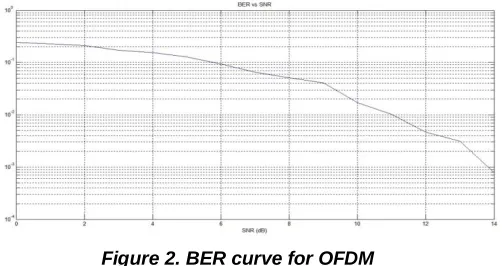
The BER performance of the LS [3],[5] estimation, DFT based CE and MMSE estimation, LMMSE estimation, DD-LMMSE, Proposed Algorithm is shown in the Figure 5. Because of the effect of the noise, the BER performance of LS estimator is the worst. The DFT based CE is better than LS estimator. The ideal LMMSE estimator has the best performance with the assumption of the channel statistical properties are available. However, the channel statistical properties are unknown in the practice system. The performance of the proposed method is better than the DFT based estimator and close to the ideal MMSE estimator. The proposed has the best performance at high SNR, hence it is accurate. After obtaining the received data it is easy to calculate the bit error rate. Error is calculated as difference between received and transmitted data. The following curve shows the bit error rate curve for various signal to noise ratio values.
Figure 2. BER curve for OFDM
Figure 3. Channel impulse responses for various algorithms
The performance analysis of various algorithms were shown in the following diagram. From this it is inferred that the proposed method is having better performance when SNR increases.
Figure 4. MSE curve for various estimation algorithms
Figure 5. BER curve for various estimation algorithms
C
ONCLUSIONThe channel is estimated using least square (LS), minimum mean-square error (MMSE), DFT based channel estimation, linear minimum mean square error (LMMSE), dual diagonal linear minimum mean square error (DD-LMMSE), Proposed Method. The performance of the proposed method is closed to the ideal LMMSE estimation and better than the LS and
DFT based CE, because it uses the channel autocorrelation matrix and the noise variance which was estimated in the LMMSE algorithm. At high SNR, the performance of the proposed method is much better. Since the effect of the noise is also small, hence the proposed method is much more accurate. It helps to estimate the impulse response of the channel and hence to reduce mean square error (MSE) and bit error rate (BER).
R
EFERENCES[1] Geng Nian, Xiaojun Yuan and Li Ping, "Dual-Diagonal LMMSE Channel Estimation for OFDM Systems‖, IEEE Trans.on Communication, pp.14-20, November 2011.
[2] Aida Zaier and Ridha Bouallègue,"Channel Estimation Study For Block-Pilot Insertion In OFDM Systems Under Slowly Time Varying Conditions‖, International Journal of Computer Networks & Communications (IJCNC) Vol.3, No.6, November 2011.
[3] Lie Ma, Hua Yu and Shouyin Liu, "The MMSE Channel Estimation Based on DFT for OFDM System", IEEE Trans.on Communication, pp. 1-4, October 2009.
[4] M. Faulkner, "The effect of filtering on the performance of OFDM systems", IEEE Trans. on Vehicular Technology, vol. 49, September 2000.
[5] Y. Qiao, S. Yu, P. Su, and L. Zhang, "Research on an interative algorithm of Is channel estimation in MIMO OFDM systems", IEEE Trans., Broadcast., vol. 51, pp. 149-153, March 2005.
[6] S. Coleri, M. Ergen, A. Puri, and A. Bahai, ―Channel estimation techniques based on pilot arrangement in OFDM systems‖, IEEE Transactions on Broadcasting, vol.48, pp. 223-229, Sept. 2002.
[7] J.-C. Lin, ―Least-squares channel estimation for mobile OFDM communication on time-varying frequency- selective fading channels‖, IEEE Transactions on Vehicular Technology, vol. 57, pp. 3538–3550, 2008.
80
A
UTHORB
IOGRAPHIESVineetha Mathai received her B. Tech degree in Electronics and Communication Engineering from Mar Baselios College of Engineering and Technology Trivandrum (Affiliated to Kerala University). She is currently pursuing her M.E degree in Communication and Networking Engineering at Madras Institute of technology, Anna University. Her current research interests include wireless mobile communications and signal processing. She has published 1 paper in IEEE international conference.