CLOUD ENVIRONMENT WITH THRESHOLD BAND
BASED FOR AUTOMATIC LOAD BALANCING
Siva Naga Manikanta Immidi
1, K Durga Prasad
2, Prof.S.V.Achutha Rao
31
M.Tech (CSE) Scholar Vikas College of Engg and Tech., Nunna, Vijayawada, A.P, (India)
2
Asst. Professor, Department of Computer Science Engg,
Vikas College of Engg and Tech., Nunna, Vijayawada. AP, (India)
3
Professor & Head, Department of CSE,
Vikas College of Engg and Tech., Nunna, Vijayawada, (India)
ABSTRACT
Virtualization is used in Cloud computing shares the essential hardware and it offers computing resources through virtual machines (VM). VMs provide separation among individual OSs. Resource usage could be upgraded by balancing the loads on the cluster and which can be reached through dynamic migrations of virtual machines anywhere required. Physical load balancing becomes very monotonous, meanwhile an administrator has to endlessly monitor the system to control which virtual machines to be transferred across the cluster. Maximum source use can be reached using involuntary load balancing through the cluster by doing active migrations of virtual machines and it is very important in such type of migrations of virtual machines to decide when to move and which virtual machine to what physical machine. Naive immigrations may result into ruin in overall performance of the cluster. The recommended solution encompasses a model which dynamically controls overloaded hosts and picks the finest virtual machine and endpoint host for migration to achieve improved load balanced environment
Keywords
-
Threshold Band, Load Balancing, Cloud Computing, Virtual Machines
I.
INTRODUCTION
Cloud computing is a approach for enabling suitable, on demand network access to a shared pool of
configurable calculating resources like , storage, networks, applications, servers, and services that can be
quickly provisioned and released with insignificant organization effort or service provider interaction. Many
types of services in Cloud Computing like Software as a Service, Public as a Service, and Infrastructure as a
Service etc. Cloud Computing depends on Virtualization for service implementation and distribute resources to
the end users over the web to achieve scalability. Virtualization presents a software abstraction layer among the
hardware and the operating system and applications running on top of the abstraction layer. It gives full control
of resource allocation to manager, resultant in finest use of assets. Load balancing is the procedure of improving
the performance of the system by shifting of workload among the all processors. Rapid migration of virtual
machines is a load balancing method which allows us to attain best use of offered resources dynamically in a
cloud computing environment.In the method presented by Hyung Won Choi involuntary load balancing is
upcoming decisions. The approach claims to perform better than the approach with threshold based migrations.
In our basic proposed approach, we recommend a model which will take well-organized choices for migration
of virtual machines from the burdened hosts. The choices depend mostly upon 3 things like CPU consumption
of all hosts called as the threshold value, main eccentricity of CPU consumptions of hosts around the threshold
rate and the CPU utilization of the most overloaded host.
1.1 Load Balancing Concepts
1.1.1 Virtualization
In cloud computing, there is a requirement to create a virtual environment by separating resources like memory,
applications, CPU, network and storage. Virtualization attains this with software as a service based
implementation and also the end user can cooperate with the computer-generated framework like a real single
consistent resource and it hides the physical arrangement of the original resource and in its place it shows
another abstract computing platform. It is elastic in terms of providing flexible provisioning of the services in a
timely and on-demand manner, which allows the cloud users to flexibly scale up and scale down the resources
as per the need. There are mainly two leading ways of implementing virtualization
1.1.2 Full Virtualization
Virtual Machine Monitor (VMM) is Virtual Machine Manager which accomplishes multiple operating systems
by distributing essential resources and preserving isolation between every virtual machine. VMM offers an
identical abstraction of the primary hardware to the virtual machines in full virtualization. But, not all designs
are virtualizable. Full virtualization totally separates primary hardware from the software and in that virtual
environment; the guest operating system need not to be changed. It will run also on the virtualized environment
as it would run in physical system.
1.1.3 Load Balancing
Well-adjusted systems always result in well performance and energy preservation. Load balancing is becoming
a very significant consideration for all cloud service providers and data canters. In order to attain minimum
resource consumption, avoid blocks, upgraded fault tolerance, scalability and over-provisioning. To gain
enhanced computing resources, burden is distributed across all the host systems in the cluster. Load balancing
allocates even workload to avoid conditions where some servers are heavily loaded and some are less loaded or
idle. The main goal of load balancing is to decrease resource consumption and to attain less response time by
preserving the balanced environment. Load balancing procedure runs for every cluster and controls source and
target for relocation to gain better usage of assets.
II.
RELATED
WORK
In cloud environment many virtual machines are organized on a cluster of hosts and also the workload on every
virtual machine could be random and also it may be change dynamically, which will leads to attention of load
on some hosts. If the burden increases on a host then the response time of that specific host gets degraded and
the cloud service providers need to deal with the Service Level Agreements those are signed with the clients on
the response time and also need to exploit the resource consumption in a cloud environment. To meet these
To meet these things, mainly 3 tasks should be performed: Identifying overloaded hosts in the cluster, choosing
the finest virtual machine for migration, avoiding undesirable migrations. The main aim of the algorithm is
separated into 2 parts. (i) To define the hosts which are already overloaded in the cluster, (ii) To decide the
finest virtual machine to migrate from these already overloaded hosts and also to specify the destination host
for data migration. Algorithm ONE, identifies the overloaded hosts in the cluster and the remaining part,
Algorithm TWO, resolves the best virtual machine to migrate from the already overloaded hosts and also the
endpoint host for migration.
2.1 Algorithm ONE: Detection of Overload by Using Threshold Band
When the use of a physical machine is beyond a static threshold, the machine is considered as overloaded. This
static threshold can become dangerous to total performance of the cluster. Even a single mistake in expecting
this threshold value may lead to needless migrations in the cloud. Later, detection of those thresholds need much
time, administrator’s continuous interference and also the resulting threshold may not be work properly for
different kind of situations since the computing loads change over time that’s why we propose a new parameter
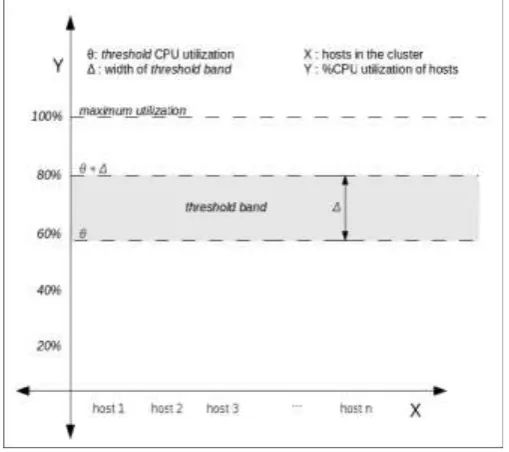
in this algorithm that is called as threshold value of CPU usage of all the hosts in the cluster is denoted by θ. Threshold value is considered occasionally and it is used as a standard to assume a host as overloaded and the
hosts which have CPU usage near to this proposed threshold value is named as overloaded. This “immediacy” is
enumerated with a model of threshold band. This defined threshold band is a section above the threshold value
and the hosts, whose CPU usage lies above this threshold band, is named as unstable. The hosts underneath this
threshold band are possible endpoints for migration. Fig 1 specifies the concept of threshold band.
Fig. 1 Threshold Band Concept
2.2 Algorithm ONE
1: Get CPU utilization (αi) of each host i in the cluster 2: Calculate Threshold: θ = (α1+α2+...+αn) / n
3: Calculate the Multiplicative factor:
4: Calculate the Mean Deviation:
n
ω = 1/n ∑ | αi−θ |
i=1
5: Calculate the width of the threshold band:
Δ = mω
6: Initialize LIST overloaded with an empty list 7: for i = 1 to i = n do
8: if αi > (θ + Δ) then
Append αi to LIST overloaded (List of overloaded hosts) 9: end if
10: end for
12: if LIST overloaded is empty then 13: Sleep for 1 second
14: Go to Step 1 of Algorithm ONE
15: else
16: Go to Step 1 of Algorithm TWO
17: end if
2.2 Algorithm TWO
1: Sort the LIST overloaded in descending order
2: SOURCE load Select MAX from (LIST overloaded).
3: Calculate the current standard deviation of the loads (SDcurr)
4: for all VMi in SOURCE do
5: SOURCE load = SOURCE load −VMi
6: αmin = αmin +VMi
7: Calculate SDi
8: end for
9: Find Minimum Standard Deviation SD min from All SDi s
10: if SD min < SD curr then
11: Perform Migration of the corresponding VMi
12: Go to Step 1 of Algorithm ONE
13: else
14: Remove the highest overloaded host from LIST overloaded
15: Sleep for 1 second
16: Go to Step 2 of Algorithm TWO
III.
RESULTS
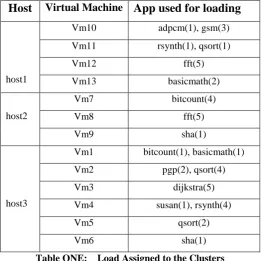
To examine our application we have created a scenario which faithfully relates to a representative computing
environment. Table ONE show the sharing of the virtual machines on the hosts and also load on virtual
machines. Here we have taken three hosts named as host1, host2 and host3, hosting virtual machines vm1
(Virtual Machine) to vm13 (Virtual Machine). Third column in the table ONE specifies the applications run on
every virtual machine. The number after the application name represents the number of occurrences of that
application running on that virtual machine and after execution of the loads on every virtual machine reports the
total time that is required by virtual machine to execute all the application occurrences allocated to it, to the
main center host.
Host
Virtual Machine
App used for loading
host1
Vm10 adpcm(1), gsm(3)
Vm11 rsynth(1), qsort(1)
Vm12 fft(5)
Vm13 basicmath(2)
host2
Vm7 bitcount(4)
Vm8 fft(5)
Vm9 sha(1)
host3
Vm1 bitcount(1), basicmath(1)
Vm2 pgp(2), qsort(4)
Vm3 dijkstra(5)
Vm4 susan(1), rsynth(4)
Vm5 qsort(2)
Vm6 sha(1)
Table ONE: Load Assigned to the Clusters
We have applied the above table loading scenario and examined the performance of our effective migration
algorithm and after that we compare performance of our proposed algorithm with other naïve migration
algorithm with nearly 50% threshold value of resource usage and to compare both the procedures, in the part of
our experimental results we run the migration algorithm with the same load scenario that is stated in the Table
ONE and catch the total execution time of the applications reported by every virtual machine.
IV.
CONCLUSION
Dynamic migrations of Virtual Machines assure maximum source usage and lowest reply time in a cluster. We
have offered a threshold band based approach which is automatically decides, on the base of the CPU usage,
which virtual machine to be migrated to which host and we took the average CPU usage of all the hosts in the
main cluster and also the CPU usage of the highest overloaded host, that will be into consideration for scheming
the threshold value. Based on the results we accomplish that using our proposed efficient migration algorithm
executes 32% faster than the previous naive algorithm for that the solution that we proposed in this paper must
be compared with the previously existing solutions. Determining the already existing solutions and comparing
framework for the calculation of CPU usage of all Virtual Machines, 2. testing our application by deploying it
on actual cloud with actual life loading environments, 3. removing the disadvantage of failure in the main server
by reproducing it to a main backup server.
REFERENCES
[1] Jyotiprakash Sahoo, Subasish Mohapatra, and Radha Lath, Virtualization: A Survey On Concepts,
Taxonomy And Associated Security Issues, in Second International Conference on Computer and Network
Technology, 2010.
[2] Sandeep Sharma, Sarabjeet Singh, Meenaksshi Sharma, Performance analysis of load balancing
Algorithms, in world academy of science in Engineering and Technology, 2008
[3] Gerald J. Popek University of California, Los Angeles ,Robert P. Goldberg Honeywell Information Systems
and Harvard University Formal Requirements for Virtualizable Third Generation Architectures
[4] Lamia Youseff1 , Rich Wolski1 , Brent Gorda2 , and Chandra Krintz1 , Paravirtualization For HPC
Systems.
[5] Gary chen,Al Gillen,KVM for server virtualization:An open source solution comes on AgeOctober : 2011.
[6] Nidhi Jain Kansal, Inderveer Chana, Existing load balancing techniques in cloud computing: A systematic
re-view ,February 15, 2012.
AUTHOR PROFILE
Siva Naga Manikanta Immidi, pursuing M.Tech(CSE) Vikas College of
Engineering and Technology, Nunna, Vijayawada. Affiliated to JNTU, Kakinada,
A.P., India
K Durga Prasad, working as an Asst. Professor at Vikas College of Engineering
and Technology, Nunna, Vijayawada, Affiliated to JNTU, Kakinada, A.P., India
Prof S.V.Achutha Rao, is working as a HOD of CSE at Vikas College of
Engineering and Technology, Nunna, Vijayawada, Affiliated to JNTU, Kakinada,