Emperor International Journal of Finance and Management Research [EIJFMR] Page 57
A STUDY ON THE CHARACTERISTICS
AND COMPETENCY OF SOFTWARE
DEVELOPER IN SELECT IT COMPANIES
IN BANGALORE
Paper Recceived 8th Aug 2017 Paper Accepted 20th Aug 2017 Paper Published 30th Aug 2017 Reviewers: Dr. R. Vasudevan Dr. V.Vijay Durga Prasad
Dr. K.RAJAKARTHIKEYAN Head & Research Supervisor Department of Corporate Secretaryship
Erode Arts and Science College Erode.
Dr.P.A.BALASUBRAMANIAN Associate Professor (Retired)
Department of Economics Erode Arts and Science College
Erode.
Dr.L.MANIVANNAN Assistant Professor
Department of Corporate Secretaryship Erode Arts and Science College
Erode.
Mr. R.SHANMUGASUNDARAM Research Scholar
Department of Corporate Secretaryship Erode Arts and Science College
Erode. Abstract
Software development is growing nowadays. This industry
needs most qualified and competent personnel for the
development of software. Top level managers, project
managers, system analyst, system designer and
programmer should have adequate competency and good
characteristics to perform their job efficiently and
effectively. Several research work found that practical
skills, multi-skilling, computer literacy, managerial skills,
personal skills, problem solving skills and inadequate
among the project managers. Among the various skills
problem solving skill is most important to the project
manager. Next to this analytical skill, team work skills,
language fluency, presentation skills, communication skills
and leadership skills are most important for the
development software. Software developers are important
keys to success of the software industry. In fact, as Turley
and Bieman , Turley and Bieman argued that much effort
has been placed in the development of engineering
approaches to software development such as software tools,
coding practices, and test technology. But the
overwhelming determiner of software productivity and
quality is still personnel and team capability argue that
software developers possess unique skills or competencies
to solve problems related to software engineering. Boyatzis
defined competency as an underlying characteristic of a
person which results in superior and/or effective
performance in a job. The study of competencies can
improve job descriptions, employee selection, staff
development, performance evaluation and promotion. In
order to analyze the above this study has been undertaken
to analyze the competencies and characteristics of a
software developer among the project managers, system
analyst, system designer and programmer and among the
top level managers in select IT companies in Bangalore
city. The study used factors analysis to analyze the
competency and characteristics of software developers.
Keywords— Software Development, Competency, Managerial Skills, Problem Solving.
I. INTRODUCTION
Emperor International Journal of Finance and Management Research [EIJFMR] Page 58 company. Software engineers must be fully qualified
for the job. Not only that they should have ability to accommodate himself to others, genuine interest in understanding what other people are trying to accomplish and based on this understanding think about creating technical solutions to help them reach their goals, Listening skills, approachable, and respect for people. Ability to work in homogeneous, multi-disciplinary, multi-locational and multicultural teams. Ability to work under supervision and constraints, Understanding of the impact of personal character and behaviours on others. Also should have the ability to apply knowledge, ability to integrate the application of knowledge, skills, and sense of responsibilities to new settings and complex problems.34. Abstraction and transition between levels of abstraction, representation skills spatial and temporal modeling skills, structuring skills, and theorizing. Algorithmic and structured thinking. Logic, pattern matching, logical what-if analysis, problem decomposition and synthesis, etc. Analytical skills, Communication skills. Based on the above this is conducted to analyse the characteristics and competencies of software developer in select IT companies in Bangalore city. The competencies and characteristics like dependability, good communication skills, technical knowledge to integrate knowledge areas, the ability to translate requirements into computational, the ability to manage the project, the ability to develop complex models, the ability to interact with system component, creativity, learn and share knowledge, a high tolerance of ambiguity in problem solving, adaptability to new situations, end-user empathy etc. The collected data was analysed using factor analysis using AMOS software and the findings of the result are presented in this research work.
II. MATERIALSANDMETHODS
Emperor International Journal of Finance and Management Research [EIJFMR] Page 59 development or training, they should group related
competencies. On the other hand, however, competencies that ar enot correlated (i.e. Logical thinking, Creative thinking, Achievement, and Service minded) may be considered important in contexts of staff development or training but not as important as the two factors. The same would be true for terms of implications for educators and curriculum content.
Linda Geoghegan and Victor Dulewicz (2008) in their study on Do Project Managers’ Leadership Competencies Contribute to Project Success?” identified 10 competent characteristics of software developer, like critical analysis and judgement, self awareness, emotional resilience, Intuitiveness, sensitivity, motivation, Conscientiousness, IQ Dimensions, EQ Dimensions and MQ Dimensions to analyse project man agers competencies for project success. Of these 10 leadership dimensions, five are management (MQ), four are social/emotional competencies (EQ), and one is an intellectual competence (IQ). It can be asserted, therefore, that MQ leadership dimensions contribute most to successful projects and therefore are highly significant in supporting the hypothesis. This is perhaps not a surprising result considering the
Emperor International Journal of Finance and Management Research [EIJFMR] Page 60 III. DISCUSSIONANDRESULTS
A Study on the Characteristics and Competency of Software Developer in Select it Companies in Bangalore
TABLE I. DISTRIBUTIONOFSAMPLEBYAGE
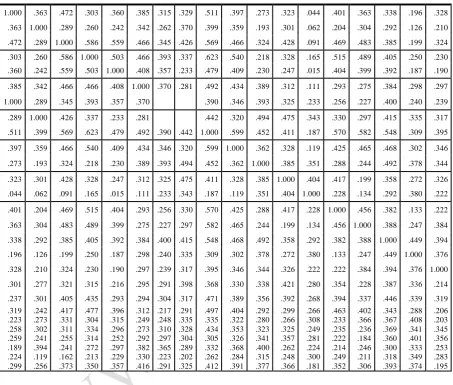
The above table correlation matrix showing how each of 27 items are associated with each of the other 26. Relatively high correlations indicate that two items are associated and will probably be grouped together by the factor analysis. Items with low correlations (eg.≤.20) usually will not have high loadings on the same factor. Items with high correlations (eg.≥.21) usually will have high loadings on the same factors. Our assumption is that the determinant located under correlation matrix should be more than .210. Hence, if it is .21 this assumption is met. If the determinant is zero, then the factor analytic solution cannot be
obtained, because this would require dividing by zero, which would mean that at least one of the items can be understood as a linear combination of some set of the other items. The table clearly shows that the factor 1 is highly associated with the factors all the factors except 13,17 and 25 as their correlations are greater than.20. Factor 2 is highly associated with all the factors except 11, 13, 17 and 26. Factor 3 is not associated with 13, 17 and 26 and are associated with all other factors. Factors 4, 6, 9 and 10 are not associated with 13th factor and is highly associated with all other factors. Fifth factor is not associated
1.000 .363 .472 .303 .360 .385 .315 .329 .511 .397 .273 .323 .044 .401 .363 .338 .196 .328
.363 1.000 .289 .260 .242 .342 .262 .370 .399 .359 .193 .301 .062 .204 .304 .292 .126 .210 .472 .289 1.000 .586 .559 .466 .345 .426 .569 .466 .324 .428 .091 .469 .483 .385 .199 .324 .303 .260 .586 1.000 .503 .466 .393 .337 .623 .540 .218 .328 .165 .515 .489 .405 .250 .230 .360 .242 .559 .503 1.000 .408 .357 .233 .479 .409 .230 .247 .015 .404 .399 .392 .187 .190
.385 .342 .466 .466 .408 1.000 .370 .281 .492 .434 .389 .312 .111 .293 .275 .384 .298 .297
1.000 .289 .345 .393 .357 .370 .390 .346 .393 .325 .233 .256 .227 .400 .240 .239
.289 1.000 .426 .337 .233 .281 .442 .320 .494 .475 .343 .330 .297 .415 .335 .317 .511 .399 .569 .623 .479 .492 .390 .442 1.000 .599 .452 .411 .187 .570 .582 .548 .309 .395
.397 .359 .466 .540 .409 .434 .346 .320 .599 1.000 .362 .328 .119 .425 .465 .468 .302 .346
.273 .193 .324 .218 .230 .389 .393 .494 .452 .362 1.000 .385 .351 .288 .244 .492 .378 .344
.323 .301 .428 .328 .247 .312 .325 .475 .411 .328 .385 1.000 .404 .417 .199 .358 .272 .326 .044 .062 .091 .165 .015 .111 .233 .343 .187 .119 .351 .404 1.000 .228 .134 .292 .380 .222
.401 .204 .469 .515 .404 .293 .256 .330 .570 .425 .288 .417 .228 1.000 .456 .382 .133 .222
.363 .304 .483 .489 .399 .275 .227 .297 .582 .465 .244 .199 .134 .456 1.000 .388 .247 .384 .338 .292 .385 .405 .392 .384 .400 .415 .548 .468 .492 .358 .292 .382 .388 1.000 .449 .394 .196 .126 .199 .250 .187 .298 .240 .335 .309 .302 .378 .272 .380 .133 .247 .449 1.000 .376 .328 .210 .324 .230 .190 .297 .239 .317 .395 .346 .344 .326 .222 .222 .384 .394 .376 1.000
Emperor International Journal of Finance and Management Research [EIJFMR] Page 61 with 13, 17 and 18 as their matrix value are less than
.20. Factors 7 and 8 are not associated with 7th and 8th factors and are highly associated with all other factors. Factors 11 and 12 are not associated with factor 2 and factor 15 respectively and are associated with all other factors. Factor 13 is not associated with factor 1 to 6 and factors 10, 15 and 27 and are associated with all other factors. Factor 14 is associated with all other factors except factor 17. Factor 15 is not associated with factor 12 and 14 and are associated with all other factors. Factors 18 and 19 are not associated with factor 27 and 26 and are associated with all other factors. Factors 16, 20, 21, 22, 23 and 24 are associated with all the other factors. Factor 25 is associated with all other factors except factor 1. Factors 26 and 27 are not associated with factors 2 and 19 and factors 13 and 18 respectively. All the factors which are associated with other factors had the matrix value greater than .20 and the factors which are not associated had the matrix value less than .20.
Table 1.1 KMO & Bartlett’s Test
KMO and Bartlett's Test
Kaiser-Meyer-Olkin Measure of
Sampling Adequacy.
0.922
Bartlett's Test of Sphericity
Approx.
Chi-Square
3394.603
df 351
Sig. 0
The above table KMO and Bartlett's Test shows that KMO Measure of sampling adequacy is greater than .70 which is .922 indicating sufficient items for each factor. Significant item is .000 so it is significant (less than .05), indicating that the correlation matrix is significantly different from an identity matrix, in which correlations between variables are all zero. The table Communalities shows explain that Communalities are interpreted like Multiple R2 in multiple regression. Communalities indicate the degree to which the factors explain the variance of the variables. There are two sets of communalities are
provided, the initial set and extracted set. The initial communalities are exactly 1.000 and not more than 1 which is possible to further extraction. The extracted communalities are above .03 except first factor which is good for further analysis.
TABLE II. COMPONENT TRANSFORMATION MATRIX
Component
1
2
3
4
1
.633
.425
.435
.358
2
-.710
.415
.034
.523
3
-.294
-.310
.777
-.339
4
.073
-.711
.076
.691
5
-.064
.213
.448
.083
The rotated component matrix results are displayed in the above table. After a factor collusion have been obtained, in which all variables have a significant loading on a factor, the researcher made an attempt to obtain some meaning to the pattern of factor loading. The variable with higher loading are considered more important and have greater influence on the name or label selected to represent a factor. Researcher examined all the underlined variables for a particular factor and placed a greater emphasis on those variables with higher loading to obtain a name or label to a factor that accurately reflected obtained by the factor analysis in computer program: rather the label is intuitively developed by the analysts based on its appropriateness for representing the underlining dimension of a particular factor. All the factors have given appropriate name on the basis of the variables represented in each case.
The above table shows the component transformation matrix in which the extracted factors are assigning a new naming related together. From the above analysis it is noted that all the loading factors which are having loading value less than 0.50 are rejected from the analysis.
Emperor International Journal of Finance and Management Research [EIJFMR] Page 62 correlated. This statement reflect the
dependability of employees. And then the researcher named the segment as “dependability
of employees. “
b) The third kind of factor explain 4.553 percent of the variances. In this segment the researcher took one variable “Good communication skill
(0.777)” is highly correlated. The researcher
named the segment as “effective
communication”.
c) The fourth factor explain 4.307 percent of variances. In this segment the researcher took one important variable “ability to integrate
knowledge areas(0.629)” is highly correlated.
The researcher named the segment as
“integration of knowledge”.
d) The fifth factor explain 3.771 percent of variance. In this segment the researcher took one important variable “the ability to translate requirements into computational structures”
(0.862)” is highly correlated. The researcher
named the segment as “translation of
computational structure”.
IV. CONCLUSION
The results of the correlation matrix shows that how each of 27 items are associated with each of the other 26. Relatively high correlations indicate that two items are associated and will probably be grouped together by the factor analysis. Items with low correlations (eg.≤.20) usually will not have high loadings on the same factor. Items with high correlations (eg.≥.21) usually will have high loadings on the same factors. Our assumption is that the determinant located under correlation matrix should be more than .210. Hence, if it is .21 this assumption is met. If the determinant is zero, then the factor analytic solution cannot be obtained, because this would require dividing by zero, which would mean that at least one of the items can be understood as a
Emperor International Journal of Finance and Management Research [EIJFMR] Page 63 dependability, good communication skills, superior
knowledge application, the ability to translate requirements into computational structures and the technical knowledge ability to integrate knowledge areas are highly influenced the corporate decision making in select IT industries employees in Bangalore city which have the cumulative percentage of 55.552 percent of the total variance. The results of the rotated component matrix shows that the first 10 factors have highest loadings which is more than .03 and these 10 factors are highly associated with first component and the factors from 11 to 14 have highest loadings which is more than .03 and these four factors are highly associated with second component, factors from 15 to 20 are highly associated with 3rd component as these matrix values are more than .03 and the factors from 21 to 23 are highly associated with fourth component and the last three factors are highly associated with the fifth component. The results of component transformation matrix also confirmed that factors like dependability, good communication skill, superior application and technical knowledge, the ability to integrate knowledge areas and the ability to translate requirements into computational structures showed high loading which was greater than .05
V. SUGGESTION
Software development is growing tremendously nowadays. The ability of competency of the software developer is a crucial factor which determine the development of software and growth of the industry. In order to fulfill the vision and mission of the software organization the ability of the software developers are enhanced with proper training and development polices so that their competencies like dependability, communication skills, ability to integrate knowledge areas are developed. Communication skill like language fluency is very important for the software developer and the managers. This skill should enhanced among them.
In order to translate the consumers requirements they must have adequate knowledge and interpretation ability to translate their requirements they should have software language skills. Also they should have the ability to envision the interactions of system components. Apart from this they are self-confident, highly motivated, organizing ability, capacity to learn and share knowledge, a high tolerance of ambiguity in problem solving, risk taking ability, responsibility to the management, highly developed attention, the ability to work under pressure, end-user empathy, challenge others ideas and ability to lead and led. These characteristics are to be developed among the software develops as well the top managers in each department of the software company.
REFERENCES
[1] Boyatzis, R.E. (1982). The Competent Manager: A Model for Effective Performance, Wiley, New York, NY.
[2] R.C. and Roach, D.A. (1984). Theoretical approaches to communication competence: A conceptual framework, Beverly Hills, CA.
[3] R. Turley and J. Bieman. (1995). Competencies of exceptional and non-exceptional software engineers. Journal of Systems and Software, 28(1), pp. 19-38. [4] Lucia, A.D. and Lepsinger, R. (1999). The Art and Science of Competency Models, Jossey- Bass/Pfeiffer, San Francisco, CA.