ISSN: 2231-5381
http://www.ijettjournal.org
Page 3258
CFD ANALYSIS OF STATIC PRESSURE AND DYNAMIC PRESSURE FOR NACA 4412
Mr. Arvind Prabhakar,
Mechanical engineering student, manipal institute of technology, Karnataka.
Flat # 203, c-19, suryanagar, Ghaziabad, uttar Pradesh-201011
Abstract— The static pressure and dynamic pressure are important parameters and have a strong influence on airplane wing lift and stagnation point. In this paper NACA 4412 airfoil profile is considered for analysis of an airplane wing .The NACA 4412 airfoil is created using CATIA V5 And CFD analysis is carried out using commercial code ANSYS 13.0 FLUENT at an inlet boundary condition of Vsound (i.e. 340.29
m/s) for angles of attack of 0˚, 6, 12 AND 16˚. Standard k-ε turbulence model with standard wall function is used for analysis. Variations of static pressure and dynamic pressure are plotted in form of contour.
Keywords
—
computational fluid dynamics, angle of attack (AOA) , airfoil , VsoundI.INTRODUCTION
It is important to study static and dynamic pressure contours on an airfoil at Vsound with varying angle of attacks to understand the impacts on lift and stagnation point. The sum of static and dynamic pressure is the total pressure, and its difference on the upper and lower surface of the airfoil is the cause of lift.
In fluid mechanics a stagnation point is a point in a flow field where the local velocity of the fluid is zero
.
The stagnation point is the dividing point for the flow to go above or below the airfoil. Stagnation points exist at the surface of objects in the flow field, where the fluid is brought to rest by the object. The Bernoulli's equation shows that the static pressure is highest when the velocity is zero and hence static pressure is at its maximum value at stagnation points. This static pressure is called the stagnation pressure. At this point dynamic pressure is zero as it is a function of the square of velocity. To study the distribution of static and dynamic pressure on a NACA 4412 airfoil, it is needed that an airfoil be sketched according to the available profile coordinates of the NACA 4412 and later extruded to the desired wingspan.For an incompressible fluid flow around an airfoil , The Bernoulli equation states that :
( P
0=constant)
Where;
•
is the static pressure• is the dynamic pressure, also denoted as ‘Q’ • , is the density of the fluid
• is the flow velocity, and
• is total pressure which is constant along any streamline
.
Every point in a steadily flowing fluid, regardless of the fluid speed at that point, has its own static pressure , dynamic pressure Q , and total pressure . Static pressure and dynamic pressure are likely to vary significantly throughout the fluid but total pressure is constant along each streamline.
Also, at stagnation point -
P(static) + Q = constant
P(static) + 0 = constant
Therefore P(static) = Maximum= stagnation pressure.
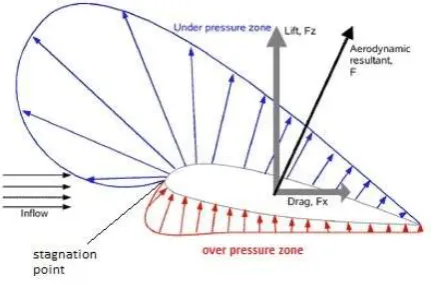
Figure 1 shows distribution of pressure around an airfoil.
Figure 1
II. NOMENCLATURE:-
•c, chord length- length from the LE to the TE of a wing cross section that is parallel to the vertical axis of symmetry •mean camber line– line halfway between the upper and lower surfaces
ISSN: 2231-5381
http://www.ijettjournal.org
Page 3259
•trailing edge (TE)- is the most rearward point on mean camber line
•camber– maximum distance between the mean camber line and the chord line, measured perpendicular to the chord line -0 camber or uncambered means the airfoil is symmetric above and below the chord line
•thickness– distance between upper surface and lower surface measured perpendicular to the mean camber line.
Angle of attack ( AOA) - angle between the relative airflow and chord of airfoil
III.SOLID MODELLING OF THE AIRFOIL AND FLOW DOMAIN
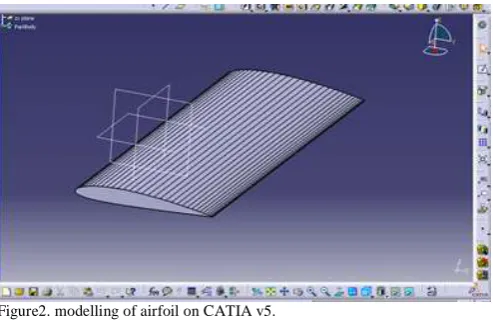
The solid modeling of the airfoil was made with the help of CAD tools CATIA v5 as shown in Figure 2. The chord of the airfoil was selected as 10 cms and extruded to a
wingspan of 27.5 cms , Considering the airfoil as one half of a wing, and wing aspect ratio as 5.5.
Figure2. modelling of airfoil on CATIA v5.
Flow domain was created using ANSYS 13.0 workbench , design modeller as shown in figure 3.
Figure3. creating fluid domain on design modeller.
IV.MESHING:-
Mesh was created using ‘ANSYS ICEM CFD’ as shown in figure 4. Sizing , relevance centre was set as medium.
Figure 4, meshing of fluid domain in ICEM CFD
V.FLOW ANALYSIS:-
a) Numerical algorithm:- Standard k–ε turbulence viscosity model with SIMPLE pressure-velocity coupling and First-Order Upwind discretization scheme was used for the analysis.
b) Boundary conditions:- Boundary conditions were specified at inlet with a velocity of 340.29 m/s.
ISSN: 2231-5381
http://www.ijettjournal.org
Page 3260
VI. FLUENT input parameters:-solver pressure based steady
state
viscous-laminar k–ε
density(kg/m3) 1.225
viscosity(kg/m –s) 1.7894*10 -5
inlet velocity(m/s) 340.29
pressure standard
VII. RESULT OF STATIC AND
DYNAMIC PRESSURE DISTRIBUTION:-
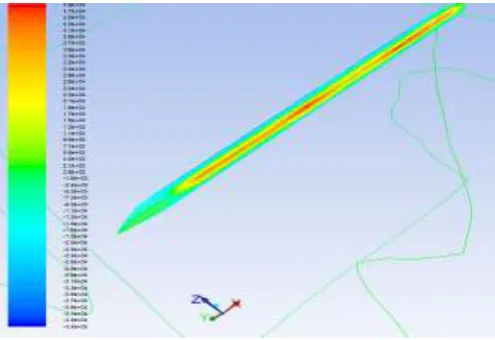
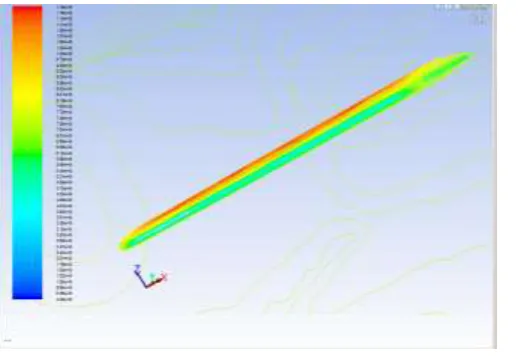
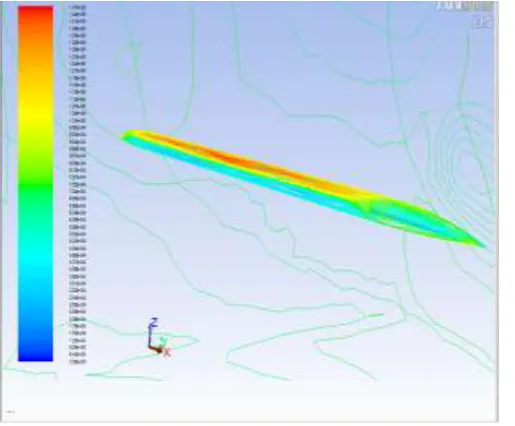
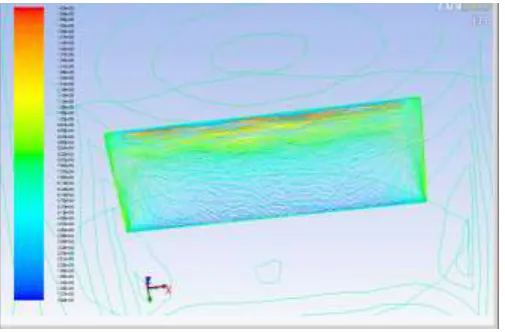
•Figure 1 to 6 below show the dynamic and static pressure distribution on different surfaces (i.e. lower surface ,upper surface and leading edge) on an airfoil with angle of attack 0 degrees.
•Figure 7 to 12 below show the dynamic and static pressure distribution on different surfaces (i.e. lower surface ,upper surface and leading edge) on an airfoil with angle of attack 6 degrees.
•Figure13 to 18 below show the dynamic and static pressure distribution on different surfaces (i.e. lower surface ,upper surface and leading edge) on an airfoil with angle of attack 12 degrees.
•Figure 19 to 24 below show the dynamic and static pressure distribution on different surfaces (i.e. lower surface ,upper surface and leading edge) on an airfoil with angle of attack 16 degrees.
•ANALYSIS OF
OBSERVATIONS:-a)On comparing figure 1,7,13,19 (i.e. contour of dynamic pressures on upper surface of airfoil at angle of attacks 0,6,12 and 16 respectively) , it is observed thatdynamic pressure on the upper surface except for some surface close to leading edge of airfoil , is decreasing as angle of attack is increased from 0 to 6,12,16 degrees.
Similarly, on comparing figures 4,10,16,22 (i.e. contour of
static pressures on upper surface of airfoils at angle of attack (0,6,12 and 16) , it is observed that static pressure has been increasing , but mostly on the surface away from leading edge and towards the trailing side of the upper surface.
The decrease in dynamic pressure can be attributed to the decreasing velocity as it moves over the top surface of the airfoil as dynamic pressure is a function of the square of velocity. As a result of decrease in dynamic pressure a simultaneous increase in static pressure results from the bernoulli’s theorem or which can also be understood as conservation of total pressure where , P0=constant=dynamic
pressure + static pressure.
b)On comparing figures 3,9,15,21 , it can be clearly seen that dynamic pressure on leading edge is decreasing with increasing angle of attack and figures 6,12,18,24 show that static pressure is increasing with increasing angle of attack.
This is again on account of conservation of total pressure P0.
c)A similar interpretation can be applied to lower surface contours of dynamic and static pressures on airfoil, from figures 2,8,14,20 it can be observed that the dynamic pressure on lower surface is decreasing with increasing angle of attack whereas, figures 5,11,17,23 show that static pressure is increasing on lower surface. Which is a consequence of conservation of total pressure P0?
d) At a point near maximum thickness, maximum velocity and minimum static pressure will occur. For example, if we consider effect of thickness on the upper surface of the airfoil (AOA 0 degrees) then this is evident from figures 1 and 4 , where maximum dynamic pressure occurs at upper surface on a location near and around maximum camber, and minimum static pressure occurs at and around the same location.
Similarly, this explanation applies to lower surface as well.
ISSN: 2231-5381
http://www.ijettjournal.org
Page 3261
point has moved further away from the leading edge. Therefore, as the angle of attack is increased the stagnation point moves away from leading edge on the lower surface of the airfoil.
figure 2 , dynamic pressure on lower surface of airfoil (AOA 0 degrees)
figure 3 , dynamic pressure on leading edge of airfoil (AOA 0 degrees)
figure 4 , static pressure on upper surface of airfoil (AOA 0 degrees)
figure 5, static pressure on lower surface of airfoil (AOA 0 degrees)
figure 6, static pressure on leading edge of airfoil (AOA 0 degrees) figure 1 , dynamic pressure on upper surface of airfoil (AOA 0
ISSN: 2231-5381
http://www.ijettjournal.org
Page 3262
figure 7 , dynamic pressure on upper surface of airfoil (AOA 6 degrees)figure 8 , dynamic pressure on lower surface of airfoil (AOA 6 degrees)
figure 9, dynamic pressure on leading edge of airfoil (AOA 6 degrees)
figure 10 , static pressure on upper surface of airfoil (AOA 6 degrees)
figure 11 , static pressure on lower surface of airfoil (AOA 6 degrees)
ISSN: 2231-5381
http://www.ijettjournal.org
Page 3263
figure 13 , dynamic pressure on upper surface of airfoil (AOA 12 degrees)figure 14 , dynamic pressure on lower surface of airfoil (AOA 12 degrees)
figure 15 , dynamic pressure on leading edge of airfoil (AOA 12 degrees)
figure 16 , static pressure on upper surace of airfoil (AOA 12 degrees)
figure 17 , static pressure on lower surface of airfoil (AOA 12 degrees)
ISSN: 2231-5381
http://www.ijettjournal.org
Page 3264
figure 19, dynamic pressure on upper surface of airfoil (AOA 16 degrees)figure 20, dynamic pressure on lower surface of airfoil (AOA 16 degrees)
figure 21, dynamic pressure on leading edge of airfoil (AOA 16 degrees)
figure 22, static pressure on upper surface of airfoil (AOA 16 degrees)
figure 23, static pressure on lower surface of airfoil (AOA 16 degrees)
ISSN: 2231-5381
http://www.ijettjournal.org
Page 3265
VIII. CONCLUSION:-
A. It is observed that dynamic pressure on the upper surface (mostly on surface away from leading edge) of airfoil is decreasing as angle of attack is increased at MACH1 progressively from 0 to 16 degrees and static pressure has been increasing , but mostly on the surface away from leading edge and towards the trailing side of the upper surface.
B. Dynamic pressure on leading edge is decreasing with increasing angle of attack and static pressure is increasing with increasing angle of attack.
C. Dynamic pressure on lower surface is decreasing with increasing angle of attack whereas, static pressure is increasing on lower surface.
D. maximum dynamic pressure occurs at upper surface near and around maximum camber and minimum static pressure occurs at and around the same location.Similarly, this explanation applies to lower surface as well.
E. As the angle of attack is increased the stagnation point moves away from leading edge on the lower surface of the airfoil.
REFERENCES:-
i.http://en.wikipedia.org/wiki/Static_pressure
ii.http://en.wikipedia.org/wiki/Dynamic_pressure
iii.http://kgraham.eng.ua.edu/classes/AEM314/lecture_notes
/airfoil_nomenclature.pdf
iv.
http://www.ijettjournal.org/volume-4/issue-5/IJETT-V4I5P142.pdf
v.‘Flight Theory and Aerodynamics: A Practical Guide for Operational Safety’ By Charles E. Dole, James E. Lewis
vi.