Global Screening of Genomic and Transcriptomic Factors
Associated with Phenotype Differences between
Multidrug-Resistant and -Susceptible
Candida haemulonii
Strains
Hao Zhang,
aYifei Niu,
bJingwen Tan,
aWeixia Liu,
aMing-an Sun,
cEnce Yang,
dQian Wang,
aRuoyu Li,
a,e,f,gYejun Wang,
bWei Liu
a,e,f,gaDepartment of Dermatology and Venereology, Peking University First Hospital, Beijing, China bDepartment of Cell Biology and Genetics, Shenzhen University Health Science Center, Shenzhen, China cEpigenomics and Computational Biology Lab, Biocomplexity Institute of Virginia Tech, Blacksburg, Virginia, USA
dDepartment of Microbiology & Infectious Disease Center, School of Basic Medical Sciences, Peking University Health Science Center, Beijing, China eResearch Center for Medical Mycology, Peking University, Beijing, China
fNational Clinical Research Center for Skin and Immune Diseases, Beijing, China gBeijing Key Laboratory of Molecular Diagnosis on Dermatoses, Beijing, China
ABSTRACT
Candida haemulonii
, a close relative of
Candida auris
, is an emerging
patho-gen which frequently shows multidrug resistance especially to triazoles, the most used
antifungal drugs. The mechanisms of drug resistance in
C. haemulonii
, however, are
largely unknown. Here, we sequenced and annotated the genomes of two reference
strains from the
C. haemulonii
complex, compared the phenotypes, genomes, and
tran-scriptomes of a triazole-susceptible and two triazole-resistant
C. haemulonii
strains, and
identified triazole susceptibility, morphology, fitness, and the major genetic and gene
expression differences between the strains. A multidrug efflux gene,
CDR1
, was
recur-rently found to be upregulated for expression in triazole-resistant strains. Blocking the
activity of Cdr1 increased the susceptibility to triazoles strikingly. Comparative
transcrip-tome analysis also demonstrated impaired cell wall integrity, filamentous growth, and
iron homeostasis in triazole-resistant strains. Finally, we also identified a zinc-binding
MHR family transcription regulator gene that mutated in triazole-resistant strains
spontane-ously, contributing to the changes of morphology and, possibly, cell wall integrity between
the strains. The study provided important clues for future studies exploring the mechanisms
of multidrug resistance and related phenotypic differences of
C. haemulonii
strains.
IMPORTANCE
A comprehensive, multi-omic survey was performed to disclose the
ge-netic backgrounds and differences between multidrug-resistant and -susceptible
C.
haemulonii
strains. Genes were identified with mutations or significant expression
differ-ences in multidrug-resistant compared to multidrug-susceptible strains, which were
mainly involved in multidrug resistance, stress fitness, and morphology. The
Cdr1-encoding gene,
C. haemulonii 2486
(
CH_2486
), was expressed at a significantly increased
level in multidrug-resistant strains. Functional inhibition experiments further implicated
potential roles of
CH_2486
in drug resistance. A gene spontaneously mutated in resistant
strains,
CH_4347
, was experimentally validated to influence the morphology of spores,
possibly by controlling cell wall integrity.
KEYWORDS
Candida haemulonii
complex, comparative genomics, genome,
multidrug resistance, transcriptome
I
n health care settings, the incidence of infections with unusual fungal pathogens has
risen tremendously due to the increased morbidity of immune deficiency and the
advance of transplant surgery (1–3). Meanwhile, the multidrug resistance of these
CitationZhang H, Niu Y, Tan J, Liu W, Sun M-A, Yang E, Wang Q, Li R, Wang Y, Liu W. 2019. Global screening of genomic and transcriptomic factors associated with phenotype differences between multidrug-resistant and -susceptibleCandida haemulonii strains. mSystems 4:e00459-19.https://doi.org/
10.1128/mSystems.00459-19.
EditorChristopher W. Marshall, Marquette University
Copyright© 2019 Zhang et al. This is an open-access article distributed under the terms of
theCreative Commons Attribution 4.0
International license.
Address correspondence to Yejun Wang, [email protected], or Wei Liu, [email protected].
Received28 July 2019
Accepted21 November 2019
Published
Molecular Biology and Physiology
17 December 2019
on September 8, 2020 by guest
http://msystems.asm.org/
pathogens has become a severe threat to human (2, 4, 5). In recent years, the
proportion of patients with invasive candidiasis caused by
Candida haemulonii
, a rare
non-
albicans Candida
species, has been increasing. The
C. haemulonii
complex species
were originally isolated at different times from blood samples from a patient with renal
failure in 1984 (6), and related species were classified into two major groups, namely,
C. haemulonii
group I (
C. haemulonii sensu stricto
and
C. haemulonii
var.
vulnera
) and
group II (
Candida duobushaemulonii
) according to isoenzyme profiles, DNA
reassocia-tions, physiological characteristics, and phylogenetic analysis (7–9).
C. haemulonii
,
characterized as a possible emerging pathogen, has been reported to be intrinsically
resistant to amphotericin B (AMB) and to exhibit
in vitro
multiresistance to triazoles
(10–12). These isolates, with a fluconazole (FLC) MIC of
ⱖ
64 mg/liter, a voriconazole
(VRC) MIC of
ⱖ
16 mg/liter, a itraconazole (ITA) MIC of
ⱖ
1 mg/liter, or a posaconazole
(POS) MIC of
ⱖ
2 mg/liter, were defined as triazole-resistant strains based on
in vitro
antifungal susceptibility data (10, 11). In recent years, clinical infections by
Candida
auris
, a phylogenetic relative of
C. haemulonii
, have been frequently reported
world-wide (13–17).
C. auris
, the so-called “superbug fungus,” also shows
in vitro
multidrug
resistance to triazoles, AMB, and echinocandins (18). The Centers for Disease Control
and Prevention have continually updated the epidemiology and showed special
con-cern regarding this fungus, since it often shows multidrug resistance, is difficult to
identify, and causes outbreaks in health care settings (18–21).
C. haemulonii
has
received less attention than
C. auris
. However, it also causes outbreaks, shows
multi-drug resistance, and leads to high mortality (2, 12).
Triazoles are the most widely used antifungal agents, targeting lanosterol 14-
␣
-demethylase (Erg11) and inhibiting biosynthesis of membrane ergosterol (22, 23). In
general, triazole resistance is common in various pathogenic fungi clinically, the
mechanisms of which in fungi involve mutation or overexpression of Erg11,
upregula-tion of multidrug transporters or cellular stress responses, etc. (23). For example, recent
studies suggested that mutation in
ERG11
in
C. auris
could confer triazole resistance
(24). Genetic analysis of
C. auris
also implicated the contribution of upregulated
expression of Cdr1, a multidrug efflux pump, to the triazole resistance (25). However,
the exact mechanisms of triazole resistance in
C. haemulonii
remain to be investigated,
although previous studies suggested possible roles of transporters and metabolic
regulators in drug responses (26).
In this work, we investigated four strains of
C. haemulonii
complex; one was a
triazole-susceptible
C. haemulonii
strain (BMU05228), and the rest were
triazole-resistant strains, including one
C. duobushaemulonii
strain (BMU05314) and two
C.
haemulonii
strains (BMU05529 and BMU05535). BMU05529 and BMU05535 were
recov-ered from a single patient at different times. BMU05228 and BMU05314 were selected
as the representative strains and sequenced for the genomes with both
second-generation and single-molecule sequencing platforms. Genome resequencing and RNA
sequencing were also performed for the two multidrug-resistant
C. haemulonii
strains.
Comparisons were performed between the multidrug-resistant and -susceptible strains
to screen the genetic and gene expression differences, followed by experimental
validation of the interesting targets which might explain the mechanisms of triazole
resistance and phenotypic changes in
C. haemulonii
strains.
RESULTS
Identification and phenotypes of four
C. haemulonii
complex strains.
We
iso-lated four fungal strains from infected patients with candidemia. All the strains were
identified as
C. haemulonii
complex by amplifying and sequencing internal transcribed
spacer 1 (
ITS1
) and
ITS4
and
D1
/
D2
, with three (BMU05228, BMU05529, and BMU05535)
being identified as
C. haemulonii sensu stricto
and one (BMU05314) as
C.
duobushaemu-lonii
, exhibiting 100% sequence identity to the corresponding sequences from
refer-ence
C. haemulonii
complex strains (
C. haemulonii sensu stricto
CBS 5149 and
C.
duobushaemulonii
CBS 7798) (Fig. 1a). The broth microdilution method was used to test
antifungal susceptibility of these strains, and the phenotype (susceptibility or
on September 8, 2020 by guest
http://msystems.asm.org/
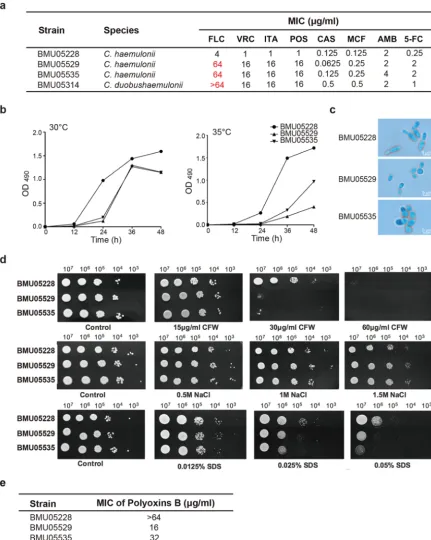
FIG 1 The phenotype differences amongC. haemuloniiisolates. (a) Susceptibility ofC. haemuloniiandC. duobushaemuloniiisolates to different antifungal drugs. (b) Growth curves under conditions of different temperatures. A total of 1⫻103C. haemuloniicells were diluted
with 100l 1640 medium and inoculated into 96-well plates. The growth speeds (represented by values of OD490) at 30°C and 35°C were
examined at different time points through XTT assay. Average OD490values determined from three repeats at every time point are
presented. (c) Cell morphology under a light microscope (⫻400 magnification). (d) Fitness under conditions of exposure to environmental stress.C. haemuloniicells were adjusted to 5⫻108cells/ml, and then 10-fold serial dilutions of cells (2l) were spotted on YPD plates and
on YPD plates containing CFW, NaCl, or SDS at different concentrations for 2 days of growth. (e) Susceptibility to polyoxin B ofC. haemuloniiisolates. Abbreviations: FLC, fluconazole; VRC, voriconazole; ITA, itraconazole; POS, posaconazole; CAS, caspofungin; MCF, micafungin; AMB, amphotericin B; 5-FC, 5-flucytosine; CFW, calcofluor white.
on September 8, 2020 by guest
http://msystems.asm.org/
tance) was determined as described in previous reports (10, 11). As shown in Fig. 1a,
BMU05228 was susceptible to FLC while the remaining strains were all resistant.
BMU05228 also appeared to be more susceptible than BMU05529, BMU05535, and
BMU05314 to other triazoles, such as VRC and POS, but no differences were observed
in susceptibility to other antifungal agents (Fig. 1a).
Other phenotypes were also compared among BMU05228, BMU05529, and BMU05535
since the three strains belonged to the same species whereas they showed different
antifungal resistance profile. At both 30°C and 35°C, BMU05228 grew more efficiently
than BMU05529 and BMU05535, with a more striking advantage seen as the
temper-ature increased (Fig. 1b). In contrast to BMU05228, for which the spores appeared with
a rod-like morphology and a median size of 2.4 by 7.0
m, BMU05529 and BMU05535
cells showed a round shape with a median size of 3.0 by 4.0
m (Fig. 1c). The levels of
fitness with respect to environmental stimuli were also different between the strains.
BMU05228 showed better fitness than BMU05529 and BMU05535 under conditions of
stimulation with calcofluor white (CFW) (30
g/ml) and SDS (0.025%), but no
differ-ences were seen with respect to responses to salt exposure (Fig. 1d). CFW is involved
in the biosynthesis of fungal cell wall. When polyoxin B, an inhibitor of chitin synthase,
was applied, BMU05529 and BMU05535 were more susceptible than BMU05228, further
suggesting that the reduced fitness of the triazole-resistant strains might be caused by
impairment of the cell wall (Fig. 1e).
Genomic mutation patterns in triazole-resistant
C. haemulonii
strains.
To
fur-ther screen the candidate genes responsible for the differences in drug resistance
and other phenotypes in
C. haemulonii
complex, the genomes of representative
strains were sequenced. We assembled and annotated high-quality genomes for
triazole-susceptible
C. haemulonii
and
C. duobushaemulonii
, respectively, followed by
resequencing the genomes of other
C. haemulonii
strains and comparing the genomes.
Triazole-susceptible
C. haemulonii
strain BMU05228 and the only
C.
duobushaemu-lonii
strain, BMU05314, were selected as representative strains for reference genome
sequencing and annotation (Materials and Methods) (see also Table S1 and S2 in the
supplemental material for a summary of the sequencing and annotation methods). The
reference genomes were 13,305,295 nucleotides (nt) and 12,568,244 nt in size,
respec-tively, for BMU05228 and BMU05314 (Table S1). High levels of sequence similarity and
conserved genome synteny were found between BMU05228 and BMU05314 and the
genomes of a
C. haemulonii
strain and a
C. duobushaemulonii
strain recently reported
by Munoz et al., respectively (26) (see Fig. S1 in the supplemental material).
Transcrip-tome sequencing (RNA-Seq) facilitated the identification of 6,155 and 5,943 genes in
BMU05228 and BMU05314, respectively, among which 5,964 and 5,761 genes encoded
proteins (Table S2). The distribution of exon numbers per gene and protein family types
and gene function annotation were analyzed, and the results are shown in Fig. S2a to
d and Table S2. The core gene set was also retrieved from representative strains of
Ascomycota
, followed by construction of a core genome tree. The tree showed a robust
topology consistent with the evolutionary relationships disclosed by traditional
taxon-omy (Fig. S3a), and the data were further confirmed by the trend of changes for
pairwise protein similarities of core genes (Fig. S3b) and the numbers of homologs or
orthologs between BMU05228 and the other strains (Fig. S3c). Comparative genomic
analysis was also performed between BMU05228 and BMU05314 and the other
repre-sentative
Ascomycota
strains. We identified a list of unique genes of BMU05228 and
BMU05314 that were not identified with homologs in other strains. Among them, 81
C.
haemulonii
genes showed homology with 71
C. duobushaemulonii
counterparts and
therefore were
C. haemulonii
complex specific; we were able to classify those genes as
50 singletons and members of 10 multimember families (Fig. S3d; see also Data Set S1
in the supplemental material). The remaining 651
C. haemulonii
and 674
C.
duobush-aemulonii
genes were species/strain specific, and all of them were classified as
single-tons (Fig. S3d; see also Data Set S1).
on September 8, 2020 by guest
http://msystems.asm.org/
Furthermore, we resequenced the genomes of BMU05529 and BMU05535, the two
triazole-resistant
C. haemulonii
strains. Alignment against the BMU05228 reference
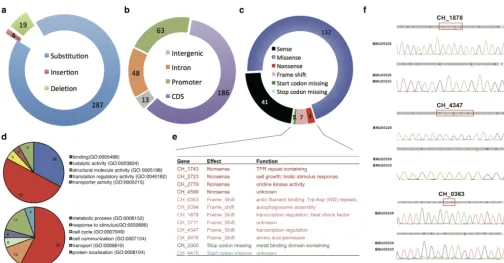
genome disclosed 23 small insertions/deletions and 287 single nucleotide substitutions
(Fig. 2a; see also Data Set S2). An absolute majority of the single nucleotide
polymor-phisms (SNPs) was consistently called from both the two triazole-resistant strains, with
only a few identified from one strain but not from the other due to the regional low
read coverage (Data Set S2). The only discrepancy with respect to different SNP
patterns in the two strains was located in
C. haemulonii 3711
(
CH_3711
) with a
binucleotide insertion in BMU05529 but a deletion in the same position of the same
two nucleotides in BMU05535, both leading to the gene frameshift (Data Set S2).
Genome localization of the 310 mutations indicated that 186 were located in exons
encoding peptide sequences, 63 in proximity of encoding genes and possible promoter
regions, 48 within introns, and 13 in intergenic regions (Fig. 2b). Among the mutations
seen in protein-encoding frames, 132 caused amino acid changes (missense), 7 caused
frame shifts, 4 caused premature translation termination (nonsense), and 2 led to loss
of translation start or termination codons (Fig. 2c). Functional clustering was performed
on the genes with mutations causing frame shifts, amino acid changes, premature
translation termination, and loss of translation start or stop codons (Fig. 2d). It was
noted that, in addition to metabolism-related genes, genes with transporter activity
and participating in response to stimulus were also enriched (Fig. 2d). The genes with
mutations causing frame changes were listed and annotated for their possible function
(Fig. 2e). Two of them,
CH_1878
and
CH_4347
, were annotated as transcription
regu-lators. Independent cloning and sequencing of these two genes and of another one
possibly encoding an actin filament binding protein (
CH_0363
) in the two
triazole-resistant strains further confirmed the frame-shifting mutations (Fig. 2f).
Constitutive gene expression differences between triazole-susceptible and
-resistant
C. haemulonii
strains.
RNA sequencing was also performed to observe
differences in the gene expression profiles of triazole-susceptible and -resistant
C.
FIG 2 Single nucleotide polymorphisms or small insertion/deletions in triazole-resistantC. haemuloniistrains. (a) Composition of genomic mutations. (b) Distribution of regions of genomic mutations. CDS, coding DNA sequence. (c) Effect of the genomic mutations within protein-encoding regions. (d) Molecular function and biological processes of the proteins with nucleotide mutations. (e) Annotation of the genes with nonsense, frame shifting, and mutations with start or stop codon missing. TPR, tetratricopeptide repeat. (f) Verification of the mutations by gene resequencing.
on September 8, 2020 by guest
http://msystems.asm.org/
haemulonii
strains incubated without any drug treatment. The differentially expressed
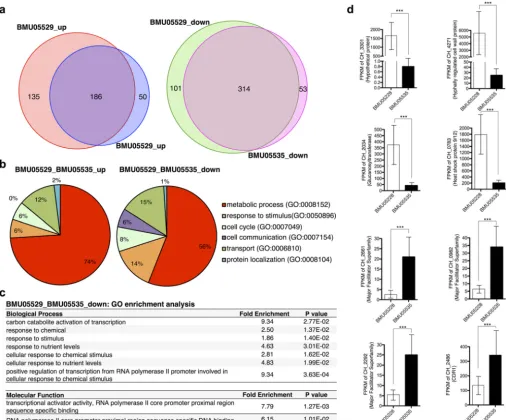
genes were extensively consistent between the two triazole-resistant strains compared
to the triazole-susceptible one, with 186 and 314 protein-encoding genes in total for
which expression was commonly up- and downregulated in the triazole-resistant
strains, respectively (Fig. 3a; see also Data Set S3). Among the differentially expressed
genes, 35 were also found with genomic mutations between triazole-susceptible and
-resistant
C. haemulonii
strains (Data Set S3). Interestingly, 11 mutations were located in
promoter regions, which might represent direct associations with the gene expression
differences (Data Set S3).
Consistent with the mutation profiling results, functional clustering of the genes
with significant expression changes also revealed that the majority of genes were
involved in transport or in responses to stimulus, besides metabolic processes (Fig. 3b).
Interestingly, the functional composition of genes with downregulated expression in
triazole-resistant strains appeared very similar to that of genes with meaningful
muta-FIG 3 Gene expression differences between triazole-susceptible and -resistantC. haemuloniistrains without drug treatment. (a) Genes with significant expression differences between BMU05228 and BMU05229 or between BMU05228 and BMU05535. (b) Biological processes of the genes with significant expression differences. (c) GO enrichment analysis for the genes downregulated in triazole-resistant strains. (d) Expression of selected genes with significant differences. FPKM, fragments per kilobase per million (1,000-bp and 1-million-bp reads).***, false-discovery rate (q)⬍0.005 (Cufflinks [cuffdiff] transcript expression comparison).
on September 8, 2020 by guest
http://msystems.asm.org/
tions in the same strains (Fig. 3b; see also Fig. 2d, lower panel). GO enrichment analysis
further indicated that the genes that participated in stimulus response or in
transcrip-tional regulation were significantly enriched in the sets of downregulated genes of
triazole-resistant strains (Fig. 3c). Expression data are shown for representative genes
with significant differences in levels of expression between triazole-resistant and
-susceptible strains (Fig. 3d). It was noted that, among the genes most significantly
downregulated in the triazole-resistant strains, there were many involved in
biosyn-thesis or in maintenance of the cell wall, e.g.,
CH_4271
and
CH_2034
(Fig. 3d). In
contrast, the genes most significantly upregulated in the triazole-resistant strains were
often involved in transport or multidrug resistance. For example,
CH_2486
encoded
Cdr1, a protein widely reported to be associated with antifungal resistance, especially
resistance to triazoles (Fig. 3d).
CH_2661
,
CH_0892
, and
CH_2292
were other examples
of genes encoding transporters that might play roles in drug resistance (Fig. 3d).
FLC-induced gene expression differences between triazole-susceptible and
-resistant
C. haemulonii
strains.
To further observe the differences between the
triazole-susceptible and -resistant strains in transcriptomic responses to drug
stimula-tion, we also performed RNA-Seq analysis on the strains under conditions of incubation
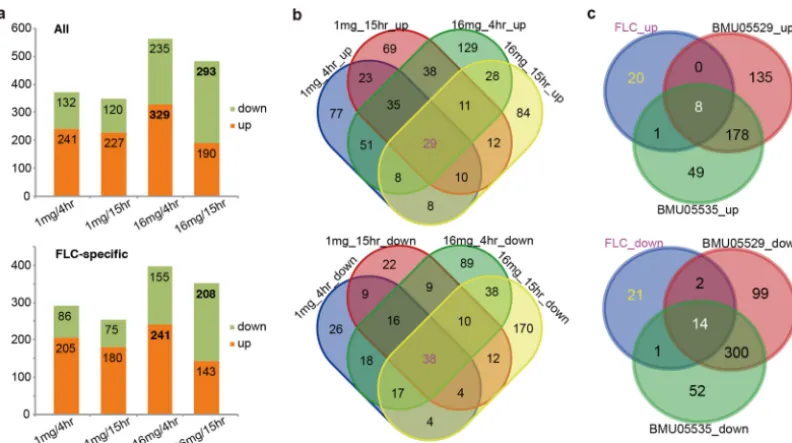
with 1 mg/liter and 16 mg/liter FLC for 4 h and 15 h, respectively. FLC used at
16 mg/liter stimulated strikingly more genes with different responses between
triazole-resistant and -susceptible strains, with the greatest number of upregulated genes seen
at 4 h and the greatest number of downregulated genes at 15 h in the triazole-resistant
strains (Fig. 4a; see also Data Set S3). There were 29 and 38 genes that consistently
showed significantly increased and decreased expression in the triazole-resistant
strains, respectively (Fig. 4b). Around 28% (8/29) of the upregulated genes and 37%
(14/38) of the downregulated genes showed stable expression differences between the
strains with or without drug stimulation, while most genes (20/29 upregulated and
21/38 downregulated) appeared to respond to FLC stimulation specifically since they
were not covered by the list of gene showing differential levels of expression between
the strains without FLC treatment (Fig. 4c). Functional annotation of the constantly
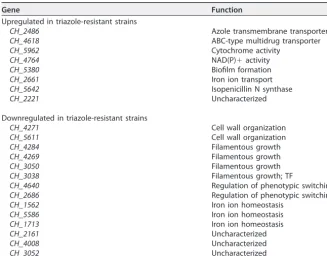
upregulated genes in triazole-resistant strains identified two genes (
CH_2486
and
CH_4618
) as being directly associated with drug resistance (Table 1). Both the genes
FIG 4 Gene expression differences between triazole-susceptible and -resistantC. haemuloniistrains with or without FLC treatment. (a) All the genes with significant expression differences between triazole-susceptible and -resistant strains treated with different doses of FLC for different durations. The numbers of genes down- or upregulated in triazole-resistant strains are shown. (b) Specific or common genes with differential expression levels among various FLC treatment regimen groups. (c) The specific or common genes with differential expression levels among FLC treatment and no-drug treatment groups.
on September 8, 2020 by guest
http://msystems.asm.org/
encode transporters, and, as indicated before,
CH_2486
encodes Cdr1, which is well
known to exhibit triazole-resistant activity in fungi by removing drugs from cells. Two
genes showed cytochrome or oxidation-reduction activity that could be related to
cellular responses to drug stresses. Among the constantly downregulated genes in
triazole-resistant strains, genes were identified that were remarkably enriched for
participating in cell wall biosynthesis or maintenance, filamentous growth, iron ion
transport and assimilation, and other phenotypic switching processes (Table 1). It
should be noted that the functions of the enriched genes were frequently correlated.
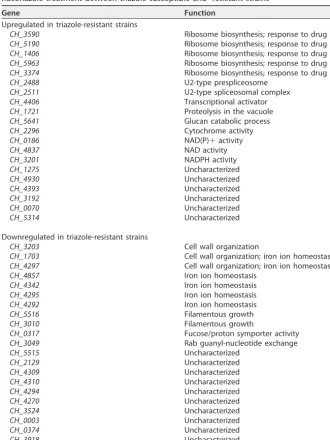
We also annotated the function of genes that specifically showed responses to FLC
stimulation (Table 2). Similarly, metabolism-related genes and oxidation-reduction
reaction-related genes responding to drug were enriched among those listed as
upregulated genes in triazole-resistant strains, while genes associated with cell wall
organization, filamentous growth, and iron homeostasis were enriched in the
down-regulated gene list (Table 2). Together, the results suggested increased activities for
multidrug efflux and stress-reactive metabolism and decreased activities or capabilities
for cell wall organization, filamentous growth, iron assimilation, and pathogenesis.
CH_2486
expression is likely associated with triazole resistance of the
C.
haemulonii
strains.
Transcriptome analysis showed constitutively increased expression
of
CH_2486
(
CDR1
) in the triazole-resistant
C. haemulonii
strains. The higher expression
of
CH_2486
in strain BMU05529 than in strain BMU05228 was further validated by
real-time quantitative PCR (qRT-PCR) after treatment with different doses of FLC
(Fig. 5a). There was only one anonymous nucleotide substitution detected within the
protein coding sequences of strain BMU05228 and strains BMU05529 and BMU05535,
and no nucleotide changes were found within the gene promoter regions (Data Set S3).
Therefore, the
CH_2486
gene expression differences were likely caused by the changes
in upstream regulator genes.
To examine whether the
CH_2486
expression differences changed the susceptibility
of
C. haemulonii
to FLC, we treated the strains with FK520, a putative Cdr1 inhibitor. As
shown in Fig. 6b, BMU05529 was much more resistant to FLC than BMU05228.
However, after simultaneous incubations with FK520, both strains showed increased
susceptibility to FLC, and BMU05529 became as nearly vulnerable as BMU05228 to the
TABLE 1Functional annotation for the genes with constitutive and constant expression differences between triazole-susceptible and -resistant strainsGene Function
Upregulated in triazole-resistant strains
CH_2486 Azole transmembrane transporter CH_4618 ABC-type multidrug transporter CH_5962 Cytochrome activity
CH_4764 NAD(P)⫹activity
CH_5380 Biofilm formation
CH_2661 Iron ion transport CH_5642 Isopenicillin N synthase
CH_2221 Uncharacterized
Downregulated in triazole-resistant strains
CH_4271 Cell wall organization CH_5611 Cell wall organization
CH_4284 Filamentous growth
CH_4269 Filamentous growth
CH_3050 Filamentous growth
CH_3038 Filamentous growth; TF
CH_4640 Regulation of phenotypic switching CH_2686 Regulation of phenotypic switching CH_1562 Iron ion homeostasis
CH_5586 Iron ion homeostasis CH_1713 Iron ion homeostasis
CH_2161 Uncharacterized
CH_4008 Uncharacterized
CH_3052 Uncharacterized
on September 8, 2020 by guest
http://msystems.asm.org/
same dose of FLC (Fig. 5b). Therefore,
CH_2486
could be an important factor endowing
the
C. haemulonii
strains with a capacity for resistance to FLC and other triazoles.
CH_4347
mutation is associated with spore morphology differences in
triazole-resistant
C. haemulonii
strains.
Experiments were also performed to investigate
whether other genes screened by genome or RNA sequencing had functional relevance
and associations with the observed phenotypic differences of the strains. As annotated,
CH_4347
likely encoded a transcription regulator, and there was a frame-shifting
mutation found in the triazole-resistant strains by genome resequencing and validation
experiments (Fig. 2e and f). We successfully knocked the gene out from the wild-type
BMU05228 strain. Triazole susceptibility tests were performed to compare the
CH_4347
-deleted (BMU05228
4347del) and wild-type BMU05228 strains. However, no significant
difference was observed (Fig. S4). The morphologies of the two strains were also
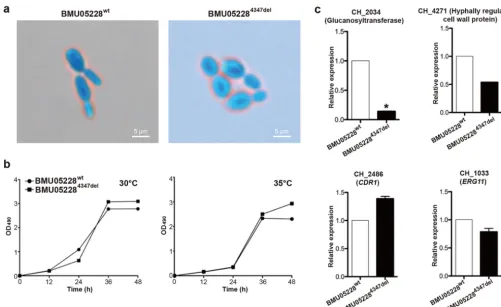
compared, and interestingly, spores of BMU05228
4347delshowed a round shape similar
to that of spores of the triazole-resistant strains, i.e., BMU05529 and BMU05535 (Fig. 6a;
see also Fig. 1c). The levels of growth efficiency of BMU05228
4347deland the wild-type
BMU05228 strain were more similar than those measured for the wild-type BMU05529
TABLE 2Functional annotation for the genes with expression differences induced by fluconazole treatment between triazole-susceptible and -resistant strainsGene Function
Upregulated in triazole-resistant strains
CH_3590 Ribosome biosynthesis; response to drug CH_5190 Ribosome biosynthesis; response to drug CH_1406 Ribosome biosynthesis; response to drug CH_5963 Ribosome biosynthesis; response to drug CH_3374 Ribosome biosynthesis; response to drug CH_2488 U2-type prespliceosome
CH_2511 U2-type spliceosomal complex CH_4406 Transcriptional activator CH_1721 Proteolysis in the vacuole CH_5641 Glucan catabolic process CH_2296 Cytochrome activity CH_0186 NAD(P)⫹activity
CH_4837 NAD activity
CH_3201 NADPH activity
CH_1275 Uncharacterized CH_4930 Uncharacterized CH_4393 Uncharacterized CH_3192 Uncharacterized CH_0070 Uncharacterized CH_5314 Uncharacterized
Downregulated in triazole-resistant strains
CH_3203 Cell wall organization
CH_1703 Cell wall organization; iron ion homeostasis CH_4297 Cell wall organization; iron ion homeostasis CH_4857 Iron ion homeostasis
CH_4342 Iron ion homeostasis CH_4295 Iron ion homeostasis CH_4292 Iron ion homeostasis CH_5516 Filamentous growth CH_3010 Filamentous growth
CH_0317 Fucose/proton symporter activity CH_3049 Rab guanyl-nucleotide exchange CH_5515 Uncharacterized
CH_2129 Uncharacterized CH_4309 Uncharacterized CH_4310 Uncharacterized CH_4294 Uncharacterized CH_4270 Uncharacterized CH_3524 Uncharacterized CH_0003 Uncharacterized CH_0374 Uncharacterized CH_3918 Uncharacterized
on September 8, 2020 by guest
http://msystems.asm.org/
and BMU05535 strains (Fig. 6b; see also Fig. 1b). Therefore,
CH_4347
is likely the key
gene responsible for the morphology of the
C. haemulonii
complex spores.
Quantitative expression analysis was performed to observe the possible gene
expression differences between BMU05228
4347deland wild-type strains. One gene
involved in cell wall biosynthesis,
CH_2034
, was found with a significantly decreased
expression level in BMU05228
4347del, the results thus being similar to those seen with
the triazole-resistant strains (Fig. 6c). Other genes related to cell wall function, e.g.,
CH_4271
, also showed a trend of expression change similar to that seen in the
triazole-resistant strains, but the data did not reach statistical significance (Fig. 6c and
data not shown). We also compared the expression levels of possibly drug
resistance-related genes between wild-type BMU05228 and its
CH_4347
mutant strains, e.g., those
with mutations in
CH_2486
(
CDR1
),
CH_1033
(
ERG11
), etc., and no expression differences
were observed (Fig. 6c; see also Fig. S5). Therefore,
CH_4347
mutation might not
represent an independent factor contributing to the phenotype of drug resistance.
DISCUSSION
The
C. haemulonii
complex is a group of emerging fungal pathogens that represent
a serious health threat globally. Outbreaks of infection by
C. auris
, a species closely
related to the
C. haemulonii
complex, have recently caused alarm worldwide (https://
www.cdc.gov/fungal/diseases/candidiasis/candida-auris.html). Bursts of
C. haemulonii
complex infections are mainly attributed to their multidrug resistance and our lack of
knowledge concerning these microorganisms.
C. haemulonii
complex showed
resis-tance to AMB and also frequently to triazoles, leading to failures in clinical treatment
(11, 12). The combination of FLC with AMB has also been commonly used in clinical
FIG 5 The expression level of efflux pump (Cdr1) was increased in the triazole-resistantC. haemuloniistrain. (a) qRT-PCR analysis of CH_2486gene expression in BMU05228 and BMU05529 treated with different doses of fluconazole (FLC) for 5 h. A total of 1⫻106C. haemuloniicells were first incubated for
10 h and then treated with 0.5 mg/liter or 16 mg/liter FLC for another 5 h. Cells were harvested, and total RNA was extracted to detect the relative expression levels ofCH_2486(CDR1) through qRT-PCR. The data are shown as means⫾standard deviations (n⫽3).***,P⬍0.005 (Student’sttest for the logarithm value). (b) Susceptibility of BMU05228 and BMU05529 strains to FLC with and without FK520 treatment.
C. haemuloniicells were adjusted to 5⫻108cells/ml, and then 10-fold serial dilutions of cells (2l) with
or without 100 mg/liter FK520 treatment were spotted on YPD plates containing 64 mg/liter FLC for
2 days of growth.
on September 8, 2020 by guest
http://msystems.asm.org/
practice, and yet the outcomes have been poor in treatment of deep-tissue infections
(2, 12). The multidrug resistance of these fungi has further caused high mortality rates.
For example, the mortality rate of
C. auris
infections was previously reported to reach
60% (19). At present, species of the
C. haemulonii
complex show high sensitivity to
echinocandins, but the high price has severely restricted their application. On the other
side, we remain at the very beginning in understanding the biology of these previously
“rare” pathogens. Robust methods still lack quick and accurate identification of the
strains (27, 28). Misidentifications happen frequently and hamper the effective
treat-ment of the infections (4, 29). The genetic and molecular mechanisms of the multidrug
resistance of these fungi remain largely unknown.
C. haemulonii
strain BMU05228 was found to be susceptible to triazoles, while the
other strains (BMU05529 and BMU05535) showed resistance (Fig. 1a). Genome
rese-quencing of the triazole-resistant strains disclosed 7 frame-shifting, 4 nonsense, 2
translation start/termination-interfering, and 132 missense mutations compared with
the reference genome of triazole-susceptible BMU05228 (Fig. 2a to c). Together with
the mutations present in potential promoter regions, the influenced genes mainly
participated in metabolism, transport, and response to stimulus (Fig. 2d). Which of the
mutations are functional remains unknown. However, RNA sequencing analysis also
disclosed similar functional enrichment of the influenced genes in the set of
down-regulated genes of triazole-resistant strains (Fig. 3b and c). The consistency between
gene expression profiles and genome mutations could highlight the main different
biological processes and pathways between the strains.
RNA sequencing analysis of the strains in the presence or absence of FLC treatment
repeatedly identified upregulation of a multidrug transporter gene (
CDR1
) and of genes
FIG 6 Phenotype and gene expression differences between wild-type andCH_4347knockout BMU05228 strains. (a) Morphology differences under light microscope (⫻400 magnification). (b) Growth curves of the strains under conditions of 30°C and 35°C. Average OD490values of three repeats at every time point
were examined through the methods described above. (c) Gene expression determined by qRT-PCR. A total of 1⫻106C. haemuloniicells were incubated for
15 h. Then, cells were harvested and total RNA was extracted to detect the relative expression levels of genes through qRT-PCR. The data are shown as means⫾ standard deviations (n⫽3).*,P⬍0.05 (Student’sttest for the logarithm value).
on September 8, 2020 by guest
http://msystems.asm.org/
with responses to drugs in triazole-resistant
C. haemulonii
strains. The upregulated
expression of
CDR1
was further validated by qRT-PCR (Fig. 5a). Treatment of the
triazole-resistant
C. haemulonii
strains with Cdr1 inhibitor restored their susceptibility to
FLC at least partially (Fig. 5b), further indicating the significant contribution of Cdr1 to
triazole resistance. It remains unclear whether other transporters or drug-responding
genes also contribute to the drug resistance for the strains. Previous studies suggested
that overexpression of multidrug efflux pump MexGHI-OpmD was capable of causing
growth deficiency in
Pseudomonas aeruginosa
(30), and overexpression of the
multi-drug efflux pump SmeDEF was shown to impair fitness and decrease virulence in
Stenotrophomonas maltophilia
(31). In triazole-resistant
Candida albicans
,
overexpres-sion of efflux pump also led to impaired fitness in response to novel stresses in the
absence of drug (32, 33). Hence, it would be tentative to hypothesize and investigate
experimentally the possibility that the slowed growth and impaired fitness to CFW and
SDS observed in the triazole-resistant
C. haemulonii
strains was related to the increased
expression of
CDR1
and other efflux pump genes. It has also been reported that defects
in cell wall integrity in
C. albicans
could decrease the growth rate, promote sensitivity
to CFW, and modestly reduce adherence (34). We also observed the typical
downregu-lation of cell wall biosynthesis genes in triazole-resistant
C. haemulonii
strains (Fig. 4).
It would be interesting to further examine the potential links between cell wall integrity
and cell morphology, growth, stress fitness, and pathogenesis in
C. haemulonii
strains.
We found increased susceptibility to polyoxin B for triazole-resistant
C. haemulonii
strains, which could also be attributable to the defect of cell wall integrity, since
polyoxin B transport was affected by cell wall integrity (35).
The RNA sequencing results also demonstrated that expression of
CH_2034
encod-ing glucanosyltransferase was significantly decreased in triazole-resistant
C. haemulonii
strains (Fig. 3d). Previous studies suggested that glucanosyltransferase was involved in
cell wall assembly and morphogenesis as shown by elongation of

-(1,3)-glucan chains
in the cell wall during vegetative growth (36, 37). We observed apparent morphological
differences between strain BMU05228 and strains BMU05529 and BMU05535, with the
former strain forming rod-like cells and the latter strains rounder cells (Fig. 1c). We
successfully knocked out one gene (
CH_4347
) in BMU05228, which mutated with frame
shifting in triazole-resistant strains spontaneously, and found that that gene
contrib-uted to the morphology changes between triazole-susceptible and -resistant
C.
haemu-lonii
strains (Fig. 6a).
CH_2034
also appeared to show a lower level of expression in the
gene knockout cells (Fig. 6c). Hence,
CH_4347
might influence the morphology of
spores in
C. haemulonii
by regulating the expression of
CH_2034
. However, no apparent
susceptibility difference was observed between the wild-type and
CH_4347
mutant
C.
haemulonii
strains. More experiments should be performed to examine how
CH_4347
influences morphology and to test whether
CH_4347
and other factors make synergic
contributions to antifungal susceptibility or virulence.
CH_4347
encodes a zinc-binding
MHR family transcription regulator but shows low homology with genes encoding
other proteins with well-annotated function. Zinc-binding MHR family proteins have
been previously reported to be involved in various functions in other fungi, including
morphogenesis, virulence, drug resistance, etc. (38–40). Heat shock factors (HSFs) were
also previously reported to regulate morphogenesis and virulence in
C. albicans
(41, 42).
They were shown to regulate the morphology shifting of
C. albicans
from yeast to
filament, representing a phenotype similar to a change regulated by
CH_4347
in
C.
haemulonii
(41). Interestingly, we also found one HSF gene (
CH_1878
) which showed a
loss of protein-encoding capability and function in triazole-resistant
C. haemulonii
strains (Fig. 2e and f). Experiments to separately and jointly mutate and recover these
and other frame-changing genes and to observe whether antifungal susceptibility and
other phenotypes are influenced are still ongoing.
In this research, we presented chromosome-level, well-annotated reference
ge-nomes for two
C. haemulonii
complex species. Genome resequencing and RNA
se-quencing performed for the triazole-resistant
C. haemulonii
strains screened a list of
interesting genes, providing important targets and clues for future studies on exploring
on September 8, 2020 by guest
http://msystems.asm.org/
the genetic and molecular mechanisms of multidrug resistance in
C. haemulonii
strains.
The data comprise valuable resources for the research and clinical communities with
respect to candidiasis.
MATERIALS AND METHODS
Isolation and identification.Four strains were isolated from the blood samples of three Chinese patients with candidemia and were named BMU05228, BMU05529, BMU05535, and BMU05314. Among those strains, BMU05529 and BMU05535 were isolated from the same patient at different infection stages. The patients were all male and were hospitalized in three different hospitals in China for treatment of colon, rectal, and lung cancer, respectively. The study was approved by the ethics committees of the involved hospitals. All the patients signed informed-consent forms. Four isolates were identified using sequencing of the nuclear ribosomal internal transcribed spacer (ITS) region and the large subunit of the 28S ribosomal DNA gene (D1/D2) as previously described (43, 44).
Phenotype comparison of fungal strains. (i) Susceptibility testing.The levels ofin vitro suscep-tibility of these four strains to eight antifungal drugs were examined using Clinical and Laboratory Standards Institute (CLSI) broth microdilution method M27-A3. MICs of antifungals were interpreted according to CLSI document M27-S3 as described previously (10, 11). Susceptible and resistant pheno-types were determined according to methods described in previous reports (10, 11).
(ii) Examining growth speed.A 2,3-bis-(2-methoxy-4-nitro-5-sulfophenyl)-2H-tetrazolium-5-carb-oxanilide salt (XTT) colorimetric assay was performed for eachC. haemuloniistrain to compare the growth speeds at 30°C and 35°C. The cultures of each strain were supplemented with 100l XTT (1 mg/ml) containing 10 mM menadione at 0, 12, 24, 36, and 48 h after inoculation in 96-well plates, followed by an incubation at 37°C for 2 h under dark conditions. A 100-l volume of supernatant was extracted, and the absorbance was examined by determination of the optical density at 490 nm (OD490).
(iii) Observing the spore morphology.TheC. haemuloniiisolates were inoculated in 10 ml yeast extract-peptone-dextrose (YPD) broth medium (Difco Laboratories, Sparks, MD) at 30°C and 200 rpm overnight. A 10-l cell suspension was then placed on the slide and stained using 10l gossypol. The morphology of the spores was observed using light microscope.
(iv) Examining stress fitness.A spotting assay was used to examine the fitness ofC. haemulonii
isolates under conditions of CFW, SDS, and NaCl stress. Serially diluted fungal suspensions (2l) were inoculated onto YPD plates with different concentrations of CFW (15, 30, and 60 mg/liter), SDS (0.125%, 0.25%, and 0.5%), and NaCl (0.5 M, 1 M, and 1.5 M). The plates were incubated at 30°C for 48 h before observation.
(v) Testing susceptibility to FK520 and polyoxin B.A spotting assay was used to determine levels of susceptibility to FK520, an inhibitor of Cdr1, inC. haemuloniistrains. Serially diluted fungal suspensions (2l) treated with 100 mg/liter FK520 were inoculated onto YPD plates with 64 mg/liter FLC. These plates were incubated at 30°C for 48 h before observation. Polyoxin B (DRE-E16283500; DRE, Germany) was used as an inhibitor of chitin synthase to examine the integrity of cell walls. The MIC value of polyoxin B for
C. haemuloniiwas evaluated through methods similar to those described above.
Genome sequencing, de novo assembly, and gene annotation of fungal strains. Strains BMU05228 and BMU05314 were collected for genome DNA extraction after inoculation in YPD medium at 30°C and 200 rpm for 16 to 18 h. PCR-free Illumina MiSeq paired-end libraries with an insertion size of 400 bp were constructed using TruSeq DNA PCR-free library preparation kits (Illumina, USA). Each library was verified with respect to size with a model 2100 Bioanalyzer (Agilent Technologies, USA) and quantified according to the Illumina qPCR quantification protocol guide (Illumina, USA). Paired 250-bp ends were sequenced for each DNA fragment with an Illumina MiSeq sequencing platform. More than 75% of the reads achieved a phred quality score over 30 (45–47). Libraries of 20-kb SMRTbell templates were also prepared for BMU05228 and BMU05314 genome DNA. Libraries were checked for the quality and were quantified and sequenced using SMRT sequencing on a PacBio RS II system (Pacific Biosciences, USA). The raw polymerase reads were checked for the quality and were filtered using SMRT Analysis 2.3.0 (Pacific Biosciences, USA). Subreads were generated from polymerase reads for further analysis. Library preparation and sequencing and preprocessing of raw data were performed in Macrogen, South Korea. The preprocessed paired-end MiSeq reads and PacBio SMRT subreads were used forde novoassembly of BMU05228 and BMU05314 genomes both independently and jointly. SPAdes was used for MiSeq sequence assembly and for the hybrid assembly of MiSeq and PacBio sequences (47), while Canu was adopted for the assembly of PacBio sequences (48). To annotate the genes, for each strain, the RNA samples were collected from the fungi cultured under different conditions and at different stages and were pooled and sequenced. The details about RNA sequencing and data analysis are described in the following section. The transcriptome data were used for model training and prediction of gene frames with GeneMark (49). rRNAs were identified by alignment of known rRNAs against the fungal genomes, while tRNAs were identified with tRNAscan-SE (50). Peptide sequences were translated from the protein-encoding genes and aligned against the NCBI nonredundant (NR) protein database with BLAST. The homologous hits were further mapped to Gene Ontology (GO) Consortium or InterPro for functional annotation or family classification (51, 52). The proteins involved in pathogen-host interactions were downloaded from PHI-base and were also aligned against the proteome of BMU05228 or BMU05314 (53). Comparative genomic and phylogenomic analysis. The genomes and encoded proteomes of representative strains ofAscomycotawere downloaded from the NCBI Genome database. A bottom-up strategy was adopted to enable genome comparisons between the BMU05228 and BMU05314 strains. Briefly, prior knowledge about the phylogenetic relationships among the strains was obtained from the
on September 8, 2020 by guest
http://msystems.asm.org/
NCBI taxonomy database and literature, and a prior phylogenetic tree was constructed roughly. The two strains with the smallest phylogenetic distance were compared in a pairwise manner with respect to their proteomes, and the core proteome was determined. The core proteome was further compared with the proteome of the second closest strain or node with a determined core proteome. With this strategy, the core proteome (or genome) ofAscomycotawas able to be determined at the final step. To reduce possible bias or complexity caused by paralogs, before the bottom-up core proteome analysis, a redundancy-filtering step was performed to remove any protein with two or more homologs in the same strain. Therefore, the proteins in the final core proteome set were all singletons in each examined strain. Homology was defined as representing greater than 30% similarity for more than 70% of the whole length of either pairwise proteins; mutual best hits were considered to represent orthologous pairs. The core protein (or gene) sequences were retrieved from each strain and concatenated according to a fixed order. MEGA6 was used to implement multiple-sequence alignments and reconstruction of the phylo-genetic tree for theAscomycotastrains (54). Custom scripts were developed to assist the analysis.
Genome resequencing and mutation calling of multidrug-resistant strains.The genome DNAs of two multidrug-resistant strains, BMU05529 and BMU05535, were also extracted for resequencing. Illumina HiSeq 2500 paired-end libraries with an insertion size of 350 bp were constructed. Paired 250-bp ends were sequenced for each DNA fragment (Novogene, China). In total, 4,379,372 and 4,699,308 reads were obtained for BMU05529 and BMU05535, respectively. After adapter removal, the cleaned reads were mapped to the BMU05228 reference genome with bowtie (55). SAMtools was used to call the substitutions and small insertions or deletions (56). The mutation sites were further located with respect to the genome and genes. If a mutation site was within the frame of a protein-encoding gene, the effect was classified as a “missense,” “nonsense,” “sense,” frameshift,” “translation start codon missing,” or “translation stop codon missing” effect. If a mutation site was outside the frames of known protein-encoding genes, the distance between the site and the closest corresponding downstream gene was determined, followed by classification of the mutation site as “promoter” for a distance of⬍1,500 bp or as “intergenic” otherwise. The functional annotations and enrichments for interesting gene sets were performed with the tools provided by at the GO website (http://geneontology.org/).
RNA extraction and sequencing and expression validation.C. haemuloniicells were grown in YPD broth medium at 30°C with shaking at 200 rpm. The cells were treated with FLC at the final concentration of 1 mg/liter and incubated for 15 h. The cells were harvested, and total RNA was extracted using TRIzol reagent (Invitrogen) and prepared for RNA sequencing (RNA-Seq). Likewise, the cells were treated with FLC at the final concentration of 16 mg/liter at 10 h postincubation and incubated for another 5 h. Total RNA was then extracted and prepared for RNA sequencing. Additionally, after 15 h of incubation, total RNA from the cells without FLC treatment was used for RNA sequencing. The RNA sequencing reads were mapped to either the BMU05228 (C. haemuloniistrain) reference genome or the BMU05314 (C. duo-bushaemuloniistrain) reference genome with bowtie (55). The splice junctions were identified with tophat (57). Cufflinks was used to distinguish the isoforms and to quantify and compare the expression levels of the genes/isoforms (58). Statistical comparisons of the results of the gene expression analyses were performed with the cuffdiff module integrated in Cufflinks (58). For expression validation, total RNA was prepared for relative real-time quantitative PCR (qRT-PCR). According to the manufacturer’s instruc-tions provided for the ReverAid first-strand cDNA synthesis kit (Thermo Science), first-strand cDNA was amplified from 1g total RNA by the use of oligo(dT) primers. Primers for qRT-PCR were designed and synthesized. The relative expression levels of genes were detected with an ABI 7900 system (Applied Biosystems) using SYBR green reagent (Applied Biosystems). Each sample was assayed in triplicate.
Transgenic analysis. Upstream and downstream 1-kb nucleic acid fragments of the CH_4347
encoding frame in strain BMU05228 were amplified by PCR and ligated to the ends of anAMP-HPHfusion accordingly with NEBuilder HiFi DNA assembly reaction mix (NEB, USA). The AMPand HPH gene fragments were amplified from pYes2 and pAN-7 plasmid (Invitrogen, USA), respectively. The ligation product was transformed intoEscherichia colicompetent cells. Colony PCR and subsequent plasmid extraction were performed to confirm the successful construction and transformation of the ligated vector. The linearized vector withCH_4347flanking nucleic acid fragments was further transformed into BMU05228 competent cells by the use of Frozen-EZ Yeast Transformation II (Zymo Research, Canada). Peptone-dextrose agar (PDA) plates with 100g/ml hygromycin B were used for screening of fungi successfully transformed with the recombinant plasmid, and colony PCR was performed to screen the fungi in which recombination had happened. PCR was performed to amplify the fragment spanning the
CH_4347 encoding frame, and the product was sequenced to validate the successful knockout of
CH_4347in BMU05228.
Statistical analyses.For analysis of RNA-Seq data, Cufflinks was used for transcript identification and expression comparisons as described above. All the graphs and diagrams from qRT-PCR were generated using the GraphPad Prism 6.0 (GraphPad, San Diego, CA) software package. Data shown represent means⫾standard deviations (SD). Student’sttests were performed for the comparisons, and aPvalue of⬍0.05 was considered to represent significance.
Data availability.All genome sequences and assemblies have been deposited in NCBI under the following BioProject accession numbers: forC. haemuloniiBMU05228, accession no.PRJNA541353; forC. duobushaemuloniiBMU05314, accession no.PRJNA541794. The RNA-Seq data have been deposited at NCBI under BioProject accession no.PRJNA541803. The scripts specifically designed for the bioinformat-ics analysis portion of this research are available via the following link:http://www.szu-bioinf.org/fungi/ scripts.
on September 8, 2020 by guest
http://msystems.asm.org/
SUPPLEMENTAL MATERIAL
Supplemental material for this article may be found at
https://doi.org/10.1128/
mSystems.00459-19.
FIG S1
, TIF file, 1.6 MB.
FIG S2
, TIF file, 1.6 MB.
FIG S3
, TIF file, 1.1 MB.
FIG S4
, TIF file, 2.5 MB.
FIG S5
, TIF file, 0.9 MB.
TABLE S1
, DOCX file, 0.1 MB.
TABLE S2
, DOCX file, 0.1 MB.
DATA SET S1
, XLSX file, 0.2 MB.
DATA SET S2
, XLSX file, 0.1 MB.
DATA SET S3
, XLSX file, 1.2 MB.
ACKNOWLEDGMENTS
This work was supported by the National Natural Science Foundation of China
(81471925), National Science and Technology Major Projects for “Major New Drugs
Innovation and Development” of the Ministry of Science and Technology of the
People’s Republic of China (2017ZX09304028009 and 2018ZX10712001-001-02), and
the Natural Science Fund of Shenzhen (JCYJ201607115221141).
Wei Liu and Yejun Wang led the project and designed and conceived the study. Hao
Zhang, Wei Liu, Yejun Wang, Ence Yang, and Ruoyu Li prepared the manuscript. Hao
Zhang, Yifei Niu, Wei Liu, Yejun Wang, and Ming-an Sun performed the data analysis.
Hao Zhang performed most of the experiments. Jingwen Tan, Weixia Liu, and Qian
Wang performed some experiments.
REFERENCES
1. de Almeida JN, Jr, Assy JG, Levin AS, Del Negro GM, Giudice MC, Tringoni MP, Thomaz DY, Motta AL, Abdala E, Pierroti LC, Strabelli T, Munhoz AL, Rossi F, Benard G. 2016.Candida haemuloniicomplex species, Brazil, January 2010 –March 2015. Emerg Infect Dis 22:561–563.https://doi.org/ 10.3201/eid2203.151610.
2. Kim MN, Shin JH, Sung H, Lee K, Kim EC, Ryoo N, Lee JS, Jung SI, Park KH, Kee SJ, Kim SH, Shin MG, Suh SP, Ryang DW. 2009.Candida haemulonii
and closely related species at 5 university hospitals in Korea: identifica-tion, antifungal susceptibility, and clinical features. Clin Infect Dis 48: e57– e61.https://doi.org/10.1086/597108.
3. Oberoi JK, Wattal C, Goel N, Raveendran R, Datta S, Prasad K. 2012. Non-albicans Candidaspecies in blood stream infections in a tertiary care hospital at New Delhi, India. Indian J Med Res 136:997–1003. 4. Kathuria S, Singh PK, Sharma C, Prakash A, Masih A, Kumar A, Meis JF,
Chowdhary A. 2015. Multidrug-resistantCandida aurismisidentified as
Candida haemulonii: characterization by matrix-assisted laser desorption ionization–time of flight mass spectrometry and DNA sequencing and its antifungal susceptibility profile variability by Vitek 2, CLSI broth microdi-lution, and Etest method. J Clin Microbiol 53:1823–1830.https://doi.org/ 10.1128/JCM.00367-15.
5. Chowdhary A, Anil Kumar V, Sharma C, Prakash A, Agarwal K, Babu R, Dinesh KR, Karim S, Singh SK, Hagen F, Meis JF. 2014. Multidrug-resistant endemic clonal strain ofCandida aurisin India. Eur J Clin Microbiol Infect Dis 33:919 –926.https://doi.org/10.1007/s10096-013-2027-1.
6. Lavarde V, Daniel F, Saez H, Arnold M, Faguer B. 1984. Peritonite mycosique aTorulopsis haemulonii. Bull Soc Fr Mycol Med 13:173–176. 7. Cendejas-Bueno E, Kolecka A, Alastruey-Izquierdo A, Theelen B, Groe-newald M, Kostrzewa M, Cuenca-Estrella M, Gomez-Lopez A, Boekhout T. 2012. Reclassification of theCandida haemuloniicomplex asCandida haemulonii(C. haemuloniigroup I), C. duobushaemulonii sp. nov. (C. haemuloniigroup II), andC. haemulonii var.vulnera var. nov.: three multiresistant human pathogenic yeasts. J Clin Microbiol 50:3641–3651.
https://doi.org/10.1128/JCM.02248-12.
8. Lehmann PF, Wu LC, Pruitt WR, Meyer SA, Ahearn DG. 1993. Unrelated-ness of groups of yeasts within theCandida haemuloniicomplex. J Clin Microbiol 31:1683–1687.
9. Grenfell RC, da Silva Junior AR, Del Negro GM, Munhoz RB, Gimenes VM, Assis DM, Rockstroh AC, Motta AL, Rossi F, Juliano L, Benard G, de
Almeida Junior JN. 2016. Identification ofCandida haemuloniicomplex species: use of ClinProTools(TM) to overcome limitations of the Bruker Biotyper(TM), VITEK MS(TM) IVD, and VITEK MS(TM) RUO databases. Front Microbiol 7:940.https://doi.org/10.3389/fmicb.2016.00940. 10. Ramos LS, Figueiredo-Carvalho MH, Barbedo LS, Ziccardi M, Chaves AL,
Zancope-Oliveira RM, Pinto MR, Sgarbi DB, Dornelas-Ribeiro M, Bran-quinha MH, Santos AL. 2015. Candida haemulonii complex: species identification and antifungal susceptibility profiles of clinical isolates from Brazil. J Antimicrob Chemother 70:111–115. https://doi.org/10 .1093/jac/dku321.
11. Hou X, Xiao M, Chen SC, Wang H, Cheng JW, Chen XX, Xu ZP, Fan X, Kong F, Xu YC. 2016. Identification and antifungal susceptibility profiles ofCandida haemuloniispecies complex clinical isolates from a multi-center study in China. J Clin Microbiol 54:2676 –2680.https://doi.org/10 .1128/JCM.01492-16.
12. Khan ZU, Al-Sweih NA, Ahmad S, Al-Kazemi N, Khan S, Joseph L, Chandy R. 2007. Outbreak of fungemia among neonates caused byCandida haemuloniiresistant to amphotericin B, itraconazole, and fluconazole. J Clin Microbiol 45:2025–2027.https://doi.org/10.1128/JCM.00222-07. 13. Emara M, Ahmad S, Khan Z, Joseph L, Al-Obaid I, Purohit P, Bafna R. 2015.
Candida auris candidemia in Kuwait, 2014. Emerg Infect Dis 21: 1091–1092.https://doi.org/10.3201/eid2106.150270.
14. Schelenz S, Hagen F, Rhodes JL, Abdolrasouli A, Chowdhary A, Hall A, Ryan L, Shackleton J, Trimlett R, Meis JF, Armstrong-James D, Fisher MC. 2016. First hospital outbreak of the globally emergingCandida aurisin a European hospital. Antimicrob Resist Infect Control 5:35.https://doi .org/10.1186/s13756-016-0132-5.
15. Calvo B, Melo AS, Perozo-Mena A, Hernandez M, Francisco EC, Hagen F, Meis JF, Colombo AL. 2016. First report ofCandida auris in America: clinical and microbiological aspects of 18 episodes of candidemia. J Infect 73:369 –374.https://doi.org/10.1016/j.jinf.2016.07.008.
16. Ben-Ami R, Berman J, Novikov A, Bash E, Shachor-Meyouhas Y, Zakin S, Maor Y, Tarabia J, Schechner V, Adler A, Finn T. 2017. Multidrug-resistant
Candida haemuloniiandC. auris, Tel Aviv, Israel. 23(1). Emerg Infect Dis
https://doi.org/10.3201/eid2302.161486.
17. Ruiz Gaitán AC, Moret A, López Hontangas JL, Molina JM, Aleixandre López AI, Cabezas AH, Mollar Maseres J, Arcas RC, Gómez Ruiz MD, Chiveli MÁ, Cantón E, Pemán J. 2017. Nosocomial fungemia byCandida