A New Dynamic Distributed Algorithm for Frequent
Itemsets Mining
Azam Adelpoor
Department of Computer, Science and Research BranchIslamic Azad University, Khouzestan, Iran
Mohammad Saniee Abadeh
Department of Electrical and ComputerEngineering TarbiatModares University, Tehran, Iran
ABSTRACT
Mining for association rules between items in large transactional databases is a central problem in the field of knowledge discovery. It has crucial applications in decision support and marketing strategy. Centralized and Distributed Association Rules Mining (DARM) include two phases of frequent itemset extraction and strong rule generation. The most important part of ARM is Frequent Itemsets Mining (FIM)and because of its importance in recent years, there have been many algorithms implemented for it. In this paper, we have focused on distributed Apriori-Like frequent itemsets mining and proposed a distributed algorithm, called New Dynamic Distributed Frequent Itemsets Mining (NDD-FIM), for geographically distributed data sets. NDD-FIM has a merger site to reduce communication overhead and eliminates size of dataset partitions dynamically. The experimental results show that our algorithm generates support counts of candidate itemsets quickerthan other DARM algorithms and reduces the size of average transactions, datasets, and messageexchanges.
Keywords
Distributed Data Mining;Frequent Itemsets;Association Rule; Apriori Algorithm
1.
INTRODUCTION
Frequent itemsets mining is at the core of various applications in the data mining area. It is majorly applied in association rules mining [1,2], correlation analysis, sequential patterns mining [3], multi-dimensional patterns mining [4], among others. The best known such task is the association rules discovery. Anassociation rule is a rule which implies certain association relationships among a set of items in a database. The meaning of an association XY, where X and Y are set of items, is that transactions of the database which contain X tend to contain Y. However, there could be a lot of associations among the data which may not be able to deduce from common knowledge. Therefore, since association ruless inception, many sequential and distributed frequent itemset mining algorithms have been proposed in the literature [5-15], etc. Many of them are correlated to the Apriori algorithm [10] which is a well-known method. However, it is costly to find candidate itemsets. Thus, many researchers have been trying to improve it.
Basically, frequent itemsets generation algorithms search the dataset to determine which combination of items occurs together frequently. Considering the commonly known market basket analysis; ARM analyses customer buying habits by finding frequent itemsets and associations between the different items that customers place in their "shopping baskets". For instance, if customers are buying milk, how likely are they going to also buy bread on the same trip to the supermarket? Each customer buys a set of items as his/her basket that is a transaction. For a fixed threshold support s, the algorithm
determineswhich sets of items, of a given size k, are contained in at least s of the ttransactionsor baskets.
Such information can lead to increased sales by helping retailers do selective marketing and arrange their shelf space.
Most enterprises collect huge amounts of business data from daily transactions and store them in distributed datasets; specially, for security issues and communication overhead, those distributed datasets are usually not allowed to be transmitted or joined together, therefore, in this study we are focusing on Apriori-based algorithms and discovering frequent itemsets on extremely large and distributeddatasets over different geographic locations and will present a well-adapted distributed approach for this purpose, based on both analytical and experimental approaches.
Like other data mining techniques that must process enormous datasets, FIM is inherently disk-I/O intensive.These I/O costs can be reduced byeliminating infrequent items, finding more identical transactions, and reducing the number of times the database needs to be scanned.
In a distributed environment the practical implications of communication overhead, the effect of the underlying architecture, and the dynamic behavior of the system are issues that contribute to the complexity of a distributed environment [16].
The partitioning of a task and subsequent migration of some of the resulting subtasks will result in increased communications overhead. Therefore, a most important problem of distributed architectures and algorithms is overheads cost in inter-site communications among processors. Some of the distributed algorithms like CD [5], FDM [6], and FPM [8] do not have any merger site and message exchange is all to all which is not a strong architecture. But, DDM [9] and ODAM [15] have used a merger site to collect local counts from other sites. This method reduces communication overhead significantly when compared to other algorithms. Generally speaking, the algorithm must balance the overhead communication cost against the resulting improvement in the throughput.
The worst-case work and communication needed by a classical distribution of the Apriori algorithm can be exponential in the size of the input. Considering the case where every transaction, in every node, contains every item, the algorithm must output and may communicate each subset of I items, at each level. This can be due to remote support counts collections for global pruning purposes. In this case, many of the communications are completely unnecessary.
classical approaches can then be highly reduced using a constrained collectionphase with much fewer passes. Moreover speed of the counting phase will be increased by elimination of the infrequent items.
Also generation of candidate itemsets will be performed by the merger site not by all nodes.
While our performance study focuses on the Apriori-baseddistribution, we believe that the key reasoning of this study will hold for many other frequentitemsets generation tasks, since it is partly related to the dataset properties.
The rest of this article is organized as follows. Section 2 provides the preliminaries of basic concepts and their notations to facilitate the description the well-known algorithms. Section 3 surveys works related to distributed frequent itemsets mining. In Section 4, we define our proposed algorithm in detail. Section 5 reports the experimental results. Finally the conclusion of this work and future works are given in Section 6.
2.
PROBLEM DEFINITION
In this Section, we define frequent itemsets mining problem, its distribution aspect, and properties.
The frequent itemsets generation problem can be stated as follows.Let I={ , … } be a set of mitems and D be a
database of transactions, where each transaction T consists of a set of items such that T I. Given an itemsetx I of size k that is known as k-itemset, a transaction T contains x if and only if x T. For an itemsetx, the support of xdenoted as (D), is defined as the number of transactions in Dwhich x occurs as a subset. Let minsup be the minimum support threshold specified by user. If (D) ≥ minsup, x is called a frequent itemset [17].
[image:2.595.56.289.520.693.2]A frequent itemset is maximalif it has nosuperset that isfrequent. Some approaches are dedicated to this problem [18,19,20].
A typical architecture of a distributed data mining approach is depicted in Figure 1.The first phase involves the analysis of the local database at distributed sites. Then, the discovered knowledge is usually transmitted to a central site, and the integration is performed. The results are transmitted back to the local databases.
In some approaches [5,6,8], instead of a merger site, the localmodels are broadcasted to all other sites, so that eachsite can in parallel compute the global model.
Fig 1: Typical architecture of Distributed Data Mining approaches [21]
The distribution aspect of FIM can be described as follows. Let
Dbe a dataset of transactions partitioned horizontally over M
nodes { , … }, and the size of the partition be . Let
(D) and ( ) be the support count of the itemsetxin Dand , respectively. For a given minimum support threshold , called
minsup, an itemsetxis globally frequent if (D) is greater than ×|D|, and islocally frequent at a node if ( ) is greater than × |.
Two basic properties are described here:
Property 2.1 A globally frequent itemset must be locally frequent in at least one node.
Proof Let x be an itemset. If ( ) is smaller than × | for i = 1,…,M, then (D) is smaller than ×|D| (since
(D)= and D = ), and x cannot beglobally
frequent. Then, if x is a globally frequent, it must be locally frequent in at least onenode .
Property 2.2 All subsets of a globally frequent itemset are globally frequent.
Proof Let x be an itemset, and xbe a subset of x. If (D) is smaller than ×|D|,then (D) is also smaller than ×|D|(since (D)≤ (D)), and x cannot be globallyfrequent. Then, if x is globally frequent, all its subsets must be frequent.
3.
PREVIOUS WORKS
Algorithms for the distributed FIM problem usually are parallelization of sequential FIM algorithms. CD, FDM, FPM and DDM [5,6,8,9] parallelize Apriori [10], PDM [12] parallelizes DHP [11], D-Sampling [7] is a combination of serialsampling approach [22] and DDM algorithm, parallel FP-growth [13] is a parallelized version of FP-FP-growth [14], and so on.As mentioned before, many frequent itemsets mining algorithms, both sequential and distributed, are related to the Apriori algorithm [10]. The name of the algorithm is based on the fact that it uses prior knowledge of frequent itemsets properties. It exploits the observation that all subsets of a frequent itemset must be frequent.Apriori is a serial algorithm that has a smaller computational complexity when compared with other serial algorithms [23]. This algorithm performsthreesteps in Fig. 2. ( and are frequent and candidate itemsets of size k, respectively).Step 2 is named as apriori_gen function which is used in the other Apriori-Based algorithms and is stated in Fig. 3.
1. Generate , then iterates steps 2, 3 and 4
2. Generate from
3. Examine to determine whether the candidate sets meet the
minsupor not. If the answer is positive, add itemsetto
4. Stop if
Fig2:Apriorialgorithm [10]
Procedure apriori_gen( ,min_sup)
1.for each itemset
2. for each itemset
3. If ( [1] = [1])^( [2] = [2])^…^ ( [k-2]= [k-2])^( [k-1]≠ [k-1]) then {
4. c= ∞ ; // join step
5. Ifhas_infrequent_subset(c, ) 6. Then delete c; // prune step
7. Else add c to ;
8. } 9.Return
The CD (Count Distribution) and DD(Data Distribution) algorithms [5]are simple parallelization of the Apriorialgorithm, and assume data sets are horizontally partitioned amongdifferent nodes and each node has a copy of candidate itemsets.CD doesn't exchange data tuples betweenprocessors, and only exchanges the counts. Each processor only needs to process the data it owns, and generates its local candidateitemsets depending on its local partition. Each node obtains global counts byexchanging local counts with all other processors. The CD's communication complexity is O (| | )inpass k, where | | and n are the size of candidate k-itemsets and number of local sites,respectively.The amount of communication, however, increases with processors increased.The program fragment of CD at processor for the kth iteration is outlined in Fig. 4.
1. Generate from
2. Scan to find ( ) for all x
3. Exchange ( ) with all other sites to calculate (D)
4. = {x | (D)≥ ×|D|}
5. Stop if
Fig4:CD algorithm [5]
The other one, DD, partitions the candidate itemsets among the processors and improves the memory usage rather than CD.It is needs to scan the rest of the transactions stored in the memory of the other processors in addition to the locally assigned transactions. This algorithm was found to be slower than the CD, because of each processor sends to all the other processors the portion of the database that resides locally and this manner has a high communication overhead.
In order to reduce the communication overhead, FDM was proposed in [6]. It is based on the fact that a globally frequent itemset must be locally frequent in at least one node. Thus, in FDM, every node finds locally frequent itemsetsin its partition and exchanges to other nodes. Next, support counts are globally summed forthose candidate itemsets which are locally frequent by at leastone site. Global frequent itemsetsare used to generate the next level candidates.
If the probability that an itemset has the potential tobe frequent is then the communication complexity of FDM is O ( | | ) in pass k. A comparison of CD and FDM
based on candidate set, message size reduction, and execution time reduction, shows FDM as performing better. The main problem with FDM is that is not scalable in n and it quickly increases to 1 as n increases [8].
Another algorithm that is based on Apriori is Distributed Mining of Association rules (DMA) algorithm [29]. It is similar to FDM but uses polling sites to optimize the exchange of support counts among sites and reducing the communication complexity in pass k to O (| |n).
FDM was further enhanced into another efficient parallel algorithm; FPM (Fast Parallel Mining) [8]. It hasincorporated two pruning techniques, distributed pruning and global pruning, and generates candidate itemsetsless than FDM.For the kth iteration of FPM, k >1, the program fragment executed at is described in Fig. 5 ( is used todenote gl-large k-itemsets at processor If an itemsetxis both globally large and locally large at processor , x is called gl-large at processor ). Another Apriori-based algorithm, the Optimized Distributed Association rules Mining (ODAM), is proposed in [15]. It follows the paradigm of FDM and eliminates all infrequent items after the first pass to reduce average size of transactions and database and efficiently generate candidate support counts
in latter passes. Nevertheless, when ODAM removes infrequent 1-itemsets from database, the chance of finding similar transactions increases. Also, at the communication level, it minimizes the total message exchange by sending support counts of candidate itemsets to a single site, called receiver. The receiver broadcasts the globally frequent itemsets back to the distributed sites.
1. =
2.Prune by global pruning 3.Scan to find ( ) for all x
4.Exchange ( ) with all other sites to calculate (D)
5. = {x | (D) ≥ ×|D|, ( ) ≥ ×| |} for all
i=1,...,M 6. =
7. Stop if
Fig5:FPM algorithm [8]
Another parallel-distributed algorithm is proposed in [24] based on the Trie tree [25]. This algorithm distributes workloads according to the first level of the Trietree to balance and speed-up the computation. However, this may cause the sizes of candidate itemsets (workloads) among processors significantly varying.
An efficient frequent-pattern mining algorithm, called EDMA [26], is proposed based on the Apriori. EDMA uses the CMatrix data structure to store the transactions and minimizes the number of candidate sets and reduces the exchange messages by local and global pruning. The execution time gets longer when the database size is larger, since EDMA will access CMatrix a lot of times when calculating candidate itemsets.
In [27] a Dynamic Distributed Rule Mining (DDRM) is implemented that is a dynamic extension of Prefix-based [31] algorithm and has used a lattice-theoretic approach for mining association rules. Actually DDRMpartitions the lattice into sub lattices to be assigned to processors for processing and identification of frequent itemsets. At first phase, the partitions are transformed from horizontal format to a vertical Tid-list format, and the candidates are counted by intersecting the Tid-lists. Unlike high performance, transferring Tid-list between local nodes and the controller node has huge amounts of overhead. Another problem is thatevery nodescans full Tid-List which is collection of local Tid-List, to process assigned sub lattice.
4.
THE NDD-FIMALGORITHM
A distributed FIM algorithm will performs better if we can reduce communication cost, idle time, wait time, and number of dataset scans.The performance of Apriori-based algorithms degrades for said various reasons.We need to focus on these problems.
We have extended this issue to all passes and eliminated all items which have not participated in production of frequent itemsets. The method of calculation of non-frequent items in the first pass ( ) and non-frequent items in the kth pass ( ) has shown as follows:
= { | ( I)^( )}
= { | ( I)^ ( ) ^ ( l l)} k ≠ 1
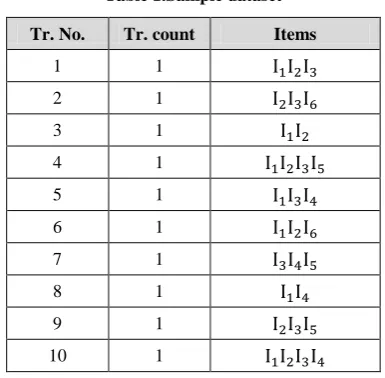
[image:4.595.324.525.89.254.2]Consider the sample dataset in Table 1 and specified minimum support 0.5. After first pass and are infrequent 1-itemset. We eliminate them and find more identical transactions (Table 2).
Table 1.Sample dataset
Tr. No. Tr. count Items
1 1
2 1
3 1
4 1
5 1
6 1
7 1
8 1
9 1
[image:4.595.73.266.231.420.2]10 1
Table 2.Sample dataset after elimination of and in first pass
Tr. No. Tr. count Items
1,4 2
2,9 2
3,6 2
5 1
7 1
8 1
10 1
ODAM stops elimination here, but we keep this technique in all of the next passes. At second iteration, we have 2-itemsets { , , , , , }that only and is frequent. Furthermore, = { } and we can eliminate from dataset (Table 3). This technique not only reduces average transaction size but also finds more identical transactions. Also, at kth iteration, transactions that are smaller than or equal to k can be eliminated. This manner is effective on final iterations of mining and real world datasets which variation of transactionss size is tremendous. Table 4 shows the result of elimination of short transactions in Table 3.
Table 3.Sample dataset after elimination of in second pass
Tr. No. Tr. count Items
1,4,10 3
2,9 2
3,6 2
5 1
7 1
8 1
Table 4.Sample dataset after reduction of transactions smaller than or equal to 2
Tr. No. Tr. count Items
1,4,10 3
4.2 Reduction of Communication Cost
A typical architecture of a distributed data mining approach wasshown in Figure 1. In summeryas mentioned before, in some approaches [9,15,27], the analysis of the local database at distributed sites is transmitted to a central site, and the integration is performed.For FIM problem, in this situation, the communication complexity is O (| |n)inpass k, where | | and n are the size of candidate k-itemsets and number of local sites, respectively.
In some other approaches [5,6,8], instead of a merger site, the local models are broadcasted to all other sites, so that each site can in parallel compute the global model.The communication complexity is O (| | ). Futhermore, we have used a merger site in NDD-FIM to reduce communication cost.
On the other hand, using a powerful pruning technique called global pruning that has been developed in FPM algorithm [8], can reduces candidate sets and communication cost and increases performance.Global pruning is stated in [8] as follows:
Global pruningLet Xbe a candidate k-itemset. At each partition , ( ) ≤ ( ), if YX. Therefore the local support
[image:4.595.74.267.460.592.2]count of Xis bounded by the value min { ( ) | Y X; and |Y|=k-1}. Since the globalsupport count of X, (D), is the sum of its local support count at all the processors, the value (D) =
where
= min { ( ) | Y X; and |Y| = k-1}
is an upper bound of (D). If (D)<minsup×|D|, then X can be pruned away.
same process and result in all sites, we can transfer it to the merger site easily and use global pruning.
Note that after global pruning, candidate set in all nodes is similar while some items maybe doesn't exist in some node. Thus we can perform a new pruning method in NDD-FIM called node pruning after global pruning and before sending candidate itemsets to each node.
Node pruning Let be candidate k-itemsets after global pruning. At each partition , if the value
= min { ( ) | Y X; and |Y| = k-1}
be equal to zero, then X can be pruned away from .
Global pruning and node pruning techniques reduce candidate sets and communication cost and increase performance. Specially, high data skewness and workload balance would increase the chance of candidate set pruning [8].
4.3Reduction of idle time
Elimination of infrequent items and finding similar transaction described in section 4-1 is a time-consuming process and placing it alongside other operation is not economical. On the other hand, the processors are idle when they are waiting the results of global processingfrom center site. Also, low-speed network for transition oflocal and global results increases idle time of processors.
Furthermore, we have created two threads in local processors. First thread is for processing local results and second thread is for elimination of infrequent items.
Second thread is a dynamic background action and every time that processor is idle or wistful, it can switch to this thread. Moreover, transition of apriori_gen function to the server causesthe local processors to be released from a useless and repetitive activity and to perform second thread.
4.4 The NDD-FIM algorithm
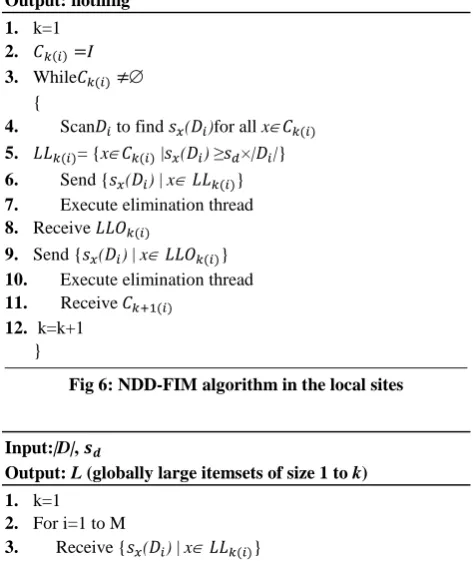
Fig.6 shows NDD-FIM's pseudocode in the local sites. It first computes support counts of 1-itemsets from local data set in the same manner as it does for the sequential Apriori, then broadcasts locally frequent items to the mergersite and starts elimination thread. Actually, at first pass, elimination thread doesn't have any infrequent items but it can find similar transactions. At next passes computed may be empty or not.
Local site stops elimination thread when receives locally large 1-itemsets in other site and candidate 2-itemsets from the merger.Subsequently, sending support counts, receiving new candidates, stopping and resuming elimination thread are performed iteratively.
In Fig. 6, and are used to denote candidate and
locally large k-itemsets at processor , respectively. Also is locally large k-itemsets at others processors
except .Fig. 7 shows NDD-FIM's pseudo code in the merger site. It receives locally frequent itemsets from local sites and computes summation of support counts. Then it finds some gl-large itemsets and sends indeterminate itemsets to other sites and receives their support counts to determine final gl-large collection.
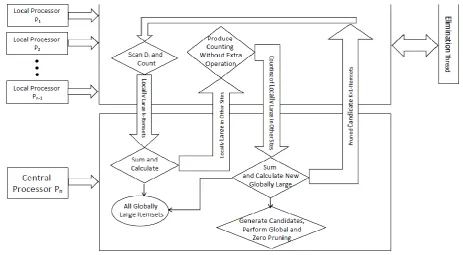
Subsequently, the merger site executes apriori_gen function to generate candidate k-itemsets and prunes them using global pruning described in section 4-2. Afterwards it performs node pruning for each local site and broadcasts pruned candidate k-itemsets to all local sites. It discovers the globally frequent itemsets of that respective length after every pass.Fig. 8 shows the flow diagram of NDD-FIM algorithm.
Input: ,i =1, . . . , M , Output: nothing
1. k=1
2. I
3. While
{
4. Scan to find ( )for all x
5. = {x | ( ) ≥ ×| |}
6. Send { ( ) | x }
7. Execute elimination thread 8. Receive
9. Send { ( ) | x }
10. Execute elimination thread 11. Receive
[image:5.595.307.544.90.371.2]12. k=k+1 }
Fig 6: NDD-FIM algorithm in the local sites
Input:|D|,
Output: L (globally large itemsets of size 1 to k)
1. k=1
2. For i=1 to M
3. Receive { ( ) | x }
4. =
5. While {
6. (D) = , for all x 7. = {x | (D) ≥ ×|D|} 8. For i=1 to M
{
9. = { x | x ^ x } 10. Send
11.Receive { ( ) | x }
}
12. =
13. (D) = , for all x
14. = {x | (D) ≥ ×|D|} 15. L=L
16. =
17.Prune by global pruning
18. For i=1 to M { 19. =
20. Prune by node pruning 21. Send
22.Receive { ( ) | x }
}
23. =
24.k=k+1 } 25.Return L
Fig 8: The flow diagram of NDD-FIM algorithm
5.
IMPLEMENTATION & EXPERIMENTAL
RESULTS
The proposed algorithm was implemented using Visual Studio .Net 2008 and C# language and generated all frequent itemsets satisfying the required minimum support indicated by the user. It was implemented using an Ethernet LAN consisting of 7 workstations and one merger site. The configuration of each workstation on the network was an AMD Athlon XP 2800+ with 2 GB of RAM. Also, the operating system was Windows XP Professional SP3.
The processors were interconnected via a 10/100 Mbps switch. The Message Passing Interface for .Net (MPI.Net) was used for communications.
[image:6.595.55.285.624.670.2]We chose two datasets to test the communication cost of NDD-FIM versus ODAM algorithm. The datasets are taken from the FIM dataset repository page (http://fimi.ua.ac.be). The Connect dataset produces many long frequent itemsets even for high support and is typical of dense datasets. Meanwhile, Mushroom is sparse and uses low support thresholds to generate frequent itemsets. Table 5 shows the characteristics of experimental datasets.
Table 5.The characteristics of experimental datasets
Datasets #Items #Records Avg.length Type
Mushroom 119 8,124 23 sparse
Connect-4 129 67,557 43 dense
We also used data from the KDD Cup 2000 [30] to generate the data used in some experiments and test the performance of NDD-FIM versus Prefix, DDRM, and ODAM algorithms. This data set was based on click-stream data obtained from a web store called Gazelle.com. The size of the data was 4.8 Mbytes with 3,465 transactions. It included 220 attributes of customer information such as gender, occupation, age, marital status, estimated income, home market value, US State, Email, etc.We
selected some attributes as categories to be investigated. Each of these categories was further subdivided into specific items, with each item being assigned an integer value used to represent it in the data file.
5.1 Communication cost experiment
To compare the number of messages that NDD-FIM and ODAM exchange among sites to generate the globally frequent itemsets in a distributed environment, we partitioned the Connect and Mushroom data sets into five partitions. Therefore, each site contains approximately 20 percent of the original data set's transactions.
Fig. 9 and 10 depicts the total size of messages that ODAM and our algorithm transmit with different support values.
As Fig. 9 and 10 shows, proposed algorithm exchanges fewer messages among sites because of global pruning and nodepruning techniques and elimination of infrequent items in all iterations.
5.2 Execution time experiment
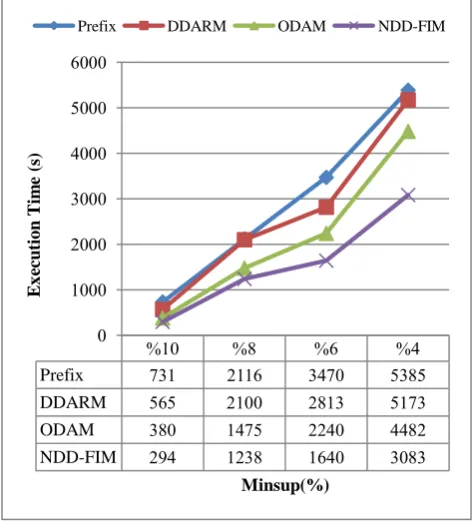
We conducted experiments on a set of data from KDD data set with 30 attributes where we vary the support from 4% to 10% for NDD-FIM, Prefix, DDRM, and ODAM algorithms. The data set was partitioned into 4 parts based on the number of processors. The obtained execution times of this experiment are shown in Fig. 10.
5.3 Transaction width experiment
Fig 9: Total exchanged messages for Connect-4 dataset
Fig 10: Total exchanged messages for Mushroom dataset
Fig 11: Execution time for KDD dataset
Fig 12: Execution time for various size of KDD dataset
6.
CONCLUSION
Distributed Data Mining (DDM) enables learning over huge amounts of data that are situated at different geographical locations. It supports several interesting applications, ranging from fraud and intrusion detection, to market basket analysis over a wide area, to knowledge discovery from remote sensing data around the globe. Frequent Itemsets Mining (FIM) in a huge database is a worthwhile research topic in DDM area and is, however, very time consuming process. Parallel and distributed computation strategies provide suitable solutions to this problem.
In this article, the New Dynamic Distributed Algorithm for FIM (NDD-FIM) is proposed. It eliminates all infrequent items after every pass and finds more identical transactions. Furthermore, NDD-FIM can effectively reduce the required scan iterations to a database and accelerate the calculation of itemsets. Also the elimination is a dynamic background activity to fill idle time of processors. On the other hand, NDD-FIM uses local and global pruning and a merger site to reduce the communication overhead. Experimental results show that NDD-FIM achieves better than some pervious works.
7.
ACKNOWLEDGMENTS
We would like to thank Blue Martini Software for contributing the KDD Cup 2000 data.
8.
REFERENCES
[1] Ailing,W.2011. An Improved Distributed Mining Algorithm of Association Rules, JCIT: Journal of Convergence Information Technology, 6(4) 118-122.
[2] Roy, S., Bhattacharyya, D.K.2008. OPAM: An Efficient One Pass Association Mining Technique without Candidate Generation, JCIT: Journal of Convergence Information Technology, 3(3) 32-38.
75 80 85 90
ODAM 61 19 7 2
NDD-FIM 36 14 4 2
0 10 20 30 40 50 60 70
M
ess
a
g
e
S
ize
(b
y
te
s)
Minsup(%)
ODAM NDD-FIM
×106
0.04 0.06 0.08 0.1
ODAM 79 33 9 5
NDD-FIM 56 24 7 4
0 20 40 60 80 100
M
ess
a
g
e
S
ize
(b
y
te
s)
Minsup(%)
ODAM NDD-FIM
×106
10
% % 8 % 6 % 4
Prefix 731 2116 3470 5385
DDARM 565 2100 2813 5173
ODAM 380 1475 2240 4482
NDD-FIM 294 1238 1640 3083
0 1000 2000 3000 4000 5000 6000
Ex
ec
u
tio
n
Tim
e
(s)
Minsup(%)
Prefix DDARM ODAM NDD-FIM
kdd10 kdd20 kdd30 kdd40 kdd50 Prefix 59 744 2944 7133 7133
DDRM 14 509 1685 3512 3477
ODAM 19 422 1350 2845 3282
NDD-FIM 11 368 925 2150 2261 0
1000 2000 3000 4000 5000 6000 7000 8000
Ex
ec
u
tio
n
Tim
e
(s)
Datasets
[image:7.595.52.292.280.455.2] [image:7.595.53.291.492.754.2][3] Li, Y., Sun, L., Yin, J., Bao, W., Gu,M.2010. Multi-Level Weighted Sequential Pattern Mining Based on Prime Encoding, JDCTA: International Journal of Digital Content Technology and its Applications, 4(9) 8-16.
[4] Lin, F., Le, W.,Bocor, J. 2010. Research on Maximal Frequent Pattern Outlier Factor for Online High-Dimensional Time-Series Outlier Detection, JCIT: Journal of Convergence Information Technology, 5(10) 66-71.
[5] Agrawal, R., Shafer,J.C. 1996. Parallel mining of association rules, IEEE Transactions on Knowledge and Data Engineering, 8(6) 962-969.
[6] Cheung, D.W., Han, J., Ng, V.T., Fu, A.W., Fu, Y. 1996. A fast distributed algorithm for mining association rules, In Proceedings of the Fourth International Conference on Parallel and Distributed Information Systems, 31-42.
[7] Schuster, A., Wolff, R., Trock,D. 2005. A high-performance distributed algorithm for mining association rules, Knowledge Information System, 7(4) 458–475.
[8] Cheung, D., Xiao, Y. 1998. Effect of data skewness in parallel mining of association rules, In 12th Pacific-Asia Conference on Knowledge Discovery and Data Mining, Melbourne, Australia, April,48-60.
[9] Schuster, A., Wolff, R. 2001. Communication-efficient distributed mining of association rules, In Proceedings of the 2001 ACM SIGMOD International Conference on Management of Data, Santa Barbara, California, May,473-484.
[10]Agrawal, R.,Srikant, R. 1994. Fast algorithms for mining association rules, In Proceedings of the 20th International Conference on Very Large Databases (VLDB94), Santiago, Chile, September,487-499.
[11]Park,J.S., Chen,M., Yu,P.S. 1995. An effective hash-based algorithm for mining association rules, In Proceedings of ACM SIGMOD International Conference on Management of Data, San Jose, California, May,175-186.
[12]Park, J.S., Chen, M., Yu, P.S. 1995. Efficient parallel data mining for association rules, in Proceedings of ACM International Conference on Information and Knowledge Management, Baltimore, MD, November,31-36.
[13]Pramudiono, I., Kitsuregawa, M. 2003. Parallel FP-Growth on PC cluster, In Proceedings of the 7th Pacific–Asia Conference of Knowledge Discovery and Data Mining, (PAKDD03)467- 473.
[14]Han, J., Pei, J., Yin, Y. 1999. Mining frequent patterns without candidate generation, Technical Report, Simon Fraser University, October,99-102.
[15]Ashrafi, M.Z., Taniar, D., Smith, K.A. 2004. ODAM: an optimized distributed association rule mining algorithm, IEEE Distributed Systems Online, 5(3).
[16]Zaki, M.J. 2000b. Parallel and distributed data mining: An introduction, In M.J. Zaki, C. Ho, (Eds.), Large-Scale Parallel Data Mining. New York, NY: Springer-Verlag. 1-23.
[17]Agrawal, R., Imielinski, T., Swami, A. 1993. Mining association rules between sets of items in large databases, In Proceedings of ACM SIGMOD International Conference on Management of Data, 207-216.
[18]Chung, S.M.,Congnan, L. 2008. Efficient mining of maximal frequent itemsets from databases on a cluster of workstations, Knowledge Information System, 16(3) 359– 391.
[19]Congnan, L., Chung, S.M. 2008. A scalable algorithm for mining maximal frequent sequences using a sample, Knowledge Information System, 15(2) 149–179.
[20]Lian, W., Cheung, D.W., Yiu,S.M. 2007. Maintenance of Maximal Frequent Itemsets in Large Databases, In Proceedings of 2007 ACM Symposium on Applied Computing (SAC’07), Seoul, 388-392.
[21]Tsoumakas,G., Vlahavas, I. 2009. Distributed Data Mining, Database Technologies: Concepts, Methodologies, Tools, and Applications,Page-710.
[22]Toivonen, H. 1996. Sampling large databases for association rules, In Proceedings of 22th International Conference on Very Large Data Bases (VLDB’96), Bombay, India, 134-145.
[23]Brin, S.,Motwani,R., Ullman, J.D., Tsur, S.1997. Dynamic itemset counting and implication rules for market basket data, In Proceedings of ACM SIGMOD International Conference on Management of Data, 255-264.
[24]Ye, Y., Chiang, C.C.2006. A parallel apriori algorithm for frequent itemsets mining, In Proceedings of the Fourth International Conference on Software Engineering Research, Management and Applications,87–94.
[25]Bodon, F. 2003. A fast apriori implementation, In Proceedings of the IEEE ICDM Workshop on Frequent Itemset Mining Implementations.
[26]Wu, J., Li,X.M.2008. An efficient association rule mining algorithm in distributed database, In International Workshop on Knowledge Discovery and Data Mining (WKDD),108–113.
[27]Wessel, T.2009. Parallel mining of association rules using a lattice based approach [dissertation], Nova Southeastern University.
[28]Aggarwal, C.C., Yu, P.S.2001. A new approach to online generation of association rules, IEEE Transactions Knowledge and Data Engineering, 13(4)527-540.
[29]Cheung, D.W., Ng, V.T., Fu, A.W., Fu, Y. 1996. Efficient mining of association rules in distributed databases, IEEE Transactions on Knowledge and Data Engineering, 8(6) 911-922.
[30]Kohavi, R., Bradley, C.E., Frasca, B., Mason, L., Zheng, Z. 2000. KDD-Cup 2000 organizers Report: Peeling the Onion. SIGKDD Exploration 2(2) 86–93.
![Fig 1: Typical architecture of Distributed Data Mining approaches [21]](https://thumb-us.123doks.com/thumbv2/123dok_us/8081328.782401/2.595.56.289.520.693/fig-typical-architecture-distributed-data-mining-approaches.webp)