Route Bazaar: Automatic Interdomain Contract Negotiation
Ignacio Castro
♣†♠Aurojit Panda
‡Barath Raghavan
♠Scott Shenker
♠‡Sergey Gorinsky
♣♣IMDEA Networks Institute †Open University of Catalonia ♠ICSI ‡UC Berkeley
Abstract
While it is widely acknowledged that the Border Gateway Protocol (BGP) has many flaws, most of the proposed fixes focus solely on improving the stability and security of its path computation. However, because interdomain routing involves contracts between Autonomous Systems (ASes), this paper argues that contractual and routing is-sues should be tackled jointly. We propose Route Bazaar, a backward-compatible system for flexible Internet con-nectivity. Inspired by the decentralized construction of trust in cryptocurrencies, Route Bazaar uses a decentral-ized public ledger and cryptography to provide ASes with automatic means to form, establish, and verify end-to-end connectivity agreements.
1
Introduction
It’s Friday night at Ballroom B at the Sheraton in Albu-querque, NM. In the vast room dwarfing the few dozen people gathered within, pairs of lonely eyes meet up to decide whether they would be a good match. Such speed dating events are about connecting, but the connections be-ing discussed tonight are not of the usual sort because the participants are Internet Service Providers (ISPs), mem-bers of an Internet eXchange Point (IXP) attending an event organized to help them negotiate peering agree-ments with other IXP participants.This is how network interconnection contracts are negotiated in the Internet of 2015.
How did we arrive at this sorry state? After infrastruc-ture privatization in the early 1990s, the Internet consisted of multiple independent networks or Autonomous Sys-tems (ASes). Global end-to-end reachability thus required the negotiated interconnection of separately owned and administered networks. Delivering the traffic of another network is a service that has its costs and can be provided with different levels of Quality of Service (QoS). As pri-vate for-profit entities, ASes seek compensation for their traffic delivery services and sign contacts that include a Service-Level Agreement (SLA). To establish conditions and accountability, the SLA determines the interconnec-tion type, service condiinterconnec-tions, compensainterconnec-tion arrangements, and penalties for contractual violations.
During the same transition in the 1990s, the main proto-col for interdomain routing changed from the centralized Exterior Gateway Protocol (EGP) [31] to the distributed
BGP [20]. In BGP, each AS independently decides which traffic-delivery paths it will offer its neighbors. An AS only announces paths to those neighbors with whom the AS has a bilateral interconnection agreement, even when the available physical connectivity is richer.
This interconnection model enabled the Internet’s rapid growth, but BGP’s distributed realization of bilateral con-tracts suffers from numerous drawbacks, including route instability, convergence slowness, policy inflexibility, and configuration complexity. While protocol improvements, new contract types, and new interconnection facilities have mitigated some of these issues, the foundations of In-ternet routing remain mostly the same and many problems persist. Most current BGP research focuses on improve-ments in the basic protocol, rather than on the contractual system that BGP realizes. In contrast, we contend that many of BGP’s woes arise due to the contractual model.
End-to-end traffic delivery requires coordination among multiple ASes that may not trust each other. The current contractual system deals with the problem of trust by relying on rigid bilateral contracts between neighbor-ing ASes. However, the transitive trust of the bilateral contracts comes at the expense of routing flexibility and efficiency. Without explicit means for direct coordination among multiple networks, the realized paths are subop-timal, oscillate needlessly, and react inappropriately to traffic-demand changes and infrastructure failures.
2
Background
Currentinterdomain routingrelies on bilateral contracts between ASes, which typically establish either transit or peering relationships. In a transit relationship, a customer network pays a provider for reaching the global Internet. Networks can also bypass transit providers and instead interconnect directly through a peering relationship. In peering, two networks obtain reachability to a restricted set of Internet addresses: peers only exchange traffic des-tined to their own networks and to networks for which they provide transit.
An AS uses BGP to exchange reachability information with neighbors with which it has bilateral contracts. An AS has limited control over the routes of inbound traffic; for outbound traffic, when multiple neighbors offer paths to the same destination, the AS can choose the neigh-bor through which to forward. Most ASes prefer to send outbound traffic through interconnections that generate revenue (i.e.,through transit customers), and avoid using transit providers if an alternate path through a customer or peer exists.
BGP is fully decentralized and is thus extremely scal-able. However, this scalability comes at the expense of flexibility and responsiveness. In particular, events such as routing policy changes, misconfigurations, and infrastruc-ture failures can trigger path oscillations and forwarding loops [18], and it is nearly impossible to verify that se-lected paths conform with global routing policies [16]. For example, BGP hijacking has in the past been used to redirect YouTube’s traffic to a fake destination in Pak-istan [2, 30], and to redirect Spamhaus’s traffic to a hacker group [35]; in both of these cases a more global view would have alerted ASes to these problems.
The rapid growth of the Internet, both in terms of users and traffic volumes, and the increasing diversity of Inter-net services have strained the existing routing framework. To cope with these challenges, new types of interconnec-tion contracts have emerged (e.g.,partial transit [37], paid peering [8] and remote peering [6]), IXPs (switching fa-cilities to reduce the costs of peering) have mushroomed, and BGP has slowly evolved.
However, many of the limitations of Internet routing stem from two root causes. First, contracts must be explic-itly negotiated by humans before two ASes can exchange traffic. Thus, in stark contrast to the dynamic nature of the Internet itself, interconnection negotiations are carried out at human-time scales (sometimes via social events for en-gineers as mentioned earlier). Second, these contracts are applied recursively: traffic that an AS sends to its neigh-bor is then governed by the contracts of that neighneigh-bor. The local (and thus recursive) routing decisions made by BGP are globally suboptimal due to limited visibility [22].
Cryptocurrencies, like Bitcoin [24], are secure, decen-tralized, anonymous digital currencies. These currencies
are often built on a public ledger, commonly referred to as a block chain. The public ledger records transactions and enables checking of the account balance for each user. Cryptocurrencies have been adopted to new non-monetary uses [7, 13, 14] that leverage the public ledger as a decentralized and hard-to-corrupt log.
The public ledger needs to be resilient (i.e., incorrupt-ible) even in the presence of untrusted participants. Bit-coin’s public ledger is therefore built using a consensus algorithm that is capable of solving the Byzantine con-sensus problem [1]. Byzantine concon-sensus is impossible to solve in asynchronous systems in general and requires at least two thirds of participants be honest. Moreover, it assumes that the set of participants is well known. Bitcoin solves this latter problem (that of limiting who can par-ticipate) by requiring each participant in the consensus algorithm to solve a puzzle before voting, and attach a proof-of-work [23] to each vote. Generating this proof requires the participant to solve a sufficiently hard algo-rithmic problem1. Since generating this proof requires computational resources, it ensures that the number of votes a malicious user can generate is in proportion to the computing power they control. Since voting multiple times is hard, a malicious user needs to instead convince a majority of participants to affect the result of the con-sensus algorithm. The lack of aligned interests among malicious parties therefore allows all users to trust the values stored in the block chain.
3
Route Bazaar
In this section, we present Route Bazaar, a novel system for flexible Internet connectivity. Inspired by cryptocur-rencies, Route Bazaar uses a decentralized public ledger to allow mutually distrustful ASes and customers to es-tablish dynamic, end-to-end QoS-aware paths as overlays on the existing Internet. In Route Bazaar, the informa-tion contained in the public ledger allows each participant to verify any participant’s conformance with previous path agreements, while simultaneously keeping the path agreements private. By relying on a public ledger, Route Bazaar establishes trust among participants which can compute the likelihood that another participant will honor a path agreement. Route Bazaar uses standard crypto-graphic tools to ensure privacy and existing techniques to establish overlays; our innovation lies in creating a trustworthy environment for the announcement, selection, and verification of end-to-end paths. In what follows, we assume that all communications with the public ledger are carried out through authenticated and encrypted chan-nels,i.e.,entities cannot impersonate each other. Several existing protocols (e.g.,TLS [9]) can be used to meet this requirement.
1Bitcoin changes the problem hardness to ensure that solving it takes
Provider Pathlet Destination Price Latency SLO Throughput SLO AS1 f48d4c4 AS2 $50 5 ms (99.9%) 3 Gbps (99.9%) AS1 d7228c5 AS3 $45 5 ms (99.9%) 3 Gbps (99.9%) AS2 97dbd13 AS9 $10 10 ms (99.9%) 1 Gbps (99.9%) AS3 ca22b8a AS9 $20 8 ms (99.9%) 2 Gbps (99.9%)
Table 1: Pathlet advertisements in the public ledger.
In Route Bazaar, aprovideris an AS that advertises connectivity over apathlet (i.e.,a path fragment [15]). Apathis formed by composing pathlets leading from a
sourceto adestination. Acustomerin Route Bazaar is an entity paying for the end-to-end connectivity provided by a path. A customer may not be an AS, and might be either the source or destination of the path.
An important aim for Route Bazaar’s design is to mini-mize the amount of information leaked about end-to-end paths and customer policies. Our design limits public in-formation to the minimum required to support flexible routing via multilateral contracts. First, providers adver-tise pathlets using the public ledger. Then, customers compose end-to-end paths by combining the advertised pathlets. Finally, providers confirm or reject the agree-ment. We envision that these decisions are made dy-namically by automated agents acting on behalf of cus-tomers and providers. Participants can hence enforce so-phisticated contractual and routing policies. For instance, Route Bazaar allows these policies to exploit the histor-ical records about forwarding performance (to choose providers) and likelihood of payment (to accept a cus-tomer) that are maintained in the public ledger. When all participants agree on a path, the public ledger records an agreement between the customer and each provider participating in the path.
As the traffic is forwarded along a computed path, the source, destination and each provider record machine-readable forwarding proofs in the public ledger. These proofs can then be used to verify that each provider deliv-ered the desired level of service. Customers also record proofs showing that they have paid providers in the public ledger. The public ledger therefore allows potential cus-tomers and providers to compare previous performance and payment history when deciding whether or not to trust each other.
3.1
Routing
Providers advertisepathletsin the public ledger (Table 1). Each pathlet advertisement specifies a tag (used to re-fer to the pathlet), the source, destination, price and Ser-vice Level Objective (SLO) for throughput and latency. For ease of exposition, here we assume that the pathlet provider is also the source, however Route Bazaar sup-ports pathlets where the source and provider differ.
A customer composes an end-to-end path between a source and destination by choosing from the set of
ad-Provider Tag Latency SLO Throughput SLO AS1 encm(f48d4c4) 5 ms (99.9%) 1 Gbps (99.9%)
AS2 encm(97dbd13) 10 ms (99.9%) 1 Gbps (99.9%)
Table 2: Pathlet commitments table in the public ledger.encm(x)here represents the value output by a PRF with keymand valuex.
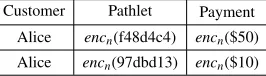
Customer Pathlet Payment Alice encn(f48d4c4) encn($50)
Alice encn(97dbd13) encn($10)
Table 3: Payment commitments in the public ledger.encn(x)here
repre-sents the value output by a PRF with keynand valuex.
vertised pathlets. The customer can enforce routing poli-cies by filtering out policy-incompatible pathlets. For ex-ample, a customer can exclude pathlets advertised by providers who have previously not met their SLOs. Be-fore a path can be used, each provider must agree to route traffic along the path; a provider can thus disallow the use of policy-incompatible paths. For example, a provider might deny service to customers who are unlikely to pay, or reject paths involving untrusted providers. Policies are enforced by automated agents, who act on behalf of providers and customers (and are hence aware of their policies) and can exploit the information contained in the public ledger to judge other participants.
Once the customer and all pathlet providers have agreed on a path, the participants use a symmetric key generated via key agreement (e.g., Elliptic Curve Diffie-Hellman (ECDH) [3]) and the pathlets’ tags as input to a cryp-tographic pseudorandom function (PRF) to generate an anonymous tag that is valid for only this specific path. Each provider then publishes a pathlet agreement which includes this encrypted tag, the provider’s identity and the SLO offered by the pathlet to a pathlet commitments ta-ble (Tata-ble 2) in the public ledger. We use path agreement to refer to the collection of all pathlet agreements that allow routing along a path. The customer and providers also agree on a second key that is used to generate an anonymized payment tag (again derived from the pathlet tag) and prices that are used to record a set of payment agreements (Table 3) between the customer and providers. This mechanism can accommodate a variety of end-to-end routing models including multipath routing [38], source routing [28], opportunistic routing [28] and route repositories [4]. Route Bazaar also allows customers to outsource path computation to trusted third parties,i.e.,
routing as a service [21]. Finally, Route Bazaar supports contractual flexibility,e.g.,it can accommodate both cases where the sender pays for connectivity and cases where the receiver pays for connectivity.
Pathlet Packet Hash Timestamp Throughput
encm(source|A6) 50 0a9f136 420 ms 1.2 Gbps encm(f48d4c4) 50 0a9f136 424 ms 1.2 Gbps encm(97dbd13) 50 0a9f136 433 ms 1.1 Gbps encm(destination|A9) 50 0a9f136 433 ms 1.1 Gbps
Table 4: Forwarding proofs in the public ledger.encm(x)here represents
the value output by a PRF with keymand valuex.
Table 1 to find two possible paths that provide this connec-tivity: AS1-AS2-AS9 and AS1-AS3-AS9. While the path through AS2 is cheaper ($60 vs $65), the path through AS3 offers better latency (13ms vs 15ms). In this ex-ample, Alice’s policy favors the cheapest path2, and she therefore decides to route along path AS1-AS2-AS9. If AS1 and AS2 agree to form a path, the three (Alice and both ASes) use ECDH to compute keysmandn. AS1 and AS2 use a PRF with keymto generate anonymized tags, and then update the pathlet commitments table in the public ledger (Table 2). Similarly, Alice uses keynto compute anonymized payment tags, and encrypt prices, and updates the payment commitment table (Table 3).
Note that while in the previous example, Route Bazaar allows Alice to exclude paths going through AS3, this is not generally possible in BGP, where all traffic originating at AS1 and destined to AS9 follows the same path (which might in fact go through AS3). Route Bazaar thus pro-vides Alice with additional routing flexibility, allowing her to choose paths based on a richer set of policies.
3.2
Forwarding
Once an end-to-end path has been agreed, providers up-date the data plane as required. Route Bazaar provides the mechanisms to form and agree on paths as well as to verify that forwarding conforms with the agreed paths. To verify path conformance, Route Bazaar generatesforwarding proofsthat are recorded in the public ledger. Customers, providers and intermediate ASes along a path use existing techniques for traffic sampling at routers to periodically generate a forwarding proof. The forwarding proof for a pathlet includes the path-specific anonymized forwarding tag (a pathlet might be used by several paths), a sample of the traffic, the timestamp indicating when the sample was captured, and the throughput averaged over the time since the last sample. In our current design, we envision that each provider sets up Generic Route Encapsulation (GRE) tunnels [19] across each pathlet (to ensure in-order packet transit) and samples a particular packet (e.g.,the 50thpacket in Table 4). The hash of this packet is used as a traffic sample for the forwarding proof.
Note that the inclusion of timestamps allows partic-ipants to compute the latency reported by a pathlet’s ingress and egress neighbors. Furthermore, the
partici-2Alice could have decided using other policies,e.g.,prior history if
available, or any other reasons.
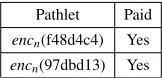
Pathlet Paid
encn(f48d4c4) Yes encn(97dbd13) Yes
Table 5: Payment proofs in the public ledger.encn(x)here represents the value output by a PRF with keynand valuex.
pants in a path (i.e.,the customer, source, destination and pathlet providers) can use their path key to discover bottle-necks in the path by observing where a (sampled) packet was dropped. To preserve the anonymity of a path, this information is not available to non-participants.
When a path’s agreement concludes3, each provider is paid by the customer, and the provider registers a payment conformation in the public ledger (Table 5). The payment proof includes the pathlet’s anonymized payment tag and a field indicating whether the payment was made. Alter-nately, the customer can record its unwillingness to pay in the public ledger, indicating that appropriate connectivity was not provided.
The payment proofs in the public ledger enable any-one to check customers’ payment history. These records can also be used for offline arbitration of payment dis-putes. During such arbitration, the entities involved in the contract can present the arbitrator with a deanonymized version of the forwarding and payment proofs.
In the example above, the participants,i.e.,the source in AS1, pathlet providers AS1 and AS2, and the destination in AS9, sample every 50th packet and publish forwarding proofs as shown in Table 4. These ASes rely on NTP (Net-work Time Protocol) for clock synchronization to ensure reported times are comparable. Once the path agreement has concluded, Alice pays AS1 and AS2, and they record her payment in the public ledger as shown in Table 5.
3.3
Privacy
The privacy offered by Route Bazaar is comparable to BGP. Similar to BGP, Route Bazaar reveals available paths (as all possible path compositions). This informa-tion is identical to what is available in public repositories,
e.g.,CAIDA [5]. Furthermore, Route Bazaar does not re-quire providers or customers to reveal routing preferences and policies.
However, unlike existing interdomain routing solutions, Route Bazaar also reveals anonymized forwarding and payment proofs. If deanonymized (e.g.,due to a compro-mised participant) these proofs expose the precise paths used by customers and the volume of transferred traffic. Similar information can be revealed today by sufficiently powerful adversaries (e.g.,governments or large ASes). Existing mechanisms,e.g.,Tor [10] and Unblock [33], for anonymizing source and destination addresses can be used on top of Route Bazaar to provide stronger anonymity.
3In our current design,path agreementsare for a fixed volume of
Finally, the forwarding commitments table in Route Bazaar leaks information about which pathlets are pop-ular, and the amount of overall traffic transmitted across a pathlet. Similarly, the payments commitment table leaks information about the number of agreements made by each customer. Route Bazaar can be extended to anonymize this information, so that contracts are estab-lished and verified out-of-band, with Route Bazaar merely serving as a record of past performance. Studying this ex-tension and its properties is left to future work.
4
Discussion
Performance Overhead.Route Bazaar imposes minimal overhead on the data plane, requiring only that routers periodically sample traffic. This feature is commonly sup-ported in most routers (to aid in debugging), and Route Bazaar does not require the samples to be transmitted in real-time. The communication overhead imposed by re-quiring ASes to record forwarding proofs with the public ledger is relatively small and can be controlled by adjust-ing the sampladjust-ing rate. Furthermore, our current design also requires the use of GRE tunnels, these are supported by most existing interdomain routers.
Because decision making in Route Bazaar is not local, routers merely forward traffic and are not responsible for control-plane decisions. Instead, control-plane decisions can be done externally by computers, or at cloud com-puting facilities. The operations required to access and update Route Bazaar today is comparable to what is per-formed by a modern web browser when connecting to a website over HTTPS [29]. The primary computation over-head during path computations is therefore a function of the policy complexity, and Route Bazaar’s control plane therefore imposes modest performance overheads. Sybil Attacks. Participants can circumvent the trust mechanisms of the public ledger by creating pseudony-mous identities,i.e.,they can perform a Sybil attack [11]. While ASes and large organizations (who are the main participants in Route Bazaar) are unlikely to jeopardize their reputation by forging their identities, Route Bazaar can protect against Sybil attacks by adopting existing solutions,e.g.,SybilGuard [39].
Rich routing policies.Route Bazaar can further enrich its supported routing policies, e.g., by linking pathlet prices to the customers’ requested traffic volume, pay-ment history, or other conditions. To attract customers, the pathlets can also expose specific salient features of the provided connectivity,e.g.,its Software-Defined Network-ing (SDN) implementation. While Route Bazaar separates routing from forwarding, the main challenge in enriching the routing policies is not their storage or processing but their expression in a machine-readable language. Backward compatibility.Because Route Bazaar can op-erate on top of today’s Internet, it is backward compatible
with traditional bilateral contracts and BGP routing. Still, Route Bazaar diversifies contractual options,e.g.,by en-abling IXP members to exchange traffic not only through traditional peering agreements but also with contracts formed dynamically via the public ledger.
5
Related Work
Since Detour [32] there have been many proposals to make Internet connectivity more flexible (e.g., AR-ROW [26]). The main contribution of Route Bazaar is that it simultaneously addresses end-to-end routing and contracts, enabling adoption of previously proposed rout-ing innovations. Among the prior work on interdomain routing, the most closely related to Route Bazaar are path-let routing [15], ICING [25,34], and Platypus [27]. Pathpath-let routing introduces the concept of composing paths from pathlets; Route Bazaar adds the mechanism to advertise pathlets via the public ledger. Route Bazaar can adopt ICING and Platypus mechanisms to verify conformance of forwarding to routing; the usage of the public ledger reduces the data-plane changes needed for such adoption. As in SDN, Route Bazaar cleanly separates the net-work data and control planes. Previous net-work, including RCP [12] and 4D [17], suggests such separation for inter-domain routing.
Kadupul [36] uses a virtual currency to incentivize low-latency forwarding in wireless mesh networks. While both Kadupul and Route Bazaar are inspired by cryptocur-rencies, Kadupul does not deal with routing or support end-to-end QoS.
6
Conclusions
The current Internet relies on explicitly negotiated bilat-eral agreements that are recursively applied via BGP, lead-ing to rigid functionality and suboptimal routlead-ing behavior. In this paper, we propose Route Bazaar, an alternative that learns from cryptocurrencies to solve the decentralized trust problem inherent in connectivity contracts. Route Bazaar forms contracts for end-to-end Internet connectiv-ity orders of magnitude faster and supports highly flexible routing.
7
Acknowledgments
This research was financially supported in part by the European Commission (FP7-ICT 288021, EINS, and H2020 644960, ENDEAVOUR), Regional Government of Madrid (S2013/ICE-2894, Cloud4BigData), and by NSF grant 1420064.
References
[2] P. Bangera and S. Gorinsky. Impact of Prefix Hi-jacking on Payments of Providers. InCOMSNETS, 2011.
[3] E. Barker, L. Chen, A. Roginsky, and M. Smid. Recommendation for Pair-Wise Key Establishment Schemes Using Discrete Logarithm Cryptography.
NIST Special Publication 800-56A, 2013.
[4] M. Caesar, M. Casado, T. Koponen, J. Rexford, and S. Shenker. Dynamic Route Recomputation Consid-ered Harmful. CCR, 40(2):66–71, 2010.
[5] Cooperative Association for Internet Data Analysis (CAIDA). http://www.caida.org/data/
active/as-relationships, 2015.
[6] I. Castro, J. C. Cardona, S. Gorinsky, and P. Francois. Remote Peering: More Peering without Internet Flat-tening. InCoNEXT, 2014.
[7] L. Chen and K. Chen. BitBill: Scalable, Robust, Verifiable Peer-to-Peer Billing for Cloud Computing. InHotCloud, 2014.
[8] A. Dhamdhere and C. Dovrolis. Twelve Years in the Evolution of the Internet Ecosystem. ToN, 19(5):1420–1433, 2011.
[9] T. Dierks and E. Rescorla. The Transport Layer Security (TLS) Protocol Version 1.2, RFC 5246, 2008.
[10] R. Dingledine, N. Mathewson, and P. Syverson. Tor: The Second-Generation Onion Router. InUSENIX Security, 2004.
[11] J. R. Douceur. The Sybil Attack. InIPTPS, 2002.
[12] N. Feamster, H. Balakrishnan, J. Rexford, A. Shaikh, and J. Van Der Merwe. The Case for Separating Routing from Routers. InFDNA, 2004.
[13] Filecoin.http://filecoin.io/, 2015.
[14] M. Ghosh, M. Richardson, B. Ford, and R. Jansen. A TorPath to TorCoin: Proof-of-Bandwidth Altcoins for Compensating Relays. InHotPETs, 2014.
[15] P. Godfrey, I. Ganichev, S. Shenker, and I. Stoica. Pathlet Routing. InSIGCOMM, 2009.
[16] S. Goldberg, M. Schapira, P. Hummon, and J. Rex-ford. How Secure are Secure Interdomain Routing Protocols? InSIGCOMM, 2010.
[17] A. Greenberg, G. Hjalmtysson, D. A. Maltz, A. My-ers, J. Rexford, G. Xie, H. Yan, J. Zhan, and H. Zhang. A Clean Slate 4D Approach to Network Control and Management. InSIGCOMM, 2005.
[18] A. Haeberlen, I. Avramopoulos, J. Rexford, and P. Druschel. NetReview: Detecting when Interdo-main Routing Goes Wrong. InNSDI, 2009.
[19] S. Hanks, T. Li, D. Farinacci, and P. Traina. Generic Routing Encapsulation (GRE),RFC 1701, 1994.
[20] S. Hares, Y. Rekhter, and T. Li. A Border Gateway Protocol 4 (BGP-4),RFC 4271, 2006.
[21] K. Lakshminarayanan, I. Stoica, S. Shenker, and J. Rexford. Routing as a Service. Technical Report UCB/EECS-2006-19,UC Berkeley, 2006.
[22] A. Lutu. A System for the Detection of Limited Visibility in BGP. PhD thesis, Carlos III University of Madrid, Spain, 2014.
[23] A. Miller and J. J. LaViola Jr. Anonymous Byzan-tine Consensus from Moderately-Hard Puzzles: A Model for Bitcoin. Technical Report CS-TR-14-01,
University of Central Florida, 2014.
[24] S. Nakamoto. Bitcoin: A Peer-to-Peer Elec-tronic Cash System. http://bitcoin.org/
bitcoin.pdf, 2008.
[25] J. Naous, M. Walfish, A. Nicolosi, D. Mazieres, M. Miller, and A. Seehra. Verifying and Enforc-ing Network Paths with ICING. InCoNEXT, 2011.
[26] S. Peter, U. Javed, Q. Zhang, D. Woos, T. Ander-son, and A. Krishnamurthy. One Tunnel is (Often) Enough. InSIGCOMM, 2014.
[27] B. Raghavan and A. C. Snoeren. A System for Authenticated Policy-Compliant Routing. In SIG-COMM, 2004.
[28] B. Raghavan, P. Verkaik, and A. C. Snoeren. Se-cure and Policy-Compliant Source Routing. ToN, 17(3):764–777, 2009.
[29] E. Rescorla. HTTP Over TLS,RFC 2818, 2000.
[30] RIPE. YouTube Hijacking: A RIPE NCC RIS Case Study.http://goo.gl/jKX6Bz, 2008.
[31] E. C. Rosen. Exterior Gateway Protocol (EGP),
RFC 827, 1982.
[32] S. Savage, T. Anderson, A. Aggarwal, D. Becker, N. Cardwell, A. Collins, E. Hoffman, J. Snell, A. Vahdat, G. Voelker, and J. Zahorjan. Detour: Informed Internet Routing and Transport. Micro, 19(1):50–59, 1999.
[33] W. Scott, R. Cheng, J. Li, A. Krishnamurthy, and T. Anderson. Blocking-Resistant Network Ser-vices using Unblock. http://unblock.cs.
[34] A. Seehra, J. Naous, M. Walfish, D. Mazieres, A. Ni-colosi, and S. Shenker. A Policy Framework for the Future Internet. InHotNets, 2009.
[35] A. Shaw. Spam? Not Spam? Tracking a Hijacked Spamhaus IP. http://goo.gl/GE0c05, 2013.
[36] M. Skjegstad, A. Madhavapeddy, and J. Crowcroft. Kadupul: Livin’ on the Edge with Virtual Currencies and Time-Locked Puzzles. arXiv:1412.4638, 2014.
[37] V. Valancius, C. Lumezanu, N. Feamster, R. Johari, and V. Vazirani. How Many Tiers? Pricing in the
Internet Transit Market. InSIGCOMM, 2011.
[38] D. Wendlandt, I. Avramopoulos, D. G. Andersen, and J. Rexford. Don’t Secure Routing Protocols, Secure Data Delivery. InHotNets, 2006.