Page 1 of 16 Article
A Novel Optimization Algorithm to Create Perennial
Calendar
System
based
on
Gregorian
and
International Fixed Calendards
Claude Ziad El-Bayeh
Abstract: Has anyone ever missed an event because he was confused in days and dates? Do we
remember the date of any day without looking at a calendar? Is the current Gregorian Calendar efficient enough for use, and does it facilitate our life or make it more complicated? Have you ever thought about a much simpler way to calculate days and dates in a year? All these questions are answered in this paper, in which the author proposes original optimization algorithm that creates optimal perennial calendars. Results show that there is more than one way to create a perennial calendar, in which the number of days in each month does not change, neither the dates. Hence, all months have the same sequence of days and dates. In other meaning, Monday becomes the first day of every month, and Sunday becomes the last day. Consequently, the calendars become much easier to memorize and very simple to predict the days and dates in any year.
Keywords: Gregorian Calendar; Weekly-based Calendar; Original Calendar; Optimization
algorithm; Energy saving.
1. Introduction
1.1. Background and Motivation
Gregorian and International Fixed Calendards
every year to supply the demand. The emission of CO2, the pollution, the waste, and the energy used to print out Gregorian calendar cannot be neglected especially when around billions of calendars are thrown every year. Therefore, Gregorian calendar imposes negative impact on the society, the economy, and the environment, in which a solution should be proposed to facilitate the life of people and create a more sustainable and greener society.
Some questions may arise. What happens if we create a more organized calendar in which the days and dates in a month do not change? For example, Monday will always be the first day of any month. The holidays will have the same dates and days in any year. For example, December 24, will always be on Wednesday, whatever is the year. Can we create an eco-friendly calendar, which is very easy to memorize without the necessity to print a hard copy to reduce the pollution? Moreover, human beings always tend to develop and invent new things every day to facilitate their lives. So why do we not develop an easier way to count days, weeks, and months in a year?
1.2. Gregorian vs. Julian Calendars
A year is the time a given celestial object (e.g., Earth, Mars, etc.) takes to complete one orbit around another celestial object (e.g., Sun), also called orbital period. However, astronomical years do not have integer numbers of days; for example, the Earth orbits the Sun in about 365.2425 days; therefore, it is necessary to introduce the intercalation system such as leap years. Julian and Gregorian calendars are the most common ones these days. A Julian calendar counts 365.25 days in a year, while 365.2425 days are considered in the Gregorian calendar. In total, a leap year occurs every four years in the Julian calendar, in which one day is added to the month of February. The Gregorian calendar follows almost the same concept; however, some new rules were added to reduce the gap with the reference (365.2422 days per year). These new rules are cited as follows:
Every year that is exactly divisible by four is a leap year, except for years that are exactly divisible by 100, but these centurial years are leap years if they are exactly divisible by 400. For example, the years 1700, 1800, and 1900 are not leap years, but the years 1600 and 2000 are [13].
These new rules reduce the error by 1.2 days every 4,000 years, as shown in the following table, while the Julian calendar shows an error of 31.2 days. From this place, the Gregorian calendar was adopted until this time.
Calendar Number of days in
a year
Number of days in 4
years
Number of days in 400
years
Number of days in 4,000 years
Error per 400 years with respect
to the reference
Error per 4,000 years with respect
to the reference
Julian 365.25 1,461 146,100 1,461,000 3.12 31.2
Gregorian 365.2425 1,460.97 146,097 1,460,970 0.12 1.2
Reference 365.2422 1460.9688 146096.88 1,460,968.8 - -
1.3. International Fixed Calendar
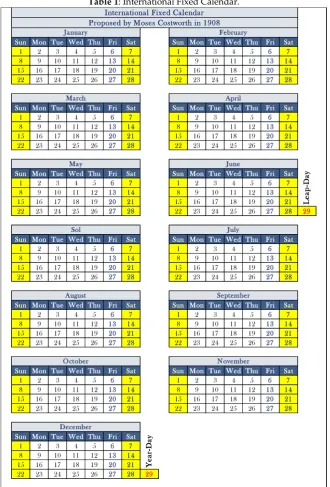
occurs every four years, which seems unpleasant to some people. Moreover, a year is divided into four quarters (3 months each quarter). If the number of days is counted in each quarter, it appears that the first quarter has 90 days, the second one has 91 days, and the third and fourth one has 92 days. The quarters are not symmetrically distributed. Therefore, two additional working days in a quarter can make a difference in the statistics for a big company. In addition, holidays are not stable during the year, for example, Christmas on December 24 is on Thursday in 2020, while it is on Saturday in 2022. In conclusion, the Gregorian calendar is difficult to handle and to memorize. To solve the problem, other sophisticated calendars were proposed to facilitate our lives []. The most famous calendar is called International Fixed Calendar and also called Cotsworth calendar, which was introduced by Moses B. Cotsworth in 1902 [14]. The calendar divides the solar year into 13 months of 28 days each. This kind of calendars is defined as a perennial calendar, in which every weekday has a fixed date every year. The International Fixed Calendar has some rules to follow, as described below [14]:
• One year has 13 months
• Each month has exactly 4 weeks
• Each week has 7 days. Therefore, the total number of days in a year becomes equal to 364 (7 days x 4 weeks x 13 months)
• An extra day is added as a holiday at the end of the year, and it is called Year Day
• The Year Day does not belong to any week. Therefore, the total number of days, including the Year day in a year, becomes equal to 365 days.
• The Cotsworth calendar is correlated to the Gregorian calendar in which it has the same number of days, and each year starts on the same date, which is January 1.
• Costworth calendar has the same month's names and order as the Gregorian calendar, except the same as those of the Gregorian calendar, except that the extra month (called Sol), which is inserted between June and July [15].
• A leap year has 366 days, and its occurrence follows the Gregorian rules.
• The Leap-Day is inserted on June 29 (between Saturday, June 28, and Sunday, Sol 1).
• Each month starts on a Sunday and ends on a Saturday.
• Both Year-Day and Leap-Day do not belong to any week. They are preceded and followed by a Saturday and a Sunday, respectively.
Table 1 presents the International Fixed Calendar, in which the Leap-Day and the Year-Day are added to the end of months June and December.
Despite the success of this calendar, it received many critics, and it has some drawbacks. The most common critics can be presented as follows:
a. The calendar claimed to have exactly 28 days in each month. However, when the leap day is added, June month will contain 29 days and not 28. The same for the leap-year, in which it is added to the month of December. Hence, the total number of days becomes equal to 29.
b. The calendar has 13 months, which is a prime number and cannot be divided by 2, nor by 3 neither by 4. Therefore, it becomes difficult to categorize activities based on a biannually, triannually, or quarterly basis. Thus, activities will be out of alignment with months.
c. The week starts with a Sunday. Hence, the calendar disagrees with ISO 8601, in which the first day is Monday and not Sunday.
d. Adding a day between Saturday and Sunday is considered confusing, especially when leap-day and year-day are added to the month of June and December.
e. Some people are pessimistic about the date Friday 13th.
Gregorian and International Fixed Calendards Table 1: International Fixed Calendar.
1.4. Contributions
In this paper, the main contributions are presented as follows:
• An original perennial calendar system is proposed that solves all the above-mentioned problems.
• A 14 months calendar instead of 13 is considered, in which the last one is called Month zero. Month zero has only one day in a year with 365 days and two days in a leap year.
• An original optimization algorithm that generates perennial calendars is proposed. An objective function and some constraints are defined for this purpose. The algorithm is solved with Mixed Integer Genetic Algorithm.
To validate our concept, the proposed calendar is compared to the Gregorian calendar and the International Fixed calendar. The advantages and disadvantages are discussed briefly.
Sun Mon Tue Wed Thu Fri Sat Sun Mon Tue Wed Thu Fri Sat
1 2 3 4 5 6 7 1 2 3 4 5 6 7
8 9 10 11 12 13 14 8 9 10 11 12 13 14
15 16 17 18 19 20 21 15 16 17 18 19 20 21
22 23 24 25 26 27 28 22 23 24 25 26 27 28
Sun Mon Tue Wed Thu Fri Sat Sun Mon Tue Wed Thu Fri Sat
1 2 3 4 5 6 7 1 2 3 4 5 6 7
8 9 10 11 12 13 14 8 9 10 11 12 13 14
15 16 17 18 19 20 21 15 16 17 18 19 20 21
22 23 24 25 26 27 28 22 23 24 25 26 27 28
Sun Mon Tue Wed Thu Fri Sat Sun Mon Tue Wed Thu Fri Sat
1 2 3 4 5 6 7 1 2 3 4 5 6 7
8 9 10 11 12 13 14 8 9 10 11 12 13 14
15 16 17 18 19 20 21 15 16 17 18 19 20 21
22 23 24 25 26 27 28 22 23 24 25 26 27 28 29
Sun Mon Tue Wed Thu Fri Sat Sun Mon Tue Wed Thu Fri Sat
1 2 3 4 5 6 7 1 2 3 4 5 6 7
8 9 10 11 12 13 14 8 9 10 11 12 13 14
15 16 17 18 19 20 21 15 16 17 18 19 20 21
22 23 24 25 26 27 28 22 23 24 25 26 27 28
Sun Mon Tue Wed Thu Fri Sat Sun Mon Tue Wed Thu Fri Sat
1 2 3 4 5 6 7 1 2 3 4 5 6 7
8 9 10 11 12 13 14 8 9 10 11 12 13 14
15 16 17 18 19 20 21 15 16 17 18 19 20 21
22 23 24 25 26 27 28 22 23 24 25 26 27 28
Sun Mon Tue Wed Thu Fri Sat Sun Mon Tue Wed Thu Fri Sat
1 2 3 4 5 6 7 1 2 3 4 5 6 7
8 9 10 11 12 13 14 8 9 10 11 12 13 14
15 16 17 18 19 20 21 15 16 17 18 19 20 21
22 23 24 25 26 27 28 22 23 24 25 26 27 28
Sun Mon Tue Wed Thu Fri Sat
1 2 3 4 5 6 7
8 9 10 11 12 13 14
15 16 17 18 19 20 21
22 23 24 25 26 27 28 29
L
e
a
p
-D
a
y
Y
e
a
r-D
a
y
October November
December
May June
Sol July
August September
International Fixed Calendar Proposed by Moses Costworth in 1908
January February
2. Proposed Perennial Calendar
The idea of creating a perennial calendar such as the International Fixed Calendar (IFC), is promising, and it can solve lots of problems. However, the IFC has many drawbacks, as mentioned previously. To reduce these drawbacks, new perennial calendars are proposed based on the idea of the IFC, the Gregorian calendar, and using the optimization model. To do so, a new annotation will be used in this paper to refer to a specific calendar. The annotation is as follows:
MWD+R
Or simply the mathematical Equation can be written as
M x W x D + R = 366 days in a leap year (1)
In which, M presents the number of months in a year (e.g., M = 12 months in a year). W shows the number of weeks in a day (e.g., W = 4 weeks in a month). D stands for the number of days in a week (e.g., D = 7 days in a week). R describes the number of remaining days that fill the gap between a perennial calendar and the real number of days in a year. For example, calculate R if there are 12 months a year, 4 weeks a month, and 7 days a week. In this case, M=12, W=4, D=7. Hence,
M x W x D + R = 12 months/year x 4 weeks/month x 7 days/week + R = 366
R = 366 – 12 x 4 x 7 = 30 remaining days per year
Based on the above-mentioned example, the number of remaining days per year is almost equal to one month for the Gregorian calendar. Therefore, the Gregorian calendar cannot be considered as a good example of a perennial calendar. From this place, the real number of months in a year should be equal to 13 in the above case. An ideal perennial calendar is when the remaining number of days in a year will be equal to zero, hence R = 0. However, this is not possible for the Earth because the number of days in a year does not have an integer value, and it is equal almost to 365.2422. Therefore, it is necessary to rearrange the number days, weeks, and months in order to minimize R. Thus, it becomes an optimization problem in which we need to recalculate the number of months, weeks, and days in a way to minimize R.
2.1. Optimization Model
As discussed previously, to minimize the number of remaining days in a year, an optimization model should be created. The objective function is described in Eq (2), and the constraints are shown in Equations (3) to (7). Where, 𝑅𝑚𝑖𝑛 and 𝑅𝑚𝑎𝑥 describe the lower and upper bound of the number
of remaining days in a perennial calendar. 𝑀𝑚𝑖𝑛 and 𝑀𝑚𝑎𝑥 are the lower and upper bound of the
number of months per year. 𝑊𝑚𝑖𝑛 and 𝑊𝑚𝑎𝑥 represent the lower and upper bound of the number
of weeks per month. 𝐷𝑚𝑖𝑛 and 𝐷𝑚𝑎𝑥 show the lower and upper bound of the number of days per
week. It is obvious that the optimization problem is mixed-integer nonlinear programming in which M, W, D, and R should be integers. To solve the problem, the Mixed-Integer Genetic Algorithm (MIGA) is used in this paper.
Objective function:
Gregorian and International Fixed Calendards
Subject to:
𝑅𝑚𝑖𝑛≤ 𝑌 − 𝑀 ∙ 𝑊 ∙ 𝐷 ≤ 𝑅𝑚𝑎𝑥 (3)
𝑀𝑚𝑖𝑛≤ 𝑀 ≤ 𝑀𝑚𝑎𝑥 (4)
𝑊𝑚𝑖𝑛 ≤ 𝑊 ≤ 𝑊𝑚𝑎𝑥 (5)
𝐷𝑚𝑖𝑛≤ 𝐷 ≤ 𝐷𝑚𝑎𝑥 (6)
[𝑅, 𝑀, 𝑊, 𝐷] ∈ ℕ (7)
2.2. Optimization Algorithm
To solve the above problem, Algorithm 1 is proposed and written in MATLAB 2018b. The initial values (such as Mmin, Mmax, etc.) can be changed according to the needs of the user.
Algorithm 1: Optimization Model of the Proposed Original Perennial Calendar %% An Original Optimal Perennial Calendar
clc; clear; close all; %Clear all previous data on MATLAB
%% Optimization Model---for section1=1:1%Initial Values
Y=366; %Number of days per year including the leap days
Mmin=0; Mmax=20; %minimum and maximum number of months in a year
Wmin=0; Wmax=20; %minimum and maximum number of Weeks in a Month
Dmin=0; Dmax=20; %minimum and maximum number of Days in a Week
Rmin=0; Rmax=10; %minimum and maximum number of remaining Days in a Year
end
for section1=1:1%Optimization Model
%Decision variable: X, X(1)=Month, X(2)=Week, X(3)=Day
OF=@(X)(Y-X(1).*X(2).*X(3)); %Objective Function
%Constraints of the Form A*x<=B
A=[1 0 0 ; 0 1 0 ; 0 0 1]; B=[Mmax, Wmax, Dmax]';
%Constraints of the Form Aeq*x=Beq
Aeq=[]; Beq=[];
%Constraints of the Form lb<=x<=ub
LB=[Mmin Wmin Dmin]'; %Lower Bound
UB=[Mmax Wmax Dmax]'; %Upper Bound
X0=zeros(3,1);%Starting point
%Solution of the Optimization
nvar=3; %Number of studied variables
IntCon=[1,2,3]; %Variable that should be integer
[X,Value,exitflag,output]=ga(OF,nvar,A,B,Aeq,Beq,LB,UB,@C_Matrix,IntCon);
R=Value %Show the remaining number of days
MWD=X(1).*X(2).*X(3) %Show total number of days in a year except the
remaining days
fprintf('M=%2.0f , W=%2.0f, D=%2.0f, R= %2.0f , MWD= %2.0f \n',X,R,MWD)
end
function [C,Ceq] = C_Matrix(X)
Y=366;
Rmin=0; Rmax=10;
C(1)= X(1).*X(2).*X(3)-Y+Rmin;
C(2)= Y-X(1).*X(2).*X(3)-Rmax;
Ceq=[];
end
3. Results and Discussions
3.1. Assumptions
After defining the optimization model and algorithm, it is necessary to present the assumptions that are considered in this paper. The optimization model requires the user to set the boundaries of the constraints. For this purpose, the limits are defined as follows:
• The remaining number of days in a year: Rmin=0 and Rmax=10. By increasing the range, more options appear to the user to choose the best calendar that fits his needs.
• The number of months in a year: Mmin=10 and Mmax=20. We do not want a number of months less than 10 because they become very long.
• Number of Weeks in a month: Wmin=0 and Wmax=20. We set the number of weeks flexible in order to get more options.
• Number of Days in a week: Dmin=5 and Dmax=8. A number less than 5 represents a too-short week, and a number greater than 8 is considered too long for a week.
3.2. Output Results of the Algorithm
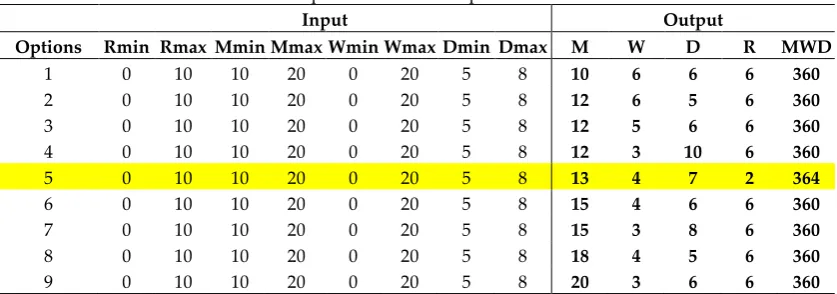
Table 2 presents the output results for the number of months, weeks, days, and remaining days per year for the proposed perennial calendars. The values can change when the boundaries of the constraints change.
Table 2: Output Results of the Optimization Model
Input Output
Options Rmin Rmax Mmin Mmax Wmin Wmax Dmin Dmax M W D R MWD
1 0 10 10 20 0 20 5 8 10 6 6 6 360
2 0 10 10 20 0 20 5 8 12 6 5 6 360
3 0 10 10 20 0 20 5 8 12 5 6 6 360
4 0 10 10 20 0 20 5 8 12 3 10 6 360
5 0 10 10 20 0 20 5 8 13 4 7 2 364
6 0 10 10 20 0 20 5 8 15 4 6 6 360
7 0 10 10 20 0 20 5 8 15 3 8 6 360
8 0 10 10 20 0 20 5 8 18 4 5 6 360
Gregorian and International Fixed Calendards 3.3. Case Study of a Calendar with 13 Months, 4 Weeks and 7 days (M13W4D7+R2)
In this paper, only the perennial calendar “M13W4D7+R2” (option 5) is discussed, while others
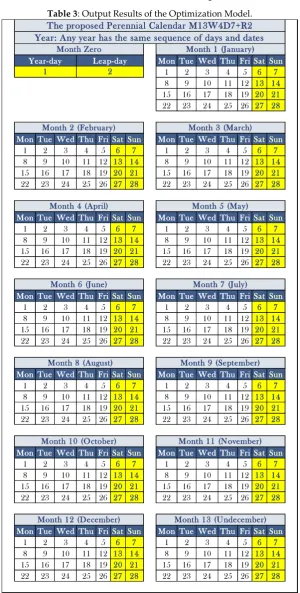
can be interpreted in the same way. Table 3 presents the proposed perennial calendar "M13W4D7+R2” based on some new rules, as stated below:
• One year has 13 months with an exact number of days and weeks. No days are added
to any month nor to any week. Hence, the problem (a) mentioned in section 1.2 is resolved.
• Each month has exactly 4 weeks
• Each week has exactly 7 days. Therefore, the total number of days in a year becomes equal to 364 (7 days x 4 weeks x 13 months)
• A new month is added to the list, which is called “Month Zero”, in which it contains the remaining days (Year-day and the Leap-day). The reason for adding this month is to separate the remaining days from the normal days, which is not the case of IFC. In addition, it respects the international standard ISO 8601 in which the dates are expressed. For example, 2020-00-01 is the Year-day, 2020-00-02 is the leap-day in a leap year, 2020-01-01 is the first official day of the year 2020, which is Monday, etc. Therefore, there is a consistency in numbering the days, dates, and their expressions.
• We do not celebrate the end of a year as other existing calendars do, such as the GC, JC, and IFC. On the contrary, we celebrate the beginning of a new year. That is why the Month Zero is added at the beginning, which represents a new start and a happy month in our lives. This method has a positive impact on the psychology of the people in which the end is not important as the beginning of a new thing in their life.
• Friday will never occur on the 13th of any month. Therefore, some people who feel pessimistic about this date will be satisfied with the new calendar. Hence, the problem (e) in section 1.2 is solved.
• The Year-Day and Leap-Day only belong to the “Month Zero”. Therefore, months still have the same number of days and will never change. Therefore, the problem (d) in section 1.2 is solved.
• A leap year has 366 days, and its occurrence follows the Gregorian rules.
• Each week starts on Monday and ends on Sunday, which agrees with the international standard ISO 8601. Therefore, the problems (c) and (f) in section 1.2 are answered.
• Each month starts on Monday and ends on a Sunday.
• Every year starts on Monday and ends on Sunday. Therefore, Month Zero is considered as a fictive month with a maximum of 2 days, which are feast days that celebrate the beginning of a new year.
Table 3: Output Results of the Optimization Model.
Based on Table 3, it is clear that the proposed Calendar has a more systematic organization of days and months in a year. The first day of a month always starts on Monday, and the last day of each month is always Sunday. Therefore, counting days becomes an easy task, and there is no need for complex algorithms to predict the days and dates in previous years. The days and dates in the proposed Calendar have strong and correlated relationships, which can be described by simple mathematical equations as in Equation (8).
Mon Tue Wed Thu Fri Sat Sun
1 2 3 4 5 6 7
8 9 10 11 12 13 14
15 16 17 18 19 20 21
22 23 24 25 26 27 28
Mon Tue Wed Thu Fri Sat Sun Mon Tue Wed Thu Fri Sat Sun
1 2 3 4 5 6 7 1 2 3 4 5 6 7
8 9 10 11 12 13 14 8 9 10 11 12 13 14
15 16 17 18 19 20 21 15 16 17 18 19 20 21
22 23 24 25 26 27 28 22 23 24 25 26 27 28
Mon Tue Wed Thu Fri Sat Sun Mon Tue Wed Thu Fri Sat Sun
1 2 3 4 5 6 7 1 2 3 4 5 6 7
8 9 10 11 12 13 14 8 9 10 11 12 13 14
15 16 17 18 19 20 21 15 16 17 18 19 20 21
22 23 24 25 26 27 28 22 23 24 25 26 27 28
Mon Tue Wed Thu Fri Sat Sun Mon Tue Wed Thu Fri Sat Sun
1 2 3 4 5 6 7 1 2 3 4 5 6 7
8 9 10 11 12 13 14 8 9 10 11 12 13 14
15 16 17 18 19 20 21 15 16 17 18 19 20 21
22 23 24 25 26 27 28 22 23 24 25 26 27 28
Mon Tue Wed Thu Fri Sat Sun Mon Tue Wed Thu Fri Sat Sun
1 2 3 4 5 6 7 1 2 3 4 5 6 7
8 9 10 11 12 13 14 8 9 10 11 12 13 14
15 16 17 18 19 20 21 15 16 17 18 19 20 21
22 23 24 25 26 27 28 22 23 24 25 26 27 28
Mon Tue Wed Thu Fri Sat Sun Mon Tue Wed Thu Fri Sat Sun
1 2 3 4 5 6 7 1 2 3 4 5 6 7
8 9 10 11 12 13 14 8 9 10 11 12 13 14
15 16 17 18 19 20 21 15 16 17 18 19 20 21
22 23 24 25 26 27 28 22 23 24 25 26 27 28
Mon Tue Wed Thu Fri Sat Sun Mon Tue Wed Thu Fri Sat Sun
1 2 3 4 5 6 7 1 2 3 4 5 6 7
8 9 10 11 12 13 14 8 9 10 11 12 13 14
15 16 17 18 19 20 21 15 16 17 18 19 20 21
22 23 24 25 26 27 28 22 23 24 25 26 27 28
1 2
Month 2 (February) Month 3 (March)
Month 4 (April) Month 5 (May)
The proposed Perennial Calendar M13W4D7+R2 Year: Any year has the same sequence of days and dates
Month Zero Month 1 (January)
Year-day Leap-day
Month 12 (December) Month 13 (Undecember)
Month 6 (June) Month 7 (July)
Month 8 (August) Month 9 (September)
Gregorian and International Fixed Calendards
{
𝑀𝑜𝑛𝑑𝑎𝑦 = 1 + 7(𝑤 − 1) 𝑇𝑢𝑒𝑠𝑑𝑎𝑦 = 2 + 7(𝑤 − 1) 𝑊𝑒𝑑𝑛𝑒𝑠𝑑𝑎𝑦 = 3 + 7(𝑤 − 1)
𝑇ℎ𝑢𝑟𝑠𝑑𝑎𝑦 = 4 + 7(𝑤 − 1) 𝐹𝑟𝑖𝑑𝑎𝑦 = 5 + 7(𝑤 − 1) 𝑆𝑎𝑡𝑢𝑟𝑑𝑎𝑦 = 6 + 7(𝑤 − 1)
𝑆𝑢𝑛𝑑𝑎𝑦 = 7 + 7(𝑤 − 1) 𝑌𝑒𝑎𝑟𝑑𝑎𝑦 = 365
𝐿𝑒𝑎𝑝 𝑑𝑎𝑦 = 366 (𝑖𝑛 𝑎 𝑙𝑒𝑎𝑝 𝑦𝑒𝑎𝑟)
𝑊ℎ𝑒𝑟𝑒 𝑤 𝑖𝑠 𝑡ℎ𝑒 𝑤𝑒𝑒𝑘 𝑛𝑢𝑚𝑏𝑒𝑟 𝑖𝑛 𝑎 {𝑚𝑜𝑛𝑡ℎ: 𝑤 ∈ [1,4]𝑦𝑒𝑎𝑟: 𝑤 ∈ [1,52] (8)
As an example, calculate the date of Monday in the third week of a month.
Answer: 𝑀𝑜𝑛𝑑𝑎𝑦 = 1 + 7(3 − 1) = 15
Another example, calculate the day number of Wednesday located on the 36th week of the year. Answer: 𝑊𝑒𝑑𝑛𝑒𝑠𝑑𝑎𝑦 = 3 + 7(𝑤 − 1) = 3 + 7(36 − 1) = 248
3.4. Comparison between the proposed calendar and the Gregorian calendar
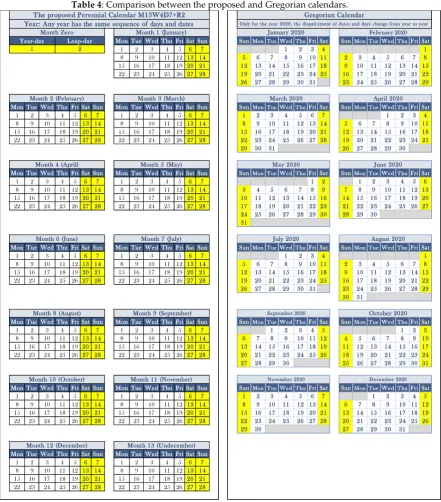
In this subsection, a comparison between the proposed and Gregorian calendars is presented.
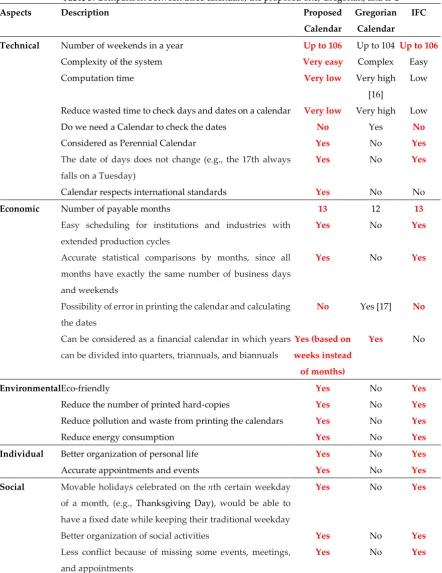
Table 4 shows both calendars, in which it is obvious that the proposed one is much easier to memorize because all months look the same. A more detailed comparison is presented in Table 5.
Mon Tue Wed Thu FriSat Sun Mon Tue Wed Thu FriSat Sun Sun Mon TueWedThuFri Sat SunMon TueWedThuFri Sat
1 2 3 4 5 6 7 1 2 3 4 5 6 7 1 2 3 4 1
8 9 10 11 12 13 14 8 9 10 11 12 13 14 5 6 7 8 9 10 11 2 3 4 5 6 7 8 15 16 17 18 19 20 21 15 16 17 18 19 20 21 12 13 14 15 16 17 18 9 10 11 12 13 14 15 22 23 24 25 26 27 28 22 23 24 25 26 27 28 19 20 21 22 23 24 25 16 17 18 19 20 21 22 26 27 28 29 30 31 23 24 25 26 27 28 29
Mon Tue Wed Thu FriSat Sun Mon Tue Wed Thu FriSat Sun Sun Mon TueWedThuFri Sat SunMon TueWedThuFri Sat
1 2 3 4 5 6 7 1 2 3 4 5 6 7 1 2 3 4 5 6 7 1 2 3 4
8 9 10 11 12 13 14 8 9 10 11 12 13 14 8 9 10 11 12 13 14 5 6 7 8 9 10 11 15 16 17 18 19 20 21 15 16 17 18 19 20 21 15 16 17 18 19 20 21 12 13 14 15 16 17 18 22 23 24 25 26 27 28 22 23 24 25 26 27 28 22 23 24 25 26 27 28 19 20 21 22 23 24 25
29 30 31 26 27 28 29 30
Mon Tue Wed Thu FriSat Sun Mon Tue Wed Thu FriSat Sun Sun Mon TueWedThuFri Sat SunMon TueWedThuFri Sat
1 2 3 4 5 6 7 1 2 3 4 5 6 7 1 2 1 2 3 4 5 6
8 9 10 11 12 13 14 8 9 10 11 12 13 14 3 4 5 6 7 8 9 7 8 9 10 11 12 13 15 16 17 18 19 20 21 15 16 17 18 19 20 21 10 11 12 13 14 15 16 14 15 16 17 18 19 20 22 23 24 25 26 27 28 22 23 24 25 26 27 28 17 18 19 20 21 22 23 21 22 23 24 25 26 27
24 25 26 27 28 29 30 28 29 30 31
Mon Tue Wed Thu FriSat Sun Mon Tue Wed Thu FriSat Sun Sun Mon TueWedThuFri Sat SunMon TueWedThuFri Sat
1 2 3 4 5 6 7 1 2 3 4 5 6 7 1 2 3 4 1
8 9 10 11 12 13 14 8 9 10 11 12 13 14 5 6 7 8 9 10 11 2 3 4 5 6 7 8 15 16 17 18 19 20 21 15 16 17 18 19 20 21 12 13 14 15 16 17 18 9 10 11 12 13 14 15 22 23 24 25 26 27 28 22 23 24 25 26 27 28 19 20 21 22 23 24 25 16 17 18 19 20 21 22 26 27 28 29 30 31 23 24 25 26 27 28 29
30 31
Mon Tue Wed Thu FriSat Sun Mon Tue Wed Thu FriSat Sun Sun Mon TueWedThuFri Sat SunMon TueWedThuFri Sat
1 2 3 4 5 6 7 1 2 3 4 5 6 7 1 2 3 4 5 1 2 3
8 9 10 11 12 13 14 8 9 10 11 12 13 14 6 7 8 9 10 11 12 4 5 6 7 8 9 10 15 16 17 18 19 20 21 15 16 17 18 19 20 21 13 14 15 16 17 18 19 11 12 13 14 15 16 17 22 23 24 25 26 27 28 22 23 24 25 26 27 28 20 21 22 23 24 25 26 18 19 20 21 22 23 24 27 28 29 30 25 26 27 28 29 30 31
Mon Tue Wed Thu FriSat Sun Mon Tue Wed Thu FriSat Sun Sun Mon TueWedThuFri Sat SunMon TueWedThuFri Sat
1 2 3 4 5 6 7 1 2 3 4 5 6 7 1 2 3 4 5 6 7 1 2 3 4 5
8 9 10 11 12 13 14 8 9 10 11 12 13 14 8 9 10 11 12 13 14 6 7 8 9 10 11 12 15 16 17 18 19 20 21 15 16 17 18 19 20 21 15 16 17 18 19 20 21 13 14 15 16 17 18 19 22 23 24 25 26 27 28 22 23 24 25 26 27 28 22 23 24 25 26 27 28 20 21 22 23 24 25 26
29 30 27 28 29 30 31
Mon Tue Wed Thu FriSat Sun
1 2 3 4 5 6 7
8 9 10 11 12 13 14 15 16 17 18 19 20 21 22 23 24 25 26 27 28
For the day 366 in a leap year For the day 365
Year: Any year has the same sequence of days and dates
The proposed Calendar based on 13 Months Gregorian Calendar
Only for t he year 2020, t he dispalcement of dat es and days change from year t o year
Tredecember Not associated
Yearday Yearday 1 2 July August September October November December March April May June January February
July 2020 August 2020
September 2020 October 2020
November 2020 D ecember 2020
January 2020 February 2020
March 2020 April 2020
May 2020 June 2020
Mon Tue Wed Thu Fri Sat Sun Mon Tue Wed Thu Fri Sat Sun SunMon TueWedThuFriSat SunMon TueWedThuFriSat
1 2 3 4 5 6 7 29 30 31 32 33 34 35 1 2 3 4 32
8 9 10 11 12 13 14 36 37 38 39 40 41 42 5 6 7 8 9 10 11 33 34 35 36 37 38 39 15 16 17 18 19 20 21 43 44 45 46 47 48 49 12 13 14 15 16 17 18 40 41 42 43 44 45 46 22 23 24 25 26 27 28 50 51 52 53 54 55 56 19 20 21 22 23 24 25 47 48 49 50 51 52 53 26 27 28 29 30 31 54 55 56 57 58 59 60
Mon Tue Wed Thu Fri Sat Sun Mon Tue Wed Thu Fri Sat Sun SunMon TueWedThuFriSat SunMon TueWedThuFriSat 57 58 59 60 61 62 63 85 86 87 88 89 90 91 61 62 63 64 65 66 67 92 93 94 95 64 65 66 67 68 69 70 92 93 94 95 96 97 98 68 69 70 71 72 73 74 96 97 98 99 100101102
71 72 73 74 75 76 77 99 100 101 102 103 104 105 75 76 77 78 79 80 81 103 104 105 106 107108109
78 79 80 81 82 83 84 106 107 108 109 110 111 112 82 83 84 85 86 87 88 110 111 112 113 114115116
89 90 91 117 118 119 120 121
Mon Tue Wed Thu Fri Sat Sun Mon Tue Wed Thu Fri Sat Sun SunMon TueWedThuFriSat SunMon TueWedThuFriSat
113 114 115 116 117 118119 141 142 143 144 145 146 147 122123 153 154 155 156157158
120 121 122 123 124 125126 148 149 150 151 152 153 154 124 125 126 127 128129130 159 160 161 162 163164165 127 128 129 130 131 132133 155 156 157 158 159 160 161 131 132 133 134 135136137 166 167 168 169 170171172 134 135 136 137 138 139140 162 163 164 165 166 167 168 138 139 140 141 142143144 173 174 175 176 177178179
145 146 147 148 149150151 180 181 182 152
Mon Tue Wed Thu Fri Sat Sun Mon Tue Wed Thu Fri Sat Sun SunMon TueWedThuFriSat SunMon TueWedThuFriSat
169 170 171 172 173 174175 197 198 199 200 201 202 203 183 184185186 214
176 177 178 179 180 181182 204 205 206 207 208 209 210 187 188 189 190 191192193 215 216 217 218 219220221 183 184 185 186 187 188189 211 212 213 214 215 216 217 194 195 196 197 198199200 222 223 224 225 226227228 190 191 192 193 194 195196 218 219 220 221 222 223 224 201 202 203 204 205206207 229 230 231 232 233234235 208 209 210 211 212213 236 237 238 239 240241242
243 244
Mon Tue Wed Thu Fri Sat Sun Mon Tue Wed Thu Fri Sat Sun SunMon TueWedThuFriSat SunMon TueWedThuFriSat
225 226 227 228 229 230231 253 254 255 256 257 258 259 245 246 247248249 275276277
232 233 234 235 236 237238 260 261 262 263 264 265 266 250 251 252 253 254255256 278 279 280 281 282283284 239 240 241 242 243 244245 267 268 269 270 271 272 273 257 258 259 260 261262263 285 286 287 288 289290291 246 247 248 249 250 251252 274 275 276 277 278 279 280 264 265 266 267 268269270 292 293 294 295 296297298 271 272 273 274 299 300 301 302 303304305
Mon Tue Wed Thu Fri Sat Sun Mon Tue Wed Thu Fri Sat Sun SunMon TueWedThuFriSat SunMon TueWedThuFriSat
281 282 283 284 285 286287 309 310 311 312 313 314 315 306 307 308 309 310311312 336 337 338339340
288 289 290 291 292 293294 316 317 318 319 320 321 322 313 314 315 316 317318319 341 342 343 344 345346347 295 296 297 298 299 300301 323 324 325 326 327 328 329 320 321 322 323 324325326 348 349 350 351 352353354 302 303 304 305 306 307308 330 331 332 333 334 335 336 327 328 329 330 331332333 355 356 357 358 359360361
334 335 362 363 364 365 366
Mon Tue Wed Thu Fri Sat Sun 337 338 339 340 341 342343 344 345 346 347 348 349350 351 352 353 354 355 356357 358 359 360 361 362 363364
For the day 365 For the day 366 in a leap year
Gregorian Calendar
Only for t he year 2020, t he dispalcement of dat es and days change from year t o year
Tredecember Not associated
Yearday Yearday 365 366 June July August September October November December
The proposed Calendar based on 13 Months Year: Any year has the same sequence of days and dates
January February
March April
May
July 2020 August 2020
September 2020 October 2020
November 2020 D ecember 2020
January 2020 February 2020
March 2020 April 2020
Table 4: Comparison between the proposed and Gregorian calendars.
Mon Tue Wed Thu FriSat Sun SunMon TueWed ThuFriSat Sun Mon TueWed ThuFriSat
1 2 3 4 5 6 7 1 2 3 4 1
8 9 10 11 12 13 14 5 6 7 8 9 10 11 2 3 4 5 6 7 8 15 16 17 18 19 20 21 12 13 14 15 16 17 18 9 10 11 12 13 14 15 22 23 24 25 26 27 28 19 20 21 22 23 24 25 16 17 18 19 20 21 22 26 27 28 29 30 31 23 24 25 26 27 28 29
Mon Tue Wed Thu FriSat Sun Mon Tue Wed Thu FriSat Sun SunMon TueWed ThuFriSat Sun Mon TueWed ThuFriSat
1 2 3 4 5 6 7 1 2 3 4 5 6 7 1 2 3 4 5 6 7 1 2 3 4
8 9 10 11 12 13 14 8 9 10 11 12 13 14 8 9 10 11 12 13 14 5 6 7 8 9 10 11 15 16 17 18 19 20 21 15 16 17 18 19 20 21 15 16 17 18 19 20 21 12 13 14 15 16 17 18 22 23 24 25 26 27 28 22 23 24 25 26 27 28 22 23 24 25 26 27 28 19 20 21 22 23 24 25
29 30 31 26 27 28 29 30
Mon Tue Wed Thu FriSat Sun Mon Tue Wed Thu FriSat Sun SunMon TueWed ThuFriSat Sun Mon TueWed ThuFriSat
1 2 3 4 5 6 7 1 2 3 4 5 6 7 1 2 1 2 3 4 5 6
8 9 10 11 12 13 14 8 9 10 11 12 13 14 3 4 5 6 7 8 9 7 8 9 10 11 12 13 15 16 17 18 19 20 21 15 16 17 18 19 20 21 10 11 12 13 14 15 16 14 15 16 17 18 19 20 22 23 24 25 26 27 28 22 23 24 25 26 27 28 17 18 19 20 21 22 23 21 22 23 24 25 26 27
24 25 26 27 28 29 30 28 29 30 31
Mon Tue Wed Thu FriSat Sun Mon Tue Wed Thu FriSat Sun SunMon TueWed ThuFriSat Sun Mon TueWed ThuFriSat
1 2 3 4 5 6 7 1 2 3 4 5 6 7 1 2 3 4 1
8 9 10 11 12 13 14 8 9 10 11 12 13 14 5 6 7 8 9 10 11 2 3 4 5 6 7 8 15 16 17 18 19 20 21 15 16 17 18 19 20 21 12 13 14 15 16 17 18 9 10 11 12 13 14 15 22 23 24 25 26 27 28 22 23 24 25 26 27 28 19 20 21 22 23 24 25 16 17 18 19 20 21 22 26 27 28 29 30 31 23 24 25 26 27 28 29
30 31
Mon Tue Wed Thu FriSat Sun Mon Tue Wed Thu FriSat Sun SunMon TueWed ThuFriSat Sun Mon TueWed ThuFriSat
1 2 3 4 5 6 7 1 2 3 4 5 6 7 1 2 3 4 5 1 2 3
8 9 10 11 12 13 14 8 9 10 11 12 13 14 6 7 8 9 10 11 12 4 5 6 7 8 9 10 15 16 17 18 19 20 21 15 16 17 18 19 20 21 13 14 15 16 17 18 19 11 12 13 14 15 16 17 22 23 24 25 26 27 28 22 23 24 25 26 27 28 20 21 22 23 24 25 26 18 19 20 21 22 23 24 27 28 29 30 25 26 27 28 29 30 31
Mon Tue Wed Thu FriSat Sun Mon Tue Wed Thu FriSat Sun SunMon TueWed ThuFriSat Sun Mon TueWed ThuFriSat
1 2 3 4 5 6 7 1 2 3 4 5 6 7 1 2 3 4 5 6 7 1 2 3 4 5
8 9 10 11 12 13 14 8 9 10 11 12 13 14 8 9 10 11 12 13 14 6 7 8 9 10 11 12 15 16 17 18 19 20 21 15 16 17 18 19 20 21 15 16 17 18 19 20 21 13 14 15 16 17 18 19 22 23 24 25 26 27 28 22 23 24 25 26 27 28 22 23 24 25 26 27 28 20 21 22 23 24 25 26
29 30 27 28 29 30 31
Mon Tue Wed Thu FriSat Sun Mon Tue Wed Thu FriSat Sun
1 2 3 4 5 6 7 1 2 3 4 5 6 7
8 9 10 11 12 13 14 8 9 10 11 12 13 14 15 16 17 18 19 20 21 15 16 17 18 19 20 21 22 23 24 25 26 27 28 22 23 24 25 26 27 28
Month 2 (February) Month 3 (March)
Month 4 (April) Month 5 (May) Month Zero Month 1 (January)
2
Month 10 (October) Month 11 (November)
Leap-day
1
Month 6 (June)
Year: Any year has the same sequence of days and dates
The proposed Perennial Calendar M13W4D7+R2 Gregorian Calendar
Only for t he year 2020, t he dispalcement of dat es and days change from year t o year
January 2020 February 2020
March 2020 April 2020
May 2020 June 2020
July 2020 August 2020
September 2020 October 2020
November 2020 D ecember 2020
Year-day
Month 7 (July)
Month 8 (August) Month 9 (September)
Gregorian and International Fixed Calendards Table 5: Comparison between three calendars, the proposed one, Gregorian, and IFC
Aspects Description Proposed
Calendar
Gregorian
Calendar IFC
Technical Number of weekends in a year Up to 106 Up to 104 Up to 106
Complexity of the system Very easy Complex Easy
Computation time Very low Very high
[16]
Low
Reduce wasted time to check days and dates on a calendar Very low Very high Low
Do we need a Calendar to check the dates No Yes No
Considered as Perennial Calendar Yes No Yes
The date of days does not change (e.g., the 17th always
falls on a Tuesday)
Yes No Yes
Calendar respects international standards Yes No No
Economic Number of payable months 13 12 13
Easy scheduling for institutions and industries with
extended production cycles
Yes No Yes
Accurate statistical comparisons by months, since all
months have exactly the same number of business days
and weekends
Yes No Yes
Possibility of error in printing the calendar and calculating
the dates
No Yes [17] No
Can be considered as a financial calendar in which years
can be divided into quarters, triannuals, and biannuals
Yes (based on
weeks instead
of months)
Yes No
Environmental Eco-friendly Yes No Yes
Reduce the number of printed hard-copies Yes No Yes
Reduce pollution and waste from printing the calendars Yes No Yes
Reduce energy consumption Yes No Yes
Individual Better organization of personal life Yes No Yes
Accurate appointments and events Yes No Yes
Social Movable holidays celebrated on the nth certain weekday
of a month, (e.g., Thanksgiving Day), would be able to have a fixed date while keeping their traditional weekday
Yes No Yes
Better organization of social activities Yes No Yes
Less conflict because of missing some events, meetings,
and appointments
Yes No Yes
For instance, just to show the importance of the proposed calendar in reducing the pollution, we want to calculate the wasted energy by checking the date and day for each person on Earth. Let us suppose the following assumptions:
• Population worldwide is about 7.8 billion people in 2020,
• Each person as a mobile with a battery capacity of about 10.78Wh (Similar to the Samsung Galaxy),
• Efficiency of the lines and cables from the power utility and homes is about 70%,
• We suppose that the power generation is renewable energy based on photovoltaic systems with an efficiency of about 12%,
Steps:
a. The needed energy to charge the mobile for a day is equal to (10.78Wh / (0.92 x 0.7 x 0.12)) = 140Wh/day.
b. We consider that each person spend about 1 minute every day just to check the calendar, the dates and days. Therefore, the total energy spent per day just to check the calendar is equal to 140Wh/day / 24h/day / 60min/h) = 0.0972Wh/day
c. The needed energy to check the calendar for the total population per day is equal to (0.0972Wh/day x 7.8 billion people) = 758,333,333.3 Wh/day = 758.333 MWh/day,
d. The needed energy to check the calendar for the total population in a year is equal to (758.333 MWh/day x 365 day/year) = 276.792 GWh/year
Therefore, almost 276.8 GWh/year are wasted just to check the Gregorian calendar, while this huge amount of energy can be saved for something else. Therefore, the advantage of our proposed calendar system is to minimize as possible the wasted time, energy and conflict.
3.5. Other proposed Calendars
Gregorian and International Fixed Calendards
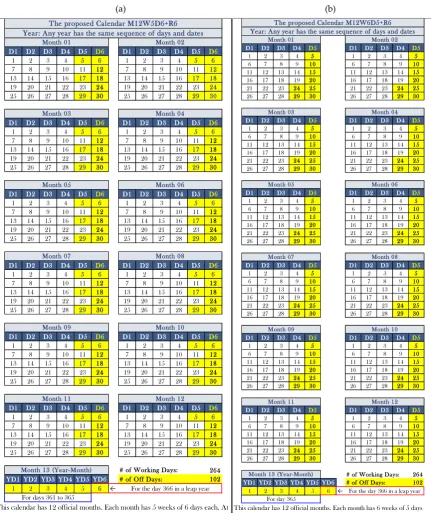
Table 6: Proposed calendars: (a) M12W5D6+R6, (b) M12W6D5+R6, (c) M10W6D6+R6, and (d) M15W3D8+R6.
(a) (b)
D1 D2 D3 D4 D5 D6 D1 D2 D3 D4 D5 D6
1 2 3 4 5 6 1 2 3 4 5 6
7 8 9 10 11 12 7 8 9 10 11 12
13 14 15 16 17 18 13 14 15 16 17 18
19 20 21 22 23 24 19 20 21 22 23 24
25 26 27 28 29 30 25 26 27 28 29 30
D1 D2 D3 D4 D5 D6 D1 D2 D3 D4 D5 D6
1 2 3 4 5 6 1 2 3 4 5 6
7 8 9 10 11 12 7 8 9 10 11 12
13 14 15 16 17 18 13 14 15 16 17 18 19 20 21 22 23 24 19 20 21 22 23 24 25 26 27 28 29 30 25 26 27 28 29 30
D1 D2 D3 D4 D5 D6 D1 D2 D3 D4 D5 D6
1 2 3 4 5 6 1 2 3 4 5 6
7 8 9 10 11 12 7 8 9 10 11 12
13 14 15 16 17 18 13 14 15 16 17 18 19 20 21 22 23 24 19 20 21 22 23 24 25 26 27 28 29 30 25 26 27 28 29 30
D1 D2 D3 D4 D5 D6 D1 D2 D3 D4 D5 D6
1 2 3 4 5 6 1 2 3 4 5 6
7 8 9 10 11 12 7 8 9 10 11 12
13 14 15 16 17 18 13 14 15 16 17 18 19 20 21 22 23 24 19 20 21 22 23 24 25 26 27 28 29 30 25 26 27 28 29 30
D1 D2 D3 D4 D5 D6 D1 D2 D3 D4 D5 D6
1 2 3 4 5 6 1 2 3 4 5 6
7 8 9 10 11 12 7 8 9 10 11 12
13 14 15 16 17 18 13 14 15 16 17 18 19 20 21 22 23 24 19 20 21 22 23 24 25 26 27 28 29 30 25 26 27 28 29 30
D1 D2 D3 D4 D5 D6 D1 D2 D3 D4 D5 D6
1 2 3 4 5 6 1 2 3 4 5 6
7 8 9 10 11 12 7 8 9 10 11 12
13 14 15 16 17 18 13 14 15 16 17 18 19 20 21 22 23 24 19 20 21 22 23 24 25 26 27 28 29 30 25 26 27 28 29 30
264
YD1 YD2 YD3 YD4 YD5 YD6 102
1 2 3 4 5 6 ←
# of Working Days:
Month 11
Month 09 Month 10
Month 07 Month 08
Month 05 Month 06
Month 03 Month 04
Month 01 Month 02
# of Off Days:
Month 12
Month 13 (Year-Month)
The proposed Calendar M12W5D6+R6 Year: Any year has the same sequence of days and dates
For days 361 to 365
For the day 366 in a leap year
This calendar has 12 official months. Each month has 5 weeks of 6 days each. At the end of the year, an additional Month is added with only 5 days (+1 leap day in a leap year). These days are called Yeardays, in which they are different from the normal days, and can be considered as holidays or day off for employees.
D1 D2 D3 D4 D5 D1 D2 D3 D4 D5
1 2 3 4 5 1 2 3 4 5
6 7 8 9 10 6 7 8 9 10
11 12 13 14 15 11 12 13 14 15
16 17 18 19 20 16 17 18 19 20
21 22 23 24 25 21 22 23 24 25
26 27 28 29 30 26 27 28 29 30
D1 D2 D3 D4 D5 D1 D2 D3 D4 D5
1 2 3 4 5 1 2 3 4 5
6 7 8 9 10 6 7 8 9 10
11 12 13 14 15 11 12 13 14 15
16 17 18 19 20 16 17 18 19 20
21 22 23 24 25 21 22 23 24 25
26 27 28 29 30 26 27 28 29 30
D1 D2 D3 D4 D5 D1 D2 D3 D4 D5
1 2 3 4 5 1 2 3 4 5
6 7 8 9 10 6 7 8 9 10
11 12 13 14 15 11 12 13 14 15
16 17 18 19 20 16 17 18 19 20
21 22 23 24 25 21 22 23 24 25
26 27 28 29 30 26 27 28 29 30
D1 D2 D3 D4 D5 D1 D2 D3 D4 D5
1 2 3 4 5 1 2 3 4 5
6 7 8 9 10 6 7 8 9 10
11 12 13 14 15 11 12 13 14 15
16 17 18 19 20 16 17 18 19 20
21 22 23 24 25 21 22 23 24 25
26 27 28 29 30 26 27 28 29 30
D1 D2 D3 D4 D5 D1 D2 D3 D4 D5
1 2 3 4 5 1 2 3 4 5
6 7 8 9 10 6 7 8 9 10
11 12 13 14 15 11 12 13 14 15
16 17 18 19 20 16 17 18 19 20
21 22 23 24 25 21 22 23 24 25
26 27 28 29 30 26 27 28 29 30
D1 D2 D3 D4 D5 D1 D2 D3 D4 D5
1 2 3 4 5 1 2 3 4 5
6 7 8 9 10 6 7 8 9 10
11 12 13 14 15 11 12 13 14 15
16 17 18 19 20 16 17 18 19 20
21 22 23 24 25 21 22 23 24 25
26 27 28 29 30 26 27 28 29 30
264
YD1 YD2 YD3 YD4 YD5 YD6 102
1 2 3 4 5 6 ←
This calendar has 12 official months. Each month has 6 weeks of 5 days each. At the end of the year, an additional Month is added with only 5 days (+1 leap day in a leap year). These days are called Yeardays, in which they are different from the normal days, and can be considered as holidays or day off for employees.
# of Off Days:
For the day 366 in a leap year For day 365
Month 11 Month 12
Month 13 (Year-Month) # of Working Days:
Month 07 Month 08
Month 09 Month 10
Month 03 Month 04
Month 05 Month 06
The proposed Calendar M12W6D5+R6 Year: Any year has the same sequence of days and dates
(c) (d)
4. Conclusions
The Gregorian calendar has been used for several centuries, in which it was introduced to correct the Julian calendar. Despite the success of the Gregorian calendar worldwide, and despite its accuracy, it is not easy to deal with the dates and days and sophisticated software is needed, and billions of hard copies of the calendar are printed every year to help people organize better their life. Thus, millions of trees are cut every year to produce calendars and planners, which increases pollution and the emission of CO2. To minimize pollution and to go a further step toward a more sustainable society, this paper proposes an original perennial calendar system that is user- and eco-friendly. The proposed calendar system is very easy to interpret and memorize. Thus, there is no need to print hard copies of the calendar; therefore, millions of trees are saved every year, and less pollution is emitted. The proposed calendar system uses optimization algorithms and mathematical modeling in order to obtain the optimal distribution of days, weeks, and months in a year. This paper compared the proposed calendar system with the Gregorian calendar and the International Fixed Calendar. Results show that the proposed one in this paper has more advantages compared to the other ones. Further statistical analysis is required to see how people react regarding the idea of changing the calendar system and what will be the next step to do in order to implement the system.
D1 D2 D3 D4 D5 D6 D1 D2 D3 D4 D5 D6 1 2 3 4 5 6 1 2 3 4 5 6
7 8 9 10 11 12 7 8 9 10 11 12 13 14 15 16 17 18 13 14 15 16 17 18 19 20 21 22 23 24 19 20 21 22 23 24 25 26 27 28 29 30 25 26 27 28 29 30 31 32 33 34 35 36 31 32 33 34 35 36
D1 D2 D3 D4 D5 D6 D1 D2 D3 D4 D5 D6 1 2 3 4 5 6 1 2 3 4 5 6
7 8 9 10 11 12 7 8 9 10 11 12 13 14 15 16 17 18 13 14 15 16 17 18 19 20 21 22 23 24 19 20 21 22 23 24 25 26 27 28 29 30 25 26 27 28 29 30 31 32 33 34 35 36 31 32 33 34 35 36
D1 D2 D3 D4 D5 D6 D1 D2 D3 D4 D5 D6 1 2 3 4 5 6 1 2 3 4 5 6
7 8 9 10 11 12 7 8 9 10 11 12 13 14 15 16 17 18 13 14 15 16 17 18 19 20 21 22 23 24 19 20 21 22 23 24 25 26 27 28 29 30 25 26 27 28 29 30 31 32 33 34 35 36 31 32 33 34 35 36
D1 D2 D3 D4 D5 D6 D1 D2 D3 D4 D5 D6 1 2 3 4 5 6 1 2 3 4 5 6
7 8 9 10 11 12 7 8 9 10 11 12 13 14 15 16 17 18 13 14 15 16 17 18 19 20 21 22 23 24 19 20 21 22 23 24 25 26 27 28 29 30 25 26 27 28 29 30 31 32 33 34 35 36 31 32 33 34 35 36
D1 D2 D3 D4 D5 D6 D1 D2 D3 D4 D5 D6 1 2 3 4 5 6 1 2 3 4 5 6
7 8 9 10 11 12 7 8 9 10 11 12 13 14 15 16 17 18 13 14 15 16 17 18 19 20 21 22 23 24 19 20 21 22 23 24 25 26 27 28 29 30 25 26 27 28 29 30 31 32 33 34 35 36 31 32 33 34 35 36
260
YD1 YD2 YD3 YD4 YD5 YD6 106 1 2 3 4 5 6 ←
For days 361 to 365
This calendar has 10 official months. Each month has 6 weeks of 6 days each. At the end of the year, an additional Month is added with only 5 days (+1 leap day in a leap year). These days are called Yeardays, in which they are different from the normal days, and can be considered as holidays or day off for employees.
Month 11 (Year-Month) # of Working Days: # of Off Days:
For the day 366 in a leap year
Month 05 Month 06
Month 07 Month 08
Month 09 Month 10
The proposed Calendar M10W6D6+R6 Year: Any year has the same sequence of days and dates
Month 01 Month 02
Month 03 Month 04
D1 D2 D3 D4 D5 D6 D7 D8 D1 D2 D3 D4 D5 D6 D7 D8
1 2 3 4 5 6 7 8 1 2 3 4 5 6 7 8 9 10 11 12 13 14 15 16 9 10 11 12 13 14 15 16 17 18 19 20 21 22 23 24 17 18 19 20 21 22 23 24
D1 D2 D3 D4 D5 D6 D7 D8 D1 D2 D3 D4 D5 D6 D7 D8
1 2 3 4 5 6 7 8 1 2 3 4 5 6 7 8 9 10 11 12 13 14 15 16 9 10 11 12 13 14 15 16 17 18 19 20 21 22 23 24 17 18 19 20 21 22 23 24
D1 D2 D3 D4 D5 D6 D7 D8 D1 D2 D3 D4 D5 D6 D7 D8
1 2 3 4 5 6 7 8 1 2 3 4 5 6 7 8 9 10 11 12 13 14 15 16 9 10 11 12 13 14 15 16 17 18 19 20 21 22 23 24 17 18 19 20 21 22 23 24
D1 D2 D3 D4 D5 D6 D7 D8 D1 D2 D3 D4 D5 D6 D7 D8
1 2 3 4 5 6 7 8 1 2 3 4 5 6 7 8 9 10 11 12 13 14 15 16 9 10 11 12 13 14 15 16 17 18 19 20 21 22 23 24 17 18 19 20 21 22 23 24
D1 D2 D3 D4 D5 D6 D7 D8 D1 D2 D3 D4 D5 D6 D7 D8
1 2 3 4 5 6 7 8 1 2 3 4 5 6 7 8 9 10 11 12 13 14 15 16 9 10 11 12 13 14 15 16 17 18 19 20 21 22 23 24 17 18 19 20 21 22 23 24
D1 D2 D3 D4 D5 D6 D7 D8 D1 D2 D3 D4 D5 D6 D7 D8
1 2 3 4 5 6 7 8 1 2 3 4 5 6 7 8 9 10 11 12 13 14 15 16 9 10 11 12 13 14 15 16 17 18 19 20 21 22 23 24 17 18 19 20 21 22 23 24
D1 D2 D3 D4 D5 D6 D7 D8 D1 D2 D3 D4 D5 D6 D7 D8
1 2 3 4 5 6 7 8 1 2 3 4 5 6 7 8 9 10 11 12 13 14 15 16 9 10 11 12 13 14 15 16 17 18 19 20 21 22 23 24 17 18 19 20 21 22 23 24
D1 D2 D3 D4 D5 D6 D7 D8
1 2 3 4 5 6 7 8 9 10 11 12 13 14 15 16 17 18 19 20 21 22 23 24
255
YD1 YD2 YD3 YD4 YD5 YD6 111 1 2 3 4 5 6
Year: Any year has the same sequence of days and dates The proposed Calendar M15W3D8+R6
Month 15
# of Working Days:
This calendar has 15 official months. Each month has 3 weeks of 8 days each. At the end of the year, an additional Month is added with only 5 days (+1 leap day in a leap year). These days are called
Yeardays that they are different from the normal days, and can be considered as holidays or day off for employees
Month 09 Month 10
Month 11 Month 12
Month 13 Month 14
Month 11 (Year-Month)
For days 361 to 365
# of Off Days:
←For the day 366 in a leap year
Month 05 Month 06
Month 07 Month 08
Month 01 Month 02
Gregorian and International Fixed Calendards
5. Nomenclature
GC Gregorian Calendar
IFC International Fixed Calendar
JC Julian Calendar
PC Perennial Calendar
Funding: This research received no external funding.
Conflicts of Interest: The author declares no conflict of interest.
6. References
[1] M. Grant, "Roman religion," in Encyclopædia Britannica, ed. England: Encyclopædia Britannica, inc., 2016.
[2] J. Rüpke, The Roman calendar from Numa to Constantine: time, history, and the fasti. John Wiley & Sons, 2011.
[3] A. K. Michels, Calendar of the Roman Republic. Princeton University Press, 2015.
[4] V. Emelianov, "Cultic Calendar and Psychology of Time: Elements of Common Semantics in Explanatory and
Astrological Texts of Ancient Mesopotamia," Comparative Mythology, vol. 5, pp. 13-32, 2019.
[5] G. A. Barton, "Recent researches in the Sumerian calendar," Journal of the American Oriental Society, pp. 1-9, 1913.
[6] L. Brack-Bernsen, "The Observational Foundations of Babylonian Astronomy," in Hellenistic Astronomy: Brill, 2020, pp.
171-189.
[7] M. Boyce, "Further on the calendar of Zoroastrian feasts," Iran, vol. 43, no. 1, pp. 1-38, 2005.
[8] A. Dieckhoff, "Hebrew, the language of national daily life," in Language, nation and state: Identity politics in a multilingual
age: Springer, 2004, pp. 187-199.
[9] M. Blomberg and G. Henriksson, "Literary and archaeoastronomical evidence for the origins of the Hellenic calendar in
the Aegean Bronze Age," BAR INTERNATIONAL SERIES, vol. 1154, pp. 53-70, 2003.
[10] M. Dimitrijevic, E. T. Theodossiou, and P. Mantarakis, "Milutin Milankovic and the reform of the Julian Calendar in
1923," Journal of Astronomical History and Heritage, vol. 11, pp. 50-54, 2008.
[11] E. L. Cohen, "Adoption and reform of the Gregorian calendar," Math Horizons, vol. 7, no. 3, pp. 5-11, 2000.
[12] S. Joshi and U. Muley, "GREGORIAN CALENDAR," Bulletin of the Marathwada Mathematical Society, vol. 12, no. 1, pp.
65-75, 2011.
[13] H. H. Green, "Zenith Sun as the Means for Achieving Concordance Between the tonalpohualli and the Tropical Year
Without Intercalation of Leap Days."
[14] M. B. Cotsworth, The Rational Almanac: Tracing the Evolution of Modern Almanacs from Ancient Ideas of Time, and Suggesting
Improvements, with Years, Half-years and Quarters Equated; 13 Months to the Year; Holidays and Festivals, Also Week Days Fixed
on Permanent Dates to Gain Much More Public Convenience; 180 Illustrations Explaining the Mystery of the Pyramids, Sphinx,
Obelisks, Druidical Circles, Mounds, Vertical Stones, Etc., Erected to Record Yearly Almanac Times. Author, 1905.
[15] M. B. Cotsworth, "Proceedings and Transactions of the Royal Society of Canada, Third Series," 1908, vol. 2: Royal Society
of Canada, 1908, pp. 211-241. [Online]. Available: https://ia802608.us.archive.org/3/items/proceedingstrans32roya/
proceedingstrans32roya.pdf.
[16] N. Dershowitz and E. M. Reingold, "Calendrical calculations," Software: Practice and Experience, vol. 20, no. 9, pp. 899-928,
1990.
[17] "One million calendars 'wrong due to bank holiday change'." BBC.
https://www.bbc.com/news/uk-england-wiltshire-48661884 (accessed June 6, , 2020).