299
Volume LX 40 Number 2, 2012
USING UML AND PETRI NETS FOR
VISUALIZATION OF BUSINESS
DOCUMENT FLOW
I. Rábová
Received: November 30, 2011
Abstract
RÁBOVÁ. I.: Using UML and Petri nets for visualization of business document fl ow. Acta univ. agric. et silvic. Mendel. Brun., 2012, LX, No. 2, pp. 299–306
The article deals with two principles of business workfl ow modeling, Petri nets and UML notation, that are the acceptable approaches to business modeling and can be used also for business documents workfl ow. The special type of Petri nets, WF-nets and UML activity diagrams are used in this article and both modeling ways are presented on the concrete business workfl ow and then there are presented and specifi ed their advantage and disadvantage for business documents fl ows.
At beginning it is explained the word workfl ow in context business documents, its features, principles and using in business environment. A er that it is clarifi ed that the UML is OMG’s most-used specifi cation, and the way the world models not only application structure, behavior, and architecture, but also business process, workfl ows and data structure. Activity diagram UML is good way to show how diff erent workfl ows in the business are managed, how they start, go and stop. Diagrams also show many diff erent decision paths that can be taken from start to fi nish. State charts can be used as a detail the transitions or changes of states when documents can go through in the business. They show how a documents moves from one state to another and the rules that govern that change.
Petri-nets off er a graphical notation for stepwise processes that include choice, iteration, and concurrent execution. Unlike UML Petri nets have an exact mathematical defi nition of their execution semantics, with a well-developed mathematical theory for process analysis. In the article there are modeled a special type of Petri nets, the WF-nets.
The practical part of article incorporates two models of concrete business documents workfl ows presented in these notations, their comparison and recommendation for using these diagrams in business process management.
workfl ow, UML, activity diagram, Petri net, WF net, business process, Business Process Management
Business Process Management (BPM) off ers tools for management, optimization, automation, and transparency of both enterprise and customer processes. Regardless whether talking about internal processing of invoices, business trip requests, vacation requests, or insurance claims adjustment. Prerequisites for productiveness and effi ciency of processes are satisfi ed if persons, company applications, and information content work in mutual harmony.
and information fl ows. A manager thus obtains a considerably faster and higher quality response to tasks assigned to individual workers thanks to the interconnection with various enterprise applications (Intext, 2011).
A model is an abstraction or representation of some subject matter. A symbolic model is a representation of some physical or conceptual subject matter that is not intended to look like the subject. Symbolic models o en represent concepts that can´t actually be observed. Both models in this article are made up of boxes, lines and texts that bear no resemblance to the people, documents and in-boxes that they represent. They picture two approach of visualization of workfl ow systems (emphasis is on the document fl ow). The fi rst approach is presented with using of UML activities diagrams and the second approach is presented with using special type of Petri-nets, WF-nets. The issues are discussed at the end of article. Article deals with using of workfl ow models for business competitiveness accomplishment.
MATERIALS AND METHODS
Why is used BPM in enterprises?
BPM integrates the roles of users, legislation, administration, and enterprise applications into a single composite solution and the important object is business document. A lot of enterprise applications run the business processes through roles of individual users with limited access to the documents and processes. Thanks to the open character of the system and support of internationally accepted standards, as well as thanks to integration with other products from Open Text portfolio, managers always have the required information at the right place in the right time. BPM enables integration with a broad scale of external systems: various databases, ERP systems (for example SAP), SCM and CRM, Offi ce applications, Microso Outlook, etc. The workfl ow modeling is the important phase of BPM transition, support and development.
What is Workfl ow?
According to the Workfl ow Management Coalition (WfMC, 1999), workfl ow represents “the automation of a business process, in whole or part, during which documents, information or tasks are passed from one participant (resource, human or machine) to another for action, according to a set of procedural rules”. The Workfl ow Management Coalition has developed a framework for the establishment of workfl ow standards. This framework includes fi ve categories of interoperability and communication standards that will allow multiple workfl ow products to coexist and interoperate within a user’s environment.
A key aspect of many workfl ow systems is the incorporation in an organizational model, enabling
workfl ow procedures to be defi ned relative to organizational roles and responsibilities. These may be separately maintained, for example by means of a directory subsystem, with associated role privileges.
Integration complexity arises from the requirements of most workfl ow systems to interact with numerous other so ware components, ranging from standard desktop tools such as forms, spreadsheets and word-processors, to server applications such as document repositories and legacy applications.
We can specify workfl ows with helping of several parameters:
• Activities that are parts of business process. Activity is controlled sequence of jobs that is made for achievement of business goals.
• Users or groups of users that perform jobs or are responsible for them.
• Relationships between these users. • Documents that the workfl ow elaborates.
The Key Benefi ts of Workfl ow
1. Improved effi ciency – automation of many business processes results in the elimination of many unnecessary steps
2. Better process control – improved management of business processes achieved through standardizing working methods and the availability of audit trails
3. Improved customer service – consistency in the processes leads to greater predictability in levels of response to customers
4. Flexibility – so ware control over processes enables their redesign in line with changing business needs
5. Business process improvement – focus on business processes leads to their streamlining and simplifi cation
In brief, workfl ow clarifi es and controls existing business processes and helps to simplifi cation, increasing of competitiveness and shortening of whole process. Automation places high requirements at accuracy and unambiguous documentation of process specifi cation. It is able to interpret the process defi nition, to communicate with workfl ow stakeholders or to run others process and to make own action. In light of technology it is very interesting concept, because it connects principles, methods and technologies of diff erent areas of informatics and management – concept client/server, email, DBMS, job monitoring, documents and knowledge workfl ow, modeling and monitoring of process etc. (AIIM, 2011, CCA, 2011).
UML in modeling of workfl ows
optimal for business process modeling. In common, activity diagrams are used to model the behaviors of a system, and the way in which these behaviors are related in an overall fl ow of the system. The logical paths in process follows, based on various conditions, concurrent processing, data access, interruptions and other logical.
An activity specifi es the coordination of executions of subordinate behaviors, using a control and data fl ow model. The subordinate behaviors coordinated by these models may be initiated because other behaviors in the model fi nish executing, because objects and data become available or because events occur external to the fl ow. The fl ow of execution is modeled as activity nodes connected by activity edges. A node can be the execution of a subordinate behavior, such as an arithmetic computation, a call to an operation, or manipulation of object contents. Activity nodes also include fl ow-of-control constructs, such as synchronization, decision, and concurrency control. Activities can form invocation hierarchies invoking other activities, ultimately resolving to individual actions. In an object-oriented model, activities are usually invoked indirectly as methods bound to operations that are directly invoked. Activities can also be used for information system modeling to specify system level processes. Activities make with documents and they are connected with them in every process. Actions have no further decomposition in the activity containing them. However, the execution of a single action may induce the execution of many other actions. For example, a call action invokes an operation that is implemented by an activity containing actions that execute before the call action completes.
In activity diagram in Fig. 1 is used except form activities and their transitions also swimmlanes. Swimmlanes are vertical or horizontal bands in a activity diagram that divide the diagram into logical areas or partitions. In the example below the activities relating to particular entities within the model (such as the user, or enterprise department or responsible business people) are placed within a containing swimmlane to indicate their association. Swimmlanes highlight the relevant variables – who, what and when – in a simple diagram of activities. Activity diagram can show a workfl ow at any level, from a very high view down to one showing each individual task. In practice virtually no one ever understands a complete business workfl ow, or even has a fully accurate understanding of its neighborhood. In activity diagrams we can map, measure and interpret all aspect of workfl ows and business documents.
Modeling of business processes in general and in detail are described in articles (Rábová, 2003, 2008). In Figure 1 workfl ow is formalized with the help of activity diagram together with swimmlanes. Activity diagrams present internal proceeding of document in succession with a view to process structure and time sequence of particular activities but also at role of people in business that are accountable for
activities perform, that is for approving, signature, version changing, or archiving of document. Documents are modeled with UML notation and with UML artifacts of object or commentary. Workfl ow Order making is large and it includes more documents as objects (order, good, invoice).
It is possible to formalize also the dynamics of these three documents. This is described in (Rábová, Jedlička, 2011). We used there state diagrams that shows life cycle of documents and their transition from one to other state.
Petri Nets and WF-nets in modeling of workfl ows
According to (AALST, 2004) the classical Petri-net is a directed bipartite graph with two node types called places and transitions the nodes are connected via directed arcs. Connections between two nodes of the same type are not allowed. Places are represented by circles and transitions by rectangles.
Defi nition: A Petri Net is a triple (P,T,F): • P is a fi nite set of places
• T is a fi nite set of transitions (P T = 0); and • F (P × T) (T × P)is a set of arcs (fl ow relation).
A place p is called an input place of transition t if (if and only if) there exists a directed arc from p to t. Place p is called an output place of transition t if there exists a directed arc from t to p We use •T to denote the set of input places for transition t. The notation t•, •p and p• have similar meaning that is p• is the set of transitions sharing p as an input place. In the context of workfl ow procedures it makes no sense to have other weights because places correspond to conditions.
At any time a place contains zero or more tokens, drawn as black dots. State M, o en referred to as marking, is the distribution of token over place that is MP IN. We can represent a state as follows: 1p1 + 2p2 + 1p3 + 0p4 is the state with one token in place p1. Two tokens in p2, one token p3 and no token in p4. We can also represent this state as follows: p1 + 2p2 + p3. To compare states we defi ne a partial ordering. For any two states M1 and M2, M1M2 if for all pP: M1(p) M2(p), where M(p) denotes the number of tokens in place p in state M.
The number of tokens may change during the execution of the net. Transitions are the active components in a Petri net: they change the state of the net according to the following fi ring rule: • A transition t is said to be enabled if each input
place p of t contains at least one token.
• An enabled transition may fi re. If transition t fi res than consumes one token from each input place p of t and produces one token for each out place p of t.
act Business Process Model
Business department Production department Expedition department Accounting department
Initial Received order
Controled Order
Order v erification
Received order
Controled Order
Is order complete and OK?
Correct order
Material requirement
Verification of av ailability of goods
Correct order
Material requirement
Canceled order
Disapprov al of order
Canceled order
Final
Is goods at disposal?
Material requirement
Material purchasing
Material requirement
Goods have to be made
Production plan
Production preparation
Production plan
Material delivering confirmation
Produced Goods
Production
Material delivering confirmation
Produced Goods
Produced goods
Goods from
warehouse Information
for invoice
Goods deliv ery
Produced goods
Goods from
warehouse Information
for invoice
Information for invoice
Invoice
Inv oice sending
Information for invoice
Invoice
Invoice
Payment
Check payment
Invoice
Payment
Is invoice paid?
Order information
Archiv ing order
Order information
Final Order is not approved
Goods is not at disposal
Good is in the warehouse
Invoice is not paid yet
Invoice is paid
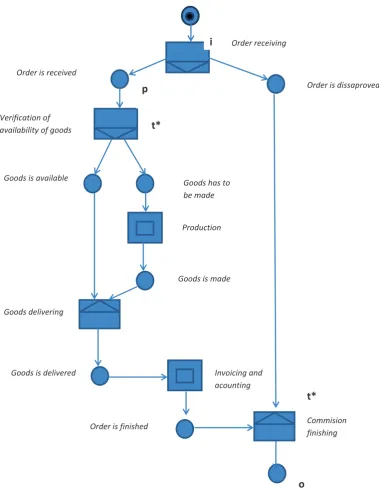
created when it enters the WFMS and is deleted once it is completely handled by the WFMS; in order words, the WF–net specifi es the lifecycle of a case. Given the defi nition of WF-net it is easy to derive the following properties.
Let PN = (P, T, F) be a PN (Petri-net). If PN is a WF-net with source place i, then for any place p P: •p ≠ 0 or p = i, i.e., i is the only source place;
If PN is a WF-net with sink place o, then for any place p P: p ≠ 0 or p = 0, i.e., o is the only sink place;
If PN is a WF-net and we add a transition t* to PN with connects sink place o with source place i (i.e.,
•t* ={o} and t*•= {i}), then the resulting Petri-net is strongly connected;
If PN has a source place i and a sink place o and adding a transition t* which connects sink place o with source place i yields a strongly connected net, then every node x P T is on a path from i to o in PN and PN is a WF-net.
Fig. 2 shows a simplifi ed WF-net that models the processing of order complaints with source place I and with sink place o.
Petri-net can be used for modeling of business workfl ows and business documents fl ows when we need to simulating activities of modeling system
Orderreceiving
Orderisreceived
Orderisdissaproved
Commision
finishing
Verificationof
availabilityofgoods
Goodsisavailable Goodshasto
bemade
Goodsisdelivered
Goodsdelivering
Goodsismade
Production
Invoicingand
acounting
Orderisfinished
i
o
t*
p
t*
and when we can to analyze important features of system. These features then could serve to system (process) optimization. In general, it is accepted that when we use higher and complicated type of Petri-net we can model more accurate the real system (in our case it is business document fl ow) but its analysis is more diffi cult. In any cases it is possibly to make the analysis by computers and to describe Petri-net into suitable format that enables its reading and running in program. To this purpose it was created special language OPMNL. OPNML (Object Petri Nets Markup Language) (Jedlička, 2004) belongs to a group of XML languages and they are useful for analysis. In this approach we don’t need OPMNL. We need only the model of real process and its objects as a documents and the common goal of contribution is the visualization of complexity of process.
It is apparently that the Petri-net brings to UML diagrams its own net-chart that allows reading not only time sequence of parts of operations but also conditions of their running and the impact. Graphs of large processes are possible to model in hierarchy and to increase their clarity. The features from models analysis can give much valuable information about workfl ows and documents. These are for example capacities of computers memory for documents archiving, minimal time for work of document in framework of business rules and business processes, and can detect non logic business rules when some conditions can’t be realizable for some operation with document running.
RESULTS AND DISCUSSION
Article deals with modeling of business document workfl ows. The above explained and showed
approaches are compared. The comparison is divided into several views.
• Object notation UML proposes two views at whole area and customer of model can see detail of operations in workfl ow with responsibilities of workgroups. WF-net gives detailed view at operations in processes. The disadvantage of Petri-net is the time consuming modeling and its diffi culty. The Petri-nets are not for beginner, it is not comfortable formalism in contrast to UML diagrams. But when we adapt a little our formalism of Petri-nets (for our case), model can be good readable and intelligible for users and business manager.
• View of so ware support and high of formalism for modeling of process document fl ow is interesting for analytics and modelers. We can say that Petri-nets have their own mathematical support (showed above). On the other hand UML diagrams are “user friendly” and they are open to extensions and adaptability. Activity diagram is diagram of activities sequence and peoples as a worker, Petri-nets are focused more at transition and conditions for transition between states of documents in business and their view is more detail.
• For modeling of Petri-nets there exist many tools for presentation, simulation and analysis (Heitmann, 2011). The most extend format for exchange of models between these tools is PNML (Pnml.org, 2009) that is from February 2011 standardized in second part of ISO/IEC 15909. Many experts create own tools for modeling their models and using for simulation and analysis. UML notation is supported by many CASE (SPARXSYSTEM, 2011) tools that are free, trial or commerce. But only some of them can simulate. For example CASEWISE Corporate Modeler could be used for monitoring and then also simulation and
I: Comparison of UML diagrams and Petri net from several views
Views of approach UML WF Petri net
1 Modeling of whole process Yes Yes, but the model is unreadable
2 Modeling of responsibility of workers Yes No
3 Modeling of operation in workfl ow Yes Yes in more detail
4 Diffi culty of modeling No Yes
5 Suitable for modeller-beginners Yes No
6 Comprehension of models for business managers Yes No
7 Targeting on document No Yes, on document elaboration
8 Number of diagrams of model More than one Only one
9 SW supporting Many CASE tools Too little tools for modeling
10 Own mathematical formalism No Yes
11 Open to extension and adaptability Yes No
12 Possibility of process simulation No Yes
13 Possibility to process optimisation No Yes
14 Language for model presentation Yes Yes, but too diffi cult
optimization of business document fl ow. These activities are very usable in nowadays business environment. Some CASE tools off er generating code for process automation. UML diagrams have lower formalism and it is not possible expressed them in mathematics but they are understandable for non-informatics experts from business and analytics can learn UML better then Petri-net. • In UML we can express and model one document
fl ow in more than one diagram but Petri-net has only one way of expressing.
• The UML diagram is more focused on whole process, on its complexity, structure and segmentation, time sequence of activities and responsible business workers or business department. It strictly corresponds to understanding of business users. In WF-net is possible to better target on document, its attributes, and excepting detail description of document can give Petri-nets also conditions and procedure of document elaborating. Petri-nets are more oriented on document.
Let me now generalize gains and recommendation for eff ective and error free deployment of managed document fl ow and for its visualization.
Why should the business have the document fl ow in fact?
Thanks to the simplifi ed, dynamic nature of modeling approach our models provide a number of benefi ts over the BPM solutions:
1. The simplifi ed model gives businesses the opportunity to go from discovery to full automation faster than was previously possible. 2. Responsible workers have proactive response.
The business can predict a future problem, adapt to changing circumstances, and succeed in overcoming those obstacles.
3. Business processes can respond rapidly to changing requirements. CASE tools as a so ware support for workfl ow modeling are confi gured through a simple, intuitive graphical interface, requiring no programming skills and make it possible for processes to change at the speed of your business.
4. Business has centralized administration of documents and assuring of information accuracy and unambiguous approach.
5. Managers have faster and better business decision.
6. Workers in business have the rapid location of business documents and detection of its state of running.
Why should the business have the model of document fl ow?
1. Manager can present information unanimously and in context of whole enterprise.
2. Manager can make fast accomplishment of business objectives and faster allocate responsibility to activities of business worker. 3. Manager has higher security of document
confi dence and can avoid its exploitation.
4. Manager can decrease possibility of los and unwanted change of documents.
5. Manager can learn and fi le person that is accountable for issues in decision running. I bring together the common contributions for user of managed and well-established document fl ow in enterprise into several points:
1. It improves customer service and partner relationship and improves the communication. 2. In increases worker eff ectiveness and
minimalizes risks.
3. It contributes to state legislative observation, improves creating and using business assets and ensures business process eff ectiveness
4. It decreases costs of documents transportation, printing and storing and creates infrastructure for enterprise document management and for strategies support of business content.
CONCLUSIONS
The business process includes people, information and applications. When these three elements cooperate together in integrated environment, is possible to increase productivity and value of cooperation the whole chain. The common goal of process management is process optimization so that organization is able to react on the dynamic change of market and customer requirements. Process management in fi rms is o en complicated. Correctly confi gured business document fl ow simplifi es and accelerates many activities.
The setting of electronic fl ow of documents in business is not simple. The initial modeling and visualization can abbreviate the realization of process and the diffi cult manipulation with paper documents falls off . Workfl ow brings more eff ectiveness of business work and also control of their fl ow in business. Which are the documents? Receiving mail, agreements, off ers, orders, invoices,, the all documents that are made by more people. The running is for example connivance, due dates, expiration of an agreement, penalty, date for actions etc. Faster end simpler processes, their monitoring and precise mapping of throughput saves time and cost.
SUMMARY
The article deals with two principles in business workfl ow modeling, Petri-nets and UML notation. Both are the good approaches to business process modeling and they can be used also for enterprise documents fl ow. We use in our presentation the objects Petri nets and UML diagrams activity and state diagrams. We discuss the both modeling ways on the concrete business workfl ow and specify advantage and disadvantage. At beginning we explain the word workfl ow in context business documents, its features, principles and using in business environment. A er it we clarify that the UML is OMG’s most-used specifi cation, and the way the world models not only application structure, behavior, and architecture, but also business process and data structure. Activity diagram UML is good way to show how diff erent workfl ows in the business are managed, how they start and the possibly many decision paths that can be taken from start to fi nish. State charts are used to detail the transitions or changes of states when documents can go through in the business. They show how a documents moves from one state to another and the rules that govern that change. Petri nets off er a graphical notation for stepwise processes that include choice, iteration, and concurrent execution. Unlike UML Petri-nets have an exact mathematical defi nition of their execution semantics, with a well-developed mathematical theory for process analysis. The practical part of our article incorporates several models of concrete business documents workfl ows presented in both notations and its comparison.
REFERENCES
AIIM, 2011: Enterprise Content Management. Dostupné z www: <http://www.aiim.org.uk/index1.asp> [cit. 14. 7. 2011].
AALST, W., 1998: The Application of Petri Nets to Workfl ow Management. Dostupné z www: http:// paginas.fe.up.pt/maspwww/files/aals-1998.pdf, [cit. 15. 2. 2012].
AALST, W., KEES MAX VAN HEE, 2004: Workfl ow management: models, methods and systems. ISBN 0-262-001189. Dostupné na
http://books.google.com/books?id=O1xW1_Za-I0C&pg=PA266&hl=c s&source=gbs_toc_r&cad= 3#v=onepage&q&f=false, [cit. 2011-11-15]. AALST, W., KEES MAX VAN HEE, 2004: Workfl ow
management: models, methods and systems. ISBN 0-262-001189, dostupné na
http://books.google.com/books?id=O1xW1_Za-I0C&pg=PA266&hl=c s&source=gbs_toc_r&cad= 3#v=onepage&q&f=false, [cit. 2011-11-15]. ARLOW, J., 2007: UML 2 a unifi kovaný proces vývoje
aplikací, ComputerPress. ISBN 978-80-251-1503-9. CCA, 2011: Document Management System. Dostupné
z www: < http://www.cca.cz/index.php/produkty-a-sluzby/document-management-system>.
HEITMANN, F., MOLDT, D., 2011: Universität Hamburg [online]. 2011 [cit. 2011-07-30]. Petri Nets Tools Database Quick Overview. Dostupné z www: <http://www.informatik.uni-hamburg.de/ TGI/PetriNets/tools/quick.html>.
INTEXT, 2011: http://www.ixtent.com/en/ pro dukty-a-reseni/pro cess-management-workflow/business-process-management.html [cit. 2011-11-15].
JEDLIČKA, P., 2004: Využití technologie XML v modelování objektovými Petriho sítěmi. Brno: MZLU. 195 s. Disertační práce.
PNML.ORG, 2009: PNML reference site [online]. [cit. 2011-07-26]. Dostupné z www: <http://www. pnml.org/>.
RÁBOVÁ, I., 2003: Modelování podnikových procesů využitím základních a rozšířených diagramů aktivit UML. Acta Universitatis agriculturae et silviculturae Mendelianae Brunensis, LI, 6: 251–258. ISSN 1211-8516.
RÁBOVÁ, I., 2008: Podniková architektura, strategický nástroj v rukou manažera, Tribun EU 2008.
SPARXSYSTEM, 2011: Dostupné z www: <http:// www.sparxsystems.com.au/resources/uml2_ tutorial/uml2_statediagram.html>, [cit 14.7.2011]. WfMC, 1999: http://www.wfmc.org/, [cit.
2011-11-15].
Address