INTELLIGENT TRAFFIC CONTROL IN HETEROGENEOUS
NETWORKS USING DEEP LEARNING TECHNIQUES
L Rajesh, E Saranya, Madras Institute of Technology, Chennai [email protected]
ABSTRACT
Deep learning is a new emanating machine learning technique to intelligently control network traffic. Researches contemplate the small and medium scale networks. Applications of deep learning in the heterogeneous network has little research attention. In this paper, envision a deep learning structure, which employs the unsupervised learning algorithm to predict the traffic-based matrix. By using this algorithm, simulation result demonstrates that the computational complexity is substantially reduced and it can achieve improved performance in the large-scale heterogeneous network.
Keywords – Machine learning, Deep learning, Convolutional Neural Network (CNN), Network traffic control, Routing
I. INTRODUCTION
Rapid growth of communication and the internet has paved a way for large-scale and heterogeneous networks. In the era of advancement in technology, machine learning plays a vital role in making decisions [8]. Machine learning provides the potential for the system to learn from the experience. Various ML techniques includes supervised, unsupervised, or reinforcement learning. The decision making is taken using those algorithms for network traffic control. Big technologies such as Facebook, google, Microsoft, Amazon, Nvidia focusing on the development of deep learning [4]. Recent breakthrough in the deep learning techniques notably provides a great impact on many research areas such as robotics, networking, and others. A subdivision of machine learning such as deep learning which will make intelligent decision. With the advancement in GPUs, deep learning provides an effective way to learn deeper inside the neural network. The built-in capability of the GPU is to run the tens of thousands of threads in order to process packets efficiently [5]. GPU will process different data in a parallel fashion. It will undertake different instructions at the same time. Because of the challenge in characterizing input and output patterns. Heterogeneous networks such as wired and
wireless network which need an intelligent mechanism for changing network scenario.
In this paper, a Deep learning-based deep convolutional neural network algorithm is performed to deal with large-scale heterogeneous networks. In Section II, we propose the system model and the design. The deep learning-based traffic control method is presented in Section III. Then, we describe experimental results in Sections IV and V, respectively.
II. LITERATURE REVIEW
In order to decide the best path, machine learning-based intelligent systems have been employed to investigate a wide spectrum network environment [11]. Packet routing can be managed by the different network scenarios [21] – [23] such as, cellular network, Wireless Mesh Networks (WMNs) and so forth [14]. These are based on traditional routing method. Because of the inefficiency in dealing with multiple network parameters and the difficulties in characterizations of the inputs and outputs [1],[9]. From the recent years, lot of improvement in the deep learning architectures has been achieved [15].
algorithms [8]. Backpropagation algorithm via Greedy Layer Wise algorithm achieve successful results in many complex applications [24]. Deep learning has a bright potential to be applied in network traffic control systems. The Deep CNN comprises two main components, namely the feature extraction and classification parts. In the feature extraction part, whereas the many convolution layers are used to filter the low-level features of the input data while the pooling layers are used to reduce the size of features and parameters.
Hence used to computation in the network. The convolution and pooling layers are employed together to eventually extract features of the input data. Based on those extracted features, the classification part carries out the final training process. The fully connected layers provide the core workspace to compute the extracted input data and outputs as an N-dimensional vector.
III. PROPOSED INTELLIGENT
TRAFFIC CONTROL METHOD
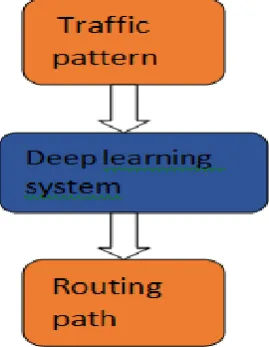
Supervised training uses the labelled data to compute the next router with traffic patterns. To design the deep learning structure, we choose the Deep CNN as our deep learning structure. It is most effective deep learning models. Deep CNN model consists of M layers with multiple hidden
layer. The input layer is denoted as x, the output layer as y, and (M− 2) hidden layers. In this paper, the system intelligently learns to take decisions from the labelled input data. Packets forwarding decisions takes place from the traffic patterns.
In a large-scale heterogeneous
network, labelled input data are provided with complex parameters. Traffic patterns
includes features like flow duration,
protocol, timestamp, IP address, computer overload, number of arrival packets, number of forwarding packets and so forth. The whole input data are configured as a 3-dimensional matrix and output ensures the better accuracy. Then, learning process continued in a parallel manner. Aftermath of learning process, the network will generate required outputs from all nodes. The learning process remains active in an online manner [15]. The training of labelled data is conducted.
The convolutional layers are deployed with filters to extract the data from the input. Every filter is small and is placed spatially and convolution operation takes place. After the completion of convolution operation, the fully connected layers are present. These layers were used to build the connection between input and output, as shown in the figure 1. From the input features get extracted which is used at each layer. Here, two different activation and loss functions are employed in the decision process. SoftMax activation function and Cross-Entropy (CE) loss function are used in the decision process [15]. In order to get the desired output, the loss function has to be minimized. Back-propagation process is used
to fine tune the weights and biases, as shown
in Figure 1 and Figure 2.
Figure 2. Input characterization for the Deep CNN
Figure 3. Characterized input and output
ω := ω + ῃ ∂J(W,B) (1) ∂ω
b := b + ῃ ∂J(W,B) (2)
∂b
where ω and b represents the weight and
bias value. Those value are adjusted in the
convolutional and fully connected layers. Further back propagation has been taking place until the training end. The trained Deep-CNN model gives the accurate reward
sequence as an output. Thus, proposed deep
learning system build the intelligent model to predict the required output.
IV. EXPERIMENTAL RESULTS
In this section, the deep learning system is proposed. The process takes place in the following steps, such as pre-processing phase, training phase, testing phase and
running phase. Those phases are discussed as follows.
a) PREPROCESSING PHASE
In this phase, the relevant data for training the deep learning system can be obtained. The relevant traffic information gets extracted from a number of available datasets. In this section, the utilizing the algorithm to determine the next nodes for building the routing is focussed.
b)TRAINING PHASE
destination routers. Thus, the obtained data packets are moved to the edge routers. The number of edge routers are denoted as (N – I). Those edge router and destination routers needs to train the learning systems. Deep learning system will be used to predict the next node. During running phase, the corresponding next nodes are used to train our proposed deep learning systems. The total router’s inbound packets are used to represent its traffic pattern. At each step, every layers of the neural network are trained with many hidden layers. Thus, we have to take the previous hidden layers which is trained and further add the kth hidden layer. After the completion of those process, the backpropagation algorithm begins at each layer. Weight and bias value can be adjusted in order to reduce the difference between the output and input. After all, router transmits its weight matrix to the inner nodes then send to all the edge routers (N – 1).Each and every edge router needs to send its weight matrices to every other edge router. So, every edge router can obtain all the weight matrices in the considered network.
Thus, the construction of the entire deep learning system uses the weight matrices obtained.
Figure4. Training accuracy of proposed method
V. CONCLUSION
Recent time, the application of deep learning network systems is a significant research area which draws the researcher’s attention. In order to deal with this challenge, an intelligent network traffic control method is needed. As wireless networks continue to become more complex, efficient network
traffic control, particularly routing methodology requires renewed research attention. this issue is addressed in this paper and envision a novel method, real-time deep learning based intelligent network traffic technique. The proposed method employs deep Convolutional Neural Networks (deep CNN) with uniquely characterized inputs and outputs. We evaluated the performance of our proposal using computer-based simulations. The simulation results demonstrated that our proposal achieves substantially better accuracy and packet loss rates in contrast with the traditional routing methods.
REFERENCES
1. Z. F. et al., “State-of-the-art deep learning: Evolving machine intelligence toward tomorrow’s intelligent network traffic control systems”, IEEE Communications Surveys Tutorials, vol. PP, no. 99, pp. 1–1, 2017.
2. F. T. et al., “On removing routing protocol from future wireless networks: A real-time deep learning approach for intelligent traffic control”, IEEE Wireless Communications, vol. 25, no. 1, pp. 154– 160, February 2018.
3. B. M. et al., “Routing or computing the paradigm shift towards intelligent computer network packet transmission based on deep learning”, IEEE Transactions on Computers, vol. PP, no. 99, pp. 1–1, 2017.
4. F. T. et al., “On Intelligent Traffic Control for Large Scale Heterogeneous Networks: A Value Matrix Based Deep Learning Approach”, IEEE Communications Letters, vol. 22, no. 1, pp. 154–160, October 2018.
5. S. Han, K. Jang, K. Park, and S. Moon, “Packet Shader: a GPU Accelerated Software Router,” ACM SIGCOMM Computer Communication Review, vol. 40, no. 4, 2010, pp. 195–206.
Q. Weinberger, “ImageNet classification with deep convolutional neural networks” in Advances in Neural Information Processing Systems, New York, NY, USA, vol. 25, pp. 1097-1105, 2012. 7. M.Barabas, G. Boanea, V. Dobrota,
“Multipath routing management using
neural networks-based traffic
prediction”, Proc. 3rd Int. Conf. Emerg. Netw. Intel., pp. 118-124, Nov. 2011. 8. T. S. R. et al., “Millimetre wave mobile
communications for 5g cellular: It will work!”, IEEE Access, vol. 1, pp. 335–349, 2013.
9. N. K. et al., “The deep learning vision for heterogeneous network traffic control: Proposal, challenges, and future
perspective”, IEEE Wireless
Communications, vol. 24, no. 3, pp. 146– 153, 2017.
10. Z. Ding, M. Peng, and H. V. Poor, “Cooperative non-orthogonal multiple
access in 5g systems”, IEEE
Communications Letters, vol. 19, no. 8, pp.1462–1465, Aug 2015.
11. H. H. et al., “Joint optimization of rule placement and traffic engineering for QoS provisioning in software defined network”, IEEE Transactions on Computers, vol. 64, no. 12, pp. 3488– 3499, Dec 2015.
12. Y. LeCun, Y. Bengio, and G. Hinton, “Deep Learning,” Nature, vol. 521, no. 7553, 2015, pp. 436–444.
13. M. S. M. et al., “A low complexity modulation classification algorithm for mimo systems”, IEEE Communications Letters, vol. 17, no. 10, pp.1881–1884, October 2013.
14. A.B. et al., “Generalized multiprotocol label switching: an overview of routing and management enhancements”, IEEE Communications Magazine, vol. 39, no.1, pp. 144–150, Jan 2001.
15. Google DeepMind, “AlphaGo,”
https://deepmind.com/alphago.
16. S.Das,G.Parulkar,N.McKeown,“Rethinki ng IP corenetworks", IEEE/OSA J. Opt. Commun. Netw., vol. 5, no. 12, pp. 1431-1442, Dec. 2013.
17. T. G. Griffin, F. B. Shepherd, G. Wilfong, "The stable paths problem and interdomain routing", IEEE/ACM Trans. Netw., vol. 10, no. 2, pp. 232-243, Apr. 2002.
18. J.Si,Y.T.Wang, "Online learning control by association and reinforcement", IEEE Trans. Neural Netw., vol. 12, no. 2, pp. 264-276, Mar. 2001.
19. A. Raniwala and T.Chiueh, “Evaluation of a Wireless Enterprise Backbone Network Architecture”, Proc. 12th Annual IEEE Symposium on High Performance Interconnects, Stanford, CA, USA, Aug. 2004.
20. A. Dosovitskiy, J. T. Springenberg, M. A. Riedmiller, and T. Brox, “Discriminative unsupervised feature learning with convolutional neural networks,” CoRR, vol. abs/1406, no. 6909, Apr. 2014. 21. Z. Li and R. Wang, “A multipath routing
algorithm based on traffic prediction in
wireless mesh networks,”
Communications and Network,vol. 1, no. 2, pp. 82–90, Aug. 2009.
22. S. Chabaa, A. Zeroual, and J. Antari, “Identification and prediction of Internet traffic using artificial neural networks,” Journal of Intelligent Learning Systems and Applications, vol. 2, no. 3, pp. 147– 155, Jul.2010.