INTRODUCTION
In the present paper, oxovanadium (IV)
complexes of the composition [VO(L)]2 or [VO(L )]2
nH2O(n= 2, 4 and L = (C19H16N2O2),(C20H18N2O3),
(C21H20N2O3), (C23H18N2O2), have been synthesissed
and their stereochemistr y is ascer tained by elemental analyses and by molecular weight, conductance, magnetic, infrared and electronic spectral measurements. The complexes have a dimeric structure involving bridging through phenolic oxygen and each unit appears to have a distorted a square pyramidal structure.
EXPERIMENTAL
Prepration and Isolation of the Complexes General methods for the preparation of oxvanadium (IV) complexes have been described.
Method (I)
The ligand (0.001 mole) was dissolved in ethanol (50 ml) and to this solution ethanolic solution of vanadyl chloride was added. The pH of the mixture was adjusted to 5-6 using 5% ammonia solution and the reaction mixture refluxed for 3 hrs. The coloured product thus obtained was filtered in not condition washed with methanol and petroleum ether and dried in vacuo.
Stereochemical features of five-coordinate dimeric
square pyramidal oxovanadium (iv) complexes
VIKAS MALIK, GEETA SOLANKI and VIJENDRA SINGH
Chemistry Department, J.V. College, Baraut, Baghpat - 250 611 (India).
(Received: August 02, 2009; Accepted: September 12, 2009)
ABSTRACT
A few complexes(1) of VO (II) with 2-3 dihydrazino quinoxaline have been synthesized and
characterized by analytical, conductance, thermal, spectral and magnetic data. The ligand behaves as bis (NN) donor in all the complexes, coordinating through the ring azomethine nitrogen and nitrogen of
terminal- NH2.
Key words: Stereochemical, Five-coordinate, Oxovanadium.
Method (II)
A freshly prepared aqueous ethanolic solution of vanadyl chloride (0.001 mol) was added drop wise to ethanolic solution of ligand which produced a brown coloured precipitate. Drop wise addition of required dilute solution of sodium acetate with continuous stirring afforded brown coloured solid after complete precipation. It was refluxed on water bath for one hour. The complex so obtained
was filtered, washed with ethanol and dried ~ 1200C
under reduced pressure to afford the desired product. Analyses of these complexes (Table 1)
correspond to the general formula [VO(L)]nH2O. All
the metal complexes are coloured and stable to air and moisture. They are soluble in DMF and DMSO.
They do not decompose below 3000C. The
elemental analysis shows metal to ligand ratio as 1:1, Vanadium metal in all the complexes was estimated using EDTA and Eriochrome black-T as indicator and confirmed by igniting the complexes in air and then estimating the metal as pentaoxide.
The conductance data show that the complexes are non electrolyte in nature. On heating
the complexes above 1300C, loss in weight
molecules are outside the coordination sphere as crystal water.
RESULTS AND DISCUSSION
The analytical data reveal that the complexes prepared by method-I have the general formula [VO(L)] whereas the complexes synthesized by method-II have one or two molecules of water of
cyrstallization, [VO(L)]nH2O. The complexes are not
monomeric as revealed by the determination of their molecular weight in benzene (cryoscopic method) which have been found to be ~1.8 times higher. This 1:1:8 ratio (calcd.Expt.) of the molecular weight suggest dimeric nature of the complexes which has been confirmed by their spectral and magnetic
studies2, 3.
Infared spectral studies
The infrared spectra of both type of complexes are similar. The broad band in the
3600-3200 cm-1 region corresponds to νOH of the lattice
held water molecules in the binuclear complexes of
the type [VO(L)]nH2O.
Amide group vibrations
The free ligands show strong band in the
region 1660-1675 cm-1 which may be assigned to
amide I of ν(C=O) vibration4. The bands, around
1510, 1250, 650-660 and 495-505 cm-1 may be
assigned to amide II (νCN + δNH), amide III (νCN),
amide, IV (C=O out–of–plane deformation) and amide VI (C=O in–plane deformation) vibrations, respectively indicating that the ligands are present
in keto-form, The bands at 3000-3050 cm-1 are
assigned to ν(NH)5.
A decrease in the frequency of (C=O)
stretching vibration (1655) cm-1 (amide-I band) by
~10 cm-1 as compared to the free ligand (1665
cm-1) support this observation. This decrease is
because of the drift in electron density from the carbonyl group of the amide function towards metal
ions, Occurrence of ν(C-N) of –C=O (amide-III)
band as well as azomethine stretching frequencies
at higher energies by about 30 cm-1 and 15 cm-1
suggest the bonding of azomethine nitrogen. In the spectra of complexes at band occur around
1595-1598 cm-1 due to >C=N–N=C< (azine group)
suggest enolic form of the ligand take part in
chelation. A band around ~370 cm-1 in the
complexes have the origin of (O=V-O) phenolic
vibration6-9.
Azomethine group vibrations
The sharp and strong band around 1615
cm-l in the spectra of ligands can be assigned to
the stretching mode of >C=N group. This band get
shifted to the lower frequency by 20-30 cm-1 in the
IR-spectra of all the vanadyl complexes along with its splitting due to the formation of >C=N-N=C< group in the complexes. This may be due to the
Five-coordinate square pyramidal
OH
C
N
R
O
V
O
O
C
N
N
C
O
V
O
O
N
C
R
T
a
ble 1:
Melting point,
molecular weight and anal
ytical data of Oxo
v
anadium (IV) Comple
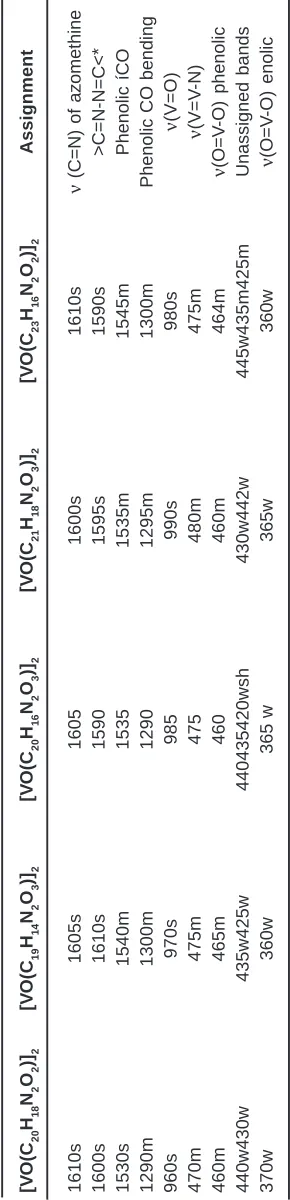
x e s S . Compound m.p.°C Molecular weight Anal ytical Data No. Found % Calcd% Calcd. Found V C H N V C H N 1 . [V O(C 19 H14 N2 O3 )]2 184 384 701 13.07 59.08 3.49 7.10 13.23 59.23 3.63 7.27 2 . [V O(C 20 H16 N2 O3 )]2 175 398 705 12.60 60.02 3.85 6.90 12.76 60.16 4.01 7.01 3 . [V O(C 21 H18 N2 O3 )]2 192 412 724 12.15 60.84 4.18 6.0 12.33 61.02 4.35 6.78 4 . [V O(C 23 H16 N2 O2 )]2 216 418 759 15.82 65.73 3.71 6.55 15.97 65.88 3.81 6.68 5 . [V O(C 19 H14 N2 O2 )]2 . 2 H2 O 288 420 769 12.0 54.02 4.20 6.48 12.10 54.16 4.27 6.65 6 . [V O(C 20 H16 N2 O3 )]2 . 2 H2 O 286 434 764 11.54 55.01 4.40 6.22 11.71 55.18 4.59 6.43 7 . [V O(C 21 H18 N2 O3 )]2 . 2 H2 O 302 448 821 11.19 56.0 4.72 6.05 11.34 56.13 4.90 6.23 8 . [V O(C 23 H16 N2 O2 )]2 . 2 H2 O 285 436 800 11.50 63.0 4.0 6.30 11.65 63.16 4.11 6.40 T a b le 2:
Assignment of the Impor
tant Frequencies in the Infrared Spectra of Oxzo
v
anadium (IV) Comple
x es (cm -1) [V O(C 20 H18 N2 O2 )]2 [V O(C 19 H14 N2 O3 )]2 [V O(C 20 H16 N2 O3 )]2 [V O(C 21 H18 N2 O3 )]2 [V O(C 23 H16 N2 O2 )]2 Assignment 1610s 1605s 1605 1600s 1610s ν
(C=N) of az
omethine 1600s 1610s 1590 1595s 1590s >C=N-N=C<* 1530s 1540m 1535 1535m 1545m Phenolic í C O 1290m 1300m 1290 1295m 1300m
Phenolic CO bending
coordinate bond for mation from one of the unsaturated nitrogen of the azomethine group to
the vanadyl ion10,11.
Phenolic group vibrations
The IR spectra of the ligands show strong
bands in the regions 3200-3250 and 1320-1350 cm
-1 which may be assigned to stretching and
deformation of phenolic OH vibrations involving hydrogen bonding, The intramolecular hydrogen bonding is also indicated by the presence of weak
broad band around 2700-2775 cm-1 in the free
ligands12. A strong band at 1320-1350 cm-1 may be
due to phenolic (C-O) stretching vibration which shifts to higher frequency in the corresponding complexes showing thereby the bonding of the vanadyl ion through phenolic oxygen atom. The complexes display strong (V=O) stretching
frequencies in the region 975-990 cm-1 which is
lower for penta coordination but compatible with
hexa coordination13-15.
The band at 540-550 cm-1 is assigned to
(V-O) aryl and those of 460-475 cm-1 and 430-440
cm-1 to the (V–N) and ν(V–O) bands respectively.
The ν(O-H) which appears or 3200-3250 cm-l in
molecule is absent in the complexes while ν(C-O)
bond in complexes is observed near 1380 cm-l which
is in the higher energy side by ~70 cm–116. Such a
large shift in higher energy direction indicates the involvement of the phenoxide moiety in the bridge in those complexes.
From the above discussion it is concluded that the ligands act in a terdentate manner and attacking the metal ion through phenolic and enolic oxygen (both deprotonated) and azomethine
nitrogen17. The dimeric nature of the complexes is
also supported by the appearance of a number of
bands between 425-465 cm–1. Similar criterion for
making distinction between dimeric and polymeric complexes has been advanced by Lever and
Ramaswamy18 on the basis of isotopic and variable
temperature metal oxygen vibrations.
Magnetic and electronic spectral studies The reported complexes are paramagnetic and the magnetic moment values are lower than
the expected value for a (d1) system (1.73 B.M.).
Such low value indicate that some amount of
T
a
ble 3:
Ma
gnetic Data and Electr
onic Spectral Bands of Ozxo
v
anadium (IV) Comple
antiferromagentic interaction is taking place with the neighbouring molecule. Infrared spectra molecular weight of the complexes suggests dimeric nature of the complexes.
A dimeric oxygen–bridged structure, which
provides an appropriate symmetry for the 3dxy
orbitals, of oxovanadium(IV) to overlap with each
other and to form a strong σ – metal – metal bond,
has been suggested for oxovanadium (IV) complexes of 5 – substituted N-(2 – hydroxyphenyl) salicylidenimine, which were also reported to have
subnormal magnetic moments19-20. Poddar et al. 21
and Yamada et al 22 also observed subnormal
magnetic moment in case of oxovanadium (IV) complexes of tridentate Schiff bases and suggested in oxygen – bridged structure. A binuclear structure
has been proposed23 in a series of oxovanadium
(IV) Schiff base complexes exhibiting subnormal
magnetic moments, in which the σ – metal – metal
interaction is the principal path for spin – spin coupling. It was argued that such an interaction leads to a singlet spin state and a higher triplet spin state with an energy separation equal to the exchange integral J. Therefore, it is presumed that the magnitude of J and the available thermal energy, both make some contribution to the population of the upper triplet state giving rise to subnormal magnetic moment of 1.28–1.67 B.M. at room temperature.
The coordination around the vanadyl ion is distorted square pyramid. For square pyramidal oxovanadium(IV) complexes, the unpaired spin is
expected to be in the 3dxy orbital24.In the present
complexes, two of the base atoms of the square pyramid are bridging oxygen atoms which are also bound to carbon atoms of the ligand molecule. Both
the Px and py orbitals of these oxygen atoms are
involved in strong σ –bonding and therefore do not
π-donate to the vanadium 3dxy orbitals (Px has
symmetry, with respect to dxy of the second vanadium
atom of the dimmer). The 3dxy orbital is therefore
lowered in energy with respect to the 3dxz and 3dyz
orbtials. In the binuclear complexes the 3dxy orbitals
have appropriate symmetry to σ–bond with each
other and as such this π–metal-metal interaction
should be the principal path for spin coupling.
The electronic spectra of complexes
recorded in ethanol exhibit bands in the regions 12200-13000, 16500-17200 and 20300-22500
cm-1.
The geometry is not ideal square pyramidel
(C4v) due to in-equivalent chromophore donor atom
NO2.O of the ligands. Therefore lower symmetry
(C2v) can be considered Kuska and Yang (25) have
proposed the energy level scheme. a2(xy)<b1(xz)
~b2(yz) <a1(x2 – y2) < a
1(z
2), to interpret the spectra
of oxovnadium (IV) complexes having C2v symmetry.
Wasson et al.(26) have advanced a crystal field model
to account for electronic and electronic – spin resonance spectra of low symmetry oxavanadium
(IV) complexes possessing effective C2v symmetry.
This model predicts the energy level order as; dxy
<dxz <dyz <dx2 –
y
2 <d
z
2. Except for the splitting of d
xz
and dyz levels, this scheme is similar to the
Ballhausen – Gray energy level scheme27.
Selbin et al., 28, 29 have also put forward an
energy level order called ‘clustered level scheme’ of Ortolano, Selbin and McGlyn (OSM) which is somewhat different from that of Balllhausen and Gray, suggesting that the three basically d-d
transition for C4v symmetry occur in a narrow region
of the spectrum below about 20000 cm-1 and the
total of four bands have been interpreted as d-d
transitions in C2v- symmetry. This scheme does not
apply to the present complexes because one band
is observed above 20000 cm-1. Hence we have
adopted the energy level schemes suggested by Wood et al. and Kuska and Yang. (Loc. Cit.) and
modified by Wasson et. al. 30 and accordingly, the
bands in the regions 12000-13000 (ν 1),
16500-17200 (ν2) and 20300-22500 (ν3) cm-1 may be
assigned to XY → YZ, XY→XZ, and XY→ X2–y2
transitions, respectively by assuming the effective symmetry of the symmetry of the complexes as
C2í The splitting of dxz and dyz levels by 4000 cm-1 is
consistent with the prediction of the model proposed by Wasson et al. (Loc. Cit.) This model predicts
another transition XY→νZ2 and the energy of
this band is too high as it falls in the ultraviolet
region31-37 (~70000 cm-1).
1. D. S. Rani, P. V. Ananthalakshmi and V. Jayatyagaraju, Ind. J. Chem. 38A: 843 (1999).
2. J. Selbin, Coord, Chem. Rev; 1: 293 (1966).
REFERENCES
3. P. C. Stewart and A. L. Porte, Jour. Chem. Soc.