68 IJSTR©2020
www.ijstr.org
Optimum Design Of PID Controller Using
Multi-Objective CBBO Algorithm
Manjeet Kaur, Anil Kumar, Ashish Luhach
Abstract: This paper offerings request of chaotic biogeography-based optimization (CBBO) for Proportional-Integral-Derivative (PID) Controller tuning. Tuning of parameters is primarily based upon maximization of all-inclusive fitness function created as inverse of weighted sum of Integral of Square of Error (ISE), Rise Time (Tr), Peak Overshoot (Mp), and Settling Time (Ts) for a category of stable and risky gadget through by CBBO set of rules. The measurement of exploration planetary is handiest 3 parameters, i.e., KP, KI and KD; so, a set weight is assigned for inertia parameter. The main impartial of this paper is to diminish PID controller’s specifications at numerous inertia loads. The proposed scheme shows outstanding closed-loop performance of 2nd order system and out of control device and to display the efficacy of proposed scheme the simulation outcomes are equated with BBO and genetic algorithm.
Index Terms: PID Controller, Biogeography-Based Optimization (BBO), Genetic Algorithm (GA), chaotic biogeography-based optimization (CBBO).
——————————◆——————————
1 Introduction
Nearly in all process control systems, controller can be a vital introductory observe. Lots of work has been carried out by the researchers and several controller systems are provided to stabilize nonlinear, stable and unstable processes [3]. If tremendous zeros are present in system, then the system show needless overshoot or inverse reaction. Although, there may be vast improvement in superior manner schemes like sliding mode control, predictive control, Proportional-crucial-by-product (PID) manage preparations are widely used due to the fact later are lingering to provide the operative answers to furthermost of the control engineering issues PID controllers can be tuned in variability of ways viz Z-N method, Cohen-Coon tuning strategies however these have their very own barriers to discover optimal solution. So, many optimization strategies had been evolved to music the parameters (KP, KI, KD) of PID controllers which includes Fuzzy Logic [2], neural Network and Neural-Fuzzy Logic. In spite, there are numerous most efficient standardization strategies for PID controllers supported numerous random search techniques as Genetic Algorithm (GA), particle swarm optimization (PSO), Artificial Fish Swarm Optimization (AFSO), and Ant Colony Optimization (ACO). Mathematical representations of biogeography designate the relocation, speciation, and disappearance of species. Islands which might be well coordinated as surroundings for biological species (solutions) are presumed to have a high habitat suitability index (HSI). Features related to HSI incorporate precipitation, topographic variety, zone, temperature, etc. The variables that illustrate those traits are termed as suitability index variables which are independent variables of the island and HSI’s are reliant on variables. Chaos concept is exemplified by means of using “butterfly effect” special via Lorenz [15]. Chaos is a fashionable nonlinear however deterministic phenomenon in nature. The technique of chaos optimization makes use of the logistic model:
xn+1 = f (xn) = μxn (1 − xn) (1) where xn ∈ [0, 1].
μ is named as logistic parameter and equivalents to 4.
The conclusion is to study physical parameters of DC motor drive for evaluating the switch characteristic in which separately excited DC motor rated 220V 19A 1000 rpm is considered and its parameters are decided to assess transfer function. The parameters are useful in layout of PID
controllers. Hence dedication of mechanical parameters of motor and load by using suitable techniques is of maximum importance. The controller tuning is accomplished contemplating mechanical parameters of motor as well as load in parameters. Accurate willpower of physical parameters is critical project. This also complements the validation capability of simulation.
2
MODELLING
OF
SEPARATETLY
EXCITED
DC
MOTOR
Detailed A DC motor encompass three foremost parts: a modern-day sporting conductor referred to as an armature; a circuit for magnetic subject supplied by magnets of poles; and a commutator. In order to construct the DC automobiles switch, feature its simplified mathematical version has been used. The modern-day inside the discipline coil and armature coil unbiased of one another. As a result, these motors have terrific velocity and torque manage.
Va = Ra.Ia+ La dIa/dt + Eb (2) Eb (t) = Kb. ω (3) TL (t) = Kt.Ia (4)
The DC motor equations dependent on Newton's law joined with Kirchhoff's law:
(5)
(6)
Fig.1. Schematic Diagram of Separately excited DC Motor
69 to embed the images in the paper itself. Please don’t send the
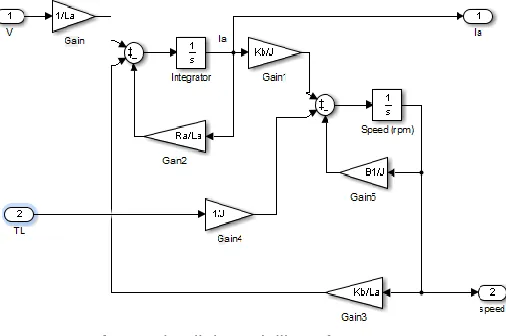
images as separate files. In the state-space structure, the conditions over will be communicated by choosing the rotational speed partner in electric current of the fact that the state variables and the voltage are considered as an input. The yield is picked to be the rotational speed.
(7)
(8)
Parameters of the DC motor like armature resistance, armature inductance, back emf steady, second of inertia of motor, force regular, friction regular of the motor need to be forced to be calculable properly in order that controller parameters can be nicely tuned and consequently the desired response can be completed from the gadget.
TABLE I.
Separately excited DC MOTOR PARAMETERS
KT, Kb, Ra and La do now not range with load and for this reason these values are decided the usage of conventional technique. However, J and B vary with admire to load. Hence, their versions will have an impact at the dynamics of the machine. The transfer feature of the armature-controlled DC motor is determined tentatively through ascertaining every one of the estimations of above referred to parameters. The exchange highlight of the armature-controlled DC motor is of the structure.
(9)
Fig. 2. Simulink Modelling of DC Motor
3. PID
CONTROLLER
PID controllers are one of the greatest working industrial controllers. The function of those controllers is principally founded on three controlling developments: Proportional, Integral, and Differential. Proportional time period makes an exchange to the yield that is corresponding to the contemporary error value. The integral action evacuates the counterbalance declared through the relative control anyway reason a portion slack into the framework. The derivative controller yield is relative to the expense of trade of error which is utilized to diminish the essentialness of overshot shaped by means of the fundamental thing.
Fig.3. Schematic Diagram of PID Controller
U (t) = Kp+ Ki ∫e(t)dt + Kd(𝑑𝑒 (𝑡))/𝑑𝑡 (10)
4. PROBLEM FORMULATION:
All viable cliques (units) of controller parameter requirements are debris that attuned to limit the goal characteristic, which on this studies painting is the error or cost criterion. It is the CBBO gives such expected controller settings that bring about a stable or unstable closed loop gadget [2].
Table 2.
Parameters used in BBO for proposed Problem
70 IJSTR©2020
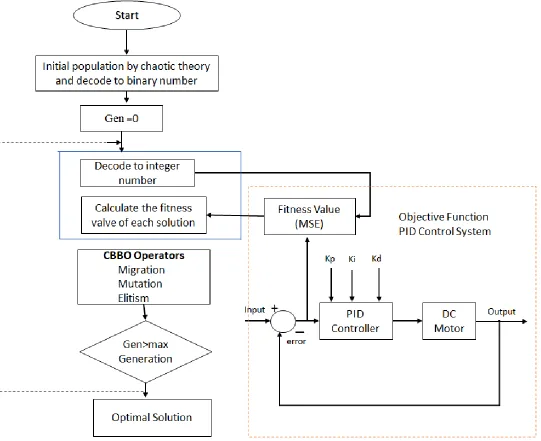
www.ijstr.org Certain parameters are important to be defined to cringe up with CBBO. Selection of these parameters (requirements) resolves, to a splendid amount to the ability of world optimization. The migration operator disturbs the power of avoidance from nearby optimization and refining international optimization [2]. Mutation
operator is used to gain required diversity a few of the populace. Elitism operator keeps the great answers the various populations [6]. For operation of the version the parameters have been initialized as suggested in Table 2. In proposed problem, the termination criterion is measured to be the realization of satisfactory (fitting) fitness function which arises with the maximum number of generations. Fitness function is considered as inverse of weightage average of performance indices [2].
Fitness-function = ((wISE + wtr + wts + wmp ))/((wISE∗ISE+ wtr∗tr + wts∗ts + wmp∗mp) (11)
Fig. 4. Flowchart of CBBO
5. RESULTS AND DISCUSSION:
The transfer function of the system being controlled is U(s)= 3.475/(2.72s^2+0.068s+0.00464) (12)
Parameters (KP, KI, KD) tuning of PID controller utilizing CBBO
71 have a more advantageous transient response of the
framework. The SIV is formed by each of the 3 parameter esteems that compare to three controller gains to be adjusted in order to initiate adequate conduct: Proportional term gain (KP), Integral term gain (KI), and Derivative term gain (KD). Our fundamental thought process of the tuning is to limit the error or maximize the fitness between set- point and desired output. To obtain this many objective functions were inscribed based on criterion of error performance but in this paper we are using maximum fitness ormaximum number of generations as stopping criterion.
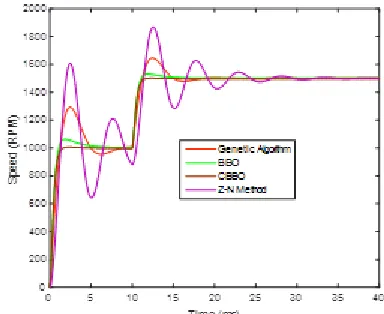
Fig. 5. Comparison of genetic Algorithm, BBO, & CBBO at 0.5 inertia load at 1000 RPM
Fig. 6. Comparison of genetic Algorithm, BBO, & CBBO at 0.5 inertia load when speed changes from 1000 RPM to 1500
RPM
Fig. 7. Comparison of genetic Algorithm, BBO, & CBBO at 0.75 inertia load at 1000 RPM
Fig. 8. Comparison of genetic Algorithm, BBO, & CBBO at 0.75 inertia load when speed changes from 1000 RPM to 1500 RPM
Fig. 9.Comparison of genetic Algorithm, BBO, & CBBO at 1.0 inertia load at 1000 RPM
Fig. 10. Comparison of genetic Algorithm, BBO, & CBBO at 1.0 inertia load when speed changes from 1000 RPM to 1500
RPM
72 IJSTR©2020
www.ijstr.org performance of the PID controllers. Here the evaluation in speed of dc motor is at 1000 RPM and whilst velocity changes from 1000 RPM to 1500 RPM represented both. Simulink outcomes show that the performance of controller grow to be better whilst we moved 1000 RPM to 1500 RPM.
Table 3.
Comparison of error criterion in Genetic Algorithm, BBO, & CBBO at 0.5 inertia load, 0.75 inertia load d 1.0 inertia load
Table 3.
Comparison of Performance Indices in Genetic Algorithm, BBO, & CBBO at 0.5 inertia load, 0.75 inertia load and 1.0
inertia load
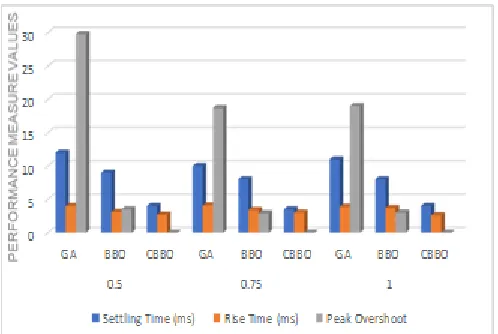
Fig. 11. Graphical representation of performance indices in Genetic Algorithm, BBO, & CBBO at various inertia loads
Fig. 12. Comparison of ISE and IAE in Genetic Algorithm, BBO, & CBBO at various inertia loads
The performance indices of controller by means of the proposed approach for various inertia loads is offered in Table 3, and are graphically reprented in Fig. 11 and 12 and the proposed approach primarily based PID settings for w= 0.75 affords imroved overall performance compared to the alternative values. This assessment affirmed that the proposed controller bears better robustness and the show is worthy over a gigantic assortment of framework operations. The PID parameter esteems which were found by means of the CBBO set of guidelines are contrasted and qualities got from Genetic Algorithm (GA) and BBO in various observations, particularly robustness and balance performances.
4
C
ONCLUSIONIn this paper, the speed control of DC motor control by unique strategies of PID Controller has been talked about. It is gotten clear from the outcomes that ordinary PID controller isn't getting the definite outcome anyway by means of improvement estimation techniques essentially dependent on Evolutionary calculations for tuning of PID controller provoked a pleasing close hover response for the speed oversee of dc motor. CBBO algorithm based PID controller is tuned for improvement of controller parameters. Optimal determination of the controller coefficients utilizing CBBO moreover
Inertia TECHNIQ UES
Rise Time (ms)
Settling Time (ms)
Peak Over shoot
0.5
GA 4 12 29.8
BBO 3.1 9 3.5
CBBO 2.7 4 0
0.75
GA 4.1 10 18.7
BBO 3.4 8 2.9
CBBO 3 3.5 0
1
GA 3.9 11 19
BBO 3.7 8 3
CBBO 2.6 4 0
Inertia TECHNIQU
ES KP KI KD ISE IAE
0.5
G A 401 354 385 4.16 1.63 BBO 413 472 479 1.98 0.78 CBBO 486 461 362 0.73 0.46
0.75
GA 412 384 405 3.85 1.15 BBO 432 458 381 1.59 0.76 CBBO 477 485 302 0.43 0.42
1
73 demonstrates that this calculation has a high capability in
tuning of the parameters of the controller and is extra proficient as contrasted and the outcomes by hereditary calculations and BBO set of principles. Additionally, this paper endeavored the PID controller optimization with CBBO with various inertia loads. The fixed inertia weight approach encourages to improve the speed of assembly and moreover proceeds with reasonable precision. Proposed weighted sum of performance indices provides the necessary parameters and enhanced performance in reference tracking.
R
EFERENCES[1] J.S. Bridle, “Probabilistic Interpretation of Feedforward Classification Network Outputs, with Relationships to Statistical Pattern Recognition,” Neurocomputing—Algorithms, Architectures and Applications, F. Fogelman-Soulie and J. Herault, eds., NATO ASI Series F68, Berlin: Springer-Verlag, pp. 227-236, 1989. (Book style with paper title and editor) REFERENCES
[2] J.G. Ziegler and N.B. Nicholas, “Optimum setting for automatic controllers, ASME Transactions”, 759-768, 1942.
[3] J.S. Saini, “Genetic Algorithm Based PID Tuner’, journal of institution of Engineers (India) Electrical Engg. Divn”, vol. 85, 216-221, 2005.
[4] Åström K., and Hägglund T., “Revisiting the Ziegler-Nichols Step Response method for PID control”, Journal of Process Control, Vol. 14, pp. 635-650, 2004
[5] Y. Luo, “Optimization of PID Controller Parameters Based on an Improved Artificial Fish Swarm Algorithm”, Third International Workshop on Advanced Computational Intelligence, 25-27, 2010.
[6] I. Chiha, N. Liouane, and P. Borne, “Tuning PID controller using Multiobjective Ant Colony Optimization”, ACIS, 1-7, 2012. [7] Yingfa Wang, Changliang Xia, Maohua Zhang, Dan Liu,
“Adaptive Speed Control for Brushless DC Motors Based on Genetic Algorithm and RBF Neural Network”, IEEE International Conference on Control and Automation, 1219-1222, 2007. [8] D. Kukolja, F. Kulica, E. Levib, “Design of the speed controller for
sensor less electric drives based on AI techniques: a comparative study”, Artificial Intelligence in Engineering, 165– 174, 2000.
[9] D. Simon, “Population Distribution in Biogeography-Based Optimization Algorithms with Elitism”, IEEE International Conference on Systems, Man, & Cybernetics, San Antonio, 991-996, 2009.
[10]Math Works Inc., “Simulink Toolbox for use with MATLAB,” Users guide version-7.11.0.584, 2015.
[11]B. Chen, Wenhua Zeng, Yangbin Lin, “A New Local Search-Based Multiobjective Optimization Algorithm”, IEEE Trans on Evol. Comp, 19 (1), 50-71, 2015.
[12]Li Niu, Dianguo Xu, Ming Yang, “On-line Inertia Identification Algorithm for PI Parameters Optimization in Speed Loop”, IEEE Trans. on Power Electronics, Vol. 30 (2), 2015.
[13]M. S. Zaky, “A self-tuning PI controller for the speed control of electrical motor drives”, Electric Power Systems Research, 119, 293–303, 2015.
[14]Golden Ali M. Ismeal, K. Kyslan, and V.Fedak, “CAD of cascade controllers for DC drives using genetic algorithm methods”, Mechatronics, 96, 182-189, 2014.
[15]Li Niu, Dianguo Xu, Ming Yang, “On-line Inertia Identification Algorithm for PI Parameters Optimization in Speed Loop”, IEEE Trans. On Power Electronics, Vol. 30 (2), 2015.
[16]Lalit Chandra Saikia, “Multi - area AGC with AC/DC link and
BES and Cuckoo Search Optimized PID Controller, Computer”, Communication, Control and Information Technology (C3IT), Pp- 1-6, 2015.
[17]Majid Zamani, Nasser Sadati, and Masoud Karimi Ghartemani, (2009) ‘Design of an H∞ PID Controller Using Particle Swarm Optimization’, International Journal of Control, Automation, and Systems, 7(2):273-280.
[18]E.N. Lorenz (1963) ‘Deterministic nonperiodic flow’, Journal of the Atmospheric Sciences 20 (2), 130–141.
[19]Santosh Kumar Suman (2016) ‘Speed Control of Dc Motor Using Optimization Techniques Based PID Controller’, ICETECH, Coimbatore.
[20]Mohd S. Saad, Hishamuddin Jamaluddin, Intan Z. M. Darus, “PID Controller Tuning Using Evolutionary Algorithms”, wseas transactions on systems and control, 4(7), 2012.
[21]Xu Wang1 and Zhidan Xu2, “Multi-Objective Optimization Algorithm based on Biogeography with Chaos”, International Journal of Hybrid Information Technology, 7(3), pp.225-234, 2014.