DIDACTIC TEST "IB GROUP OF THE PERIODIC TABLE" (10TH GRADE) Antoaneta A. Angelacheva
University of Plovdiv, Faculty of Chemistry, Chair of General and Inorganic Chemistry with Methodology of Chemistry Teaching, Bulgaria
Abstract
In the article are outlined the stages of building and realization of didactic test for diagnostics teaching results in chemistry in the 10th grade, section IB group. The statistical analysis of research results includes analysis of tests' tasks, analysis of the test as a whole and analysis of students' achievements.
Key words: chemistry education, didactic test for measuring the level of students' knowledge and skills, IB group of the periodic table
1. INTRODUCTION
The problem for the objective diagnostics and measurement of the level of students' knowledge and skills is one of the main problems of educational practice. During the past years the special interest in this problem breeds aspiration to creat didactic tests by which to expand the possibilities for rejection of subjectivity in diagnostics and measurement in the education field.
The analysis of pedagogical literature and practice shows that the didactic tests are used both for determination of students' achievements and for development of students' cognitive interest and logical thinking.
The objective of the work is by using ideas from the theory and methodology of the tests to create a didactic test for measuring the level of knowledge and skills of students in studying IB group of the periodic table in the 10th grade.
To achieve this aim, it is necessary to solve the following tasks:
• Study of literature on the issue of the classification of the didactic tests and the tests' tasks.
• Analysis of the educational content for IB group in order to highlight the basic concepts in its study; determination students' knowledge and skills which may be object for control and evaluation.
• Preparation of a test on the educational content for IB group in accordance with the requirements of the theory and methodology of didactic tests.
• Approbation of the created test. Analysis of the quality of tests' tasks, the test as a whole and the results for the level of students' achievements in studying IB group.
2. RESEARCH CONTEXT
In literature are known a number of definitions of the concept didactic test. The most authors consider the test as a form for application of the written method for control and self-control of the students' knowledge and skills (Bizhkov, 1996; Ivanov, 2006).
According to the method of assessment of the achievements from learning activity the didactic tests are normative and criterion. The normative tests establish the intellectual achievements of student in comparison with other students who take part in the test. The criterion tests establish students' achievements in predetermined and measurable criteria (Bizhkov & Kraevski, 2007). Our attention is directed to the normative tests.
In the practice of chemical tests, unlike other private scientific areas, the special is that in them is widely accepted the language of chemical symbols, chemical nomenclature and terminology (Ganchev & Gergova, 1998).
The choice of the curriculum for IB group of the periodic table (in order to develop a didactic test) is prompted by its great cognitive and practical significance. In studying IB group are specified the logical relationships between the place of the chemical element in the periodic table, the structure of its atoms, the possible oxidation states, the chemical activity and the type and the properties of elementary substances and chemical compounds, which the chemical element forms. These links determine deductive learning path: overview of IB group, a concrete representative of the group and its chemical compounds. The chemical elements (copper Cu, silver Ag), their elementary substances and chemical compounds are studied in the contemporary cognitive level in the presence of a large theoretical store of knowledge about structure of atoms, periodic table, chemical bonds, electrolytic dissociation and oxidation-reduction processes.
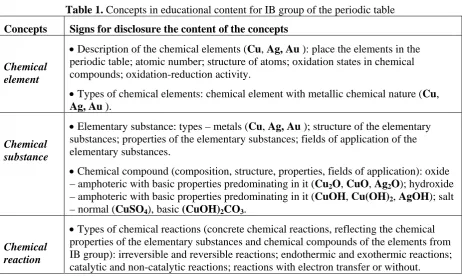
The basic chemical concepts are developed in the educational content for IB group – chemical element, chemical substance and chemical reaction. In table 1 are presented the essential signs of their description.
Table 1. Concepts in educational content for IB group of the periodic table Concepts Signs for disclosure the content of the concepts
Chemical element
• Description of the chemical elements (Cu, Ag, Au ): place the elements in the periodic table; atomic number; structure of atoms; oxidation states in chemical compounds; oxidation-reduction activity.
• Types of chemical elements: chemical element with metallic chemical nature (Cu, Ag, Au ).
Chemical substance
• Elementary substance: types – metals (Cu, Ag, Au ); structure of the elementary substances; properties of the elementary substances; fields of application of the elementary substances.
• Chemical compound (composition, structure, properties, fields of application): oxide – amphoteric with basic properties predominating in it (Cu2O, CuO, Ag2O); hydroxide – amphoteric with basic properties predominating in it (CuOH, Cu(OH)2, AgOH); salt – normal (CuSO4), basic (CuOH)2CO3.
Chemical reaction
• Types of chemical reactions (concrete chemical reactions, reflecting the chemical properties of the elementary substances and chemical compounds of the elements from IB group): irreversible and reversible reactions; endothermic and exothermic reactions; catalytic and non-catalytic reactions; reactions with electron transfer or without.
3. METHODOLOGY AND DESCRIPTION OF THE RESEARCH The stages of creation the didactic test are as follows:
3.1. Determination of the test' purpose and creation of a test-specification
The aim of the test is to measure the level of students' achievements on educational content for IB group of the periodic table. The aim reflects the conscious need of objective measurement the students' knowledge and skills in application of theories for the structure of atom, the chemical bond and the chemical processes in studying IB group.
Specifying the aim in a task of measurement requires commitment to the objectives and the content of training with objectives and the tasks of control. This relates to the preparation of a test-specification
(a detailed list of knowledge and skills that can be subject of control and evaluation), which is presented in table 2.
Table 2. Knowledge and skills, which are the subject of control and evaluation
Knowledge about:
– the relationship between the place of chemical elements from IB group in the periodic table, structure of their atoms and typical oxidation states;
– the relationship between the place of chemical elements from IB group in the periodic table and the type of elementary substances and chemical compounds, which the elements form;
– the relationship between the structure and the properties of the substances of the chemical elements from IB group;
– the relationship between the properties, natural occurrence, application and methods for preparation the substances of chemical elements from IB group;
– the relationship between the properties of the substances of chemical elements from IB group and their biological importance or toxic effect;
– ion-exchange and oxidation-reduction processes, in which take part substances of chemical elements from IB group;
– the genetic relation between the substances that the chemical elements from IB group form;
– the relationship between the smaller atomic radius of the elements from IB group and less chemical activity in comparison with the elements from IA group.
Skills for:
– a graphical presentation of structure of the atoms' electron shells of the elements from IB group;
– determination of the chemical nature of the elements from IB group according to their place in the periodic table;
– clarification of causal link between the structure and the properties of the substances of the elements from IB group;
– description of the natural occurrence, application and methods for preparation of substances of the elements from IB group in connection with their properties;
– disclosure the physiological effect of the elements from IB group and the problems related to environmental protection;
– experimental activity in studying IB group;
– generalization and systematization the knowledge about the genetic relation between the substance of the elements from IB group;
– application of knowledge in unfamiliar (new) cognitive situations;
– comparison between the elements from IB and IA groups on the properties of their substances and chemical activity;
– expression of chemical reactions with ion-electron or ionic chemical equations.
3.2. Development of the content of the tests' tasks
The content of the created tests' tasks (see appendix 1) may be presented briefly through description of the activity in solving them:
Task 1. Determination of the electron configuration of the elements from IB group according to their place in periodic table.
Task 2. Characterization of the structure of atoms, the oxidation states and the chemical activity of the elements from IB group.
Task 3. Identification of chemical equations, which reflect the interaction between copper Cu and concentrated acids.
Task 4. Comparison of the properties of substances copper Cu and silver Ag based on signs of similarity.
Task 5. Application of chemical facts related to the properties of the elementary substance silver Ag. Task 6. Identification of oxidation-reduction processes in which take part the elementary substance copper Cu and chemical compounds of copper.
Task 7. Expression by chemical equations of transitions with participation of the elementary substance copper Cu and its chemical compounds.
Task 8. Generalization of knowledge about application of simple substance and chemical compounds of copper Cu in connection with their properties.
Task 9. Application of knowledge about chemical element copper Cu on facts for the element silver Ag.
Task 10. Comparison of the chemical interactions and the chemical activity of the elementary substances sodium Na, copper Cu and silver Ag.
In the test are included tasks from different type – with a structured answers, with a free answer and tasks for comparison.
3.3. Construction of the test and approbation
For compilation of test the following requirements are met:
– the test is consistent with the national standarts for educational content and educational programme "Chemistry and protection of the environment" (10th grade);
– the test is self-dependent with respect to the content;
– the tests' tasks include an essential points of the educational content for IB group of the periodic table;
– the tests' tasks are arranged according to the levels for evaluation of students' achievements (table 3);
– each tests' task is independent in content from the other;
– for each task is determined an assessment that corresponds to the complexity of its content;
– a scale for conversion of the points (the ball) from the true solved tasks in evaluations is selected (table 4).
Experience shows that the more tasks contains a test, the greater are its opportunities for achieving high reliability. The proposed normative test contains 10 tasks. Theoretically based this ensures its high reliability.
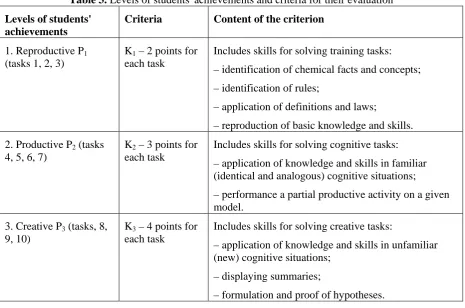
The points which evaluate the right decision of the tests' tasks have different weight depending on the nature of the activity, which requires the decision of the task and depending on the determined by us levels of students' achievements (table 3).
Table 3. Levels of students' achievements and criteria for their evaluation Levels of students'
achievements
Criteria Content of the criterion 1. Reproductive P1
(tasks 1, 2, 3)
K1 – 2 points for each task
Includes skills for solving training tasks:
– identification of chemical facts and concepts;
– identification of rules;
– application of definitions and laws;
– reproduction of basic knowledge and skills.
2. Productive P2 (tasks 4, 5, 6, 7)
K2 – 3 points for each task
Includes skills for solving cognitive tasks:
– application of knowledge and skills in familiar (identical and analogous) cognitive situations;
– performance a partial productive activity on a given model.
3. Creative P3 (tasks, 8, 9, 10)
K3 – 4 points for each task
Includes skills for solving creative tasks:
– application of knowledge and skills in unfamiliar (new) cognitive situations;
– displaying summaries;
– formulation and proof of hypotheses.
So that the test can fulfill its purpose it is necessary to compile a rating scale for its implementation. In our school practice are used six-grade evaluation scale. Therefore the resulting number of points must be converted into scores on this scale. To realize this is determined the percentage of the resulting points in relation to the maximum number of points for the test. The resulting percentage part is converted to an assessment on a six-point scale (table 4).
Table 4. Transformation of scores in the six-point scale Points 0-6 7-12 13-18 19-24 25-30
Assessment 2 3 4 5 6
The final result of the test for each student is a consequence of the ball from true solved tasks. It forms the total test ball which is used in the formation of the contrasting groups. For this purpose the written works of students are arranged in order of increasing their total test ball. It is used the suggested by R. Ebel approach – the volume of each group is 27% of the total number of tested students (Bizhkov, 1996, p. 188). The total number of students who participate in testing is 60. Their average grade in chemistry is very good 4,50. For "strong" group are chosen 16 students whose scores are at the beginning of the rank order. The "weak" group includes the last 16 students. In the further analysis of the tests' tasks are used the students' results from these two groups.
4. RESULTS AND DISCUSSION
After the test's approbation is carried out an analysis of the quality of the tests' tasks (difficulty, diskriminative power and distraktors) and the qualities of the test as a whole (reliability, validity).
The difficulty of the tasks is performed by the index of difficulty P. It represents the percentage of the tested students who correctly are solved the task and is calculated with the formula (1) (Bizhkov, 1996, p. 189):
P = NR
N . 100 (1), where
NR – number of persons from both groups who have decided the task correctly; N – total number of persons from both groups.
According to R. Ebel in normative tests the difficulty of tasks have to be in the range 20%-80% (Bizhkov, 1996, p. 192). The obtained results from testing the difficulty of the tasks from the created test coming into these limits (table 5). Tasks 1, 2 and 3 of the test are with lower difficulty levels, i.e. to a least extent hinder the students. These tasks are selected on the first levels of mastery of knowledge and skills from students and they are with multiple choice answer. Other tasks are of medium difficulty. They are selected on second and third level of students' achievements. Therefore the tasks of the test do not need to change in terms of their difficulty.
Diskriminative power shows the possibilities of a task to distinguish the "strong" students from the "weak" students on their achievements and is calculated with the formula (2) (Bizhkov, 1996, p. 193):
DP = RU−RL
1/2T (2), where
RU – number of students from the "strong" group, who have decided the task correctly; RL – number of students from the "low" group, who have decided the task correctly; T – total number of students from both groups whether true or not answered.
The reasonable index of diskriminative power is in the range 0.40-0.60 (Bizhkov, 1996, p. 192).
The obtained results for diskriminative power show that for the tests' tasks it is positive and is within the specified limits. Therefore the test tasks can distinguish students with strong and weak achievements.
The properties of the tests' tasks (difficulty and diskriminative power), reflected in the table. 5, give a reason for the evaluation of the test.
Table 5. Qualities of the tests' tasks Qualities of the tests' tasks Tests' tasks
1 2 3 4 5 6 7 8 9 10
Index of difficulty, % 25 29 42 48 70 72 69 65 68 73
Diskriminative power 0.41 0.45 0.58 0,52 0,57 0,48 0.59 0.59 0.54 0,55
In tasks with multiple choice answer analysis of distraktors is necessary to establish whether and to what extent they are acceptable to the students and how they allow to distinguish the "strong" from the "weak" students (Bizhkov, 1996, p. 195). The data of the test show that each of the distraktors is indicated by the more "weak" students, rather than "strong" students; in the group of the "strong" students none of the distraktors is not mentioned more times than the correct answer. Therefore
distraktors are acceptable for all students and they have a positive role to distinguish the achievements of students from both groups.
The reliability of the test is determined according to the durability of the results of two testings (test/ retest), carried out at an interval of 3-4 weeks. The correlation coefficient of Pearson-Brave Ri (Bizhkov, 1996, p. 216)] which can take values between 0 and 1, is an index for the reliability of the normative tests. The higher are these values, the more reliable is the test. The correlation coefficient of the test is Ri = 0,72. The good value of Ri gives a reason the test is assessed as sufficiently reliable.
To determine the content validity of the test is used the assessment of experts (teachers) about the correlation between the content of the test tasks and educational content, whose mastery it is designed to measure. For the didactic tests a criterion for their content validity is the curriculum. For each task of the test experts respond to the question: What are the knowledge and the skills that are measured with this task?
(a) basic;
(b) useful, but not essential;
(c) unsubstantial.
Quantitative expression of this compliance is calculated with the suggested from C. Lawshe compliance coefficient CVR (formula 3) (Bizhkov, 1996, p. 243):
CVR = ne−N�2
N�2 (3), where
ne – number of experts that evaluated the test positively; N – total number of experts.
The coefficient CVR can range from –1, when none of the experts has not indicated that the test complies with the objectives, to + 1, when all the experts accept the test corresponding to the objectives of the study.
In this case, after substitution of the data from the expert evaluation of the test in the formula (3) is got:
CVR = 1 (where ne = 6 and N = 6).
The results give a reason to confirm that the content validity of the test is very good.
5. CONCLUSION
In conclusion it can be noted that the properties of the tests' tasks and the test as a whole correspond to the basic requirements described in the literature to the normative tests. It can be assumed that the developed test effectively can be used for diagnostics and measurement of the students' achievements in study IB group of the periodic table (see appendix 2).
The methodology of creation of the test could be used in composition of didactic tests not only in chemistry but also in other school subjects.
According to the opinion of teachers who have made testing and assessed the test material, the content of the test (and the additional tests' tasks, which are provided to the teachers) enables to enrich the system of students' knowledge and skills for chemical elements and their compounds.
ACKNOWLEDGEMENTS
The author would like to thank the Research Fund of the Plovdiv University for its financial support (contract NI 15 HF 001).
REFERENCES
Bizhkov, G. (1996). Theory and Methodology of Didactic Tests (in Bulgarian). Sofia, “Prosveta” Publishing House.
Bizhkov, G. & Kraevski, V. (2007). Methodology and methods of pedagogical researches (in Bulgarian). Sofia University Press, Sofia.
Bliznakov, G., Boianova, L., Sokolova, A. & Ribarska, P. (2002). Chemistry and environmental protection 10th grade, specialized training (in Bulgarian). Anubis Publishing House, Sofia.
Ganchev, G., Gergova, E. (1998). The test in chemistry (in Bulgarian). Palmyra Publishing House, Stara Zagora.
Ivanov, I. (2006). Bases of pedagogical diagnostics (in Bulgarian). Shumen University Press, Shumen.
Lakurski, A. (1999). Mathematical and statistical methods in psychological and pedagogical researches (in Bulgarian). Softtreid Publishing House, Sofia.
Stoichev, D. (2007). Quantitative methods for modeling and diagnostics in the experimental pedagogy, psychology and sociology (in Bulgarian). Plovdiv University Press, Plovdiv.
APPENDIX 1
DIDACTIC TEST "IB GROUP OF THE PERIODIC TABLE"
Task 1. What is the electronic configuration of atoms of the chemical elements from IB group of the periodic table? Circle the letter of the correct answer.
A. Cu 3d104s1; Ag 4d105s1; Au 4f145d106s1; B. Cu 3d104s2; Ag 4d105s2; Au 4f145d106s1; C. Cu 3d84s2; Ag 4d85s2; Au 4f145d86s2; D. Cu 3d64s2; Ag 4d65s2; Au 4f145d66s1; E. Cu 3d74s1; Ag 4d65s1; Au 4f145d76s2.
Task 2. Which signs are characteristic of the chemical elements from IB group? Circle the letter of the correct answer.
A. They reveal less chemical activity in comparison with the elements from IA group of the periodic table.
B. They reveal variable oxidation state.
C. They have smaller atomic radius in comparison with the elements from IA group, which belong to the same period.
D. The chemical activity of the metals decrease in order Cu-Ag-Au. E. All of the above mentioned signs together.
Task 3. Which chemical equations reflect true the interaction between copper Cu and acids? A. Cu + 2HCl → CuCl2 + H2;
B. Cu + 2H2SO4 → CuSO4 + SO2 + 2H2O; C. 2Cu + 4HCl + O2 → 2CuCl2 + 2H2O; D. Cu + 4HNO3 → Cu(NO3)2 + 2H2O + 2NO2; E. Cu + H2S → CuS + H2.
Circle the letter of the correct answer.
(a) A and E; (b) A and B; (c) A, B and C; (d) B, C and D; (e) E and D.
Task 4. Interaction with which of the following substances is a characteristic of the elementary substances copper Cu and silver Ag? Circle the letter of the correct answer.
A. H2O; B. H2;
C. diluted solutions of HCl and H2SO4 ; D. concentrated solution of NaOH ; E. concentrated solution of HNO3 .
Task 5. In the presence of traces in the air of hydrogen sulphide H2S the silver objects (jewelry, coins, cutlery, etc.) darken due to the formation on the surface of the metal a layer of black silver sulfide Ag2S.
Express by chemical equation the interaction between silver Ag, hydrogen sulphide H2S and oxygen O2 from the air when you consider that one of the products of the reaction is water H2O. Mark the oxidation states of the elements. Define the oxidizing and the reducing agent, write the ion-electron equations.
Task 6. In which of the expressed by equations chemical reactions copper Cu is the oxidizing agent? Mark the oxidation states of the elements and transfer of electrons in oxidation-reduction processes. Circle the letter of the correct answer.
A. 2Cu + O2 → 2CuO; B. Cu + Cl2 → CuCl2;
C. Cu + 4HNO3 → Cu(NO3)2 + 2H2O + 2NO2; D. CuSO4 + Fe → FeSO4 + Cu;
E. CuSO4 + NaOH → Cu(OH)2 + Na2SO4.
Task 7. Express by appropriate chemical equations the following transitions: Cu(NO3)2 ← X ← Cu → Y → Cu(OH)2 → CuCl2.
Task 8. Suggest an examples of chemical reactions with practical significance in which take part substances of the element copper Cu.
Task 9. Express by chemical equations the reactions which correspond to the following transformations:
Ag0 → Ag+1 → Ag0.
Task 10. Compare the elementary substances of the elements sodium Na, copper Cu and silver Ag on the signs given in the table. Explain the reasons for the common and the different properties.
Elementary substances
Properties
O2 H2 other non-metals
H2O diluted solutions of acids
concentrated solutions of acids
Na
Cu
Ag
Evaluation of the test's tasks
The total test ball is formed by summing the number of correct answers which correspond to a certain number of points:
Task 1. 2 points for correct answer A.
Task 2. 2 points for correct answer E.
Task 3. 2 points for correct answer (d).
Task 4. 3 points for correct answer E.
Task 5. 3 points for a correct answer.
Task 6 3 points for correct answer D.
Task 7. 3 points for a correct answer.
Tasks 8, 9, 10. 4 points for each correct answer.
Maximum points from the test – 30 points.
APPENDIX 2
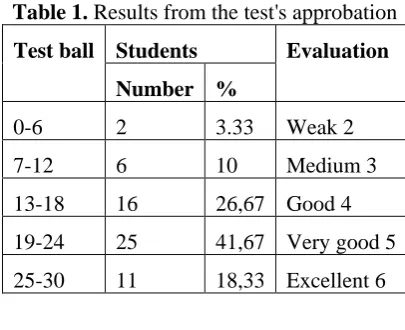
Table 1. Results from the test's approbation Test ball Students Evaluation
Number %
0-6 2 3.33 Weak 2
7-12 6 10 Medium 3
13-18 16 26,67 Good 4
19-24 25 41,67 Very good 5
25-30 11 18,33 Excellent 6
Table 2. Results for the students' achievements Levels of the students'
achievements
Number of students who have reached to the relevant level
%
Reproductive P1 (tasks 1, 2, 3) 58 96,67
Productive P2 (tasks 4, 5, 6, 7) 44 73,33
Creative P3 (tasks, 8, 9, 10) 27 45