R E S E A R C H
Open Access
Comparison of MetaMap and cTAKES for
entity extraction in clinical notes
Ruth Reátegui
1,2*and Sylvie Ratté
1FromThe 7th Translational Bioinformatics Conference Los Angeles, CA, USA. 29 September - 01 October 2017
Abstract
Background:Clinical notes such as discharge summaries have a semi- or unstructured format. These documents contain information about diseases, treatments, drugs, etc. Extracting meaningful information from them becomes challenging due to their narrative format. In this context, we aimed to compare the automatic extraction capacity of medical entities using two tools: MetaMap and cTAKES.
Methods:We worked with i2b2 (Informatics for Integrating Biology to the Bedside) Obesity Challenge data. Two experiments were constructed. In the first one, only one UMLS concept related with the diseases annotated was extracted. In the second, some UMLS concepts were aggregated.
Results:Results were evaluated with manually annotated medical entities. With the aggregation process the result shows a better improvement. MetaMap had an average of 0.88 in recall, 0.89 in precision, and 0.88 in F-score. With cTAKES, the average of recall, precision and F-score were 0.91, 0.89, and 0.89, respectively.
Conclusions:The aggregation of concepts (with similar and different semantic types) was shown to be a good strategy for improving the extraction of medical entities, and automatic aggregation could be considered in future works.
Keywords:cTAKES, MetaMap, UMLS, Clinical documents
Background
Electronic Health Records (EHR) or Electronic Medical Records (EMR) save patients’information in a format that is either structured (e.g., diagnosis codes, laboratory re-sults, medication) or unstructured (e.g., clinical notes). Clinical notes, such as discharge summaries, radiology notes, and progress notes, have an unstructured format with a narrative style. These documents provide a more complete portrait of the patient’s health [1–3], as well as additional valuable information (e.g., diagnosis, symptoms, medical history, social history, medication, lab tests, treat-ments, etc.). Unfortunately, unstructured formats compli-cate information extraction. First, they contain many abbreviations, acronyms, and specialized terms [4]. Sec-ondly, a variety of natural languages are used, depending
on the particular health professional or institution [5], and may not correspond to a general domain. Furthermore, manual annotations and analysis present in clinical notes can transform extraction into a time-consuming, labor-in-tensive, and error-prone endeavor [6].
Nowadays, various tools exist for extracting informa-tion from clinical texts created in an unstructured for-mat. Two such tools, which are widely used and known in the biomedical field, are MetaMap and cTAKES [7,8]. MetaMap was developed by the National Library of Medicine (NLM) to map biomedical text to concepts in the Unified Medical Language System (UMLS) [9, 10]. The tool uses a hybrid approach combining a natural language processing (NLP), knowledge-intensive ap-proach and computational linguistic techniques [10]. The Clinical Text Analysis and Knowledge Extraction System (cTAKES) combines rule-based and machine learning techniques to extract information from a clin-ical text [6]. cTAKES executes some components in * Correspondence:[email protected]
1École de technologie supérieure, Montreal, Canada 2
Universidad Técnica Particular de Loja, Loja, Ecuador
sequence to process the clinical text. Both MetaMap and cTAKES use the Unified Medical Language System (UMLS) to extract and standardize medical concepts.
The extraction of medical entities (e.g., diseases, treat-ments, drugs, etc.) is important for patients and medical research [4,7,11]. Moreover, these medical entities form the basis for other tasks such as disease correlation [1], disease classification [12, 13], disease diagnosis [5, 14], phenotype identification [2,3] etc.
Given the significance of medical entity extraction, this paper aims to compare this extraction carried out using two different tools (MetaMap and cTAKES). For this project, we worked with the i2b2 (Informatics for Inte-grating Biology to the Bedside) Obesity Challenge data. The automated extraction was evaluated against the ex-perts’ manual annotations of 14 obesity comorbidities (simultaneous presence of two chronic diseases or con-ditions in a patient) from discharge summaries.
Methods
Dataset
The i2b2 2008 Obesity dataset consists of 1237 dis-charge summaries of overweight and diabetic patients [15]. The documents contain two different expert anno-tations: textual and intuitive. In this work, we use textual
annotations where experts classified 15 obesity
comorbidities based on the explicit information in dis-charge summaries. The diseases had four classifications:
Present: The patient has/had the disease. Absent: The patient does not/did not have the
disease.
Questionable: The patient may have the disease. Unmentioned: Absence of information of the disease
in the discharge summary.
The first column of Table 1 shows the 14 comorbidi-ties used. Hypertriglyceridemia was excluded due to a lack of sufficient samples. Out of 1237 summaries, we selected the 412 summaries which had obesity as a comorbidity.
Unified medical language system
The National Library of Medicine Unified Medical Lan-guage System (UMLS) provides terminology, coding standards, and resources for biomedical and electronic health systems. UMLS has three Knowledge Sources: the Metathesaurus, the Semantic Network and the SPE-CIALIST lexicon.
The Metathesaurus is organized by concepts or mean-ings. A concept has a unique and permanent identifier (CUI) and a preferred name. The concept is a meaning, and a meaning can have different names from different
Table 1List of entities or concept
Entities annotated by experts Entities in the first experiment Entities or groups in the second experiment Name of disease Preferred name, CUI, Semantic Type Preferred name, CUI, Semantic Type Hypertension Hypertensive disease, C0020538, dsyn Hypertensive disease, C0020538, dsyn Diabetes Diabetes mellitus, C0011849, dsyn Diabetes mellitus, C0011849, dsyn
Diabetes mellitus, insulin-dependent, C0011854, dsyn Diabetes mellitus, non-insulin-dependent, C0011860, dsyn Atherosclerotic Cardiovascular Disease (CAD) Coronary artery disease, C1956346, dsyn Coronary artery disease, C1956346, dsyn
Coronary arteriosclerosis, C0010054, dsyn Congestive Heart Failure (CHF) Congestive heart failure, C0018802, dsyn Congestive heart failure, C0018802, dsyn Hypercholesterolemia Hypercholesterolemia, C0020443, dsyn Hypercholesterolemia, C0020443, dsyn
Hyperlipidemia, C0020473, dsyn Obstructive Sleep Apnea (OSA) Sleep apnea obstructive, C0520679, dsyn Sleep apnea obstructive, C0520679, dsyn Osteoarthritis (OA) Degenerative polyarthritis, C0029408, dsyn Degenerative polyarthritis, C0029408, dsyn Depression Mental depression, C0011570, mobd Mental depression, C0011570, mobd
Depressive disorder, C0011581, mobd
Asthma Asthma, C0004096, dsyn Asthma, C0004096, dsyn
Gastroesophageal Reflux Disease (GERD) Gastroesophageal reflux disease, C0017168, dsyn Gastroesophageal reflux disease, C0017168, dsyn Gallstones/Cholecystectomy Cholecystectomy procedure, C0008320, topp Cholecystectomy procedure, C0008320, topp
Cholecystolithiasis, C0947622, dsyn Cholecystitis, C0008325, dsyn Cholelithiasis, C0008350, dsyn
Gout Gout, C0018099, dsyn Gout, C0018099, dsyn
Peripheral Vascular Disease (PVD) Peripheral vascular diseases, C0085096, dsyn Peripheral vascular diseases, C0085096, dsyn Venous Insufficiency Venous insufficiency, C0042485, dsyn Venous insufficiency, C0042485, dsyn
Postthrombotic syndrome, C0277919, patf
The second experiment grouped together some entities related to the disease annotated by the experts
vocabularies or thesauruses. [16]. The Semantic Network provides (1) a categorization (semantic type) of all con-cepts represented in the UMLS Metathesaurus; and (2) a set of relationships (semantic relations) between these concepts [16]. The Semantic Network contains 133 se-mantic types and 54 relationships.
UMLS is based on some electronic thesauruses, classifications, code sets, and lists of controlled terms
like SNOMED CT and RxNorm [16]. The
Systema-tized Nomenclature of Medicine - Clinical Terms (SNOMED CT) is a multilingual health terminology used for the electronic exchange of clinical health in-formation [17]. In the U.S., SNOMED CT is the na-tional standard for electronic exchange of clinical health information [17]. On the other hand, RxNorm standardizes clinical drug names and links the names to other vocabularies used in pharmacy management and drug interaction software [18].
In this work, the medical entities extracted will be the concepts represented by the CUIs. We worked with SNOMED CT and RxNorm as vocabularies and with four semantic types (henceforth ST):
Disease or Syndrome
Mental or Behavioral Dysfunction Pathologic Function
Therapeutic or Preventive Procedure
Automatic extraction
We used separately MetaMap (version 2015) and cTAKES (version apache-ctakes-3.2) to extract the CUIs
related with the 14 obesity comorbidities above men-tioned. With each tool, two different experiments were carried out in order to extract the entities automatically.
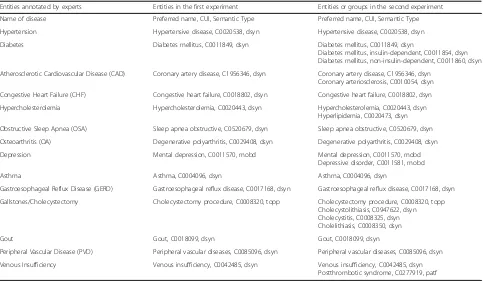
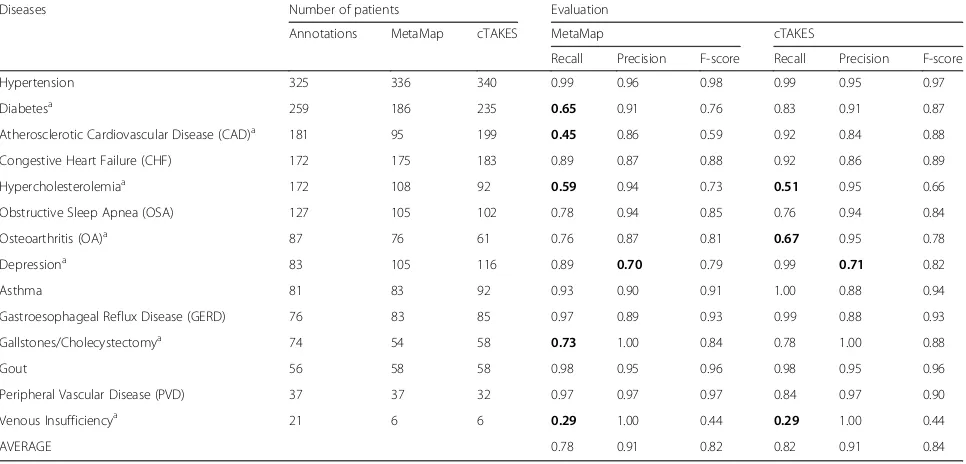
In the first experiment, we identified one CUI code re-lated to each comorbidity or disease. The extracted CUI and the preferred name of the concepts are shown in Table 1, column 2. In this experiment, diabetes, athero-sclerotic cardiovascular disease (CAD), hypercholesterol-emia, osteoarthritis, depression, venous insufficiency, and cholecystectomy have low values in the evaluation (see Table2). Therefore, to improve the results for these diseases, a second experiment was performed.
In the second experiment, we worked with two types of aggregations described below. Aggregation has been wide applied in the genetic field. For example, a pathway level is used instead of individual genes to obtain a com-pact representation or to improve tasks like classification or clustering [19].
(1) Aggregation of CUIs with the same ST. The aggregation of CUIs belonging to the ST“Diseases or Syndromes”allowed us to cover diabetes, coronary artery disease and hypercholesterolemia, while the aggregation of CUIs belonging to the ST “Mental or Behavioral Dysfunction”allowed us to cover mental depression.
(2) Aggregation of CUIs with different ST. First, we aggregated CUIs belonging to the ST“Diseases or Syndrome”with CUIs belonging to the ST “Pathologic Function”; this grouping allowed us to recover enough information to better identify
Table 2Summary of first experiment
Diseases Number of patients Evaluation
Annotations MetaMap cTAKES MetaMap cTAKES
Recall Precision F-score Recall Precision F-score
Hypertension 325 336 340 0.99 0.96 0.98 0.99 0.95 0.97
Diabetesa
259 186 235 0.65 0.91 0.76 0.83 0.91 0.87
Atherosclerotic Cardiovascular Disease (CAD)a 181 95 199 0.45 0.86 0.59 0.92 0.84 0.88 Congestive Heart Failure (CHF) 172 175 183 0.89 0.87 0.88 0.92 0.86 0.89
Hypercholesterolemiaa 172 108 92 0.59 0.94 0.73 0.51 0.95 0.66
Obstructive Sleep Apnea (OSA) 127 105 102 0.78 0.94 0.85 0.76 0.94 0.84
Osteoarthritis (OA)a 87 76 61 0.76 0.87 0.81 0.67 0.95 0.78
Depressiona
83 105 116 0.89 0.70 0.79 0.99 0.71 0.82
Asthma 81 83 92 0.93 0.90 0.91 1.00 0.88 0.94
Gastroesophageal Reflux Disease (GERD) 76 83 85 0.97 0.89 0.93 0.99 0.88 0.93
Gallstones/Cholecystectomya 74 54 58 0.73 1.00 0.84 0.78 1.00 0.88
Gout 56 58 58 0.98 0.95 0.96 0.98 0.95 0.96
Peripheral Vascular Disease (PVD) 37 37 32 0.97 0.97 0.97 0.84 0.97 0.90 Venous Insufficiencya
21 6 6 0.29 1.00 0.44 0.29 1.00 0.44
AVERAGE 0.78 0.91 0.82 0.82 0.91 0.84
The lowest values for recall and precision are in bold a
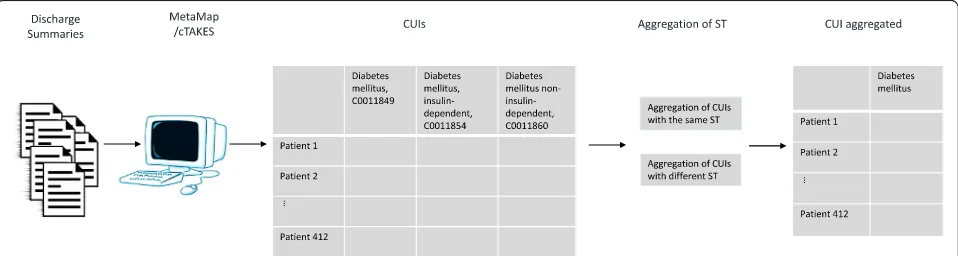
venous insufficiency. Second, we aggregated CUIs belonging to the ST“Therapeutic or Preventive Procedure”with CUIs belonging to the ST “Diseases or Syndrome”; this second grouping allowed us to recover the information needed to identify cholecystectomy. Details of the CUIs grouped together are shown in Table1, column 3. Figure1shows the process for the second experiment and Fig.2shows the aggregation process.
Evaluation metrics
We considered the experts’annotations as a gold stand-ard in evaluating the automatic extraction. Only the “Present” annotation was taken into account in identify-ing whether the patient has or had the diseases.
We used the recall (or sensitivity), precision and F-score to evaluate the results:
Recall¼TPTPþFN ð1Þ
Precision¼TPTPþFP ð2Þ
F score¼2 Precision:Recall
PrecisionþRecall
ð Þ ð3Þ
where TP is the number of true positives of the CUIs mentioned, FN is the number of false negatives of the CUIs mentioned, and FP is the number of false positives of the CUIs mentioned.
Results
In the first experiment (see Table2), the averages for the recall, precision and F-score with MetaMap were 0.78, 0.91, and 0.82, respectively. With cTAKES, the averages
for the same measures were 0.82, 0.91, and 0.84, respect-ively. MetaMap showed a low recall value for diabetes (0.65), CAD (0.45), hypercholesterolemia (0.59), and venous insufficiency (0.29). Cholecystectomy presents a satisfactory recall value (0.73) although much lower than the overall results. Also, cTAKES had low recall values for hypercholesterolemia (0.51), osteoarthritis (0.67), and venous insufficiency (0.29).
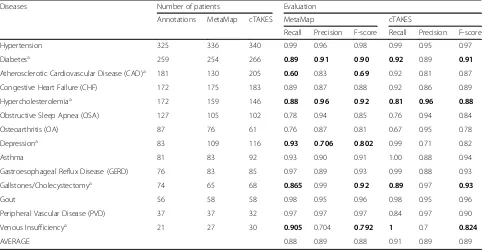
In the second experiment (see Table 3), we achieved better results. MetaMap had an average of 0.88 in recall, 0.89 in precision, and 0.88 in F-score. With cTAKES, the averages for recall, precision and F-score were 0.91, 0.89, and 0.89, respectively. That means that aggregation im-proves the results. For example, in the first experiment, diabetes had a recall value of 0.65 (MetaMap) and 0.83 (cTAKES), but in the second experiment, these values increased to 0.89 (MetaMap) and 0.92 (cTAKES). The same can be said about hypercholesterolemia. In the first experiment, this disease had a recall value of 0.59 (Meta-Map) and 0.51 (cTAKES), but in the second experiment, these values improved to 0.88 and 0.81.
CAD is a special case which illustrates the difference between both tools. For a sentence like (1) below, cTAKES recognized, among many other clues, the ab-breviation “CAD”, but MetaMap did not. Consequently, the number of patients with this disease was lower in MetaMap; however, this notwithstanding, the recall in-creased from 0.45 to 0.6, which is a direct consequence of the aggregation of ST.
(1)“Conditions, Infections, Complications, Affecting Treatment/Stay HTN, CAD, High cholesterol, OSA, OA, Depression, and Anxiety”
(2)“ST depression in the inferior leads and V5-V6” (3)“was found to be in atrial flutter with a 2:1 block
and 2-3 mm lateral ST depressions in V4-V6”
Depression is another interesting case. In the first ex-periment, it was the disease with the lowest precision in
both tools, 0.70 in MetaMap, and 0.71 in cTAKES. Sen-tences (2) and (3) above illustrate the problem. For both sentences, MetaMap and cTAKES consider that the word “depression” refers to the disease, which is clearly not the case. In both sentences,“depression” refers to a part that is lower than the surrounding area, not to the disease. This problem increased the number of false pos-itives. Consequently, the aggregation of ST, used in the
second experiment, did not significantly increase preci-sion. However, the aggregation of ST allowed MetaMap to increase the recall from 0.89 to 0.93.
In the first experiment, we considered the cholecystec-tomy procedure, but in order to know other ways to identify the presence of gallstones, we added information referring to diseases and syndromes such as cholecysto-lithiasis, cholecystitis, and cholelithiasis. Therefore, the
Fig. 2Aggregation process
Table 3Summary of second experiment
Diseases Number of patients Evaluation
Annotations MetaMap cTAKES MetaMap cTAKES
Recall Precision F-score Recall Precision F-score
Hypertension 325 336 340 0.99 0.96 0.98 0.99 0.95 0.97
Diabetesa 259 254 266 0.89 0.91 0.90 0.92 0.89 0.91
Atherosclerotic Cardiovascular Disease (CAD)a 181 130 205 0.60 0.83 0.69 0.92 0.81 0.87
Congestive Heart Failure (CHF) 172 175 183 0.89 0.87 0.88 0.92 0.86 0.89
Hypercholesterolemiaa 172 159 146 0.88 0.96 0.92 0.81 0.96 0.88
Obstructive Sleep Apnea (OSA) 127 105 102 0.78 0.94 0.85 0.76 0.94 0.84
Osteoarthritis (OA) 87 76 61 0.76 0.87 0.81 0.67 0.95 0.78
Depressiona 83 109 116 0.93 0.706 0.802 0.99 0.71 0.82
Asthma 81 83 92 0.93 0.90 0.91 1.00 0.88 0.94
Gastroesophageal Reflux Disease (GERD) 76 83 85 0.97 0.89 0.93 0.99 0.88 0.93
Gallstones/Cholecystectomya 74 65 68 0.865 0.99 0.92 0.89 0.97 0.93
Gout 56 58 58 0.98 0.95 0.96 0.98 0.95 0.96
Peripheral Vascular Disease (PVD) 37 37 32 0.97 0.97 0.97 0.84 0.97 0.90
Venous Insufficiencya 21 27 30 0.905 0.704 0.792 1 0.7 0.824
AVERAGE 0.88 0.89 0.88 0.91 0.89 0.89
The values improved are in bold a
second experiment increased the recall from 0.73 to 0.87 (for MetaMap), and from 0.78 to 0.87 (for cTAKES).
Venous insufficiency increased its recall from 0.29 to 0.9 (for MetaMap), and from 0.29 to 1 (for cTAKES). To improve the venous insufficiency result, we added the postthrombotic syndrome which corresponded to the ST pathologic function.
Osteoarthritis or degenerative polyarthritis presented a low recall with cTAKES, bringing us to review the automatic extraction of the disease. In many cases, health professionals use the abbreviation OA for this disease, an abbreviation which is not recognized by cTAKES; consequently, the number of patients with this disease was low as compared to MetaMap. In some cases, MetaMap mapped this disease to a pre-cise CUI such as C0409959 (Degenerative joint dis-ease of knee), but in other cases, when the experts classified the disease as “OA”, MetaMap and cTAKES generalized it using the general concept “arthritis”. Since osteoarthritis is a specific type of arthritis, we decided not to proceed, in that specific case, with the aggregation of all CUIs under “arthritis”.
Discussion
Considering the results shown in Table 2 (first experi-ment), it is not surprising that previous authors chose to combine both tools to secure better results [20]. In this work, we avoid that combination because we intended to compare the results of each tools. The results in Table3(second experiment) show that at least two types of relationships have to be taken into account to obtain, with both tools, better results.
(1) Aggregation of CUIs with the same ST (e.g., “Disease or Syndrome”and“Mental or Behavioral Dysfunction”): This form of aggregation takes into account the“isa/inverse_isa”relations between concepts in the Metathesaurus. This relation, allowed us to group under“diabetes mellitus”, both “insulin-dependent-diabetes”and“ non-insulin-dependent-diabetes”. Similarly,“coronary
arteriosclerosis”was grouped with“coronary artery disease”,“hyperlipidemia”with
“hypercholesterolemia”, and“depressive disorder” with“mental depression”.
(2) Aggregation of CUIs with different ST: An example here is using the Metathesaurus relation“due_to/ caused_by”to combine venous insufficiency disease with the postthrombotic syndrome pathologic function. Also, we noted that for many forms of gallstones, the clinical notes mentioned the cholecystectomy procedure instead of the specific disease (e.g., cholecystolithiasis). Using the relation “clinically_associated_with”, we were able to
connect the cholecystectomy procedure with the cholelithiasis disease, and then with the
cholecystolithiasis and cholecystitis diseases, among others.
Tables2and 3show the results of the first and second experiments. Overall, the aggregations carried out in the second experiment increased the F-score by 7.3% for MetaMap, and by 6% for cTAKES. The recall values in-creased by 12.8% for MetaMap and by 11% for cTAKES, while the precision values decreased slightly in both tools,−2.2% for both MetaMap and cTAKES.
As we mentioned above, clinical notes contain many abbreviations, acronyms, and specialized terms that renders difficult the extraction of patient infor-mation. Abbreviations such as CHF and PVD were identified by both tools, but CAD and OA were not. It means that the results are sensitive to abbrevia-tions used in the clinical notes. To resolve this prob-lem, MetaMap allows users to define a list of abbreviations and acronyms. On the other hand, cTAKES does not have such a list [21]. In this work, we did not use any list of abbreviations with the aim to keep the same configuration for both tools, but the use of this option could help MetaMap improve its results.
In the annotations made by the experts, they used gen-eral names or maybe a preferred name to denote a co-morbidity. For that reason, in the second experiment, we had to look for some UMLS concept to identify one an-notated comorbidity (e.g. we matched 3 UMLS diabetes mellitus concepts). In other cases, we worked with dif-ferent semantic types such as pathological function and therapeutic or preventive procedures to referred to a co-morbidity mentioned by the experts (e.g. venous insuffi-ciency and gallstones).
Future works
In future works, we will consider the automatic aggrega-tion of concepts or CUIs using the relaaggrega-tions between the concepts described in the Metathesaurus and the seman-tic relation present in the Semanseman-tic Network.
Conclusion
In this paper, we compared the automatic extraction of 14 obesity comorbidities using MetaMap and cTAKES. Automatic extraction was compared to manual annota-tion by experts. The result of the experiments we
con-ducted proved that cTAKES slightly outperforms
MetaMap, but this situation could change considering other configuration options that each tool has such as the abbreviations list in the MetaMap tool. Moreover, we worked with two types of aggregations: aggregation of CUIs with the same semantic type and aggregation of CUIs with different semantic types. These groups im-prove the results. Hence, the use of cTAKES or even MetaMap, using the proposed aggregations, can repre-sent a good strategy to replace the manual extraction of medical entities.
Finally, it should be noted that both tools are con-stantly improving the quality of their results. However, we believe that the combination of both, along with the aggregations, might even permit to cover complemen-tary cases where both tools give different results.
Abbreviations
CAD:Atherosclerotic cardiovascular disease; CHF: Congestive heart failure; CUI: Concept unique identifier; EHR: Electronic Health Record;
GERD: Gastroesophageal reflux disease; OA: Osteoarthritis; OSA: Obstructive sleep apnea; PVD: Peripheral vascular disease; UMLS: Unified Medical Language System
Funding
The cost of the of the publication was funded by the 7th Annual Translational Bioinformatics Conference, TBC 2017.
Availability of data and materials
The dataset used during the current study is available fromhttps:// www.i2b2.org/NLP/DataSets/Main.phpunder a data use agreement.
About this supplement
This article has been published as part ofBMC Medical Information and Decision MakingVolume 18 Supplement 3,2018: Selected articles from the 7th Translational Bioinformatics Conference (TBC 2017): medical information and decision making.The full contents of the supplement are available online athttps://bmcmedinformdecismak.biomedcentral.com/articles/ supplements/volume-18-supplement-3.
Authors’contributions
RR and SR worked in all the sections of this article. Both authors read and approved the final manuscript.
Ethics approval and consent to participate
To access to the i2b2 Obesity dataset the first author signed the Data Use and Confidentiality Agreement from i2b2. The ethics approval was not required because the data have been De-Identified.
Consent for publication
Not applicable.
Competing interests
The authors declare that they have no competing interests.
Publisher’s Note
Springer Nature remains neutral with regard to jurisdictional claims in published maps and institutional affiliations.
Published: 14 September 2018
References
1. Roque FS, Jensen PB, Schmock H, Dalgaard M, Andreatta M, Hansen T, Brunak S. Using electronic patient records to discover disease correlations and stratify patient cohorts. PLoS Comput Biol. 2011;7(8):1–10.
2. Lyalina S, Percha B, LePendu P, Iyer SV, Altman RB, Shah NH. Identifying phenotypic signatures of neuropsychiatric disorders from electronic medical records. JAMIA. 2013;20(e2):e297–305.
3. Alnazzawi N, Thompson P, Batista-Navarro R, Ananiadou S. Using text mining techniques to extract phenotypic information from the PhenoCHF corpus. BMC Med Inform Decis Mak. 2015;15:1–10.
4. Chiaramello E, Paglialonga A, Pinciroli F, Tognola G. Attempting to use MetaMap in clinical practice: a feasibility study on the identification of medical concepts from Italian clinical notes. Stud Health Technol Inform. 2016;228:28–32.
5. Pereira L, Rijo R, Silva C, Agostinho M. Using text mining to diagnose and classify epilepsy in children. In: 2013 IEEE 15th International Conference on e-Health Networking, Applications and Services (Healthcom 2013): 9–12 Oct. 2013; 2013:345–9.
6. Savova GK, Masanz JJ, Ogren PV, Zheng J, Sohn S, Kipper-Schuler KC, Chute CG. Mayo clinical text analysis and knowledge extraction system (cTAKES): architecture, component evaluation and applications. J Am Med Inform Assoc. 2010;17(5):507–13.
7. Pradhan S, Elhadad N, South BR, Martinez D, Christensen L, Vogel A, Suominen H, Chapman WW, Savova G. Evaluating the state of the art in disorder recognition and normalization of the clinical narrative. J Am Med Inform Assoc. 2015;22(1):143–54.
8. Kovacevic A, Dehghan A, Filannino M, Keane JA, Nenadic G. Combining rules and machine learning for extraction of temporal expressions and events from clinical narratives. J Am Med Inform Assoc. 2013;20(5):859–66. 9. Aronson AR, Lang F-M. An overview of MetaMap: historical perspective and
recent advances. JAMIA. 2010;17(3):229–36.
10. Aronso A. Effective mapping of biomedical text to the UMLS Metathesaurus: the MetaMap program. AMIA Annu Symp Proc. 2001;2001:17–21. 11. Becker M, Bockmann B. Extraction of UMLS (R) concepts using apache
cTAKES (TM) for German language. Stud Health Technol. 2016;223:71–6. 12. Yildirim P, Çeken Ç, Hassanpour R, Tolun MR. Prediction of similarities
among rheumatic diseases. J Med Syst. 2012;36(3):1485–90. 13. Yıldırım P, Çeken Ç, Çeken K, Tolun M. Clustering analysis for vasculitic
diseases. In: Zavoral F, Yaghob J, Pichappan P, El-Qawasmeh E, editors. Networked Digital Technologies, vol. 88: Springer, Berlin, Heidelberg; 2010: 36–45.
14. Bejan CA, Xia F, Vanderwende L, Wurfel MM, Yetisgen-Yildiz M. Pneumonia identification using statistical feature selection. JAMIA. 2012;19(5):817–23. 15. Uzuner Ö. Recognizing obesity and comorbidities in sparse data. JAMIA.
2009;16(4):561–70.
16. UMLS® Reference Manual.http://www.ncbi.nlm.nih.gov/books/NBK9676/. Last accessed 30 June 2018.
17. SNOMED CT.https://www.nlm.nih.gov/healthit/snomedct/snomed_ overview.html. Last accessed 30 June 2018.
18. RxNORM.https://www.nlm.nih.gov/research/umls/rxnorm/. Last accessed 30 June 2018.
19. Hwang S. Comparison and evaluation of pathway-level aggregation methods of gene expression data. BMC Genomics. 2012;13:1–18. 20. Tang B, Wu Y, Jiang M, Denny JC, Xu H. Recognizing and encoding
discorder concepts in clinical text using machine learning and vector space model, Online working notes of the CLEF 2013 Evaluation Labs and Workshop; 2013:23–6.
21. Jonnagaddala J, Jue TR, Chang NW, Dai HJ. Improving the dictionary lookup approach for disease normalization using enhanced dictionary and query expansion. Database (Oxford). 2016;2016:1–14.