Kernel-Space Intrusion Detection Using
Software-Defined Networking
Tommy Chin
1, Kaiqi Xiong
2,*, and Mohamed Rahouti
2 1Rochester Institute of Technology, Rochester, New York, 14623, USA 2University of South Florida, Tampa, Florida 33620, USAAbstract
Software-Defined Networking (SDN) has encountered serious Denial of Service (DoS) attacks. However, existing approaches cannot sufficiently address the serious attacks in the real world because they often present significant overhead and they require long detection and mitigation time. In this paper, we propose a lightweight kernel-level intrusion detection and prevention framework called KernelDetect, which leverages modular string searching and filtering mechanisms with SDN techniques. In KernelDetect, we sufficiently utilize the strengths of the Aho-Corasick and Bloom filter to design KernelDetect by using SDN. We further experimentally compare it with SNORT and BROS, two conventional and popular Intrusion Detection and Prevention System (IDPS) on the Global Environment for Networking Innovations (GENI), a real-world testbed. Our comprehensive studies through experimental data and analysis show that KernelDetect is more efficient and effective than SNORT and BROS.
Receivedon 01 May 2018;acceptedon 02 June 2018;publishedon09 October 2018
Keywords: IntrusionDetectionandPreventionSystems(IDPS),Software-DefinedNetworking(SDN),BloomFilter, Aho-Corasick,Security
Copyright© 2018 Tommy Chin etal.,licensedto EAI. Thisisanopen accessarticledistributedunderthetermsofthe Creative Commons Attribution license (http://creativecommons.org/licenses/by/3.0/), which permits unlimited use,distributionandreproductioninanymediumsolongastheoriginalworkisproperlycited.
doi:10.4108/eai.13-7-2018.155168
1. Introduction
Software-Defined Networking (SDN) has become an emerging technology in computer science and engineer-ing. It has been applied to solve a variety of real-world problems such as cloud resource managements, net-work provisioning, storage management, netnet-work intel-ligence and monitoring, distributed service control and cloud integration, high performance computing, and an Intrusion Detection and Prevention System (IDPS). For example, a network administrator may leverage multiple options in optimizing and securing a com-puter network by implementing a De-Militarized Zone (DMZ), integrating a Quality-of-Service (QoS) rule set, or installing an in-line IDPS. SDN can effectively help solve these real-world problems due to the two key fea-tures of SDN including its programmability and global-view of an environment. Researchers have leveraged these two features to minimize end-to-end delay [5], control network traffic [17], and security attacks [8].
∗
Corresponding author. Email:[email protected]
and BRO [20] suffer from threat detection and mit-igation time so as to cause significant performance overhead.
In this paper, we consider an environment like Sci-ence DMZ where there is a need to high-speed net-work access to computation and storage for science research. We propose a lightweight modular-based fil-tering approach inspired by Amann et al. [16] and Mekky et al. [17], calledKernelDetect, to detect and mit-igate security attacks in an SDN environment. Specifi-cally, KernelDetect is an independent application-plane network Test Access Point (TAP) approach using Switch Port Analyzer (SPAN) interfaces [12] on SDN switch-ing devices. Moreover, in KernelDetect, we consider the fact that the Aho-Corasick and Bloom filter are exact string matching and partial matching techniques, respectively. We sufficiently utilize the strengths of these techniques to design KernelDetect by using SDN. By using a modular approach as a key component, KernelDetect can interchange the technique for string matching in addition to updating its signatures while providing threat mitigation capabilities within a kernel space. As we know, IDS signature methods are to com-pare a list of given strings or a set of rules with incom-ing network traffic signatures. In this paper, the pro-posed KernelDetect provides the ability to dynamically update the rule set in SDN environments in which we can optimize traffic inspection when detecting network threats.
To understand the efficiency and effectiveness of KernelDetect, we experimentally compare it with SNORT [19] and BRO [20], two conventional and popular IPDPS on a real-world testbed - Global Environment for Network Innovations (GENI) [18] to conduct our real-world experimental evaluation. In this comparison, KernelDetect leverages the Aho-Corasick [39] algorithm and Bloom filter [40] with SDN. To provide hybrid network communications, we utilize D-ITG [21] and iPerf [22] as traffic generation software for normal user data in the SDN experiments. To mix normal user traffic with malicious ones, we implement DoS attacks [35] in our threat detection and mitigation experiments. We further implement KernelDetect in an environment driven by Floodlight [24] using Representational State Transfer (REST) Application Program Interface (API) as our method of communication for KernelDetect to mitigate adverse threats and attacks. To be precise, we focus on DoS attacks in this research. That is, we comparatively examine KernelDetect over traditional IDPS technologies, SNORT and BRO, for the detection and mitigation of DoS attacks in a real-world testbed environment where we test various numbers of packets ranging from 100K to 500K and examine SYN flooding attack with different packet sizes and sampling times. In our extensive experiments, we measure the average
load of system resources, inspection time, mitigation time, true positive, false positive, and false negative. Our comprehensive studies through experimental results and analysis show that KernelDetect is more efficient and effective than SNORT and BROS. That is, KernelDetect has great performance in intrusion detection and prevention.
In this research, we have made the following main contributions.
1. DoS has been identified as a serious attack in an SDN environment [23]. We present KernelDe-tect, a lightweight kernel-level IDPS approach to thwarting DoS threats with the ability to inter-change string matching detection mechanisms between the Aho-Corasick algorithm [39] and the Bloom filter algorithm.
2. Existing IDPS tools such as SNORT and BRO utilize a culmination of user and kernel space due to the necessary user interaction needed to configure both solutions. Contrary to existing conventional studies, KernelDetect is a pure kernel-space solution. Furthermore, the default installations of SNORT and BRO provide many detection rules for their respective systems. The more number of rules we use, the more performance overhead is added. KernelDetect has a much less overhead compared to SNORT and BRO.
3. We leverage the common architecture of Science DMZ with SDN technologies to develop Ker-nelDetect. Thus, KernelDetect applies to Science DMZ, and it can enhance data-driven research in academia and national laboratories, and other related applications in industry and government agencies.
4. As SNORT [19] and BRO [20] are traditional IDS solutions, we experimentally evaluate Ker-nelDetect against the two well-known kernel-space and user-kernel-space detection tools in a real-world testbed, whereas many existing studies are evaluated either through a simulator such as Mininet [13] or in a lab environment whose results are often away from realistic.
The rest of this paper is organized as follows. Section 2 gives our research background with the discussion of our challenges in the research. Section 3
Section7summarizes our research results and provides future work.
2. Research Background and Challenges
This research aims to design and develop an efficient IDS solution on a kernel space. In this section, we present a brief background of kernel-space detection techniques and discuss the main challenges of our research studied in this paper.
2.1. Kernel-Space Detection Background
Although system applications and services and a traditional IDS exploits both user and kernel-spaces of computing [15], existing kernel-space solutions present limited visibility. The majority of them are based on a culmination of kernel and user spaces to characterize their network threats and anomalies. Furthermore, in an SDN environment, SDN switches (e.g., Open vSwitch (OVS) ) are linked to both user and kernel-spaces and they inquire network data packets from raw sockets on their corresponding operating system to carry the proper packet data to the SDN switching service. Using a kernel space guarantees full knowledge of threads, high-performance, and low overhead. However, it preserves an instability concern due to kernel panic, and therefore introduces the following challenges.
2.2. Research Challenges and Assumption
Common approaches to detect and mitigate adverse threats is through the use of an IDPS. One major issue of such a technique is through user-space utilization. Moreover, numerous IDS solutions rely on user-space interfaces to allow administrators to manage and maintain the various services that are implemented to identify and thwart malicious attacks.
1. Kernel Panic: The first challenge through the use of a kernel space is when a system is panic. Commonly, when a kernel module or a kernel-space application generates an erroneous issue such as a programming bug or a buffer overflow, a panic occurs such that the operating system is no longer function to provide service to the end user. When such an event occurs, a sequence of recovery mechanisms is executed such as memory dumping and a total system restart. We identify this challenge as a significant area to address as KernelDetect resides purely on a kernel-space. We identify this challenge as a significant area to address as the operation of KernelDetect resides purely in kernel-space and that if KernelDetect malfunctions or generates a programmatic error, a kernel panic would occur.
2. Root Access and System Vulnerability: Using kernel-space detection requires a significant level of system access to identify such malicious traffic. This level of access is known as root-access and proposes a serious challenge if the IDPS solution [11] were to be compromised or exploited.
Moreover, to both inspect traffic and determine adverse behaviors, elevated access is required on such service to gain a control of raw sockets on an operating system. Using traditional IDS solutions such as BRO and SNORT, service accounts are created to secure the system from exploitation through techniques such as chroot and jailing. These concerns present the second challenge.
The first challenge is that IDPS solutions [37], unar-guably, need to provide robustness against buffer over-flow, resiliency to exploitation schemes and attacks [27], and ability to manage and inspect large quantities of network traffic in an efficient manner, which depends on the use of a operating system’s raw socket feature. Moreover, under a scenario of a DoS attack, excessive packet drops would occur as the system is incapable of dealing with the quantity of network packets prop-erly [1], and therefore the overhead and congestion caused by the DoS attack results in a significant delay as the inspection system places network packets into a queue waiting for their evaluation. This temporary queue would significantly increase overtime, which might result in a buffer overflow. The simplest resolu-tion to alleviate the overflow would be firmly dropping packets in order to limit resource exhaustion of the inspection system. However, this procedure would be problematic if the network traffic has a certain level of urgency or priority (i.e., QoS) [5, 9, 41, 45]. Another serious concern regarding the utilization of kernel space detection is that the application configuration requires root-level privileges on the IDPS solution and therefore, introduces security concerns if the system becomes compromised.
In this work, we presume that the implementation of our KernelDetect is on secure kernel and it does not introduce any software or hardware bugs.
3. Related Work
String searching (a.k.a. string matching) is an appli-cable technique widely used in a variety of network security applications, such as IDS. The threat filter-ing and detection engine used in many popular IDS solutions such as Snort [19] and BRO [20] depend on early string searching algorithms like Bloom filter [40], Aho-Corasick [39], and Boyer-Moore algorithm [44] to identify network anomalies and threats. Up to today, there have been many studies to identify and examine each string matching approach [39, 40] for efficiency and robustness. However, these studies fall short in the efficiency of kernel-space detection. Furthermore, the study of IDS has been an important aspect of network security. There have been numerous developments of IDS solutions to deter malicious traffic [7, 8, 14, 15,
30, 33, 37, 42], but they heavily rely on user-space detection.
SDN boosts network traffic management and security as a security conflict can be feasibly resolved from the logically centralized control plane of SDN infras-tructures. In this paper, we deploy SDN aspects to address a particular security challenge. Scott-Hayward, et al. [38] and Ahmad, et al. [48] summarized recent studies on the vulnerabilities of existing approaches in an SDN environment and security techniques that can strengthen the network-wide security in SDNs. Although some solutions such as FloodGuard [14], SPHINX [15], [46], and FortNOX [33] leveraged the SDN capabilities to provide anomaly detection and mit-igation, they performance overheads are so significant that their applications are hindered.
SnortFlow [49] is a Snort-based [19] IDPS that lever-ages the strengths of Snort for pattern matching and content analysis to detect network intrusions in the cloud and deploy countermeasures in run-time. Fort-Nox [33] is a security enforcement kernel deploying the NOX OpenFlow controller to address SDN tunneling attack and also check flow rule conflicts using a syn-chronous detection engine. Furthermore, Mahout [28] introduced a novel low-overhead framework for net-work traffic management that checks socket buffers to detect elephant flows and improve the prevention mechanism for flooding attacks in the SDN environ-ment. SPHINX [15] proposes a flow graph-based pro-totype in an attempt to identify various threats in SDN traffic flows. RAID [16] is a SNORT-based IDS prototype that leverages the computational power of graphics cards and Aho-Corasick approach to offloading pattern matching computation, passively monitor the network, and to targeting operational exploitation in a large-scale
environment. However, the effectiveness of this proto-type was assessed only through OpenFlow backed con-necting to three hardware switches. Moreover, Wang, et al. [35] proposed an entropy-based solution to address the problem of DoS attacks and monitor the detection accuracy of such a network threat. FRESCO [29] is a prototype developed within the application layer and the control layer of SDN. Its design facilitates the imple-mentations of new security features in addition to pre-built security modules that could be easily integrated in any SDN controller.
TopoGuard [23] is introduced to address the topological poisoning vulnerabilities and threats in SDN environments based on security omission’s fixation. By introducing a practical approach based on an extension of NOS design, Rosemary [36] addressed the issue of control layer resilience that affects the control plane. However, these solutions have mainly focused on protecting the data plane of SDN controller from malicious applications, our lightweight kernel-level solution is capable to dynamically update the rule set in SDN environments and optimize traffic inspection while detecting network anomalies through dynamic switching between two string matching and filtering mechanisms.
Furthermore, VeriFlow [31] is a layer-based solution residing between SDN controller and network devices that dynamically checks for network-wide invariant violations during the insertion of forwarding rules. But, the proposed prototype is only examined through Mininet emulator [13]. NetPlumber [32] is a real-time policy verification framework that incrementally checks for compliance of state changes, using the Header Space Analysis (HSA) aspect. NICE [37] is a distributed multiphase-based framework deploying OpenFlow APIs to implement a monitoring module for network bugs and collaborative attack detection and mitigation in a cloud virtual networking environment. While FAST [6] identifies areas in conducting a forensic study on switching devices.
Most of existing studies deals with withstanding a single type of network anomalies using SDN capabilities and techniques, e.g., Wang, et al. [35]. SDNScanner [34] and AVANT-GUARD [30] introduces a practical solution based on connection migration techniques to solve the problem of scalable control plane saturation attack, by altering flow management at a switch level, but their approaches exposed only the flows that complete a TCP handshake based on a SYN proxy implementation and are limited to TCP saturation attacks only.
space that overcomes the implementation difficulty of a kernel space (e.g., SoftFlow [4]). As Snort and Bro are popular tools in this area, we choose them in our comparison study.
The majority of existing solutions to building network security applications on top of SDNs are either not practical or limit performance and or deployability. While most existing evaluation methods deploying SDN for detection and mitigation are based on Mininet [13], a network emulator whose results might not be practical and far from real-world scenarios.
4. Threat Models and Attack Vectors
As stated before, SDN infrastructures are vulnerable to a variety of security attacks While SDN is widely used in different applications such as network traffic management. These various serious attacks include DoS [35], LDS [23], and man-in-the-middle attack (MITM) [23]. They have been found in an SDN environment. That is, launching these three types of attacks on SDN can be found in [23,35]. Without loss of generality, we concentrate on DoS attacks in this paper, where we examine adverse users who may launch DoS attacks and normal users (or called clients) who launch a series of normal network traffic within an SDN environment. That is, the attack vector of this research is DoS and DoS [35] demonstrates its threat model in SDN. In this research, we will study the implementation method of DoS attacks in an SDN environment and periodically launch such attacks on GENI as described in Section6, where we will examine the effectiveness of KernelDetect in terms of detection and mitigation time as well as its accuracy.
In this research, we assume that all SDN controllers and switching devices are safe from a threat actor, but leave end devices vulnerable to attacks. Mitigation is a critical way to thwart an attack and to prevent false positive events carefully; whitelisting will be required.
Whitelisting is a common approach to safeguarding mitigation faults such as disabling the WAN interface at an edge router and a network link to a known trusted computing device. In our threat detection approach, we do not implement any whitelisting for end devices attached to SDN switches as all users can be adverse at some point of time. Moreover, using KernelDetect, we implement detection on each suitable switching device for inspection purposes that will be further described in our experimental evaluation. Inter-switch links, commonly identified as a shared network link between two switching devices, contain a variety of network traffic intent from malicious to a normal user. Moreover, if these links were to be disabled through mitigation techniques, network operations would potentially fail. We inter-switch links to prevent mitigation faults from occurring. Although safeguarding inter-switch
links provides reassurance from mitigation faults, a compromised end device has a greater potential to establish a significant threat to an SDN environment.
Lastly, we treat KernelDetect trustworthy even though adverse users can potentially obfuscate, exploit or overfill buffers specific to IDS solutions in addition to our string matching methods, Bloom filter, and the Aho-Corasick algorithm. We will identify an attack method in our experimental evaluation of Section 6. Following our evaluation, we have also investigated an IDS solution for other threats. However, we only present our study for DoS in this paper due to the page limit.
5. Design of KernelDetect
This section presents the architectural design of KernelDetect with discussions. We further discuss a threat signature structure for our proposed detection solution.
5.1. KernelDetect Placement and Architecture
The placement of KernelDetect is critical to detection and mitigation timings of an emerging threat. Before we present the architectural design of KernelDetect, Figure 1 shows the location and functionality of KernelDetect whose implementation is done in a configuration that operates in tandem with an SDN switching device.
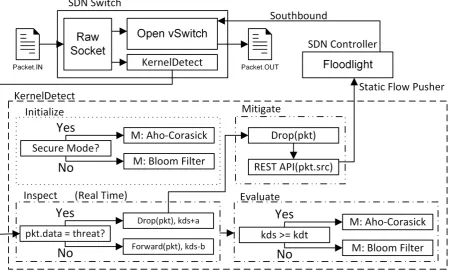
Traffic duplication occurs within KernelDetect as both KernelDetect and OVS utilize raw socket com-munications in the back-end of the software system. The SDN Controller receives REST API calls from each switch when identifying a threat for mitigation. In this research, we use Floodlight as the controller software due to its REST API features. Figure 2 pro-vides an architectural design of KernelDetect for both traffic inspection and signature matching with decision-making processes.
Letkdsbe a KernelDetect score,aan administrative-set incremental value for adverse traffic, b a decre-mental value for trustworthy traffic, andkdta thresh-old value to determine whether such traffic should be placed in an inspection through either the Aho-Corasick algorithm or Bloom filter, calledAho-Corasick inspectionorBloom filter inspection, respectively.M sim-ply denotes the matching scheme for KernelDetect.
Figure 1. The placement and functionality of KernelDetect for network traffic flows.
Figure 2. The architecture of KernelDetect consisting of four states: “Initialize," the beginning state of the SDN switch operations, “Inspection," a real-time inspection of traffic obtained from the raw socket of the operating system, “Mitigation," a critical step to thwart an attack and to prevent false positive events carefully, and “Evaluation," the examination of incoming traffic through ‘Aho-Corasick’ or ‘Bloom filter’ with a global view of the network.
enforce a detailed inspection using Aho-Corasick. If the placement does not have severe inspection approaches, then KernelDetect may use Bloom filter for detection. During the inspection process, we identify and examine to see whether the traffic has malicious intent through signature matching. If the intent is considered trustworthy, then we simply forward the traffic and decrease kds by a value of b, and add a when the intent is not trustworthy. Using a threshold condition of comparingkdstokdt, we examine whether
future traffic should remain in Aho-Corasick or Bloom filter inspection. If the traffic has a malicious intent, we simply drop the packet from the raw socket and inform the SDN controller using REST API calls to block the adverse threat.
5.2. Threat Signature Structure
are considered to identify traffic threat through string-based matching, and traffic over time where an obser-vation of a pattern of network packets occurs in a given period. As mentioned before, although KernelDetect applies to various attacks, this paper focuses on a DoS attack vector due to the page limit.
DoS: The identification of a DoS attack can be a challenge in an at-scale network. There are multiple methods to create a DoS attack from TCP SYN-flooding to other detailed approaches such as OSI Layer 7-based flooding. Like [35], we can identify a traffic pattern over an interval of time to determine if there is a DoS attack. That is, if the quantity of traffic exceeds a given threshold, KernelDetect considers that a DoS attack occurs, and it raises an alert. This threshold is a fixed value among all the approaches studied in our experiments later. The correlation with signature matching relates towards the frequency of alerts that is, KernelDetect raises an alert when a match occurs. The observation of a threat can originate from one or multiple sources where the attacker may spoof the source address of the DoS. Based on this given knowledge, KernelDetect accounts for such threats.
Signature-based matching may not be the appropri-ate tool to detect DoS attacks where the adversary can often insert arbitrary data into a packet payload. This approach renders signature-based detection ineffective. In some cases, DoS attacks may not have any form of data for its payload, such as a low-profile TCP SYN flood attack. However, KernelDetect, considers match-ing the header information of a network packet rather than its packet payload, which increases the perfor-mance of threat detection. Below is the algorithm for KernelDetect where TH and THP are threshold values for time and packet intervals, respectively.
P = PACKET_IN while P do
TS = TIMESTAMP
if P.TYPE == ICMP then Q{P.SRC_ADDR}++
if P.SRC_ADDR NOT IN S then S{P.SRC_ADDR} = TS
else
if TS - S{P.SRC_ADDR} > TH then if Q{P.SRC_ADDR} > THP then
REST API Call to SDN Controller else
S{P.SRC_ADDR} = TS end if
end if end if end if end while
6. Experimental Evaluation
This section presents our experimental design and evaluation of KernelDetect. In order to conduct a comprehensive examination of KernelDetect, we manipulate different experimental parameters such as the varying number of transmitted packets, threshold time, and the duration of experiments.
6.1. Experimental Topology Design
To measure the effectiveness of KernelDetect, we utilize GENI [18] for experimental evaluation. GENI is a real-world heterogeneous virtual testbed with networking capabilities including SDN. To evaluate KernelDetect, we construct a topology with the following three constraints: (1) An adverse user attached to a single network link identifying major areas of mitigation. (2) A shared network link used by both a normal user and an attacker. (3) An edge network link that carries both normal and attack traffic. This edge link has limited SDN controller management. Figure 3 gives a visual view of the experimental topology that considers the previous research challenges where the locations of adverse users are explicitly labeled. For presentation purpose in this paper, we give a relatively simple topology for our evaluation as shown in Figure 3. However, KernelDetect is applicable to any complex network topology.
At a certain point of time, clients may be adverse or potentially compromised. However, we do not take into account this particular scenario in our evaluation experiments as we do not implement any whitelisting technique for end devices attached to SDN switches in our threat detection approach. For this reason, normal users could have the potential to be prone to mitigation techniques depending on IDS signatures and rule sets.
6.2. Detection Rules in BRO and SNORT
As SNORT and BRO are rule-based detection
approaches, they are involved in an attempt to define a set of rules for the understanding of network traffic behaviors to determine whether or not the network traffic is adverse, SYN flood detection and mitigation rules needs to be manually downloaded and added to the rule set files in both BRO and SNORT accordingly, unless they were by default installed along with the detection systems. The following figure depicts the detection rule of SYN flood attacks (i.g. DoS) for SNORT IDS. In this rule definition, an alert is raised whenever 70 or more packets are sent within a 10 second interval that is TCP-SYN flagged.
alert tcp any any -> $HOME_NET 80(flags:S; msg:"Possible TCP DoS is Detected !!";
flow: stateless; detection_filter: track by_dist, count 70, seconds 10; sid 10001;rev:1;)
Figure 3. GENI experimental topology for evaluation where KernelDetect is only implemented in switches B and D as depicted in the diagram. Moreover, CTRL links are the communication medium between each SDN switch and their respective controller. Lastly, our experimental evaluation interchanges KernelDetect-enabled switches with SNORT and BRO for our comprehensive study.
6.3. Traffic Generation Techniques
Network traffic is comprised of two intent-types: normal and adverse. While adverse traffic is transmitted into our proposed solution, normal traffic will be mixed into our experiments to simulate a real-world environment. In order to provide hybrid network communication and mix normal traffic into the grand scheme of our experiments, we utilize D-ITG [21] and IPerf [22] as traffic generation software. Specifically, we utilize a culmination of both tools and increase the quantity of traffic for our experiments. Although we cannot fully emulate a normal user, we believe that iPerf tool should provide a fundamental approach to measuring our solution as it provides the ability to saturate a network link in addition to real-time network throughput analysis. To be concise, we configure iPerf with the default parameters for operational use.
6.4. Experimental Results
The performance of an IDS/IPS solution is critical to counter adverse network threats and, specifically, threat actors. As traffic flows from one host to another, congestion, computational bottlenecks and system’s resource draining can occur within a network environment and in regards to an IDS solution, packet inspection and the level of detail can produce resource strain on a computing device. In this section, we evaluate the performance of our KernelDetect in term of its inspection time, mitigation time, detection accuracy, and system resource consumption comparatively compared to SNORT and BRO.
Inspection Time. To combat network anomalies, it
is important to consider run-time filters as an independent threat detector able to detect attacks against itself. Such threat detection, together with
judicious rate-limiting of traffic forwarded to full packet inspection, allows the detection and mitigation of threats while preserving the overall improvements in NIDS performance, including but not limited to, the average inspection time. For this reason, a full packet inspection procedure that is critical to the mitigation of threat actors and adverse network traffic need to be performed whenever an IDS/IPS is placed in service. Specifically, as packets arrive at an IDS, the information is placed in a buffer and waits for inspection. This waiting time increases the time needed to mitigate the adverse threat if the packet has malicious intent. To measure such inspection time, we established a near-equal configuration for each IDS solution with similar parameters of threat signatures in each respective database for measurement fairness purposes. We establish this approach to examining the effectiveness of each solution to have near mirror-like configurations and to examine the performance of each IDS solution closely.
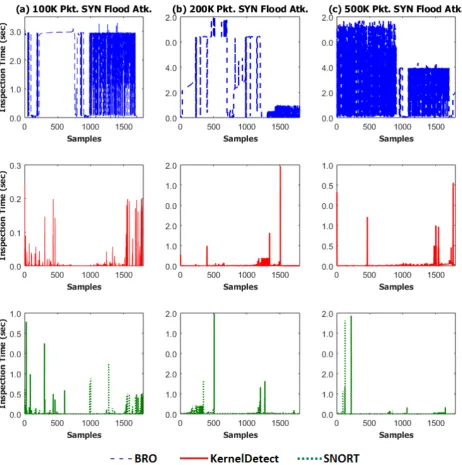
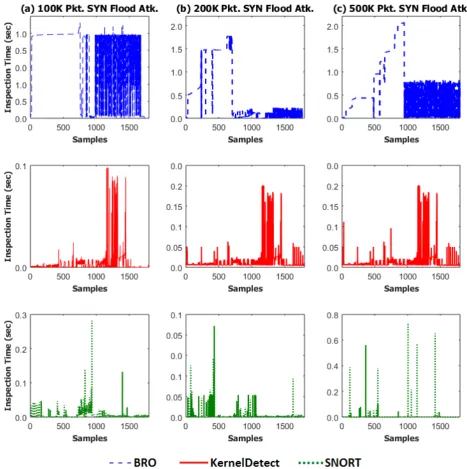
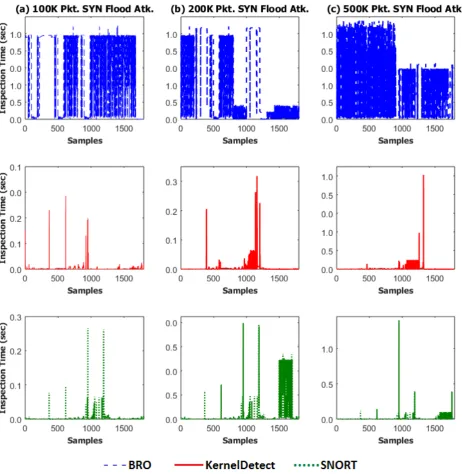
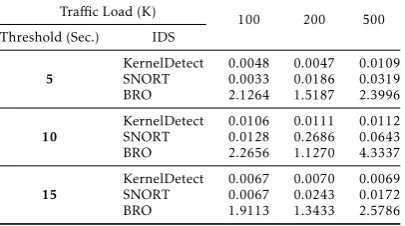
To measure inspection time, we establish the communication between two devices using hping3 where we transmit small-size packets with the large quantity of traffic at one nanosecond interval of time, achieving a link saturation. We evaluate three threshold values of 5, 10, and 15 seconds for detection. In this evaluation, we run all the experiments 10 times and then average their results. Figures 4, 5, and 6 show the average inspection time for the threshold of 5-seconds, 10-seconds and 15-5-seconds, respectively. Our experimental results demonstrate that KernelDetect has the overall lowest average inspection time compared to SNORT and BRO.
Figure 4. A comparative analysis of the inspection time for each IDS under 100K, 200K and 500K SYN flagged packet DoS attack using a 5 second threshold signature.
interval statistic. In Table 2, we only compare KernelDetect with SNORT because BRO has much higher inspection time than KernelDetect and SNORT as shown in Table1so that it would not be helpful even if we included a 95% confidence interval statistic for BRO in the table. Furthermore, although KernelDetect has some confidence interval overlap with SNORT, it is demonstrated in Table2 that KernelDetect is still a clear winner in comparison to SNORT under various traffic loads with different signature threshold values regarding inspection time.
Figure 5. A comparative analysis of the inspection time for each IDS under 100K, 200K and 500K SYN flagged packet DoS attack using a 10 second threshold signature.
network at scale. Although each IDS has its unique attributes to capture an adverse attacks and mitigate them, we comprehensively examine the efficiency and robustness of KernelDetect solution by measuring its threat mitigation.
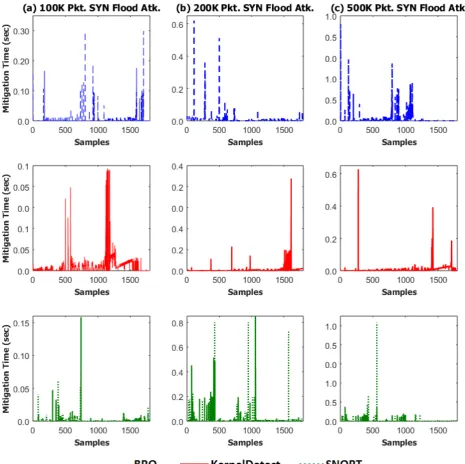
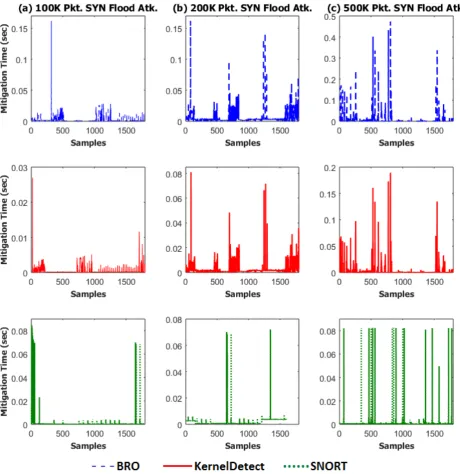
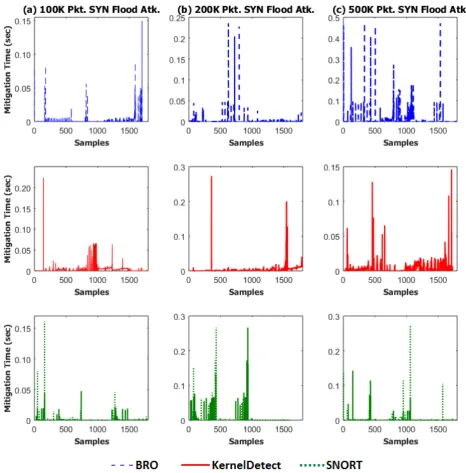
To measure the mitigation time, we examine the time between the initiation of each network attack and compared it to the time needed to rectify the threat as shown in Figures7,8, and9, which is also represented in Table3as an average mitigation delay, and expressed using a 95% confidence interval in Table 4. Although
Table 3 demonstrates that KernelDetect has a nearly-similar mitigation time as SNORT, it is still slightly better than SNORT in term of average, and significantly superior than BRO. Furthermore, similar to Table 2, we excluded BRO from Table 4 for the same reason discussed in inspection time section. As expressed in Table4, KernelDetect solution shows better mitigation performance than SNORT when comparing their corresponding confidence intervals. Figures7,8, and9
Figure 6. comparative analysis of the inspection time for each IDS under 100K, 200K and 500K SYN flagged packet DoS attack using a 15 second threshold signature.
provided necessary alerting and mitigation procedures. The mitigation technique for each solution utilizes the same function such that when an alarm is raised, the message presented will be used to block the respective address. Figure10presents the clearness of mitigation time using 10-seconds threshold value, and therefore proves that KernelDetect is a better solution to guarantee small mitigation delay.
False Negative and False Positive. False positive state is when the IDS characterizes a normal network traffic as a security threat. False negative state is when the
Figure 7. Threat mitigation time for each IDS under 100K, 200K and 500K SYN flagged packet DoS attack using a 5 second threshold.
rate in comparison to KernelDetect and SNORT where KernelDetect presented the most accurate results based on the analysis of the experimental results.
System Resource Utilization. The performance of an
IDS/IPS solution is critical to counter adverse network threats and specifically—threat actors. As traffic flows from one host to another, congestion and computational bottlenecks can occur within a network environment in addition to an IDS solution. Inspection and the level of detail in examining the content of the packet can produce resource strain on a computing device. As network packets traverse between two devices, the
Figure 8. Threat mitigation time for each IDS under 100K, 200K and 500K SYN flagged packet DoS attack using a 10 second threshold.
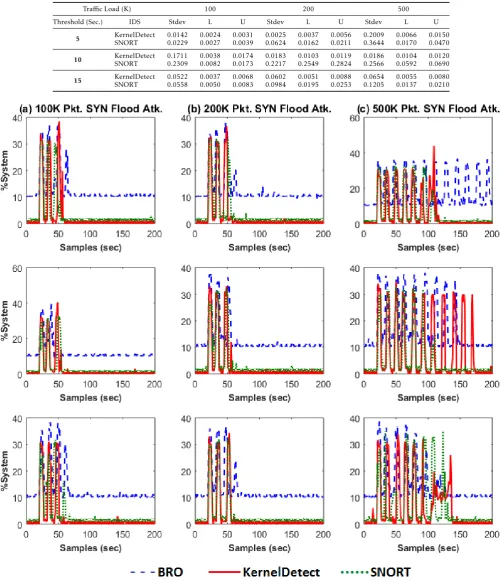
where KernelDetect is more efficient than SNORT and BRO in the events of a post-DoS scenario. To be concise, once the DoS attack ends, both BRO and SNORT maintain constant memory resource utilization while KernelDetect’s usage reduces to the lowest percentage rate. Moreover, to measure averaging CPU utilization in a kernel space, samples of system resource utilization are used where each IDS is under 500K SYN flagged packet DoS attack using a 10-seconds threshold signature. Figure 12 demonstrates that BRO has a higher-level system resource utilization in comparison
to KernelDetect and Snort and KernelDetect shows significantly less average load in term of CPU usage.
Figure 9. Threat mitigation time for each IDS under 100K, 200K and 500K SYN flagged packet DoS attack using a 15 second threshold.
in the implementation such that the discovery of a serious vulnerability would be well-known and urgent for patching purposes. One configuration that may be sub-optimal for an SDN environment is to implement KernelDetect on an independent computing system that is attached to a port mirroring interface using a SPAN/TAP configuration such that if kernel panic would occur, SDN switching operations would continue to function. Lastly, KernelDetect utilizes raw socket information to read incoming packets. This read procedure could be insufficient for the switching operation such that OVS could process the raw socket
Figure 10. Threat mitigation for each IDS under 100K, 200K, and 500K SYN flagged packet flood attack using 10 second threshold detection technique and represented as a box plot.
Figure 11. ROC Curve for threat detection for each IDS under 100K Packets SYN flood attack using various thresholds of 5, 10 and 15 seconds for threat signatures of a DoS attack.
Table 1. A comparison of the average inspection time in seconds among KernelDetect, SNORT and BRO under various traffic loads of 100K, 200K, and 500K SYN flagged packets using detection thresholds of 5, 10, and 15 seconds.
Traffic Load (K)
100 200 500 Threshold (Sec.) IDS
5
KernelDetect 0.0048 0.0047 0.0109 SNORT 0.0033 0.0186 0.0319 BRO 2.1264 1.5187 2.3996
10
KernelDetect 0.0106 0.0111 0.0112 SNORT 0.0128 0.2686 0.0643 BRO 2.2656 1.1270 4.3337
15
KernelDetect 0.0067 0.0070 0.0069 SNORT 0.0067 0.0243 0.0172 BRO 1.9113 1.3433 2.5786
7. Conclusions and Future Work
In this paper, we have introduced KernelDetect, a lightweight kernel-level intrusion detection and prevention framework. KernelDetect is a modular
countermeasure framework in an SDN environment. It leverages modular string searching and filtering mechanisms along with SDN techniques and features. KernelDetect is designed in a way that leverages the strengths of both Aho-Corasick and Bloom filter with SDN controller techniques. Although KernelDetect approach can be applicable to handle and thwart different types of network anomalies and adverse threats, in this paper, we only explore and focus on the events of a DoS attack in an SDN environment.
We have exploited and dynamically integrated modular detection mechanisms that are an exact string matching and a partial matching algorithms together to thwart the above network threats that reside in the application plane of an SDN environment.
Table 2. 95% confidence interval statistic for inspection time (seconds) between KernelDetect and SNORT where L and U represent their lower and upper bound, respectively.
Traffic Load (K) 100 200 500
Threshold (Sec.) IDS Stdev L U Stdev L U Stdev L U
5 KernelDetect 0.0142 0.0024 0.0031 0.0025 0.0037 0.0056 0.2009 0.0066 0.0150
SNORT 0.0229 0.0027 0.0039 0.0624 0.0162 0.0211 0.3644 0.0170 0.0470
10 KernelDetect 0.1711 0.0038 0.0174 0.0183 0.0103 0.0119 0.0186 0.0104 0.0120
SNORT 0.2309 0.0082 0.0173 0.2217 0.2549 0.2824 0.2566 0.0592 0.0690
15 KernelDetect 0.0522 0.0037 0.0068 0.0602 0.0051 0.0088 0.0654 0.0055 0.0080
SNORT 0.0558 0.0050 0.0083 0.0984 0.0195 0.0253 0.1205 0.0137 0.0210
Figure 13. Memory utilization for each IDS under the scenario of a single attack with 100K SYN flagged packets (Pkt.) using a 10 second threshold detection rate. Additionally, a full-link saturation is achieved during the attack in this evaluation.
Table 3. The average mitigation time in seconds for KernelDetect, SNORT and BRO under various traffic loads of 100K, 200K, and 500K SYN flagged packets using detection thresholds of 5, 10, and 15 seconds.
Traffic Load (K)
100 200 500 Threshold (Sec.) IDS
5
KernelDetect 0.0036 0.0074 0.0123 SNORT 0.0056 0.0012 0.0130 BRO 0.0060 0.0100 0.0108
10
KernelDetect 0.0060 0.0054 0.0044 SNORT 0.0055 0.0065 0.0078 BRO 0.0074 0.0080 0.0118
15
KernelDetect 0.0042 0.0049 0.0086 SNORT 0.0071 0.0101 0.0200 BRO 0.0096 0.0635 0.1254
including but not limited to, the number and length of network packets (the number of network packets ranges from 100K to 500K and launched SYN flooding attacks with different packet sizes) and sampling times. In order to compare the effectiveness and validity of KernelDetect with traditional IDSs, SNORT [19] and BRO [20], we have measured the performance constraints and overhead, utilization of system resources, average inspection and mitigation time, true positive, false positive, and false negative for each IDS among 10-run experiments in order to identify
and address network scalability where traffic quantity can be saturated for an SDN environment.
Through our extensive evaluation for each IDS performance, We have shown that our KernelDetect solution is an effective and efficient approach to detect and thwart the DoS threats within the data plane of an SDN environment.
In our future work, we plan to extend and adjust the implementation of our KernelDetect solution to deal with different types of network anomalies and adverse threats such as man-in-the-middle (MITM) attacks and Link Discovery Service Exploitation (LDS). Moreover, we plan to identify the potential areas of threat detection in control plane communications.
Acknowledgement. We acknowledge National Science
Foundation (NSF) to partially sponsor the work under grants #1633978, #1620871, #1620862, and #1636622, and BBN/GPO project #1936 through NSF/CNS grant. We also thank the Florida Center for Cybersecurity for a seed grant. The views and conclusions contained herein are those of the authors and should not be interpreted as necessarily representing the official policies, either expressed or implied of NSF.
References
[1] Xiong K., Wang R., Du W and Ning P. (2012)
Table 4. 95% confidence interval measurements for mitigation time (seconds) between KernelDetect and SNORT where L and U represent their lower and upper bound, respectively.
Traffic Load (K) 100 200 500
Threshold (Sec.) IDS Stdev L U Stdev L U Stdev L U
5 KernelDetect 0.0141 0.0032 0.0040 0.0376 0.0063 0.0087 0.0966 0.0097 0.0149
SNORT 0.0424 0.0044 0.0067 0.1137 0.0078 0.0167 0.0820 0.0094 0.0166
10 KernelDetect 0.0302 0.0051 0.0068 0.0355 0.0045 0.0063 0.0230 0.0038 0.0050
SNORT 0.0542 0.0027 0.0037 0.0530 0.0026 0.0037 0.0190 0.0081 0.0093
15 KernelDetect 0.0267 0.0035 0.0060 0.0656 0.0030 0.0067 0.0629 0.0068 0.0104
SNORT 0.0494 0.0058 0.0085 0.0921 0.0065 0.0137 0.0932 0.0096 0.0240
authentication in sensor networks.ACM Transactions on Sensor Networks (TOSN). Vol. 8. P: 20.
[2] Ko C., Fraser T., Badger L. and Kilpatrickv D.
(2000)Detecting and Countering System Intrusions Using Software Wrappers. USENIX Security Symposium. pp: 1157-1168.
[3] Vasiliadis G., Antonatos S., Polychronakis M.,
Markatos E. and Ioannidis S. (2008) Gnort: High
performance network intrusion detection using graphics processors. Recent Advances in Intrusion Detection (RAID). pp: 116-34.
[4] Jackson E. J, Walls M., Panda A., Pettit J., Pfaff B.,
Rajahalme J., Koponen T. and Shenker S. (2016)
SoftFlow: A Middlebox Architecture for Open vSwitch. USENIX Annual Technical Conference. pp: 15-28.
[5] Chin T., Xiong K. andRahouti M. (2017) End-to-End
Delay Minimization Approaches Using Software-Defined Networking.Proceedings of ACM RACS 2017.
[6] Chin T.andXiong K.(2017)A Forensic Methodology for Software-Defined Network Switches.Proceedings of IFIP International Conference on Digital Forensics. pp: 97-110.
[7] Chin T.andXiong K.(2016)Dynamic generation contain-ment systems (DGCS): A Moving Target Defense approach. Proceedings of 3rd IEEE International Workshop on Emerging Ideas and Trends in Engineering of Cyber-Physical Systems (EITEC). pp: 11-16.
[8] Chin T.,Mountrouidou X.,Li X.andXiong K.(2015)An SDN-supported collaborative approach for DDoS flooding detection and containment.Proceedings of IEEE Military Communications Conference (MILCOM). pp: 659-664. Proceedings of 35th IEEE International Conference on Distributed Computing Systems Workshops (ICDCSW). pp: 95-99.
[9] Akella A. V and Xiong K. (2014) Quality of service
(QoS)-guaranteed network resource allocation via software defined networking (SDN). Proceedings of IEEE Inter-national Conference on Dependable, Autonomic and Secure Computing (DASC). pp: 413-424.
[10] Apache Spam Assassin Public Corpus. https:
//spamassassin.apache.org/publiccorpus/
[11] Pfaff B.,Pettit J.,Koponen T., Jackson E. J, Zhou A., Rajahalme J.,Gross J.,Wang A.,Stringer J.,Shelar P.
and others. (2015) The design and implementation of
OpenvSwitch.Proceedings of the USENIX Symposium on Networked Systems Design and Implementation (NSDI). pp: 117-130.
[12] Ahrenholz J.,Danilov C.,Henderson T. RandKim J. H (2008)CORE: A real-time network emulatorProceedings of the first IEEE Premier Military Communications Conference (MILCOM). pp: 1-7.
[13] Mininet: An Instant Virtual Network on your Laptop (or other PC).http://mininet.org
[14] Wang H., Xu L.and Gu G.(2015) FloodGuard: A DoS
Attack Prevention Extension in Software-Defined Networks. Proceedings of 45th Annual IEEE/IFIP International Conference on Dependable Systems and Networks (DSN). pp: 239-250.
[15] Dhawan M.,Poddar R.,Mahajan K.andMann V.(2015)
SPHINX: Detecting Security Attacks in Software-Defined Networks.Proceedings of the 22th Annual Network and Distributed System Security Symposium (NDSS).
[16] Amann J. and Sommer R. (2015) Providing Dynamic
Control to Passive Network Security Monitoring.Research in Attacks, Intrusions, and Defenses. pp: 133-152.
[17] Mekky H.,Hao F.,Mukherjee S.,Zhang Z.and
Laksh-man T.(2014)Application-aware Data Plane Processing in SDN.Proceedings of the Third ACM Workshop on Hot Topics in Software Defined Networking. pp: 13-18.
[18] Berman M., Chase J., Landweber L., Nakao A.,
Ott M., Raychaudhuri D., Ricci R. and Seskar I.
(2014)GENI: A Federated Testbed for Innovative Network Experiments. Computer Networks. Vol. 63 (Special issue on Future Internet Testbeds-Part I). pp: 5-23. doihttp://dx.doi.org/10.1016/j.bjp.2013.12.037.
[19] Roesch Martin et all.(1999) SNORT-LIGHTWEIGHT
INTRUSION DETECTION FOR NETWORKS. USENIX
LISA. Vol. 99. pp: 229-238.
[20] Vern Paxson. (1999) BRO: A System for Detecting
Network Intruders in Real-Time. Computer Networks. Vol. 31. pp: 2435-2463. http://www.icir.org/vern/ papers/bro-CN99.pdf
[21] Avallone S., Guadagno S., Emma D., Pescap A. and
Ventre G. (2004) D-ITG: Distributed Internet Traffic Generator.Proceedings of First International Conference on the Quantitative Evaluation of Systems (QEST). pp: 316-317.
[22] Tirumala A.,Qin F.,Dugan J.,Ferguson J.andGibbs K. (2014)iPerf: The TCP/UDP Bandwidth Measurement Tool.
http://dast.nlanr.net/Projects,
[23] Hong S.,Xu L., Wang H. andGU G.(2015) Poisoning
[24] Floodlight OpenFlow Controller. Project Floodlight.http: //www.projectfloodlight.org/floodlight/
[25] The CAIDA UCSD DDoS Attack - 2007 Dataset.https: //www.caida.org/data/passive/ddos-20070804_ dataset.xml.
[26] Ballard J., Rae I. and Akella A. (2010) Extensible
and Scalable Network Monitoring Using OpenSAFE. Proceedings of the Internet Network Management Workshop/ Workshop on Research on Enterprise Networking (INM/WREN), in conjunction with the 7th USENIX Symposium on Networked Systems Design and Implementation (NSDI).
[27] Giotis K., Argyropoulos C., Androulidakis G.,
Kalogeras D. and Maglaris V. (2014) Combining
OpenFlow and sFlow for an effective and scalable anomaly detection and mitigation mechanism on SDN environments. The International Journal of Computer and Telecommunications Networking. Vol. 62. pp: 122-136.
[28] Curtis A.,Kim W.andYalagandula P. (2011)Mahout:
Low-Overhead Datacenter Traffic Management using End-Host-Based Elephant Detection.In Proceedings of the IEEE International Conference on Computer Communications (INFOCOM). pp: 1629-1637.
[29] Shin S.,Porras P.,Yegneswaran V.,Fong M.,GU G.and
Tyson M.(2013)FRESCO: Modular Composable Security
Services for Software-Defined Networks. Proceedings of Network Distributed Security Symposium (NDSS), San Diego, CA, USA.
[30] Shin S., Yegneswaran V., Porras P. and GU G.
(2013)AVANT-GUARD: Scalable and Vigilant Switch Flow Management in Software-Defined Networks.Proceedings of the 20th ACM Conference on Computer and Communications Security (CCS). pp: 413-424.
[31] Khurshid A., Zou X., Zhou W., Caesar M. and
Godfrey P. B. (2013) VeriFlow: Verifying Network-Wide
Invariants in Real Time. Presented as part of the 10th USENIX Symposium on Networked Systems Design and Implementation (NSDI). pp: 15-27
[32] Kazemian P., Chang M., Zeng H., Varghese G.,
Mckeown N. andWhyte S. (2014) Real Time Network
Policy Checking using Header Space Analysis.Proceedings of the 10th USENIX Symposium on Networked Systems Design and Implementation (NSDI). pp: 99-111. [33] Porras P.,Shin S.,Yegneswaran V.,Fong M.,Tyson M.
and GU G. (2014) A Security Enforcement Kernel for OpenFlow Networks. Proceedings of the first ACM SIGCOMM Workshop on Hot Topics in Software Defined Networking (ACM HotSDN). pp: 121-126.
[34] Shin S. and Gu G. (2013) Attacking Software-Defined Networks: A First Feasibility Study. Proceedings of the second ACM SIGCOMM workshop on Hot topics in software defined networking (ACM HotSDN). pp: 165-166.
[35] Wang R.,Jia Z.andJu L.(2015)An Entropy-Based Dis-tributed DDoS Detection Mechanism in Software-Defined Networking. Proceedings of the IEEE Trustcom/Big-DataSE/ISPA. Vol. 1. pp: 310-317.
[36] Shin S., Song Y., Lee T., Lee S., Ching J., Porras P.,
Yegneswaran V., Noah J. and Kang B. B. (2014)
Rosemary: A Robust, Secure, and High-Performance Network Operating System.Proceedings of the 21th ACM Conference on Computer and Communications Security (CCS). pp: 87-89.
[37] Chung C-J.,Khatkar P.,Xing T.,Lee J.andHuang D. (2013) NICE: Network intrusion Detection and Counter-measure Selection in Virtual Network Systems.IEEE Trans-actions on Dependable and Secure Computing. Vol. 10. pp: 198-211.
[38] Scott-Hayward S., Natarajan S. and Sezer S. (2016)
A Survey of Security in Software Defined Networks. IEEE Communications Surveys Tutorials. Vol. 18. pp: 623-654. doi=10.1109/COMST.2015.2453114
[39] Alicherry M., Muthuprasanna M. and Kumar V.
(2006)High Speed Pattern Matching for Network IDS/IPS. Proceedings of the 14th IEEE International Conference on Network Protocols (ICNP’06). pp: 187-196.
[40] Dharmapurikar S. and Lockwood J. W. (2006) Fast
and Scalable Pattern Matching for Network Intrusion Detection Systems. IEEE Journal on Selected Areas in Communications. Vol. 24. pp: 1781-1792.
[41] Xiong K. (2008) Resource optimization and security for
distributed computing,https://repository.lib.ncsu. edu/handle/1840.16/3581.
[42] Chin T., Mountrouidou X., Li X. and Xiong K.
(2015) Selective packet inspection to detect DoS flooding using software defined networking SDN. The 35th IEEE International Conference on Distributed Computing Systems Workshops (ICDCSW). pp: 95-99.
[43] Xiong K.(2009)Multiple priority customer service guaran-tees in cluster computing.IEEE International Symposium on Parallel & Distributed Processing (IPDPS). pp: 1-12. [44] Boyer R. SandMoore J S.(1977)A fast string searching
algorithm.Communications of the ACM. Vol. 20 pp: 762-772.
[45] Xiong K. (2014) Resource optimization and security for
cloud services, Wiley-ISTE.
[46] Sonchack J., Smith J., Aviv A. JandKeller E. (2016) Enabling Practical Software-defined Networking Security Applications with OFX.Network and Distributed System Security Symposium (NDSS). Vol. 16. pp: 1-15.
[47] Porras P. A, Cheung S., Fong M. W, Skinner K.and
Yegneswaran V. (2015) Securing the Software Defined
Network Control Layer.Network and Distributed System Security Symposium (NDSS).
[48] Ahmad I., Namal S., Ylianttila M. and Gurtov A.
(2015) Security in software defined networks: A survey. IEEE Communications Surveys & Tutorials. Vol. 17. pp: 2317-2346.
[49] Xing T., Huang D., Xu L., Chung C. and Khatkar P.
(2013) Snortflow: A openflow-based intrusion prevention system in cloud environment.Second IEEE Research and Educational Experiment Workshop (GREE). pp: 89-92..
[50] Xing T., Xiong Z., Huang D. and Medhi D. (2014)