Available online athttp://www.ijabbr.com
International journal of Advanced Biological and Biomedical Research
Volume 2, Issue 3, 2014: 847-853
Effect of lemon juice on the egg shell quality of layers subjected to heat stress
Hadi Tavakkoli1*, Seyede Saeedeh Masallanejad2, Sajedeh Salandari3
1
Department of Avian Medicine, School of Veterinary Medicine, Shahid Bahonar University of Kerman, Kerman, Iran
2
Graduate student, School of Veterinary Medicine, Shiraz University, Iran
3
School of Veterinary Medicine, Shahid Bahonar University of Kerman, Kerman, Iran
Abstract
Heat stress is an effective factor on immune responses, body weight, egg production and egg quality of chickens. The major effect of heat stress is due to decreased food intake and alteration in acid-base balance. During the recent years, efforts to improve laying performance at high temperatures have been relatively successful. Supplementation of the diet or drinking water with special nutrient has been proposed as a means to reduce the effects of heat on the layer hens. There is scantly information about the effects of natural compounds on the heat-stressed hens. In this regard, the aim of the present study was to determine the effect of lemon juice on egg shell quality in layers subjected to hot climate. 50-week-old commercial layer chickens were divided into 2 equal treatment groups of 2400 birds each. Each treatment has three replicates. The experimental groups were fed as follows: in the control and test groups (groups A and B), birds were fed a standard diet. In the test group (group B), 5 ml/L of lemon juice was added to the drinking water for 30 days. At the end of each week, eggs with broken and fragile shell were recorded. Our results showed that the addition of lemon juice in drinking water was significantly reduced eggs with broken and fragile shells during heat stress (P<0.05). Based on findings, it is concluded that lemon juice can be considered as a natural supplement to alleviate heat stress in laying hens under hot climate.
Key words: Heat stress, Hot climate, Layer, Lemon juice
Introduction
of chickens (Mashaly et al. 2004; Oguntunji and Alabi 2010; Brake and Yahav 2011). Fortunately, during the recent years, efforts to improve laying performance at high temperatures have been relatively successful. Methods include supplementation of the diet or drinking water with special nutrient, housing practices and development in the management protocols (Daghir 2008; Ajakaiye et al. 2010; Marques et al. 2011; Bozkurt et al. 2012). However, problems associated with egg production and egg shell quality have proved difficult to resolve. Although nutritional strategies have been proposed as a means to reduce the effects of heat on layer hens, there is little information that addresses the effects of natural compounds on heat-stressed hens. In this regard, the present study was conducted to determine the effect of lemon juice on egg shell quality in layers subjected to hot climate. We believe that this investigation may further help us to use a natural additive of plant origin in the poultry industry.
Materials and Methods
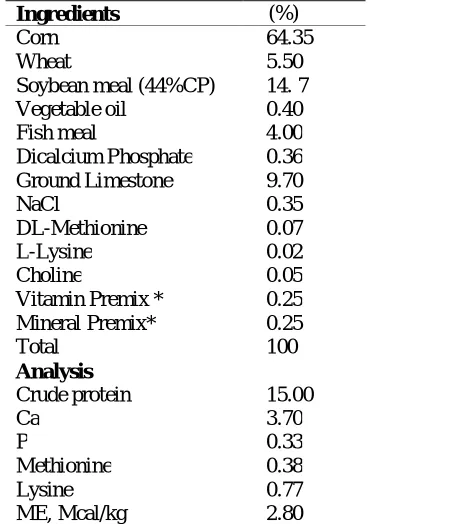
50-week-old commercial layer chickens (Hy-Line W-36) were randomly divided into 2 equal treatments A and B groups of 2400 birds each. Each treatment group was further sub-divided into three replicates of 800 birds per replicate. The mean rate of lay was 83% at the beginning of the experiment. The presence and level of lemon juice in drinking water were the main factor tested. The experimental groups were fed as follows: in the control and test groups (groups A and B), the birds were fed a standard diet. In the test group (group B), 5 ml/L of lemon juice was added to the drinking water and the control group received water without any additives. Feed and water were available ad-libitum. The ingredients of standard diet are presented in table 1.
Table 1: Ingredient and chemical composition of the standard diet (%)
*Vitamin/Mineral Premix (Talavang) supplied per 5 kg: vitamin A, 11000000 IU; cholecalciferol, 5000000 IU; vitamin E, 7 500 IU; K3, 3000 mg; vitamin B1, 3000 mg; vitamin B2, 8000 mg; niacin, 4000 mg; d-pantothenic acid, 15555 mg; vitaminB12, 16 mg; folic acid, 2000 mg; biotin, 150 mg, Mn, 120000 mg; Fe, 40000 mg; Zn, 100000 mg; Cu, 16000 mg; iodine, 125 mg; Se, 300 mg; cholinchloride, 900000 mg.
Ingredients (%)
Corn 64.35
Wheat 5.50
Soybean meal (44%CP) 14. 7
Vegetable oil 0.40
Fish meal 4.00
Dicalcium Phosphate 0.36
Ground Limestone 9.70
NaCl 0.35
DL-Methionine 0.07
L-Lysine 0.02
Choline 0.05
Vitamin Premix * 0.25
Mineral Premix* 0.25
Total 100
Analysis
Crude protein 15.00
Ca 3.70
P 0.33
Methionine 0.38
Lysine 0.77
In a cage brooding system, five birds were kept in separate cages. The temperature was 35-37°C during the laying period. A photoperiod of 16 h/day was maintained. The experiment was carried out in a hot region was located in the Fars province of Iran, in July. The trail was lasted for 30 days.
Measurements
The eggs were collected daily. Eggs with broken and fragile shell were also collected and recorded weekly.
Statistical analysis
Statistical analysis was performed using SPSS version 20. The Chi-Square test was used to determine the significant differences between experimental groups. A P-value of <0.05 was considered as statistically significant.
Results
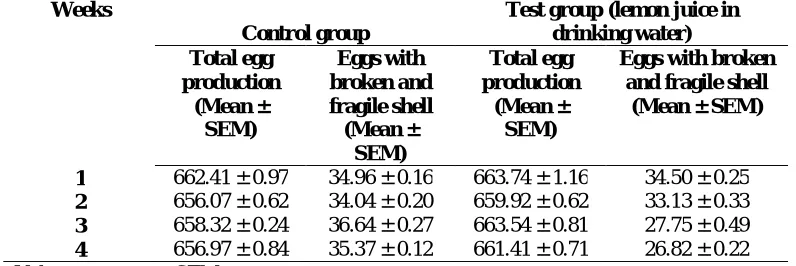
The effects of lemon juice on the egg shell quality (eggs with broken and fragile shell) of layers maintained at high temperature are given in Tables 2 and 3. The analysis of data at the start of the experiment (weeks 1 and 2) showed that there was no significant difference in egg shell quality between experimental groups, while it was different significantly from weeks 3 to 4 (p<0.05). The best value was observed in the layers of group B which treated with 5 ml/L of lemon juice in drinking water. The addition of lemon juice in drinking water was significantly reduced eggs with broken and fragile shells.
Table 2: The total egg production and eggs with broken and fragile shell of layers maintained at high temperature.
Weeks
Control group
Test group (lemon juice in drinking water) Total egg
production (Mean ±
SEM)
Eggs with broken and fragile shell (Mean ±
SEM)
Total egg production
(Mean ± SEM)
Eggs with broken and fragile shell
(Mean ± SEM)
1 662.41 ± 0.97 34.96 ± 0.16 663.74 ± 1.16 34.50 ± 0.25
2 656.07 ± 0.62 34.04 ± 0.20 659.92 ± 0.62 33.13 ± 0.33
3 658.32 ± 0.24 36.64 ± 0.27 663.54 ± 0.81 27.75 ± 0.49
4 656.97 ± 0.84 35.37 ± 0.12 661.41 ± 0.71 26.82 ± 0.22
Values are mean ± SEM.
Table 3: The effect of lemon juice on the eggs with broken and fragile shell (%)
Weeks Control group Test group (lemon
juice in drinking water)
P values
1 5.27 ± 0.01a 5.15 ± 0.02 NS
2 5.18 ± 0.02 4.98 ± 0.03 NS
3 5.56 ± 0.04 4.23 ± 0.06 S
4 5.38 ± 0.01 4.01 ± 0.02 S
a
Discussion
Most of the major international poultry breeders are located in temperate countries such as Canada, France, Germany, the Netherlands, the UK and the USA. Nevertheless, much of the world’s poultry production takes place under hot climate. In these regions, often humidity conditions are extreme and the temperature is over 35°C in some seasons. For many years, researchers have been investigating the effect of high ambient temperatures on the performance of different poultry species, including quail (Sahin and
Kucuk 2003; Sahin et al. 2006; Halıcı et al. 2012), turkeys (Renaudeau et al. 2011; Yahav et al. 2011),
young chickens (Mahmoud and Edens 2005; El-Habbak et al. 2011; Willemsen et al. 2011; Ashraf et al. 2013; Montanhini Neto et al. 2013), broilers (Hasheimi et al. 2012; Sohail et al. 2012; Sakomura et al. 2013; Sohail et al. 2013) and laying hens (Deng et al. 2012; Irandoust et al. 2012). Their results established that high environmental temperatures have adverse effects on the production performance. In laying hens, heat stress decreases protein digestion, body weight, egg production, egg weight and shell quality. Heat exposure is generally accompanied by suppression of feed intake. Whereas egg production and egg weight are influenced by the reduction in feed consumption, egg shell quality is influenced primarily by high temperature (Daghir 2008; Bozkurt et al. 2012). Furthermore, the status of Ca2+, and ability of gastrointestinal cells to transport calcium could be important factors in the detrimental effects of heat stress on performance and egg shell characteristics in laying hens (Mashaly et al. 2004). On the other hand, hyperventilation, the respiratory alkalosis and alterations in acid-base balance that occur when hens are located at high temperature cause in the loss of carbon dioxide from the blood and associated losses of bicarbonate from the blood and body fluids. A reduced bicarbonate concentration in the lumen of the shell gland adversely affects egg shell quality. Therefore, it is possible that, at high temperatures, the hens have a nutritional requirement to reduce heat stress (Lin et al. 2006; Daghir 2008; Lara and Rostagno 2013). The current experiment was conducted to evaluate the effect of lemon juice on the egg shell quality of hens are located at high temperature. Our study showed that the addition of lemon juice in drinking water was significantly reduced eggs with broken and fragile shells. This result agrees with those of researches suggest that at high temperature laying hens need special nutritional requirement to improve egg production and egg shell quality (Puthpongsiriporn et al. 2001; Lin et al. 2006; Deng et al. 2012; Irandoust et al. 2012). Lee et.all (1998) showed that dietary supplementation with extra vitamin E can alleviate the adverse effects of chronic heat stress in laying hens. It was also shown that a diet with mannan-oligosaccharide or essential oil mixture provided increment in the egg shell quality of laying hens (Bozkurt et al. 2012).
In our study, the useful effect of lemon juice on the egg shell quality of heat-stressed bird could be due to ingredients such as ascorbic acid content of lemon juice. Ascorbic acid is the most-studied vitamin in relation to heat stress (Abidin and Khatoon 2013; Mahmoud et al. 2013). Njoku and Nwazota (1989) found that the ascorbic acid could improve food intake and food utilization in layers. There is some evidence, which indicates that during high environmental temperatures, birds are not able to synthesize sufficient ascorbic acid to replace the severe losses of this vitamin (Daghir 2008). Ahmad et al. (1967) showed that ascorbic acid limited the increase of body temperature during heat stress up to 35ºC. Supplemental ascorbic acid has also been reported to improve heat resistance and reduce mortality associated with elevated ambient temperature (Pardue et al. 1984). In laying hens, ascorbic acid supplementation was shown to improve egg production, egg weight and egg shell thickness (Daghir 2008). Nevertheless, little is known about the useful effects of lemon juice on the layer performance, subjected to high temperatures and no well-described experimental model exists. Further efforts are needed to evaluate the usage of lemon juice under this newfound aspect.
Conclusion
development during the last decades and the need to increase in animal protein sources, it is suggested that lemon juice can be considered as a natural supplement to alleviate heat stress in laying hens in the hot climate.
Acknowledgment
The authors wish to thank Mr. M. Mosallanejad for his kind cooperation in data recording.
References
Abidin Z, Khatoon A (2013). Heat stress in poultry and the beneficial effects of ascorbic acid (vitamin C) supplementation during periods of heat stress. World's Poult. Sci J. 69(01): 135-152.
Ahmad M, Moreng R, Muller H (1967). Breed responses in body temperature to elevated environmental temperature and ascorbic acid. Poult. Sci. 46: 6-15.
Ajakaiye J, Perez-Bello A, Cuesta-Mazorra M, Díaz JG, Mollineda-Trujillo Á (2010). Effect of heat stress on some plasma electrolytes of layer hens reared during summer in hot-humid climate and administered with vitamins C and E. Cuban J. Agric. Sci. 44(4): 213-220.
Ashraf S, Zaneb H, Yousaf M, Ijaz A, Sohail M, Muti S, Usman M, Ijaz S, Rehman H (2013). Effect of dietary supplementation of prebiotics and probiotics on intestinal microarchitecture in broilers reared under cyclic heat stress. J. Anim. Physiol. Anim. Nutr. 97(s1): 68-73.
Bollengier-Lee S, Mitchell M, Utomo D, Williams P, Whitehead C (1998). Influence of high dietary vitamin E supplementation on egg production and plasma characteristics in hens subjected to heat stress. Br. Poult. Sci. 39(1): 106-112.
Bozkurt M, Küçükyilmaz K, Çatli A, Çınar M, Bintaş E, Çöven F (2012). Performance, egg quality, and
immune response of laying hens fed diets supplemented with mannan-oligosaccharide or an essential oil mixture under moderate and hot environmental conditions. Poult. Sci. 91(6): 1379-1386.
Brake J, Yahav S (2011). Responses of poultry to environmental challenges. Environmental Physiology of Livestock. 309-335.
Daghir NJ (2008). Poultry industry in hot climates. London, Cromwell Press, Trowbridge.
Deng W, Dong X, Tong J, Zhang Q (2012). The probiotic Bacillus licheniformis ameliorates heat stress-induced impairment of egg production, gut morphology, and intestinal mucosal immunity in laying hens. Poult. Sci. 91(3): 575-582.
El-Habbak M, El-Ghamry A, El-Mallah G, Younis H, El-Komy E (2011). Influence of Dietary Vitamin E and C Supplementation on Performance and Some Metabolic Response of Broiler Chicks Subjected to Heat Stress. WJAS 7(3): 258-269.
Halıcı M, Imik H, Koç M, Gümüş R (2012). Effects of α‐lipoic acid, vitamins E and C upon the heat stress in Japanese quails. J. Anim. Physiol. Anim. Nutr. 96(3): 408-415.
its effect on heat shock protein 70 expression, blood parameters and body temperature. J. Anim. Physiol. Anim. Nutr. 97(4): 632-638.
Irandoust H, Samie A, Rahmani H, Edriss M, Mateos G (2012). Influence of source of fat and supplementation of the diet with vitamin E and C on performance and egg quality of laying hens from forty four to fifty six weeks of age. Anim. Feed Sci. Technol. 177(1-2): 75–85.
Lara LJ, Rostagno MH (2013). Impact of Heat Stress on Poultry Production. Animals 3(2): 356-369. Lin H, Jiao H, Buyse J, Decuypere E (2006). Strategies for preventing heat stress in poultry. World's
Poult. Sc.i J. 62(1): 71-86.
Mahmoud KZ, Edens F (2005). Influence of organic selenium on hsp70 response of heat-stressed and enteropathogenic Escherichia coli-challenged broiler chickens ( Gallus gallus). Comparative Biochemistry and Physiology Part C: Toxicology & Pharmacology 141(1): 69-75.
Mahmoud UT, Abdel-Rahman MA, Hosny MA (2013). Effects of Propolis, Ascorbic Acid and Vitamin E on Thyroid and Corticosterone Hormones in Heat Stressed Broilers. J. Advanc. Vet. Res. 4(1): 18-27.
Marques RH, Gravena RA, Silva JDTd, Roccon J, Picarelli J, Hada FH, Queiroz SAd, Moraes VMB (2011). Effect of supplementation of diets for quails with vitamins A, D and E on performance of the birds and quality and enrichment of eggs. Rev Bras Zootec 40(6): 1222-1232.
Mashaly M, Hendricks G, Kalama M, Gehad A, Abbas A, Patterson P (2004). Effect of heat stress on production parameters and immune responses of commercial laying hens. Poult. Sci. 83(6): 889-894.
Montanhini Neto R, Ceccantini M, Fernandes J (2013). Effects of methionine source, arginine: lysine ratio and sodium chloride level in the diets of grower broilers reared under high-temperature conditions. Revista Brasileira de Ciência Avícola 15(2): 151-160.
Njoku P, Nwazota A (1989). Effect of dietary inclusion of ascorbic acid and palm oil on the performance of laying hens in a hot tropical environment. Br. Poult. Sci. 30: 831–840.
Oguntunji A, Alabi O (2010). Influence of high environmental temperature on egg production and shell quality: a review. World's Poult. Sc.i J. 66(4): 739.
Pardue S, Thaxton J, Brake J (1984). Effects of dietary ascorbic acid in chicks exposed to high environmental temperature. JAPh. 58: 1511–1516.
Puthpongsiriporn U, Scheideler S, Sell J, Beck M (2001). Effects of vitamin E and C supplementation on performance, in vitro lymphocyte proliferation, and antioxidant status of laying hens during heat stress. Poult. Sci. 80(8): 1190-1200.
Quinteiro-Filho W, Ribeiro A, Ferraz-de-Paula V, Pinheiro M, Sakai M, Sá L, Ferreira A, Palermo-Neto J (2010). Heat stress impairs performance parameters, induces intestinal injury, and decreases macrophage activity in broiler chickens. Poult. Sci. 89(9): 1905-1914.
Sahin K, Kucuk O (2003). Zinc supplementation alleviates heat stress in laying Japanese quail. The Journal of nutrition 133(9): 2808-2811.
Sahin K, Onderci M, Sahin N, Gursu MF, Khachik F, Kucuk O (2006). Effects of lycopene supplementation on antioxidant status, oxidative stress, performance and carcass characteristics in heat-stressed Japanese quail. J. Therm. Biol. 31(4): 307-312.
Sakomura N, Barbosa N, Longo F, Silva Ed, Bonato M, Fernandes J (2013). Effect of dietary betaine supplementation on the performance, carcass yield, and intestinal morphometrics of broilers submitted to heat stress. Revista Brasileira de Ciência Avícola 15(2): 105-112.
Sohail M, Hume M, Byrd J, Nisbet D, Ijaz A, Sohail A, Shabbir M, Rehman H (2012). Effect of supplementation of prebiotic mannan-oligosaccharides and probiotic mixture on growth performance of broilers subjected to chronic heat stress. Poult. Sci. 91(9): 2235-2240.
Sohail M, Ijaz A, Younus M, Shabbir M, Kamran Z, Ahmad S, Anwar H, Yousaf M, Ashraf K, Shahzad A (2013). Effect of supplementation of mannan oligosaccharide and probiotic on growth performance, relative weights of viscera, and population of selected intestinal bacteria in cyclic heat-stressed broilers. J. App. Poult. Res. 22(3): 485-491.
Willemsen H, Swennen Q, Everaert N, Geraert P-A, Mercier Y, Stinckens A, Decuypere E, Buyse J (2011). Effects of dietary supplementation of methionine and its hydroxy analog dl-2-hydroxy-4-methylthiobutanoic acid on growth performance, plasma hormone levels, and the redox status of broiler chickens exposed to high temperatures. Poult. Sci. 90(10): 2311-2320.
Yahav S, Druyan S, Rusal M, Shinder D (2011). Diurnally cycling temperature and ventilation affect young turkeys' performance and sensible heat loss. J. Therm. Biol. 36(6): 334-339.