SVITLANA RADZIEVSKA1
ABSTRACT. The article proves that the main factor of crisis is introduction of the sixth technological structure and the crisis gets global status as the result of financialization of global economy. The analysis of works of leading foreign scientists suggests that the term “financialization” grew out of the ideology of liberalism in the 1920s and was widespread in the 1990s based on the establishment in the late 1970s — early 1980s of the ideology of neoliberalism. Financialization increases volumes of global financial sector, strengthens its role in the enlarged reproduction of global economy, redistributes in its favor income of global real sector diverting financial resources needed for its development and thus holding back the process of production technological renewal. Countries of the world kernel, financial sector of which plays a leading role in the global financial sector, get the opportunity of redistributing income of real sector of the countries of global periphery in their favor. It is emphasized that introduction of new technological structure creates opportunities for technological development of the periphery countries, but dominance in terms of financialization in the global financial market of speculative capital makes it difficult for them to obtain a reliable source of medium- and long-term loans and investments. Opportunities are created For developed countries to get rid of their previous productions of dominant technological structure by transferring them to less developed countries and conserving the existing technological hierarchy of the global economy by implementing new technological structure of production, which allows us reasonably believe the financialization is a factor to preserve the differentiation of levels of technological development of countries of the world. Two ways to improve technological level of countries of global periphery are analyzed: way of catching up development and way of advancing development. The article proves catching up with leading countries and even getting ahead of them becomes possible only when moving from the “pursuit curve” to “lead motion” innovative technologies are introduced before them. This opportunity to make technological leap for the periphery countries according to the Kondratiev “long waves” occurs once every in 50-60 years and requires relevant scientific, technological, financial base and leads to serious life changes of the whole society. It proves that the only entity for making such technological leap is the national state.
KEY WORDS. Global crisis, financialization, financial and production capital, speculative capital, technological development, technological revolution, technological structure, catching-up development and rapid development.
Introduction
The beginning of the XXI century was marked by the deployment of the global financial crisis of 2008-2010, the largest since the “Great Depression” of 1929-1932, the first global crisis due to which it became clear that the US is the main financial center of the world. Regional
* This article was translated from its original in Ukrainian.
1Svitlana Radzievska – Ph.D. in Economics, Ph.D. in Philology, associate professor, associate professor of department of economic theory at the State Economic and Technological University of Transport. Sphere of scientific interest: global economy and its development trends, financial aspects of globalization, techno-globalism. E-mail: [email protected].
IEP, № 24, (2016) pp. 124—154
financial crises (Asian financial crisis, Japanese banking crisis, Latin American debt crisis) did not have such an impact on the global financial system. The reason is that it is the United States is the main guarantor of the international financial system; supplier of dollars that are widely used both as reserves and as international means of payment; contributor of financial capital that travels the world to gather the best harvest. Other countries may not like all of the above, but the financial crisis in the US has global dimension2. The crisis has shown that finances play a leading role in globalization, which is seen as a political project3. This crisis, starting as a global financial one, grew into a global economic crisis, finding dominance in the modern world economy of the global financial sector, crucial role in the nature of global processes, their financialization. That was due to the increasing role of finance capital A.Turner, head of Britain’s Financial Services Authority, in February 2010 named financialization as primary cause of the 2007-2010 financial crisis4.
Along with the development of this global crisis, we can observe a process of technological renewal of the world, transition of leading countries to the sixth technological structure, post-industrial society being built by them. Synchronicity of the global crisis development and technological renewal of the world confirm the reliability of
M.Kondratiev’s “long waves” theories5, during which there is
introduction of innovations, changes in key technologies, and cyclic processes of business activity by J.Schumpeter6, in which he placed the concept of “Kondratiev’s waves” by linking cycles with innovation activities7 and recognizing the specificity of the crisis as “the process of creative destruction”8. Attention should be drawn to the fact that “Joseph Schumpeter anew revived a very old concept of “destructive innovations”, with which he tried to explain the nature of economic crises. It was one of the few attempts to combine the problem of crises and innovations” 9.
2 The Global Financial Crisis: Analysis and Policy Implications. Dick K. Nanto [Coordinator, Specialist in Industry and Trade]. Report for Congress, Prepared for Members and Committees of Congress. October 2, 2009. (Washington: Congressional Research Service, 2009), 4.
3 Report of the Secretary-General of UNCTAD to UNCTAD XIII. Development-led globalization: Towards
sustainable and inclusive development paths. (New York; Geneva: UN, 2011), 5.
4 Financialization." Wikipedia. The Free Encyclopedia. June 12, 2016. https://en.wikipedia.org/wiki/ Financialization.
5Kondratiev N.D. Large cycles of conjuncture and theory of forecasting: Selected works. Edited by L.I. Abalkin et al. Compiled by Yu.V. Yakovets. Moscow: Publishing house “Economics”, 2002. [In Russian].
6 Schumpeter J. The theory of economic development: an inquiry into profits, capital, credit, interest and the
business cycle. Translated from English by V.Starko. 2nd ed. Kyiv: «Kyiv Mohyla Academy», 2014. [In Ukrainian]. 7 Antonyuk L.L., Poruchnik A.M., and Savchuk V.S. Innovations: Theory, Mechanism of Development and
Commercialization. (Kyiv: KNEU, 2003), 15 [In Ukrainian].
Research of cycles of economic development, cooperation in them of financial capital with introduction of new technologies was what scientific works of foreign scientists J.Kitchin, M.Kondratiev, B.Kuzyk10, S.Kuznets, C.Lapavitsas11, G.Mensch, S.Menshykov12, C.Perez13, G.Soros, J.Foster14, J.Schumpeter, Yu.Yakovets and Ukrainian scientists L.Antoniuk15, Yu.Bazhal, O. Bilorus16, A.Halchynskyi,
V.Heiets, P.Yeshchenko17, T.Kalchenko18, D.Lukyanenko19,
O.Lukyanenko20, Z.Lutsyshyn, Yu.Makohon, A.Porychnyk, O.Rohach21, A.Rumiantsev, V. Sidenko, O.Sliozko, Ya.Stoliarchuk, L.Fedulova22, A.Filipenko23, A.Chukhno24, O.Shnyrkov25 and others were dedicated to.
Analysis of these works allows to conclude that the increase of the role of the world's ability to stay ahead of competitors in usage of technological revolutions by obtaining revenue of scientific innovations. Popular in the recent past ideology of catching up development loses its supporters and its place is taken by ideology of advancing development26 based on a skill of developed countries “to jump” earlier on a new only
10 Kuzyk B.N., and Yakovets Yu.V. Russia – 2050: strategy for innovative breakthrough. 2nd ed. Moscow: Publishing house “Economics”, 2005.[In Russian].
11 Lapavitsas C. The Era of Financialization // Dollars and Sense. – An Interview with Costas Lapavitsas, a professor of economics at SOAS, University of London, and the author of Financialised Capitalism: Expansion and Crisis (Maia Ediciones, 2009) and Profiting Without Producing: How Finance Exploits Us All (Verso, 2014): Parts 1 and 2. Мay/June 2014. – Available at: http://www.dollarsandsense.org/archives/2014/0414lapavitsas.html
12 Menshikov S.M., and Klimenko L.A. Long waves in the economy. When society changes its skin. Moscow: International Relations, 1989.[In Russian].
13 Perez C. Technological Revolutions and Financial Capital. The Dynamics of Bubbles and Golden Ages. Translated from English by Maevskyi F.V. Moscow: Publishing House «Delo», 2011. [In Russian].
14 Foster J.B. "The financialization of capitalism." Monthly review 58 No. 11. (2007): 1–14.
15 Antonyuk L.L., Poruchnik A.M., and Savchuk V.S. Innovations: Theory, Mechanism of Development and
Commercialization. Kyiv: KNEU, 2003. [In Ukrainian].
16 Bilorus O.G. The economic globalistics. The world system of globalism. Kyiv: University “Ukraine”, 2016. [In Ukrainian].
17 Yeschenko P.S. "The world needs a new development vector: from bubble economics – to person-economy."
Economy of Ukraine 6 (2014): 4–22. [In Ukrainian].
18 Kalchenko T.V. Global economy. Kyiv: KNEU, 2009. [In Ukrainian].
19 Lukianenko D.G. Global economic integration. Kyiv: “National textbook”, 2008. [In Ukrainian]. 20 Lukianenko O.D. Innovation factors of global competitiveness. Kyiv: KNEU, 2015. [In Ukrainian].
21 Rogach O.I. ed, Snizhko O.V., and Lutsyshyn Z.O. et al. World finance: current trends and prospects for
development. Kyiv: “Kyiv University”, 2013. [In Ukrainian].
22 Androschuk G.O, Davmuka S.A., and Fedulova L.I. National Innovation Systems: Evolution, Determinants
of Performance. Kyiv: Parliament Publishing House, 2015. [In Ukrainian].
23 Filipenko A.S. Economic globalization: origins and results. Moscow: Economics, 2010. [In Russian]. 24 Chukhno A.A. Information postindustrial economy: theory and practice 2. Kyiv, NAS of Ukraine, Taras Shevchenko Kyiv National University, Science and research financial institute at the Ministry of finance of Ukraine, 2006.[In Ukrainian].
25 Shnyrkov O.I. Competition policy of the European Union. Kyiv: Kyiv University, 2015. [In Ukrainian]. 26 Yagelska K.Yu. Outpacing national economic development: theoretical, methodological and applied aspects. Kyiv: “Center for educational literature”, 2015. [In Ukrainian].; Bilorus O.G. "Political World System of Financial and Economic Globalization: New Trends and Patterns of Global Financial Sector (First part)." Finances of Ukraine
emerging wave of technological progress, and thus to catch up and get ahead of them.
The aim of the publication is the disclosure of relationships of global crisis, financialization and technological development, identifying factors of intensive development of financialization and introduction of advancing technological development.
Financialization is the Main Trend of Contemporary Stage of Global Economy Development
The most important feature of global economy is the development of its financial sector. It is considered that the main direction of globalization of the world economy is globalization of finance, which manifests itself in the emergence of new mechanisms and instruments of international financial transactions and formation of global financial market, which promotes redistribution of huge financial resources. Famous financier and expert in international affairs O.I. Rohach notes that financial globalization on the one hand opened new opportunities for countries to receive the resources of money and capital they need, for corporations–additional income on effective investment of available resources, but on the other hand, these processes greatly increased risks of global financial instability, hence significant losses for all entities that operate in global financial environment27. Mobility of financial capital in terms of globalization manifests as the ability both to come freely to any country in the world and to leave it28.
Outstanding Ukrainian scientist D.H. Lukyanenko noted that total world stock market in its transparent segments according to expert estimates exceeds global GDP more than twice. And this asymmetry in the development of the securities market manifests itself both in international terms (more than 75% of the world volume fall to G7 countries, which twice exceeds their share in world GDP) and in terms of functional: if earlier in developed stock markets principal place held shares of corporations and government debts, now there dominate financial derivatives with annual turnover estimated at hundreds of trillions of US dollars: new instruments emerging in hundreds and thousands on the world stock markets have even in the future no tasks of solving the problems of the real economy. Speculative transactions in the international financial and investment markets reach 95% of the
27 Rogach O.I. ed, Snizhko O.V., and Lutsyshyn Z.O. et al. World finance: current trends and prospects for
development. Kyiv: “Kyiv University”, 2013. [In Ukrainian]
total, and daily trillion volumes of speculation ten times exceed the cost of international trade29.
O.I.Rohach stressed that in the 90s of XX century and the pre-crisis years of the past decade operations in all segments of the world market have grown truly explosively. Daily volume of transactions in the global currency market reached $3.2 trillion, which is much higher than the foreign currency reserves of all countries. Compared to this average daily volume of world exports of goods and services at that time was only $25 billion (or $6,6 trillion per year). New financial instruments developed by transnational banks began to appear in global financial environment. Extraordinary was rate of increased activity on OTC derivatives. The total value of OTC financial derivatives in 2007 was estimated at $596 trillion, that is it was higher than the value of the entire global economy30. These data, along with data on large scale mobilization of capital by transnational banks and growth rate of the industry of hedge funds show increase of virtuality of international finance and their growing separation from the real economy, generating of so-called fictitious economy independent of actual production, the extraordinary increase in the flow of short-term , volatile, speculative resources. Especially important is the finding that the profits of financial institutions almost did not depend on the state of real production; they were created as a result of complex financial transactions, while financing of real economy has become a minor problem31. Recently, the financial sector is inflated, while the real economy weakens32. Thus, in Ukraine's economy, “with GDP trillion losses share of gross profit in financial (non-productive) sector increased in 1990-2011 years by more than 13 times; at the same time as the economy as a whole has not reached even the level of 1990. In non-financial segment in 2012 gross added value was produced by almost 17% less than in 1990. This indicates a growing high rate of separation of financial system of production base of the economy, development of “economy of speculative money” instead of the material, especially of high-tech production required for domestic economy to reach the European average GDP per capita ($16,000-18,000)” 33.
29 Lukianenko D.G. Global economic integration. (Kyiv: “National textbook”, 2008), 101-102 [In Ukrainian]. 30 Rogach O.I. ed, Snizhko O.V., and Lutsyshyn Z.O. et al. World finance: current trends and prospects for
development. (Kyiv: “Kyiv University”, 2013), 13 [In Ukrainian]
31 Rogach O.I. ed, Snizhko O.V., and Lutsyshyn Z.O. et al. World finance: current trends and prospects for
development. (Kyiv: “Kyiv University”, 2013), 14-17 [In Ukrainian]
32 Collins M. "Financialization of the Economy Hurts Manufacturing." Industry Week. Advancing the Business
of Manufacturing., September 25, 2015. http://www.industryweek.com/competitiveness/financialization-economy-hurts-manufacturing
Foreign scientists explain the gap between financial sector and real sector by the specifics of formation and functioning of capitalism. Capitalism as a system of economic life of society was formed on a basis of free-market ideology (liberalism) and paid considerable attention to the accumulation of industrial capital based on which financial capital developed.
The end of the XIX century — early XX century is characterized by a flourishing power of financial capitalists in some leading capitalist countries, especially in the US and Germany. With the increasing role of financial capital, before the “Great Depression” the term
“financialization” appears in the 20s of XX century34. However,
surmounting the “Great Depression” was based on the transition from ideology of liberalism to the ideology of state-regulated capitalism and led to the reduced role of finance, denying the relevance of a newly emerging term.
Returning attention to finance is observed since the late 1960s. The term “financialization” began increasingly used since the early 1990s35 to describe the processes in a capitalist economy, on which the ideology of neoliberalism was based. The assertion of ideology of neoliberalism in the late 1970s — early 1980s was what brought in terms of development of globalization to that transformation of financial sector, which eventually was named financialization and became the object of research of many scientists36. That is, if the basis of launching the term “financialization” was the ideology of liberalism, then its recovery and widespread use occurred in the dominance of the ideology of neoliberalism.
As a result of deploying crisis special attention of scientists was focused on financialization and its relationship with globalization and neoliberalism, which is the ideological foundation of the power of finances. Finance achieved hegemonic dominance by way of internationalization of capital and globalization of markets in terms of the dominant role of neoliberalism37. Transformation of neoliberal capitalism could change the processes of development of financial sectors of the economy and the concept of “financialization”, which has had no final definition of its nature so far (Table 1).
34 Kotz D.M. Neoliberalism and Financialization. This paper was written for a conference in honor of Jane D'Arista at the Political Economy Research Institute, University of Massachusetts, Amherst, May 2-3, 2008. (University of Massachusetts, March 29, 2008), 13-16.
35Foster J.B. "The financialization of capitalism." Monthly review 58 No. 11. (2007): 1–14.
36 Kotz D.M. Neoliberalism and Financialization. This paper was written for a conference in honor of Jane D'Arista at the Political Economy Research Institute, University of Massachusetts, Amherst, May 2-3, 2008. University of Massachusetts, March 29, 2008.
Table 1 «Financialization» in Scientific Works
# Definition and characteristics Author and source
1.
Financialization is a process due to which financial markets, financial institutions and financial elite obtain growing opportunities to influence on economic policy and economic performance. Financialization transforms economic systems functioning on both macro and micro levels.
Palley T.I. Financialization: what it is and why it matters. Paper presented at a conference on “Finance-led capitalism? Macroeconomic effects of changes in the financial sector,” sponsored by the Hans Boeckler Foundation and held in Berlin, Germany, October 26-27, 2007. Paper No. 525. Washington: The Levy Economics Institute and Economics for Democratic and Open Societies Working, 2007: 2.
2.
The term “financialization” is used to describe changes that occur with financial markets during the period of deregulation that began in the 1970s. Financialization
is the growing importance of financial activities as a source of revenue in the economy. Financialization is the growth of activity of financial market which does not improve and may reduce effectiveness of redistribution of financial resources by financial sector.
Turbeville W. Financialization and a new paradigm for financial markets. Financial Pipeline Series. Demos. New Economic Paradigms. Rockefeller Foundation (Innovation for the next 100 years), 2013: 5-6
3. Financialization system power of finance and financial is the growing and engineering
Blackburn R. "Finance and the Fourth Dimension." New Left Review 39 (May-June 2006).
https://newleftreview.org/II/39/robin-blackburn-finance-and-the-fourth-dimension.
4. Financialization of capitalism which has taken place is system transformation during past forty years
Lapavitsas C. The Era of Financialization.
Dollars and sense. An Interview with Costas Lapavitsas, a professor of economics at SOAS, University of London, and the author of Financialised capitalism: expansion and crisis (Maia Ediciones, 2009) and Profiting without producing: how finance exploits us all (Verso, 2014): Parts 1 and 2. Мay/June 2014. http://www.dollarsandsense.org/archives/2 014/0414lapavitsas.html
5.
Financialization is the process of transformation of financial capital into fictitious and virtual capital and its division (separation) from the real economy, manufacturing sector, resulting in conversion of financial capital into speculative capital that no longer serves the manufacturing sector taking it under its control and thereby creating a new form of global exploitation
Bilorus O.G. "The hyperfinancialization of the world economy, its global problems and consequences" Finance of Ukraine 10 (2014): 25. [In Ukrainian].
# Definition and characteristics Author and source
6.
Financialization is the process of transformation of financial capital in fictitious, virtual capital and its division from real, manufacturing sector
Bukvich R., and Otsich Ch. "Financialization and the Current Economic Crises." Bulletin of
NSEEU 3, no. 22 (2013).
http://cyberleninka.ru/article/n/finansiali zatsiya-i-sovremennye-ekonomicheskie-krizisy. [In Russian].
Kozmenko S.M., Korneyev M.V., and Makedon V.V. "Financialization of economy and its influence on the indicators of countries’ social and economic development."
Actual problems of economics 11 (2014): 291. http://nbuv.gov.ua/UJRN/ape_2014_11_3 9.
7.
Financialization is a form of the economy functioning characterized by the predominance of financial transactions in the total structure of domestic and especially international relations, and the subordination of the real sector of economy to financial sector
Ossik Yu.I. "De-globalization of the world economy as a consequence of its financialization." Economic sciences. International journal of applied and fundamental research 1 (2014): 202.
8.
Financialization is manifested in the rapid development of financial markets, accumulation of huge financial resources, and turns from serving power to self-sufficient power, increasingly dictates its rules of conduct
Lukyanov V.S. "Financialization as a manifestation of globalization transformations"
Actual problems of economics 4 no.142 (2013): 15. [In Russian].
9.
Financialization is associated with the growing importance of financial markets and financial institutions and their penetration into the life of national economies. Development of financialization is characterized by statistics data like share of financial sector in GDP, volume of investment in financial sector and comparison with investment in real sector, volume of corporate debt, value of public debt, volume of transactions on financial markets, etc.
Chumanskaya O.A. "The financialization of the global economy and its consequences for Russia" Young researcher 19 no. 99 (October 2015): 438. [In Russian].
In our view, financialization is a process that disrupts the best value of financial and real sectors of the economy, increases volumes of financial sector and its role in the processes of economy expanded reproduction. Particular negative role in the development of financialization play derivative financial instruments basically based like speculations on future38. Flourishing financial capital as opposed to capital in production is peculiar to contemporary neoliberal capitalist
world economy39. Academician of the National Academy of Sciences of Ukraine O.H. Bilorus even uses the term “Hyperfinansialization”40 and notes that the main role in this process is played by constantly increasing emission and expansion of artificial money and securities and their acceptance and absorption by global financial market41. This refers to “malignant accumulation of fictitious capital as the foundation of buildup of virtual operations that generate bumper profits not seen in the manufacturing sector” and it is noted that: “Today, 90% of the operations of global financial market are purely speculative, and their share will increase, and global derivatives market is already about $100 trillion”42. The capacity of global financial market for the period 1980-2010 has increased from $12 to $212 trillion. Leading countries of global financial market usually are the largest recipients of financial-credit and investment resources43.
Given the key role of the financial system for the economy, no country in the world can remain outside the process of financialization which is dictated by globalization and liberalization of the capital market44.
Financialization can be characterized by three trends. The
first one is seen in the activities of industrial and commercial enterprises which instead of investing their free capitals in their own production direct to lucrative financial transactions becoming to some extent financial institutions, getting finansialized. The second trend can be observed at the level of banks that begin to pay more attention to operations in open market and doing business rather with households than traditional operations with money. The third trend is manifested in the active participation in the financial activities of households, particularly in the insurance, pensions, etc.45.
The mechanism of rapid growth of the financial sector are not seen in the manufacturing sector income, and high yield of financial
39 Patnaik P. "Globalization of capital and the theory of imperialism." Globalization and Economy 2 (2007): 28–29. Globalizing Finance and the New Economy / Edited by P.James, H.Patomaki. Los Angeles: Sage publications.
40 Bilorus O.G. "The hyperfinancialization of the world economy, its global problems and consequences"
Finance of Ukraine 10 (2014): 25–26. [In Ukrainian].
41 Bilorus O.G. "Political World System of Financial and Economic Globalization: New Trends and Patterns of Global Financial Sector (First part)." Finances of Ukraine 5 (2015): 14. [In Ukrainian].
42 Bilorus O.G. "Political World System of Financial and Economic Globalization: New Trends and Patterns of Global Financial Sector (Second part)." Finances of Ukraine 6 (2015): 11-12. [In Ukrainian].
43 Bilorus O.G. "Political World System of Financial and Economic Globalization: New Trends and Patterns of Global Financial Sector (Second part)." Finances of Ukraine 6 (2015): 8. [In Ukrainian].
44 Grischenko T.V., and Anzina H.V. "The effect of financialization of the economy on functioning of the frontier capital markets." The Problems of economy 1 (2015): 20. [In Ukrainian].
speculations is an obstacle for capital flows for further development. In the financial sector “wages is on average several times higher than wages in the industrial and scientific fields”46. Focusing on higher profit margins and lower risks capital that is released will abandon manufacturing sector and go to the scope of financial speculations47. That is, financialization means not only separation of financial market from the real economy but their opposition because it washes from the real economy financial resources necessary for its development.
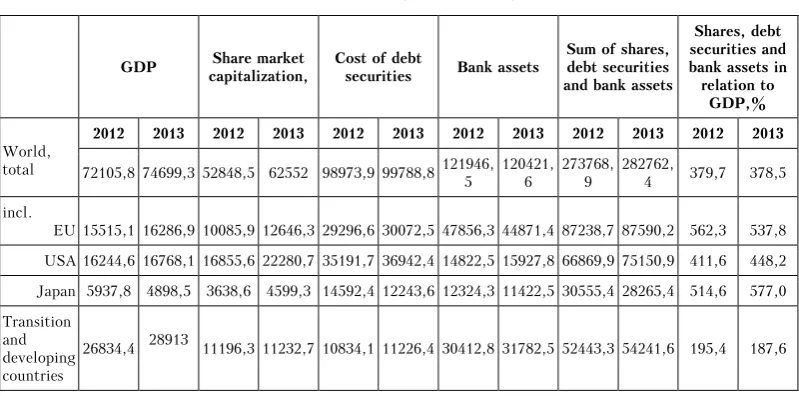
Let us see the data characterizing the state of the world financial market (Table 2).
Table 2 World Financial Market and Its Structure: Selected
Indicators ($ billions)
GDP capitalization,Share market Cost of debt securities Bank assets
Sum of shares, debt securities and bank assets
Shares, debt securities and bank assets in relation to
GDP,%
World, total
2012 2013 2012 2013 2012 2013 2012 2013 2012 2013 2012 2013
72105,8 74699,3 52848,5 62552 98973,9 99788,8 121946, 5
120421, 6
273768, 9
282762,
4 379,7 378,5
incl.
EU 15515,1 16286,9 10085,9 12646,3 29296,6 30072,5 47856,3 44871,4 87238,7 87590,2 562,3 537,8
USA 16244,6 16768,1 16855,6 22280,7 35191,7 36942,4 14822,5 15927,8 66869,9 75150,9 411,6 448,2
Japan 5937,8 4898,5 3638,6 4599,3 14592,4 12243,6 12324,3 11422,5 30555,4 28265,4 514,6 577,0
Transition and developing countries
26834,4 28913 11196,3 11232,7 10834,1 11226,4 30412,8 31782,5 52443,3 54241,6 195,4 187,6
Source: IMF Global Financial Stability Report. April 2014. Statistical Appendix. P. 153; IMF Global Financial Stability Report. October 2014. Statistical Appendix. P. 163.
Data presented in Table 2 show that the share of financial markets of the USA, the EU and Japan in the world financial market amounted in 2012 to 67.45%, in 2013–67.55%, and transition and developing countries–19.16% and 19.18% of the world financial market respectively. The share of financial markets of these countries in the world financial market is growing, and the USA, the EU and Japan grow faster than transition and developing countries. However, there is
46 Malitskiy B.A. Neoliberalism and the crisis of innovation development of the economy. Crisis formula. 2nd ed. (Kyiv: Fenix, 2013), 24 [In Russian].
47 Pechonik O.I. "The prerequisites and changes to the methodology of financial system management."
unevenness in the dynamics of the share in the world financial market of financial markets of most developed countries, characterized by the following data: the EU–31.87% and 30.98% respectively; the USA– 24.43% and 26.58%; Japan–11.16% and 9.99%. That is, the EU and Japan reduced their share in the world financial market and the USA increased it by strengthening their role.
The essence of financialization of the economy can be disclosed by K.Peres’s division of capital to financial and production48. The term “financial capital” includes criteria and behavior of agents who possess wealth in the form of money and other securities. These agents perform such actions which according to their expectations will increase this wealth. To that end agents interact with banks, brokers and other intermediaries that facilitate registration of contracts with people providing an increase in ‘paper’ wealth. It’s the actions of these mediators aimed at obtaining money from money which should be regarded as the behavior of financial capital, which acts as means of wealth redistribution. The term “production capital”, in contrast, combines behavior of agents that create new wealth by producing goods and services (including transportation, shopping and other activities). These agents borrow from financial capital and return it part of created wealth. If they use their own money, thus they perform both functions. Their goal as production capital–to produce as much as possible, to increase profit opportunities through investments in innovation and increasing production capacity. Thus, production capital and its agents are the real sector that creates real wealth in the form of goods and services provided, and financial capital and its agents contribute to the functioning of production capital and participate in the distribution of its results. It is the financial capital the possibilities of introducing new technologies, solving fundamental problems of technological, social and environmental development of the society are associated with49.
According to modern economic theory, by value in creation and redistribution of income, capital can be real or fictitious (including speculative). Real capital serves primarily the movement of industrial capital, plays a decisive role in creating income by emboding in materials and things, financial and spiritual values. Fictitious capital
(from the Latin fictio–fiction) is capital represented by securities (stocks, bonds, etc.), which regularly brings income to their owner and makes its own other than real capital movement on the securities market. Fictitious capital by itself as the title of ownership of
48 Perez C. Technological Revolutions and Financial Capital. The Dynamics of Bubbles and Golden Ages. Translated from English by Maevskyi F.V. (Moscow: Publishing House «Delo», 2011), 61, 103–104 [In Russian].
securities does not create revenue but only contributes to its redistribution50. Production capital (production sphere capital) is the real capital that serves primarily the movement of industrial capital, plays a decisive role in creating income by emboding in materials and things, financial and spiritual values.
Due to the fact that the vast majority of financial market belongs to developed countries (including the US, EU and Japan–67.55%), these countries receive the bulk of the redistributed revenue of the real sector. O.H. Bilorus says: “The whole process of creating a national and global value is disrupted in the totally finansialized global economy, because as we know, value is not created in financial sector at all”51.
It is quite logical to conclude that the income derived in the financial market is actually the income of real sector redistributed in favor of financial sector through complex financial transactions. Redistribution of income from real sector to financial one the majority of which belongs to the leading countries of the world kernel explains rapid hypertrophied development of financial sector, increasing financialization.
An important element of the world financial market structure is external debts of countries which pose a real threat to transition and developing countries. The analytical report of the team of authors headed by corresponding member of the NAS of Ukraine V.R. Sidenko says: “One of the most important features of the debt structure of major
economies — the US, UK, Japan and the Eurozone–is that their
“national” currencies (dollar, pound, yen and euro) are both recognized world currencies for which there is global quite stable demand. And, accordingly, debts of economic entities–both residents and non-residents–are also formed mainly in local currency (for example, over 80% of US external debt are in dollars, and foreign debts of Japan are almost entirely in yen). That is why the above countries and the Eurozone almost never in the present institutional terms can be insolvent or bankrupt (central banks, at urgent need, will be able to cover all sovereign debts)”52. Analysis of international investment position of the most developed countries shows that today's debt structure of most developed economies in the world contains no critical or default features, and therefore most debt risks for such countries should not be exaggerated53. In this context it is worth recalling that
50 Bazylevych V.D., ed. Economic Theory: Political Economy: Textbook. 8th ed. (Kyiv: Znannya, 2012), 301-302 [In Ukrainian].
51 Bilorus O.G. The economic globalistics. The world system of globalism. (Kyiv: University “Ukraine”, 2016), 280 [In Ukrainian].
52Sidenko V., Yurchishyn V., and Markevych K. Debts: time to take and time to repay. Global trends and
challenges for Ukraine: analytical report. (Kyiv: Zapovit, 2015), 40 [In Ukrainian].
53 Sidenko V., Yurchishyn V., and Markevych K. Debts: time to take and time to repay. Global trends and
after the debt crisis of the 1980s management of many developing countries decided to trade carefully and give up loans “doing everything to feel self-sufficient, autonomous and freely”54.
Conclusions made on major economies–the US, UK, Japan and the Eurozone–are based on the fact that these countries are able to print money and pay off the debts. That is, it is about correction of the market mechanism by intervention of the state to which special attention is paid in the regulation of the functioning of the European Union. Renowned scientist O.I. Shnyrkov exploring the role of the state in the implementation of scientific and technological progress in the production, said: “A special place in the system of state aid has the state participation in the capital. On the one hand, by using the mechanism of its participation in the capital the state can support those companies that are in difficult situation and are, in fact, bankrupts. Such participation is an irrevocable subsidy. On the other hand, the state as the co-owner of the company can direct appropriate financial flows to restructure production adapting it to new market requirements, and in this respect such actions of the state are justified. But it is very difficult to determine in practice where the state provides aid, and when acts as an investor according to the laws of the market and competition”55.
Dominance in the global economy of its financial component creates opportunities for destabilization of any country’s economy by blocking medium and long-term loans and investments without limiting short-term transactions, thereby creating opportunities for speculative transactions in the financial market of the country. As a result of the simultaneous outflow of long-term capital and inflow of short-term speculative capital monetary and financial market system loses its stability. Because of super returns of speculative transactions on monetary and financial market major domestic credit and financial institutions and monetary authorities turn onto them and aim all available economic capital to conduct them. Almost all country’s money issued by the Central Bank (CB) to refinance commercial banks are invested by the latter in currency assets, which makes it impossible to replace external sources of loans with domestic loans which are allocated to speculative transactions and wash away currency reserves of the country. Trying to save them, Central Bank leaves the foreign exchange market leaving it entirely in the hands of speculators. These speculators manipulate the market causing fluctuations of national
54 Soederberg S. "The transnational debt architecture and emerging markets: the politics of paradoxes and punishment." Globalization and Economy 2. (2007): 50–51. Globalizing Finance and the New Economy / Edited by P.James, H.Patomaki. Los Angeles: Sage publications.
currency they need with all negative consequences for the country and disrupting normal process of expanded reproduction of the real sector of economy. Enterprises curtail production investment and direct released funds to financial market, while population is losing part of its income and savings. Raising interest rates on loans to level that exceeds profitability of production sector deprive production sector of opportunity to take bank loans. Thus, the conditions for worsening of country’s economic situation and population are created and the leading role of financial sector in the global market economy is proved. “It’s the increasing separation of financial system from production base of the economy that is the key fundamental threat not only for economic security but also for national security as a whole»56. Consequently, financialization: first, increases the importance of financial sector relative to the real one; second, redistributes real income of financial sector; third, increases income inequality and promotes freezing wages. Moreover, financialization may cause long recession57.
It is necessary to regulate financial sector which must be profitable and receive income but on condition that its operation increases efficiency of the real sector which eventually will help to meet social needs58. Overcoming negative effects of financialization requires introduction of a set of measures, including: 1) renovation of financial market control policy; 2) finding answer to challenges of neoliberal economic paradigm policy that promotes financialization; 3) commitments of corporations to act in the interests of shareholders, not just financial markets; 4) political process reform in order to reduce the influence of corporations and the financial elite59. Special attention should be paid to the regulation of introduction of financial innovation, including derivatives, the use of which in speculative operations is accompanied by deregulation of financial institutions and markets60. The need for regulation of financial sector confirms the experience of the
56 Malitskiy B.A. Science, technology, innovation and national security: theoretical and applied aspects. (Makarov: «Sofia», 2014), 21 [In Russian].
57PalleyT.I. Financialization: what it is and why it matters. Paper presented at a conference on “Finance-led capitalism? Macroeconomic effects of changes in the financial sector,” sponsored by the Hans Boeckler Foundation and held in Berlin, Germany, October 26-27, 2007. Paper No. 525. Washington: The Levy Economics Institute and Economics for Democratic and Open Societies Working, 2007.
58 Turbeville W. Financialization and a new paradigm for financial markets. Financial Pipeline Series. Demos. New Economic Paradigms. (Rockefeller Foundation (Innovation for the next 100 years), 2013), 18.
59PalleyT.I. Financialization: what it is and why it matters. Paper presented at a conference on “Finance-led capitalism? Macroeconomic effects of changes in the financial sector,” sponsored by the Hans Boeckler Foundation and held in Berlin, Germany, October 26-27, 2007. Paper No. 525. Washington: The Levy Economics Institute and Economics for Democratic and Open Societies Working, 2007.
“Great Depression” of 30s as analyzed by David Kotz61. Nobel Laureate John Stiglitz says: “The financial sector should serve the economy and not vice versa”62. Achieving this goal is possible only by establishing the optimal balance of financial and real sectors of economy that in terms of hypertrophied development of financial sector needs to be regulated and brought in compliance with real sector which must be technologically updated.
Technological Development in Terms of Globalization
“Technology” is a special form of intellectual product that goes from the results of fundamental and applied research presented by discoveries, inventions, know-how, to technical knowledge embodied in projects, technical documentation, and sample equipment. Completed in development and ready for implementation technology also includes the processes needed to produce that equipment (products)63. Modern technology is the result of technological revolutions that occurred
during the lifetime of humanity. Technological revolutions are
qualitative changes of technological modes of production the essence of which is in a radical redistribution of basic technological forms between human and technical components of productive forces of society64.
Technological revolution is defined as a strong and dynamic cluster of new and dynamic technologies, products and industries that can lead to growth and long-term development trend. This is a complex of closely interrelated technological innovations which usually include important low-cost widespread resource–the energy source, new material and new products and processes and new infrastructure. Each complex contains a set of related widespread use technologies and organizational principles that ensure quality quantum leap in potential productivity for almost all economic activities65.
The main driving force of the spread of complex of breakthrough technical widespread use innovations, which together alter general best practices, is defined as techno-economic paradigm, or technological
61 Kotz D.M. Neoliberalism and Financialization. This paper was written for a conference in honor of Jane D'Arista at the Political Economy Research Institute, University of Massachusetts, Amherst, May 2-3, 2008. (University of Massachusetts, March 29, 2008), 4.
62 Kotz D., ed. The way out of the crisis: towards a more perfect model of equitable and sustainable growth.
Report of the ad hoc group of trade union experts. Translated from English. Brussels: European trade union institute (ЕПИ/ETUI), 2011. http://perc.ituc-csi.org/IMG/pdf/vyhod_iz_krizisa_rus_edited_cle0335d5.pdf [In Russian]
63 Odotyuk I.V. Technological structure of Ukraine’s industry: realities and prospects. (NAS of Ukraine, Institute for economics and forecasting. Kyiv, 2009), 13-14 [In Ukrainian].
64"Technological revolutions." National Collegiate Russian Service http://terme.ru/dictionary/906/word/tehnologicheskie-revolyuci. [In Russian]; "Technological revolutions in the history of mankind." http://masters.donntu.org/2012/fkita/chekunkov/library/philosophy.htm. [In Russian].
structure. Initiator of the emergence of these terms is considered J. Schumpeter, “the founder of all innovative concepts developed by Western economists”66, who by studying innovation processes in economy saw their discrete nature and named time intervals of their manifestation “clusters”. The term “cluster” has been replaced by “waves of innovation”; English scientist C. Freeman formulated the concept of “techno-economic paradigm”, which subsequently was developed in the works by C.Perez. Domestic scientific literature used the term “technological structure” defined as a set of related industries with the only technical level and which develop simultaneously. Changing technological structures that dominate in the economy determines the uneven progress of science and technology. Thus, terms “wave of innovation”, “techno-economic paradigm” and “technological structure” are synonymous67. Technological structure is defined also as coherent macroeconomic complex of technologically related industries, components of which are characterized by common technical and engineering solutions, methods of production management they are based on. Life cycle of each technological structure is the stage of technical-and-economic development68.
Note that technological developments move ahead of changes in institutional structure and are based on key parameters, which are shown by changing the cost structure that is influenced exactly by new technologies and methods of production management. It was found that the process of replacing the previous structure with the following one requires certain changes in social and institutional systems that promote mass introduction of technologies of new TS (technological structure), formation of corresponding type of consumption and even lifestyle. In ensuring a successful combination of industrial and financial capital, and thus stimulating investment and implementation of introduction of basic technologies of new TS, the state acts as the main subject69.
Technological structure comes both as a driving and braking factor in the spread of technological revolution. Braking factor is the need to overcome the inertia generated by the success of the previous structure. The very same inertia is the main obstacle to the spread of technological
66Menshikov S.M., and Klimenko L.A. Long waves in the economy. When society changes its skin. (Moscow: International Relations, 1989), 183 [In Russian].
67 "Technological mode." Wikipedia. The Free Encyclopedia. https://ru.wikipedia.org/wiki/ Технологический_уклад. [In Russian].
68 Odotyuk I.V. Technological structure of Ukraine’s industry: realities and prospects. (NAS of Ukraine, Institute for economics and forecasting. Kyiv, 2009), 33-34 [In Ukrainian].
69 Odotyuk I.V., Salikhova O.B., and Musina L.A. et al. High-tech industry of Ukraine: resources of
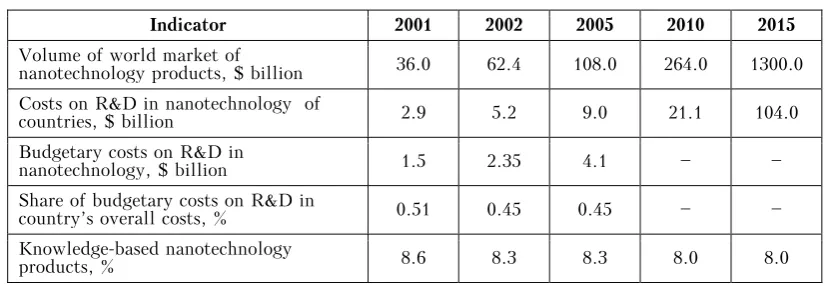
revolution. Specifically technological revolutions are manifested in consistent implementation into production of six technological structures. Fifth and sixth technological structures are being successfully introduced in developed countries, where prevail: introduction of achievements in the fields of microelectronics, computer science, biotechnology, use of new forms of energy, space exploration, biotechnology, artificial intelligence systems, global information communication (Internet) integrated high-speed transport systems, etc.70. In the spectrum of scientific and technological breakthroughs the highest expectations of quality progress are associated with nanotechnology, whose figures in the short term are given in Table 3.
Table 3 Main Indicators of Nanotechnology in Developed
Countries, 2001-2015
Indicator 2001 2002 2005 2010 2015
Volume of world market of
nanotechnology products, $ billion 36.0 62.4 108.0 264.0 1300.0 Costs on R&D in nanotechnology of
countries, $ billion 2.9 5.2 9.0 21.1 104.0
Budgetary costs on R&D in
nanotechnology, $ billion 1.5 2.35 4.1 — —
Share of budgetary costs on R&D in
country’s overall costs, % 0.51 0.45 0.45 — —
Knowledge-based nanotechnology
products, % 8.6 8.3 8.3 8.0 8.0
Source: Lukianenko O.D. Innovation factors of global competitiveness. Kyiv: KNEU, 2015: 77 [In Ukrainian].
The emergence of new technological structures and their implementation is cyclical in nature ad is related to curtailment of productions of previous technological structures and their replacement by productions of new technological structure. Such cyclical nature is due to the fact that the basis of both technological revolutions and new technological structures they introduce are innovations and their life cycle considered as a process of creative destruction, first investigated by J.Schumpeter71. That is why there is a cyclical movement that provides for some definitions–rise, recession (decline), followed by
70Lukianenko O.D. Innovation factors of global competitiveness. (Kyiv: KNEU, 2015), 76-77 [In Ukrainian]. 71 Schumpeter J. The theory of economic development: an inquiry into profits, capital, credit, interest and the
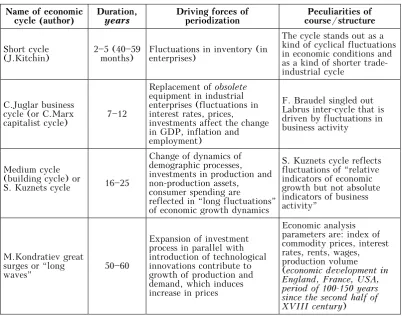
depression and finally reviving72, by others– implementation phases (time of technology), aggressive investment (time of finance), synergy (time of production), maturity (time to doubt complacency)73. Foreign sources use terms: expansion, boom, recession and depression74. Periodization of cyclical fluctuations of economic dynamics prepared by I.V. Odotiuk is presented in Table 4.
Table 4 Periodization of Cyclical Fluctuations
of Economic Dynamics
Name of economic
cycle (author) Duration, years Driving forces of periodization course/structure Peculiarities of
Short cycle
(J.Kitchin) 2—5 (40—59 months) Fluctuations in inventory (in enterprises)
The cycle stands out as a kind of cyclical fluctuations in economic conditions and as a kind of shorter trade-industrial cycle
C.Juglar business cycle (or C.Marx
capitalist cycle) 7—12
Replacement of obsolete
equipment in industrial enterprises (fluctuations in interest rates, prices,
investments affect the change in GDP, inflation and employment)
F. Braudel singled out Labrus inter-cycle that is driven by fluctuations in business activity
Medium cycle (building cycle) or
S. Kuznets cycle 16—25
Change of dynamics of demographic processes, investments in production and non-production assets, consumer spending are
reflected in “long fluctuations” of economic growth dynamics
S. Kuznets cycle reflects fluctuations of “relative indicators of economic growth but not absolute indicators of business activity”
M.Kondratiev great surges or “long
waves” 50—60
Expansion of investment process in parallel with introduction of technological innovations contribute to growth of production and demand, which induces increase in prices
Economic analysis parameters are: index of commodity prices, interest rates, rents, wages, production volume (economic development in England, France, USA, period of 100-150 years since the second half of XVIII century)
Source: Odotyuk I.V., Salikhova O.B., and Musina L.A. et al. High-tech industry of Ukraine: resources of development. Edited by Odotyuk I.V. (NAS of Ukraine, Institute for economics and forecasting. Kyiv, 2013), 8 [In Ukrainian].
72Menshikov S.M., and Klimenko L.A. Long waves in the economy. When society changes its skin. (Moscow: International Relations, 1989), 182 [In Russian].
73 Perez C. Technological Revolutions and Financial Capital. The Dynamics of Bubbles and Golden Ages. Translated from English by Maevskyi F.V. Moscow: Publishing House «Delo», 2011. [In Russian].
74 Snyder M. If economic cycle theorists are correct, 2015 to 2020 will be pure hell for the United States."
Super large civilization cycles at intervals of a few centuries based on epoch-making discoveries are added to four cycles of economic dynamics outlined in Table 475. The above Table 4 shows that introduction of innovations occurs in terms of “long waves”. That is why special attention is paid to the concept of “Big Wave of Development” by defining it as the spread of technological revolution and appropriate technological structure of economy which generates structural changes in production, distribution, communication and consumption and leads to powerful structural changes in society76. This concept emerged thanks to research of M.Kondratiev that proved the existence of “long waves” of economic development associated with the loss of balance by third structure between the so-called “core capital goods” (industrial buildings, infrastructure facilities, skilled workforce) and all factors that determine the mode of production (existing industrial structure, raw materials and energy sources, prices, employment and public institutions, state of monetary system, etc.)77. Key role in the emergence of “long waves” plays innovation and implementation on its basis of a new technological paradigm requires adequate financial support, which is not only the key to sustainable economic development but also is a kind of catalyst of market transformations in society, a prerequisite for introduction of innovation and social development in general78.
The process of accumulation of investment capital is regarded as one of the key factors of successful technological development, with investing of investment resources concentrated in three areas–in basic science and applied R&D, in industrial production and in the reproduction of labor force; with emphasis placed on priority of investments in science and human capital79. The latter can be explained by the fact that the widespread introduction of generations of new technological structure technology that underlies the Kondratiev cycles, radical changes in production conditions and management require new labor skill level and lead to take-over, revolution in education80. Long
75Kuzyk B.N., and Yakovets Yu.V. Russia – 2050: strategy for innovative breakthrough. 2nd ed. (Moscow: Publishing house “Economics”, 2005), 46 [In Russian].
76 Perez C. Technological Revolutions and Financial Capital. The Dynamics of Bubbles and Golden Ages. Translated from English by Maevskyi F.V. (Moscow: Publishing House «Delo», 2011), 46 [In Russian].
77 Kondratiev N.D. Large cycles of conjuncture and theory of forecasting: Selected works. Edited by L.I. Abalkin et al. Compiled by Yu.V. Yakovets. Moscow: Publishing house “Economics”, 2002. [In Russian]; Menshikov S.M., and Klimenko L.A. Long waves in the economy. When society changes its skin. (Moscow: International Relations, 1989), 14-15 [In Russian].; Galchinsky А.S. Crisis and cycles of world development. (Kyiv: ADEF – Ukraine, 2009), 75 [In Ukrainian].
78Tkach S.V. "Financial sources of economic growth in UkraineFinancial provision of the economic growth in
Ukraine: state, trends and prospects: "monograph. Edited by prof. P.O.Nikiforov. (Chernivtsy: Chernivtsy national university, 2015), 22 [In Ukrainian].
79 Odotyuk I.V. Technological structure of Ukraine’s industry: realities and prospects. (NAS of Ukraine, Institute for economics and forecasting. Kyiv, 2009), 27 [In Ukrainian].
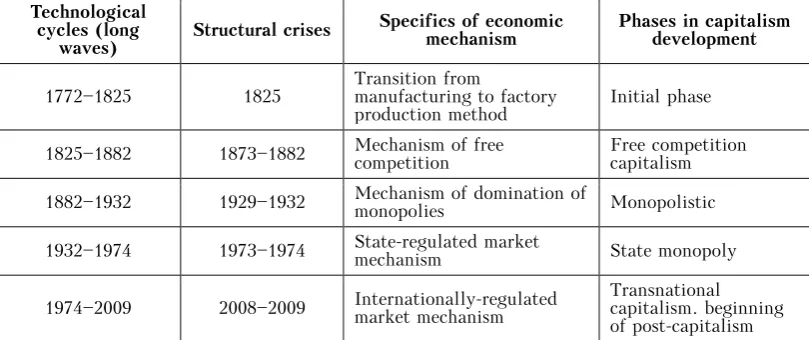
term cyclical fluctuations of technical and technological process are closely linked with institutional changes. A.S.Halchynskyy notes that “this or another technical and economic system in its development nears its limit earlier then institutional limit. On this basis, there is a delay effect of institutional transformations. Structural crisis is essentially a mechanism for solving this discrepancy”81, and presents chart of appropriate correlation of long waves and institutional cycles in the table (see Table 5).
Table 5 The Interdependence of Technological Cycles, Structural
Crises, Specifics of Economic Mechanism and Phases of Capitalism Development
Technological cycles (long
waves) Structural crises
Specifics of economic
mechanism Phases in capitalism development
1772—1825 1825 Transition from manufacturing to factory
production method Initial phase
1825—1882 1873—1882 Mechanism of free competition Free competition capitalism
1882—1932 1929—1932 Mechanism of domination of monopolies Monopolistic
1932—1974 1973—1974 State-regulated market mechanism State monopoly
1974—2009 2008—2009 Internationally-regulated market mechanism Transnational capitalism. beginning of post-capitalism
Source: Galchinsky А.S. Crisis and cycles of world development. (Kyiv: ADEF — Ukraine, 2009), 82 [In Ukrainian].
Thus, the birth of a new technological structure takes place in a downward phase of the previous long wave and coincides in time with deployment of economic crisis, and time of active introduction of new technological structure takes place in the ascending phase of the next long wave and coincides in time with the economy surmounting the this crisis, which is actually facilitated by the introduction of advanced productive productions of new technological structure.
Introduction of new technological structure requires significant capital investment and at the same time is constrained by the need to minimize production of the previous dominant technological structure. It is the interaction of these processes that creates opportunities for technologically less developed countries to catch up and even get ahead
of technologically more developed countries by receiving the status
of advancing development countries, and for developed
countries–to get rid of their productions of previous dominant technological structure by transferring them to technologically less developed countries and introducing new technological structure instead, to preserve the existing technological hierarchy of the global economy.
Introduction of New Technological Structure and Financialization
State of country’s technological development is characterized by the presence of three or more technological structures: new, emerging, and for a long period of time will determine future technological state of the country, the main dominant and one or more previous ones, whose share will gradually decrease.
Strategic nature for the future of the country has a new structure, whose share must increase. It is the focus of theories of innovative breakthrough and technological structures, Kondratiev “long waves”. Implementation of new structure for any country can occur in three ways: 1) independent development of new technologies; 2) development of new technologies in cooperation with other countries in the so-called techno-globalism; 3) transfer of such technologies. Obviously, for lagging countries the latest way becomes the simplest one because it, first, is more costly, and, second, does not guarantee receipt of really advanced, breakthrough technologies because of the reluctance of manufacturing countries of such technologies to lose their monopoly position. Independent development of new technologies due to high financial costs and the need to achieve a high level of scientific and technological development can be carried out by developed countries only. More promising is the way of developing and implementing a new structure in cooperation with other countries in terms of techno-globalism.
All ways of obtaining and introducing new technologies in production, managing new technological structure productions include the need to invest significant amounts of capital. In terms of financialization economy bulk of global capital is speculative capital not interested in its transformation into production capital. It is this speculative capital that creates in the process of introducing a new technological structure so-called “bubbles” and their “collapse” that generate economic crisis82. The dominance on the global financial market
82 Rogach O.I. ed, Snizhko O.V., and Lutsyshyn Z.O. et al. World finance: current trends and prospects for
of speculative capital makes it difficult for periphery countries to obtain a reliable source of medium and long-term loans and investments. So financialization is a factor to preserve differentiation of levels of technological development of the world countries. Overcoming significant and growing differentiation of the world technological development is unlikely to be achieved in the near future. The first real step towards solving this problem should be transformation of the current global financial system83, which is based on currency unit not secured with real values, and which creates the possibility of financial system functioning in imbalance with real economy and this distorts the process of its normal reproduction.
Activation of production lending, increase production investment leads to reduction of share of financial capital, economy de-financialization84. That is, financialization of economy and raising
technological level of production are in inverse proportion.
The above does not apply to developed countries whose national currencies are internationally recognized and which allows them to import for their currency for their real sector resources it needs, thus ensuring technological development. This is confirmed by the analysis of accumulation of capital in terms of financial crisis and debt congestion, which is one of the indicators of economy financialization. “The US has practically no connection between cyclical nature of economic development and accumulation of capital, because this country is the issuer of global reserve currency and can secure capital accumulation even in times of economic crisis”85. Moreover, the US dominance in the global economy is secured not only by their monopoly on the issue of world money, but benefits of implementing productions of fifth and sixth technological structures.
The leading countries are not interested in advancing technological development of other countries through efforts to maintain their technological leadership and thus obtain high technological rent, to ensure their high standard of living86. This is confirmed in particular by
83Slozko O.O. "The Analysis of Exchange Rates Regulation and the Introduction of the Global Currency by the International Monetary Fund." Scientific Bulletin of Kherson State University, Economic Science, no. 13, part 4 (2015): 12-16. [In Ukrainian].
84 Zaletnyi A.A. "From "homo finansus" to "homo creator": diversity of dimensions and approaches."
Philosophy of economy. The almanac of the Center for social science and economics department of Moscow state
University named after M.V.Lomonosov 3 no. 93 (2014): 181–188.
https://istina.msu.ru/media/publications/article/753/74b/6520595/Zaletny_in_Philosophy_of_Economy_393.pdf [In Russian].
85 Yemets V.V. "The accumulation of capital in the conditions of the financial crisis and debts." Financial
aspects of the development of the state, regions and business entities: current state and prospects. Collected papers of the Int. scientific and practical conf. 25-26 Dec. 2015, Odessa. Odessa: Bondarenko M.O. (2015): 41. [In Ukrainian].
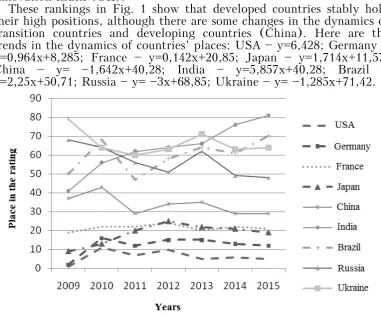
the study of the countries’ rating dynamics according to the Global Innovation Index (GII).
These rankings in Fig. 1 show that developed countries stably hold their high positions, although there are some changes in the dynamics of transition countries and developing countries (China). Here are the trends in the dynamics of countries’ places: USA — y=6,428; Germany — y=0,964x+8,285; France — y=0,142x+20,85; Japan — y=1,714x+11,57; China — y= —1,642x+40,28; India — y=5,857x+40,28; Brazil — y=2,25x+50,71; Russia — y= —3x+68,85; Ukraine — y= —1,285x+71,42.
Fig. 1. Dynamics of the Global Innovation Index
Source: prepared according to The Global Innovation Reports 2008—2015
Technological level of the global periphery countries can be raised by two fundamentally different ways: by catching-up development and by advancing development.
The first and foremost factor of catching-up development is the state itself interested in improving competitiveness of its economy in the global market87. For each state becomes important the issue of forming the national innovation system (NIS), solution of which is associated with preservation and development of national scientific systems, as evidenced by the experience of transformation research systems in
countries of Central and Eastern Europe88. Measures should be developed and introduced at the state level aimed against the possibility of conducting speculative transactions on national financial market open for free movement of capital by manipulating the exchange rate. World famous financier Soros says: “financial markets, whose matters are intervened by no one, are prone to excesses and eventually are destroyed. Therefore, they cannot be left to fend for themselves; their activities should be in view of financial authorities and to some extent guided by them”89.
Second factor in the introduction of productions of new technological structures in the countries of world periphery are the transnational corporations (TNCs), whose activity is aimed at maximizing their profits by improving the global division of labor and applying the latest scientific and technical progress achievements. This is proved by the experience of newly industrialized countries90. TNCs are based in developed countries; they implement their interests and cannot be a factor in the introduction in countries of world periphery of advanced technological development. “No matter how rapidly would transitional society perform catching-up development, it will be left behind a highly developed society”, said K.Yu. Yahelska91. Catching-up leading countries and even getting ahead of them becomes possible only when moving from the “pursuit curve” to “lead motion” by introducing a fundamentally new technology earlier than they will. According to the Kondratiev “long waves” this possibility occurs once in 50-60 years when introducing new technological structures, when technological leap of backward countries becomes theoretically possible. Advancing development requires scientific, technological and financial base for the introduction of new production and technological structure and is associated with serious life changes in the whole society. The subject of its implementation and ensuring can be a national state only.
Conclusions
The 2008-2010 global crisis demonstrated the crucial role of financial sector in the course of global processes, strengthening of which was named “financialization”. The term originated from the ideology of liberalism in the 1920s and has undergone extensive use since 1990s on
88 Yegorov I.Yu. "The transformation of science systems in the countries of Central and Eastern Europe: possible lessons for Ukraine." Science and innovation 11 no.1 (2015): 26–33. [In Ukrainian].
89Soros G. George Soros on globalization. Translated from English by A.Florkin. (Kyiv: Solomiya Pavlychko Publishing House “Osnovy”, 2002), 105 [In Ukrainian].
90Rogach O., and Kosmina V. Transnational corporations and export of the newly industrializing countries of
Asia: monograph. (Kyiv: “Centre of educational literature”, 2016), 118-128 [In Ukrainian].