© Universiti Tun Hussein Onn Malaysia Publisher’s Office
IJIE
Journal homepage: http://penerbit.uthm.edu.my/ojs/index.php/ijie
The International
Journal of
Integrated
Engineering
Improvement on Bill of Materials Formatting Process by
Adopting Lean and Six Sigma Approaches
-
A Case Study in a
Semiconductor Industry
Ilhammee
Abd
Wahab
1, Rosmaini
Ahmad
2*,
Shaliza Azreen
Mustafa
2,
Muhammad Shahar Jusoh
3,
Mohd Salleh Hj Din
31School of Manufacturing Engineering, Ulu Pauh Campus,
Universiti Malaysia Perlis, 02600 Arau, Perlis, MALAYSIA
2Advanced Manufacturing System (AMS) Research Group, School of Manufacturing Engineering, Ulu Pauh Campus,
Universiti Malaysia Perlis, 02600 Arau, Perlis, MALAYSIA
3School of Business Innovation and Technopreneurship, Universiti Malaysia Perlis, Jalan Alor Setar - Kangar, 01000
Kangar, Perlis, MALAYSIA
*Corresponding Author
DOI: https://doi.org/10.30880/ijie.2019.11.08.009
Received 25 March 2019; Accepted 19 August 2019; Available online 15 December 2019
1. Introduction
In profit making organization like manufacturing industries, ability to meet customer requirements with highly cost-effective operations determined the survivability of their business. Many studies related to sustaining customer satisfaction are presented in the literature and one of the examples is given in [1].Although with fourth Industrial Revolution (IR) or also known as IR4.0 currently spreading around the world (e.g. Germany and China[2]),the element of “customer” is continuously becoming the main subject to be focused. One of the fundamental goals of IR4.0 is to
fulfil the complexity of customer needs (e.g. customized products, varieties, fast production, perfect quality, reasonable
Abstract: This paper present an improvement project for the case of Bill of Materials (BOM) formatting process
by adopting Lean and Six Sigma approaches. Currently, BOM formatting process involved repetitive tasks, where many of manual touches (manual computer mouse clicks), thus consumed a significant amount of time. The focus of Lean approach in this project is to identify and analyze the related wastes in the current BOM formatting process. Several Lean tools are applied such as, Root Cause Analysis (RCA), Five Whys analysis and Value Stream Mapping (VSM) concept to analyze the problem. Six Sigma approach plays an important role to systematically carry out the improvement project based on it well known method called; Define, Measure, Analyze, Improve and Control (DMAIC). This paper gives an insight that the right application of Lean and Six Sigma approaches will significantly helped an organization to achieve operational excellence, where in this project it happens at BOM formatting process. Through this project, the case study company has improved (reducing) the BOM processing time from average 50 to 5 minutes, while manual touches reduced from 290 to 30 touches only. Furthermore, elimination of these wastes (waiting and motion) has increase work efficiency and contributes to a significant financial savings to $1680 per month.
price etc) by adopting diverse of high technologies such internet of things (IoT), simulation, artificial intelligent (AI) and predictive process.
Although the above-mentioned statements, continuous improvement practice is another key element that should come concurrently to ensure business operations is stay in highly cost effective and efficient. Lean and Six Sigma are the two popular approaches or methods that can be applied to drive the continuous improvement project in many organizations. It is well known by researchers and practitioners that Lean/ Lean Manufacturing (LM) approach or also known as Toyota Production System (TPS) originally invented and practice in Toyota Company since over the last 50 years ago. It then been popularized in academic and research world by Womack, Jones and Roos [3] in their very popular book ‘The Machine that Changed the World’. Lean is a comprehensive approach, where all workers in an
organization have to get involves in Leanness activities (Lean culture development). It starts with the understanding the concept of Lean, where the reduction/elimination of wastes will directly increase the values (value added), thus accomplishes one of the Lean goals to ‘achieve more with less’. One of the useful studies on Lean evolution journey is reported by Stone [4].Some latest LM application based on industry case study is given by Chan and Tay [5], where the lessons learned from two kaizen events in printing company were reported. They claimed that a mix application of Lean tools for these two Kaizen events resulted significant productivity improvement. Another industry case study based regarding LM application is reported by Nallusamy and Adil-Ahamed [6]. They presented the application of Lean tools such as 5S, VSM and line balancing to identify and eliminate the non-value-added activities.
Six Sigma is another popular approach that can be applied to support an organization to carry out their improvement projects. Six Sigma was developed by Bill Smith at Motorola Corporation in middle 1980’s [7]. Originally, Six Sigma is applied to solve related product quality issues via it well known systematic process called DMAIC, which it stands for Define, Measure, Analyze, Improve and Control. This process is considered as standard methodology to guide any improvement projects. One of the practical examples of the DMAIC application is given by Jirasukpraset et al [8]. They reported the success story of improvement project based on DMAIC application to reduce the defects in a rubber gloves manufacturing process. Among the latest study on DMAIC application in manufacturing industry is presented by Gupta et al [9]. They applied DMAIC method to reduce the defect issues in tire manufacturing process in India. They claimed that the presented project has achieved the objective, where the process capacity (Cp
value)and performance (Cpkvalue) measures have improved from 1.65 to 2.95from 0.94 to 2.66, respectively.
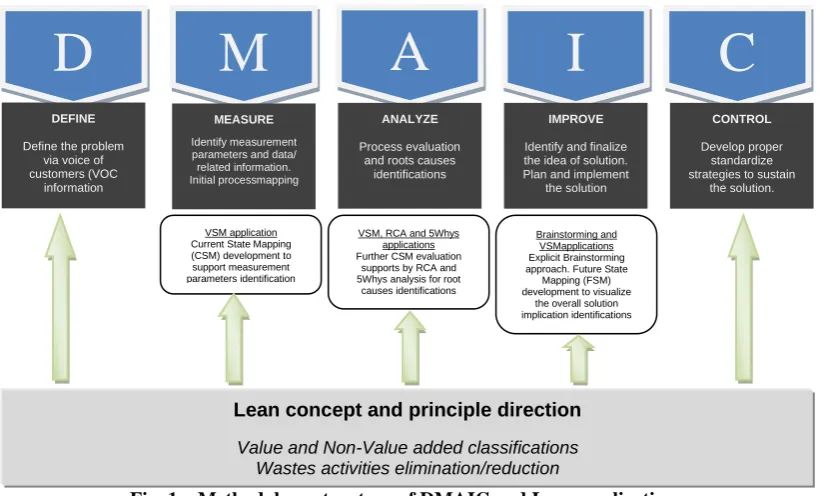
Fig. 1 – Methodology structure of DMAIC and Lean applications
On the other hands, the combine approach of Lean and Six Sigma (LSS) become the popular way of practice to improve operational excellence [10] and provide better driver to the improvement projects [11]. The core value behind this integration is to maximize the benefits from both of approaches, where Six Sigma via DMAIC process will systematically guide the improvement activities, while the Lean approach will support in defining and analyzing the problem based on related Lean tools/techniques, thus better solution to the defined problem can be found. An example application of Lean and Six Sigma approach is given by Panat et al [12], where they reported the success of this integration approach application to improve the configuration control in R&D environment. One of the latest literature review study on LSS applications in various industry sectors is documented by Singh and Rathi [13]. They performed comprehensive literatures study on LSS applications within three different industrial sectors: manufacturing, service
C
I
A
M
D
DEFINEDefine the problem via voice of customers (VOC
information
MEASURE
Identify measurement parameters and data/ related information. Initial processmapping
ANALYZE
Process evaluation and roots causes
identifications
IMPROVE
Identify and finalize the idea of solution. Plan and implement
the solution
CONTROL
Develop proper standardize strategies to sustain
the solution.
Lean concept and principle direction
Value and Non-Value added classifications Wastes activities elimination/reduction VSM application
Current State Mapping (CSM) development to support measurement parameters identification
VSM, RCA and 5Whys applications Further CSM evaluation
supports by RCA and 5Whys analysis for root
causes identifications
Brainstorming and VSMapplications Explicit Brainstorming approach. Future State
Mapping (FSM) development to visualize
and process. The article is then discussed the critical barriers and benefits of LSS implementation including highlighted some important research gaps. Another latest and significant literature review study on LSS related issues is presented by Alexander et al [14]. The main purpose of their study is to explore the most common themes within LSS relating to small- and medium-sized enterprises (SMEs) within manufacturing organizations. The research gaps are then presented for future guidance of researchers and practitioners in pursuing better LSS applications.
The improvement project reported in this paper presents another success story in the application of LSS approach but with specific scope of a case study. This paper is presented as follow. The next section present the methodology used in this research project. It follows by improvement project overview section to describe the background of the case study under consideration. The paper continues to present the results and discussions section, where step-by-step of the improvement project activities have been carried out based on DMAIC process. The last section is conclusions, where the important summary and findings have been presented.
2.
Methodology
The main structure of methodology used in this improvement project is Six Sigma methodology steps, namely Define, Measure, Analyze, Improve and Control (DMAIC). In addition, related Lean concept, principle and tools are applied to support the steps. Fig. 1 presents the overall methodology structure, which it modified version from [15].The precise and concise description of methodology structure based on DMAIC and Lean applications is given as follow.
Define Step: Define step discuss and finalize the problem statement, objective, benefit and scope of the project,
where it summarizes in project charter format [16]. In this step, series of discussions among group members have been performed including initial records of voice of customers (VOC), where it will be analyzed further in the following step. In this reported improvement project, VOC is referred to the responds/complains from external customers (owners of the products) regarding how their products orders are manage for manufactured. This responds/complains are collected from current technical communication platforms of the case study company such as via emails and conference call.
Measure Step: Identify the right measurement metrics of the project, thus the results of before and after improvement can be properly measured. In this project, the initial idea of measurement metrics that can be considered are the time completing the Bill of Materials (BOM) formatting process, which it relates with time and number of steps (activities) to perform the BOM formatting process. The process mapping based on Value Stream Mapping (VSM) technique is applied to show the current flow of the BOM formatting process.
Analyze Step: This step focus on roots causes identification and evaluation [10]. It involves further analysis of the
data and information that have been collected including further evaluation of Current State Mapping (CSM). In this project, Lean manufacturing analysis tools to perform Root Cause Analysis (RCA) such as Ishikawa/ Fishbone analysis and Five Whys are applied.
Improve Step: In this step, series of brainstorming sessions have been carried out to evaluate the results that have
been generated in previous step. The main root cause and solution concepts are then identified. Few improvement strategies/solutions have been suggested by the team and it follows by the best strategy evaluation process. The Future State Mapping (FSM) is then developed to visualize the final improvement strategy.
Control Step: This step presented some appropriate strategies to sustain the improvement activities. Therefore, the new standard of procedure (SOP) can be practiced in very consistent way.
3.
Improvement Project Overview
The presented improvement project reported in this paper is carried out in a semiconductor industry located in northern peninsular of Malaysia. The case study company is classified as contract-based and multinational level company that have numbers of operations plants focuses on manufacturing and services. The focuses of this reported improvement project is at product design department. One of the important processes in this department is to manage related product design aspect, namely BOM formatting process. This process is compulsory for the products that been ordered by the customers before it can be transferred to manufacturing department for their production process.
The important of BOM formatting is that it becomes main prerequisite for products assembly activities (manufacturing process). BOM formatting is used to identify the engineered components and the related engineering documents that are required to build the assembly process at a specified revision. In other words, BOM will identify the complete requirements of the products engineering characteristics such as; the part number, title and revision of every engineered component and document required before production activities can be performed. Therefore, under this department, it starts by receiving the raw BOM document of the products from the customers and the responsible workers under this department will perform the formatting process, which means the products details (parts numbers, title, quantities etc) needs to be sort, identified and classified.
formatting process is not considered as a clear value added activity. Therefore, the success of this project will directly reflect to reduce the waiting time of the BOM formatting process and thus faster the manufacturing process. In this project, the team has initially been setup to improve the above mentioned scenario with the name of Design for Excellence (DFX) team. The team members include engineers, technical staffs and manager of the department.
4.
Results and Discussion
Step by step DMAIC application results and its discussions are presented in the following sub-sections.
4.1
Define
A Project charter (Fig. 2) is presented to summarize the overall of the improvement project, which it includes problem statement, objectives, project scope and benefits.In term of time duration, this project is carried out within the period of four months.
Fig. 2 - Project charter
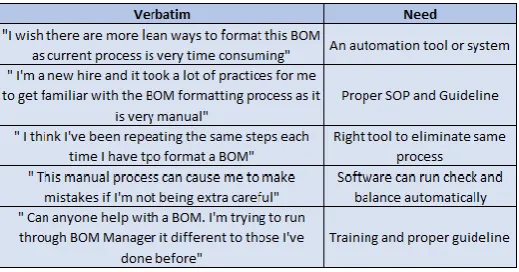
In relation to this step (Define Step), the significant of this project is also highlighted customers. Fig. 3 shows the summary of VOC and their recommendations. The ‘Verbatim’ section given in the Fig. 3 presents the actual version of customers respond (via emails communication) on current BOM formatting process, while the ‘Need’ section is the
initial solution ideas for each customer respond which it come from project team members. This information helps project team to highlight the relevant information and ideas that can be used in this improvement project.
Fig. 3 - Summary of voice of customers
4.2
Measure
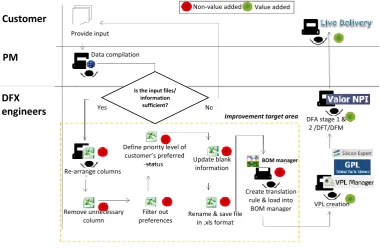
In this step, all the project team members are noticed the important of fundamental measurement metrics that need to be considered in this project, that is the time taken of BOM formatting process, where it can relate with the number of steps/activities involved in the process. Statistical data shows that the average time to complete the BOM formatting process is 50 minutes. Meanwhile the number of activities that currently practice can be presented in Fig. 4.
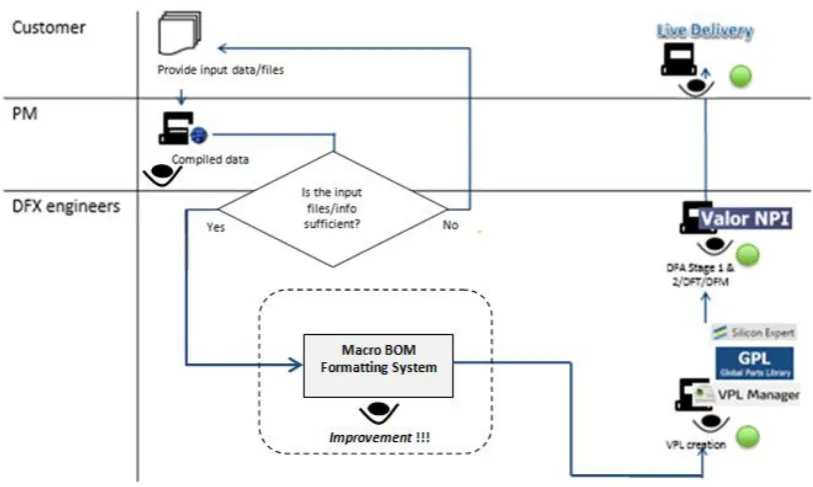
Fig. 4 shows current process flow mapping of the BOM formatting process. It presents possible activities that classified under non-value-added type (red dotted marks). The result found that the non-values added activities in current practice of BOM formatting can be classified under wastes of waiting and motion. The map reveals that there
Title: BOM Formatting Process Improvement
Problem Statement:
BOM formatting process is time consuming. Initial statistical data shows average 50 minutes per product.
Benefits:
Significant reduction of time in BOM formatting process will significantly shorten the overall lead time of the product. Thus, reflects many related manufacturing costs (e.g. utilities, workers, etc.).
Objectives/Goals:
Reduce the BOM formatting process time at least 50% from current process’s time.
Project Scope:
are seven in sequence steps of activities; re-arrange columns, remove unnecessary columns, filter out preferences designator item, define priority level of customer’s preference status, update blank information, rename & save file in .xls format and create translation rule & load into BOM manager that are potentially classified as non-values added activities that cause to long BOM processing time. Moreover, these activities required manual touches (repeat the computer mouse touches/clicks). Meanwhile, the average current processing time is 50 minutes per BOM list and manual touches is 290 steps.
Fig. 4 - Current state mapping
Fig. 5 - Ishikawa diagram (root cause analysis)
4.3
Analyze
In this step, the main focus is to analyze and evaluate the roots causes of the problem, which is to support the initial findings of current process flow mapping as presented in Fig. 4. Root Cause Analysis (RCA) is carried out in team basis, where the involvement of all group members (engineers, technical staffs and manager) in projecting any related causes were encouraged. A series of brainstorming sessions have performed to systematically identify and mapped the causes. Fig. 5 presents Ishikawa diagram to visualize the possible causes to the problem under consideration. Fig. 5 shows numbers of causes that are possible to contribute to the BOM formatting problems, which it divided into four
Customer
PM
DFX
engineers
Data compilation Provide input files
Yes No
Improvement target area
Re-arrange columns
Remove unnecessary column
Filter out
preferences Rename & save file in .xls format Define priority level of
customer’s preferred
status Update blank information
Create translation rule & load into
BOM manager
BOM manager
VPL creation DFA stage 1 &
2 /DFT/DFM Non-value added Value added
Is the input files/ information
sufficient?
Time consuming in performing BOM formatting process
PEOPLE PROCESS
MATERIAL TOOL
Lack of focus (exhaustion)
Mistake
Repetitive
Redundant
Human-dependent
Manual task in data key in process
Non-standardized input data/info
Incomplete input data/info
Insufficient license
Delay/ network issue
Bugs Insufficient
workers
source groups of causes; people, process (activities steps), material and tool. The “People” refer to the responsible worker that performs the BOM formatting, while the “Process” refers to working procedure that currently practices in completing the BOM formatting process. Meanwhile, the “Material” refers to the raw data/information features, while the “Tool” refers to the current software system to manage the data/information that has been key-in.
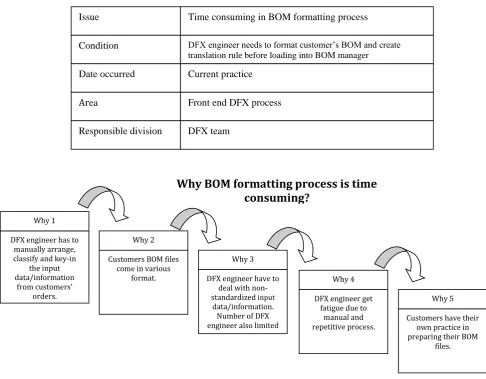
The results of this analysis concluded that there are eight (circle with orange color) significant causes that are inter-related from one to another. Based on Lean concept, mistake and lack of focus relates with “overburden” waste that usually happen when there are involves with manual-based repetitive works in long time period. In this step (Analyze Step), further RCA is carried out by applying Five Whys analysis to identify clear main root cause of the problem under consideration. Fig. 6 visualizes the application of Five Whys analysis.
Fig. 6 - Five whys analysis
Fig. 6 presents a summary of Five Why’s analysis and its pattern of answers from the DFX engineers that currently responsible for BOM formatting process. The result of Five Why’s analysis found two main causes that contribute to long BOM formatting process. First cause is related with human issue, which it refers to DFX engineer currently have difficulty in manage the data manually (Refers the answer patterns of Why 1, Why 3 and Why 4). Thus, the performance (time taken to perform BOM formatting process) of the DFX engineering deteriorate with time and lead to do mistakes (wrong data/information to key in). This cause, relates with the “overburden” scenario (lack of focus,
mistake etc) as highlighted in Ishikawa diagram (Fig. 5). Another cause is regarding the input data/information format that comes from the customers. The answer patterns of Why 2 and Why 5 have highlighted this point. Currently, there have no standard format in preparing input data/information of order from the customers.
4.4
Improve
This step focuses on improvement strategy/solution concept generation and evaluation based on the Root Cause Analysis (RCA) carried out in previous step (Analyze Step). In this project, numbers of brainstorming sessions have been carried out to generate the idea to solve the above mentioned problem. The key guidance in generating the solutions should reduce the identified non-value-added activities (as been highlighted in Fig. 4) and the main cause that
Issue
Condition
Date occurred
Area
Responsible division
Time consuming in BOM formatting process
DFX engineer needs to format customer’s BOM and create translation rule before loading into BOM manager
Current practice
Front end DFX process
DFX team
DFX engineer has to manually arrange, classify and key-in
the input data/information
from customers’ orders. Why 1
Customers BOM files come in various
format. Why 2
DFX engineer have to deal with non-standardized input
data/information. Number of DFX engineer also limited
Why 3
DFX engineer get fatigue due to
manual and repetitive process.
Why 4
Customers have their own practice in preparing their BOM
files. Why 5
has been identified in previous step (Analyze Step). Fig. 7 summarizes the solutions concept. There are four top solutions concept that are possible to be applied and implemented.
Fig. 7 - Solution concept brainstorming summary
The evaluation of these four solutions ideas is then carried out to present explicitly the most practical solution to be considered. This evaluation process is performed based on six evaluation criteria; time efficiency, cost effectiveness, business competitive, automation, error proof and feasibility. All group members in this improvement project including DFX engineers and customers are participated in this evaluation process. The standard evaluation scale 1-5 is applied for all six mentioned evolution criteria. The result of this evaluation shows the highest score is goes to solution idea 3 (62), follow by solution idea 2 (45), solution idea 4 (42) and the lowest score is for solution idea 1(37).
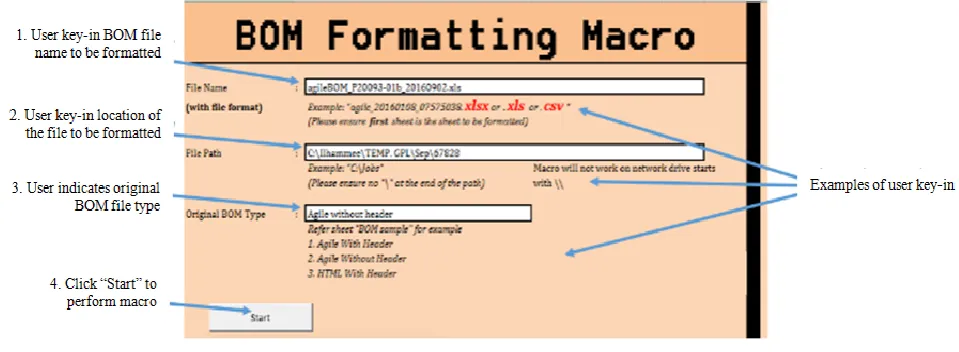
This evaluation concluded that collectively the respondents preferred solution idea 3, where the concept is to develop the system that can manage different format of BOM that come from the customers. The system should be able to sort and classify and standardize format (currently based on manual activities) automatically. Therefore, the project namely “BOM Formatting Macro” was then carried out.
Fig. 8 - Macro graphic user interface feature design
Fig. 8 and 9 visualize the first phase of “BOM Formatting Macro” development that focuses on feature design of Macro graphic user interface and their process flow. Three input data are required in Macro graphic user interface, first is BOM file name, followed by location of the file and finally the type of BOM file. Once the start button is click, the BOM file formatting process begin as presented in Fig. 9. The formatting process initially verified with two simple “Yes/No” decisions sequence. First is based on the question “is user input competed?” and followed by “is the original BOM format matches the type selection?”. If the respond for both of these questions is “No”, then the Macro system presents the error signal, which it means that, the input data required are incomplete format. Otherwise, if the decision
So
lutio
n Co
ncept
Idea Impose BOM format guideline to
customer
Idea 1
Request vendor to upgrade BOM
Manager to read various BOM input formats
Idea 2
Develop macro tool to
automate BOM formatting
process
Idea 3
Transfer BOM information into standard
excel template
Idea 4
Idea
Ass
e
ss
ment
Crit
er
ia
1. Time efficiency 2. Cost effective 3. Business competitive 4. Automation
is verified to be “Yes”, then the next BOM file formatting process followed the process number 1 until process number 5 to complete the overall cycle of the BOM file formatting process.
Fig. 9 - Design macro flow
It is encouraging to compare the finding with previous current state mapping (Fig. 4) to see significant improvement after implementation of Macro formatting system. Fig. 10 shows the future state mapping after improvement has been done. The most significant improvement is average BOM formatting processing time is reduced for 90% (from 50 to 5 minutes only), while the manual touches (computer mouse clicks) is reduced from 290 to30 touches. This is logic improvement due to elimination strategy applied, where seven manual steps of formatting process before improvement are eliminated once the Macro formatting system is introduced. In relation, the number of operators is also reduced from two to one operator only. This is another key solution strategy based on Lean approach that is applied. The overall cost saving so far from this project is $1680 per month, where it contributes from the shorten BOM formatting processing time and reduction of operator, thus it reduces the overall customers lead time for their products.
Fig. 10 - Future state mapping
Start Is user input completed?
Is the original BOM format matches the type
selection?
Reformat (column re-arranging) starts
Message box of related error
Priority assignment
based on customer’s preference status
Prepare BOM using BOM
manager standard translation
template Save files in .xls
(BOM manager readable format) Reset Macro user
interface
End
Yes Yes
No
No
1
2
3
4.5
Control
Control is the last step of DMAIC process. In this project, this step highlighted appropriate strategies that can be carried out by the case study company (especially in the responsible department) to sustain the solution that has been recommended in previous steps. Following are the recommended strategies;
1. New SOP development: It refers to the blue prints of standard of operation (SOP) in performing BOM processing. This new SOP also been shared to the customers, so that they notice how their ordered products will be processed in the stage of BOM process.
2. Training: This strategy focus on new skills development among related worker in using the system (BOM formatting macro system).
5. Conclusion
The application of Lean and Six Sigma approaches to improve the BOM formatting process is presented in this paper. The popular Six Sigma methodology via DMAIC process is applied to systematically guide the improvement project. The related concept and tools of Lean approach are applied to analyze the problem. The development of BOM Formatting Macro System is the key improvement that proposed in presented project. The implementation result reveals that the case study company improve the BOM formatting process by reducing their processing time from average 50 to 5 minutes only, while the manual touches (computer mouse clicks) has reduced from 290 to 30 touches only. In term of cost saving, this improvement project so far have contributes to $1680 of saving per month, where it comes from the shorten effect of BOM processing time due to the implementation of BOM Formatting Macro System implementation.
Acknowledgement
Authors wishing to acknowledge assistance and encouragement from colleagues from School of Manufacturing Engineering Universiti Malaysia Perlis, also top management and technical staffs of the case study company especially in providing data and related information of the project. Authors wish to thank for the financial support from Universiti Malaysia Perlis in completing this publication. Finally, the authors also thank the referees for their useful suggestions to improve the quality of the article.
References
[1] Marisa, F, Ahmad, S. S. S., Yusof, Z. Z. M., Fachrudin, & Aziz, T. M. A. (2019). Segmentation model of customer lifetime value in small and medium enterprise (SMEs) using K means clustering and LRFM model. International Journal of Integrated Engineering, 11(3), 169–180.
[2] Adam, A., Yusof, Y., Iliyas, M., Saif, Y., & Hatem, N. (2018). Review on manufacturing for advancement of industrial revolution 4.0. International Journal of Integrated Engineering, 10(5), 93-98.
[3] Womack, J. P., Jones, D. T., & Roos, C. (1990). The machines that changed the world. Massachusetts Institutes of Technology, New York, NY.
[4] Stone, K. B. (2012). Four decades of lean: a systematic literature review. International Journal of Lean Six Sigma. 3(2), 112-132.
[5] Nallusamy, S., & Adil-Ahamed, M. A. (2017). Implementation of Lean tools in an automotive tndustry for productivity enhancement - a case study. International Journal of Engineering Research in Africa. 29, 175-185. [6] Chan, C. O., & Tay, H. L. (2018). Combining lean tools application in kaizen: a field study on the printing
industry. International Journal of Productivity and Performance Management. 67(1), 45-65, https://doi.org/10.1108/IJPPM-09-2016-0197.
[7] de Jesus, A. R., Antony, J., Lepikson, H. A., & Cavalcante, C. A. M. T. (2015). Key observations from survey about six sigma implementations in Brazil. International Journal Productivity Performance Management. 64(1), 94-111.
[8] Jirasukprasert, P., Garza-Reyes, J. A., Kumar, V., & Lim, M. K. (2014). A six sigma and DMAIC application for the reduction of defects in a rubber gloves manufacturing process. International Journal of Lean Six Sigma. 5(1), 2-21.
[9] Gupta, V., Jain, R., Meena, M. L., & Dangayach, G.S. (2018). Six-sigma application in tire-manufacturing company: a case study. Journal of Industrial Engineering International. 14(2), 511-520.
[10] George, M. L. (2002). Lean six sigma: combining six sigma quality with lean production speed, 1st ed., Tata
McGraw Hill Publication, New York, NY.
[12] Panat, R., Dimitrova, V., Selvamuniandy, T.S., Ishika, K., & Sun, D. (2014). The application of lean six sigma to the configuration control in intel’s manufacturing R&D environment. International Journal of Lean Six Sigma. 5(4), 444-549.
[13] Singh, M., & Rathi, R. (2019). A structured review of Lean Six Sigma in various industrial sectors. International Journal of Lean Six Sigma. 10(2), 622-664, https://doi.org/10.1108/IJLSS-03-2018-0018.
[14] Alexander, P., Antony, J., & Rodgers, B. (2019). Lean Six Sigma for small- and medium-sized manufacturing enterprises: a systematic review. International Journal of Quality & Reliability Management. 36(3), 378-397, https://doi.org/10.1108/IJQRM-03-2018-0074.
[15] Hart, R. (2015). Five-step process improvement with DMAIC, TRACC Publications Editor, https://traccsolution.com/blog/dmaic/.
[16] Ahmad, R., & Soberi, M. S. F. (2018). Changeover process improvement based on modified smed method and others process improvement tools application: an improvement project of 5-axis cnc machine operation in advanced composite industry. International Journal of Advanced Manufacturing Technology. 94, 433-450. [17] Chen L., & Meng, B (2010). The application of Value Stream Mapping based lean production system.