Original Research Article
Prevalence and determinants of dental caries among primary school
children in urban area of Kancheepuram district, Tamil Nadu:
a cross sectional study
Arunkumar M.*, Gopalakrishnan S., Uma Devi R.
INTRODUCTION
Oral health as a component of general health is essential to lead good quality of life.1 Oral diseases are major public health problems owing to their high prevalence and incidence. Dental caries is a global public health problem which affects individuals of all age groups especially children and contributes for their tooth loss if left untreated.2 Dental caries is defined as a localized post
eruptive, pathological process of external origin involving softening of the hard tooth tissue and proceeding to the formation of a cavity.3 Dental caries is a preventable multi factorial disease caused mainly due to bacterial infection as a result of poor oral hygiene. While the other direct causes are defect in the morphology and alignment of the teeth, abnormalities in quantity and quality of saliva and intake of refined carbohydrates. Dental caries is also caused by some Indirect causes like
ABSTRACT
Background: Dental caries is a preventable multi factorial disease which shows increase in prevalence over last five
decades in India. In order to reduce its magnitude and for effective prevention and control, the risk factors and distribution should be well known. This study was planned with the objective of assessing the prevalence and determinants of dental caries among primary school children in an Urban area of Kancheepuram district, Tamil Nadu, India.
Methods: This school based cross sectional study was carried out between November 2017 and February 2018 using
a sample size of 430 selected from two schools by simple random sampling. Data were collected using a pre-tested, structured questionnaire, which were analyzed using SPSS version 16.0 and presented using descriptive and analytical statistics.
Results: Among the study participants, 52.9% had dental caries. Plaque accumulation was noted in 46.2%. About 74% were taking junk foods daily. About 47.1% children were rinsing their mouth daily and 34.6% were brushing more than once daily. Factors found to be protective against dental caries were high socio economic class and daily mouth rinsing habit. Odds of getting dental caries was more among children with visible dental plaque, daily junk foods intake, brushing once daily and failing to brush after foods.
Conclusions: Dental caries is a high prevalent, preventable disease affecting both young and old aged individuals that
can be mitigated by health education activities. Proper oral hygiene can prevent dental caries. Hence more importance should be given for oral hygiene and behavioral changes in dietary habits.
Keywords: Cavities, Oral hygiene, Tooth decay
Department ofCommunity Medicine, Sree Balaji Medical College and Hospital, Chennai, Tamil Nadu, India
Received: 20 February 2019
Revised: 03 April 2019
Accepted: 04 April 2019
*Correspondence:
Dr. Arunkumar M.,
E-mail: [email protected]
Copyright: © the author(s), publisher and licensee Medip Academy. This is an open-access article distributed under
the terms of the Creative Commons Attribution Non-Commercial License, which permits unrestricted non-commercial use, distribution, and reproduction in any medium, provided the original work is properly cited.
gingival recession and some distant causes like age, sex, socio economic status, literacy level, location, dietary habits, social and cultural practices, availability and access to health care facility.4
The major impacts of dental caries on children are pain, discomfort, inflammation of pulp, sensitivity and bacteraemia which affects their daily routine activities like food intake, speech, attendance at school and self esteem at greater level.1,5
According to World Health Organization, dental caries stands third among chronic non communicable diseases with 60 to 90% prevalence among school going children.1,2 Developing countries are at major risk of developing dental caries.6 Indian trends shows increase in prevalence of dental caries over last five decades with prevalence of 50 to 60%.4,7 The prevalence of dental caries in Tamil Nadu among twelve years old age group was 52.2%.8 The prevalence of dental caries in Chennai among five years and twelve years old age group was 83% and 80% respectively.9 Increase in burden level is mainly due to poor oral hygiene and dietary habits.6
For taking effective prevention and control measure of any disease its magnitude and distribution should be well known in advance.6 Dental caries is predominant among children of primary school age group.School age is an influential stage during which every individual develops health related behaviors, beliefs and attitudes.2 In general Children are easily accessible at school.Schools are the prime area for bringing the overall changes from where health messages can be transmitted through school children to their homes and neighbourhood.6
Based on the above background the present study was conducted with the aim of assessing the prevalence and determinants of dental caries among primary school children in an urban area of Kancheepuram district, Tamil Nadu, India, to ascertain the gaps existing in the study area and to plan appropriate preventive measures.
METHODS
Study design
This study was a school based cross sectional descriptive study.
Study area and population
The Study was conducted in Anakaputhur, the urban field practice area attached to a medical college in Kancheepuram district, Tamil Nadu. The Study population included primary school children aged between 5–10 years in the study area. Anakaputhur municipality has population of 48050 of which 24158 are males and 23892 are females. Children aged between 0-6 years constitutes 11.25% of total population of
Anakaputhur. There are total of nine schools in the study area.
Study period
The study was done for a period of four months, from November 2017 to February 2018.
Sample size
The sample size was calculated based on the prevalence of dental caries identified in a study done by P.D.Garkoti et al in the year 2015 among primary school children of Haldwani in uttarakhand, which showed that 58.18% of the study population had dental caries.1 Using the formula 4pq/L2,with 95% confidence level and 5% allowable error, the sample size was calculated to be 390. Adding 10% as non-response rate, the sample size was calculated to be 429, which was rounded off to 430.
Sampling technique
There are nine schools in Anakaputhur. Out of which two schools with primary sections were selected by simple random sampling method. The sampling frame was made by enlisting all the children aged between 5–10 years from the two schools selected. Out of 605 students from the selected two schools, 430 children were identified for the study by using simple random sampling technique. Permission for carrying out the study was obtained from the school management before the commencement of this study.
Inclusion criteria and exclusion criteria
Students aged between 5–10 years who were permitted by their parents and present on the day of study were included in the study. Those who were not permitted by their parents and absent on the day of study were excluded.
Study tool
Data was collected by using a pre-tested structured, interviewer-administered questionnaire. Information on the socio-demographic profile, dietary habits, oral hygienic practices like brushing the teeth and rinsing after food intake was collected and finally examination of oral cavity was carried out. The investigators got trained in examining the oral cavity to identify any oral pathology.
Data collection
study. The children were interviewed and examined in their respective schools. The study subjects were made to sit on a chair in natural daylight. Prior to the examination the children were asked to rinse their mouth with water, then the teeth were dried with cotton swab and the visible dental caries were recorded. 14 children who gave insufficient data were excluded from the study. Study findings were intimated to the respective class teachers and school principals and recommendations for referral to appropriate health facility was made. An intimation was forwarded to the parents of those who are in need of proper dental care. At the end of the study, a session on oral health education was conducted.
Statistical analysis
Collected data were entered in Microsoft Excel and analyzed by using SPSS software version 16.0. Data were presented using descriptive and analytical statistics. Chi-square test was used as the test of significance and was used to compare the differences in proportions with the significance level set at p≤0.05. Odds ratio (OR) with 95% confidence interval was used to describe the association between exposure and outcome variables.
Ethical approval and informed consent
Ethical approval was obtained from Institutional Ethics Committee of Sree Balaji Medical College and Hospital. After explaining about the study and its objectives, written and oral Informed consent was obtained from the parents and the study participants respectively.
RESULTS
The study included 416 school going children aged between 5-10 years from two schools situated in Anakaputhur, the urban field practice area attached to a medical college in Kancheepuram district, Tamil Nadu. The outcome of the study is presented below in the form of tables and graphs.
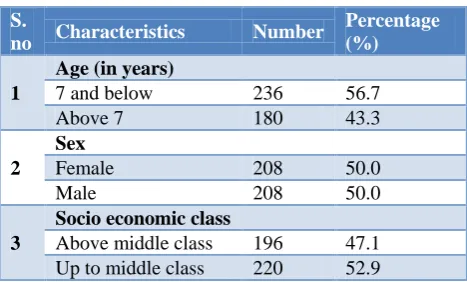
In this study, it was found that among the 416 students, 236 (56.7%) students belonged to the age group between 5–7 years and 180 (43.3%) students belonged to the age group between 8–10 years. Mean age of the study participants were 8.13 years with a standard deviation of 1.4 years. This study includes equal proportion of 208 boys and 208 girls. In this study, 196 (47.1%) students were above middle class and 220 (52.9%) students were middle class and below. The socio demographic details of the study population are given in the Table 1.
With reference to the diet habits, it was found that 352 (84.6%) of the study population consumed mixed diet while 64 (15.4%) of the study population consumed vegetarian diet. It was also found that 308 (74%) study participants were taking sweets, chocolates and junk foods daily and 108 (26%) study participants were consuming them occasionally.
Table 1: Socio demographic characteristics of the study participants (n=416).
S.
no Characteristics Number
Percentage (%)
1
Age (in years)
7 and below 236 56.7
Above 7 180 43.3
2 Sex
Female 208 50.0
Male 208 50.0
3
Socio economic class
Above middle class 196 47.1
Up to middle class 220 52.9
Table 2: Details of oral hygienic practices and problems of the study subjects (n=416).
S.
no Characteristics Number
Percentage (%)
1
Brushing frequency
Once daily 272 65.4
More than once daily 144 34.6
2
Brushing after foods
No 304 73.1
Yes 112 26.9
3
Rinsing after foods
Yes 196 47.1
No 220 52.9
4
Visible dental plaque
Yes 192 46.2
No 224 53.8
Oral hygienic practices like brushing the teeth and rinsing the mouth were practiced among the study population. With reference to the oral hygienic practices, it was found that 272 (65.4%) study participants were brushing once daily and 144 (34.6%) study participants were brushing more than once daily. Meanwhile 112 (26.9%) study participants were brushing after intake of foods and 304 (73.1%) study participants do not have the habit of brushing after foods. It was also found that 196 (47.1%) study participants had regular mouth rinsing habit after food intake and 192 (46.2%) study participants were with visible dental plaque. The details of oral hygienic practices and problems of the study population are given in Table 2.
On clinical examination of the oral cavity, the prevalence of dental caries was found in 220 (52.9%) students and 196 (47.1%) students were free from dental caries (Figure 1).
and the presence of dental caries. Factors found to be protective against dental caries were high socio economic class and daily mouth rinsing habit. Odds of getting dental caries was more among children with plaque accumulation, daily sweets, chocolates and junk foods
intake, brushing once a day and failing to brush their teeth after food intake. The details of association between the determinants and dental caries are given below in Table 3.
Table 3: Association between the determinants and dental caries.
S.
no Factors
Dental caries present (n=220)
Dental caries absent (n=196)
Total no.(%)
Chi square value
P value Or (95% ci)
Demographic factors No. % No. %
1 Age (in years) 7 years and below 128 54.24 108 45.76 236(100) 0.401 0.527 1.13 (0.77 – 1.67) Above 7 years (ref) 92 51.11 88 48.89 180(100)
2 Sex
Female 112 53.85 96 46.15 208(100)
0.154 0.694 1.08 (0.74 – 1.59) Male (ref) 108 51.92 100 48.08 208(100)
3 Socio
economic class
Above middle
Class 84 42.86 112 57.14 196(100)
14.96 <0.0001* 0.46 (0.31 – 0.69) Upto middle
Class (ref) 136 61.82 84 38.18 220(100) Dietary practices
4 Type of diet Vegetarian 28 43.75 36 56.25 64(100) 2.53 0.111 0.65 (0.38 – 1.11) Mixed (ref) 192 54.55 160 45.45 352(100)
5
Frequency of sweets, chocolates and junk foods intake
Daily 212 68.83 96 31.17 308(100)
121.08 <0.0001* 27.60
(12.92 – 58.99) Occasionally (ref) 8 7.41 100 92.59 108(100)
Oral hygiene practices and problems 6 Brushing
frequency
Once daily 192 70.59 80 29.41 272(100)
11.53 <0.0001* 9.94
(6.10 – 16.20) More than once
daily (ref) 28 19.44 116 80.56 144(100) 7 Brushing after
foods
No 208 68.42 96 31.58 304(100)
109.36 <0.0001* 18.06 (9.47 – 34.44) Yes (ref) 12 10.71 100 89.29 112(100)
8 Rinsing after foods
Yes 64 32.65 132 67.35 196(100)
60.88 <0.0001* 0.19 (0.13 – 0.30) No (ref) 156 70.91 64 29.09 220(100)
9 Visible dental plaque
Yes 128 66.67 64 33.33 192(100)
27.18 <0.0001* 2.87 (1.92 – 4.29) No (ref) 92 41.07 132 58.93 224(100)
OR: Odds Ratio; CI: Confidence Interval; ref: reference; p<0.05- statistically significant at 95% confidence interval.
Figure 1: Prevalence of dental caries (in percentage) among the study participants.
DISCUSSION
Dental caries stands third among chronic non communicable diseases with 60 to 90% prevalence
among school going children. Indian trends shows increase in prevalence of dental caries over last five decades with prevalence of 50 to 60%. This study outcome from Kancheepuram district shows interesting findings, which is discussed below.
Socio demographic variables
Age
In the present study, the overall prevalence of dental caries among 5–10 years aged school going children was found to be 52.9% which is concordant with the study by Garkoti et al among 6–11 years aged children in which the prevalence of dental caries was 58.18%.1 Gomathi et al, in their study among 5-10 years aged children reported the prevalence of dental caries to be 63.9% and Hiremath et al in their study among 6–11 years aged school children found that the prevalence of dental caries was 78.9% while Karunakaran et al in their study among 4-6
years children found that the prevalence of dental caries was 65.88%.2,7,10
Dental caries being a cumulative process showed high prevalence in children mainly due to accessibility to caries prone foods. The higher overall prevalence of caries status indicates continued negligence of oral health.
Mulu et al in their study among school children between 6–15 years of age, found the prevalence of dental caries to be 21.8% which is far below the prevalence in the present study.11 Similarly the study on prevalence of dental caries among 12 years old children by Tasneem et al showed 25% prevalence while Rajesh et al reported the prevalence of dental caries among 3-15 years children as 32.9% and Bansal et al on their study on dental caries among 5-18 years aged school children reported 30.8% prevalence. This discrepancy can be attributed to different age group and geographic locations of that study.6,12,13 Further various factors like availability of dental services and level of oral health awareness leads to wide variation in the level of disease in same age group.7
In the present study, the prevalence of dental caries among the children of 5–7 years age group (54.24%) was higher than the prevalence of dental caries among children of 8–10 years age group (51.11%). But this difference is not statistically significant (p=0.527). This shows that the prevalence of dental caries is not statistically associated with age of the children.
Gender
In the present study, the prevalence of dental caries was found to be comparatively higher among girls (53.85%) than that of boys (51.11%) and this difference is not statistically significant (p=0.694).
Similarly, Gomathi et al, in their study reported slightly higher prevalence among girls (54%) than boys (46%).2 Mulu et al in their study, found the prevalence of dental caries was higher among girls (24.4%) than that of boys (18.5%) while Khanal et al also observed higher prevalence among girls (62.7%) than that of boys (53.4%).11,14 The higher dental caries prevalence among girls might be due to early eruption of teeth in girls and hence their teeth being exposed to caries prone environment for a longer duration when compared with boys.Recent studies suggest that the females are highly susceptible to dental caries which may be attributable to changes in salivary rates and composition induced by
hormonal fluctuations among them.7
In contrary to the above, Garkoti et al in their study reported that the overall prevalence of dental caries was higher among boys (60%) than girls (56%) and Karunakaran et al in their study reported that the prevalence of dental caries was 69.57% among boys and 61.5% among girls while Dhar et al, in their study
observed that caries prevalence was higher among boys with 48.13% than girls with 45.26%.1,10,15 Similarly Joshi et al in their study reported a higher prevalence among boys (80%) than in girls (73%) and Saravanan et al in their study found that among the 5 year group, prevalence of dental caries was 47.4% in males and 41.1% in females.16,17
Socio–economic status
In the present study, the prevalence of dental caries decreases with better socio economic status. This study shows 61.82% prevalence among children up to middle class and 42.86% among children above middle class and this difference is statistically significant (p<0.0001). Children with socio economic class of above middle class are less likely to develop dental caries than those of middle class and below (OR–0.46, 95% CI 0.31–0.69).
Datta et al in their study found that 84.2% of the students belonging to the less income group had dental caries in comparison to 59.65% students in higher income group and this difference is statistically significant.18 In the same way Sudha et al also reported that the prevalence of dental caries was higher in the low socio-economic group (96.2%) than the high socio-economic group (77.1%) which was also statistically significant.19 Gomathi et al and Tasneem et al also reported that the prevalence of dental caries decreases with better socio economic status.2,6
This significant variation in the prevalence of dental caries can be because of better economic status, accessibility to oral hygiene products at appropriate age, increased level of knowledge and awareness on oral health, among individuals with better socio economic status.
Dietary habits
Type of diet
In this study the prevalence of dental caries was higher among those who consumed mixed diet (54.55%) than those who consumed vegetarian diet (43.75%). But this difference is not statistically significant (p=0.111).
This variation in prevalence of dental caries with type of diet may be due to increased intake of sucrose-containing foods among individuals taking mixed died than vegetarians.
Daily intake of sweets, chocolates and junk foods
In the present study 212 children (68.83%) who were consuming sweets, chocolates and junk foods daily and 8 children (7.41%) who were consuming sweets, chocolates and junk foods occasionally presented with dental caries. This difference is statistically significant (p<0.0001). The Odds of developing dental caries was 28 times more among individuals who consumed sweets, chocolates and junk foods daily than those who consumed them occasionally (OR–27.6, 95% CI 12.92–58.99).
Gomathi et al in their study found that the prevalence of dental caries was higher among children with regular intake of sweets, chocolates and junk foods (58.9%) than among children with occasional intake (9.2%) and this difference is also statistically significant.2 Mulu et al in their study among school children between 6–15 years of age, reported that 29.6% prevalence among children with daily consumption of sweets, chocolates and junk foods than 14.7% among children with occasional consumption of sweets, chocolates and junk foods. This difference is also statistically significant.11 Similarly the study by Rajesh et al and Joshi et al also reported the higher prevalence of dental caries among regular consumers of sweets, chocolates and junk foods than occasional consumers.12,20
In general increased sweets intake leads to increased fermentation of sweet foods which results in copious acid production by cariogenic bacteria. These cariogenic bacteria are adherent to the teeth and ultimately leads to decalcification of the dental enamel.
Oral hygienic practices and problems
Brushing practice
In this study oral hygienic practices like brushing the teeth and rinsing after food intake was practiced among the study participants and it was found that 272 (65.4%) children brushed their teeth once a day and 112 (26.9%) children were brushing after intake of foods.
With reference to the habit of brushing the teeth, it was found that individuals who brushed their teeth more than once a day (19.44%) had lower prevalence of dental caries than those who brushed their teeth once a day (70.59%) and this difference is statistically significant (p<0.0001). Children with the habit of brushing once a day are 10 times more prone for developing dental caries than those children brushing more than once a day (OR– 9.94, 95% CI 6.10–16.20).
This is in concordance with the study done by Gomathi et al and Datta et al this difference was statistically significant.18 Mulu et al in their study reported that only 16% of children who were cleaning their teeth regularly presented with dental caries whereas 36.6% children with irregular brushing habits had dental caries and this difference was also statistically significant.11
In the present study it is observed that 112 (26.9%) children were brushing after intake of foods and 304 (73.1%) children do not have the habit of brushing after foods. Among them 10.71% of those who were brushing after intake of foods and 68.42% of those who do not have the habit of brushing after foods developed dental caries. This difference is statistically significant (p<0.0001). The odds of developing dental caries was 18 times more for children without the habit of brushing their teeth after food intake than those with the same habit (OR–18.06, 95% CI 9.47–34.44).
Rinsing habit
Mouth rinsing habit was also practiced among the study participants and it was found that 196 (47.1%) children were washing their mouth after each meal while 220 (52.9%) children do not have the habit of rinsing their mouth after each meal.
Gomathi et al in their study found that 54.1% of the children rinse their mouth with water regularly after each meal and Khanal et al reported that 74.6% of the children had the habit of rinsing their mouth after every meal.2,14
It is observed in our present study that mouth rinsing habit is a protective factor against dental caries with 32.65% prevalence among children with regular rinsing habit than those children without regular rinsing habit (70.91%). This difference is also statistically significant (OR–0.19, 95% CI 0.13–0.30, p<0.0001).
Gomathi et al and Datta et al also reported that the prevalence of dental caries was lower among children with habit of rinsing their mouth after every meal and this difference is again statistically significant in both their studies.2,18
In contrast to this, Sudha et al stated in their study that dental caries has no association with oral hygienic practices. In addition, they also reported that caries prevalence was higher in children with regular rinsing habit. 19 This variation might be due to the possibility of false report of rinsing habit by the children to please the investigator.
Plaque accumulation
In the present study, it is observed that plaque accumulation was present in 192 (46.2%) children. It is also noted that individuals with visible plaque accumulation are 2.9 times more prone to develop dental caries than their plaque free counterparts (OR–2.87, 95% CI 1.92–4.29). Here 66.67% of those with plaque accumulation developed dental caries. Whereas only 41.07% of their plaque free counterparts developed dental caries. This difference is statistically significant (p<0.0001).
Similar to our study Mulu et al also observed increased prevalence of dental caries among individuals with visible dental plaques (28.28%) than their plaque free counterparts(14.02%).11 Sudha et al also reported the similar result of increased caries prevalence among the children with visible dental plaque.19
This is because, visible dental plaque being a good indicator of poor oral hygienic practices, increases the colonization of cariogenic bacteria which ultimately leads to development of dental caries.
Limitations of the study
In the present study dental caries was identified by clinical examination and no radiographs were taken. This might either over estimate or under estimate the actual burden of the problem. This study was done among private school children and so the outcomes could not be generalized to children studying in government schools. This study was done in the urban field practice area of our Institution as a school based study. It would be better if the study have been planned on a larger scale, covering general populations to have a better understanding on magnitude of the problem, so that the outcomes could be generalized to a larger study area.
CONCLUSION
Dental caries is a major public health problem among primary school children. Low socio economic status, improper dietary habits and poor oral hygienic practices contributes for the development of dental caries. Hence more importance should be given for accessibility to healthy foods and promotion of behavioral changes in oral hygiene. The disease burden can be can be alleviated by creating awareness through health education on oral hygiene and dietary habits. Active involvement of both school teachers and parents is mandatory for promoting oral health and preventing oral morbidities among school children.
Recommendations
Oral health should be considered as a part of general health by promoting periodic dental visits. Dental health facilities should be made available at all primary health
care level. Regular screening camps should be conducted for early diagnosis and prompt treatment of oral morbidities. Educating school teachers, forming a school health team and creating awareness among parents regarding oral hygiene will helps to reduce the disease burden. Fluoride level of drinking water should be monitored periodically to prevent the development of dental caries. Further studies including all methods of diagnosing dental caries and assessment of knowledge, attitude and practices on dietary habits and oral hygiene among school children and their parents should be recommended.
ACKNOWLEDGEMENTS
We would like to thank the College Management, Faculty of Department of Community Medicine and staffs of Urban Health Training Centre, Anakaputhur for helping us in every possible way to successfully complete this study. My sincere thanks to the management, staffs of the schools and parents of the study participants for their valuable time in carrying out this study. A special gratitude to my friends and family members for their moral support.
Funding: No funding sources Conflict of interest: None declared
Ethical approval: The study was approved by the Institutional Ethics Committee of Sree Balaji Medical College and Hospital
REFERENCES
1. Garkoti PD, Singh RK, Rawat CMS, Pandey S.
Prevalence of Dental Caries among Primary School Children of Haldwani: A Cross Sectional Study. J Evol Med Dent Sci. 2015;4:7096-100.
2. Parasuraman G, Gowtham Krishna Y, Kaviya M,
Jain NA, Rajendiran P, Dutta R. A study on the prevalence of dental caries among the school going children in Tamil Nadu. Int J Community Med Public Health. 2017;4:3582-9.
3. World Health Organization. Technical report series
242. Available at: http://apps.who.int/iris/
handle/10665/ 38150/WHO_TRS_242. Accessed on 25 November 2018.
4. National Commission on Macroeconomics and
Health. Burden of disease in India 2005. Available at: http://www.who.int/macrohealth/action/national_ reports/en. Accessed on 25 November 2018. 5. Suprabha BS, Rao A, Shenoy R, Khanal S. Utility
of knowledge, attitude, and practice survey and prevalence of dental caries among 11- to 13-year-old children in an urban community in India. Glob Health Action. 2013;6:20750.
6. Ain TS, Sultan S, Gowhar O, Ravishankar TL,
7. Hiremath A, Murugaboopathy V, Ankola AV, Hebbal M, Mohandoss S, Pastay P. Dental Caries Among Indian School Children. J Clin Diagnos Res. 2016;10(10):47-50.
8. Veerasamy A, Kirk R, Gage J. Epidemiology of
dental caries among adolescents in Tamil Nadu, India. Int Dent J. 2016;66(3):169-77.
9. Mahesh Kumar P, Joseph T, Varma RB, Jayanthi M.
Oral health status of 5 years and 12 years school going children in Chennai city - An epidemiological study. J Indian Soc Pedod Prev Dent. 2005;23:17-22.
10. Karunakaran R, Somasundaram S, Gawthaman M,
Vinodh S, Manikandan S, Gokulnathan S. Prevalence of dental caries among schoolgoing children in Namakkal district: A cross-sectional study. J Pharm Bioall Sci 2014;6:160-1.
11. Mulu W, Demilie T, Yimer M, Meshesha K, Abera
B. Dental caries and associated factors among primary school children in Bahir Dar city: a cross-sectional study. BMC Res Notes. 2014;7:949.
12. Rajesh SS, Venkatesh P. Prevalence of dental caries
among school-going children in South India. Int J Med Sci Public Health. 2016;5:700-4.
13. Bansal R, Sharma S, Shukla AK, Parashar P, Singh
D, Varshney AM. Prevalence of dental caries among school children in Meerut. Asian Pac J Health Sci. 2015;2(1):84-8.
14. Khanal S, Acharya J. Dental caries status and oral health practice among 12-15 year old children in
Jorpati, Kathmandu. Nepal Med Coll J.
2014;16(1):84-7.
15. Dhar V, Bhatnagar M. Dental caries and treatment needs of children (6-10 years) in rural Udaipur, Rajasthan. Indian J Dent Res. 2009;20:256-60.
16. Joshi N, Rajesh R, Sunitha M. Prevalence of dental
caries among school children in Kulasekharam village: A correlated prevalence survey. J Indian Soc Pedod Prev Dent. 2005;23:138-40.
17. Saravanan S, Anuradha KP, Bhaskar DJ. Prevalence
of dental caries and treatment needs among school going children of Pondicherry, India. J Indian Soc Pedod Prev Dent. 2003;21:1-12.
18. Datta P, Datta PP. Prevalence of Dental Caries among School Children in Sundarban, India. Epidemiol. 2013;3:135.
19. Sudha P, Bhasin S, Anegundi RT. Prevalence of
dental caries among 5-13-year-old children. J Indian Soc Pedod Prev Dent. 2005;23(2):74–9.
20. Joshi N, Sujan SG, Joshi K, Parekh H, Dave B. Prevalence, Severity and Related Factors of Dental Caries in School Going Children of Vadodara City – An Epidemiological Study. J Int Oral Health. 2013;5(4):40-8.
Cite this article as: Arunkumar M, Gopalakrishnan
S, Uma Devi R.Prevalence and determinants of