* To whom all correspondence should be addressed. Tel.: +98-912-2497906; Fax: +98-2188202520 E-mail: [email protected]
Designing, Implementation and Evaluation of a
Blended Learning Model in Large Class Education
Malahat Nikravan Mofrad* and Mehrnoosh Pazargadi
Member of Faculty, Shahid Beheshti University of Medical Sciences, Tehran, Iran.
DOI: http://dx.doi.org/10.13005/bbra/1180
(Received: 15 August 2013; accepted: 10 October 2013)
High content of heading of most theory courses, in comparison with the hours to teach them, make severe problems for using student - centered (learner - centered) learning methods . In this regard, one of the strategies outlined in teaching / learning processes, is to away from lecture-based classes, and transfer some parts of learning responsibility to students. Designing methods to engage students in self learning, can afford to make learning more efficient. This study with the purpose of designing, implementation and evaluation of blended learning model in large class education in medical science, is trying, with develop and designing a model based on combination of face to face training with distance education as virtual classes, meets some major problems of teachers and students in large classes.
Key words: Blended learning model, Learning in large class, Active learning, Face to face training, Distance education.
Typically in most major academic classrooms, lecture method is used by most of instructors. In order to the large number of students in classes and few hours for teaching in comparison with headings, lecture still is the common educational method,that includes as best, questioning and answering .
This method is totally teacher-centered, and requires very few of students learning activities. The result of such training method is to achieve low levels of learning in cognitive domain. It is shown that in passive learning with lecturing, attention is going to be decreased rapidly. Even if we assume that our lectures have the necessary characteristics and appropriate. In addition to, it is important to have deep understandings of how people learn as well as what new technology can provide for the successful design of
technology-integrated learning environments1 .Studies show
that the exclusive use of the lecture in class, lead to decrease and stop students learning. Some researchers analyzed the performance of learners during the 50 minutes lecturing. They have shown that after 10 to 20 minutes, attention and delicacy drops quickly. However, many of them ignore this issue2.According to Boettcher during a lecture,
students typically learn and focus on the vocabulary related to the course. But this often done separately from understanding the concepts of the words . Therefore in short time after exam students forget them3.
Distance learning is the method that with using educational Medias, engages students actively in self directed and self paced learning methods4.
in 2009 indicate that using educational courses in blended form, in comparison with traditional courses can more effectively lead to improvement of the level of student’s learning. findings of Iley, etal study indicates that by blended learning, mentors identified higher levels of confidence and greater depth of knowledge and skills amongst their student6. Also the results of Chen & Jones,
illustrate that students feel more power in the blended classes in concepts understanding and their analysis skills are increased during the course7.
findings of greener’s study in 2008 indicates that the use of self directed learning methods and interdependence of students in group, are the key factors of their success in blended learning8.
In this study, we tried by designing, implementation and evaluation of a blended learning model, engage students in large classes actively in learning activities. Use of this methods in small groups, typically is possible, but this research aims to design a blended learning model for large classes.
The overall objectives of this study include:
1. Design and provide blended learning model for teaching in large classes.
2. Performance testing and evaluation of blended learning model for teaching in large classes.
3. Provide the ultimate model of blended learning for teaching in large classes in medical science.
Materials and Methods
This research was a mixed method one, in which, after design of blended learning model for teaching in large classes, first its validity was discussed by experts in educational sciences, through the expert panel, and after accrediting by them, the experiment was carried out. And at the end, it was evaluated and integrated from different aspects.
This study was based on both qualitative and quantitative approach and has the following three steps:
First stage
In regard with first objective of the study- After review of research’s background and literature review, consideration of theoretical teaching
aspects for clinical features, as well as conditions and requirements of teaching and learning in nursing students, a model of blended learning with the use of educational media (virtual classes) and face to face classes in college, was extracted and compiled. To determine the validity of the proposed model, it has been discussed in an expert panel by specialists in the field of educational sciences. finally, the proposed model was corrected. In this step, study population consisted of 19 specialists in educational sciences.
second stage
In regard with second objective of the study- In this stage, the proposed blended model was implemented in theory course of “ nursing patients with internal heart disorders “, and the various qualitative and quantitative aspects of it were evaluated.
At this stage, the study population consisted of 37 students(boys and girls) in third semester of nursing, of Shahid Beheshti Nursing and Midwifery University.
third stage: in regard with third objective of the study
1. According to the results of qualitative and quantitative research, the blended learning model for teaching in large classes was integrated. 2. The ultimate model as blended learning model for teaching in large classes in medical education was presented.
results and discussion
In relation with the first goal, the findings indicate that 42.11% of educational especialists approved the proposed model of blended learning for teaching in large classes in high-level and told that it is applicable. 57.89% of the experts partially approved it.
In general, the results of extensive quantitative evaluation of the virtual and face to face classes illustrated that this model has been able to reach successfully the measures of active learning in large classes. In this regard, the strengths and weakness of model were assessed and evaluated by students by qualitative aspect. in relation with second goal
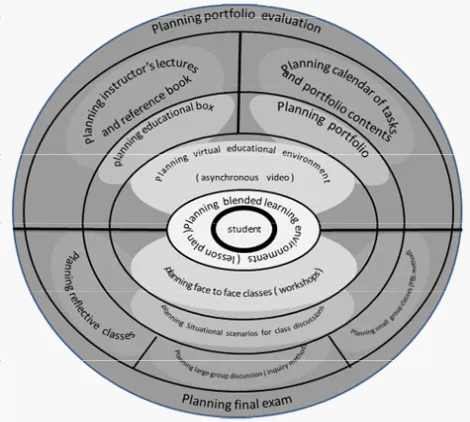
Fig. 1. Showsblended learning model for teaching in large classes in medical science
Fig. 2. Displays four concepts of blended learning model 2. Based on the qualitative findings, the
necessity of reflection classes was consolidated.
3. Considering all the points of reform, the ultimate blended learning model for teaching in large classes in medical education was presented.
Final result
Final model of blended learning to teach in large classes in medical science
Philosophy
Due to necessity of shifting away from teacher-based toward student-centered education
trends, one of the policies offered worldwide is to shift away from lecture-based education and assigning part of the learning responsibility to students. Thus, the student with conduction of instructor can learn part of the theoretical courses remotely. Thus, in face to face classes, more time is left for presenting courses that require more clarification and justification by the instructor and also conducting some of the issues in format of educational workshops.
Fig. 3. Shows educational environments in large training groups, facilitates activation of
learning process and deepens learning up to the level at which learner would be able to act properly, make decisions, evaluate, and apply theoretical knowledge in real environments (figure 1). Principles and theoretical issues of model : A) Having a model in medical Universities,
especially nursing colleges to improve Learners’ learning outcomes.
B) Increasing the learner’s potential for self-guided learning and independent learning. C) Development of lifelong learning.
D) Increasing the learner’s potential to solve problems in real situations
E) Enhancing and developing learner’s potential for making personal and professional
decisions.
f) Developing the learner’s potential for clinical judgment
Purpose
A) Improving the quality of training in Medical sciences, in large educational groups B) Achieving criteria for active learning in large
educational groups
C) Providing basis for reaching the desirable learning outcomes
D) Helping the students to achieve their independent and self –directed learning skills
E) Bringing theoretical closer to the skills of practical use, through workshops training f) generating knowledge through forcing
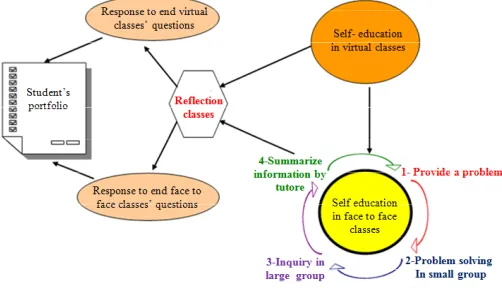
Fig. 5. Displays schematic view of discussion in class
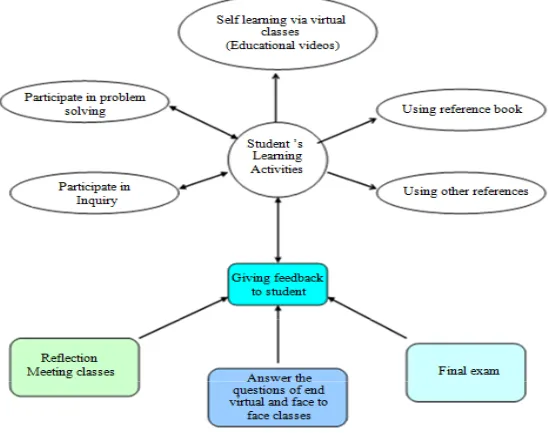
Fig. 6. Shows student’s activities students to participate in group discussion
for problem solving structure
This model has been designed based on three theories of distance learning:
A) Authority and independence theory: in this theory, the learner is placed in the center of learning. The center place of the learner is a prominent and evident feature of distance learning.
B) Industrial development theory: This theory is based on enabling learners to do what they have learned theoretically into practice. C) Interaction and communication theory:
This theory is based on the importance of communications in planned interactions.
The structure this model consists of the
virtual learning environment as training films, from a professor’ lectures, and a face to face learning environment includes a classroom with a special arrangement for discussion in small groups and then in large group.
Based on content of this model, the role of each of the relevant factors is as following: tutore’s role
- Presenting contents of theoretical course focusing on learning requirements through lectures in virtual classes
- guide and discussion facilitator in face to face classes
the student’s role
- S e l f - l e a r n i n g , s e l f - g u i d a n c e a n d independence in learning
- Active participation in group discussions - Completing the assignments in format of
portfolio
the role of virtual classes
- Providing an environment in which, contents of lessons, are delivered to students as training movies, with emphasis on learning necessities.
- Providing an environment in which the student is able to self-learn in any place and any time.
the role of face to face classes
- Phyical location where large educational groups gather and exchange what they learned for solving clinical issues raised in class.
- The environment in which students generate the knowledge by participating and interaction with each other, with the instructor’s guidance.
steps of implementation of the model
The final model of blended learning for teaching in large groups, educational is designed based on a combination of face to face and virtual education. This model is student-centered and can be explained based on four concepts as tutor activities, educational environment s, learning
activities and evaluation and feedback (figure 2). tutore activities
tutore activities include
1. Course designing: at first tutore must design a course plan and lesson plans for bout virtual and face to face classes.
2. D e s i g n a n d d eve l o p e d u c a t i o n a l environments: These environments include virtual learning and face to face environment that subsequently will be explained. Design and develop learning resources: Includes a reference book, training video presentations, and other helpful resources on sites in relation with the course.
3. Design of scenarios related to the workshops: Includes the design of specific clinical situations that students should have discussed on them.
4. Preparation of educational box. This package includes the following:
- guidelines for passing blended learning course
- Lesson plan with expected outcomes - Educational video (DVDs) related to the
virtual classroom
- Answersheets of questions at the end of each educational video
- Answersheets of questions at the end of each workshop session
design of student assessment methods: include a designing portfolio, reflection sessions and final evaluation.
educational environment
This environment is composed of two parts: the virtual learning environment and face to face classes (fig. 3).
Virtual learning environment
In this environment, part of the theory courses that can be presented in lecture format, through 10-30 minutes recorded videos are provided on DVDs. These videos should be presented in the form of instructor’s lectures with educational slides and movies presentation, and should be prepared in an attractive environment for students. Up to 3 to 4 movies per week should be considered, and students should watch them with their own planning and scheduling.
At the end of each video, a challenging question related to the instructed content should be raised. The student is required to answer it on the answer sheet that has been provided in training package. Answers to these questions require students to refer to the reference book, various sites and other resources, or any other exploring activities.
Face to face classes
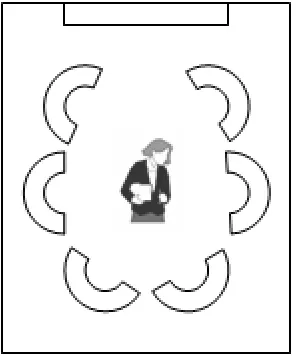
This environment is related to education in the classroom. given that part of the course contents are offered in virtual classes, class time is devoted to focus and discussing on applicated clinical contents. In order to create deeper learning in students, the classroom should be run as a workshop. Due to the large number of students per term, usually between 40 and 60, students should be divided into 6 groups of 6 to 7. Class arrangement should be U-shaped (fig. 4).
first, a clinical situation is presented for each group (different scenarios for each group). These scenarios include questions that the group is required to answer them in relation with educational videos, background information, and also resources that instructor provide for them in class. To respond to the scenarios presented, 30 minutes is given to all groups. After 30 minutes, all groups will be ready to discuss on their scenario with other students. By the way, inquiry and discussion in large group begins on scenario 1.
Before beginning the discussion, a print of that scenario is given to all students, so they will
be dominated on the issue and questions, and can write the desired points and answers on it. The first question is raised by one of the members of small group and then inquiry is formed in large group. Due to the large number of students in class, tutor is required to run the discussion among all of them. This discussion and inquiry continues 20 minutes so that all students reach the final answer. Then scenario 2 is presented, etc....
After 4 hours workshop, a challenging question is raised by tutor for all class and they must answer it on their answer shit in their portfolio. figure 5 shows the schematic view of discusion process in class. (fig. 5)
student’s activities
These activities are students-centered, and include self-learning in virtual environment and active participation in the workshops and feedback sessions (fig. 6).
self education
Student is required to self education in the virtual learning environment through watching all the training videos; go to reference book, internet and any other resources. In this regard, the student is required to answer questions at the end of each training videos, and deliver them to the tutor as portfolio.
Workshop training
The student is required to attend face to face classes, and participate actively in small group discussion to solve the problem offered the group. Also student is required to actively participate in query in large group.
reflection session
Students with presence in reflection sessions, introduce their questions and uncertainties, and assess their responses to questions in their portfolio.
student evaluation and feedback
Students are evaluated in three ways: portfolio, reflection and final test (fig. 7).
Portfolio
Answer sheets of questions raised at the end of each film, and also each face to face classes, are in student’s portfolio. The portfolio has goals consistent with the objectives of the course. (How ratings portfolio is according to the tutore) reflection sessions
at the end of each workshop, so the students’ questions are answered strictly and their mistakes are corrected specifically.
Final exam
This test is done at the end of the course and reflects the level of student’s learning.
conclusion
In general, the result of the qualitative and quantitative research indicates the effectiveness of this model for teaching and learning in large classes. The following,are the summary of the results of evaluation of blended learning model, for education in large classes in medical science :
• Based on the results of statistical analysis of
virtual classes, And the results of qualitative research, using educational video as a professor’s lecture s, with slides show, is an effective method for virtual education.
• Using portfolio to create motivation for
investigation related to course content is effective method for activating and giving feedback to students.
• Using problem solving method with
providing scenarios resources needed to solve the problem, and give limited time to students is a very effective method for discussion in small groups, and make students more active and enable them to learn more deeper . During these situations, learning from peers was happened and students will also develop and train together to pay to fix the problem.
• Using inquiry for large group discussion
in class (all students participation in class discussion), is a very effective method of activating students, and increase the level and depth of learning.
• In general, the use of blended learning model
has this feature that keeps typical classroom lecture as videos to students, so they learn them at self paced and self directed manner.
By this reason, the face to face class time will be enough to run workshops and make all students more engaged in active learning.
reFerences
1. Bransford, J. D., Brown, A. L., & Cocking, r. r., How people learn: Brain, mind, experience, and school. Washington,DD: National Academy Press, 2002.
2. oliveira .P. C., oliveira. C. g., Souza. f. N., & N., C., Teaching Strategies to Promote Active Learning in Higher Education. IV International Conference on Multimedia and Information & Communication Technologies in Education, 2006; 636-640.
3. Judith, V. B., Ten Core Principles for Designing Effective Learning Environments: Insights from Brain research and Pedagogical Theory. League for Innovation Conference on Information Technology, 2004.
4. Holden . Jolly T., Westfall. Philip J.-L, & I., g. K., An instructional media selection guide for distance learning— Implications for blended learning featuring, An introduction to virtual world (SECoND EDITIoN ed.): United States Distance Learning Association(USDLA), 2010. 5. griffiths . Michael E., & r., g. C., Using
Asynchronous Video in online Classes: results from a Pilot Study. International Journal of Instructional Technology and Distance Learning March 66 6, 2009.
6. Iley. Karen, McInulty. Lorna, Jones. Ian, Yorke. Janelle, & Martin, J., Developing competence in cardiac care through the use of blended learning: Course members’ and mentors’ accounts. Nurse Education Today 2011; 31(4): 323-327. 7. Chen .Clement C., & T., J. K., Blended Learning
vs. Traditional Classroom Settings: Assessing Effectiveness and Student Perceptions in an MBA Accounting Course. The Journal of Educators Online, 2007; 4.
8. Susan, L. g., Selfaware and Selfdirected: Student Conceptions of Blended Learning. MERLOT Journal of Online Learning and Teaching,