A Theoretical Consumer Decision Making Model:
The Influence of Interactivity and Information
Overload on Consumers Intent to Purchase Online
Raushan Gross
Greensboro College
Abstract
The study examined factors that influence virtual online consumer decision making by interpreting relevant decision making models. This conceptual paper suggest that consumer purchase intent, when mediated by virtual websites, are influenced by interactivity and information overload. This is of course, built on the overarching concept of consumer decision making. Therefore, the researcher outlines numerous decision making models. The researcher proposed the assumption that decision making models are geared to either the consumers’ cognition, or information flow. That is to say, the e-tail merchant can change the flow and amount of information, mitigate the online purchasing risk, and of course, allow for interactivity between the online site and the consumer.
Keyword:
Virtual shopping, Consumer, Decision making, Interactivity, information overload
CONSUMER DECISION MAKING MODELS:THE INFLUENCE OF INTERACTIVITY AND INFORMATION OVERLOAD ON CONSUMERS INTENT TO PURCHASE ONLINE
With the advent of the internet and online shopping, customers are exposed to a great deal of product information. In this quantitative study, the independent variable is the consumers’ intent on making an online purchase. The dependent variables are interactivity, and information overload, which is mediated by online e-tail website. We know that e-e-tailers purposefully add tremendous amount of product and service content to entice buyers to make purchases at their website. It has been documented in the literature that consumers do become overwhelmed with information overload when the content is too robust (Chen, Shang & Kao, 2009) which is clearly impactful to a consumers decision making. However, with that said, theorist in the information overload camp has mechanisms that are said to alleviate overload of information to the customer.
This significance of this study seeks to fill the gap in the literature according to Fang (2012) who stated that, “…the current literature suffers dearth of research on the effects of interactivity on online customers” (Huang, Lurie, & Mitra, 2009). Also, it was notes by (Jones, Ravid, and Rafaeli, 2004) who rather forthright acknowledged that, “Consequently, less attention has been paid to the impact the nature of such virtual [online merchants] spaces has on user behavior, where shared public online interactions occur” (p. 194). However, some of the past researches have researched the effects of interactivity and the use of online shopping aids available to online shoppers, but not to a level of sophistication. Interactivity has a presence in the online shopping literature, and many authors do state that the need exists for more studies in this field relating to consumer decision making. Interactive mechanisms are added webpages to assist shoppers as they go through the decision making process. It was acknowledged in a seminal study conducted by Liu and Shrum (2002) that, “Though the importance of interactivity in website design is well-recognized, attention paid to understanding the impacts of interactivity on web consumers is sparse” (p. 121).
Consumers experience online shopping differently depending on , not only their experience, but factors such as: interactivity, and elements related to consumer decision making. Thus, the significance of this paper is to answer the question: does interactivity and information overload influence consumer decision making when mediated by online shopping. This paper introduces decision making models from various studies; this is of course, to show similarities and differences between them and their approaches to commit the consumer to purchase. The researcher dispels a comprehensive model for online shopping decision making, with of course, variables used from previous studies that reflect today’s virtual shopping dilemmas. This study makes a contribution by closing the gap on the influence of interactivity and information overload, and the effect on consumer decision making in the context of online shopping.
THEORETICAL FRAMEWORK
Payne, 1991) agreed consumers choices become increasingly difficult due to the following reasons: 1) the number of alternatives and attributes increase 2) if some specific attribute values are difficult to process 3) if there is a great deal of uncertainty about the values of the attributes 4) as the number of shared attributes becomes smaller (p. 51). On another note, Lysonski, Durvasula, and Zotos (1995) highlighted consumer decision making by placing the construct into three approaches. These approaches are: typology, psychographics/ life style approach, and consumer characteristics approach (p. 11). Sullivan (1999) defined interactivity as the extension in which a dialog can be created between the online seller and the potential buyer. Interactivity consists of emails, chat rooms both of which provide asynchronous and synchronous communications to potential consumers. Jiang, Chan, and Tan (2009), explained how interactivity is a mere feature to a website that creates stimuli for the virtual buying process (p. 4).
The overload camp is concerned with a few variables, those involving spaces, users, and social networks. The information overload construct specifically examines relationships between virtual spaces and online behaviour- the interaction of the two. Information overload has been defined in the literature as the state of individuals and systems where communication inputs are not processed and or utilized which leads to breakdown in data processing (p. 196). According to Miller’s (1965) study reported that data retention happens as a cognitive process of bits and chunks (p. 197). However, as it relates to the input of information, the researcher distinguished the difference between cybersocities and virtual publics. Virtual Publics as defined by (Jones, Ravid & Rafaeli, 2004) is a combination of information stemming from email, news groups, computer-medicated spaces that enable individuals to contribute to a forum of communication interaction.
LITERATURE REVIEW
This literature review discusses the consumer decision making models that are prevalent in the realm of online shopping. The researcher used numerous search databases to extrapolate sources that are relevant to e-tailing, retail, and online access; interaction between retailer and consumer. This review starts with the consumer decision making models that exists, and then goes into interactivity, return policies, and consumer behavior- all which pertains to online shopping behaviour.
Decision Making Models
Lamb, Hair, and McDaniel (2014) devoted a chapter in their book that outlined the needs and wants of consumers through sequential steps in this model. This model they purport capture the essence of consumer thinking- called the consumer decision-making process model. This particular model has five elements that explain sequential steps as a consumer makes a decision. However, it is important to note, each decision making segment steams from consumers cultural, social, individual, and psychological factors (p. 90). These factors weigh heavily in ones thought process either indirectly or directly, in both online and in-store purchasing. However, in this particular study, the ability of consumers to make decisions on a purchase online is what this study seeks to answer. Online shopping information search where a site has low interactivity could potentially create a drop-off in consumers revisiting the site and non-commitment with the purchase.
Lamb, Hair, and McDaniel explained the sequential step each customer processes seems appropriate in both online and in-store settings. This study suggested that, it’s the level of interactivity between the information search step and purchase step is where a big part of consumer drop-off could happen. Perhaps, if the interconnectivity was increased between consumer and e-tailer, the consumer experience is positive and result in commitment to the purchase. Also, between the stages of information search and evaluation of alternatives, there needs to be a decreased amount of information overload, so that customers have increased time, and can filter the tools to process the online information related to product and service offerings.
Shiv and Fedorikhin (1991) study focused on the affective and cognitive reactions elicited and the non-spontaneous reaction by an alternative with the choice task. Their decision making model purported when exposed to options consumers may experience two choices, either- affirmative in nature or cognitive in nature (p. 279). To explain these two natures of choice-making, the researcher explained that affirmative is most likely affected by availability of processing resources. This results with the consumer realizing the consequences of choosing available options. While cognition tends to occur automatically, but differs by being either positive or negative (p. 279).The model was tested using chocolate cake and fruit salad (alternative choice). The method used in this study replicated that of the seminal work of (Berkowitz, 1993) who proposed three types of process likely to occur when exposed to stimulus events. Basically, exposure to an alternative in choice-task results in varied consumer thought processes (p. 280). The researchers conducted two experiments concerning consumer choice with constrained or available resources. The propositions made were supported: choice of chocolate cake was higher when availability of processing resources was low than when it was high (p. 288). This, or course, was high when respondents was presented with impulsivity (p. 288).
competitors’ vexing for customers’ expenditures and their loyalties (p. 78). The complexity required of consumers’ decision-making requires high levels of involvement, which thus extends the amount and intensity of decision-making. The researchers of this study used India intentionally, based on the globalization effect that they are currently experiencing. Indians are able to shop in most online retailers and are trading with global partners for their brick-and-motor retailers. More importantly, Lysonski and Durvasula study identified the mental characteristics of consumer decision making which are: perfectionism, brand consciousness, novelty-fashion conscience, recreational, price-conscience, impulsive, confused (over brand choice), and habitual (p. 77). These are based on Sproles and Kendall (1986) instrument of 40 items. These items were used to measure on a five-point rating scale: time pressure, shopping opinion leadership, shopping self-confidence, and consumer susceptibility (p. 80).
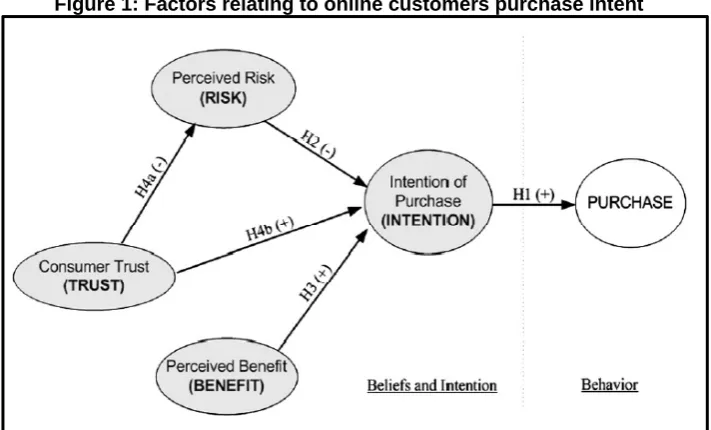
Kim, Ferrin, and Rao (2008) conducted an empirical study that examined the effects of trust and risk on consumer decision making. Thus, both trust and risk have strong impacts on consumer decision making (p. 545). Through this study it’s apparent that trust and risk is a major factor when shopping online. If we take the concept of trust in the shopping context, it is clear that trust created via in-store is based on the face-to-face quality; while trust in online shopping is based on the transactional process (p. 545).
Figure 1: Factors relating to online customers purchase intent
Adopted by: Kim, Ferrin, and Rao (2008) Model of online decision making
There is a perceived risk associated with online shopping decision making such as: financial risk, product risk, and information risk (p. 546). These risk factors are vital to decision making, because consumers tend to make trusting decisions when they have enough information and trust the sellers’ interface in which they are receiving the information. The issues that hinder the sellers’ decision to make a purchase online are: defective products, technological error, unintended click on wrong item, and apprehension of credit card fraud (p. 547). The sample respondents were undergraduate students who identified themselves as online shoppers. The study concluded that “trust” directly and indirectly affected purchasing decisions. Also, customers’ perceived risk reduces customers’ intent to make a purchase. The trust-based decision model provided insights on consumers purchasing model process.
Interactivity
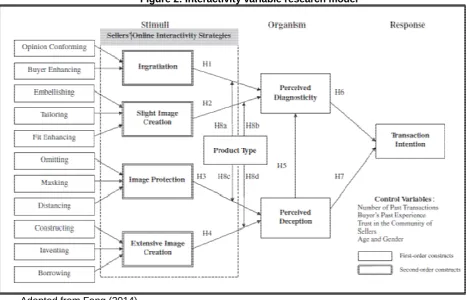
Figure 2: Interactivity variable research model
Adopted from Fang (2014)
The proposed interactivity model clearly explained the researcher intentions regarding the idea of information control and flow to the consumer. The flow enables the online shopper to interact with the supplier to discern information regarding the product or service. Thus transactions intention is based on perceived diagnosticity and perceived description of the item for sale.
Esteban-Millot et al., (2014) examined how interactivity flow determined consumer decision making. They stated that, “a seamless sequence of responses facilitated by machine interactivity, intrinsically enjoyable, is accompanied by a loss of self-consciousness and is self-reinforcing (p. 374). Interactivity is the exchange between people and technology that can result in the consumer change in behaviour. This is a communication process. This communication process [interactivity] has degrees to consumer to merchant interactivity, such as: speed, range, mapping, and ease of use (p. 387). When consumers enjoy their navigation at an e-tail store, they become more involved and thus have a higher opinion of the items presented (p. 388). By implementing a navigation interactive flow, it improves customers’ attitudes, which increases future purchase intent. Ultimately, with increased interactivity merchants create expected behaviour that the customer must adopt, either to: purchase a product, obtain information, or to simply evaluate alternatives.
Information Overload
Chen, Shang, and Kao (2009) study was focused on how information overload influences information quality which alters the quality of consumers decision making. The researchers defined information overload, “as the drop-off of response rates due to the input surpassing the limits of capacity” (p. 49). Information overload affects ones subjective state where a good purchasing experience online plays a substantial part in their intent to shop at that online retailer in the future (p. 48). Customers experience does not determine the information overload levels, or threshold, because each consumer has their own processing capabilities. However, a perception of information overload can limit a consumer’s cognitive process (Grise and Gallupe, 2000). When consumer make [experienced or inexperienced] decisions their subjective states are triggered by emotional reactions; thus a better buying decision leads to a better psychological state (p. 51). They presented a model that was tested where online shopping experience is moderated and perceived information overload is mediated to impact consumers’ subjective state in making an online purchasing decision.
whether or not consumers can adopt or they suffer from overload (p. 2). They stated that, “the most active and popular social media users are often the ones that are overloaded” (p. 2).This notion was explained by the rate at which users received information, and their processing behaviour in prioritizing information from various sources (p. 2). The researchers gathered information from Twitter, with all published Tweets during July 2009 to September 2009, a duration of three months. The conclusion of the study declared it is the rate at which users receive information that is dependent on the processing ability of the user.
PROPOSED THEORETICAL MODEL
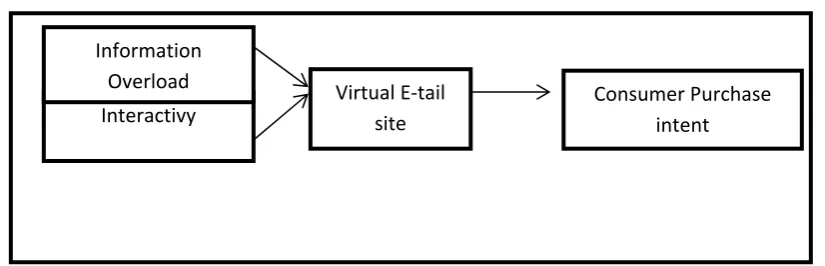
This proposed model of consumer decision making is based on the foresaid research studies that created models to explain such phenomena. This model explained gaps that exist in the literature on the nature of decision making in the context of online retail shopping. On most virtual sites there are rich amounts of product information, however, due to many capabilities of processing the information there is a need for increased interactivity that could mitigate this issue. In the same vein, interactivity and information overload both could influence the behaviour of the shoppers buying decisions. Shown below in figure four is how consumers purchase intent is mediated by online access by interactivity and information overload.
Figure 3: Theoretical consumer virtual decision making model
CONSUMER DECISION MODELS: DIFFERENCES AND SIMILARITIES
The decision making models presented in this study fall into three main categories that signify the role of either the merchant, user/consumers cognition, or other influential factors. In this study there are two studies by (Shiv & Fedorikhin, 1991; Lysonski & Durvasula, 2013) that put heavy emphasis on the consumers’ cognitive and psychological state. Both models showed little involvement from the merchant as the catalyst to assist in decision making. However, the model created by (Lamb, Hair, and McDaniel, 2013) illustrated the initial importance of factors (cultural, social, individual, and psychological) prior to a consumer making a decision. In fact, they state that these factors have great impact on consumers drive and reasoning when it comes to making a purchasing decision.
The interactivity and overload models confirmed that the flow of information can determine ones online shopping experience. There is also emphasis in these models showing that consumers process online data differently, but even so, online merchants have to regulate the amount of information exposure to assist with the purchase decision. In the model developed by (Esteban-Millot et al., 2014) acknowledged that communication and navigation of an online website increases positive experiences for consumers. This model was similar to that of (Fang, 2012) where the merchants’ intervention is related to the prediction of purchase commitment behaviour. Their model has three sections that interact as the consumer exhibits reliance on online interactions. The three sections of their model are: stimuli, organism, and response. This model (Fang, 2012) is probably the only dissimilar model in this study. The decision making models proposed in this study do not place emphasis on merchant online interaction as being a predictor on consumer decisions.
MANAGERIAL IMPLICATIONS
It is in the best interest of [e-tail] business owners to embrace the power of online shopping decision making and the effect on customer retention. Laroche and Odile-Richard (2014) pointed out in a study how most businesses use websites as a communication tool rather than to run and generate transactions (p. 326). Managers need to focus on the importance of website navigation and the consumer behaviour response, and the site characteristics. Such a review was conducted by (Rodriguez-Ardura et al., 2010) who put emphasis on user profiles, online decision making resulting in purchasing, and the use of social media. To combat information overload relating to decision making, make information search queries one of the most important factors in website construction or implementation activities. Search queries, in essence, assist consumers in making tough decisions, particularly, in the beginning stages of the decision making process (information
Interactivy Information
Overload
Virtual E‐tail site
search & evaluation). The fine tuning of an e-tailing website increases interactivity during the decision making stages allows for a positive post-purchase experience which results in decreased cognitive dissonance. Also, it is advantageous for e-tailers to develop a decision friendly structure for the e-tail site (Laroche & Odile-Richard, 2014) to inhibit more controllable and responsive mode of interactivity, which does increase consumer motivations to commit to the final purchase (Huang, Tim-Huang, 2013, p. 310).
For the most part, consumer decision making processes can be altered based on the condition of the e-tail website. Management needs to examine the amount of information that consumers are able to process, before reaching their information threshold- before the customer decides to view an alternate website. Implications of decision making process are inherently connected to the profitability of the e-tailer. Thus, it is imperative for online sites to, above all, examine how these suggested variables support their consumer purchasing retention. The propensity for consumers to commit to making the purchase however does rest on factors outside of the information on the website (Lamb, Hair, and McDaniel, 2013). That is why it is important for e-tailers to understand the three approaches per the models presented to either change the flow of data given to consumers, increase interactivity with consumes, or as (Kim, Ferrin, and Rao, 2008) suggest to increase trusting elements of the e-tail site to mitigate the perceived risk in decision making.
CONCLUSION
As seen in this decision making conceptual model study, there are many approaches to understanding how consumers make decisions. The proposed models are ultimately concerned with the ability to interpret the cognitive process of consumers in the virtual shopping environment. Ideally, these models display accurately the level of consumer commitment and intent to make purchases. Decision making asserts that consumers go through steps to help in making either easy or tough decisions. Often times the literature alludes to the fact that these decisions are of the more complex, where the customers require experience with the product or service. Experience, as a variable, in dealing with the product or service should be added in such decision making models for future studies. The common variable in most proposed models are, data points that consumers receive [price, item specifications, and promotions], and the progression through which the evaluation steps of the alternative products or services available to consumers. However, there are differences as to the intervention aspects of variables in the models that seemed consistent with the reality of online decision making. Some models had variables that intervened during the decision making steps, some decisions made solely based on the webpage interface; that are used by the merchant. On the other hand, some decision models intervened at the consumer level of decision making. This study showed the implications of decision making by consumers for merchant and e-tailing managers; the decision making models showed the importance of interactivity and information overload and how it impacts consumers’ ability to make positive purchasing decisions without post-purchase cognitive dissonance. Also, it was noted in this study that information overload can have damaging effects on consumers experience, how they view the merchant, and if they would spend their extra time interacting within the virtual site, both exploring, or asking questions for product specifications to further add commitment to purchase decisions.
REFERENCES
Bettman, J. R., Johnson, E. J., & Payne, J. W. (1991). Consumer decision making. Handbook of consumer behavior, 44(2), 50-84.
Chen, Y. C., Shang, R. A., & Kao, C. Y. (2009). The effects of information overload on consumers’ subjective state towards buying decision in the internet shopping environment. Electronic Commerce Research and Applications, 8(1), 48-58.
Esteban-Millat, I., Martínez-López, F. J., Luna, D., & Rodríguez-Ardura, I. (2014). The concept of flow in online consumer behavior. In Handbook of Strategic e-Business Management (pp. 371-402). Springer Berlin Heidelberg.
Fang, Y. H. (2012). Does online interactivity matter? Exploring the role of interactivity strategies in consumer decision making. Computers in Human Behavior, 28(5), 1790-1804.
Fried, T. A. (2008). The Relationship Between Psychological Types, Demographics and Post-purchase Buyer's Remorse. ProQuest.
Gomez-Rodriguez, M., Gummadi, K. P., & Schölkopf, B. (2014). Quantifying Information Overload in Social Media and its Impact on Social Contagions. arXiv preprint arXiv:1403.6838.
Huang, P., Lurie, N. H., & Mitra, S. (2009). Searching for experience on the web: an empirical examination of consumer behavior for search and experience goods. Journal of Marketing, 73(2), 55-69.
Huang, E., & Huang, Y. T. (2014). Interactivity and Identification Influences on Virtual Shopping. International Journal of Electronic Commerce Studies, 4(2), 305-312.
Jiang, Z., Chan, J., & Tan, B. (2009). Effects of Interactivity on Website Involvement and Purchase Intention.
Jones, Q., Ravid, G., & Rafaeli, S. (2004). Information overload and the message dynamics of online interaction spaces: A theoretical model and empirical exploration. Information systems research, 15(2), 194-210.
Kerlinger Fred, N., & Lee Howard, B. (2000). Foundations of behavioral research. New York.
Kim, D. J., Ferrin, D. L., & Rao, H. R. (2008). A trust-based consumer decision-making model in electronic commerce: The role of trust, perceived risk, and their antecedents. Decision support systems, 44(2), 544-564.
Lamb, C., Hair, J., & McDaniel, C. (2013). MKTG 7. Cengage Learning.
Laroche, M., & Richard, M. O. (2014). A Model of Online Consumer Behavior. In Handbook of Strategic e-Business Management (pp. 325-346). Springer Berlin Heidelberg.
Liao, T. H., & Keng, C. J. (2014). ONLINE PURCHASE DELAY: THE ROLES OF ONLINE CONSUMER EXPERIENCES. Journal of Electronic Commerce Research, 15(2).
Lysonski, S., & Durvasula, S. (2013). Consumer decision making styles in retailing: evolution of mindsets and psychological impacts. Journal of Consumer Marketing, 30(1), 75-87.
Shiv, B., & Fedorikhin, A. (1999). Heart and mind in conflict: The interplay of affect and cognition in consumer decision making. Journal of consumer Research, 26(3), 278-292.