Original Research Article
A study on epidemiological and clinical characteristics of measles
patients admitted to Sir Ronald Ross institute of tropical and
communicable diseases, Hyderabad, India
Asma,
Anupama Pulla*, Vimala Thomas
INTRODUCTION
Measles is an acute and highly infectious disease of childhood, transmitted by droplets from nose, mouth or throat. It is caused by paramyxovirus, which is a single-stranded, negative-sense, enveloped RNA virus of the genus Morbillivirus belonging to the family Paramyxoviridae. Humans are the natural hosts of this virus. Measles is characterized by 3 stages i.e., prodromal stage, eruptive stage and post measles stage. Prodromal stage is characterized by fever and upper respiratory tract symptoms like cough and cold (coryza). Koplik’s spots which are pathognomonic of measles appear on the
buccal mucosa opposite to first and second molars. The eruptive phase is characterized by typical, dusky–red macular or maculo-papular rash. The rash starts from behind the ears and spreads to face and neck and extends towards lower extremities. In the post measles stage, there will be loss of weight and increased susceptibility to bacterial and viral infections.1
The disease remains one of the leading causes of death among young children globally, despite the availability of a safe and effective vaccine. Approximately 89, 780 people died from measles in 2016 globally. The fatality was higher among children less than 5 years of age.2
ABSTRACT
Background: Measles is an acute infectious exanthematous disease of childhood caused by paramyxovirus. With increase in immunization coverage levels, the intensity of measles outbreak has decreased in the country. In some parts of India, measles is still a major cause of morbidity and childhood mortality. Objective of the study was to determine the epidemiological and clinical characteristics of patients with macular/maculo-papular rash.
Methods: A cross sectional record based retrospective study was carried out at Sir Ronald Ross institute of tropical and communicable diseases, Hyderabad. All the cases admitted in year 2016 with history of fever and macular/maculo-papular rash were included in the study. The study was carried out for 2 months.
Results: A total of 639 cases were admitted to infectious disease hospital during the year 2016 with history of fever and rash. The mean age of study population was 6.08±4.9 years. Around 43.7% of cases were in the age group of 1–5 years. The disease was slightly higher among boys (52.3%) as compared to girls (47.7%). Amongst the clinical features, fever and rash were seen in 100%, coryza in 80%, and conjunctivitis in 63.3% of study population.
Conclusions: Majority of the children suffering from measles was not vaccinated and the most common reason for failure to immunize children was lack of awareness. There is a need to increase awareness about importance of measles immunization to reduce under five mortality.
Keywords: Measles, Maculopapular rash, Clinical and epidemiological characteristics Department of Community Medicine, Gandhi Medical College, Hyderabad, Telangana, India
Received: 15 January 2019
Accepted: 13 February 2019
*Correspondence:
Dr. Anupama Pulla,
E-mail: [email protected]
Copyright: © the author(s), publisher and licensee Medip Academy. This is an open-access article distributed under the terms of the Creative Commons Attribution Non-Commercial License, which permits unrestricted non-commercial use, distribution, and reproduction in any medium, provided the original work is properly cited.
Complication rates, from measles are highest in children less than 5 years of age. The most common complications of measles are otitis media, pneumonia and acute diarrheal diseases. Measles vaccination constitutes a protection against complications by preventing natural measles from occurring.3
Accelerated immunization activities have had a major impact in reducing measles deaths. During 2000–2016, measles vaccination prevented an estimated 20.4 million deaths. Global measles deaths have decreased by 84% from an estimated 550100 in 2000 to 89780 in 2016.2
In India, a total of 23,348 cases with 33 deaths were reported during the year 2014.1 India reported 17,250 measles cases in 2016, down from 30,168 in 2015. By 2018, India plans to reach 40 crore children with the measles vaccine, which is expected to considerably reduce the disease burden and help India meet its 2020 elimination target.4
Global measles and rubella strategic plan 2012-2020 aims to eliminate measles and rubella from at least 5 World Health Organization regions by 2020. The plan is to achieve at least 95% immunization coverage with both first (at 9 months completion) and second (at 16-24 months of age) routine doses of measles rubella vaccine in each district and nationally by 2020.5
Despite many efforts from World Health Organization and government of India, cases of measles tend to occur throughout the country owing to lower immunization coverage and lack of awareness among public to utilize immunization services for prevention of diseases. The present study was undertaken to describe the epidemiological and clinical characteristics of measles patients attending infectious disease hospital in Hyderabad, India.
Objectives of the study were to determine the epidemiological characteristics of patients with macular/maculo-papular rash attending Sir Ronald Ross institute of tropical and communicable diseases and to assess the clinical characteristics of patients with macular/maculo-papular rash attending Sir Ronald Ross institute of tropical and communicable diseases.
METHODS
The present study is a record based retrospective analysis of data available from January 2016 to December 2016 at Sir Ronald Ross institute of tropical and communicable diseases (SRRITCD)/government fever hospital, (tertiary care center) Hyderabad, India. Clinically suspected measles patient’s identified in Hyderabad and neighboring districts are admitted to the fever hospital for treatment as it is the sentinel surveillance center for treatment. Criteria for case description for clinical and laboratory confirmed case was made as per World Health Organization (WHO) guidelines.
Case definition as per WHO guidelines6
Clinical case definition
Any person in whom a clinician suspects measles infection, or Any person with fever and maculopapular rash (i.e. non-vesicular) and cough, coryza (i.e. runny nose) or conjunctivitis (i.e. red eyes)
Clinically confirmed
A case that meets the clinical case definition and for which no adequate blood specimen was taken.
All the patients, who satisfied the clinical definition of measles as per WHO guidelines were included in the study. No laboratory confirmation was done for this study.
The study duration was for a period of 2 months (September and October 2017). A pre tested and pre designed proforma was used to obtain information from medical records. The data was analyzed retrospectively with respect to demographic details, clinical features, and complications using MS excel and open epi. Descriptive statistics were calculated. Statistical tests of significance were applied wherever necessary.
Treatment protocol
All patients identified as clinical measles were given symptomatic treatment as per standard treatment protocol. The patients were given paracetamol for treatment of fever and calamine lotion for topical application to provide smoothening effect and reduce the intensity of itching, which thereby reduces the risk of secondary infections. Intravenous fluids and oral rehydration salt solution were also given if the child developed diarrhea or dehydration.
RESULTS
A total of 639 cases of clinical measles were reported from January to December 2016 at Sir Ronald Ross institute of tropical and communicable diseases (SRRITCD)/government fever hospital, (tertiary care center) Hyderabad, India.
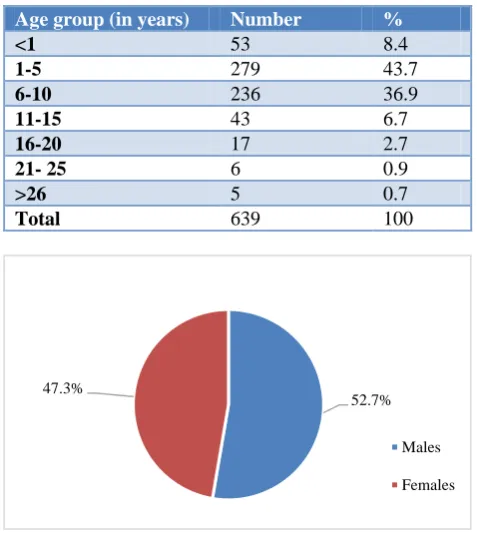
The mean age of study population is 6.08±4.9 years. The highest proportion of disease (43.7%) was found in the age group of 1-5 years and around 36.9% was found in the age group of 6-10 years. Around 8.4% cases were less than 1 year old. A total of 11% of cases were found in the age group of greater than 10 years. The disease burden was found to show a declining trend as age increased to greater than 10 years. The youngest case was 4 months old and the oldest study subject was 50 years old.
(47.3%). Around 94.2% cases were from the Hyderabad city i.e. urban areas and 5.8% of cases were from rural areas.
Table 1: Distribution of study population according to age.
Age group (in years) Number %
<1 53 8.4
1-5 279 43.7
6-10 236 36.9
11-15 43 6.7
16-20 17 2.7
21- 25 6 0.9
>26 5 0.7
Total 639 100
Figure 1: Distribution of study population according to gender.
Table 2: Distribution of study population according to age and gender.
Age group (years)
Males (%)
Females (%)
Total (%)
<1 42 (6.6) 11 (1.8) 53 (8.4)
1-5 145 (22.6) 134 (20.9) 279 (43.7)
6-10 122 (19.1) 114 (17.8) 236 (36.9)
11-15 21 (3.3) 22 (3.4) 43 (6.7)
16-20 4 (0.6) 13 (2.1) 17 (2.7)
21-25 2 (0.3) 4 (0.6) 6 (0.9)
>26 1 (0.2) 4 (0.5) 5 (0.7)
Total 337 (52.7) 302 (47.3) 639 (100)
In the present study, it was found that in the younger age groups (0-5 years) the disease burden was higher among males (29.2%) when compared to females (22.7%). The disease showed a slightly higher preponderance in the age group of more than 15 years among females (3.2%) when compared to males (1.1%).
The difference of disease burden in the age group of 0-10 years and >10 years among males and females was found to be statistically significant (p<0.05).
Table 3: Relationship between gender and age of onset of disease.
Age group (in years)
Males (%)
Females (%)
Total (%)
0-10 309 (54.4) 259 (45.6) 568 (100)
>10 28 (39.4) 43 (60.6) 71 (100)
Total 337 (52.7) 302 (47.3) 639 (100) Using chi square test of significance, chi square value–5.08; p<0.05.
In the present study it was found that measles was higher among muslims (70.1%) followed by hindus (29.3%) and was least among christians (0.6%). In the present study it was found that the mean duration between onset of symptoms and first contact with health centre was 4.5 days. The mean duration between admission and discharge was found to be 8 days.
In the present study, almost half the cases (49.2%) were reported in the months of October-December (corresponding to winter season). Around 30.7% of cases were in the months of January–April (corresponding to spring and early summer season). No cases of measles were reported in the months of June and July, which correspond to monsoon season.
In about 17 cases (2.7%) of study subjects there was a history of similar complaints/ cases in family in the previous 10 days. Around 22 other cases (3.4%) of them reported a child suffering with similar complaints in the neighborhood.
Figure 2: Month wise distribution of cases.
Table 4: Distribution of study population according to clinical features.
Clinical features Number %
Fever with macular/
maculopapular rash 639 100
Coryza 511 80
Conjunctivits 405 63.3
Koplik’s spots 301 47.1
52.7% 47.3%
Males
Females
0 20 40 60 80 100 120 140 160
January February March April
May June July August
The most common clinical presentation among study subjects was fever with rash (100%) and coryza (80%). Around 80% of study subjects had conjunctivitis during the course of illness and 47.1% of them had koplik’s spots on the buccal mucosa opposite to first and second molars which is pathognomonic of measles.
Around 83.8% of study subjects were not vaccinated against measles and around 7.8% of study subjects failed to take the booster dose of measles vaccination. Around 8.4% of study subjects developed the disease before the age of primary vaccination i.e. 9 completed months.
Table 5: Distribution of study population according to complications.
Clinical features Number %
None 351 54.9
Diarrhea 131 20.5
Pneumonia 85 13.3
Otitis media/ear discharge 72 11.3
Total 639 100
The most common complication was diarrhea (20.5%) followed by pneumonia (13.3%) and around 11.3% of them developed otitis media.
Table 6: Relationship between complications and age.
Complications 0-10 years (%) >10 years (%)
Present 268 (47.1) 20 (28.1)
Absent 300 (52.8) 51 (71.8)
Total 568 (100) 71(100)
Using chi square test of significance, chi square value–9.2; p<0.0001.
In the present study it was found that the complications were higher among 0 - 10 years of age group (47.1%) and study subjects greater than10 years of age had a lesser rate of complications (28.1%). The difference was found to be statistically highly significant (p<0.0001).
Table 7: Relationship between complications and gender.
Complications Males (%) Females (%)
Present 197 (58.5) 91 (30.1)
Absent 140 (41.5) 211 (69.9)
Total 337 (100) 302 (100) Using chi square test of significance, chi square value–51.6; p<0.0001.
In the present study, it was found that among males, 58.5% had complications and among females 30.1% had complications. The difference was found to be statistically significant (p<0.001).
Around 90.5% of study subjects were cured, 6% left against medical advice and 3.5% of the study subjects absconded.
DISCUSSION
In the present study the mean age of study population is 6.08±4.9 years. This finding was similar to a study conducted by Deepa where mean age of study population was found to be 7.5 years.7 Maximum incidence of disease (43.7%) was found in the age group of 1-5 years and around 36.9% was found in the age group of 6-10 years. Around 8.4% cases were less than 1 year old. A total of 11% of cases were found in the age group of greater than 10 years. Similar findings were found in a study conducted by Rahima et al where maximum disease burden (57.2%) was found among children 0-6 years of age.8
The disease was found to be slightly higher prevalent among males (52.7%) when compared to females (47.3%). The present study findings concurred with a study conducted by Sultana et al where disease was higher among males.9 The present study findings were also similar to a study conducted in North Kerala where 54.8% were males.7 The present study findings were different in comparison to a study conducted in Rajasthan where 60% of study subjects were females.10
In the present study, almost half the cases (49.2%) were reported in the months of October–December (corresponding to winter season). The present study findings concurred with a study conducted by Babita et al where maximum cases were found in the months of September to December.11
In this study the most common clinical presentation among study subjects was fever with rash (100%) and coryza (80%). Around 80% of study subjects had conjunctivitis during the course of illness and 47.1% of them had koplik’s spots on the buccal mucosa opposite to first and second molars which is pathognomonic of measles. The present study findings were similar to a study by Deepa et al and Gerald et al.7,12
In this study, around 83.8% of study subjects were not vaccinated against measles and around 7.8% of study subjects failed to take the booster dose of measles vaccination. This findings were similar to a study conducted by Singh et al where the incidence of disease was highest among unimmunized children followed by partially immunized followed by completely immunized.10
CONCLUSION
From this study it can be concluded that children who belong to the age group of 1-5 years and male gender are at higher risk of developing the disease. The disease spreads rapidly during the months of October to December. Majority of cases were found among muslim community owing to lack of immunization due to social and religious reasons. The most common complications in this study were diarrhea and pneumonia, which if untreated at the correct time can lead to higher fatality. Majority of the patients suffering from measles were not vaccinated and the most common reason for failure to immunize children was lack of awareness. Some of the children had missed the booster dose of measles vaccine given at 16-24 months of age leading to occurrence of disease at a higher age (greater than 10 years).
Recommendations
Measles is a vaccine preventable disease and can be easily prevented by taking 2 doses of vaccine. The vaccine is provided free of cost to all the children at 9 months of age and 16-24 months of age through universal immunization programme (UIP). Despite so many efforts from government there is resistance in community in accepting the immunization services. The study recommends creation of awareness through health education regarding measles to masses so as to improve the vaccination coverage and reduce the disease burden and child mortality due to measles. Coverage of at least 85% of immunization is required to eliminate measles from the country by 2020.
Limitations: No laboratory confirmation of the measles disease was done. Only clinical criteria were used to diagnose the disease as measles. As it’s a hospital based retrospective study, subjects who left against medical advice could not be retrieved with regards to their outcomes and all the findings of this study cannot be generalized to community. Data on nutritional status of children less than 5 years of age and history of vitamin A prophylaxis was not recorded in the case sheets.
ACKNOWLEDGEMENTS
The authors are grateful to the Principal of Gandhi medical college and superintendent of government fever hospital/Sir Ronald Ross Institute of tropical and communicable diseases for providing an opportunity to carry out the study. The authors are thankful to the records section in charge for her cooperation and support in carrying out this study.
Funding: No funding sources Conflict of interest: None declared
Ethical approval: The study was approved by the Institutional Ethics Committee
REFERENCES
1. Park K. Park’s textbook of Preventive and Social Medicine. 24th edition. Jabalpur: Banarsi Das Bhanot; 2017: 156-9.
2. World Health Organization. WHO News. Measles Factsheets, 2018 Available at: http://www.who.int/ news-room/factsheets/detail/ measles. Accessed on 30 December 2018.
3. Suryakantha AH. Community Medicine with recent advances. 3rd edition. Jaypee publishers; 2014: 317-24.
4. World Health Organization – South East Asia Region. WHO News and factsheets on Measles. Available at: http://www.who.int/en/news-room/fact-sheets/detail/immunization-coverage. Accessed on 30 December 2018.
5. Global Measles and Rubella strategic plan 2012-2020. World Health Organization, 2012. Available at: http://apps.who.int/iris/bitstream/handle/ 10665/44855/9789241503396_eng.pdf;jsessionid= DDDB22A36C928C63FE9D0A42F93D7588?seque nce=1. Accessed on 30 December 2018.
6. WHO-recommended surveillance standard of measles. Available at: http://www.who.int/ immunization/monitoring_surveillance/burden/vpd/ surveillance_type/active/measles_standards/en/. Accessed on 30 December 2018.
7. Deepa KS. Clinical Profile of Measles in Children Admitted to a Rural Tertiary Care Hospital. J Evolution Med Dental Sci. 2015;4(46):7995-9. 8. Rahima J, Humera PJ, Denis Z. Epidemiological
and Clinical characteristics of children with measles hospitalized at the department for infectious diseases in Tuzla during the 2014-2015 measles epidemic. Central Eur J Paed. 2017;13(1):62-8. 9. Sultana A, Sabir SA, Awan A. Characteristics of
patients with measles admitted to allied hospital Rawalpindi. J Ayub Med Coll Abbottabad. 2015;27(2):318–22.
10. Singh K, Garg R. Outbreaks of measles in Rajasthan in 2014: a cross sectional epidemiological investigation. Int J Community Med Public Health. 2017;4:1751-7.
11. Babita, Suman S, Prakash S. Epidemiological Study of Measles in Bihar. J Evolution Med Dental Sci. 2013;2(26):4695-700.
12. Sume GE, ArsèneBitaFouda A, Kobela M, Nguelé S, IrèneEmah, Atem P, et al. Epidemiology and clinical characteristics of the Measles outbreak in the Nylon Health District, Douala Cameroon: a retrospective descriptive cross sectional study. Pan African Med J. 2012;13:66.