R E S E A R C H
Open Access
Succinylcholine versus rocuronium for rapid
sequence intubation in intensive care: a
prospective, randomized controlled trial
Stephan C Marsch
1*, Luzius Steiner
1,2, Evelyne Bucher
1,2, Hans Pargger
2, Martin Schumann
1,2, Timothy Aebi
1,
Patrick R Hunziker
1and Martin Siegemund
1,2Abstract
Introduction:Succinylcholine and rocuronium are widely used to facilitate rapid sequence induction (RSI) intubation in intensive care. Concerns relate to the side effects of succinylcholine and to slower onset and inferior intubation conditions associated with rocuronium. So far, succinylcholine and rocuronium have not been compared in an adequately powered randomized trial in intensive care. Accordingly, the aim of the present study was to compare the incidence of hypoxemia after rocuronium or succinylcholine in critically ill patients requiring an emergent RSI. Methods:This was a prospective randomized controlled single-blind trial conducted from 2006 to 2010 at the University Hospital of Basel. Participants were 401 critically ill patients requiring emergent RSI. Patients were randomized to receive 1 mg/kg succinylcholine or 0.6 mg/kg rocuronium for neuromuscular blockade. The primary outcome was the incidence of oxygen desaturations defined as a decrease in oxygen saturation≥5%, assessed by continuous pulse oxymetry, at any time between the start of the induction sequence and two minutes after the completion of the intubation. A severe oxygen desaturation was defined as a decrease in oxygen saturation≥5% leading to a saturation value of≤80%.
Results:There was no difference between succinylcholine and rocuronium regarding oxygen desaturations
(succinylcholine 73/196; rocuronium 66/195;P= 0.67); severe oxygen desaturations (succinylcholine 20/196; rocuronium 20/195;P= 1.0); and extent of oxygen desaturations (succinylcholine -14 ± 12%; rocuronium -16 ± 13%;P= 0.77). The duration of the intubation sequence was shorter after succinycholine than after rocuronium (81 ± 38 sec versus 95 ± 48 sec;P= 0.002). Intubation conditions (succinylcholine 8.3 ± 0.8; rocuronium 8.2 ± 0.9;P= 0.7) and failed first intubation attempts (succinylcholine 32/200; rocuronium 36/201;P= 1.0) did not differ between the groups.
Conclusions:In critically ill patients undergoing emergent RSI, incidence and severity of oxygen desaturations, the quality of intubation conditions, and incidence of failed intubation attempts did not differ between succinylcholine and rocuronium.
Trial Registration:ClinicalTrials.gov, number NCT00355368.
Introduction
Endotracheal intubation in critically ill patients is a high risk procedure containing the danger of hypoxia and cardiovascular collapse. The method of choice for emer-gency intubation in the intensive care unit (ICU) is a rapid sequence induction (RSI). Because of its fast onset,
succinylcholine is the most commonly used neuromus-cular blocking drug in RSI. Due to its depolarizing mechanism of action resulting in an increase in extracel-lular potassium, succinylcholine is contraindicated in a number of circumstances and diseases frequently pre-sent in critically ill patients [1]. Rocuronium has the most rapid onset of the currently available non-depolar-izing neuromuscular blocking drugs. As the only contra-indication to rocuronium is the very rare occasion of allergy, this agent is regarded as an attractive alternative
* Correspondence: [email protected] 1
Department of Medical Intensive Care, University Hospital Basel, University of Basel, Petersgraben 4, Basel 4031, Switzerland
Full list of author information is available at the end of the article
to succinylcholine [2,3]. Assessing current clinical prac-tice by analyzing large contemporary trials reveals a wide variation in the use of rocuronium or succinylcho-line for RSI in the ICU [4-8]. However, neither agent has been so far tested against each other or any other neuromuscular blocking agent in an adequately powered randomized trial in critically ill patients.
Compared to succinylcholine, rocuronium is asso-ciated with less optimal intubation conditions [3,9] and a longer intubation sequence [9] in the operating thea-tre. As the most frequent complication of RSI in the ICU is severe hypoxemia [4,7] the combination of less optimal intubation conditions and longer intubation sequence may be of relevance. Given the low rate of hypoxemia during RSI in the operating theatre, available studies are underpowered for this outcome. The aim of this prospective randomized controlled trial was, there-fore, to compare the incidence of hypoxemia after rocuronium or succinylcholine in critically ill patients requiring an emergent RSI.
Material and methods Design
This is a prospective randomized controlled single-blind trial. The trial is registered, ClinicalTrials.gov, number NCT00355368.
Setting
The trial took place in the medical and surgical ICUs of the University Hospital of Basel, a tertiary care center.
Patients
All adult (age ≥18 years) patients requiring emergent endotracheal intubation with a RSI were eligible. The indication for intubation was made by the staff physician in charge of the patient’s care. Patients could be included only once in the trial. Exclusion criteria were contraindications against succinylcholine (that is, hyper-kalemia, neuromuscular diseases, denervation of mus-cles, tetraplegia, long-term immobilization, extensive muscle trauma, burns, familial history of malignant hyperthermia), allergy to rocuronium, pregnancy, known or anticipated difficult intubation warranting awake fiberoptic intubation, and absence of a qualified study physician to perform the intubation. Patients excluded from the study because of the absence of a qualified study physician and those erroneously included more than once were included in a registry. Acute Physiology And Chronic Health Evaluation II (APACHE II) scores [10] were calculated for each patient based on the 24 hours preceding intubation.
The study was conducted in compliance with the Hel-sinki Declaration and was approved by the regional Ethics Committee (Ethikkommission beider Basel, Basel,
Switzerland). Because critically ill patients requiring an emergent intubation are typically unable to give informed consent, the regional Ethics Committee granted a waiver of consent prior to the intubation. Instead, investigators were obliged to inform relatives and obtain written informed consent from patients as soon as feasible.
Intervention
Stratified randomization by gender was used to ensure a similar distribution of gender in both groups. Using sealed envelopes, patients were randomly allocated by the study physician to receive either 0.6 mg/kg rocuro-nium (Esmeron®, Organon, Pfäffikon, Switzerland) or 1.0 mg/kg succinylcholine (Lystenon®, Nycomed, Opfi-kon, Switzerland) intravenously as neuromuscular block-ing drug.
Preparations for intubation followed a checklist (Additional file 1). Intubations were performed or supervised by a study physician, defined as a physician with dual training in anaesthesia (board certified) and critical care (board certified or in the last year of train-ing). The pre-intubation management including the position of the head of the bed (horizontal or ele-vated), the application of cricoid pressure [11], and the management of difficulties and complications, if any, was at the discretion of the study physicians. The pro-tocol encouraged, time permitting, cardiovascular opti-mization prior to intubation using fluids and catecholamine infusion. In patients undergoing non-invasive ventilation, the protocol encouraged continued non-invasive ventilation with 100% oxygen as the means of oxygenation. All other patients were pre-oxygenated using a bag-mask device with high flow oxygen. Patients receiving light sedation to tolerate non-invasive ventilation continued to do so until the beginning of the induction sequence.
Outcome measures
The primary outcome was the incidence of oxygen desa-turations defined as a decrease in oxygen saturation ≥ 5%, assessed by continuous pulse oxymetry, at any time between the start of the induction sequence and two minutes after the completion of the intubation. A severe oxygen desaturation was defined as a decrease in oxygen saturation of ≥ 5% leading to a saturation value of ≤ 80%.
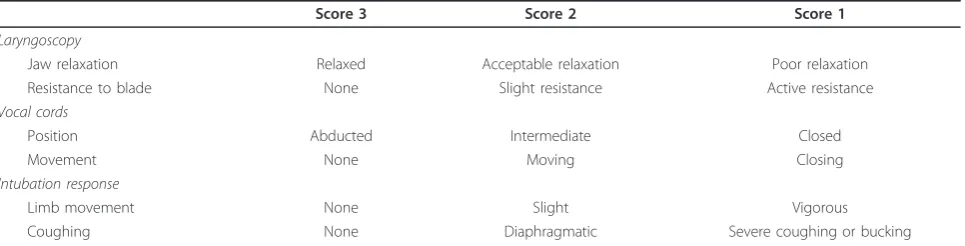
Secondary outcomes were 1) the duration of the intu-bation sequence, defined as the time interval between the injection of the induction agent and the first appear-ance of end-tidal carbon dioxide on the screen of the monitor; 2) the incidence of failed first intubation attempts; 3) numerical [2] and qualitative [13] intuba-tion condiintuba-tions as rated by the intubating study physi-cian using a scoring system proposed for good clinical research practice in studies of neuromuscular blocking drugs [14] (Table 1); and 4) haemodynamic conse-quences of intubation between the start of the induction sequence and five minutes after the completion of the intubation.
Statistical analysis
Data, presented as means ± SD unless otherwise stated, were analyzed using SPSS 15.0 for Windows (SPPS Inc., Chicago, IL, USA). Two-way ANOVA, unpaired Stu-dent’st-test, Mann-Whitney test, Fisher’s exact test and the logrank test were applied as appropriate. Based on data from the literature we estimated that approximately 250 patients were required for each study group to detect a difference of 20% in the primary outcome, inci-dence of oxygen desaturation≥5%, with a power of 0.9 and a two-sided a of 0.05. A planned interim power
analysis, performed with the results of the first 100 patients of the succinylcholine group, revealed that, in fact, approximately 200 patients were required for each study group. To account for protocol violations related to an emergent procedure we planned to enroll 210 patients per group.
Results
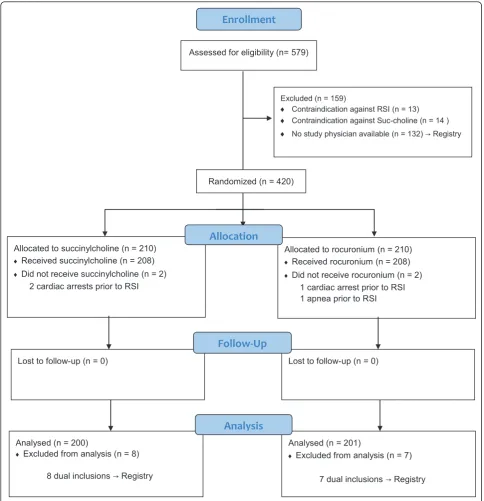
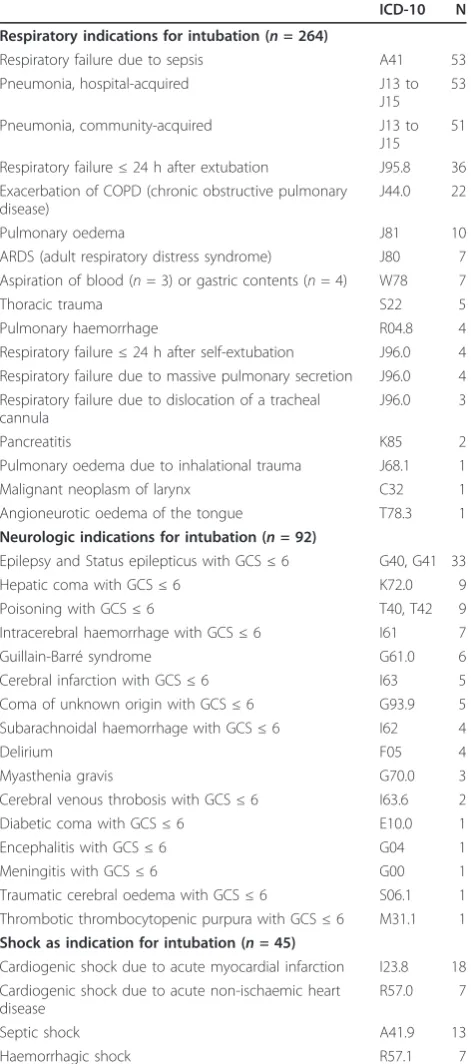
The study started in August 2006 and ended with the inclusion of the 420th patient in June 2010. Figure 1 shows the patients’ flow. Of the 401 intubations 333 (83%) were accomplished on the first, 57 (14.2%) on the second, 9 (2.2%) on the third, and 2 (0.5%) on the fourth attempt. No periprocedural death occurred. Table 2 shows the indications for the intubations performed. Demographics of the patients included in the study and the registry are shown in Table 3.
Primary outcome
[image:3.595.58.541.526.649.2]Due to a severe shock state, pulse oxymetry could not measure oxygen saturation in four patients of the suc-cinylcholine group and in six patients of the rocuro-nium group. In the remaining patients, there was no significant difference in the incidence of oxygen desa-turations (succinylcholine 73/196 = 37%; rocuronium 66/195 = 34%;P = 0.67) and severe oxygen desatura-tions (succinylcholine 20/196 = 10%; rocuronium 20/ 195 = 10%; P = 1.0) between the groups. In those patients exhibiting a decrease in oxygen saturation ≥ 5%, there was no difference between the groups with regard to the extent of the decrease (succinylcholine -14 ± 12%; rocuronium -16 ± 13%; P = 0.77). Figure 2 displays the course of the oxygen saturation over the intubation period.
Table 1 Scoring system for intubation conditions
Score 3 Score 2 Score 1
Laryngoscopy
Jaw relaxation Relaxed Acceptable relaxation Poor relaxation
Resistance to blade None Slight resistance Active resistance
Vocal cords
Position Abducted Intermediate Closed
Movement None Moving Closing
Intubation response
Limb movement None Slight Vigorous
Coughing None Diaphragmatic Severe coughing or bucking
Table 1 shows the scoring system used to derive both a numerical and qualitative intubation score. The factors laryngoscopy, vocal cords, and response to intubation are individually rated with a score from 1 (worst) to 3 (best). The assignment of a score for each of the three factors is based on the lower rating of two parameters. For example, the combination of the parameters“no limb movement”and“no coughing”results in a score of 3 for the factor response to intubation, while the combination of the parameters“no limb movement”and“severe coughing”results in a score of 1.
The numerical intubation score was obtained by summing up the scores assigned to the factors: laryngoscopy, vocal cords, and response to intubation. The maximum score is thus 9, while the minimum score is 3.
Secondary outcomes
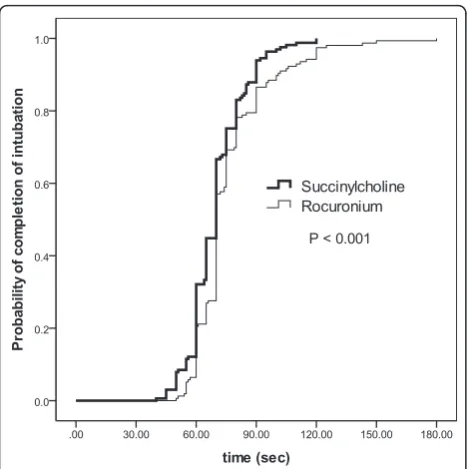
More than one intubation attempt was required in 32/ 200 patients under succinylcholine and in 36/201 patients under rocuronium (P= 0.4; Table 3). In 77/200 (39%) patients of the succinylcholine group fascicula-tions were not visible or had not ceased 45 sec after the injection of the drug. Figure 3 depicts the duration of the intubation sequence which was significantly shorter (P = 0.002) in the succinylcholine group (81 ± 38 sec)
than in the rocuronium group (95 ± 48 sec). Intubation was not completed within 90 sec in 50/200 patients under succinylcholine and 67/201 patients under rocur-onium (P= 0.048). Qualitative scores of intubation con-ditions are shown in Figure 4. The numerical sub-scores for ease of laryngoscopy (succinylcholine 2.75 ± 0.45; rocuronium 2.75 ± 0.46;P= 0.84) and conditions of the vocal cords (succinylcholine 2.61 ± 0.52; rocuronium 2.67 ± 0.56;P= 0.32) did not differ between the groups Assessed for eligibility (n= 579)
Excluded (n = 159)
i Contraindication against RSI (n = 13) i Contraindication against Suc-choline (n = 14 ) i No study physician available (n = 132) ൺ5HJLVWU\
Analysed (n = 200)
iExcluded from analysis (n = 8)
8 dual inclusions ൺ Registry
Lost to follow-up (n = 0)
Allocated to succinylcholine (n = 210)
iReceived succinylcholine (n = 208)
iDid not receive succinylcholine (n = 2)
2 cardiac arrests prior to RSI
Lost to follow-up (n = 0)
Allocated to rocuronium (n = 210)
iReceived rocuronium (n = 208)
iDid not receive rocuronium (n = 2)
1 cardiac arrest prior to RSI 1 apnea prior to RSI
Analysed (n = 201)
iExcluded from analysis (n = 7)
7 dual inclusions ൺ Registry
Allocation
Analysis
Follow-Up
Randomized (n = 420)
[image:4.595.56.541.88.590.2]Enrollment
while there was a small, but significant difference in the sub-score of the response to intubation (succinylcholine 2.97 ± 0.20; rocuronium 2.86 ± 0.36; P = 0.001). The overall numerical score for intubation conditions
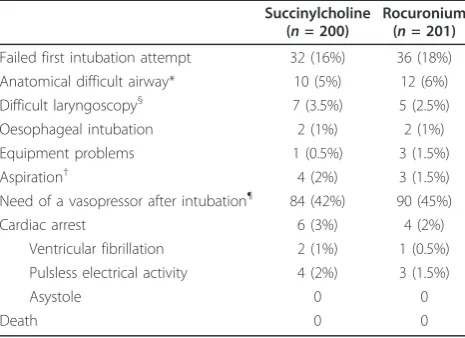
(succinylcholine 8.3 ± 0.8; rocuronium 8.2 ± 0.9; P = 0.7) did not differ between the groups. There was no difference between the groups in the incidence of hemo-dynamic consequences of intubation (Table 4).
Discussion
During the course of an emergent intubation the inci-dence and severity of oxygen desaturations did not differ between critically ill patients undergoing RSI with succi-nylcholine and those undergoing RSI with rocuronium as the neuromuscular blocking agent. The mean intuba-tion sequence was 14 sec shorter after succinylcholine than after rocuronium. Succinylcholine and rocuronium resulted in similar intubation conditions and a similar incidence of intubation related complications.
A recent Cochrane Review demonstrated that for a RSI succinylcholine created better intubation conditions than rocuronium [3]. However, all patients included in the Cochrane Review were intubated in the operating theatre. Conditions in intensive care and in the emer-gency department may differ in several important aspects from those in the operating theatre (for example, severity of patients’illness, limited possibility to perform a pre-intubation airway assessment, less ideal ergonomic conditions) so that findings from one setting are not necessarily applicable to the other. Particularly, the inci-dence of relevant intubation-related complications is very small in the operating theatre so that available stu-dies are underpowered for these outcomes. In keeping with previous work, the present study demonstrates that emergent intubations in intensive care are associated with a high rate of immediate and potentially life-threa-tening complications like oxygen desaturations and failed intubation attempts [4,5,15].
[image:5.595.57.293.113.646.2]In contrast to the majority of studies performed in the operating theatre [3], the present study demonstrated no difference in intubation conditions between succinylcho-line and rocuronium. In emergency department RSI, Lauren et al. reported that succinylcholine resulted in less body movements as a reaction to intubation than rocuronium, while there was no difference between the two drugs with regard to the degree of vocal cord move-ments [16]. In emergent RSI in the operating theatre, Sluga et al. reported that the difference in the overall intubation scores between succinylcholine and rocuro-nium was entirely due to a difference in the sub-score assessing the intubation response, that is, limb move-ments and/or coughing, while there was no difference in the remaining sub-scores assessing the ease of laryngo-scopy or the conditions of the vocal cords [9]. The pre-vious finding of similar sub-scores for laryngoscopy and vocal cords is confirmed by our results. As limb move-ments and/or coughing were only rarely observed in the present study, sub-scores for the intubation response Table 2 Indications for emergent intubations in 401
critically ill patients
ICD-10 N Respiratory indications for intubation (n= 264)
Respiratory failure due to sepsis A41 53
Pneumonia, hospital-acquired J13 to
J15 53
Pneumonia, community-acquired J13 to
J15 51
Respiratory failure≤24 h after extubation J95.8 36 Exacerbation of COPD (chronic obstructive pulmonary
disease)
J44.0 22
Pulmonary oedema J81 10
ARDS (adult respiratory distress syndrome) J80 7 Aspiration of blood (n= 3) or gastric contents (n= 4) W78 7
Thoracic trauma S22 5
Pulmonary haemorrhage R04.8 4
Respiratory failure≤24 h after self-extubation J96.0 4 Respiratory failure due to massive pulmonary secretion J96.0 4 Respiratory failure due to dislocation of a tracheal
cannula
J96.0 3
Pancreatitis K85 2
Pulmonary oedema due to inhalational trauma J68.1 1
Malignant neoplasm of larynx C32 1
Angioneurotic oedema of the tongue T78.3 1
Neurologic indications for intubation (n= 92)
Epilepsy and Status epilepticus with GCS≤6 G40, G41 33
Hepatic coma with GCS≤6 K72.0 9
Poisoning with GCS≤6 T40, T42 9
Intracerebral haemorrhage with GCS≤6 I61 7
Guillain-Barré syndrome G61.0 6
Cerebral infarction with GCS≤6 I63 5
Coma of unknown origin with GCS≤6 G93.9 5
Subarachnoidal haemorrhage with GCS≤6 I62 4
Delirium F05 4
Myasthenia gravis G70.0 3
Cerebral venous throbosis with GCS≤6 I63.6 2
Diabetic coma with GCS≤6 E10.0 1
Encephalitis with GCS≤6 G04 1
Meningitis with GCS≤6 G00 1
Traumatic cerebral oedema with GCS≤6 S06.1 1
Thrombotic thrombocytopenic purpura with GCS≤6 M31.1 1
Shock as indication for intubation (n= 45)
Cardiogenic shock due to acute myocardial infarction I23.8 18 Cardiogenic shock due to acute non-ischaemic heart
disease
R57.0 7
Septic shock A41.9 13
Haemorrhagic shock R57.1 7
were very high in both groups and did not result in a difference in the overall score for intubation conditions. This absent response to intubation in the majority of critically ill patients is most likely due to the severity of the underlying illness. Based on the present results and previous findings [9,16] we propose that the difference Table 3 Demographics
Succinylcholine (N= 200)
Rocuronium (N= 201)
Registry (N= 147)
Age (years) 60 ± 16 63 ± 14 59 ± 16
Sex (m:f) 114:86 112:89 94:54
Height (cm) 170 ± 8 170 ± 9 171 ± 10
Weight (kg) 73 ± 15 74 ± 19 74 ± 11
Apache II Score 21 ± 7 22 ± 7 21 ± 6
Underlying COPD 32 (16%) 30 (15%) 27 (13%)
28-day mortality 73 (37%) 82 (41%) 53 (36%)
Indication for intubation
Respiratory failure 134 (67%) 130 (65%) 91 (62%)
Neurology 42 (21%) 50 (25%) 41 (28%)
Shock 24 (12%) 21 (10%) 15 (10%)
Non-invasive ventilation prior to intubation 93 (47%) 85 (43%) 62 (42%)
Induction agent
Propofol 101 (50%) 94 (47%) 47 (32%)
Etomidate 99 (50%) 107 (53%) 67 (46%)
Other 33 (22%)
Neuromuscular blocking agent
Succinylcholine 78 (53%)
Rocuronium 44 (30%)
Other 25 (17%)
The registry includes patients who were intubated while the trial was recruiting but were not included in the trial due to the unavailability of a study physician (n= 132) or had to be excluded from the trial due to dual inclusion (n= 15).
The observed 28-day mortality corresponds to the expected mortality as APACHE II scores of 21 and 22 predict a mortality of approximately 39% and 42% respectively [10]. COPD, chronic obstructive pulmonary disease.
[image:6.595.57.292.419.654.2]Figure 2Intubating times. Kaplan-Meyer curve of the probability of the completion of the endotracheal intubation sequence including succinylcholine or rocuronium in patients successfully intubated in the first attempt. The x-axis denotes the time interval after the beginning of the injection of the induction drug. The intubation sequence was defined to be completed upon the first appearance of end-tidal carbon dioxide after intubation.
[image:6.595.305.539.510.654.2]reported for intubation conditions between succinylcho-line and rocuronium [3] results entirely from a differ-ence in the response to intubation, an event occurring after the completion of the intubation with marginal relevance for patients’safety. By contrast, succinylcho-line and rocuronium do not differ in two aspects of intubation conditions highly relevant for patients’safety - the ease of laryngoscopy and the conditions of the vocal cords.
During emergent intubations in the operating theatre, succinylcholine allowed for a 35 sec earlier completion of the intubation sequence than rocuronium [9]. In the present study involving critically ill patients, this favor-able effect of succinylcholine was reduced to 14 sec, that is, to approximately 15% of the total length of the intu-bation sequence with rocuronium. In almost 40% of our patients visible fasciculations had not occurred or had not ceased within 45 sec after the injection of succinyl-choline, and, according to study protocol, laryngoscopy was started in these patients at the same time as in the rocuronium group. To the best of our knowledge, a delayed onset of succinylcholine-induced fasciculations in critically ill patients has not been reported so far. As severe illness may have a profound effect on the neuro-muscular system [17] it is tempting to speculate that the severity of underlying illness is responsible for the differ-ence in the onset of fasciculations and, hdiffer-ence, the reduced advantage of succinylcholine with regard to rapid completion of the intubation sequence between patients in the operating theatre and patients in inten-sive care.
A limitation of this trial is the lack of a double-blind design. However, masking the effects of drugs like succi-nylcholine that have visible effects (fasciculations) is inherently difficult. A RSI in critically ill patients is a high-risk procedure requiring the full attention of an appropriately trained physician. Since in our settings the simultaneous achievement of perfect blinding and opti-mal patient safety was not feasible, we opted for a sin-gle-blind study design. Using experienced operators and a checklist (containing all relevant aspects recently found to decrease complications related to intubation in intensive care [5]), every effort was made to protect the patients’ safety. Thus, our results are not necessarily generalisible to settings with less stringent procedural guidelines and/or less experienced operators. Our find-ings were obtained with an induction sequence of fenta-nyl and propofol or etomidate and cannot be extrapolated to other drugs and/or doses.
The dose of rocuronium was chosen based on the best evidence available at the time of the design of the trial, that is, the Cochrane Review of 2003 [2]: For the out-come acceptable versus suboptimal intubating condi-tions, this review revealed no significant difference between succinylcholine and rocuronium at a dose of 0.6 to 0.7 mg/kg. Moreover, a sensitivity analysis within the propofol induction group (n = 640) for dose of rocuronium used (0.6 to 0.7 mg/kg versus 0.9 to 1.0 mg/kg) demonstrated that dose did not alter intubating conditions. Weighing the risk of prolonged neuromus-cular blockade associated with higher doses of rocuro-nium against the lack of convincing evidence of better intubating conditions, we chose the smallest dose Excellent Good Poor
0 25 50 75 100
Succinylcholine Rocuronium
[image:7.595.56.290.88.238.2]%
Figure 4Intubating conditions. Intubation conditions during rapid sequence induction intubation with succinylcholine or rocuronium. The scoring system is explained in Table 1. There were no significant differences between the two neuromuscular blocking drugs.
Table 4 Incidence of complications other than oxygen desaturation of emergent intubations in 401 critically ill patients
Succinylcholine (n= 200)
Rocuronium (n= 201)
Failed first intubation attempt 32 (16%) 36 (18%)
Anatomical difficult airway* 10 (5%) 12 (6%)
Difficult laryngoscopy§ 7 (3.5%) 5 (2.5%)
Oesophageal intubation 2 (1%) 2 (1%)
Equipment problems 1 (0.5%) 3 (1.5%)
Aspiration† 4 (2%) 3 (1.5%)
Need of a vasopressor after intubation¶ 84 (42%) 90 (45%)
Cardiac arrest 6 (3%) 4 (2%)
Ventricular fibrillation 2 (1%) 1 (0.5%)
Pulsless electrical activity 4 (2%) 3 (1.5%)
Asystole 0 0
Death 0 0
* An anatomically difficult airway was defined as more than two attempts or a successful second attempt with the help of additional equipment (for example, a different blade) or a modified technique (for example, preforming a stylet).
§
Difficult laryngoscopy was defined as impaired vision of laryngeal structures due to non-anatomical reasons (for example, blood or secretion).
†Blood, gastric content, or foreign body visible below the vocal cords during laryngoscopy
[image:7.595.57.290.473.642.2]proven to be effective, that is, 0.6 mg/kg. However, the 2008 update of the Cochrane Review demonstrated an advantage of succinylcholine against lower (0.6 to 0.7 mg/kg), but not against higher (> 0.9 mg/kg), doses of rocuronium for the outcome acceptable versus subopti-mal intubating conditions [3]. As the difference is ssubopti-mall (risk ratio 0.95, 95% confidence intervals 0.90 to 0.99) and, as extensively discussed above, appeared to be mainly caused by the response to intubation [9], we decided not to modify the protocol of our ongoing trial. Our trial demonstrates identical intubating conditions with 1 mg/kg succinylcholine and 0.6 mg/kg rocuro-nium. Thus, in critically ill patients there is not an advantage in choosing higher doses of rocuronium than 0.6 mg/kg.
Conclusions
The adverse effect profile of succinylcholine is of con-cern and some authors even considered its use in the ICU as obsolete [1]. Optimal intubation conditions [2,3], a short intubation sequence [9], and the return of spontaneous respiratory activity within 5 to 10 min-utes are the main arguments of the proponents of the use of succinylcholine in the ICU [18,19]. The present study is the first formal comparison of succinylcholine and rocuronium in an adequately powered randomized controlled trial in critically ill patients. Our results demonstrate that in emergent intubations in intensive care 1) the incidence and severity of hypoxaemia does not differ between rocuronium and succinylcholine; 2) intubating conditions do not differ between rocuro-nium and succinylcholine; 3) the advantage of succi-nylcholine with regard to the length of the intubation sequence is markedly reduced to a difference of ques-tionable clinical significance; and 4) the incidence of failed intubation attempts does not differ between rocuronium and succinylcholine. Lee et al. reported that the reversal of profound rocuronium-induced neu-romuscular block with sugammadex was significantly faster than spontaneous recovery from succinylcholine [20]. Taking together its favourable safety profile, the availability of a rapid-acting antagonist, and our pre-sent results, rocuronium appears to be more than a suitable alternative to succinylcholine for emergent RSI intubations in acutely ill patients.
Key messages
■This is the first formal comparison of succinylcho-line and rocuronium for use in emergent rapid sequence induction intubation in intensive care in an adequately powered randomized controlled trial.
■ In critically ill patients, undergoing an emergent rapid sequence induction intubation, the incidence and severity of oxygen desaturations, the quality of
intubation conditions, and the incidence of failed intubation attempts did not differ between succinyl-choline and rocuronium.
Additional material
Additional file 1: Checklist of preparations to be performed prior to RSI.
Abbreviations
APACHE II: Acute Physiology And Chronic Health Evaluation; COPD,: chronic obstructive pulmonary disease; ICU: intensive care unit; RSI: rapid sequence induction (intubation): SpO2:oxygen saturation.
Acknowledgements
This trial is investigator-driven and was performed without external funding.
Author details
1Department of Medical Intensive Care, University Hospital Basel, University
of Basel, Petersgraben 4, Basel 4031, Switzerland.2Department of Surgical Intensive Care, University Hospital Basel, University of Basel, Petersgraben 4, Basel 4031, Switzerland.
Authors’contributions
SM had full access to all of the data in the study and takes responsibility for the integrity of the data, and the accuracy of the data analysis. SM was a principal investigator, and conceived and designed the trial and developed the protocol and the statistical analysis plan, participated in the recruitment of patients and performed or supervised intubations and drafted the manuscript. HP and MSie were principal investigators, conceived and designed the trial and developed the protocol and the statistical analysis plan, participated in the recruitment of patients and performed or supervised intubations. PH conceived and designed the trial and developed the protocol and the statistical analysis plan and reviewed the safety data. LS, EB, MSch and TA participated in the recruitment of patients and performed or supervised intubations. All authors read and approved the final manuscript.
Competing interests
The authors declare that they have no competing interests.
Received: 14 June 2011 Revised: 7 July 2011 Accepted: 16 August 2011 Published: 16 August 2011
References
1. Booij LH:Is succinylcholine appropriate or obsolete in the intensive care unit?Crit Care2001,5:245-246.
2. Perry J, Lee J, Wells G:Rocuronium versus succinylcholine for rapid sequence induction intubation.Cochrane Database Syst Rev2003,1: CD002788.
3. Perry JJ, Lee JS, Sillberg VA, Wells GA:Rocuronium versus succinylcholine for rapid sequence induction intubation.Cochrane Database Syst Rev
2008,2:CD002788.
4. Jaber S, Amraoui J, Lefrant JY, Arich C, Cohendy R, Landreau L, Calvet Y, Capdevila X, Mahamat A, Eledjam JJ:Clinical practice and risk factors for immediate complications of endotracheal intubation in the intensive care unit: a prospective, multiple-center study.Crit Care Med2006, 34:2355-2361.
5. Jaber S, Jung B, Corne P, Sebbane M, Muller L, Chanques G, Verzilli D, Jonquet O, Eledjam JJ, Lefrant JY:An intervention to decrease complications related to endotracheal intubation in the intensive care unit: a prospective, multiple-center study.Intensive Care Med2010, 36:248-255.
7. Griesdale DE, Bosma TL, Kurth T, Isac G, Chittock DR:Complications of endotracheal intubation in the critically ill.Intensive Care Med2008, 34:1835-1842.
8. Jabre P, Combes X, Lapostolle F, Dhaouadi M, Ricard-Hibon A, Vivien B, Bertrand L, Beltramini A, Gamand P, Albizzati S, Perdrizet D, Lebail G, Chollet-Xemard C, Maxime V, Brun-Buisson C, Lefrant JY, Bollaert PE, Megarbane B, Ricard JD, Anguel N, Vicaut E, Adnet F:Etomidate versus ketamine for rapid sequence intubation in acutely ill patients: a multicentre randomised controlled trial.Lancet2009,374:293-300. 9. Sluga M, Ummenhofer W, Studer W, Siegemund M, Marsch SC:
Rocuronium versus succinylcholine for rapid sequence induction of anesthesia and endotracheal intubation: a prospective, randomized trial in emergent cases.Anesth Analg2005,101:1356-1361.
10. Knaus WA, Draper EA, Wagner DP, Zimmerman JE:APACHE II: a severity of disease classification system.Crit Care Med1985,13:818-829.
11. SELLICK BA:Cricoid pressure to control regurgitation of stomach contents during induction of anaesthesia.Lancet1961,2:404-406. 12. Ummenhofer WC, Kindler C, Tschaler G, Hampl KF, Drewe J, Urwyler A:
Propofol reduces succinylcholine induced increase of masseter muscle tone.Can J Anaesth1998,45:417-423.
13. Andrews JI, Kumar N, Van Den Brom RHG, Olkkola KT, Roest GJ, Wright PMC:A large simple randomized trial of rocuronium versus succinylcholine in rapid-sequence induction of anaesthesia along with propofol.Acta Anaesthesiolog Scand1999,43:4-8.
14. Viby-Mogensen J, Engbaek J, Eriksson LI, Gramstad L, Jensen E, Jensen FS, Koscielniak-Nielsen Z, Skovgaard LT, Ostergaard D:Good clinical research practice (GCRP) in pharmacodynamic studies of neuromuscular blocking agents.Acta Anaesthesiol Scand1996,40:59-74.
15. Schwartz DE, Matthay MA, Cohen NH:Death and other complications of emergency airway management in critically ill adults. A prospective investigation of 297 tracheal intubations.Anesthesiology1995,82:367-376. 16. Laurin EG, Sakles JC, Panacek EA, Rantapaa AA, Redd J:A comparison of
succinylcholine and rocuronium for rapid-sequence intubation of emergency department patients.Acad Emerg Med2000,7:1362-1369. 17. Latronico N, Peli E, Botteri M:Critical illness myopathy and neuropathy.
Curr Opin Crit Care2005,11:126-132.
18. Mallon WK, Keim SM, Shoenberger JM, Walls RM:Rocuronium vs. succinylcholine in the emergency department: a critical appraisal.J Emerg Med2009,37:183-188.
19. Seupaul RA, Jones JH:Evidence-based emergency medicine. Does succinylcholine maximize intubating conditions better than rocuronium for rapid sequence intubation?Ann Emerg Med2011,57:301-302. 20. Lee C, Jahr JS, Candiotti KA, Warriner B, Zornow MH, Naguib M:Reversal of
profound neuromuscular block by sugammadex administered three minutes after rocuronium: a comparison with spontaneous recovery from succinylcholine.Anesthesiology2009,110:1020-1025.
doi:10.1186/cc10367
Cite this article as:Marschet al.:Succinylcholine versus rocuronium for rapid sequence intubation in intensive care: a prospective, randomized controlled trial.Critical Care201115:R199.
Submit your next manuscript to BioMed Central and take full advantage of:
• Convenient online submission
• Thorough peer review
• No space constraints or color figure charges
• Immediate publication on acceptance
• Inclusion in PubMed, CAS, Scopus and Google Scholar
• Research which is freely available for redistribution