Original Research Article
Effectiveness of intervention on breast cancer among select students
of Annamalai University, Tamil Nadu
V. Swarnapriya, N. Srinivasan*, A. J. W. Felix, L. Arjun, A. R. Boornema
INTRODUCTION
Among the different cancers affecting women worldwide, almost an one fourth of them are found to be of breast cancer and the number of new cases of this nature was estimated at 1.67 million.1 The magnitude of cervical cancer was surpassed by breast cancer among Indian women and considered as the commonest one with increasing occurrence along with age.2 Apart from hereditary, known risk factors of breast cancer includes reproductive, lifestyle or environmental factors.3 Frequency of occurrence of breast cancer was found to be in the range of 7.2 to 33.4 per one lakh population and it constitutes around 50 percent of all mortality related to cancer.4 It is reported that 25 to 32% of all cancers among
women are from the cities in India such as Mumbai, Delhi, Ahmedabad and Chennai.5 In terms of mortality, breast cancer occupies 5th position as a cause of death with 6.4%.6 Examining the causes for low survival rate of breast cancer patients indicate absence of diagnosis at an early stage, improper diagnosis and inadequate treatment as the causes. The diagnosis at early stage of this problem could be made possible by the visit of the patients to health care facility at an earliest possible time.7 Awareness of the patients, screening and diagnosis made by higher health facilities at early stage brings great improvements in the breast cancer management outcome.8 In order to increase quality of life and survival of the breast cancer patients, the World Health Organisation has advocated raising awareness among
ABSTRACT
Background: Breast cancer is a public health problem worldwide and in India as well. Early diagnosis of this problem needs knowledge of the women. Further, belief on this disease also has been reported playing a role in taking steps in the early diagnosis and treatment.
Methods: A total of 165 participants of this study include first year students pursuing various courses such as Agriculture, Medicine and Dentistry. The knowledge was assessed in terms of risk factors, symptoms, methods of diagnosis and self-breast examination. Belief on breast cancer was also assessed. After pre assessment, intervention with video and power point presentation was carried out. Then assessments were made at immediate and 24 hours after interventions.
Results: Significant improvements in the knowledge and belief were observed from pre intervention to immediately after intervention. Knowledge gained was sustained at 24 hours after intervention. Significant improvements in belief were observed between immediate and 24 hour assessments.
Conclusions: The intervention was found to be effective. As regards the belief on breast cancer, it was observed that temporal dimension of belief was revealed by the improvements between the assessments.
Keywords: Breast cancer, Knowledge, Belief, Intervention, Temporal dimension of belief
Department ofCommunity Medicine, Rajah Muthiah Medical College, Annamalai University, Tamil Nadu, India
Received: 02 January 2019
Revised: 17 January 2019
Accepted: 18 January 2019
*Correspondence:
Dr. N. Srinivasan,
E-mail: [email protected]
Copyright: © the author(s), publisher and licensee Medip Academy. This is an open-access article distributed under the terms of the Creative Commons Attribution Non-Commercial License, which permits unrestricted non-commercial use, distribution, and reproduction in any medium, provided the original work is properly cited.
women and reporting of any breast abnormalities.9 Though breast cancer is found to be common among women, lack of awareness about breast self-examination made them seeking medical care at a very late stage.5 Information, education and communication activities on breast cancer, need for early detection and methods of diagnosis are to be carried out to sensitise the women and the community at large since the disease has been shrouded with issues like taboo.10
In this context, this cross sectional study was undertaken among the female students of Annamalai University. The levels of knowledge and belief on breast cancer are discussed in this study.
Objective
The study was carried out to find out the level of knowledge and belief of female students on breast cancer.
METHODS
This cross sectional study was carried out among the female students residing in two hostels of Annamalai University. A total of 165 participants of this study include first year students pursuing various courses such as Agriculture, Medicine and Dentistry. They were included in the study based on convenience sampling. Necessary permission was obtained from the authorities. Informed consents from the participants were obtained. The study was conducted between November 2017 and February 2018.
Data collection
Data collection was carried out using a pre-tested, structured questionnaire. This questionnaire consists of 4 sections. The knowledge was assessed in terms of risk factors (14 questions), symptoms (12 questions), methods of diagnosis (5 questions) and self-breast examination (6 questions). Belief on breast cancer was assessed with 9 questions. All the answers were coded 1 for correct answers and marked 0 for wrong responses. The range of score for knowledge is 0 to 37 and 0 to 9 for belief.
Scoring and interpretation
Knowledge on breast cancer was classified as good if the score is above 70% (26-37), satisfactory with a score of 50 - 69% (19-25) and poor with a score of less than 50% (<19). Belief on breast cancer was classified as good if the score is above 70% (7-9), satisfactory with a score of 50 - 69% (5-6) and poor with a score of less than 50% (<5).
Data analysis
The data were analysed using SPSS software for windows (Statistical Package for Social Sciences) version
20. Frequency distributions of knowledge on breast cancer in terms of risk factors, symptoms, methods of diagnosis, self-breast examination, over all knowledge and belief on breast cancer were obtained. General linear model repeated measures with contrast were performed to find out the variations among the three measurements made at baseline, immediately after intervention and 24 hours after intervention. P value less than 0.05 was considered as statistically significant.
RESULTS
An interventional study was carried out among 165 students to evaluate the effectiveness of health education on breast cancer. The intervention has covered the risk factors of breast cancer, self–breast examination, symptoms of breast cancer, methods of diagnosis and belief about breast cancer. Majority of the participants (61.8) were agriculture students followed by medical (26.7%) and dentistry (11.5%). All of them were within the age of 17 and 21. Their mean age was 18.58 with a standard deviation of 1.19.
Table 1: Level of knowledge of the participants at pre, immediate post and 24 hours after intervention.
Variable Pre
intervention
Immediate post
intervention
24 hours after intervention
N (%) N (%) N (%)
Inadequate
knowledge 39 (18.2) 1 (0.6) 4 (2.4) Moderate
knowledge
89 (53.9)
34 (20.6) 21 (12.7)
Adequate knowledge
46 (27.9)
130 (78.8) 140 (84.8)
Total 165 (100) 165 (100) 165 (100) Comparison, between pre intervention and immediate post intervention, shows changes in the level of knowledge by the shift in the percentage of respondents from the poor and moderate levels to good knowledge. A majority from 18.2% at poor level and 53.9% were moved to good level. However, 20.6% of the respondents remain at moderate level of knowledge. Further, shift in the level of knowledge was evident also at 24 hours after intervention. A reduction from 20.6% to 12.7% at moderate level and an increase in the good level from 78.8% to 84.8 were observed (Table 1). Hence, it is concluded that the intervention was effective.
components of knowledge on breast cancer, significant differences were found in all the components from pre intervention to immediate post and 24 hours after
intervention. This indicates that the intervention was effective (Table 3).
Table 2: Level of belief of the participants at pre, immediate post and 24 hours after intervention.
Variable Pre intervention Immediate post intervention 24 hours after intervention
N (%) N (%) N (%)
Unfavourable belief 39 (23.6) 25 (15.2) 13 (7.9)
Moderately favourable belief 62 (33.6) 41 (24.8) 36 (21.8)
Favourable belief 64 (38.8) 99 (60) 116 (70.3)
Total 165 (100) 165(100) 165 (100)
Table 3: Effectiveness of intervention on the different aspects of knowledge on breast cancer ANOVA repeated measures (n=165).
Knowledge Assessment Mean Std. dev ANOVA repeated
F Sig
Risk factors
Pre intervention 8.158 2.09
102.484 <0.001 Immediately after intervention 10.92 2.13
24 hours after intervention 11.0 1.8
Symptoms
Pre intervention 7.006 2.99
52.473 <0.001 Immediately after intervention 9.50 2.08
24 hours after intervention 9.31 2.27
Self-breast examination
Pre intervention 2.533 1.28
157.529 <0.001 Immediately after intervention 4.345 1.02
24 hours after intervention 4.527 1.11
Methods of diagnosis
Pre intervention 3.115 1.40
69.661 <0.001 Immediately after intervention 4.358 0.92
24 hours after intervention 4.339 0.75
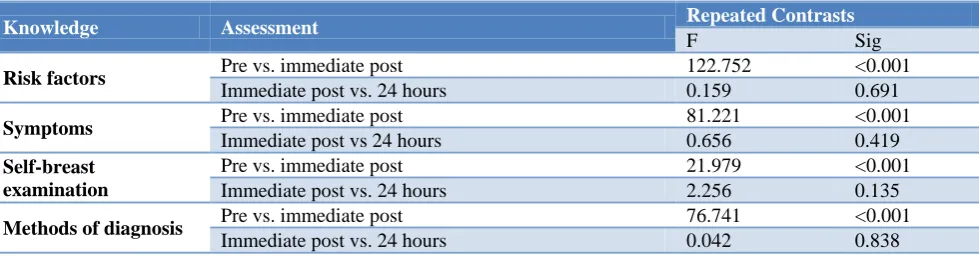
Table 3A: Repeated contrasts for variations among the assessments (n=165).
Knowledge Assessment Repeated Contrasts
F Sig
Risk factors Pre vs. immediate post 122.752 <0.001
Immediate post vs. 24 hours 0.159 0.691
Symptoms Pre vs. immediate post 81.221 <0.001
Immediate post vs 24 hours 0.656 0.419
Self-breast examination
Pre vs. immediate post 21.979 <0.001
Immediate post vs. 24 hours 2.256 0.135
Methods of diagnosis Pre vs. immediate post 76.741 <0.001
Immediate post vs. 24 hours 0.042 0.838
In order to get more details on the significance level, repeated contrast tests were applied. For all the components, immediately after the intervention, significant increases have been observed. However, no significant variations were found between the immediate and 24 hours after interventions. (Table 3A).
Testing for variations among the three assessments made in the overall level of knowledge and belief, analysis of variance with repeated measures were performed. The results indicated significant differences in the knowledge and belief with the intervention (Table 4).
Table 4: Effectiveness of intervention on knowledge and Belief on breast cancer ANOVA repeated measures (n=165).
Variable Assessment Mean Std. dev ANOVA repeated
F Sig
Knowledge
Pre intervention 20.81 5.15
199.945 <0.001 Immediately after intervention 29.12 3.95
24 hours after intervention 29.17 3.86
Belief
Pre intervention 5.74 1.74
32.667 <0.001 Immediately after intervention 6.56 1.72
24 hours after intervention 7.18 1.76
Table 4A: Knowledge and belief-repeated contrasts for variations among the assessments (n=165).
Variable Assessment Repeated contrasts
F Sig
Knowledge Pre vs. immediate post 256.092 <0.001
Immediate post vs. 24 hours 0.018 0.892
Belief Pre vs. immediate post 21.348 <0.001
Immediate post vs. 24 hours 12.879 <0.001
DISCUSSION
This study was carried out to assess the level of knowledge and belief on breast cancer among female university students of Annamalai University and also to assess the effectiveness of intervention on breast cancer. It was found that the majority of the study participants (53.9%) were having moderate level knowledge about breast cancer. This finding is similar to the results of another study conducted in central India.11 In the present study, after intervention, a majority of participants moved to good level from 27.9% to78.8% immediately after intervention and further increase to84.8% after 24 hours of intervention. Similar results were reported by Yadav et al.12 As regards the belief on breast cancer, the same effect was seen as the movement of respondents to favourable belief from 38.8% before intervention to 60% immediately after intervention and 70% post 24 hours. This result was similar to that was obtained in another study where it was observed that after awareness programme, there was significant increase in level of knowledge about breast cancer amongst college teachers in different states in India at 6 months and this was sustained for 1 year.13 The knowledge of self-breast examination of the participants in the study was found at a mean score of 2.533 with a standard deviation of 1.28 out of maximum score 6 whereas 22% of women attending a medical college hospital in Hyderabad had knowledge on self-breast examination.14
With regard to the components of knowledge, including risk factors, self-breast examination, symptoms and methods of diagnosis, the present study found a mean score of 8.158 for risk factors (score range 0-14) at base level got increased to 10.92 at immediate post intervention. Further, an increase was observed at 24
hours after intervention to a mean score of 11. The knowledge on symptoms (score range 0-12) with a mean score at 7.006 got increased to 9.50 at immediate post intervention. The knowledge on self-breast examination (Score range 0-5) with a mean score 2.533 moved to 4.345 at immediate post intervention and still more (mean 4.527) increase was observed at 24 hours after intervention. As regards the methods of diagnosis (Score range 0-6), an increase from a mean score of 3.115 at base level to 4.358 at immediate post intervention. Similar results were reported by Yadav et al, Herman et al, Gupta et al and Moustafa et al.12,15-17 However, Nabi et al in their a study on women who attended medical college hospital in north India found that the majority (60%) of the participants had poor knowledge about various risk factors and symptoms.18 Another study among adult women over the age of 18 in Bahawalpur, Pakistan reported that there was severe lack of awareness regarding BC risk factors.19
Breast self-examination is inexpensive and can be performed by women on themselves. Studies have shown that most early breast cancers are self-discovered by women who performed breast self-examination on a regular basis.20 In the present study, the respondents had an average knowledge (2.5 out of 5) of breast self-examination which increased significantly post intervention. A hospital based study at Deccan College of Medical sciences, Hyderabad reported only 20% had knowledge of breast self-examination.21
students (70.8%) didn’t have false beliefs about breast cancer that it was a punishment from God. The authors have reported that it was in contrast to the findings of studies from developing countries.22 The present study has also found that the respondents had poor (23.6%) and moderate belief (33.6%).
CONCLUSION
In conclusion, the present study has showed significant differences with knowledge and belief on breast cancer immediately after health education intervention. However no significant difference in knowledge was found at 24 hours after intervention. This shows the sustainment of knowledge gained and the effectiveness of the intervention. Significant improvement observed at 24 hours after intervention level from immediate post intervention, as the temporal dimension of belief which takes some time to get changed.
Limitations
The limitation of the study is that the participants were chosen by convenient sampling and therefore, does not reflect the knowledge of all female students.
ACKNOWLEDGEMENTS
The authors thank the authorities and the participants. Funding: No funding sources
Conflict of interest: None declared
Ethical approval: The study was approved by the Institutional Ethics Committee
REFERENCES
1. Malvia S, Bagadi SA, Dubey US. Epidemiology of breast cancer in Indian women : Breast cancer epidemiology Epidemiology of breast cancer in Indian women. Asia-Pacific J Clin Oncol. 2017;13(8):289–95.
2. Gupta S. Breast cancer: Indian experience, data, and evidence. South Asian J Cancer. 2016;5(3):85-6. 3. ICMR. Consensus Document for Management of
Breast Cancer, 2016.
4. Siddharth R, Gupta D, Narang R, Singh P. Knowledge, attitude and practice about breast cancer and breast self ‑ examination among women seeking out ‑ patient care in a teaching hospital in central India. Indian J Cancer. 2016;53(2):2016–9. 5. Fletcher-brown J, Pereira V, Nyadzayo MW. Health
marketing in an emerging market : The critical role of signaling theory in breast cancer awareness. J Bus Res. 2018;86:416-34.
6. Ferlay J, Soerjomataram I, Dikshit R, Eser S, Mathers C, Rebelo M, et al. Cancer incidence and mortality worldwide : Sources, methods and major patterns in GLOBOCAN 2012. Int J Cancer Cancer. 2015;386:359–86.
7. Singh R, Turuk A. A study to assess the knowledge regarding breast cancer and practices of breast self-examination among women in urban area. Int J Community Med Public Health. 2017;4(11):4341–7. 8. Agodirin S, Olayide AS, Halimat AJ, A OASR.
Level of Awareness and Knowledge of Breast Cancer in Nigeria. A Systematic Review. Ethiop J Heal Sci. 2017;27(2):163–74.
9. Musallam R, Junaibi A, Khan SA. Knowledge and Awareness of breast cancer among university female students in Muscat, Sultanate of Oman- A pilot study. J Appl Pharm Sci 01. 2011;01(10):146– 9.
10. Somdatta P, Baridalyne N. Awareness of breast cancer in women of an urban resettlement colony. Indian J Cancer. 2008;45(4):149–53.
11. Gangane N, Ng N, Sebastián MS. Women’s Knowledge, Attitudes, and Practices about Breast Cancer in a Rural District of Central India. Asian Pacific J Cancer Prev. 2015;16:6863–70.
12. Yadav SP, Jiwane NN, Dhanorkar A. Impact of educational intervention on awareness of breast cancer among female students of Government College of Nursing, Nagpur. Int J Community Med Public Heal. 2019;6(1):197–202.
13. Shankar A, Rath GK, Roy S, Malik A, Bhandari R, Kishor K, et al. Level of awareness of cervical and breast cancer risk factors and safe practices among college teachers of different sates in India: Do awareness programmes have an impact on adoption of safe practices? Asian Pac J Cancer Prev. 2015;16:927-32.
14. Santoshini A, Prathyusha R, Babu SR. Evaluation of knowledge attitude and awareness of breast cancer among south indian women population. Eur J Pharm Med Res. 2016;3(5):523–30.
15. Herman H, Novriani H, Putri YE. The effect of health promotion about breast self- examination for student’ s knowledge at the first senior high school of Enam Lingkung Padang Pariaman. Int J Res Med Sci. 2015;3(10):2589–93.
16. Gupta SK, Pal DK, Garg R, Tiwari R, Shrivastava AK, Bansal M. Impact of a Health Education Intervention Program Regarding Breast Self Examination by Women in a Semi-Urban Area of. Asian Pacific J Cancer Prev. 2009;10:1113–8. 17. Moustafa DG, Abd-allah ES, Taha NM. Effect of a
Breast-Self Examination (BSE) Educational Intervention among Female University Students. Am J Nurs Sci. 2015;4(4):159–65.
18. Nabi MG, Ahangar A, Akhtar H, Akbar A, Mustafa SA. Awareness and knowledge of breast cancer risk factors, symptoms and screening among females in a hospital in North India. J Evolution Med Dent Sci. 2016;5:171924.
20. Odusanya OO. Breast cancer: knowledge, attitudes and practices of female school teachers in Lagos, Nigeria. Breast J. 2001;7:171-5.
21. Ahmad SR, Ameer SR, Chandrasekhar A. A study to assess the knowledge and belief of female towards breast cancer and its screening practices in Hyderabad, India. Natl J Res Community Med. 2017;6(2):116–9.
22. Suleiman AK. Awareness and attitudes regarding breast cancer and breast self-examination among
female Jordanian students. J Basic Clin Pharma. 2014;5:74-8.