Original Research Article
Knowledge and practice of polio vaccination among mothers of infants
attending community health centre of northern Kerala
Nivya Noonhiyil Kaithery*, Jayasree Anandabhavan Kumaran
INTRODUCTION
Poliomyelitis is a highly contagious disease caused by polio virus. It can result in irreversible total paralysis.1 Children under five years of age are mainly affected.
Cases have decreased from the estimated 350000 cases to 74 reported cases in 2015.1 Three countries (Pakistan, Afghanistan and Nigeria) are still endemic to wild polio virus.1 India was declared polio free by World Health Organization (WHO) during March 2014.2 As part of preventing poliomyelitis, interruption of endemic wild polio virus (WPV) circulation was an essential, which was achieved by India during January 2011 to March 2012. Since our neighboring countries like Afghanistan,
Pakistan are not polio free, India is still at the risk of developing polio.2
For a polio-free world, “Polio eradication and endgame strategic plan 2013-2018” was introduced by World Health Assembly.3 According to this strategy, at least one dose of IPV should be introduced into routine immunization systems by the end of 2015. On April 25th 2016, India switched from trivalent OPV to bivalent OPV and withdrawn Sabin poliovirus type 2 vaccine.4 At the same time inactivated poliovirus vaccine (IPV) was introduced into the routine immunization program.4 Any reported case of vaccine-derived poliovirus type 2 (VDPV2) would be considered as a public health emergency necessitating monovalent type 2 oral vaccine, IPV or both.
ABSTRACT
Background: Poliomyelitis is a highly infectious disease caused by polio virus which invades the nervous system causing irreversible total paralysis.The aim of the study is to assess the knowledge and practice of mothers regarding polio vaccination.
Methods: It‟s a descriptive type of study conducted in mothers of Infants who had attended Community health centre
of Kannur district during a study period of 2 weeks (June 1 to June 14, 2017). Written consent was obtained from the mothers. Data was collected using a semi structured questionnaire with 3 sections -demographic details, knowledge and practice. Data was analyzed and the results are expressed in terms of frequency and percentage.
Results: A total of 220 women were studied. Out of 220 mothers, 93.6% had satisfactory knowledge and 90.45% mothers had their child immunized up to age according to National Immunization Schedule. All of them were taking their children to government hospital for vaccination and their main source of knowledge were health workers.
Conclusions: In the present study, majority of the mothers had attended immunization class and had satisfactory knowledge. In order to achieve 100% vaccination coverage, we have to emphasize more on awareness campaigns.
Keywords: Polio, Immunization, Mothers
Department ofCommunity Medicine, Academy of Medical Sciences, Pariyaram, Kannur, Kerala, India
Received: 30 March 2018
Revised: 16 May 2018
Accepted: 17 May 2018
*Correspondence:
Dr. Nivya Noonhiyil Kaithery, E-mail: [email protected]
Copyright: © the author(s), publisher and licensee Medip Academy. This is an open-access article distributed under
the terms of the Creative Commons Attribution Non-Commercial License, which permits unrestricted non-commercial use, distribution, and reproduction in any medium, provided the original work is properly cited.
Mainly there are two types of vaccine for polio. They induce immunity to polio, efficiently block transmission of wild poliovirus, and create Herd immunity.5
OPVs do not require health professionals as it is administered orally5. Following vaccination, the vaccine virus replicates in the intestine, gets excreted and can be spread to others in close contact. This helps in „passive immunization‟ of people who have not been vaccinated in areas with poor sanitation.5 In extremely rare cases (approx. 1 in every 2.7 million first doses of the vaccine) the live attenuated vaccine-virus in OPV can result in paralysis. Immunodeficiency can also lead to this in some cases.5 IPV can be given as intramuscular or (0.1 ml) intra dermal injection and needs the help of a trained health worker for administration.5 There is no such risk of VAPP with IPV as it is not a live vaccine. IPV prevents against paralytic disease caused by all three types of poliovirus and triggers an excellent immune response.5 CDC recommends four doses of polio vaccine for the protection of the children.6
In spite of high immunization coverage of Kerala (82.1% NFHS4) compared to national average, there are several pockets of areas with low coverage. Immunization is essential in bringing up a healthy future generation and to reduce mortality and morbidities due to vaccine preventable diseases. There are various factors which influence the coverage of vaccination. Parent‟s understanding and perception is one such key factor. The aim of the study is to assess the knowledge and practice of mothers regarding polio vaccination.
METHODS
Study design
It is a descriptive type of study conducted during a study period of 2 weeks (June 1 to June 14, 2017)
Study setting
Community Health Centre in Kannur district of Northern Kerala
Study population
All Mothers of Infants who had attended Community Health Centre of Kannur district during the study period.
Data collection method
Written consent was obtained from the mothers. Data was collected using a semi structured questionnaire with 3 sections -demographic details, knowledge and practice scoring system was used to assess knowledge. Each of the knowledge questions were given scores, total score being 17. More than 8.5 considered to be satisfactory. Less than 8.5 considered to be not satisfactory.
Data was analyzed with software EPI INFO 7. All results expressed in terms of frequency and percentage.
RESULTS
A study was conducted among mothers of infants, who have attended Community Health Centre, Kannur district of Northern Kerala. A total of 220 women were studied. The mean age of mothers was 25.97±4 (in years).
Out of 220 mothers, 90.45% mothers had their child immunized up to age according to National Immunization Schedule. All of them were taking their children to government hospital for vaccination and their main source of knowledge was health workers.
Figure 1: Distribution of mothers according to age.
Majority of the mothers (43.6%) belong to 18-24 years of age. Majority of the infants (59.55%) belong to 7-12 months of age.
Figure 2: Distribution of infants based on age.
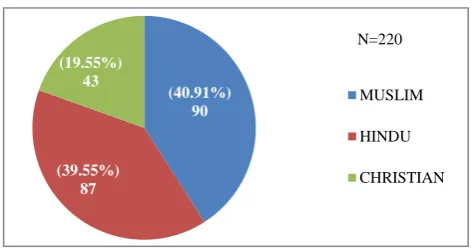
Figure 3: Distribution of mothers based on religion. 43.64%
(96)
30.45%
(67) 25.91% (57)
0 20 40 60 80 100 120
18-24 25-29 30-35
n
u
m
b
er
o
f
w
o
m
en
Age group
Frequency
40.45% (89)
59.55% (131)
0 20 40 60 80 100 120 140 160
0-6 MONTHS 7-12MONTHS
N
o
.
Of
i
n
fa
n
ts
Age in months
N=220
(40.91%) 90
(39.55%) 87 (19.55%)
43
MUSLIM
HINDU
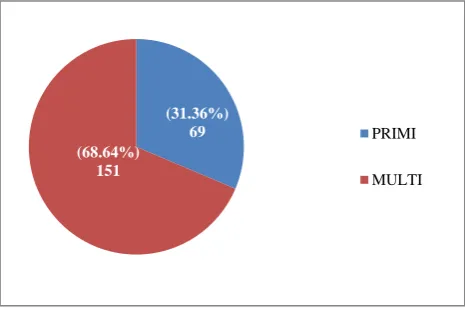
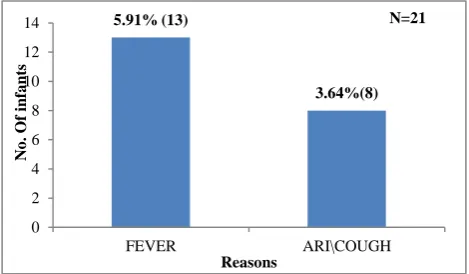
Majority of the mothers (40.9%) were Muslims. Majority of the mothers (68.9%) were multipara. Majority of the mothers (71%) have degree but 80.9% of them were not working. Health workers were the main source of knowledge (86%). Majority of the mothers (57%) take their child to CHC for immunization. Majority of the mothers had satisfactory knowledge (93.6%). Most of the mother (5.9%) said fever as the reason for not taking child for immunization.
Figure 4: Distribution of mothers according to parity.
Table 1: Distribution of mothers according to education, income and occupation.
Education High
school/ +2 Degree
Post graduate
Percentage 24.55%(54) 71.36%
(157) 4.09% (9)
Income Less than
5000
5000-10000
More than 10000
Percentage 4.55% (10) 70.45%
(155)
25.00% (55)
Occupation Working Not
working
Percentage 19.09% (42) 80.91%
(178)
Figure 5: Distribution of mothers based on source of knowledge.
Table 2: Distribution of mothers according to over all knowledge on polio immunization.
Knowledge
Satisfactory Not satisfactory
93.64% (206) 6.36% (14)
Table 3: Distribution of mothers according to knowledge on polio immunizations.
Knowledge questions
No. of correct responses
Percentage (%)
1. Virus as causative
organism 119 54.09
2. After effects of polio 162 73.64
3. Awareness about polio
vaccines 220 100
4. Prevention of polio by
vaccine 182 82.73
5. IPV introduction in
immunisation schedule 199 90.45
6. Route of polio vaccine
as oral 28 12.73
7. Route of polio vaccine
as both oral & injection.
192 87.27
8. Doses of OPV 185 84.09
9. Doses of IPV 146 66.36
10.Schedule of OPV 190 86.36
11.Schedule of IPV 146 66.36
12.Reason for introducing
IPV along with OPV 159 72.27
Table 4: Distribution of mothers according to practice.
Practice of mothers Good
practice
Percentage (%)
1. Immunised the child
according to the schedule
199 90.45
2. Previous child
immunised upto age (multiparous mothers){N=151}
151 100
3. Birth dose of OPV 220 100
4. Completed all 4 doses
of opv (infants between 14 wks - 1 yr N=191)
180 94.24
5. IPV atleast one dose to
present child 208 94.55
6. Completed all 2 doses
of IPV (infants between 14 wks – 1yr N=191)
180 94.24
(31.36%) 69 (68.64%)
151
PRIMI
MULTI
191 (86.2%) 17
(7.73%) 12
(5.45%) HEALTH WORKER
CINEMA/TV ADS.
Figure 6: Distribution of mothers according to place of immunization.
Figure 7: Reason for not taking polio vaccination.
DISCUSSION
In the present study, mean age of the mothers was 25.97±4 years which is similar compared to a study done by Sarada et al (27.3±3.9 years).7 Majority of the mothers (68.6%) were multipara and belong to Muslim community(40.9%). About 24.5%, 71.65% and 4% of the mothers were educated up to high school, degree and post-graduation respectively. Whereas in a study done by Sarada et al 34%, 30.7% and 24% mothers had education up to graduation, high school and higher secondary respectively.7 Health workers were the main source of information. This study showed 93.6% of the mothers had satisfactory knowledge which is very high compared to the study done by Khan et al, where only 38.8% of the participants exhibited good knowledge about polio.8 About 73.64% of mothers knew paralysis of lower limb as the symptom, which is high (56%) compared to study conducted in rural area of Kannur near Anjarakandy and in highly affected areas of Pakistan (58.4%).7,8
About 87.73% of mothers were aware of IPV in the present study, which is very high compared to study done in south east Nigeria (47%).9 Eighty seven percent of the mothers were aware that the route of polio vaccine as both oral and injection but in a study done by Sarada et al, 65.3% and 11.3% of the mothers told that the route of administration of polio vaccine as oral drops and as injection respectively.7 In the present study, about
90.45% of mothers knew that IPV was recently introduced in national immunization schedule, which is in contrast to a study conducted in rural area of Kannur near Anjarakandy (14%).7 About 90% of the mothers had immunized their child up to age in the present study. All of the mothers have taken the birth dose of OPV for their children. About 94.55% had given at least one of dose of IPV to their infants in this study whereas only 7.33% of mothers had practiced the same in a study conducted in rural Kannur near Anjarakandy.7 94.24% of mothers in the study have completed all four doses of OPV and all two doses of IPV for their child.
CONCLUSION
In the study majority of the mothers had attended immunization class and had satisfactory knowledge. Most of the mothers were aware of the importance of polio vaccinations and had their child immunized up to age. Health workers were the main source of knowledge regarding immunization. In order to achieve 100% coverage, mothers should be informed of the role of both IPV and OPV in polio eradication. There is a need to arrange health education program sessions for mothers with main emphasis on importance of vaccination, its timing and the absolute contraindications of vaccination, so as to fill the gaps in their knowledge and practice.
ACKNOWLEDGEMENTS
I extend my sincere gratitude to the HOD, the whole staff and the interns of the Department of Communiy Medicine, ACME, Pariyaram.
Funding: No funding sources Conflict of interest: None declared
Ethical approval: The study was approved by the Institutional Ethics Committee
REFERENCES
1. Poliomyelitis. WHO. World Health Organization; 2016. Available at: http://www.who.int/ mediacentre/factsheets/fs114/en/. Accessed on 14 December 2016.
2. World Health Organization, Polio-free certification: WHO South-East Asia. SEARO. World Health Organization, South-East Asia Regional Office; 2016. Available at http://www.searo.who.int/ entity/immunization/topics/polio/eradication/seapoli o-free/en/. Accessed on 14 December 2016.
3. World Health Organization, UNICEF, CDC. Polio eradication and endgame strategic plan 2013-2018 executive summary. World Health Organization.
Geneva; 2009. Available at
http://www.who.int/immunization/diseases/poliomy elitis/endgame_objective2/about/en/. Accessed on 13th dec 2016
4. Maya C. IPV Introduction in Kerala to check wild polio virus. Available at http://www.thehindu.com/ (27.27%)
60
(57.27%) 126 (15.45%)
34
PHC CHC
ANGANWADI
5.91% (13)
3.64%(8)
0 2 4 6 8 10 12 14
FEVER ARI\COUGH
N
o
.
Of
i
n
fa
n
ts
Reasons
news/cities/Thiruvananthapuram/ipv-introduced-in-state-to-check-wild-polio-viruses/article
8431493.ece. Accessed on 14 December 2016. 5. Park K. Park‟s textbook of preventive medicine.
23rd edition. Jabalpur: m/s Banarsidas Bhanot; 2015: 123,206.
6. Vaccines and preventable diseases. Polio Vaccination. Available at https://www.cdc.gov/ vaccines/vpd/polio/index.html. Accessed on 16th December 2016
7. Sarada AK, Thilak SA, Sushrit A. Neloopant A cross sectional study on awareness about injectable polio vaccine among pregnant women and mothers of children under 14 weeks in a rural area of Kannur, North Kerala, India. Int J Community Med Public Health. 2016;3:2004-7.
8. Khan MU, Ahmad A, Aqeel T, Salman S, Ibrahim Q, Idrees J, Khan MU. Knowledge, attitudes and perceptions towards polio immunization among residents of two highly affected regions of Pakistan, BMC Public Health. 2015;15:1100.
9. Tagbo BN, Ughasoro MD, Esangbedo DO. Parental acceptance of inactivated polio vaccine in Southeast Nigeria: a qualitative cross-sectional interventional study. Vaccine. 2014;32(46):6157-62.
Cite this article as: Kaithery NN, Kumaran JA.