_____________________________________________________________________________________________________
Effect of Placenta and Fermentation Duration on
Drying Dynamics of Cocoa Beans in a Tropical
Environment
J. Amponsah
1, P. Kumah
1and P. K. Tandoh
1*1Department of Horticulture, Kwame Nkrumah University of Science and Technology (KNUST),
Ghana.
Authors’ contributions
This work was carried out in collaboration between all authors. All authors read and approved the final manuscript.
Article Information
DOI: 10.9734/JAERI/2018/45924 Editor(s): (1) Dr. Maria Panitsa, Department of Environmental and Natural Resource Management, University of Patras, Greece. Reviewers: (1)Gideon Ramtahal Cocoa, The University of the West Indies, Trinidad and Tobago. (2)Adeji Alaba Olaitan, Cocoa Research Institute of Nigeria, Nigeria. Complete Peer review History:http://www.sdiarticle3.com/review-history/45924
Received 13 October 2018 Accepted 19 December 2018 Published 18 January 2019
ABSTRACT
Cocoa is an important economic crop and has many uses industrially and locally. For its chocolate flavour to be obrained proper fermentation, drying and other postharvest practices needs to be done.
A study was conducted to examine the effect of placenta and varied fermentation periods on drying time and moisture reabsorption of cocoa beans from December, 2017 to January, 2018. Experimental design was 2×5 factorial of placenta inclusion or exclusion and varied fermentation days in CRD and replicated three times. Parameters studied included; drying time, weight loss, moisture reabsorption. The study revealed that placenta exclusion and fermenting for at least six days quickened the drying time (5 days) and boosted the mean bean weight of the cocoa beans. Also significantly maximum % moisture reabsorption (0.51%) was produced by cocoa beans w ith placenta fermented for eight days and the minimum (0.26%) was recorded by cocoa beans without placenta fermented for eight days. It was concluded that for the production of premium quality cocoa beans, fermentation should be done for, at least, six days without placenta since that reduced the time of drying significantly.
Amponsah et al.; JAERI, 17(1): 1-10, 2018; Article no.JAERI.45924
Keywords: Moisture; reabsorption; capillarity; diffusion; weight loss.
1. INTRODUCTION
Cocoa (Theobroma cacao L.) meaning “food of the gods” in Greek, is a cash crop with massive economic significance in the world and doubles as the main raw material for chocolate production [1,2]. The crop is now cultivated in more than 50 countries on 0.2 per cent of the world’s agricultural productive land. Currently it is one of the most domineering agricultural export commodities in the world. In 2016, the global chocolate market reached a value of 98.30 billion USD. Five countries alone accounted for 80% of the global production. Measured by capacity, the topmost five producers are Côte d’Ivoire (36%), Ghana (22%), Indonesia (11%), Nigeria (6%), and Brazil (5%) [3]. Ghana’s Cocoa has superior quality specifications, attributable to excellent post-harvest handling procedures such as harvesting, pod storage, pod breaking, fermentation, drying, transportation and storage which some Ghanaian cocoa agronomists had maintained over the years. [4]. But of recent, Ghana’s premium quality cocoa is grappling with such discrepant issues like suspected adulteration, black beans, presence of debris and foreign matter which may possibly be due to presence of placenta mottled with extracted cocoa beans during the process of fermentation and drying. Accord ing to Internat ional Cocoa Standards requ irements, cocoa of tradable qual ity should be well fermented and thoroughly dr ied and free from any ev idence of adulterat ion [5]. Folayan [6] expla ined that, the root cause of quality anomal ies in cocoa could be traced to poor postharvest handl ing techniques which included addition of placenta during the bean extraction from the pod stage, bad fermentat ion including overly fermenting the beans coupled with inadequate dry ing or over drying. These bad practices make the produce vulnerable to mould and bacter ial growth. In some cocoa producing communities in Ghana, the placenta is excluded from the fermentation process whereas in other communities it is included and later removed after the process of fermentation is accomplished, especially during the drying process. There is no clear cut guiding principle as to whether placenta should be included or excluded and when it should be done in the value chain of cocoa processing. Futhermore, placenta inclusion or exclusion can influence the effectiveness and duration of fermentation, the drying time, as well as the attendant labour cost in cleaning beans off placenta before or during
drying period. Well fermented cocoa gives the best chocolate flavour and the presence of placenta could impact the microbial activities as well. Major research works on cocoa have concentrated on the roles fermentation and drying play on the quality of cocoa beans there is dearth of knowledge on the effect of presence or absence of placenta and fermentation duration on drying time of cocoa beans. The objective, therefore, of this study was to evaluate the effect of inclusion of placenta and varied fermentation periods on drying time and moisture reabsorption of cocoa beans in a tropical environment.
2. MATERIALS AND METHODS
2.1 Experimental Site
The study was conducted in the Bekwa i Mun icipality of Ashanti Region. Bekwai municipal is one of the 30 adm in istrat ive distr icts in the Ashant i Reg ion. The mun icipal shares boundaries w ith Amans ie West D istr ict to the west, Bosomtwe D istr ict to the north, Adans i south and North D istr icts to the south and the Asante Ak im south D istr ict to the east. W ith a populat ion of 208,987, and an intercensal growth rate of 3.2 percent males in the mun ic ipal const itute 52% while females const itut ing 48%. The rural populat ion of the mun ic ipal is 8.4% wh ile the urban populat ion is 11.6%. Farm ing is the dom inant occupat ion of the people in the mun ic ipal w ith cocoa farm ing be ing the ma in crop produced.
2.2 Exper imental Design
A 2X5 factor ial Completely Random ized Des ign w ith two exper imental factors (Extracted cocoa beans w ith and w ithout placenta) and f ive d ifferent fermentat ions duration (4 days, 5 days, 6 days,7 days and 8 days) wh ich were repl icated three t imes was used for the field exper iment.
2.3 Sample Collection Procedure
2.3.1 Harvesting, sorting and pod storage or resting
exper iment at Ashanti Bekwai. The riped pods on the cocoa tree stem were harvested using a well sharpened machete whiles fruits high up the tree were harvested using pruning hook or go to hell [7]. Debr is, deseased infested and blem ished pods were sorted o
harvested stock in order to prevent them from being added to the experimental samples. Each daily harvested batch of pods (120 pods) were stored or rested for three days period as recommended by Sanag i et al. [8] before pod break ing process commenced.
2.3.2 Pod breaking and bean extraction
The one hundred and twenty harvested cocoa pods for the first batch treatment were divided into two equal groups, sixty (60) pods each and were opened for the beans to be extracted. Break ing of the pods were done us
cutlass to expose the beans. Th
ease of bean-scoop ing from the pods. The muc ilag inous beans from first 60 pods were extracted w ith placenta and replicated into three groups and the other remaining 60 pods were extracted w ithout placenta and also replicated into three and were put on a plantain leaves for the fermentat ion process. This procedure was repeated for the subsequent harvested batches.
2.3.3 Fermentation method and process
The trad it ional heap fermentation method was used w ith varied fermentation periods (4 days, 5 days, 6 days, 7 days and 8days). In th is method, cocoa beans were heaped on a bed of banana leaves w ith or w ithout placenta.
replicated into three groups and located at three different locations in the cocoa farm for the fermentation processs. The heap fermentation
Plate 1. Cocoa beans extracted without placenta (A) with placenta (B)
A
iment at Ashanti Bekwai. The riped pods on the cocoa tree stem were harvested using a well sharpened machete whiles fruits high up the tree were harvested using pruning hook or go to is, deseased infested and ished pods were sorted out from the harvested stock in order to prevent them from being added to the experimental samples. Each daily harvested batch of pods (120 pods) were stored or rested for three days period as [8] before pod
breaking and bean extraction
The one hundred and twenty harvested cocoa pods for the first batch treatment were divided into two equal groups, sixty (60) pods each and were opened for the beans to be extracted. of the pods were done us ing a blunt cutlass to expose the beans. Th is fac il itated ing from the pods. The ilag inous beans from first 60 pods were ith placenta and replicated into three 60 pods were ithout placenta and also replicated into three and were put on a plantain leaves for This procedure was repeated for the subsequent harvested batches.
2.3.3 Fermentation method and process
onal heap fermentation method was ith varied fermentation periods (4 days, 5 In th is method, cocoa beans were heaped on a bed of banana ith or w ithout placenta. This was ocated at three different locations in the cocoa farm for the The heap fermentation
method was used because it is cheap,
well fermented cocoa beans and is good for small production volumes [9]. Th is was followed up by the turn ing of the cocoa beans every two days to ensure even fermentat ion within every two days [7], unt il the end of the four to e ight days.
2.3.4 Drying of fermented beans
Drying was done on a raffia mat at a cocoa depot sited in Bekwai. The drying raffia mat was ra one meter above ground and supported below w ith sawn bamboo st icks wh ich facilitated movement of a ir around the platforms. Initial cocoa beans of mass 2.5 kg from each of the cocoa beans of var ied fermentat ion per
or w ithout placenta were we ighed separately and put on the raff ia mat for dry ing to commence. A space of dimension 100 cm x 50 cm square (ie drying Cell) was measured on the raffia mat This drying cell was replicated three times at different locations on the raffia mat of dimension 1000 cm x 200 cm square to create 30 different drying cells within which the drying of the treated cocoa samples were done.
Dry ing started from 8:00am to 5:00 pm each day. Beans were per iod ically st irred every hours to ensure un iform dry ing. Dry ing cont inued unt il 7.5 to 6% mo isture content was ach ieved.
Polyethene sheet was used to cover the beans on occas ion of ra in ing and sunset. A d ig ital t imer was used to t ime the dry ing process. Ambient Temperature and relat ive hum id ity (RH) of the env ironment were mon itored us ing the data logger (RH range 5.0% to 95.0%).
Cocoa beans extracted without placenta (A) with placenta (B)
B
method was used because it is cheap, produces well fermented cocoa beans and is good for is was followed ing of the cocoa beans every two ion within every il the end of the four to e ight
Drying was done on a raffia mat at a cocoa depot . The drying raffia mat was ra ised one meter above ground and supported below ith sawn bamboo st icks wh ich facilitated ir around the platforms. Initial cocoa beans of mass 2.5 kg from each of the ied fermentat ion per iod w ith ithout placenta were we ighed separately and ia mat for dry ing to commence. A space of dimension 100 cm x 50 cm square (ie drying Cell) was measured on the raffia mat This drying cell was replicated three times at different locations on the raffia mat of dimension 1000 cm x 200 cm square to create 30 different drying cells within which the drying of the treated cocoa
ing started from 8:00am to 5:00 pm each day. iod ically st irred every three iform dry ing. Dry ing inued unt il 7.5 to 6% mo isture content was
Polyethene sheet was used to cover the beans ion of ra in ing and sunset. A d ig ital imer was used to t ime the dry ing process. ive hum id ity (RH) ironment were mon itored us ing the data logger (RH range 5.0% to 95.0%).
Amponsah et al.; JAERI, 17(1): 1-10, 2018; Article no.JAERI.45924
Plate 2. F ield layout and labels of beans undergo ing fermentat ion in the cocoa farm
2.4 Parameters Measured
The following data were monitored and recorded during the drying period:
i. The in it ial mo isture content as well as da ily mo isture content of the drying treated cocoa samples were measured every three-hour interval w ith an electron ic mo isture meter (KPM(Aqua-Boy) KAM I I Ia-K IT (USA).
ii. The in it ial we ight as well as the da ily we ight of the dry ing treated cocoa samples were determ ined every three-hour interval w ith an Electron ic Table Top We igh ing scale (s ilver Eagle) EX Tax 414( Ind ia)
iii. Da ily amb ient temperature and Relat ive
Humid ity of the dry ing env ironment were also determ ined from 6:00 am to 5:00
pm w ith a d ig ital indoor and outdoor Hydro-thermometer (Extech 445713, USA).
iv. The number of days taken to achieve 7.5- 6% mo isture content of the cocoa bean sample were also mon itored.
2.4.1 Drying time of the variedly fermented cocoa bean samples
The time (Days) taken for each of the variously fermented cocoa sample to dry from their initial moisture content value to the 7.5
-6% moisture level were monitored and recorded.
2.4.2 Cumulative moisture loss of the variously fermented cocoa bean samples
This was determined by measuring the dialy moisture content of the variously fermented cocoa bean samples undergoing drying with a moisture meter and the difference in moisture loss were expressed as a cumulative percentage of moisture loss from the initial moisture content of the cocoa bean samples [10].
2.4.3 Cumulative weight loss of the variously fermented cocoa bean samples
Cumulative weight lossof the variously femented cocoa samples weredetermined by weighing the cocoa bean samples daily and the difference in weight loss were expressed as a cumulative percentage of weight loss from the initial weight of the cocoa bean samples [10].
2.4.4 Moisture reabsorption rate of the variously fermented cocoa bean samples
This is the measure of the hydroscopic ability among the variedly fermented cocoa bean samples with or without placenta. It was based on how much moisture regained by the treated cocoa bean samples.
the beginning of new day. These moisture regained by the cocoa samples were cumulated and expessed as a percentage.
This was expressed mathematically as:
Moisture Reabsorption rate =
∑ (%) (%)
( )
Where
MC = Moisture Content of a Treated Cocoa Bean Sample
3. RESULTS
3.1 Ambient Temperature (°C) and
Relative Humidity (%) of the
Environment during the Drying of Cocoa Bean Samples
Dur ing the per iod of dry ing, the average max imum temperature was 49.2°C and the correspond ing average max imum relat ive hum id ity of 90%. The average m in imum temperature was 38.3°C and the average m in imum relat ive hum id ity was 78% as shown Table 1. In all, the mean amb ient temperature was 43.8°C w ith the assoc iated relat ive hum id ity of 81%.
Table 1. Amb ient temperature and relat ive hum id ity dur ing dry ing of cocoa beans
Days Temperature (°C)
Relat ive Hum id ity (%)
1 38.3 78
2 44.2 80
3 49.2 78
4 40..5 90
5 48.7 82
6 42.3 82
7 43.5 80
8 38.7 79
9 48.8 81
Mean 43.8 81
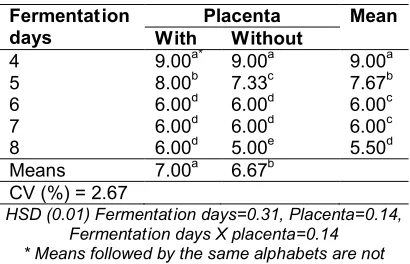
3.2 Drying Time (Days) of Cocoa Beans Fermented for Various Days with or Without Placenta
Dry ing t ime was s ign if icantly (p≤0.05) affected by fermentat ion days and placenta interact ion (Table 2). H ighest dry ing t ime was recorded by beans fermented for four days w ith and w ithout placenta (9 days), whiles the least dry ing t ime was recorded by beans fermented for e ight days
w ithout placenta (5 days). Among the fermentat ion days, h ighest dry ing t ime was recorded by beans fermented for four days (9 days) and the least was recorded by beans fermented e ight days (5.50 days). Among the levels of placenta, beans dr ied w ith placenta had the h ighest dry ing t ime (7 days) and the least was w ithout placenta (6 days).
Table 2. Dry ing t ime (Days) of cocoa beans fermented for var ious days w ith or w ithout
placenta Fermentat ion
days
Placenta Mean W ith W ithout
4 9.00a* 9.00a 9.00a
5 8.00b 7.33c 7.67b
6 6.00d 6.00d 6.00c
7 6.00d 6.00d 6.00c
8 6.00d 5.00e 5.50d
Means 7.00a 6.67b CV (%) = 2.67
HSD (0.01) Fermentat ion days=0.31, Placenta=0.14, Fermentat ion days X placenta=0.14
* Means followed by the same alphabets are not s ign if icantly d ifferent (p≤0.05) from each other
3.3 Cumulative Moisture Loss (%) of Cocoa Beans Fermented For Various Days with or Without Placenta
Cumulat ive mo isture loss of dr ied cocoa beans were s ign if icantly (p≤0.05) affected by fermentat ion days and placenta interact ion (Table 3). H ighest cumulat ive mo isture loss (54.72,54.83 and 54.72%) were produced by cocoa beans w ith placenta fermented for four,five and six days respectively and the least (54.06%) was recorded by beans w ith placenta fermented for e ight days. Across the fermentat ion days, s ign if icantly (p≤0.05) h ighest cumulat ive mo isture loss (54.62,54.69 and 54.60) were produced by cocoa beans fermented for four.five and six days and the least (54.21%) was recorded by those beans fermented for e ight days. Across the Placenta, there were no s ign if icant d ifferences (p≤0.05) in the cumulative mo isture loss among the dr ied cocoa beans.
3.4 Cumulative Weight Loss (%) of Cocoa Beans Fermented for Various Days with or Without Placenta
Amponsah et al.; JAERI, 17(1): 1-10, 2018; Article no.JAERI.45924
weight loss on the dried cocoa beans. The h ighest cumulat ive we ight loss (60.00%) was produced by cocoa beans w ith placenta fermented for eight days whiles the least cumulat ive we ight loss (49.20%) was recorded by beans w ithout placenta and fermented for seven days. Across the fermentat ion days, s ign if icantly (p≤0.05) h ighest cumulat ive we ight loss (56.4%) was produced by cocoa beans fermented for five and eight days and the least (50.80%) was recorded by beans fermented for six days. Across the Placenta, the h ighest cumulat ive we ight loss (55.60%) was produced by beans w ith placenta and the least (52.40%) was produced by those w ithout placenta.
Table 3. Cumulat ive mo isture loss (%) of cocoa beans fermented for var ious days w ith
or w ithout placenta
Fermentat ion days
Placenta Means W ith W ithout
4 54.72a* 54.51ab 54.62a 5 54.83a 54.55ab 54.69a 6 54.72a 54.48ab 54.60a 7 54.43ab 54.37ab 54.40ab 8 54.06b 54.36ab 54.21b Means 54.55a 54.45a
CV (%)=0.40
HSD (0.01) Fermentat ion days=0.38, Placenta=0.17, Fermentat ion days X placenta=0.63 * Means followed by the same alphabets are not
s ign if icantly d ifferent (p≤0.05) from each other
Table 4. Cumulat ive we ight loss (%) of cocoa beans fermented for var ious days w ith or
w ithout placenta
Fermentat ion days
Placenta Mean W ith W ithout
4 54.80bcd* 54.00bcd 54.40ab 5 56.80ab 55.60abc 56.40a 6 51.20cde 50.80de 50.80c 7 54.40bcd 49.20e 52.00bc 8 60.00a 52.80bcde 56.40a Means 55.60a 52.40b
CV (%)=1.88
HSD (0.01) Fermentat ion days=0.07, Placenta=0.03, Fermentat ion days X placenta=0.12 * Means followed by the same alphabets are not
s ign if icantly d ifferent (p≤0.05) from each other
3.5 Moisture Reabsorption (%) Rate of Cocoa Beans Fermented For Various Days with or Without Placenta
Moisture reabsorption of dr ied cocoa beans were s ign if icantly (p≤0.05) affected by fermentat ion
days and placenta interact ion (Table 5). Maximum % Moisture reabsorption (0.51%) was produced by cocoa beans w ith placenta fermented for eight days and the minimum (0.26%) was recorded by cocoa beans without placenta fermented for eight days. Across the fermentat ion days, the h ighest % Moisture reabsorption (0.41%) was produced by cocoa beans fermented for seven days and the least (0.37%) was recorded by beans fermented for five days. Across the Placenta, the h ighest % Moisture reabsorption (55.60%) was produced by beans w ith placenta and the least (0.32%) was produced by those w ithout placenta.
Table 5. Mo isture reabsorpt ion (%) rate of cocoa beans fermented for var ious days w ith
or w ithout placenta
Fermentat ion days
Placenta Mean W ith W ithout
4 0.48b* 0.29g 0.39bc
5 0.42d 0.33f 0.37c
6 0.43cd 0.34f 0.38b
7 0.44c 0.38e 0.41a
8 0.51a 0.26h 0.39bc Means 0.46a 0.32b
CV (%)=1.76
HSD (0.01) Fermentat ion days=0.01, Placenta=5.20, Fermentat ion days X placenta=0.02 * Means followed by the same alphabets are not
s ign if icantly d ifferent (p≤0.05) from each other
4. DISCUSSION
4.1 Placenta and Varied Fermentation Days on Drying Time (days) of Cocoa Beans
cocoa beans are not adequately dried, they are likely to go mouldy.Though too rapid drying rate could be bad as, in which case acetic acid will be trapped inside the beans, leading to a highly acidic end product) [14].
Takrama et al. [15] confirmed that Ochratoxin ‘A’might develop in a contaminated cocoa beans like those with placenta inclusion whiles drying. This finding was later on confirmed by Amoa‐Awua et al. [16]. Results from the current study showed that cocoa beans fermented for at least six days w ith or w ithout placenta dr ied faster than those fermented for less than six days w ith or w ithout placenta. Th is could be due to the fact that longer fermentat ion days’ lead to rap id mo isture loss wh ich eventually reduced the t ime of dry ing. Ndukwu [17] reported on the effect of the drying air temperature and air velocity on the drying rate and drying constant of cocoa beans. He further stated that the more mo isture that has been removed, the stronger the attract ion to that rema in ing. Thus dry ing is itself influenced by the amount of dry ing that has already taken place [18]. Mo isture transfer to the surface of the dry ing sol id occurs through var ious mechan isms includ ing d iffus ion, cap illar ity, and internal pressures set up by shr inkage dur ing dry ing. These factors poss ibly act in comb inat ion [19]. Ant i [20] ma inta ined that, bean mass, type of mat for dry ing and sunl ight intens ity were some of the key factors involved when it comes to fermentat ion perious and its effect on dry ing t ime. Ant i [20] further revealed that the smaller the bean mass or the th inner the bean layer, the faster the dry ing t ime. the current study the presence of placenta added to the mass compared to those without placenta hence the longer drying period with respect to beans with placenta and fermented for less than six days. The more mo isture there is in the beans the longer it w ill take to remove them result ing in a longer drying period.
Furthermore, the weather cond it ion preva il ing at the per iod of dry ing the variously fermented cocoa beans also accelerated the rap id ity of dry ing. The m in imum temperature dur ing the per iod was 38.3°C and the max imum was 49.2°C w ith a correspond ing max imum and m in imum relat ive hum id ity of 78% and 90% respect ively. Th is assert ion is supported by [21] who stated that the dry ing t ime of cocoa beans is largely determ ined by the amb ient temperature and the relat ive hum id ity. Bharath and Bowen-O’Connor [22] also stated that the rate of dry ing of cocoa beans depends on; heat
transfer into the bean, water transfer from w ith in the bean to the a ir, hum id ity of the a ir, and surface area of the bean exposed to the a ir. This assertion has again been confirmed by Sukha [23].
4.2 Cummulative Moisture Loss of Cocoa Beans Fermented on Various Days with or Without Placenta
The result revealed that beans fermented for at least 4 days without placenta loss more moisture due to the fact that moisture loss from the product surface depended on drying air conditions while surface moisture conditions influence the mass transfer from the inside to the surface, [24]. The removal of moisture at the product-air interface depends on the temperatures of the product and drying medium, air humidity, air flow rates and volume pressure conditions, and the amount of product surface exposed to the drying medium [19].
The higher cumulative moisture loss by the cocoa beans with placenta fermented for less days could probably be due to the fall ing rate dry ing character ist ics of cocoa beans as op ined by Chinenye et al. [25]. S ince those Beans dr ied w ith placenta had h igher retent ion of mo isture than those without placenta hence the ir rate of dry ing was quicker in accordance w ith the bas ic dry ing pr inc iples outlined by Doymaz [24] who stated that at the fall ing rate per iod of drying of cocoa beans, movement of mo isture w ith in the crop to the surface is governed by d iffus ion s ince the mater ial is no longer saturated w ith water. However, Baryeh [26] stated that cocoa exh ib its constant rate behav iour dur ing dry ing, from mo isture content of 70-7.5%; however, the in it ial mo isture content was not up to th is range. But, too much moisture loss means reduction in weight leading to reduction in revenue.
4.3 Cumulative Weight Loss of Cocoa Beans Fermented on Various Days with or Without Placenta
Amponsah et al.; JAERI, 17(1): 1-10, 2018; Article no.JAERI.45924
we ight loss correlation. Mossu [7] revealed that we ight of beans is d irectly related to its mo isture and dry matter content.
Drying of the fermented cocoa beans reduces moisture content from 45% to 7% and as the moisture content within the beans reduces the weight also reduces. Bean we ight is the quant ity of matter that an ind iv idual gra in conta ins. It includes the dry matter and the mo isture present w ith in the gra ins. However, the mo isture present is dependent on the water hold ing ab il ity of the gra in and vo id spaces [7].
Weight of cocoa bean is a useful index to ‘m ill ing out turn’ in measur ing the relat ive amount of dockage or fore ign mater ial in a g iven lot of gra in, and the amount of shr iveled or immature beans [27]. The weight of gra ins has been found to increase l inearly w ith an increase in mo isture content for barley gra ins [28].
The cumulative loss in we ight among the cocoa bean w ith placenta were influenced by the fermentat ion days and placenta inclus ion. Th is could probably be due to mo isture ava ilab il ity prov ided by placenta and shorter days in fermentat ion. Adu et al. [29] stated that cocoa mucilage together with its placenta consists of about 87% water content.
In order to obtain beans with optimum weight, cocoa beans without placenta should be fermented for at most seven days.
4.4 Moisture Reabsorption of Cocoa Beans Fermented On Various Days with or Without Placenta
Cocoa beans dr ied w ith placenta had the h ighest rate of mo isture reabsorpt ion. Th is could be due to the presence of placenta wh ich served as mo isture reservo ir [29] for the beans wh ich had already lost some amount of mo isture due to its hygroscop ic nature [14]. Garg et al. [30] revealed in their study that, a product’s res istance to internal mo isture loss depends on its hygroscop ic and collo idal propert ies as well as the s ize of the pores, wh ich govern the cap illary movement of flu id. Beans with placenta has a higher hygroscopic and colloidal properties than cocoa beans fermented without placenta hence high moisture reabsorption capacity.
Sanag I et al. [8] also revealed that mo isture transfer to the surface of the dry ing sol id occurs through var ious mechan isms includ ing d iffus ion,
cap illar ity, and internal pressures set up by shr inkage dur ing dry ing. These factors poss ibly act in comb inat ion according to Mujumdar and Menon [19].
Cocoa beans are highly hydroscopic particularly when it is mottled with placenta [13]. That is, they can reabsorb moisture during storage and transport resulting in mould growth which can cause Aspergillus ochraceus establishment and contaminate beans with harmful ochratoxins [31].
5. CONCLUSION
The study revealed a high cumulative loss in weight of cocoa bean sample treated with placenta. For least weight loss of cocoa beans they should be fermented for at least six days without placenta. For drying wet cocoa to low mo isture quite rapidly, beans should be femented w ithout placenta for at least six days. Beans w ith placenta had the highest rate of mo isture reabsorpt ion at storage hence to avoid high hydroscopic activity of drying cocoa, placenta inclusion during bean extraction and fermentation should be discouraged. For the best in achieving quickest optimum drying duration, at least six days of fermentation of a well riped cocoa beans extracted without placenta should be adopted.
COMPETING INTERESTS
Authors have declared that no competing interests exist.
REFERENCES
1. Krähmer A, Engel A, Kadow D, Al i N, Umaharan P, Kroh LW and Schulz H. Fast and neat–Determ inat ion of b iochem ical qual ity parameters in cocoa us ing near infrared spectroscopy. Food Chem istry. 2015;181:152-159.
2. Ho VTT, Zhao J, Fleet G. The effect of lact ic ac id bacter ia on cocoa bean fermentat ion. Internat ional Journal of Food M icrob iology. 2015;205:54–67.
M icrob iol., 86: 87- 99. Industr ial Crops Products 24: 87–94. Internat ional Journal Food M icrob ial. 2007;114:124-130. 4. Binam J, Gockowski J, Nkamleu G.
Technical efficiency and productivity potential of cocoa farmers in West African countries. The Development Economies, XLVI-3. 2008;242–263.
5. Afoakwa EO, Paterson A. Cocoa fermentat ion: Chocolate flavour qual ity. Encycloped ia of B iotechnology in Agr iculture and Food. Taylor & Franc is Publ ish ing Inc. Oxford, UK. 2010;457- 468.
6. Folayan JA. N iger ian cocoa and cocoa by-products: Qual ity parameters, spec if icat ion and the roles of stakeholders in qual ity ma intenance. Pak istan Journal of Nutr it ion. 2010;9(9):915-919.
7. Mossu G. Cocoa. The trop ical agr icultural ist. London, England. Motamayor, J. C., Risterucci, A. M., Lopez, P. A., Ortiz, C. F., Moreno, A. and Lanaud, C. (2002). Cacao domestication I: The origin of the cacao cultivated by the Mayas. Heredity. 1992;89(5):380.
8. Sanag i MM, Hung WP, Md Yas ir S. Supercr it ical flu id extract ion of pyraz ines
in roasted cocoa beans – Effect of pod storage per iod. Journal of
Chromatography. 1997;785:361-367 9. Doyle MP, Beuchat LR, Montville TJ.
Cocoa and coffee. Food Microbiology. 2001;720e733.
10. Nirupama P, Neeta B. Gol, Ramana Rao TV. Effect of post-harvest treatments on physicochemical characteristics and storage life of tomato (Lycopersicon esculentum Mill). Fruits during Storage. American-Eurasian Journal Agricultural and Environmental Science. 2010;9(5): 470-479.
11. Di Matt ia C, Martuscell i M, Sacchett i G, Sche irl inck I, Beheydt B, Mastrocola D, P itt ia P. Effect of fermentat ion and dry ing on Procyan id ins, Ant irad ical Act iv ity and reduc ing propert ies of cocoa beans. Food and B ioprocess Technology. 2013;6(12): 3420–3432.
12. Afoakwa EO, Quao J, Takrama J, Budu AS, Saal ia FK. Effect of pulp precond it ion ing on ac id if icat ion, proteolys is, sugars and free fatty ac ids concentrat ion dur ing fermentat ion of cocoa (Theobroma cacao) beans. Internat ional Journal of Food Sc iences and Nutr it ion. 2011;62(7):755–764.
13. Magan N, Sanchis V, Aldred D. Role of spoilage fungi in seed deterioration. Fungal Biotechnology in Agricultural, Food and Environmental Applications. 2004; 311-323.
14. Wood GAR, Lass RA. Cocoa, 4th ed. Longman Group L im ited, London; 1985. 15. Takrama JF, Aculey PC, Aneani F
Fermentation of cocoa with placenta: A scientific study. Posters presentation. Chemistry, technology and quality. In 15th International Cocoa Research Conference; 2007.
16. Amoa‐Awua WK, Sampson E, Tano‐Debrah K Growth of yeasts, lactic and acetic acid bacteria in palm wine during tapping and fermentation from felled oil palm (Elaeis guineensis) in Ghana. Journal of Applied Microbiology. 2007; 102(2):599-606.
17. Ndukwu MC. Effect of drying temperature and drying air velocity on the drying rate and drying constant of cocoa bean. Agricultural Engineering International: CIGR Ejournal. Manuscript 1091. 2009;XI. 18. Keey RB. Introduct ion to industr ial dry ing
operat ions. K inet ics of the format ion of free am ino ac ids in cocoa seeds dur ing fermentat ion. Food Chem istry. 1978;34: 161-179.
19. Mujumdar AS, Menon AS. Drying of solids: principles, classification, and selection of dryers. Handbook of Industrial Drying. 1995;1:1-39.
20. Ant i EO. Effects of two d ifferent dry ing mats at d ifferent load ing dens it ies on the phys ical and chem ical qual it ies of cocoa beans MPh il d issertat ion; 2014.
21. Fagunwa AO, Koya OA, Faborode MO Development of an interm ittent solar dryer for cocoa beans. Agr icultural Eng ineer ing Internat ional: C IGR Journal; 2009.
22. Bharath S, Bowen-O’Connor C. (Assessing drying rates of cacao beans using small samples. Cocoa Research Unit the University of the West Indies. 2008;52. 23. Sukha DA. Innovat ions in solar dry ing of
the f ine or flavour cocoa bean. The cocoa research un it. Presentat ion from “Cocoa sector Techn ical forum”, K ingston and St. Mary, Jama ica; 2009.
Available:http://sta.uw i. edu/cru/
24. Doymaz I. Drying characteristics and kinetics of okra. Journal of food Engineering. 2005;69(3):275-279.
Amponsah et al.; JAERI, 17(1): 1-10, 2018; Article no.JAERI.45924
drying kinetics. Chilean Journal of Agricultural Research. 2010;70(4):633-639.
26. Baryeh E. Cocoa drying and storage using charcoal and solar heated rocks. Agricultural Mechanization in Asia, Africa and Latin America. 1985;16(1):23-28. 27. Saiedirad MH, Tabatabaeefar A, Borghei
A, Mirsalehi M, Badii F, Varnamkhasti MG. Effects of moisture content, seed size, loading rate and seed orientation on force and energy required for fracturing cumin seed (Cuminum cyminum Linn.) under quasi-static loading. Journal of Food Engineering. 2008;86(4):565-572.
28. Tavakoli M, Tavakoli H, Rajabipour A, Ahmadi H, Gharib-Zahedi SMT. Moisture-dependent physical properties of barley
grains. International Journal of Agricultural and Biological Engineering. 2010;4:84- 91.
29. Adu MO, Cobbinah T, Asare PA, Yawson DO, Taah KJ. Demucilaging freshly stored seeds of cocoa (Theobroma cacao L.) improves seedling emergence and growth. Journal of Botany; 2017.
30. Garg HP, Datta G, Bhargava, AK. Performance studies on a finned-air heater. Energy. 1989;14(2):87-92.
31. Cairns‐Fuller V, Aldred D, Magan, N. Water, temperature and gas composition interactions affect growth and ochratoxin A production by isolates of Penicillium verrucosum on wheat grain. Journal of Applied Microbiology. 2005;99(5):1215-1221.
_______________________________________________________________________________ © 2018 Amponsah et al.; This is an Open Access article distributed under the terms of the Creative Commons Attribution License (http://creativecommons.org/licenses/by/4.0), which permits unrestricted use, distribution, and reproduction in any medium, provided the original work is properly cited.
Peer-review history: