www.ijaera.org 2016, IJA-ERA - All Rights Reserved 537
Development of Lab Scale Pyrolysis Setup to
Convert Waste Plastic into Oil
Akansha Bhatia1*, Jyoti Rani1, Dr. Rohit Singh Lather2 and Anmol Bhatia2
1Deenbandhu Chhotu Ram University of Science and Technology, Murthal, Haryana India
2Department of Mechanical Engineering, The NorthCap University, Gurugram, Haryana, India
Abstract: Utilization of waste effectively and efficiently is one the major concern of the world. The depleting natural resources (like fossil fuels) add further to this concern. If we continue to use and exploit fossil fuels at the existing rate, then after another 150 years or so they would be no longer available for our use. Therefore, it is the duty of present generation to use fossil fuels judiciously to ensure sustainable development. The need of the hour is to adopt some measures which can help to manage wastes and at the same time to generate some alternate fuels out of it to conserve the precious fossil fuels. The process known as “Pyrolysis” which can be a possible solution for conversion of waste to fuel. In pyrolysis, wastes like plastic, polythene, tyres and biomass etc. can be converted to fuel oil, chemicals and gas, using heat in absence of air. Thus, pyrolysis these days is catching everybody’s attention due to its potential to utilize variety of waste feedstocks to generate combustible products and may prove to be potential technology for society in the times to come. Based upon this idea, an effort is made in this study to produce oil from the pyrolysis of waste plastic. In the present work, plastic waste was converted into pyrolytic oil using self fabricated pyrolytic reactor at Energy Lab in DCRUST, Murthal and vapour condensing unit. Various properties like calorific value, kinematic viscosity and density were measured and compared with diesel.
Keywords: Pyrolysis, fossil fuels, Viscosity, Calorific value and density
I. INTRODUCTION
www.ijaera.org 2016, IJA-ERA - All Rights Reserved 538 curbs on some items like polythene. Plastics are simply synthetic or semi-synthetic long chain
polymers. They are made from inorganic and organic materials like C (carbon), Si (silicon), H (hydrogen), N (nitrogen), O (oxygen), and chloride. Due to presence of these long chain inorganic and organic materials they are not easily degradable and that’s why their disposal become a serious problem. The technique of recycling the waste plastics through pyrolysis started some 20 years back. Recycling of waste plastics is very important by seeing the increasing amount of these polybags.
II. LITERATUREREVIEW
Recycling of waste plastics has become very important as they are non-biodegradable and pose a threat to our environment. Among six main plastics, low density polyethylene (LDPE) is used in various field such as grocery bags, water hoses, garbage cans, film, containers, plastic bottles etc [12]. As per the report from United Nations Environment Program (UNEP), it is advisable to dispose the waste plastic by some suitable alternatives, the report suggested that the Pyrolysis process under suitable conditions of feedstock and temperature conditions is the best method so far. They have also mentioned that it is safe to produce liquid fuel from polyethenes and waste plastics [13] The research carried out by various researchers after carefully observing the various properties of conventional fuels in comparison to plastic derived oil it is established that plastic derived oil can be used as an alternate fuel to suffice our needs. With the help of pyrolysis process, plastic waste substances can be decomposed into three different fractions which are solid, liquid and gas [14]. There are high boiling point hydrocarbons in liquid products. There is a requirement of fractional distillation inorder to obtain useful gasoline ranged hydrocarbons. There are other products of pyrolysis like benzene, toluene and other aromatic hydrocarbons. Studies conducted on waste plastic pyrolytic oil have suggested that this oil can be used as a substituent to both petrol and diesel [7].
III. DESIGNANDFABRICATIONOFLABSCALEPYROLYSISSETUP
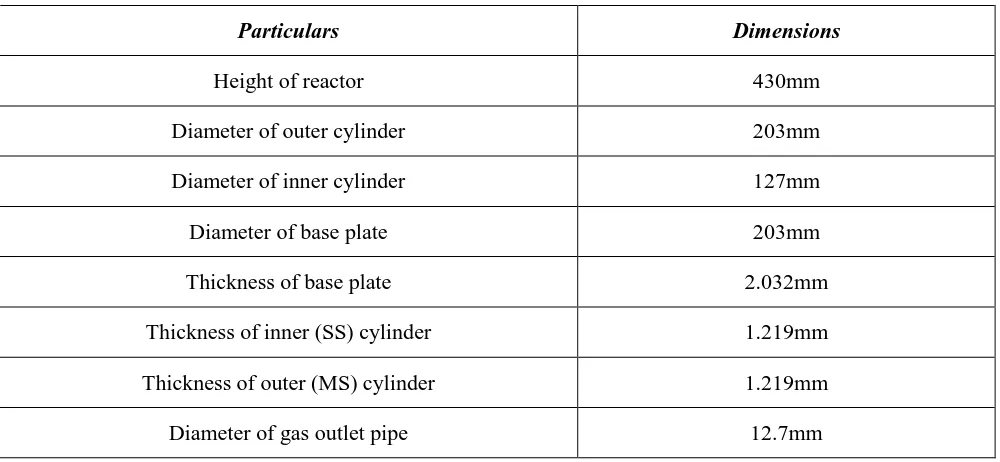
www.ijaera.org 2016, IJA-ERA - All Rights Reserved 539 Table 1: Dimensions of reactor
Particulars Dimensions
Height of reactor 430mm
Diameter of outer cylinder 203mm
Diameter of inner cylinder 127mm
Diameter of base plate 203mm
Thickness of base plate 2.032mm
Thickness of inner (SS) cylinder 1.219mm
Thickness of outer (MS) cylinder 1.219mm
Diameter of gas outlet pipe 12.7mm
B. Fabrication of the Pyrolysis Setup
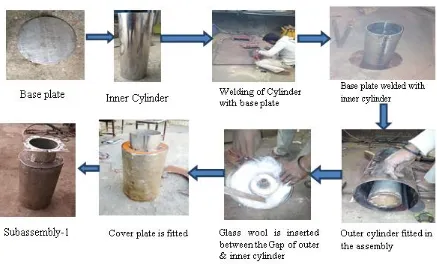
First step is welding of stainless steel cylinder on an iron plate so that iron plate is facing bottom position and stainless steel cylinder is welded on it because the iron plate comes in direct contact to heat and after that due to conduction heat is transferred inside the cylinder. For casing of the stainless-steel cylinder another cylinder is used which is of mild steel and it also welded on the base iron plate. Dimensions are illustrated in the table-1. The gap between the inner stainless steel cylinder and outer mild steel cylinder is filled with glass wool which acts as an insulation between two cylinders, as temperature and heat inside the inner cylinder is going to be very high, to prevent that transfer of heat in outward direction. Last step is to close the top of the cylindrical portion, for that a flange type arrangement is made with small outlet for exhaust and a bolt arrangement to fed into the reactor and to pull out the residues left after pyrolysis.
www.ijaera.org 2016, IJA-ERA - All Rights Reserved 540 Figure 2: Assembly of the components to for sub-assembly 1 of pyrolysis.
www.ijaera.org 2016, IJA-ERA - All Rights Reserved 541 IV. PRODUCTIONOFPYROLYTICOIL
The procedure for converting waste plastic into pyrolytic oil is carried out in a pyrolysis reactor. The feedstock i.e. plastic waste is cleaned up by washing. They are then dried up completely and weighed initially. The bigger size plastics are reduced to smaller size by using cutting snips before feeding them into the reactor. Equal proportion of plastic and polythene waste, about 600gms are taken and fed into the reactor from the upper side, by opening the flange of the reactor. The amount of fed material depends upon the size of reactor. After feeding the raw materials the reactor is closed with help of nuts and bolts on the flange, this does not allow any type of leakage. Now place the reactor on the stand which is mounted on burner and burner is connected to LPG gas cylinder. Fill the condenser with appropriate amount of water which is used to condense the gases. Before starting the unit make sure all the connections are alright. Start the burner and note the time of the pyrolysis process, the flame speed from the burner should be constant so that we can get maximum yield from the waste materials. With help of sensor we can check the temperature at different intervals. The valve which is mounted after the pressure gauge on the outlet of reactor is closed initially after 30 minutes from the starting time. Then after some time if the pressure gauge shows some variations, it means gases have started coming out of the reactor and the valve is opened after some pressure created inside the reactor. As valve is opened the gases start coming out of reactor, through the arrangement passes into the condensing unit. After 35 minutes when the temperature is measured it is about 350-400oC and the mixture of plastic and polythene inside the reactor gets melted and vapours start coming out from the exhaust, which contains the fuel particles. When these vapors are passed into the condenser they get condensed and convert into fuel which is dark red in colour. This liquid fuel is further filtered to get cleaner liquid fuel. The whole process of Pyrolysis takes around 30 to 45 minutes for processing a feedstock of 1Kg. by weight. Since the heating rate is uniform, the outcome is also uniform and after about thirty minutes the output is regular, the reason is that all the waste polythene inside the reactor gets converted into fuel with small amount of residue left behind. So, by burning 6oo grams of waste plastic, the yield obtained is about 70 percent that is 400ml pyrolytic oil, and there are some losses in the sense like-some ml fuel is left inside the condensing unit and some amount get spit out from the collecting chamber, so overall 70-74 percent yield.
V. DETERMINATIONOFPYROLYTICOILPROPERTIES
After production of fuel it is very important to determine and analyze the various fuel properties. Various fuel properties are analyzed in the laboratory using different equipment. The properties are illustrated below:
A. Determination of Calorific value
Calorific value can be defined as the energy released per kg of the fuel. The property defines the energy content of the fuel [18]. In this study, the calorific value is measured with the help of a bomb calorimeter and the Calorific value of pyrolytic oil was found to be 40769.017 KJ/Kg.
B. Determination of Viscosity
www.ijaera.org 2016, IJA-ERA - All Rights Reserved 542
C. Determination of density
Density of a substance is defined as the mass per unit volume [1]. It is expressed in kilograms per cubic meter. The greater the fuel density, the greater the mass of fuel that can be stored in each tank and the greater the mass of fuel than can be pumped for a given pump [7]. The Density of the derived fuel is 790 Kg/m3
D. Comparison of properties of pyrolytic oil with Diesel
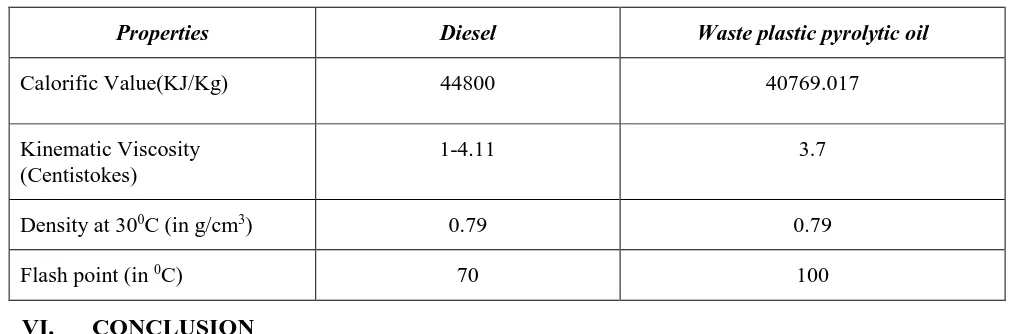
Table 2 shows the comparison between the waste plastic pyrolytic oil and diesel. The comparison shows that the calorific value of Pyrolytic oil and diesel are similar and the oil can be used to run the compression ignition engine. The Kinematic viscosity of diesel is much less than that of the pyrolytic oil that means that the pyrolytic oil has high flowing capacity as compared to diesel. The densities of both the oils are almost the same that means pyrolytic oil has the similar properties as that of diesel. Thus, from this comparison, it can be concluded that the pyrolytic oil can be used to run the diesel engine.
Table 2. Comparison of Properties between Waste Plastic pyrolytic oil with Diesel
Properties Diesel Waste plastic pyrolytic oil
Calorific Value(KJ/Kg) 44800 40769.017
Kinematic Viscosity (Centistokes)
1-4.11 3.7
Density at 300C (in g/cm3) 0.79 0.79
Flash point (in 0C) 70 100
VI. CONCLUSION
This paper describes the importance of plastic pyrolysis and its usefulness for sustainable development. The paper also described the design and fabrication of pyrolysis setup for the extraction of oil from waste plastic. Further this paper also indicates the properties of the oil derived from pyrolysis like calorific value, density, Kinematic viscosity etc which was found comparable to diesel. This means that the pyrolytic oil derived from waste plastic can be used in the Compression ignition engines which uses diesel as fuel or it can be used in blended form with diesel to run the engine.
Conflict of Interest: The authors declare that they have no conflict of interest.
Ethical Statement: The authors declare that they have followed ethical responsibilities.
REFERENCES
[1] G. D. Rai (2004), Non-Conventional Sources of Energy, Khanna Publishers.
www.ijaera.org 2016, IJA-ERA - All Rights Reserved 543 [3] Ahmad Tawfie qurrahman Yuliansyah, Agus Prasetya, Muhammad A. A. Ramadhan and Rizki Laksono
(2015), Pyrolysis of plastic waste to produce pyrolytic oil as an alternative fuel, International Journal of Technology, 7, 1076-1083.
[4] Kumar S.P., Bharathi kumar M., Prabhakaran C., Vijayan S. and Ramakrishnan K. (2015), Conversion of waste plastics into low-emissive hydrocarbon fuels through catalytic depolymerisation in a new laboratory scale batch reactor, International Journal of Energy and Environmental Engineering, 44, 1-7
[5] Syamsiro M., Saptoadi H., Norsujianto T., Noviasri P., Cheng S., Alimuddin Z. and Yoshikawa K. (2014), Conference and Exhibition Indonesia Renewable Energy & Energy Conservation Energy Procedia,12, 180 – 188.
[6] Murugan S. (2014), Light Oil Fractions from a Pyrolysis Plant-An Option for Energy Use, Energy Procedia, 54, 615 – 626
[7] T.J. Anup and Watwe Vilas (2014), Waste Plastic Pyrolysis Oil as Alternative for SI and CI Engines, International Journal of Innovative Research in Science, Engineering and Technology, 3,14680-14687 [8] Patni N., Shah P., Aggarwal S. and Singhal P. (2013), Alternate Strategies for Conversion of Waste Plastic
to Fuels, ISRN Renewable Energy Article ID 902053, 7 pages.
[9] Wongkhorsub C. and Chindaprasert N. (2013), A Comparison of the Use of Pyrolysis Oils in Diesel Engine, Energy and Power Engineering, 5, 350-355.
[10] Abatneh Y. and Sahu Omprakash (2013), Preliminary Study on the Conversion of different Waste Plastics into Fuel Oil, International Journal of Scientific & Technology Research, 2, 226-229.
[11] Murugan S, Ramaswamy MC and Nagarajan G. (2009), Assessment of pyrolysis oil as an energy source for diesel engines, Fuel Process Technology,90, 67-74.
[12] Panda A.K., Singh R.K., and Mishra D.K (2010), Thermolysis of waste plastics to liquid fuel A suitable method for plastic waste management and manufacture of value added products—A world prospective, Renewable and Sustainable Energy Reviews ,14, 233–248.
[13] Compendium of Technologies (2006), Converting waste plastic into a resource, A Report compiled by UNEP, Division of technology, Division of Technology Industry and Economics, International Environment.
[14] Park J.J., Park K. winam, Park Jin-Won and Kim Dong Chan (2002), Characteristics of LDPE Pyrolysis, Korean Journal of chemical Engineering, 19, 658-662.
[15] Demirbas Ayhan (2004), Pyrolysis of municipal plastic wastes for recovery of gasoline-range hydrocarbons, Journal of Analytical and Applied Pyrolysis, 72, 97-102.
[16] Williams A.E. and Williams P.T. (1997), Analysis of products derived from the fast pyrolysis of plastic waste, Journal of Analytical and Applied Pyrolysis, 40, 347-363.
[17] Pradhan D. and Singh R.K. (2011), Thermal Pyrolysis of Bicycle Waste Tire Using Batch Reactor, International Journal of Chemical Engineering and Applications, 2,332-336.
[18] B.P Pundir (2007), Engine Emissions – Pollution Formation and Advances in Control Technology, Narosa Publishing House, New Delhi.
[19] Bhatia A., Sanghwan V., Kaistha T., Varshney V. and Dalal S. (2016), Energy harvesting through Footsteps, International Journal of Advanced Engineering research and Applications,1(10),405-412. [20] Man Djun, Lee, Shahidul, M.I., Houssein Elaswad, Abdullah Yassin & Syed Tarmizi Syed Shazali