Original Research Article
A cross sectional study on personal hygiene among rural school students
in southern Rajasthan
Nitesh Mangal, Dilip Kumar L.*, K. A. Varghese, Meet Chauhan
INTRODUCTION
Personal hygiene can be defined as the practice of maintaining cleanliness and promoting and preserving body health.1 Personal hygiene is a condition promoting healthy and sanitary practices by a person. Personal hygiene which includes set of healthy practices are either inherited or deliberately learnt during various phases of the life of a person. Every person develops hygienic practices and standards that have been either taught to them or that they have learnt by themselves. Generally, the practice of personal hygiene is employed to prevent
or minimize the incidence and spread of communicable diseases. Good personal hygiene practices are the prerequisites for the formation of a healthy community. The old saying that „Health is Wealth‟ becomes a reality only when good personal hygiene practices are followed by all the members of the society , right from person to family and other bigger segments of the society.
The level of personal hygiene of a person is the cumulative effect of his or her own efforts to be neat and clean both externally and internally. The knowledge for this is attained through sources like parents, friends, teachers, books, media and all other sources which have
ABSTRACT
Background: The level of personal hygiene has a strong bearing on preventive capacity for many diseases and hence
the assessment of its level assumes great significance. The school being a strong base for hygienic practices, the present study aimed to assess the level of personal hygiene and its associated factors as well as its effect on morbidity level of school children in a rural belt of southern Rajasthan.
Methods: The cross-sectional study was conducted among 250 students studying in classes VIII to XII in 3 different
schools of southern Rajasthan from November 2018 to February 2019.The data was obtained by interview method using pretested questionnaire which included socio-demographic factors, the hygienic practices and occurrence of diseases as dichotomous questions. The association of the attributes was tested through Chi-square test, correlation and regression techniques.
Results: Only 22% students scored above 75% and were categorized as good practioners of personal hygiene. The age of students, parents literacy, and household income were significantly associated with personal hygiene. The common morbidities like head lice and dental caries were found gender sensitive in the study area. The negative association between disease score and personal hygiene score implied that the disease burden of children can be minimized with higher personal hygiene practices.
Conclusions: Systematic efforts to sensitize school children and parents about importance of personal hygiene, improvement in parental literacy coupled with economic empowerment of rural families can help to enhance the status of personal hygiene of students and thereby drastic reduction in their disease burden.
Keywords: Personal hygiene, Diseases score, Rural school children, Southern Rajasthan
Department ofCommunity Medicine, Pacific Institute of Medical Sciences, Udaipur, Rajasthan, India
Received: 05 April 2019
Accepted: 15 May 2019
*Correspondence:
Dr. Dilip Kumar L,
E-mail: [email protected]
Copyright: © the author(s), publisher and licensee Medip Academy. This is an open-access article distributed under
the terms of the Creative Commons Attribution Non-Commercial License, which permits unrestricted non-commercial use, distribution, and reproduction in any medium, provided the original work is properly cited.
direct or indirect impact on people. In order to remain healthy and thereby socially and economically strong one has to strictly follow hygienic practices applicable to the whole as well as for each part of the body. The personal hygienic practices include practices like whole body cleaning through regular baths; mouth cleaning through brushing the teeth at least twice a day and mouth washing always after taking food; regular hand washing before and after making, distributing and taking food, after defecation, after touching any dirty material and visiting any public place; regular cleaning of nose, eyes , ears and sexual organs; nail and hair cutting at regular intervals; protection of hairs from lice, regular changing of clothes, bed sheets and other items of personal use. Family level practices like drying of clothes under sun shine, having separate bathing towels for each member of the family, eating of fresh and clean food, drinking of clean water also contributes toward personal hygiene. It also includes use of sanitary pads by women during menstruation, use of toilets for defecation and its cleanliness and a host of other practices at home and at public places. The absence of hygienic practices in daily life paves way for a large number of health problems and occurrence of many diseases in the community.
According to the Centers for Disease Control and Prevention, addressing the spread of germs in schools is essential for the health of our youth, our schools and our nation. Good hygienic practices help to prevent the spread of germs and also give good impression of a person to others.2 Day to day activities related to personal hygiene if practiced properly the health can be improved and maintained.3 Communicable diseases which are spread through food, water, personal contact and surrounding environment can be adequately controlled through adoption of hygienic practices.4
Bad personal hygiene leads to different sicknesses such as halitosis, tonsillitis, throat infection, viral hepatitis especially like hepatitis A & E, cholera, typhoid, diarrheal diseases & food poisoning, cold , influenza, sinusitis and LRTI, ear discharge, boils, dental carries, periodontal diseases, dandruff, lice infestation, scabies, ring worm, fungal infection, boils and many others.2,5
School plays an important role to educate children about hygienic practices right from their younger age.6 The present focus of health service in schools is on regular nutritional support and clinical assessment of students. While these are important, equally important is to sensitize school children on personal hygiene in a developing country like India.4 While schools are better places to mould behavior of students, it can also be used as good source to develop healthy habits in children.7 The knowledge related to personal hygiene can be easily imparted in the school children for better health promotion during the rest of their lifetime.8 In other words, schools provide an opportunity to better educate the children regarding different aspects of health such as nutrition, immunization, hygiene, environment,
sanitation, social customs and so on.7,9 Regular school health check- ups can prevent complications in school children by early detection of childhood illnesses.10
The school and family are the two major sources from one can develop a strong base for hygienic practices. The level of personal hygiene has a strong bearing on preventive capacity for many diseases and hence the assessment of its level assumes great significance. This will further enable children to attend schools regularly and thereby improving higher academic excellance.11 Though it is taught in schools and practiced in many of the families, the hygienic practice are not rigorously followed by all. Therefore, an attempt has been made to assess the level of hygienic practices by school children in a rural belt of southern Rajasthan. The specific objectives of the study are:
To assess the level of hygienic practices followed by grown up school children in rural areas of southern Rajasthan.
To examine the association between level of hygienic practices followed by school children with socio-economic factors of their families.
To examine the association between levels of hygienic practices with occurrence of common diseases.
METHODS
Study design and participants
As the level of personal hygienic practices followed by rural school children in the study area or in the State of Rajasthan was not readily available, a pilot study representing the students of class VIII to class XII in one of the schools in the study area was conducted to assess the level of personal hygienic practices by such students and it was estimated that only 20 percent of students could be categorized as good hygienic practitioners. Keeping this proportion as the basis for final sample size determination, the sample size was calculated as:
n= z2pq/d2= (1.96)2(0.20)(0.80)/(0.05)2= 246 (approximately 250 students).
to them. Thereafter, selected students of each class were interviewed and the questionnaires were filled through queries and observation. The clinical examination of students was also done by the team of doctors.
Study tool
A well structured questionnaire keeping in view the list of personal hygienic practices advocated by the Indian Adolescent Health Questionnaire (IAHQ) and Global School based Student Health Survey (GSHS) agencies was prepared.12,13 Pretested and predesigned questionnaire was administered in local language to all the selected students after obtaining the consent from school authorities. Each student was interviewed and examined for about 20-25 minutes.
The questionnaire included socio-demographic details like age, sex, class, religion, type of family, household income, parent‟s occupation and education. The questions related to personal hygiene included aspects like daily bath, lice problems, brushing the teeth, hand washing, uses of foot wears, open defecation, frequency of changing clothes and socks, nail cutting, hair cutting etc. The disease aspect included frequency and occurrence of diseases like fever, cold, diarrhea, dental caries, scabies, fungal infection, impaired visual acuity and so on. It included 18 questions on personal hygienic practices, eight on knowledge and other associated factors related to personal hygiene and information on occurrence of ten common diseases or problems they had during the last three months.
A scoring system was used to classify students into either good or bad hygiene practitioner. The level of practices by each student was assessed on the basis of total score obtained by each student on personal hygienic practices. All the questions related to hygienic practices were dichotomous in nature. If the answer was “Yes” a score of one and if “No” a score of zero was given. Those secured a minimum aggregate score of 14 or more (about 3/4th of 18) were classified as “good personal hygiene practitioner” while those who secured below 14 were categorized as “bad personal hygiene practitioner.”
Inclusion criteria
Students who were willing to participate were only included in the study.
Exclusion criteria
Those students who were mentally/physically unfit or absent on the day of study were excluded.
Statistical analysis
The data was entered on MS excel sheet and analysis was done by using available options under MS Excel and Minitab. The association of socio-demographic factors
and occurrence of the diseases with personal hygiene were tested using chi- square test. The statistical significance in the proportions of boys and girls affected with the different diseases was tested using the SND test for equality of two proportions. The correlation between personal hygienic score with disease score was assessed by calculating the Karl Pearson‟s coefficient of correlation and also by estimating the linear function using the relationship Y= a+bX , where Y stand for disease score and X stand for personal hygiene score and its significance was tested using student‟s t-test.
RESULTS
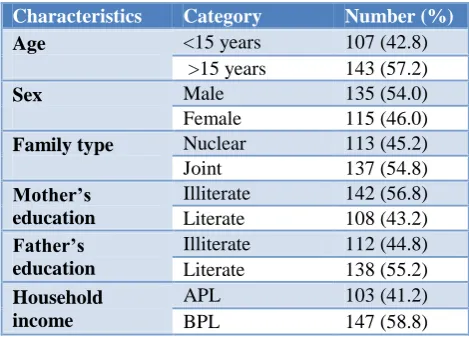
Overall 250 students participated in the study. The mean age of the study participants came out to be 15.8 years. The good personal hygiene was found in 55 (22%) students and bad personal hygiene was found in 195 (78%) students. In the study area, joint families 137 (54.8%) dominated over nuclear families 113 (45.2%). About 142 (56.8%) mothers were illiterate and 147 (58.8%) of the households belonged to below poverty line (BPL) categories. The study participants consisted of 135 (54%) male and 113 (46%) females (Table1).
Table 1: Socio-demographic characteristics of study participants (n=250).
Characteristics Category Number (%)
Age <15 years 107 (42.8) >15 years 143 (57.2)
Sex Male 135 (54.0) Female 115 (46.0)
Family type Nuclear 113 (45.2)
Joint 137 (54.8)
Mother’s education
Illiterate 142 (56.8) Literate 108 (43.2)
Father’s education
Illiterate 112 (44.8) Literate 138 (55.2)
Household income
APL 103 (41.2) BPL 147 (58.8)
Association of socio-demographic factors and levels of personal hygiene scores
Among the parents of 250 students, 108 (43.2%) mothers and 138 (55.2%) fathers were literate. The age of students, parent‟s literacy and father‟s income were found to have significant association with personal hygienic scores of students. Remarkably, the gender of students and type of family were found to have non-significant association with hygienic score of students (Table 2 and Table 3).
Association of diseases occurrences with personal hygiene
associated attributes (Table 4). The correlation coefficient between hygienic score and disease score of selected students was worked out to be r = -0.9642 which is statistically significant (p<0.01). Efforts were also made to estimate disease score (Y) as a function of personal hygiene score (X). The estimated relationship is Y=
16.27- 0.92 X. Both the slope and intercept of the linear function were statistically significant. The negative slope of linear equation indicates that the disease score of the subject is inversely related to their personal hygiene score. It is seen that one unit increase in personal hygiene score can reduce the disease score by 0.92 units.
Table 2: Association of age and sex of children and type of family with personal hygiene score.
Personal hygiene practices
Age (in years) Sex Type of family
<15 yrs (N)
>15 yrs (N)
Male (N)
Female (N)
Nuclear (N)
Joint (N)
Good personal hygiene (n=55) 16 39 31 24 27 28
Bad personal hygiene (n=195) 91 104 104 91 86 109
Chi-square value 5.41 0.15 0.43
P-value 0.01* 0.69 0.51
*Significant (p<0.05).
Table 3: Association of parent’s literacy level and household income with personal hygiene.
Personal hygiene practices
Mother’s literacy Father’s literacy Household income level
Literate (N)
Illiterate (N)
Literate (N)
Illiterate (N)
APL (N)
BPL (N)
Good personal hygiene (n=55) 36 19 40 15 32 23
Bad personal hygiene (n=195) 72 123 98 97 71 124
Chi-square value 14.23 8.75 8.39
P-value 0.0001* 0.003* 0.003*
*Significant (p<0.05).
Table 4: Association of disease occurrence with personal hygiene.
Personal hygiene practices Disease occurrence
Yes (N) No (N)
Good personal hygiene (n=55) 16 39
Bad personal hygiene (n=195) 128 67
Chi-square value 23.46
P-value 0.000001*
*Significant (p<0.05).
Table 5: Distribution of disease occurrence in study participants.
Disease/sufferings Boys (n=135)
Number (%)
Girls(n=115)
Number(%) P-value
Cold 25 (18.52) 18 (15.65) >0.05
Fever with or without cough 20 (14.81) 14 (12.17) >0.05
Diarrhea 11 (8.15) 15 (13.04) >0.05
Passage of worms in stool 5 (3.70) 6 (5.22) >0.05
Head lice 11 (8.15) 38 (33.04) <0.05*
Dental caries 17 (12.59) 29 (25.22) <0.05*
Scabies 11 (8.15) 13 (11.30) >0.05
Multiple boils 10 (7.41) 8 (6.96) >0.05
Foul smell in breath (Halitosis) 9 (6.67) 3 (2.61) >0.05
Impaired visual acuity 25 (18.52) 23 (20.00) >0.05
Fungal infection 40 (29.63) 30 (26.09) >0.05
No morbidity 27 (20.00) 21 (18.26) >0.05
Gender effect on occurrence of common diseases It is revealed that fungal infection 40 (29.63%) followed by impaired visual acuity 25 (18.52%), cold 25 (18.52%) and fever 20 (14.81%) were the major diseases faced by the boys .The girls reported head lice problem as a major one 38 (33.04%) followed by fungal infection 30 (26.09%), dental caries 29 (25.22%), impaired visual acuity 23 (20%) and cold 18 (15.65%).The multiple diseases were reported by 49 (36%) out of 135 boys and 62 (53%) out of 115 girls .It is remarkable to note that 27 (20%) of the boys and 21 (18.26%) of girls did not have any morbidity at all during the last three months of the conduct of the survey. The high rate of multiple problems in girls coupled with relatively lower rate of absence of morbidity in girls revealed that girls are more susceptible to problems due to lack of personal hygiene. It is also observed that there has been significant difference in proportion of boys and girls affected by diseases like head lice and dental caries (Table 5).
General observations
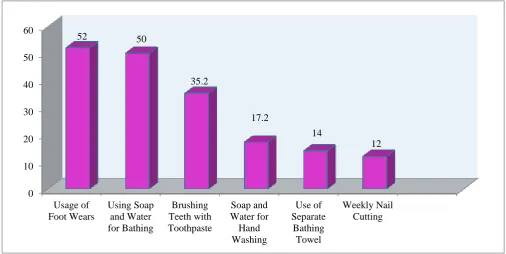
While 112 (97%) of girls were aware of using sanitary napkins as a good practice to promote menstrual hygiene, only 103 (90%) were found using sanitary napkins. Similarly about 118 (87.04%) boys were cutting hair once in a month. About 125 (50%) students were found using water and soap for bathing. However there were some students taking bath with water alone or using local materials such as turmeric, oil etc. along with water. The practice of brushing teeth with toothpaste was found among 88 (35.20%) students. However some students were found using neem stick, or charcoal while brushing the teeth. While 43 (17.20%) students reported using soap and water for hand washing after coming from toilet and the remaining students either washed with water alone or by using soil and water. About 30 (12%) students used to cut nails once a week and the remaining were either irregular in cutting nails or at periods more than a week. About 35 (14%) students were reported using separate bathing towels and 130 (52%) students were regularly using foot wears while going out (Figure 1).
Figure 1: Distribution of some personal hygienic practices among study population.
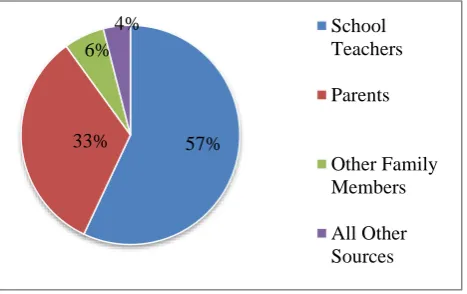
Knowledge about personal hygiene among students Majority of the students reported that the sources of information for the knowledge about personal hygiene were school teachers (57%), parents (33%), other family members (6%) and other sources (4%) including friends (Figure 2).
Most of the students had perception about importance of personal hygiene. However only 57 (23%) students knew that open air defection affects personal health. The knowledge about food borne disease was more among
girls 84 (73.04%) compared to boys 64 (47.40%). Almost all the students were of the opinion that schools must provide more opportunity to know about practices of personal hygiene.
Environment and personal hygiene
Information related to their house and environmental factors were also ascertained as a part of the study. Remarkably, majority 195 (78%) of the houses of school children had separate kitchen in their houses. However mixed use of fuel likes LPG, cow dung, firewood, 0
10 20 30 40 50 60
Usage of Foot Wears
Using Soap and Water for Bathing
Brushing Teeth with Toothpaste
Soap and Water for Hand Washing
Use of Separate
Bathing Towel
Weekly Nail Cutting 52 50
35.2
17.2
14
kerosene etc. was reported by the students. Large number of students 173 (69.20%) reported that drainage system outside their houses was not congenial.
Figure 2: Sources of information of personal hygiene.
DISCUSSION
The subjects involved in this study were assessed for their practices related to personal hygiene in relation to their socio- demographic factors and also occurrence of common diseases. While 45.2% students in this study belonged to nuclear family system, 54.8% were from joint family system. A similar study by Jitendra Sihra et al conducted at Jaipur, reported a reverse pattern with respect to type of family.14 In this study the prevalence of poor personal hygiene was 78 % which is high when compared with the studies done by Motakpalli et al in Karnataka (27%) and in another study by Ratnaprabha et al showed that among 213 students, bad hygiene practices were seen in 57.70 % of the study subjects.4,15 Apart from the area effect, the definitions followed to delineate good and bad hygiene practice could be the reason for such variations in the level of good and bad practicing classes. Besides, the present study was confined to rural areas dominated by large number of below poverty line households.
Personal hygiene was found to be strongly associated with age (Chi square value is 5.41, p<0.05) in the present study. Similar finding was observed in the study done by Mukherjee et al at Kolkata.16 The present study revealed that the level of personal hygiene was better among the boys compared to girls though the difference is not statistically significant. Similar finding was observed in the study done by Ratnaprabha et al at Karnataka.15 The study by Sihra et al showed that 37.1% girls had knowledge about sanitary pad while in the present study, 97% girls had knowledge about sanitary pads as the girls in this study covered class from VIII and above.14 Besides, such pads are made available to needed students from school itself these days. In this study 88 (35.20%) students were found using toothpaste for brushing the teeth, however the remaining were found using other materials such as neem stick, charcoal for brushing the teeth. It is very much comparable to the finding in the
study conducted by Vismita et al at Jaipur in which 30% were found using toothpaste for brushing the teeth and the remaining 70% were found using neem stick for the same.17
Parental literacy and household income were found to play crucial role in determining the hygienic level of students. Mukherjee et al also showed that parental literacy and per capita monthly family income were significantly associated with the personal hygiene practice score of the students.16
The present study showed that 30 (12.00%) students were cutting nails once a week while the study conducted by Ansari et al reported that 89% students were cutting nails once a week.18 It was found that 43 (17.2%) students were using soap and water for hand washing after coming from toilet while majority of the students either washed with water alone or by using soil and water. The study conducted by Sreenivasan in Chennai reported that 91.60% students used soap to wash their hands after defection.19 About 125 (50%) students were found using soap and water for bathing whereas the study conducted by Ratnaprabha reported that the extent of such students comes to 96.71%. 15 Remarkably, the present study showed that out of 250 students, 48 (19.20%) did not have any morbidity. Motakpalli et al reported that 111 (22.20 %) out of 500 students did not have any morbidity.4 The multiple morbidities were to the tune of 76.50% for the whole sample of which 76 (56.29%) boys and 103 (89.56%) girls were found having multiple morbidities in the present study .Similar finding was shown by Paul in Odisha in which 77 % were found having multiple morbidities.13 It was found in this study that 49 (19.60 %) students had head lice problem with female predominance. Sreenivasan et al reported that 48.8% students suffered from this problem.19 The problem of dental caries in our study was to the tune of 18.40 % whereas Kant et al reported the extent of the problem as 41.33 % among school going students.20 Only 11 (4.40%) students reported worm infestation in the present study while Pallavi et al reported it to be 13.2 %.7 In this study the extent of fungal infection was 29.63 % among boys and 26.09 % among girls respectively, while the study by Paul et al reported the fungal infection was to the extent of 9.4% among boys and 24.1% among girls.13 In the present study the share of scabies in boys and girls were 8.15% and 11.30% respectively whereas Sumit el al reported this problem to the extent of 25.9% among boys and 20.0% among girls.21
The inverse relationship of the level of personal hygiene with diseases score was established through chi-square test, correlation and regression analysis. It indicates the need to promote the level of personal hygiene in school children to minimize the common morbidity problem. The study by Thekdi et al in Surendranagar, Gujarat also concluded that their existed significant association between personal hygiene and their health related problems.22
57% 33%
6%
4% School
Teachers
Parents
Other Family Members
CONCLUSION
School teachers and parents are found to be the main sources of knowledge on personal hygiene of students. Only 22% of students were found to follow good personal hygiene practices. Age of the students, parent‟s literacy and household income were found to have associated with personal hygiene level of students. The occurrences of diseases were found significant associated with hygienic level and this association is inverse in nature as reveled by negative correlation coefficient between these two.
Limitations of study
Study was confined to higher secondary schools and subjects of study included were students from class VIII onwards. In spite of cross-sectional study, an interventional study could have given the actual impact of personal hygiene practices among school children‟s.
Recommendations
Efforts to sensitize parents on the importance of personal hygiene and subsequently by focusing curricular and extra- curricular activities in schools for improving hygienic level of school children can pay rich dividends. Systematic efforts to sensitize growing children and parents about importance of personal hygiene, improvement in parental literacy coupled with economic empowerment of rural families can play a crucial role to enhance the status of personal hygiene of our young generation and thereby drastic reduction in their disease burden. Training of the students regarding knowledge and practice of personal hygiene should be done through active involvement of parents and teachers. Parents, teachers and students meeting can be used to educate the students regarding personal hygiene practices.
Funding: No funding sources Conflict of interest: None declared
Ethical approval: The study was approved by the Institutional Ethics Committee
REFERENCES
1. Al-Rifaai JM, Al Haddad AM, Qasem JA. Personal hygiene among college students in Kuwait: A Health promotion perspective. J Edu Health Promot. 2018;7(92):1-7.
2. Chaudhari A, Mansuri S, Singh A, Talsania N. A study on Personal Hygiene of school going and non- school going children in Ahmedabad district, Gujarat. Ntl J of Community Med. 2015;6(3):437-41.
3. Gupta R, Sharma H, Sharma I, Meena S. Association of Dental Diseases with Personal Hygiene in School Children of Rural Rajasthan, India. IMJH. 2016;2(9):27-31.
4. Motakpalli K, Indupalli AS, Sirwar SB, Jayaalakshmi KN, Bendigeri ND ,Jamadar DC.A Study on health hygiene among school children in rural field Practice area of AJIMS Mangalore in Karnataka: India. Int J Bioassays. 2013;02(10):1407-10.
5. Walvekar PR, Naik VA, Wantamutte AS, Mallapur MD. Impact of child to child programme on knowledge, attitude practice regarding diarrhoea among rural school children. Indian J Community Med. 2006;31(2):56-9.
6. WHO Expert Committee on School Health Services. Report on the First Session. Geneva, World Health Organization, 1950 (WHO Technical Report Series, No. 30).
7. Kunde Pallavi B, Balkrishna A. Can Personal Hygiene determine Health? : Study amongst School Children in a tribal area of Thane District. National Journal of Research in Community Medicine. 2014;3(2):127-32.
8. Khatoon R, Sachan B, Khan MA, Srivastava JP. Impact of school health education program on personal hygiene among school children of Lucknow district. J Family Med Prim Care. 2017;6(1):97-100.
9. Berad AS, Chandra Sekhar Reddy B, Ravi Kumar BP, Bolisetti V. Study of personal hygiene, nutritional and morbidity profile of school children in rural area of khammam district, Andhra Pradesh. J Evol Med Dental Sci. 2013;2(34):6402-5.
10. Panda P, Benjamin AI, Singh S, Zachariah P. Health status of school children in Ludhiana city. Indian J Community Medicine. 2000;25(4):150-5.
11. Mhaske MS, Khismatrao DS, Kevin F, Pandve HT, Kundap RP. Morbidity pattern and personal hygiene in children among private primary school in urban area: Are the trends changing? J Fam Med Primary Care. 2013;2(3):266-9.
12. Meher S, Nimonkar R. Study of hygiene practices among school going children in a government school in Kolkata. Int J Community Med Public Health. 2018;5 (7):3102-5.
13. Paul KK, Panigrahi SK, Soodi Reddy AK, Sahu T. Association of personal hygiene with common morbidities among upper primary school children in rural Odisha. J Family Med Prim Care. 2017;6(3):509-12.
14. Sihra J, Meena G, Meena N, Naroliya D, Saini L, Kaur M, Gaur K. Assessment of Knowledge and Practices regarding personal hygiene among students of Government schools of Jaipur city: A cross-sectional survey. International Multispecialty J Health. 2018;4(4):125-30.
15. Ratnaprabha GK, Kumar A, Kumar A. Practices regarding personal hygiene among government high school students of a rural area in Central Karnataka. Int J Med Sci Public Health. 2018;7(6):457-461. 16. Mukherjee A, Sinha A, Taraphdar P, Haldar D,
children in slum area of Kolkata, India. IOSR J Dental Med Sci. 2014;13(12):13-7.
17. Vismita P, Paliwal CK, Nishi F, Surabhi C. Personal hygiene habits among school-going children in rural areas of Jaipur, Rajasthan, India. Int J Sci Res Rev. 2014;3(2):126-42.
18. Ansari SY, Warbhe PA. Assessment of the Knowledge and Practice Regarding Personal Hygiene among School Children from an Urban Area. International J Current Med Applied Sci. 2014;4(1):1-12.
19. Seenivasan P, Mary AE, Priya KC, Devi E, Nanthini S, Nuzrathjahan SA, et al. A Cross Sectional Study on The Health Hygiene Status Of School Children In North Chennai. Stanley Med J. 2016;3(2):8-14. 20. Sehgal RK, Garg R, Anand S, Dhot PS, Singhal P.
A Study of the Morbidity Profile, Personal Hygiene and Nutritional Status of School Children in Rural
Areas of District Ghaziabad in Uttar Pradesh. J Evol Med Dental Sci. 2015;4(72):12574-80.
21. Wasnik S, Pinto V, Joshi S. Prevalence of Skin Infections and Regular Personal Hygiene Practices in Ashram School Students: A Cross-Sectional Study. Natl J Community Med. 2018;9(4):274-7. 22. Thekdi KP, Kartha GP, Thekdi PI. Morbidity
pattern and its association with personal hygiene practices among school going children (11 to 15 years of age group) in Surendranagar, Gujarat, India. Int J Community Med Public Health. 2016;3(8):2125-8.
Cite this article as: Mangal N, Kumar DL, Varghese