SUPPLEMENT ARTICLE
Early Developmental Processes and the Continuity of
Risk for Underage Drinking and Problem Drinking
Robert A. Zucker, PhDa,b, John E. Donovan, PhDc, Ann S. Masten, PhDd, Margaret E. Mattson, PhDe, Howard B. Moss, MDf
aDepartment of Psychiatry andbAddiction Research Center, University of Michigan, Ann Arbor, Michigan;cWestern Psychiatric Institute and Clinic, University of Pittsburgh, Pittsburgh, Pennsylvania;dInstitute of Child Development, University of Minnesota, Minneapolis, Minnesota;eTreatment and Recovery Research Branch, National Institute on Alcohol Abuse and Alcoholism, Bethesda, Maryland;fOffice of the Director, National Institute on Alcohol Abuse and Alcoholism, Bethesda, Maryland
The authors have indicated they have no financial relationships relevant to this article to disclose.
ABSTRACT
Developmental pathways to underage drinking emerge before the second decade of life. Many scientists, however, as well as the general public, continue to focus on proximal influences surrounding the initiation of drinking in adolescence, such as social, behavioral, and genetic variables related to availability and ease of acquisition of the drug, social reinforcement for its use, and individual differences in drug responses. In the past 20 years, a considerable body of evidence has accumulated on the early (often much earlier than the time of the first drink) predictors and pathways of youthful alcohol use and abuse. These early developmental influences involve numerous risk, vulnerability, promotive, and protective processes. Some of these factors are not related directly to alcohol use, whereas others involve learning and expectancies about later drug use that are shaped by social experience. The salience of these factors (identifiable in early childhood) for understanding the course and development of adult alcohol and other drug use disorders is evident from the large and growing body of findings on their ability to predict adult clinical outcomes. This review summarizes the evidence on early pathways toward and away from underage drinking, with a particular focus on the risk and protective factors and the mediators and moderators of risk for underage drinking that become evident during the preschool and early school years. It is guided by a developmental per-spective on the aggregation of risk and protection and examines the contributions of biological, psychological, and social processes within the context of normal develop-ment. Implications of this evidence for policy, intervention, and future research are discussed.
S
EVERAL BASIC THEMESprovide guidance for developing a perspective on the timing, processes, and experiencesin earlier life relevant to the acquisition, use, and problem use of alcohol. First, much of the causal structure underlying youthful alcohol use and abuse is not specific to alcohol and in particular is either directly or indirectly the result of the development of externalizing and internalizing behaviors.1–3Family history of antisocial behavior,
child maltreatment, and other negative life experiences are well-established precursors of later alcohol problems and alcohol use disorders (AUDs). These predictors are nonspecific risks for alcohol involvement, because they also predict a broad array of other problematic outcomes, including problems of undercontrolled or dysregulated behavior such as conduct problems, impulsivity, attention problems, aggressiveness, antisocial personality disorder, and depressive spectrum disorders.
Second, at the same time that children develop behavior problems not specific to alcohol, they acquire knowledge about the existence of alcohol as an object in the social environment. Learning about alcohol includes developing beliefs about alcohol on the basis of an awareness of its special characteristics as a drug (how it produces changes in cognition, feeling, and behavior) and its place in social relationships (who uses it and why) and, ultimately, developing expectancies about its use. To a large degree, these cognitive variables regulate when and how much consumption takes place and shape recognition of the appropriate circumstances for desistance from use.
Third, in tandem with the development of behaviors and beliefs related to alcohol, other developmental changes that influence behavior occur within the individual and in the social context. As the brain is developing, consumption of beverage alcohol interacts with changing brain structures and functions related to appetite, reward, planning, and affective and behavioral control. These neurobehavioral processes proceed from the interplay of genes and experience, in many cases operating through intermediate endophenotypes.4The latter are traits or biological indicators that are genetically
simpler than the diagnostic phenotype and are more proximal to the genetic influence but are part of the vulnerability pathway for the disorder.
Fourth, social environmental influences in the family, peer group, school, community, and larger macrosystems of society also play a significant role in modeling alcohol intake and the contexts of acceptable use. At the cultural
www.pediatrics.org/cgi/doi/10.1542/ peds.2007-2243B
doi:10.1542/peds.2007-2243B
Key Words
aggregation of risk, susceptibility, alcoholism, early childhood risk
Abbreviations
SUD—substance use disorder AUD—alcohol use disorder ADHD—attention-deficit/hyperactivity disorder
COA— child of alcoholic 5-HT—serotonin
level, social norms specify the age grades and social roles within which alcohol use/heavy use is acceptable and the situations in which it is unacceptable, and these social norms have been incorporated into legal norms that specify the appropriate sanctions for violations of alcohol use regulations.
Fifth, this multilevel dynamic interplay of biological, psychological, and social processes shapes not only risk but also normal development.5Normal development has
the potential to alter risk parameters and pathways of behavior profoundly and even to move at-risk children into a different, nonproblem pathway. The present re-view focuses on processes of risk for underage and adult drinking that emerge before adolescence (generally de-fined as before the second decade of life). We recognize that puberty may be well underway for some young people⬍10 years of age; however, our focus is on early and middle childhood and processes that generally pre-cede pubertal development and the social changes that characterize adolescence.
BRIEF DEVELOPMENTAL PORTRAIT OF THE UNDER-10 PERIOD
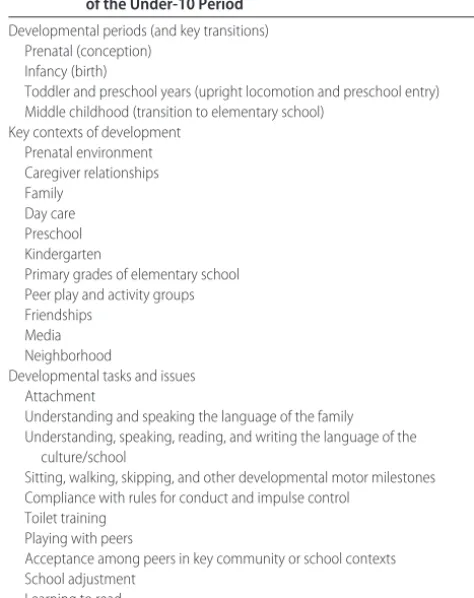
The years before 10 years of age encompass all of the growth and development from conception to the begin-nings of adolescence. These years are often divided into prenatal development, infancy, early childhood or the toddler and preschool years, and middle childhood. Key contexts after birth include attachment relationships, the family and home, the family neighborhood, day care, and preschool settings, kindergarten and the early pri-mary grades of school, playgrounds, peer play groups, school classrooms, and, increasingly, the media worlds afforded by television, music, electronic toys and games, computers, and movies (Table 1).
The pace of development during the first 10 years of life is astonishing, from conception to fetuses to children who can manipulate their parents, play card games, build elaborate castles from sand or blocks, cruise the Internet, hit a baseball, gossip, read and write stories, understand other people, and feel guilty about breaking the rules. The human brain undergoes remarkable growth and change, in structure, organization, and func-tion, over this period. During these years, fundamental self-regulation and social regulation systems develop, including the regulation of sleep, stress, and behavior.
During these years, many of the most-basic human systems for adapting to the world are developing, includ-ing ways we perceive and learn, solve problems, com-municate, regulate emotion and behavior, respond to stress, and get along with other people. What we call “personality” is taking shape as a result of individual differences in genetically influenced temperament, ex-perience, and their complex interactions over time. All of these adaptive systems continue to change with de-velopment and experience throughout the life course. By 10 years of age, however, many fundamental adap-tive systems of the human organism, both those embed-ded in the person and those embedembed-ded in relationships and connections to the social world, have assembled and exhibit some stability. Children arrive at the transitions
and challenges of adolescence with the personality and human and social capital they have accumulated in childhood, as well as their record of achievements and failures in meeting the various developmental tasks of childhood. Therefore, it is not surprising that many of the influential factors associated with early drinking emerge and are shaped during the first decade of life.
This review has 6 sections. In the first section, we describe how core developmental processes, such as be-havioral and emotional dysregulation, function as pre-disposing risk factors for youthful alcohol use. In the second section, we review other non–alcohol-specific risk factors that enhance drinking risk. In the third sec-tion, we describe alcohol-specific risk factors in child-hood that are associated with subsequent alcohol use. In the fourth section, we summarize what is known about risk and resilience developmental pathways, either to-ward or away from problematic alcohol use. In the fifth section, we describe briefly the next-step tasks needed for the formulation of policy in this area. In the sixth section, we outline the implications of existing knowl-edge for the development of focused interventions. In addition, we identify critical gaps, problems, and ques-tions that need to be addressed as part of a new devel-opmental research agenda for understanding and ad-dressing the problems of underage drinking, both as problems in their own right and as precursors in the pathway to later alcohol problems and AUDs.
TABLE 1 Developmental Periods, Transitions, Contexts, and Tasks of the Under-10 Period
Developmental periods (and key transitions) Prenatal (conception)
Infancy (birth)
Toddler and preschool years (upright locomotion and preschool entry) Middle childhood (transition to elementary school)
Key contexts of development Prenatal environment Caregiver relationships Family
Day care Preschool Kindergarten
Primary grades of elementary school Peer play and activity groups Friendships
Media Neighborhood
Developmental tasks and issues Attachment
Understanding and speaking the language of the family Understanding, speaking, reading, and writing the language of the
culture/school
Sitting, walking, skipping, and other developmental motor milestones Compliance with rules for conduct and impulse control
Toilet training Playing with peers
Acceptance among peers in key community or school contexts School adjustment
PREDISPOSING CHILDHOOD RISK FACTORS
This section presents findings on nonspecific factors that predict likelihood for subsequent alcohol involvement, such as behavioral dysregulation/undercontrol (includ-ing factors such as conduct disorder, attentional deficits, and aggressiveness); other childhood psychopathology; environmental influences such as family, peer, and school relationships; and precocious puberty.
Emergence of Behavioral and Emotional Dysregulation and Predisposition to Alcohol Involvement
Newborns emerge into the world with cries of greater or lesser intensity, lasting for shorter or longer periods of time, and with quicker or slower responses to the care-taking agents who attempt to soothe and to comfort them. If the comforting (feeding, handling, and being engaged by the caretaker) is sufficient, then the infant begins to display signs of satisfaction and relaxation. If it is not, then the affective expression continues. The dis-play of emotion, its intensity, and the degree to which it is capable of being modulated are basic characteristics of the human organism for display of displeasure, discom-fort, and pain on one hand and pleasure, comdiscom-fort, and happiness on the other. These are basic temperamental characteristics that serve signaling (communicative) functions, facilitate social engagement, and serve as or-ganismic motivators either to sustain current activity or to drive us to seek a change of state.6,7Such differences
are observable even at birth and form the substructure for later, more-differentiated feelings of happiness, self-satisfaction, sadness, and anxiety.
Parallel to the emergence of emotionality and the existence of individual differences in affective expres-sion, a developmental sequence is present for the emer-gence of motoric behavior and for attention. We know that there are fetal differences in activity levels even before birth, and such variations are quickly evident after birth. Infants vary in how much they move, as well as how quickly they respond to stimuli of light, sound, and touch. Some respond more quickly than others. Similarly, very early differences are evident in the de-gree to which children sustain focus or attention on an object and shift focus when a new set of stimuli are presented and in the amount of information they can retain. Such differences reflect the rudiments of a be-havioral regulation and control system on one hand and an attentional regulation and control system on the other, which ultimately determine the ability to plan, to inhibit responses while reflecting on alternative plans, and to access a broad array of information used in de-ciding whether it is wiser to carry out or to inhibit a particular action. These regulation functions are essen-tial to such basic processes as learning, planning, and forethought. When they function poorly, or when the social environment makes it difficult for them to develop (such as in homes where there is abuse and violence), social achievement and academic achievement are more difficult, and risk for substance use disorders (SUDs) is substantially elevated. In fact, one of the most promi-nent theories for the development of AUD and other SUDs posits the importance of a central dysregulatory
trait, involving delayed or deficient development of be-havioral, emotional, and cognitive regulation, in the early emergence of SUDs.8The dysregulation is
identifi-able as “difficult” temperament in infancy and early childhood and as an array of behavioral and neuropsy-chological deficits in adolescence. A substantial body of evidence supports the validity of this dysregulatory hy-pothesis.9,10
The processes we have described here are basic to the development of all children and are relevant to the many tasks of adolescence and adult life. Although we do not yet understand fully the mechanisms of impact of behavioral regulation and attentional control, these do-mains seem to be highly relevant to the acquisition and maintenance of alcohol use, as well as the progression into problem use. Given the centrality of these processes to relationships, to purposive behavior, to making choices, and to desistance, it is not surprising that they also are tied to the emergence of alcohol problems. The choice to use alcohol for the first time (ie, drinking onset) is a cognitive choice (regarding whether this is a wise act and what the consequences are of doing so at any particular time). It also is a behavioral act and is more likely to take place among young people who act impulsively and who are interested in new sensations and new experiences. Finally, it is an emotional act, driven to some degree by one’s sense of satisfaction or discontent with the world as one knows it before drink-ing. The possibility that a drink can create a change is more attractive if one is unhappy with one’s self and one’s social relationships.
Substance abuse researchers have been aware of these non–alcohol-specific processes for some time, which has led to the search for the traits that underlie them. In the past 20 years, an increasing amount of evidence from longitudinal studies has identified 2 such traits that are detectable very early in life, that predict alcohol (and to some degree other drug) involvement, and that seem to be markers of an underlying genetic diathesis for early use, heavy use, problem use, and AUD. This work, coming from 6 long-term prospective studies,11–15provides a remarkable convergence with the
genetic literature in demonstrating that externalizing (aggressive, impulsive, and undercontrolled) and to a lesser degree internalizing (anxious, sad, and depressive) symptoms appearing in early childhood are predictive of SUD outcomes 15 to 20 years after the first appearance of the non– drug-specific behavioral risk (see ref 3 for a review of this work). Moreover, these traits are known to be relatively stable over the course of childhood and adolescence,16,17with the individuals showing the
great-est continuity of problems also being the most likely to develop the more chronic and more severe forms of SUDs in adulthood.18,19
Neurobiological and Cortical Development of Regulatory Systems
multiple constituent functions.20 This is a
multicompo-nent construct, including such elements as response sup-pression/inhibition (the ability to suppress strategically a prepotent or prepared motor response), working mem-ory (itself multicomponent), set shifting (shifting from one task set or “set of rules” to another), and interfer-ence control (inhibition of a relatively dominant re-sponse system to allow another system to operate).21
These capacities are represented to a large degree in parallel frontal-subcortical-thalamic neural loops. Im-portant structures include the right inferior frontal cor-tex to basal ganglia (response inhibition22), dorsolateral
prefrontal cortex and associated structures (working memory23), and anterior cingulate cortex. These
net-works are heavily subserved by catecholamine innerva-tion. To the extent that they translate directly into be-havioral differences, they have relevance to a spectrum of activities that increase or decrease risk. They relate to wisdom in choice of peers, understanding of the impor-tance of context for appropriate drinking behavior, and the ability to resist peer pressure to drink when negative drinking consequences are likely (such as increasing in-toxication and the inability to get to school or work the next day and to function adequately).
Extensive theories as long as a generation ago at-tempted to link aspects of executive control to alcohol-ism risk, but findings supporting this linkage have been mixed.7,24–26 More-recent work27 suggests that the risk
element is related primarily to response inhibition. In addition, Finn et al28 theorized that auditory working
memory moderates temperamental risk for alcoholism. Other neuropsychological theories of individual vulner-ability to alcoholism are numerous, but most are at a low level of specificity.8It is essential to develop (and to test)
models with a higher level of specificity.
Closely intersecting these processes is the domain of motivation, particularly reward responsivity. Reward re-sponse involves dopaminergic pathways in the mesocor-tical and mesolimbic pathways that are closely related to those involved in executive control. The literature clearly indicates that executive and reward responses influence one another,6 both in development and
dy-namically. Extensive research suggests that at both the behavioral and neural levels, substance use problems are associated with dysregulation of reward responsivity, such that the subcortical involuntary elements (sub-served by limbic and striatal circuitry) over-respond to salient drug-associated stimuli and the normal cortical control (via frontal circuitry) over this response is im-paired or inhibited, leading to excessive risk-taking be-havior.29–31 Furthermore, there is preliminary evidence
for dysregulation of reward-related circuitry in at-risk populations even before alcohol and illicit drug use oc-curs.32
During the developmental period in which alcohol use and alcohol problems escalate, neural alterations occur in the frontal executive and reward systems in-volved in impulse and emotion regulation. The dorso-lateral prefrontal cortex (important to executive func-tioning as well as motivation) is one of the last brain regions to mature, with myelogenesis continuing at least
until early adolescence and potentially into early adult-hood.33Progressive increases in the white matter of this
region during childhood and adolescence have been demonstrated.34 These developmental changes directly
affect impulse and emotion regulation. It is known that, throughout childhood, there are developmental gains in the ability to suppress or to inhibit prepotent responses and in the ability to suppress irrelevant information.35
Social and emotional skills, such as the ability to discrim-inate emotional facial expressions, also develop through-out childhood and early adolescence, with associated changes in amygdala responsivity.36 Furthermore,
dur-ing the period from childhood through adolescence, the prefrontal cortex gains greater efficiency in its inhibitory control over the amygdala and other limbic structures involved in emotion and reward responses.37,38In
addi-tion to these structural brain changes, both human and animal studies indicate that there is an alteration in mesocorticolimbic dopamine systems in the brains of adolescents.39 Dopamine input to the prefrontal cortex
peaks during adolescence in nonhuman primates,40and
dopamine binding, primarily in the striatum but also in the nucleus accumbens (important for reward respon-sivity), peaks during adolescence.41
Understanding, at the neural activation level, how these mechanisms operate is crucial to a full explanation of individual risk using neurocognitive and neurobehav-ioral models. The developmental significance of these changes is substantial when superimposed on a social structure that is supportive of alcohol use. Extensive evidence from neuroimaging studies indicates that alco-hol and other substances of abuse have acute and lasting effects on these frontolimbic and frontostriatal systems that are implicated in impulse control and reward re-sponsivity.42–44 Such effects are thus superimposed on
this developing circuitry. Major issues not yet addressed concern the relative importance of the amount and tim-ing of alcohol (and other drug) exposure in brtim-ingtim-ing about such changes, the degree to which other environ-mental exposures (eg, stress) also play a role, and the degree to which early neurocognitive vulnerabilities in-teract with the drug exposure in producing change. An understanding of these processes requires a multilevel/ multisytem explanatory structure.
Genetics of Dysregulation
The strong evidence reviewed above for temperamental individual differences in behavioral regulation and control is paralleled at the genetic level by evidence from a number of heritability studies indicating that one of the core path-ways of genetic risk for SUDs involves a major common externalizing/disinhibitory factor.1,2,45A number of
molec-ular genetic studies also support this relationship, with genetic variants in the serotonergic system having received the largest amount of work to date. Serotonin (5-HT) is believed to operate as a regulator, with increased 5-HT being associated with inhibition of behavior46and genetic
variants of tryptophan hydroxylase, the rate-limiting en-zyme in the biosynthesis of serotonin, being associated with anger-related traits.47Genetic variants in monoamine
been associated with impulsive aggression,48antisocial
al-coholism,49and impulsive antisocial behavior in the
con-text of childhood maltreatment.11The 5-HT
1Breceptor has
been linked to antisocial alcoholism in humans50and to
increased impulsive aggression in mice.51 Other potential
candidate genes with apparent relationships to the exter-nalizing/undercontrol domain includeGABRA2, associated with conduct disorder and drug use disorder in childhood and adulthood and alcohol dependence in adulthood,52,53
and DRD4, associated with attention-deficit/hyperactivity disorder (ADHD).54
In addition to this major common genetic pathway, a number of more-specific factors have been identified, whose level of influence and role in the development of SUD vary across the different drugs of abuse. For AUD, by far the majority of these have involved genes linked to the metabolism of alcohol; however, given the hetero-geneity of the phenotype, it would not be surprising if other pathways of genetic control are also uncovered.
Environmental Influences on Regulational and Attentional Risk Development and Protective Factors
Environmental experiences such as stress, arousal, nur-turance, and other aspects of social interaction (eg, phys-ical abuse or observed family conflict) affect the brain either directly through changes in the development of neural networks or through the production of hormones that alter their development. The brain is thus the arena within which gene-behavior-environment interactions ultimately take place. A critical question is the following: what sites seem to have a predispositional vulnerability, both to impairment and to alcohol-seeking behavior?
Substantial basic science literature demonstrates, in animal models, strong effects of maternal rearing char-acteristics on the development of the biological stress response systems and the drug reinforcement pathways of the brain.55,56Adverse environmental exposures can
influence strongly the ontogenic development of the limbic-hypothalamic-pituitary axis and the mesolimbic dopamine reward pathways of the brain. The evidence suggests increasingly that adverse socioenvironmental influences, acting in concert with genetic factors, alter the physiologic reactions to stressors and to later expo-sure to alcohol and other drugs of abuse, as well as predicting the cognitive and behavioral responses to later prevention interventions.
An impressive body of preclinical research has dem-onstrated, at least in rats, that the ontogeny of the stress response system is regulated in part by maternal factors during early life. Groundbreaking work by Levine55
demonstrated that at least 3 aspects of maternal behavior in rats play a role in the regulation of the limbic-hypo-thalamic-pituitary axis during development, that is, tac-tile stimulation, feeding behavior, and passive contact. The maternal factors have important analogues in hu-man maternal care and attachment. Also in the rat model, Liu et al57investigated how variations in
mater-nal care affect offspring responses to stress across the lifespan, and they elucidated the epigenetic mechanisms through which variations in maternal stress response behavior are transmitted from one generation to the
next, independent of genetic influences. This group also demonstrated that early environmental stress and ma-ternal rearing behavior predict not only the ontogeny of the stress response circuitry but also the ontogeny of the mesolimbic dopamine reward pathway that underlies drug reinforcement.56 Studies in nonhuman primates
and humans have confirmed that exposure to early-life stressors alters the response to stress and its underlying circuitry in adults. This observation was confirmed in women who had experienced childhood abuse. A his-tory of childhood abuse was found to predict neuroen-docrine stress reactivity, which was enhanced by expo-sure to additional stressors in adulthood. This work has some parallels with the longitudinal behavioral litera-ture on the long-term effects of child abuse, but its correspondence is not perfect. In a long-term study by Widom et al58of children who were abused and/or
ne-glected atⱕ11 years of age and evaluated 20 years later, childhood neglect but not abuse was related to later alcohol abuse for women but neither neglect nor abuse was related for men. Later analyses showed that gradu-ation from high school served as a protective factor for the women’s later alcohol symptoms.59Work needs to be
performed to resolve these inconsistencies.
More generally, the attentional regulation and control system seems to be subject to the effects of early environ-mental experience, and an increasing body of evidence suggests that the interactional experiences affecting this system’s development also play a role in the development of drinking behavior. Early stress has lasting effects on brain areas and neurochemical systems involved in im-pulse control and reward circuitry, systems that increase the risk for alcoholism by facilitating the onset of drinking, maintenance of drinking behavior, and relapse. Recent work by Nigg et al60showed that poor response inhibition
contributes uniquely to early drinking onset and problem use, over and above the usual family risk variables, and plays a predictive role separate from that of behavioral undercontrol.
Emotional display and its obverse, emotional regulation, reflect a process of social transaction between infants and their caretakers.61Changes in emotional display and ability
to regulate have been shown to be influenced by the de-gree of attentiveness and responsiveness of the mother and, as the infant grows older, by the mother’s broader social environment, including her relationships with the father and with other adults in her support network,62,63
and her own previous social experience, including her own history of abuse or other trauma. Eiden et al63also showed
the contribution that fathers make to this process, even early in the life of the child. Alcoholic fathers are lower in sensitivity and higher in negative affect toward their chil-dren than are nonalcoholic fathers, and this parenting be-havior predicts the reciprocal effect (ie, lower infant re-sponsivity to the parents). Paternal depression, antisocial behavior, and aggression also were associated with lower sensitivity.
drug involvement in adolescence.64 The circumstances of
“mismatch” between parents and children are of greatest interest here, because they offer the greatest opportunity for the dampening of risky child temperament on one hand and the greatest potential for altering the developmental course in a destructive way on the other. Parents who are responsive to their children’s needs gradually increase the self-regulatory capacities of the children.65Conversely,
par-ents who are aggressive toward their children and who create a conflict-laden family climate diminish the chil-dren’s capacity to regulate and to control their own behav-ior.16,19
From the perspective of prevention, perhaps the most promising preclinical finding is that the effects of an ad-verse rearing environment are reversible. Enrichment of the rearing environment enhances the functioning of the frontal cortex of the brain, including the medial prefrontal cortex, which provides inhibitory regulation of limbic-hy-pothalamic-pituitary axis responses to stress. Furthermore, environmental enrichment reverses the effects of maternal separation on stress reactivity in the rat model.56Consistent
with this preclinical finding is the observation that child-hood interventions can offset the cognitive and emotional developmental risks associated with family stress and chil-dren who demonstrate the most-profound deficits show the greatest improvements with intervention.
OTHER NONSPECIFIC CHILDHOOD RISK FACTORS FOR ALCOHOL INVOLVEMENT
A number of antecedent risk factors in childhood that predict the early onset of drinking and the development of alcohol problems and AUDs in adolescence or adulthood have been identified. Many of these involve higher-order constructs such as behavioral undercontrol, dysregulation, and negative affectivity. They are assessed variously through personality measures, symptom counts, and even formal child psychiatric diagnoses. In addition to these individual factors, 2 socialization domains have been iden-tified consistently as risk factors, one involving neglectful or poor parenting and the other involving earlier exposure to alcohol and other drug use by parents and by peers. As noted in the following review, predictors in these domains have been replicated many times over.
Other antecedent risk factors that do not fall so readily into these domains have also been identified, including early childhood sleep problems, attention problems, and deficits in reading achievement. In the neurophysiologic domain, investigators have also suggested that the P300 waveform of event-related brain potential is a marker of a risk endophenotype for SUDs.66P300 appears⬃300
milli-seconds after presentation of a discrete auditory or visual stimulus. The measure has a variable latency, depending on the complexity of the eliciting task and the processing speed of the individual. The measure is conceptualized as reflecting a memory-updating process in response to stim-ulus-driven changes in memory representations. It is thought to index the allocation or updating of working memory, as well as a cortical orienting reflex.67Reduction
in the amplitude of the P300 potential has been hypothe-sized to be an endophenotype for SUDs, possibly reflecting central nervous system disinhibition.66 Because much of
this work has not yet been replicated and because the predictors do not fall so easily into the aforementioned domains, they have received less attention. Nevertheless, these findings are robust and need to be considered in any comprehensive explanation of the early development of risks for drinking and for progression into drinking prob-lems and AUDs.
The multiplicity of factors identified here and their substantial overlap suggest that (1) a clearer understand-ing regardunderstand-ing the core individual vulnerabilities and which are secondary needs to be established, (2) the manner in which individual and environmental factors interact needs to be specified more clearly, and (3) a better understanding of sequencing is required. The fol-lowing sections provide a detailed account of the perti-nent studies.
Antecedent Predictors of Onset of Drinking in Childhood (Initiation Before 13 Years of Age)
Previous longitudinal research on children tended to focus on adolescent, young adult, or adult, rather than child, alcohol use outcomes. Where childhood initiation has been studied, the focus has been on substance use more generally (alcohol, tobacco, or marijuana use), rather than solely on alcohol use, because of the gener-ally low rates of use by children.68–70Significant
anteced-ent predictors of children’s substance use initiation in those studies included lower prosocial family processes (monitoring, rules, and parent-child attachment), devi-ant peer affiliation, peer drug use, parental tolerance of substance use, parental drug abuse, child overactivity, child social skills deficits, and single-parent families.
Among the few studies examining antecedent predic-tors of child alcohol use are those by Baumrind71 and
Bush and Iannotti.72In her study of children tested at 4
to 5, 9 to 10, and 14 years of age, Baumrind71reported
that earlier ages of onset of alcohol use were associated with less social assertiveness for both genders. For girls, earlier onset also correlated with less parental respon-siveness and less encouragement of the child’s individ-uality at age 4 and with less parental monitoring and lower socioeconomic status at age 9. For boys, earlier onset of alcohol use correlated with less parental encour-agement of independence and individuality at age 4 and with less individuation and self-confidence at age 9. When alcohol use occurred during the early elementary school years, the child was generally introduced to the substance by an adult, usually a parent or close family member. Later ages of initiation generally involved peer instigations. Bush and Iannotti,72 in their study of a
largely black sample of fourth-graders, found that child socialization, as rated by other students, did not predict the onset of alcohol use without parental permission.
the age of first use. Studies involved both high-risk and population samples. In the high-risk Seattle Social De-velopment Study,73 for example, earlier age of alcohol
initiation was predicted by the following predictors at 10 to 11 years of age: white ethnicity, greater parental drinking, less bonding to school, and having more friends who drink. In a high-risk study of boys from Pittsburgh,74 age of onset of alcohol use (use of ⱖ1
standard drink per episode) through 15 years of age was predicted by antisocial disorder (conduct disorder or op-positional-defiant disorder) but not ADHD or negative-affect disorder (anxiety or mood disorder). An earlier analysis of that sample, using a lower threshold of any alcohol use, found that the number of conduct disorder symptoms from mothers’ reports for children 10 to 12 years of age and children’s executive cognitive function-ing were not related to alcohol use at 12 to 14 years of age.75In a community-based, high-risk sample of
fami-lies,76parental alcoholism and mothers’ ratings of
chil-dren’s sleep problems, trouble sleeping, and being over-tired at 3 to 5 years of age predicted onset of alcohol use by 12 to 14 years of age. Parental alcoholism also pre-dicted onset of drunkenness by 12 to 14 years of age. The authors interpreted the sleep problems measure as an indicator of instability of biological rhythms, as well as of social dysregulation. Finally, Dobkin et al77found, in a
lower-socioeconomic status sample of boys from Mon-treal, Canada, that ratings of fighting and hyperactivity at 6 years of age and ratings of their aggressiveness and friends’ aggressiveness at 10 years of age predicted drunkenness at 13 years of age. Age of onset of drunk-enness (by 15 years of age) was predicted for these boys by teachers’ ratings of higher novelty-seeking and lower harm avoidance at 6 and 10 years of age.14
For population samples, studies suggested that factors very similar to those found in high-risk samples also predicted early initiation of use. Among 10- to 12-year-old abstainers selected from the Minnesota Twin Family Study, antecedent predictors of alcohol use initiation at 14 years of age were conduct disorder, oppositional-defiant disorder, and any externalizing disorder but not major depressive disorder or ADHD.78 In another study
with the same sample, King et al79found that the same
externalizing factors predicted regular use, ever being drunk, and heavy drinking at 14 years of age. Several other studies provided significant overlap with the Min-nesota findings but also extended the network of pre-dictors. In the Ontario Child Health Study, children rated by teachers as having conduct disorder at 8 to 12 years of age were more likely to be regular drinkers 4 years later.80In a study of a birth cohort of children in New
Zealand, Lynskey and Fergusson81 found that conduct
problems at 8 years of age predicted usual intake of alcohol, maximal intake of alcohol, and alcohol-related problems experienced before 15 years of age (even con-trolling for gender, family socioeconomic status, parental illicit drug use, and parental conflict, which also relate to later alcohol use). In this sample, attention-deficit be-haviors in childhood were not related to alcohol behav-iors and problems at 15 years of age (similar to results found by McGue et al78).
Early-onset alcohol use (by 14 years of age) was predicted in the Finnish Twin Study by a number of social contextual factors assessed at 11 to 12 years of age, including lower parental monitoring and worse home environment. Individual difference measures, including greater behavior problems and fewer emotional prob-lems, as well as gender, also predicted this outcome.82
Genetic analyses showed that shared environmental in-fluences predominated as inin-fluences on drinking initia-tion in early adolescence. Finally, the Great Smoky Mountain Epidemiologic Study of Youth tested children at 9, 11, and 13 years of age; antecedent predictors of having initiated alcohol use 4 years after baseline assess-ment were greater depression, less separation anxiety, and greater generalized anxiety.83
A number of investigators have found a relationship between early pubertal maturation in girls and early-onset alcohol use.84–86 This relationship is usually
ex-plained by precocious affiliation with older, drinking peers, but the possible interplay between the social fa-cilitation that drinking peer involvement creates and the biological changes that may make alcohol use more plea-surable or reinforcing has not been evaluated. Although adrenarche typically occurs before 10 years of age and menarche typically occurs after 10 years of age (but before 10 years of age among precociously maturing girls), the consequences of these pubertal processes alter development in lasting ways that are highly salient dur-ing adolescence. These relationships are discussed in more detail in another article in this issue.87
Childhood Predictors of Drinking in Middle Adolescence Several studies have linked childhood functioning to later adolescent alcohol consumption levels. For example, in the Woodlawn Study,88 teacher ratings of aggressiveness in
first grade predicted more-frequent use of alcohol at 16 to 17 years of age for black boys (but not girls). There was also a trend for shyness to be related to less alcohol use for boys but not girls. In a follow-up study of children diagnosed as having ADHD and control subjects, childhood symptoms of inattention measured at 5 to 12 years of age were predic-tive of frequency of drunkenness and alcohol problems in adolescence.89In contrast to the findings of Kellam et al88
for a large general population sample, Hill et al90 studied
families at high risk for alcoholism because of their dense family history of alcoholism. They found that age of onset of regular drinking with negative consequences was pre-dicted by greater extraversion, deficits in reading achieve-ment, reduced P300 (visual and auditory), and greater postural sway.
Childhood Predictors of Adolescent Problem Drinking
To date, only 2 groups have examined early childhood predictors of problem drinking assessed within adoles-cence. Both studies involved high-risk samples. In the Seattle Social Development project,73 the strongest
and perceived harm of drinking) were mediated by age of initiation. In another report on the Michigan Longi-tudinal Study high-risk sample, Wong et al91 observed
that, although the normal pattern of increases in behav-ioral control over the course of childhood was present in the sample, a slower rate of increase in behavioral con-trol from preschool age through middle childhood pre-dicted more drunkenness and more problem alcohol use in adolescence.
Earlier Childhood Predictors of Young Adult Problem Drinking/Alcohol Dependence
A number of studies evaluated children as young adults and assessed their experience of alcohol problems. Pulk-kinen and Pitkanen,92for example, found in a sample of
Finnish children that aggressiveness at 8 years of age was predictive of problem drinking at 26 years of age for boys but not for girls, whereas social anxiety at 8 years of age was predictive for girls but not for boys. Similarly, in a community sample in New York, childhood aggression at 5 to 10 years of age, assessed as anger, sibling aggres-sion, noncompliance, temper, and nonconforming be-havior, was related toDiagnostic and Statistical Manual of Mental Disorders, Revised Third Edition,alcohol abuse at 16 to 21 years of age.93 Other evidence for the predictive
power of childhood undercontrol comes from a birth cohort study of children from Dunedin, New Zealand,10
which found that boys (but not girls) who were under-controlled (impulsive, restless, or distractible) at 3 years of age were more than twice as likely as control children to exhibit a diagnosis of alcohol dependence at 21 years of age. The 1 study that did not replicate the undercon-trol findings was also a birth cohort study from New Zealand, the Christchurch Health and Development Study.94There, conduct problems at 7 to 9 years of age
did not relate toDiagnostic and Statistical Manual of Mental Disorders, Fourth Edition,alcohol dependence at 21 to 25 years of age. Although it is impossible to know what the sample differences might be that led to these divergent findings, a review by Zucker3 of 6 other longitudinal
studies, some population-based and some high-risk, in-dicated that the relationship of undercontrol to adult alcohol problem use is extraordinarily robust (all 6 stud-ies replicated the finding), which in turn suggests that the findings of Fergusson et al94are anomalous.
It remains to be determined which facets of under-control are responsible for this predictive relationship. Although the undercontrol relationship is a robust one, other facets of cognitive control also seem to predict the early drinking outcome. A study of boys (n ⫽ 122) recruited in prenatal clinics in a small community out-side Stockholm, Sweden,95 found that lower ability to
concentrate at 10 years of age and lower levels of school achievement at 10 years of age were related to hazard-ous use of alcohol before 21 years of age and at 36 years of age. (Hazardous use was defined on the basis of police register data on public drunkenness and drunk driving and high levels of reported alcohol intake.) Similarly, as noted earlier, Nigg et al60found that poor response
in-hibition also predicted early initiation of drunkenness
and problem use, even controlling for conduct problems (as an index of behavioral undercontrol).
In addition to individual difference factors, early con-textual influences predict later problem alcohol use. Data from the New York Longitudinal Study96 showed
that parental conflict over childrearing and maternal rejection of the child, both assessed at child age of 3, were significant predictors of greater (more-severe) al-cohol involvement at child age of 19.
The work of Guo et al97extends the conceptual
frame-work of predictors in a more-integrated fashion. Those authors used a social development model that included individual difference, family, and neighborhood factors to predict AUD outcomes in adulthood. They assessed internalizing disorders, externalizing disorders, male gender, delinquency, unclear family rules, poor family monitoring, less bonding to school, living in a neighbor-hood with more troublemakers, having antisocial friends, having friends who drink frequently, bonding to antisocial friends, greater intentions to use alcohol, and more-favorable attitudes toward alcohol at 10 years of age. They found that a model integrating all of these factors was predictive ofDiagnostic and Statistical Manual of Mental Disorders, Fourth Edition, alcohol abuse and de-pendence at 21 years of age.
Childhood Predictors of Adult Alcohol Use and Disorders Studies linking childhood data to follow-up data col-lected later than young adulthood are rare. In the Ter-man Life-Cycle Study, low conscientiousness and high sociability ratings at 12 years of age were related mod-estly to alcohol involvement at 40 to 50 years of age.98
Among Hawaiian elementary schoolchildren evaluated at an average age of 45 years, higher teacher ratings of extraversion and lower ratings of emotional stability were associated with greater adult alcohol intake.99
Cloninger et al12 reported that Swedish children who
were rated higher in novelty-seeking and lower in harm avoidance and reward dependence at 11 years of age were more likely to be involved in alcohol abuse (de-fined as registration with the Swedish Temperance Board, arrests for drunkenness or driving while intoxi-cated, or treatment for alcoholism) at 27 years of age. In the Danish Longitudinal Study of Alcoholism,100
mea-sures of motor development in the first year of life (muscle tone at day 5, inability to sit without support at 7 months, and inability to walk at 1 year) were related to the diagnosis of alcohol dependence at 30 years of age. In the age 42 follow-up evaluation of black children who were first studied in first grade as part of the Woodlawn Study,101 a diagnosis of adult alcohol abuse or
depen-dence was associated with lower math achievement scores in first grade and lower ratings of shyness for boys only and with mother’s regular alcohol use for both genders. Lastly, in the Stockholm prenatal study referred to above, Wennberg and Bohman95found that
with lifetime alcohol problems to age 36 (r ⫽ 0.22; P⬍.05).
ALCOHOL-SPECIFIC RISK FACTORS IN CHILDHOOD
In contrast to the previous section, the focus here is on alcohol-related factors that predict risk for later alcohol use and abuse, as well as those that predict actual drink-ing and drinkdrink-ing outcomes. Although these 2 sets of variables often overlap, they are not always the same. This section presents data on the rates of alcohol use among children, on the development of alcohol-related beliefs and expectancies in childhood, on the social con-texts encouraging children to use alcohol, and on the several mechanisms through which children in alcoholic families are at risk of early-onset and later problems.
Level of Alcohol Use in the Population
Alcohol is the most used and also the most abused drug in US society. According to data from the National In-stitute on Alcohol Abuse and Alcoholism,102a large
ma-jority of US adults (75.3%) have tried alcohol at some point in their lives, and a clear majority (61.1%) have had a drink in the past year (42.1% are light drinkers, 14.2% are moderate drinkers, and 4.8% are heavier drinkers). Men are more likely than women to be cur-rent drinkers (67.6% vs 55.1%) and are substantially more likely to be moderate drinkers (21.6% vs 7.3%) or heavier drinkers (5.6% vs 4.0%). College graduates are more likely to be current drinkers than are adults with less education. Non-Hispanic white and Hispanic indi-viduals are more likely to be current drinkers than are non-Hispanic black and other non-Hispanic individuals. Adults living in the South are more likely to be abstain-ers than are adults from other regions of the country.
Data from the 2001–2002 National Epidemiologic Survey on Alcohol and Related Conditions showed sub-stantial variation in the rates of current alcohol abuse and alcohol dependence across subsets of the US popu-lation.103 Overall, 8.5% of US adults exhibited either
alcohol abuse or dependence. Alcohol dependence in the past 12 months was seen for 5.4% of men and 2.3% of women. White, Native American, and Hispanic indi-viduals had significantly higher rates of alcohol depen-dence (3.8%, 6.4%, and 4.0%, respectively) than did Asian American individuals (2.4%). Although religious background is not covered in federally sponsored sur-veys, alcohol dependence has historically been higher among Catholics and liberal Protestants than among fundamentalist Protestants and Jews. As a result of these variations in adult alcohol use and abuse, children’s exposure to alcohol use in the home varies as a function of region of the country, parental education, religious denomination of the parents, and ethnic/racial back-ground.
Rates of Alcohol Use and Abuse Among Children
Lifetime Alcohol Use
There is currently little good information on how many children have ever had experience with alcohol, either from retrospective recall by adolescents or from surveys
of children themselves. Retrospective reports of age at the first drink are not very reliable for this life stage. Age of onset generally increases as older adolescents are questioned.104,105For example, in national data from the
2005 Youth Risk Behavior Survey, the proportions of respondents who stated that they drank alcohol before age 13 decreased from 33.9% for 9th-grade students to 19.3% for 12th-grade students.106These are not cohort
effects but rather are evidence of “forward telescoping,” as shown by the fact that similar proportions of students in these grades reported drinking before age 13 in each of the 5 previous surveys (1995, 1997, 1999, 2001, and 2003) that asked this question. Similar findings were also obtained in the national Monitoring the Future surveys, comparing eighth-graders and 12th-graders across multiple annual surveys regarding their reported incidence rates of alcohol use by sixth grade.107
There-fore, determination of average or modal age of initiation of alcohol use on the basis of retrospective recall is problematic. Results vary depending on the age of the population sampled, the number of years since initia-tion, and the age categories presented as responses and cannot be used with any confidence to characterize the level of current alcohol use in the child population. Surveys of children asking about current or recent drinking are more likely to capture normative data on ages of onset than are retrospective recall reports pro-vided by adolescents or adults.
Large-scale epidemiologic surveys of alcohol use that include children ⱕ10 years of age are extremely rare, however. According to the most-recent Partnership At-titude Tracking Study (sponsored by the Partnership for a Drug-Free America), which surveyed a national prob-ability sample of nearly 2400 US elementary school stu-dents in 1999, 9.8% of fourth-graders, 16.1% of fifth-graders, and 29.4% of sixth-graders had had more than just a sip of alcohol in their lives.108Data on the use of
alcohol in the past year (rather than lifetime) has been reported annually by PRIDE Surveys.109According to the
2003–2004 summary of school district surveys per-formed across the United States, 4.2% of fourth-graders, 5.6% of fifth-graders, and 8.7% of sixth-graders had had a beer in the past year.110 Slightly more had had wine
coolers (4.4%, 6.7%, and 10.3%, respectively), and ap-proximately one half as many reported drinking liquor in the past year (1.9%, 2.8%, and 5.2%, respectively). These data, although based on a large sample of children from many school districts across the country, reflect a convenience sample rather than a representative na-tional sample and therefore contain an unknown level of bias. Clearly, national surveillance efforts need to be directed toward monitoring the alcohol involvement of children starting in grade 4. Initiating surveillance in grade 8 (as in the Monitoring the Future study) or grade 9 (as in the Youth Risk Behavior Survey) or at age 12 (as in the National Survey of Drug Use and Health) is simply too late.
Health Organization survey of health behavior in 11-, 13-, and 15-year-old schoolchildren that was conducted in 1997–1998 with 120 000 students in 28 countries, including countries in all parts of Europe, Canada, and the United States.111Rates of having at least tasted
alco-hol varied widely across countries. The proportions of 11-year-old children who had at least tasted alcohol (averaged across genders) ranged from 91% in Slovakia to 85% in Scotland, 78% in England, 73% in Ireland, 71% in Sweden, 69% in Canada and Greece, 63% in Germany, 59% in Austria, 57% in Poland, 52% in France, 44% in Israel, 40% in Switzerland, and⬃35% in Norway. Ever experience with alcohol was reported by 62% of 11-year-old boys and 58% of 11-year-old girls in the United States. These US prevalence rates ranked 16th among the 28 countries studied. In most countries, more male than female 11-year-old children had at least tasted alcohol.
Alcohol Problems in Children
Although there are anecdotal reports and clinical reports of alcoholic children,112,113 the little available evidence
suggests that few children exhibit problematic levels of involvement with alcohol such as alcohol abuse or de-pendence. In the few studies that have examined this, the incidence of diagnosed AUDs atⱕ12 years of age is close to 0 cases in the general population.114Subclinical
levels of alcohol problems in childhood are somewhat more prevalent. For example, Chen et al115found that
4.8% of fifth-graders in Baltimore, Maryland, had al-ready experiencedⱖ1 alcohol problem.
Early Alcohol Use Onset as Risk Factor for Later Problems It is critical to develop better information regarding the extent of alcohol experience among US children, be-cause younger ages of onset of alcohol use are associated with a greater likelihood of developing both problem drinking in adolescence73,116–118and alcohol abuse or
de-pendence in adulthood.119–121 Although studies do not
agree on whether alcohol use in childhood (ⱕ12 years of age) or in early adolescence (13–14 years of age) carries greater risk, they do agree that early alcohol use predicts later problematic drinking. Given this linkage between the early onset of drinking and later alcohol problems, it is also crucial to develop a better understanding of the factors that influence the initiation of alcohol use in childhood.
In addition to the increased risk for later alcohol problems, early-onset drinking has been shown to be related to a variety of other problematic outcomes. Onset of drinking by 10 to 12 years of age is associated with absences from school, drinking and driving, and mari-juana and other illicit drug use in grade 12.118Onset by
grade 7 (12–13 years of age) was found to be related to more school problems, more delinquent behavior, more smoking, and more illicit drug use in grade 12, compared with later onset, and to smoking, illicit drug use, drug selling, and criminal behavior at age 23.116In a follow-up
study in grade 10, those who began drinking by the autumn of grade 7 reported more recent drinking,
drunkenness, and alcohol or drug problems and were more likely to have initiated sexual intercourse, to have had⬎2 partners, and to have gotten pregnant (or gotten someone pregnant).122 Methodologic problems in this
area involve the use of retrospective reports, variability in the definition of “early onset” across studies, apparent use of age of onset as a substitute for examination of a larger array of alcohol “landmark” behaviors that may be of relevance for later alcohol problems (eg, regular use and first drunkenness), and the absence of questions regarding context of first use (eg, use as part of religious services or ceremonies, with family members, or with friends).
Development of Children’s Beliefs and Expectancies About Alcohol
The developmental process through which children’s attitudes toward alcohol are transformed from “tastes yucky” to “tastes great, less filling” has been largely unexplored. Relatively little is known about the mile-stones along this transition in orientation toward alco-hol.123
Preschool-aged children’s ability to identify alcoholic beverages by smell increases with age and is associated with the level of alcohol use by their parents.124,125This
ability increases throughout childhood, with greater ac-curacy of identification with age from 6 years through 10 years of age.126,127
By 6.5 to 7.5 years of age, the majority of children can demonstrate the concept of “alcohol” by correctly label-ing photographs of bottles of alcoholic beverages and by being able to explain the difference between clusters of bottles of alcohol and clusters of other bottles. Younger children (4.5– 6.5 years of age), although they could label individual bottles correctly, could not explain how the bottles were grouped. Fossey127replicated the
origi-nal bottle-grouping task used by Jahoda and Cramond126
and found that older children did better than younger children in grouping actual bottles.
Learning about alcohol in childhood involves more than identifying it by smell or grouping bottles. Children also learn that alcohol use is an activity in which adults typically engage. An early form of alcohol expectancies consists of “alcohol schemas,” which were measured at 3 to 5 years of age with a task in which children were presented with drawings of child and adult figures in common social situations (eg, 2 adults on a sofa in front of a fireplace, a family eating dinner, and a man watch-ing television) and were asked what kind of beverages the figures were drinking (alcoholic versus nonalcohol-ic).128Alcoholic beverages were attributed to adults more
often than to children pictured and to men more often than to women. In other words, even in preschool, children know the norms about drinking in the adult culture, namely, adults drink alcoholic beverages and children do not and men drink more than women. As might be anticipated, these drinking attributions were more evident for children of alcoholics (COAs) than for children of nonalcoholic parents.128
6 years of age were observed role-playing as adults shop-ping for a social evening with friends in a miniature grocery store stocked with 73 different products, includ-ing beer, wine, and cigarettes. Sixty-two percent of the children bought alcohol for this adult situation, and those with parents who drank at least monthly were more likely to do so.
Affective components of children’s alcohol schemas also vary as a function of age. Studies of normal samples over a 20-year period showed that children’s ratings of adults depicted drinking alcohol are basically neutral at age 6 and become more negative up through 10 years of age.126,127 Additional research with this same paradigm
showed that these attitudes become more positive be-tween 10 and 14 years of age.130 Between third and
seventh grade, significantly more children say it is “okay” for people to drink alcohol.131
Children have also been shown to have definite be-liefs about the characteristics of drinkers and the behav-ioral effects of drinking by 10 years of age.127,132–134Girls,
particularly in the younger grades (kindergarten and third grade), were found to provide more coordinated, psychological, and causal responses than boys when asked to explain why men and women described in the vignettes were drinking.133
Children’s expectancies about the effects of alcohol on drinkers are also generally negative124 but become
more positive as the children become older134and as they
move into adolescence.132Early expectancies emphasize
the affective dimension (positive versus negative), with effects such as wild, dangerous, rude, and goofy being chosen, whereas later expectancies incorporate a phar-macologic dimension (sedation versus arousal), exem-plified by wild, dangerous, talkative, and cool.132In the
age range from 8 years to 12 years, positive and negative expectancies increase concurrently, presenting evidence of increasing ambivalence regarding the effects of alco-hol.131Positive expectancies have been shown to predict
onset of drinking in adolescence,135 although studies
linking child expectancies to adolescent drinking are currently lacking. These data suggest that, although rel-atively few children have initiated drinking at these ages, there is the development of attitudes, beliefs, and ex-pectancies that place them at increasing risk for move-ment into alcohol use.
Childhood Social Contexts That Facilitate Drinking
In childhood, children are exposed to alcohol use through a number of social mechanisms, including drinking by their parents and other adults in the family context, as well as alcohol use by adolescents and adults that is portrayed in the mass media (television, movies, print media, and advertising). In the absence of their own experience with alcohol, this vicarious learning is the major influence on their attitudes toward alcohol and their expectancies about the effects of drinking.
Home
Parents constitute the major source of children’s expo-sure to alcohol use. Research over the past 40 years is
consistent in indicating that children are more likely to eventually become drinkers if their parents are drinkers. Among children, self-reports of alcohol use correlate significantly with the children’s perceptions of their par-ents’ drinking.136
In addition to modeling alcohol use through their own drinking, parents increase the likelihood of their child’s drinking through having alcohol available and accessible in the home and through active encourage-ment of child experiencourage-mentation with alcohol. Research has shown that, when children are asked where they got their first drink of alcohol, they overwhelmingly cite their parents or home as the source. For example, among third- through sixth-grade children participating in the Bogalusa Heart Study in 1993–1994 who had ever tried alcohol, the majority first tried it with someone in the family (78%), 8% tried it alone, 8% tried it with someone their own age, and 6% tried it with someone older than themselves.137Fifty-six percent reported that
they got the alcohol from someone in their family, 32% drank from someone else’s drink, 6% took it from home, and 6% got the alcohol from another child (see also refs 131 and 135). In a community survey of children in Oregon,138few of the children, especially in the younger
grades (grades 1– 4), who had ever tried alcohol had done so without their parents’ knowledge. There is cur-rently little research on subcultural, religious, or regional variations in parents’ beliefs about the appropriateness of introducing their children to alcohol in the home.
Mass Media
In addition to their observation of parental drinking, children learn about alcohol use and its effects through their exposure to movie and television content and ad-vertisements. The alcohol industry spends more than $1.6 billion per year on advertising in radio, television, magazines, newspapers, and billboards.139 The alcohol
industry routinely exposes adolescents 12 to 20 years of age to high levels of alcohol advertising, through the placement of advertisements at times when adolescents are most likely to be watching or listening, in magazines they are likely to read, on radio stations to which they are likely to listen, and during television programs in which they are likely to be interested. For example, in 2003, teens saw twice as many advertisements for beer,
⬎3 times as many advertisements for alcopops (sweet-flavored alcoholic drinks), and 50% more advertise-ments for spirits in magazines, on a per-capita basis, than did adultsⱖ35 years of age.140
tele-vision, relative to their prevalence in the overall popu-lation.140They are exposed to less than one half as many
television alcohol advertisements as are 12- to 20-year-old youths. This does not mean that they are not ex-posed, however. On average, children 2 to 11 years of age saw 99.4 alcohol advertisements on television be-tween January 2004 and October 2004 (81% for beer and ale, 11% for spirits, 5% for alcopops, and 3% for wine, calculated from data in that article). At this rate, the average child could have seen almost 1200 alcohol advertisements on television before age 12 (assuming similar rates across years).
Alcohol advertisements are not the only source of alcohol portrayals on television. Portrayals of alcohol use and its (lack of) consequences are pervasive on televi-sion programs aired in prime time (8 –11 PM), when children may be watching. Estimates from the 1998 – 1999 season indicated that 71% of sampled episodes included alcohol use by characters on the shows.141Most
disturbing was the finding that 38% of shows with a TV-G rating (appropriate for most children) depicted alcohol use. More episodes characterized drinking as a positive experience than as a negative experience. Neg-ative consequences were portrayed or mentioned in only 23% of episodes.
Children’s animated films have also been analyzed for alcohol content. All G-rated, animated films that were released by 5 major studios between 1937 and 1997 and were available on videotape were reviewed for episodes of tobacco and alcohol use.142Of the 50 films reviewed,
50% included alcohol use, which was portrayed by 63 characters for a total of 27 minutes. Seven of the 50 films depicted effects of alcohol use (eg, drunkenness, passing out, losing balance, or falling), but none addressed any of the negative health consequences of alcohol use.
In a study of fifth- and sixth-grade students,143greater
awareness of beer advertisements (ability to identify cor-rectly the brand names for still photographs from cur-rent television commercials) was related significantly to greater intentions to drink as an adult through its rela-tionship to more-positive beliefs about alcohol (a medi-ated path). A recent study of 10- to 14-year-old non-drinkers found that the level of exposure to alcohol use in motion pictures predicted whether the subjects were drinkers 1 to 2 years later.144Considerably more research
is necessary, however, to determine the linkage of media exposure to drinking and children’s initiation of alcohol use. Of major importance is determination of the impact of media exposure as a function of parental modeling of alcohol use in the home.
Children in Alcoholic Families: A Special Early-Risk Population
Prevalence
According to National Longitudinal Alcohol Epidemio-logic Survey data,145⬃9.7 million childrenⱕ17 years of
age, or 15% of the children in that age range, were living in households withⱖ1 adult classified as having a cur-rent (past-year) diagnosis of alcohol abuse or depen-dence. Approximately 70% of those children were bio-logical children, foster children, adopted children, or
stepchildren. That is, 6.8 million children meet the for-mal definition of COAs, although not all are exposed to the same level of risk for use, problem use, and AUD. As far as socialization risk is concerned, these figures reflect only acute (past-year) exposure to ⱖ1 alcoholic adult. According to other data from the National Longitudinal Alcohol Epidemiologic Survey,14543% of the⬍
18-year-old population, or slightly less than one half of all chil-dren, were exposed to a currently or previously alcoholic adult in the household. The figure for just COAs was 30% of the⬍18-year-old population, but even this rep-resents an enormous population at risk. The sheer size of this group indicates that any approach to risk identi-fication will be extremely complex politically and will need to differentiate considerably the risk variability among these families. It is essential that this be done, given the magnitude of the problem. COAs are 4 to 10 times more likely to become alcoholics themselves.146
They are also at elevated risk for earlier drinking onset147
and earlier progression to drinking problems.119
Genetic Risk
Although the observation that alcoholism runs in fami-lies has been known for centuries, it has only been within the past generation that definitive studies have been conducted. Studies have involved children with an alcoholic biological parent who were raised by nonalco-holic adoptive parents,148 thus enabling a test of the
separate influences of genetics and environment on the development of alcoholism. Despite the lack of modeling of alcohol abuse in the home, these adopted children were still significantly more likely to develop alcoholism later in life than were control children with no genetic risk for alcoholism.
Although studies such as this establish the baseline relationship of family risk to later disorder, ongoing re-search is working to identify the specific aspects of ge-netic risk that produce this outcome and to identify environmental factors that moderate or mediate the in-fluence of genetic risk for alcoholism. It is essential to keep in mind that some of the elevated risk is attribut-able to exposure and socialization effects found in alco-holic households, some to genetically transmitted differ-ences in responses to alcohol that make drinking more pleasurable and/or less aversive, and some to elevated transmission of risky temperamental and behavioral traits that lead COAs into greater contact with earlier-and heavier-drinking peers.
Factors Involved in Familial Transmission